Munich Personal RePEc Archive
NBA Expansion and Relocation: A
Viability Study of Various Cities
Rascher, Daniel and Rascher, Heather
University of San Francisco, SportsEconomics, LLC
2004
Online at
https://mpra.ub.uni-muenchen.de/25740/
EXAMINING THE VIABILITY OF VARIOUS CITIES FOR NBAEXPANSION OR RELOCATION
Daniel A. Rascher
Sport Management Program
University of San Francisco
San Francisco, CA
&
President
SportsEconomics, LLC
Berkeley, CA
Introduction & Literature Review
Regardless of the state of the economy, many cities continue their pursuit to entice
big league sports franchises to locate within their metropolitan area. For instance, Louisville
has been trying to lure a National Basketball Association (NBA) franchise to its city for
more than seven years. More recently, New Orleans was successful in attracting the former
Charlotte Hornets to move into a new arena in the city.1 Both Northern Virginia and
Washington D.C. are currently looking to house a Major League Baseball (MLB) team.
Moreover, Paul Allen was interested in bringing a National Hockey League (NHL) or MLB team to the city of Portland in an effort to provide content for his regional sports network.
Since professional basketball began in the United States in 1946 with eleven teams,
three of which are still in existence, some teams have gone out of business while others have
moved to different cities and have changed names.2 Instances of relocation, however, are
infrequent. Some of the recent team relocations include the Golden State Warriors move
from San Francisco to Oakland (1971); the Rockets move from San Diego to Houston
(1971); the Wizards move to Washington in 1974 (renamed the Wizards in 1997 from the
Washington Bullets); the Nets move to New Jersey (East Rutherford) from New York
(1977); the Jazz move from New Orleans to Salt Lake City (1979); the Clippers move to Los
Angeles from San Diego (1984); and the Kings move to Sacramento from Kansas City
1 The third time was a charm for New Orleans. Twice before the city attempted to land an NBA team
since losing the Jazz to Utah in 1979. The NBA blocked an attempt to bring the Minnesota Timberwolves to New Orleans in 1994, and the city made a major effort in 2000 to land the Vancouver Grizzlies, who instead moved to Memphis.
2 The original teams include the Boston Celtics, Chicago Stags, Cleveland Rebels, Detroit Falcons,
(1985).3 The Vancouver Grizzlies move in 2001 to Memphis (over cities such as Louisville,
St. Louis, and New Orleans) and the aforementioned Hornets move to New Orleans are the
most recent relocations.
One key impetus for relocation is to increase arena-related team revenues. Some
owners argue that the increased revenues from a new arena will put a franchise in a better
position to bid for quality players, resulting in a better team, drawing more fans, resulting in
more revenues and so on. The type of sports facility and lease arrangements are as important
as the quality of the market in an owner’s location decision.
For instance, in the NFL a few teams have recently relocated to smaller markets in
order to play in a new stadium with a “sweetheart” lease agreement, in which the teams are
offered more favorable stadium deals in order to entice them to relocate. In 1995, the
Raiders moved from Los Angeles (the second largest market in the Country) back to
Oakland and the Rams moved from Los Angeles to St. Louis. In 1996, the Browns moved
to Baltimore to become the Ravens, while the Oilers moved to Tennessee from Houston
(becoming the Titans) the following year.4 In each of these cases the new market was
smaller (in terms of population) than the former market. Moreover, the Hornets move from
Charlotte to New Orleans was primarily due to a more appealing facility agreement with
3 The American Basketball Association (ABA) existed for nine full seasons from 1967 to 1976.
During that time, the ABA competed with the established NBA for players, fans, and media attention. In June 1976, the two rival professional leagues merged, with the four strongest ABA teams (the New York Nets, Denver Nuggets, Indiana Pacers, and San Antonio Spurs) joining the NBA. The other remaining ABA teams vanished, along with the ABA itself.
4
New Orleans for a state-of-the-art facility, however, the relocation placed the team in a
smaller media market and a less affluent city.5
Team relocations, and the threat thereof, have commensurately increased the value
of major league clubs. The Oakland A’s and Montreal Expos (MLB), the Minnesota
Vikings (NFL), and numerous NHL franchises are also considering new locations. This is
primarily due to the fact that the four major sports leagues control the supply of teams, the
placement of franchises, and the number of teams that are permitted to locate in any market.
In spite of demand, the leagues are reluctant to increase the rate of creating expansion teams.
In fact, since the NFL and AFL merged in 1966, the NFL has added only seven other teams,
even though several markets desire franchises.6
Which cities should teams choose when considering their ideal locale? The choice
of a city depends on at least three major factors: the owner’s personal preference, the
political climate, and the economics of the location. While many team owners are
profit-maximizers and make decisions accordingly, some owners may be more personally
motivated, perhaps choosing to move a team to a city because it is where they live. For
instance, Georgia Frontiere, owner of the St. Louis Rams, moved the team from Los Angeles
to her hometown of St. Louis, Missouri. Similarly, the Minnesota Vikings are considering a
5
The agreement is for a 10-year lease, with the team paying $2 million annual rent and receiving all the revenue from premium seating, advertising, naming rights, concessions, novelty and parking - a guarantee of at least $18 million in annual arena revenue for the team. The rent is subject to adjustment if attendance is under 11,000 a game -- but not less than $1 million. All expenses to move the team were covered by the city of New Orleans, as were all incidentals incurred as a result of the relocation. The team moved into New Orleans Arena, which the city spent $15 million to upgrade to NBA-quality.
move to San Antonio, Texas because owner Billy Joe “Red” McCombs is from there.7
Personal preference, as in these cases, is idiosyncratic and will therefore not be investigated
in this analysis.
Political support for a major league team within a city is very important because
arenas and stadiums are often financed in part or in full by local governments.8 The
locational decision is usually the result of a bidding competition between the governments of
various cities, each offering various amenities to the teams in order to attract the team to
their locale. In fact, the moves by the Oilers, Rams, and Raiders were all to smaller markets,
but the stadium leases were more favorable in these markets, despite the reduced population
of their new locations.
Finally, the economics of the market matters. Regions with larger, richer
populations containing large businesses or numerous corporate headquarters are assumed to
more readily support a team than a smaller city which lacks these desirable demographic
features. However, the three overarching decision criteria can be interrelated. For instance,
the degree of public funding is likely to correspond to the size and economic demographics
of the market. In fact, there is a correlation of 0.33 (significant at the 1% level) between the
percentage of public funding and the population for six cities with NBA teams that are in
6
Those teams are the New Orleans Saints (1966), Seattle Seahawks (1974), Tampa Bay Buccaneers (1974), Carolina Panthers (1994), Jacksonville Jaguars (1994), Cleveland Browns (1999), and Houston Texans (2002).
7
Minnesota Viking owner Red McCombs said the Vikings cannot remain competitive unless they get a new stadium to replace the Metrodome. Getting a new stadium built for the Vikings was Red McCombs' top priority, but measures to finance a stadium in Minnesota have twice failed. McCombs suggestion that the team relocate to San Antonio is unlikely due to the fact that San Antonio is another small market in a state with two teams, the Dallas Cowboys and the Houston Texans.
8
relatively smaller population centers. Also, an owner’s preferences are likely to be in favor
of locating in a large metropolitan area because of the potential favorable economics.
This paper analyzes the economics of each potential market to determine which
cities are likely to be the best prospects for expansion or relocation of NBA teams. A
hierarchical two-equation system is employed. In the first equation of the Location Model,
the 25 current U.S. markets that have NBA franchises are examined to determine the
relationship between the underlying factors.9 It is then used to forecast the relative
likelihood of other cities being similar enough to NBA cities to be able to support a team
(again based on economic factors, not personal preference or political factors). This model
is similar to the analysis for baseball teams by Bruggink and Zamparelli (1999), except that
the NBA model has additional variables, two stages, and uses a substantially different
econometric approach.
The second equation is a revenue equation. The revenue forecasts generated are
used as inputs into the first equation. The logic is that the potential revenues that each
location could generate are certainly important factors in an owner’s location decision.
One objective of the overall analysis is to be able to aid in the financial decision
regarding league expansion or team relocation. The current methodology used in the field
involves separate comparisons of cities by population and a few other measures as opposed to an integrated approach that captures the relationships between the factors and relative
importance of each factor. A set of models such as described in this paper can be used to
rank cities for further, more in-depth analysis, across many sports in many countries.
9
The next section will examine the basic theory underlying the analysis. In the third
section, the data, its sources, and its limitations will be described. The analysis and results
for the two-equation system will be developed in the fourth section. The final section
concludes with a summary and a discussion of the results.
Theoretical Model
The Location Model is a franchise model based on the work most recently of
Benjamin Klein (1995). Franchises of the same company have the incentive and desire to
locate at least some minimum geographic distance away from each other, but want to
maintain similarity in terms of quality and products offered so that uncertainty is reduced for
customers. For instance, Domino’s Pizza franchises are not allowed to locate near each
other unless they are owned by the same franchisee.
Sports teams or franchises operate in a similar manner, and each of the leagues has
developed rules regarding franchise movement and location. In the NBA, there is a radius of
75 miles surrounding each NBA team in which no other NBA team is permitted to locate
without permission of the incumbent team. To understand the rationale as to why NBA
teams chose their current locations, the Location Model takes into consideration the
information that is available from current teams, uses that data to determine the common underlying economic factors of existing NBA locations, and applies those factors to the
cities currently without NBA teams. In order to discern between successful locations of
current NBA teams and less successful ones, the revenue equation within the Location
The general model is: Location = f(market characteristics, revenue potential,
political support, owner preferences), and Revenue Potential = g(market characteristics,
team characteristics). The latter relationship is an input into the former relationship. This creates a hierarchical two-equation system. Owner preferences are idiosyncratic because
they are based on where an owner would like to locate a team above and beyond the
economic and political factors. Moreover, for the cities that do not have an NBA team, it is
not feasible to figure out where prospective owners would want to locate a team. Also,
franchises that are owned by a group or a corporation would have divergent owner
preferences. Hence, owner preferences are excluded from the models.
Similarly, there are issues in trying to model political support. First, the political
support for constructing an NBA arena in a city without an NBA team may not be revealed
in any data available if the issue has not previously arisen. Second, information on political
support for other major professional sports teams might be a useful comparable variable.
However, many of these cities do not have any other major professional sports teams. Also,
if a city has already spent a large sum of public money to build a baseball stadium, it is not
obvious whether it is more or less likely to financially support an NBA arena with public
funds. Another avenue in modeling potential political support is to note that if political
leaders account for the public’s preferences when deciding on whether to spend public money, or if the public votes directly on the issue, then a measure of the public’s preferences
towards basketball might be informative. An explanatory variable, basketball fanaticism,
might capture the public’s likely support for publicly financing an arena. In fact, there is a
correlation of –0.23 between the existing degree of public support for the current arena (for
higher means less fanatical), and it is significant at the 5% level.10 Further, cities with
higher populations are more likely to publicly fund an arena.11 Population is one of the
explanatory variables in the model. Therefore, basketball fanaticism and population partially
capture the degree of political support that an owner might expect to receive in each
potentia
Team ch
termine the importance of population as a
commo
The two-equation syste l location.
In the above equations, market characteristics contain variables such as population,
income, competition from other sports teams, basketball fanaticism, and corporate depth.
aracteristics contain variables such as prices, winning percentage, and arena quality. In summary, the theoretical model is a two-equation system measuring whether or
not a city is a good candidate for an NBA team. A testable assumption is that there is
commonality across NBA cities that allows them to maintain a team over a long period of
time. For example, the empirical analysis will de
n factor that successful NBA teams share.
m representing the model is as follows:
1 1 1 2 1 =
α
Y +β
XY +
μ
(1)2 2 2 =
β
2X +μ
Y (
where Y1 is a binary variable, X1and X2 are vectors of independent variables, 1 2)
μ
d 2
an
μ
are error terms,α
andβ
i (i = 1, 2) are vectors of parameters to be estimated, and2
Y is a continuous variable. Eq. (2) is a revenue equation, and based on the triangular
hierarchical structure, feeds into Eq. (1), the location equation. Y1 takes a value of 1 if the
10
Data for the degree of public financial support for current arenas comes from Turnkey Sports, LLC.
11
city contains an NBA team, and 0 otherwise. The error terms,
μ
1 andμ
2, are notuncorrelated because Y2 is correlated with
μ
2, and given that Y2 is part of Eq. (1),μ
2 iscorrelated with
μ
1.Eq. (1) mod s which cities currently have NBA franchises based on X1, market
characteristics, and Y2, a forecast of potential revenue for an NBA team in that location. Eq.
(2) is the forecast equation that is an input into Eq. (1). It is explained by factors in X
el
an
2 that
affect revenu ms such as eristics and tea cteris
Data
ion).
the year
h NBA team (or tw m a prospective NBA city r
the 199
e of NBA tea
it
market charact
13
o) fro
m chara
Each observation represents information for tics.
without a team fo The cross-sectional data for Eq. (1) of the Location Model consists of 48
observations, with 25 being cities with NBA teams and 23 being cities without NBA teams
in 1999 that potentially are the most eligible cities for league expansion or team relocation.12
There are twelve potential explanatory variables, some of which are correlated (e.g., 1995
MSA population and 2000 MSA populat
1999 (except where specified).
The dependent variable in Eq. (1), Y1, is an indicator or dummy variable that
delineates a city w
9 season.
In developing a forecasting model for the existence of an NBA team, it is imperative
to include the population of the market for each team. Five population variables are
12
The choice of the 23 non-NBA cities is simply based on MSA population.
13
examined: 1990 city population, 1999 city population, Metropolitan Statistical Area (MSA)
population for the years 1995 and 2000, and the MSA population growth over that period.14
It is likely that an NBA team not only draws from the city in which it is located, but also
from the surrounding towns and communities. Therefore, the MSA population is expected
to provide the best relative forecast of the population variables. It is expected that the effect
of population on whether a city has or attains an NBA team will be positive. A summary of
the data
population) could decrease the probability of an NBA team choosing to locate in
the city
ld income in an
MSA will increase the probability of an NBA team choosing to locate there. is provided in Table 1.
The growth of a community may play a role in whether an NBA team has chosen to
locate there, especially if annual growth is significant and consistent. The growth variable is
the change in MSA population during the past five years. The expected effect is that a
higher population growth rate will increase the probability of an NBA team choosing to
locate in a particular area. Alternatively, a city that has significant negative growth
(declining
.
Typical household income and average pay per worker of the MSA are also included
as potential determining factors of NBA franchise location.15
Other studies have found
income to be a significant factor in determining attendance at sporting events.16
As for
location of sports teams, Bruggink and Zamparelli (1999) found that an increase in average household income by $1,000 increased the probability of the city having a Major League
Baseball team by 8%. The expected effect is that a higher typical househo
14
City population variables derived from U.S. Census data. MSA population data from Places Rated
MSA (1999), and typical household income by Almanac (2000).
15
Similarly, a measure of the relative cost of living in these metropolitan areas is
considered. To get a reasonable measure of household disposable income, the cost of living
index takes into consideration nine items which collectively represent more than 60% of the
typical household budget, which vary widely between regions.17
The annual costs for these
items were ranked from lowest to highest and then scored such that 100.00 represents the
least expensive, 50.00 indicates the median, and 0.00 ranks as the most expensive city. The
theory here is that regions with higher disposable income may choose to allocate a higher
percentage of their budget towards recreational and leisure activities, such as attending an
NBA game.
The success of sports teams in the modern era is largely dependent on corporate
support via the purchase of luxury suites, club seats, sponsorship (including naming rights)
and other premium services. The locational analysis includes a measure of corporate supply
by using the number of Fortune 500 companies that are headquartered in a relevant city.18
While not a perfect measure of corporate supply, it is expected that large corporations may
want to entertain clients or employees in the luxury suites of a professional sports franchise
located within the city in which they are headquartered. Also included are two measures of
the number of companies that are considered to be large enough to be interested in premium
services such as luxury seats, and profitable enough to be able to afford such services..19
16
See Rascher (1999) for a discussion of factors that affect demand at sporting events.
17 Theses nine items include 1) state income taxes, 2) state and local sales taxes, 3) property taxes, 4)
home mortgage/rent, 5) utilities, 6) food, 7) health care, 8) transportation, and 9) recreation. The remaining 40% is composed of federal income taxes, investments, and miscellaneous goods and services. Source: Places Rated Almanac (2000).
18Source: Places Rated Almanac (2000). 19 Source:
As in any spatial model of competition, the distance between competitors can affect
the success of a business. The distance in miles to the nearest city with an NBA team is used
as a measure of spatial competition. All else equal, it is expected that franchises that are
located far distances from other franchises have a higher likelihood of success.20
A competitor to sports franchises is other major professional sports teams located in
the same area. For instance, a fan may choose to attend a hockey game instead of a
basketball game. However, if there was not a hockey team nearby, the fan may choose the
basketball game for lack of other sporting alternatives. Therefore, the hypothesis is that the
fewer other major professional sports teams there are, the higher will be the likelihood of
success of an NBA team. The number of teams in the other major professional sports
leagues (NHL, NFL, and MLB) is used as a proxy for sports entertainment competition.
Bruggink and Zamparelli (1999) found that the number of other sports teams had a positive
effect on the location of MLB teams, stating that “the placement of other professional teams
establishes the city as ‘major league’.”21
Similarly, another measure, an index of the recreational assets available within an
MSA, is included. This is determined by a factor analysis assessed on thirteen criteria to rate
an MSA's supply of recreation assets.22
These totals are ranked from most (100.0) to least
(0.0) supply of recreational assets. The hypothesis here is that the lesser the supply of
20
However, while it is true that distance isolates the franchise from competition, the amount of isolation from competitors also has the negative effect of increasing team travel costs. This paper analyzes revenues, not costs. In general, the variation in costs from franchise to franchise is not a function of locational attributes, but on decisions regarding team salary and marketing expenditures, for instance. An analysis of profits was considered, but reliable profit data are unavailable.
21 Bruggink and Zamparelli (1999), p. 55. 22
recreational assets (lower index score), the lesser the recreational alternatives to attending an
NBA game.
Recently, Scarborough Sports Marketing created an index of basketball fanaticism
based on their survey of U.S. markets. This index is a measure of the importance of
basketball to local residents. For instance, some regions, such as Indiana, North Carolina,
Louisville, and New York City, are known as basketball ‘hotbeds’. The index is used as a
measure of consumer demand for NBA games and ranges from 1 for the most fanatical city
to 63 for the city with the least fanaticism.
-- Insert TABLE 1--
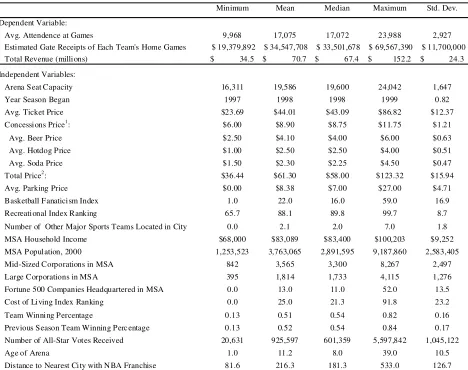
Eq. (2) utilizes a panel data set consisting of nineteen variables for each team in the
NBA (except the two Canadian teams) over the years 1997-1999.23 There are three
dependent variables: attendance, an estimate of gate receipts, and total team revenue. The
focus of this part of the research is to create a forecasting model of financial success in the
NBA with the proxy for success being total game attendance, gate receipts, or total revenue.
Unlike the NFL, total revenues in the NBA are highly correlated with gate receipts because
there is not a significant amount of revenue sharing in the NBA.24
23
The Canadian teams are excluded for lack of comparable data. In excluding the Canadian teams there are 27 teams. Therefore, there are 81 observations (27 teams for three seasons).
24
Average attendance is being used instead of total attendance because there was a
lockout during the 1999 season causing approximately 32 games of the 82 game season to be
cancelled, including the All-Star Game but not the playoffs. High attendance represents one
of the goals of a sports organization. See Table 2 for a summary of the data utilized for Eq.
(2).
-- Insert TABLE 2--
High gate receipts are another goal of sports organizations. Gate receipts also help
account for capacity constraints, whereas attendance does not. For instance, smaller arenas
can charge higher prices if the supply of seats is less than demand, mitigating part of the
capacity constraint issue. Ticket prices vary significantly across teams, and by solely using
attendance, this price information would be lost. Gate receipts are estimated using actual
attendance and average ticket price for all three years. Actual gate receipts are proprietary
information, so attaining correct information is difficult. Therefore, an estimate is used. For
the one season of actual reported gate receipts for NBA teams that is available, the
correlation between the estimate and the actual is a 0.94.25 This analysis uses the estimate
based on attendance and average ticket price.
The third measure of revenue is total team revenue as reported by Forbes magazine.
Gate receipts do not capture other localized revenue sources such as media, sponsorship,
concessions and parking.
The level of an individual team’s financial success is dependant on the team’s ability to capitalize on the local market in terms of stadium economics.
25
The independent variables used to predict financial success or to measure attendance
demand are prices, team winning percentage, a measure of the quantity of ‘star’ players, the
age of the venue, the year of the season, basketball fanaticism, household income, number of
other professional sports teams located in the MSA, 2000 MSA population, recreational and
cost of living indices, number of Fortune 500 companies headquartered in MSA, the number
of mid-sized and large corporations in MSA, and distance to nearest NBA city.
There is a vector of prices that fans pay to attend sporting events. These include the
ticket price, the price of a 12 oz. beer, the price of a hot dog, the price of a 12 oz. soda, and
the price of parking.26 The first law of demand predicts that higher prices will lead to lower
levels of demand, ceteris paribus. Ticket prices average $44 for the sample, with a low of
$24 and a high of $87.
Winning percentage is expected to be an important proxy for the quality of the home
team. The winning percentage in the year each season began, for years 1997 through 1999,
was used.27 Numerous studies have found winning to be an important determinant of
attendance demand.28 As expected, the average winning percentage is near 0.500 (at 0.514),
with the minimum at 0.134 and the maximum at 0.817.29
Lagged winning percentage is also expected to affect demand because the previous
season’s performance affects season ticket sales and the appeal of early season games. For instance, Rascher (1999) shows that in baseball an extra win by the home team in the
previous season increases per game attendance by about 450 fans for the first half of the
26 This data comes from the Fan Cost IndexTM published annually by Team Marketing Report. 27
However, to create a fair forecast , all cities were assumed to have a winning percentage of 0.500, given that non-NBA cities do not have a winning percentage at all.
28
season, but declines in magnitude, to 150 fans per game, and in significance, with the
t-statistic dropping from 7.64 to 3.02, for the second half of the season.
Relative to other major professional sports, the NBA markets its product by focusing
on the individual talent of the players more so than the quality of each team. It is expected
that the star power of the players on a team affects the demand for games above and beyond
their skill in producing wins. The analysis uses the number of All-Star votes that each team
received as a proxy for the individual star power of each team.
Sports teams in the U.S. have been on a facility construction spree in the last decade.
The older, sterile domes built in the late 1960s and early 1970s have given way to newer,
higher quality, entertainment oriented facilities. These facilities increase the revenue
streams for NBA and NHL teams by as much as 50% because they offer better amenities
including premium seating, parking, food, drink, and non-game entertainment. In Major
League Baseball, a new stadium can generate more than $40 million in new stadium revenue
annually.30 The analysis uses the age of the sports venue as a proxy for the quality of the
experience that the fan receives that is unrelated to the game itself. The remaining variables
were described above.
Analysis & Results
The Location Model creates a forecast of the best cities for NBA expansion or
relocation based on economic factors that exist in current NBA cities. The dependent
variable, whether the city has an NBA team, is an indicator variable. The model is a
two-equation system with a binary dependent variable and a continuous endogenous variable.
29
The type of triangular system described in Section II requires a two-stage probit least
squares (2SPLS) estimation technique.
The first stage is the estimation of Eq. (2), the revenue equation. Typically, OLS
estimation would be unbiased and efficient, but there are a few econometric issues that
prevent straight OLS from working. First, the revenue equation is estimated using data for
27 teams over 3 years. The error structure exhibits cluster correlation. For each team, the
error term for three years is auto-correlated. Even though there is not correlation across
teams, there is correlation of the errors within each team. The effect of cluster correlation is
to inflate t-statistics. In this case, the t-statistics are about 12% higher when not accounting
for the cluster correlation problem. The solution involves estimating robust errors by
analyzing a cluster variable in the model itself.
The second estimation problem is that one of the dependent variables, attendance, is
censored because of the capacity constraint of the size of an arena. True demand may be
larger than actual attendance, but the size of the arena prevents the full demand from being
satisfied. Interval regression offers a solution in the tradition of Tobit.
In calculating the correlation between each of the variables, income and population,
as expected, are correlated – people in large cities have higher incomes. Another
multicollinearity issue is between population, the number of corporate headquarters, and the number of non-NBA sports teams. The smallest bi-variate correlation between these
variables is 0.73. While not surprising that corporations and sports teams locate in large
population centers, the interpretation of the individual effects of these factors on NBA team
location could be inefficient, although not biased, if included simultaneously in econometric
30
analysis. Given that the goal in this step of the analysis is not to interpret individual effects,
but to create an endogenous variable to be used in the next step, these variables were
included in the analysis.
Sensitivity analyses showed that there was no omitted variable bias. Evidence of
heteroscedasticity was accounted for using White’s corrected errors. Log-linear models
were estimated, but the levels models had superior fit. Log-linear models are often used in
demand estimation, but only because the elasticities are easy to calculate. In this case that
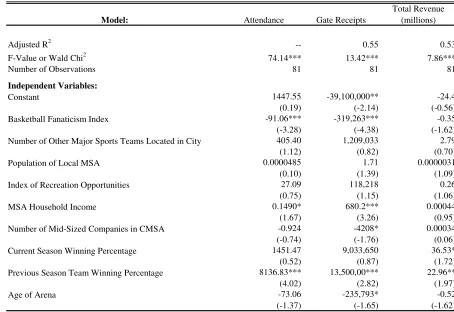
reason is not compelling enough to use log-linear models. Table 3 shows the results of the
revenue and attendance equations estimation.
--Insert TABLE 3--
Overall, the attendance model is extremely statistically significant with a Wald Chi2
statistic of 74.14. Both the gate receipts and total revenue models have
R
2 greater than 0.53and F-values that are significant at the 1% level. Each of the stage one models is statistically
significant and provide suitable endogenous variables for stage two. Basketball fanaticism,
household income, previous season’s winning percentage, and age of the arena are
consistently statistically significant with the expected signs.31 Interpreting the marginal
impacts of a few of the variables that do not suffer from multicollinearity, a 5% increase in household income is associated with an 8% increase in gate receipts. An increase in winning
percentage by 0.100 (e.g., from 0.500 to 0.600 is eight more wins) is associated with a rise in
31
Prices were not found to be an important factor (except to the extent that there was
gate receipts of 4%, or $1.35 million. Each additional year a stadium ages lowers gate
receipts by about $235,000.
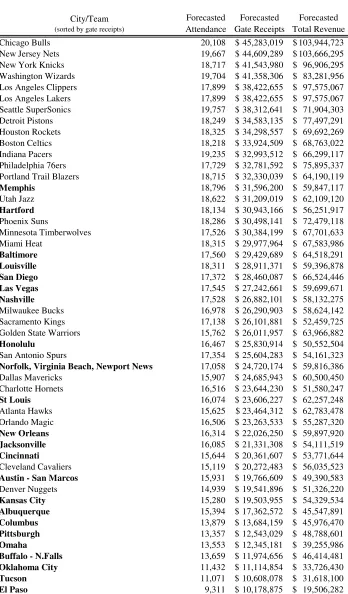
Table 4 shows the forecasts of attendance, gate receipts, and total revenue for each
NBA and non-NBA city, sorted by decreasing gate receipts.32 Gate receipts range from a
high of $84 million in Chicago, down to $32 million in El Paso, Texas. Based on these stage
one results (revenues), the best cities for expansion or relocation are Memphis, Hartford,
Baltimore, Louisville, San Diego, Las Vegas, and Nashville.
--Insert TABLE 4--
The second stage of the 2SPLS involves the estimation of Eq. (1) with the estimated
dependent variable from Eq. (2) as an endogenous variable in the model. Again, the
attendance, gate receipts, and total revenue estimates from Table 3 are regressors in the
estimation of Eq. (2). A number of sensitivity tests were performed on the model before
final selection occurred. Scatter plots and the Cook-Weisberg test show that
heteroscedasticity is an issue with the data. White’s corrected errors are used to avoid
inflated t-statistics from heteroscedasticity. There appears to be an omitted variable or more
based on the results of the Ramsey RESET test.
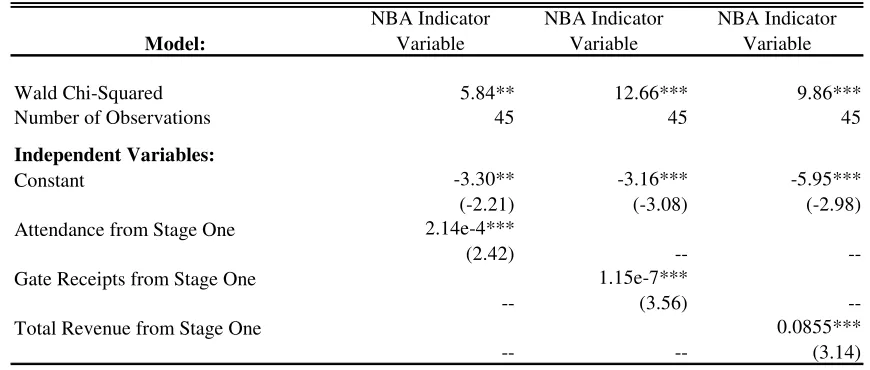
Table 5 shows the results of the probit analysis. Overall, the models are significant
at the 5% or better level. Interpretation of the marginal impacts shows that a 10% increase
votes, and distance to nearest NBA city also proved to be insignificant predictors of attendance and revenue.
32
in attendance, gate receipts, or total revenue is associated with an 11%, 10%, and 17%
increase in the probability that a city is suitable for an NBA team, respectively.
--Insert TABLE 5--
Conclusion & Discussion
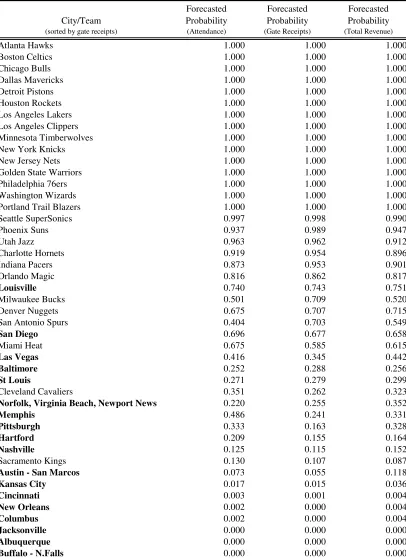
The forecasts for which cities are “best” for NBA expansion or relocation are shown
in Table 6. The cities of Louisville and San Diego lead the list of potential candidates. This
model examines the underlying economic structure of the cities to create forecasts for
expansion or relocation of NBA teams. Models of this sort could be used for many other
sports in other regions or countries.
--Insert TABLE 6--
Before the 2001-2002 season, the Vancouver Grizzlies of the NBA had to make a
location decision. The team decided to move out of Canada and created a short list of
possible locations that they believed could sustainably and successfully support the
franchise. The list contained the cities of San Diego, Las Vegas, New Orleans, Memphis, and Louisville. The city of San Diego showed no interest in obtaining the Grizzlies because
at the time the city was embroiled in a half-built publicly financed baseball stadium issue.
The NBA ruled out the city of Las Vegas because of its ties to gambling. St. Louis had been
a contender the year prior to the sale, with the failed purchase of the team by St. Louis Blues
(NHL) owner, Bill Laurie, who would not open the Savvis Center to a an NBA team of
which he was not the owner. The three final locations were quickly narrowed to two, as
New Orleans was unable to generate an offer that was suitable to the Grizzlies. The decision
between Memphis and Louisville was tipped in favor of Memphis when Federal Express
(FedEx), whose headquarters are in Memphis, made a naming rights offer and equity
purchase of the team.33 The results here lend credence to the location decision made by the
Grizzlies.
More recently, the Hornets considered Louisville, Norfolk, VA, and New Orleans
for their relocation out of Charlotte before agreeing to terms with New Orleans. Based on
the findings here, the Hornets might have been better off moving to Louisville. Attendance
last season in New Orleans was below expectations.
Changes in the revenue generating capability of sports facilities are among the most
important factors that have improved the profitability of team sports franchises recently. All
four of the major professional sports leagues have recently seen an increase in the variance
of team valuations because much of facility revenues are retained by the team owners.
Although the size and magnitude of a team’s market is important in determining its
revenue-generating ability in the league, facility economics has quickly caught up with market size in
determining financial success, as evidenced by the recent franchise moves and the awarding of a new NFL franchise in Houston over Los Angeles. Therefore, one of the determinants of
the profitability of any major professional sports franchise is the type of lease agreement it
teams (which do not have a corresponding winning percentage).
33
has, and the quality of its stadium. Hence, an important aspect of the location decision is not
only the underlying economics of the market, but the actual lease agreement offered to a
team by each city. This model can be used to help determine the size of the inducement
needed by a smaller market in order to win the franchise free agency battle over a larger
market. In other words, if the market economics are better in a larger city, models of this
sort can help determine how much better a lease agreement has to be from a smaller city in
order to convince an owner to move to the smaller city.34
For example, if an expansion team were considering a relatively larger market like
Kansas City (population of 1.8 million) versus a smaller market like Buffalo (population of
1.2 million), the model forecasts that a Kansas City team would generate about $8 million
more per year in total revenue (about 17% more) than a team in Buffalo. In order for a team
to move to Buffalo, the lease agreement would have to include at least $8 million more per
year in expected revenue that the team was able to keep. For instance, the combination of
lower rent, property tax, sales tax, percentages of parking, concessions, etc. that the team
keeps would have to add up to at least $8 million more than the lease in Kansas City offered.
In a real example, in choosing New Orleans over Louisville, the Hornets assessed
expected attendance, gate receipts, and total revenues. According to the findings here,
expected total revenues were about the same, but attendance and gate receipts were forecasted to be higher in Louisville than in New Orleans. Presumably, the lease agreement
in New Orleans accounts for the difference from the expected lease agreement in Louisville.
In choosing Memphis over New Orleans, Louisville, St. Louis, Las Vegas, and San
Diego, the Grizzlies chose the market with the highest expected attendance and gate receipts,
but not the highest total revenue. However, as described above, San Diego was not in a
position to offer to build a new facility and the owner of the Savvis Center in St. Louis was
not interested in having an NBA team in the facility unless it was owned by him.
By utilizing an hierarchical two-equation system involving the underlying economic
factors which are deterministic for a team’s success, this paper serves to aid in the financial
decision regarding league expansion or team relocation. This integrative approach
effectively captures inter-relationships between factors as well as the relative importance of
each factor. A set of models such as described in this paper are not solely applicable to NBA
franchise locational decisions, and can instead be used to rank cities for further, more
in-depth analysis, across many sports in many countries.
34
References
Alvarez, R. Michael and Garrett Glasgow (2000). “Two-Stage Estimation of Nonrecursive Choice Models”. Political Analysis, 8:2, pp. 147-165.
Rivers, D., and Q.H. Vuong (1988). “Limited Information Estimators and Exogeneity Test for Simultaneous Probit Models”. Journal of Econometrics, 39: pp. 347-366.
Baim, Dean V. and Sitsky, Larry (October 1994). The Sports Stadium as a Municipal Investment. Greenwood Publishing Group.
Bruggink, Thomas H., and Zamparelli, Justin M. (1999). “Emerging Markets in Baseball: An Econometric Model for Predicting the Expansion Teams’ New Cities”. J. Fizel, E. Gustafson, and L. Hadley, eds., Sports Economics: Current Research. Praeger Press, p. 55.
Burdekin, Richard C., and Idson, Todd L. (1991). “Customer Preferences, Attendances and the Racial Structure of Professional Basketball Teams”. Applied Economics, 23: 179-86.
Burger, J.D., and S.J.K. Walters (2003). “Market Size, Pay, and Performance: A General Model and Application to Major League Baseball”. Journal of Sports Economics, 4(2), pp. 108-125.
Dun and Bradstreet. Corporate Depth data.
CSL, Inc. (1999). Feasibility Study for Baseball in Washington D.C.
Hausman, Jerry A., Leonard, Gregory K. (October 1997). “Superstars in the National Basketball Association: Economic Value and Policy”. Journal of Labor Economics, 15(4), pp. 586-624. Hoang, Ha, and Rascher, Daniel A. (January 1999). “The NBA, Exit Discrimination, and Career
Earnings”. Industrial Relations, Vol. 38, No. 1.
Paul Kagan and Associates (1999). The Business of Basketball. Carmel, Indiana.
Klein, Benjamin. (October 1995). “The Economics of Franchise Contracts”. Journal of Corporate Finance, Contracting, Governance, and Organization, Vol. 2 (1-2), pp. 9-37.
Maddala, G.S. (1983). Limited-Dependent and Qualitative Variables in Econometrics. Econometric Society Monographs.
McDonald, Mark, and Rascher, Daniel A. (January 2000). “Does Bat Day Make Cents?: The Effect of Promotions on the Demand for Baseball”. Journal of Sport Management, Vol. 14, No. 1.
Rascher, Daniel A. (1999). “A Test of the Optimal Positive Production Network Externality in Major League Baseball”. J. Fizel, E. Gustafson, and L. Hadley, eds., Sports Economics: Current Research. Praeger Press.
Rich, Wilbur C. (May 2000). The Economics and Politics of Sports Facilities. Quorum Books. Savageau, David with D’Agostino, Ralph (2000). Places Rated Almanac, Millennium Edition. IDG
Appendix
Minimum Mean Median Maximum Std. Dev.
Dependent Variable:
Avg. Attendence at Games 9,968 17,075 17,072 23,988 2,927 Estimated Gate Receipts of Each Team's Home Games $ 19,379,892 $ 34,547,708 $ 33,501,678 $ 69,567,390 $ 11,700,000 Total Revenue (millions) $ 34.5 $ 70.7 $ 67.4 $ 152.2 $ 24.3
Independent Variables:
Arena Seat Capacity 16,311 19,586 19,600 24,042 1,647 Year Season Began 1997 1998 1998 1999 0.82 Avg. Ticket Price $23.69 $44.01 $43.09 $86.82 $12.37 Concessions Price1: $6.00 $8.90 $8.75 $11.75 $1.21 Avg. Beer Price $2.50 $4.10 $4.00 $6.00 $0.63 Avg. Hotdog Price $1.00 $2.50 $2.50 $4.00 $0.51 Avg. Soda Price $1.50 $2.30 $2.25 $4.50 $0.47 Total Price2
: $36.44 $61.30 $58.00 $123.32 $15.94
Avg. Parking Price $0.00 $8.38 $7.00 $27.00 $4.71 Basketball Fanaticism Index 1.0 22.0 16.0 59.0 16.9 Recreational Index Ranking 65.7 88.1 89.8 99.7 8.7 Number of Other Major Sports Teams Located in City 0.0 2.1 2.0 7.0 1.8 MSA Household Income $68,000 $83,089 $83,400 $100,203 $9,252 MSA Population, 2000 1,253,523 3,763,065 2,891,595 9,187,860 2,583,405 Mid-Sized Corporations in MSA 842 3,565 3,300 8,267 2,497 Large Corporations in MSA 395 1,814 1,733 4,115 1,276 Fortune 500 Companies Headquartered in MSA 0.0 13.0 11.0 52.0 13.5 Cost of Living Index Ranking 0.0 25.0 21.3 91.8 23.2 Team Winning Percentage 0.13 0.51 0.54 0.82 0.16 Previous Season Team Winning Perc entage 0.13 0.52 0.54 0.84 0.17 Number of All-Star Votes Received 20,631 925,597 601,359 5,597,842 1,045,122
Age of Arena 1.0 11.2 8.0 39.0 10.5
[image:28.612.88.556.162.532.2]Distance to Nearest City with NBA Franchise 81.6 216.3 181.3 533.0 126.7 Table 1: Simple Statistics of the NBA Revenue Model Data
Minimum Mean Median Maximum Std. Dev.
Dependent Variable:
NBA Team Located in City 0.00 0.52 1.00 1.00 0.50
Independent Variables:
MSA Population Growth, 1995-2000 -1.2% 5.9% 5.1% 21.6% 4.7%
MSA Population, 2000 712,460 2,451,255 1,619,450 9,220,312 1,947,821
MSA Population, 1995 669,998 2,340,977 1,629,508 9,054,394 1,923,162
Basketball Fanaticism Index 1.0 27.2 26.0 63.0 18.6
MSA Household Income $52,700 $77,935 $77,150 $100,203 $10,393
Number of Other Major Sports Teams Located in City 0.0 1.5 2.0 7.0 1.5
Fortune 500 Companies Headquartered in MSA 0.0 8.4 4.0 52.0 9.3
Mid-Sized Corporations in MSA 289 2,190 1,612 8,267 1,975
Large Corporations in MSA 153 1,113 762 4,115 1,036
Recreational Index Ranking 42.5 85.1 87.5 100.0 10.9
Cost of Living Index Ranking 0.0 36.1 35.0 95.5 25.3
Avg. Nielsen T.V. Ratings for NBA Games in City 0.9 2.6 2.0 6.9 1.61
Avg. Nielsen T.V. Ratings for 6 NBA Games in City 1.5 4.6 4.2 13.1 2.25
[image:29.612.90.563.95.295.2]Distance to Nearest City with NBA Franchise 45 274 194 2,560 361
Table 2: Simple Statistics of the NBA Location Model Data
Model: Attendance Gate Receipts
Total Revenue (millions)
Adjusted R2 -- 0.55 0.53
F-Value or Wald Chi2 74.14*** 13.42*** 7.86***
Number of Observations 81 81 81
Independent Variables: Constant 1447.55 (0.19) -39,100,000** (-2.14) -24.4 (-0.56)
Basketball Fanaticism Index -91.06***
(-3.28)
-319,263*** (-4.38)
-0.35 (-1.62)
Number of Other Major Sports Teams Located in City 405.40
(1.12)
1,209,033 (0.82)
2.79 (0.70)
Population of Local MSA 0.0000485
(0.10)
1.71 (1.39)
0.0000031 (1.09)
Index of Recreation Opportunities 27.09
(0.75)
118,218 (1.15)
0.26 (1.06)
MSA Household Income 0.1490*
(1.67)
680.2*** (3.26)
0.00044 (0.95)
Number of Mid-Sized Companies in CMSA -0.924
(-0.74)
-4208* (-1.76)
0.00034 (0.06)
Current Season Winning Percentage 1451.47
(0.52)
9,033,650 (0.87)
36.53* (1.72)
Previous Season Team Winning Percentage 8136.83***
(4.02)
13,500,00*** (2.82)
22.96** (1.97)
Age of Arena -73.06
(-1.37)
-235,793* (-1.65)
-0.52 (-1.62)
Significance: * - 10% level; ** - 5% level; *** - 1% level.
[image:29.612.95.549.351.663.2]City/Team
(sorted by gate receipts)
Forecasted Attendance Forecasted Gate Receipts Forecasted Total Revenue
Chicago Bulls 20,108 $ 45,283,019 $ 103,944,723
New Jersey Nets 19,667 $ 44,609,289 $ 103,666,295
New York Knicks 18,717 $ 41,543,980 $ 96,906,295
Washington Wizards 19,704 $ 41,358,306 $ 83,281,956
Los Angeles Clippers 17,899 $ 38,422,655 $ 97,575,067
Los Angeles Lakers 17,899 $ 38,422,655 $ 97,575,067
Seattle SuperSonics 19,757 $ 38,312,641 $ 71,904,303
Detroit Pistons 18,249 $ 34,583,135 $ 77,497,291
Houston Rockets 18,325 $ 34,298,557 $ 69,692,269
Boston Celtics 18,218 $ 33,924,509 $ 68,763,022
Indiana Pacers 19,235 $ 32,993,512 $ 66,299,117
Philadelphia 76ers 17,729 $ 32,781,592 $ 75,895,337
Portland Trail Blazers 18,715 $ 32,330,039 $ 64,190,119
Memphis 18,796 $ 31,596,200 $ 59,847,117
Utah Jazz 18,622 $ 31,209,019 $ 62,109,120
Hartford 18,134 $ 30,943,166 $ 56,251,917
Phoenix Suns 18,286 $ 30,498,141 $ 72,479,118
Minnesota Timberwolves 17,526 $ 30,384,199 $ 67,701,633
Miami Heat 18,315 $ 29,977,964 $ 67,583,986
Baltimore 17,560 $ 29,429,689 $ 64,518,291
Louisville 18,311 $ 28,911,371 $ 59,396,878
San Diego 17,372 $ 28,460,087 $ 66,524,446
Las Vegas 17,545 $ 27,242,661 $ 59,699,671
Nashville 17,528 $ 26,882,101 $ 58,132,275
Milwaukee Bucks 16,978 $ 26,290,903 $ 58,624,142
Sacramento Kings 17,138 $ 26,101,881 $ 52,459,725
Golden State Warriors 15,762 $ 26,011,957 $ 63,966,882
Honolulu 16,467 $ 25,830,914 $ 50,552,504
San Antonio Spurs 17,354 $ 25,604,283 $ 54,161,323
Norfolk, Virginia Beach, Newport News 17,058 $ 24,720,174 $ 59,816,386
Dallas Mavericks 15,907 $ 24,685,943 $ 60,500,450
Charlotte Hornets 16,516 $ 23,644,230 $ 51,580,247
St Louis 16,074 $ 23,606,227 $ 62,257,248
Atlanta Hawks 15,625 $ 23,464,312 $ 62,783,478
Orlando Magic 16,506 $ 23,263,533 $ 55,287,320
New Orleans 16,314 $ 22,026,250 $ 59,897,920
Jacksonville 16,085 $ 21,331,308 $ 54,111,519
Cincinnati 15,644 $ 20,361,607 $ 53,771,644
Cleveland Cavaliers 15,119 $ 20,272,483 $ 56,035,523
Austin - San Marcos 15,931 $ 19,766,609 $ 49,390,583
Denver Nuggets 14,939 $ 19,541,896 $ 51,326,220
Kansas City 15,280 $ 19,503,955 $ 54,329,534
Albuquerque 15,394 $ 17,362,572 $ 45,547,891
Columbus 13,879 $ 13,684,159 $ 45,976,470
Pittsburgh 13,357 $ 12,543,029 $ 48,788,601
Omaha 13,553 $ 12,345,181 $ 39,255,986
Buffalo - N.Falls 13,659 $ 11,974,656 $ 46,414,481
Oklahoma City 11,432 $ 11,114,854 $ 33,726,430
Tucson 11,071 $ 10,608,078 $ 31,618,100
[image:30.612.109.457.76.670.2]El Paso 9,311 $ 10,178,875 $ 19,506,282 Note: Bolded cities are those without an NBA team in 1999.
Model:
NBA Indicator Variable
NBA Indicator Variable
NBA Indicator Variable
Wald Chi-Squared 5.84** 12.66*** 9.86***
Number of Observations 45 45 45
Independent Variables:
Constant -3.30**
(-2.21)
-3.16*** (-3.08)
-5.95*** (-2.98)
Attendance from Stage One 2.14e-4***
(2.42) --
--Gate Receipts from Stage One
--1.15e-7***
(3.56)
--Total Revenue from Stage One
--
--0.0855*** (3.14)
[image:31.612.114.549.119.304.2]Significance: * - 10% level; ** - 5% level; *** - 1% level.
City/Team (sorted by gate receipts)
Forecasted Probability (Attendance) Forecasted Probability (Gate Receipts) Forecasted Probability (Total Revenue)
Atlanta Hawks 1.000 1.000 1.000
Boston Celtics 1.000 1.000 1.000
Chicago Bulls 1.000 1.000 1.000
Dallas Mavericks 1.000 1.000 1.000
Detroit Pistons 1.000 1.000 1.000
Houston Rockets 1.000 1.000 1.000
Los Angeles Lakers 1.000 1.000 1.000
Los Angeles Clippers 1.000 1.000 1.000
Minnesota Timberwolves 1.000 1.000 1.000
New York Knicks 1.000 1.000 1.000
New Jersey Nets 1.000 1.000 1.000
Golden State Warriors 1.000 1.000 1.000
Philadelphia 76ers 1.000 1.000 1.000
Washington Wizards 1.000 1.000 1.000
Portland Trail Blazers 1.000 1.000 1.000
Seattle SuperSonics 0.997 0.998 0.990
Phoenix Suns 0.937 0.989 0.947
Utah Jazz 0.963 0.962 0.912
Charlotte Hornets 0.919 0.954 0.896
Indiana Pacers 0.873 0.953 0.901
Orlando Magic 0.816 0.862 0.817
Louisville 0.740 0.743 0.751
Milwaukee Bucks 0.501 0.709 0.520
Denver Nuggets 0.675 0.707 0.715
San Antonio Spurs 0.404 0.703 0.549
San Diego 0.696 0.677 0.658
Miami Heat 0.675 0.585 0.615
Las Vegas 0.416 0.345 0.442
Baltimore 0.252 0.288 0.256
St Louis 0.271 0.279 0.299
Cleveland Cavaliers 0.351 0.262 0.323
Norfolk, Virginia Beach, Newport News 0.220 0.255 0.352
Memphis 0.486 0.241 0.331
Pittsburgh 0.333 0.163 0.328
Hartford 0.209 0.155 0.164
Nashville 0.125 0.115 0.152
Sacramento Kings 0.130 0.107 0.087
Austin - San Marcos 0.073 0.055 0.118
Kansas City 0.017 0.015 0.036
Cincinnati 0.003 0.001 0.004
New Orleans 0.002 0.000 0.004
Columbus 0.002 0.000 0.004
Jacksonville 0.000 0.000 0.000
Albuquerque 0.000 0.000 0.000
Buffalo - N.Falls 0.000 0.000 0.000
[image:32.612.100.506.98.656.2]Note: Bolded cities are those without an NBA team in 1999.