An Analysis of the Mobile Payment
Problem in Europe
Pousttchi, Key
University of Augsburg
An Analysis of the Mobile Payment Problem
in Europe
Key Pousttchi University of Augsburg
Abstract: Mobile payment is crucial for, but not limited to mobile commerce. But a role as an established payment system still seems to be a distant prospect for it. In this paper we examine the basic conditions to mobile payment with special regard to the European market. Based on this, we analyze the current deadlock on the mobile payment market in order to develop a set of requirements to an integrative solution in the form of a Universal Mobile Payment System (UMPS). Finally, applications and constrictions of the results are shown and an outlook on the future of mobile payment is given.
Key words: mobile commerce, mobile payment
1 Introduction
One of the most important preconditions for business-to-consumer (B2C) mobile commerce is the opportunity to generate direct revenues. Whereas in electronic commerce (EC) we still see the dominance of traditional payment systems [e.g. LeSt2003], a payment system for mobile commerce (MC) will be typically not adequate until it shares fundamental characteristics of the mobile offer it is to bill for, in particular its ubiquity [PST02]. From this postulation follows the necessity of mobile payment. Mobile payment is crucial for, but not limited to MC scenarios. According to the sweeping enthusiasm that characterized much of the news reporting in the years 1999 and 2000 mobile phones should by now have been firmly established as payment terminals in the most diverse fields. Reality today is a different matter though. Mobile payment as an established payment system seems to be a distant prospect.
We define mobile payment (MP) as that type of payment transaction processing in the course of which – within an electronic procedure – (at least) the payer employs mobile communication techniques in conjunction with mobile devices for initiation,
authorization or realization of payment. We refer to the term payment systems whenever
In this paper we examine the basic conditions to mobile payment with special regard to the European market. Based on this, we analyze the current deadlock on the MP market in order to develop requirements to an integrative solution.
We begin in section 2 with the examination of the basic conditions: relevant payment scenarios, differentiation of payment amounts, (potential) mobile payment service providers and finally aspects of merchant and customer acceptance. Based on this, we examine the current market situation in Europe in section 3. Relevant procedures were identified according to the MP standard types defined in [KPT02b], the roles of the market participants are taken into account and major shortcomings of existing procedures are explained. In section 4 we draw conclusions and derive a set of requirements to an integrative solution. Section 5 provides an outlook on the future of mobile payment.
2 Basic Conditions
2.1 Payment Scenarios
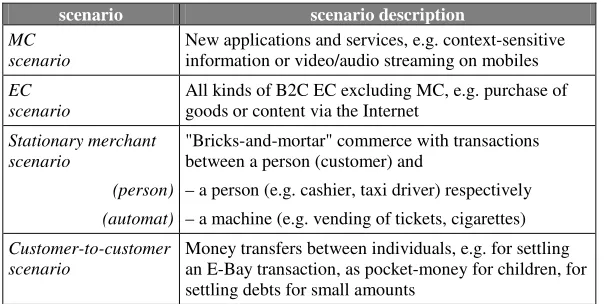
We already claimed that MP is not limited to MC. Instead, an MP transaction can take place in different general settings (table 1).
scenario scenario description
MC scenario
New applications and services, e.g. context-sensitive information or video/audio streaming on mobiles
EC scenario
All kinds of B2C EC excluding MC, e.g. purchase of goods or content via the Internet
Stationary merchant scenario
(person) (automat)
"Bricks-and-mortar" commerce with transactions between a person (customer) and
– a person (e.g. cashier, taxi driver) respectively – a machine (e.g. vending of tickets, cigarettes)
Customer-to-customer scenario
[image:3.595.148.450.448.600.2]Money transfers between individuals, e.g. for settling an E-Bay transaction, as pocket-money for children, for settling debts for small amounts
Table 1: Relevant MP scenarios
2.2 Payment Amounts
Amounts are usually categorized in picopayments, micropayments and macropayments, the latter could additionally be differentiated in low and high macropayments (e.g. [PST02]). This detailed differentiation is appropriate for examinations of customer acceptance. The in section 2.1 cited study showed a basic acceptance for MP on all payment heights but a clear main emphasis on lower macropayments (which are defined there from 2,50 to 50 ✂✁☎✄✝✆✞✠✟☛✡✌☞✎✍✌✏✒✑✔✓✕✏✖✏✒✡✘✗✖✙✛✚✢✜✘✙✒✡✂✣✤✗✒✥✦✏✖✣✧✟✑★✗✖✙✒✥✖✣✩✚✫✪☎✬✮✭✰✯✲✱✴✳✩✵☎✶✝✷✹✸✩✓
ever, for a strategic view on MP we see only two important categories:
• micropayments with a main problem in cost efficiency but relatively low
requirements for security and management of claims,
• macropayments which require higher security levels and an effective management of claims while cost-efficiency remains on a lower level of importance.
The lower the micropayments or the higher the macropayments are, the more valid get these statements. A good clue about the limit between micro- and macropayments is the amount of 5 ✌✶
2.3 Mobile Payment Service Providers
Typically, a mobile payment service provider (MPSP) falls in one of three categories. Either it is a Mobile Network Operator (MNO) or it is a bank respectively financial service provider (FSP, esp. credit card company) or it is a specialized intermediary. (In some rare cases, a company offering a service decides to offer an MP procedure on its own, e.g. a company who offers a mobile service and charges its customers directly.) While MNO and banks/FSP can operate on an existing infrastructure and customer base (with an existing billing relationship), a specialized intermediary runs an MP procedure as its core business and has to build up both from scratch. Thus, its revenue model is rather difficult as it has to refinance itself completely from the revenues generated in MP while others may simply generate additional revenues and improve the capacity utilization of their infrastructure. Typical specialized intermediaries are payment startups.
2.4 Merchant and Customer Acceptance
The issue of acceptance has already had a significant amount of discussion in the literature, (e.g. [ChTa01, Krup01]). For the customer, the arguments can typically be subsumed into three categories ([KPT02a], put in an order of relevance according to [Pous2003]):
•
• costs which include direct transaction costs and fixed costs of usage plus the cost of the technical infrastructure for the customer (e.g., a new mobile phone),
• convenience which includes any issues related to ease and comfort of use.
For the merchant, security and cost issues are also very important, but above all, network effects have to be regarded (see 3.2).
While these conditions act as essential conditions, their fulfillment just causes a mobile phone user or a merchant to accept an MP procedure as a usable method of payment in principle. Thus, whereas fulfillment of the conditions does not yet mean actual usage, infringement of one single condition will prevent the customer from using the procedure. However, fulfilling essential conditions only removes obstacles, but still provides no strong incentive to use an MP procedure. Merchants as well as customers do not use a new payment system because of its simple existence. Added values are necessary, namely the realization of informational added values e.g. with effectiveness or efficiency impacts [Pous2003].
3 Current Market Situation
3.1 Types of Existing MP Procedures
Analyzing MP from a theoretical viewpoint, [KPT02b] defines five (non-disjoint)
standard types of MP procedures: Conventional Settlement, Premium Rate Number,
Prepaid, Mobile Money and Dual-Card. The latter two are subtypes which are
representing the concept of using tokens for direct payment with a mobile device respectively the concept of enforcing security by the use of a second smart card. Up to now these have very limited importance to the real MP market. The same is true for the
Prepaid MP standard type.
The first considerations about MP originated from the objective (ubiquity and identifying functions) and subjective (trust of users) advantages of mobile devices making these suitable to be used for payment purposes. In this early phase, the ideas of the MP community mainly revolved around the stationary merchant scenario, most of
the newly introduced procedures belonged to the Conventional Settlement standard type
(using a mobile device to initiate and authorize a payment via standard procedures as credit card usage or direct debit) and were more or less bank-centric. The end of the mobile commerce hype also marked the end of many of these procedures, if they went beyond the prototype state at all.
payment in the MC scenario – for the MNO’s own services as well as for those directly available from third parties (e.g. content providers). The result is the whole string of MNO-centric MP procedures which can be observed today. (This standard type was originally named premium rate number in [KPT02b]. Since this is misleading as it is explicitly defined by the settlement via the phone bill, we rename this MP standard type to phone bill according to [TuPo03].) The current focus of mobile payment lies on the standard type phone bill, reducing real MP usage to the MC scenario.
3.2 Roles of Market Participants
In 2.3 we named banks/FSP, MNO and specialized intermediaries as (potential) MPSP.
Specialized Intermediaries. The strengths of a specialized intermediary are that he runs an MP procedure as his core competency and is the only type of MPSP who would be able to provide a bank- and MNO-independent solution. But as we already stated in 2.3, the business model is extremely difficult. Thus, autonomous specialized intermediaries running an MP procedure will not remain on the market – either they will not remain autonomous or they will not remain on the market. We already saw examples for both, the second being more likely to happen. An interesting example for the first one was the purchase of Paypal by E-Bay in the US, with the Paypal MP procedure becoming the proprietary payment solution for the E-Bay C2C scenario.
Banks/FSP. The core business of banks/FSP is the completion of payments. They have special advantages in the field of security. This covers subjective factors (as banks are most trusted by the customer [KPW03]) and objective factors as their experience in fraud recognition, check of credit-worthiness and management of claims whereas their completion of transactions is relatively expensive. Thus, under the conditions of section 2.2 banks/FSP are especially suited for treating macropayments.
MNO. The core business of MNO is to run a mobile network. In this framework they are
experienced in and already run the infrastructure to charge small amounts to their customers. They do not own the special reliability and security knowledge of banks/FSP but are able to conduct billing very cost-effective. Thus, under the conditions of section 2.2 MNO are especially suited for treating micropayments.
3.3 Shortcomings of Existing Procedures
Not every MP procedure sufficiently meets security and convenience issues. But as these are operative questions and general techniques and solutions are available, we will not examine the two issues in detail.
Most of the existing procedures are limited to certain scenarios which is often reflecting the interests, the core business or the special knowledge of the MPSP. Typical examples are MNO-centric procedures limited to MC or bank/FSP-centric procedures limited to the EC and the stationary merchant scenario.
Most of the existing MP procedures are either bank/FSP-centric and concentrate on macropayments (generating too high transaction costs to be suitable to others as well as direct debit or credit card may not be the appropriate settlement for low amounts) or they are MNO-centric and concentrate on micropayments (not being reliable and secure enough to treat others as well as the phone bill may not be the appropriate settlement for high amounts).
Most procedures are offered either by a bank or by an MNO. In both cases the offer is limited to own customers, also limiting the maximum market share of the procedure to those of the issuer which is usually far too low to be an incentive for merchants.
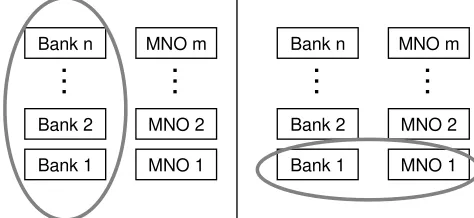
The last years showed vertical (e.g. an alliance of all banks in the market) as well as horizontal (e.g. a joint venture of bank 1 and MNO 1) approaches to overcome these problems (Figure 1).
Bank 1 Bank 2 Bank n
MNO 1 MNO 2 MNO m
…
…
Bank 1 Bank 2 Bank n
MNO 1 MNO 2 MNO m
[image:7.595.176.413.465.574.2]…
…
Figure 1. Vertical (left) and horizontal (right) approaches.
Euro in mobile banking which also did not take off) while MNO limit their solutions to the (desperately needed) payment in the MC scenario hoping to extend them to EC and stationary merchant in the following. Neither side is able to implement a mobile payment solution suitable for a market breakthrough without the support of the other. The occurring situation is a stalemate.
While Europe shares a common currency for two years now, mobile payment even does not reach a national level.
4 Requirements to a Solution
After analyzing the determinants of today’s mobile payment problem we will now draw conclusions in order to derive requirements to a solution which could allow for an MP market breakthrough.
An MP market breakthrough will not happen with procedures which are only covering single scenarios or payment amount level. This already leads us to the first two requirements:
R 1: Applicability in any payment scenario
R 2: Suitability for any payment amount level
The reflections on market fragmentation resulted in the conclusion that most of the current procedures are already very limited in the number of potential users, making an acceptance not remunerative to merchants. This would dramatically change if a merchant could assume that with the acceptance of just one more payment procedure he could address any mobile phone user of a country (or beyond). This leads to the third requirement:
R 3: Availability for every mobile phone user
These first three requirements could be met if it would be possible to combine the vertical and the horizontal approach, i.e. to bring all banks and MNO as complementary or even concurrent partners in a common mobile payment system. Within this, complementary would mean that the MP system consists only of one MP procedure while concurrent would mean that the MP system contains several MP procedures. Of course an attempt to bring different MPSP together will only be successful if each participating party receives added values, either by being able to offer additional services or by being able to offer existing services more efficient:
R 4: Effectiveness or Efficiency Added Values for the MPSP
R 5: Employment of existing standards
The application of these efforts could be an entirely integrative universal mobile payment system (UMPS) which could be realized through one of two possibilities:
• Different procedures within one system: The UMPS would be based on an
abstraction layer above the procedure level allows to use any given payment procedure on any given mobile device and network with any given merchant and financial service provider interface.
• Unified procedure: The UMPS would consist of one procedure with an
acquirer-issuer model and a kind of centralized billing, a solution alike the credit card market. A respective solution could not only be beneficial on a national level, but also on an European one.
5 Conclusions and Outlook
In this paper we examined the basic conditions to mobile payment with special regard to the European market. Based on this, we analyzed the current deadlock on the mobile payment market and developed a set of five requirements to an integrative solution in the form of an Universal Mobile Payment System (UMPS).
The most relevant MPSP participants in the market are banks and MNO. The latter desperately need MP for setting up their MC scenario and possess knowledge and infrastructure to settle the appropriate amounts, typically micropayments. Banks/FSP on the other hand possess the knowledge and infrastructure to settle especially macropayments, typically in the merchant scenario.
MNO and banks/FSP operate on existing reliable customer relationships while mostly using their available infrastructure and thus optimizing its workload. Specialized intermediaries operate an MP procedure as their core business, acting under the pressure to generate revenues recovering the costs for their whole infrastructure. Even if such a company succeeds in contracting large numbers of customers and participating merchants, gets favorable media coverage and establishes a brand with enormous marketing efforts, its revenue model still remains difficult.
In order to establish MP as a payment system, it is necessary to come to an integrated solution. This UMPS is to cover all payment scenarios and amount levels and to be available for every owner of a mobile phone. This can only be realized if added values for the different MPSP can be found or created. The system should, as far as possible, use existing standards from the telecom and from the banking world.
same time, customers as well as merchants could be relieved of the need to occupy themselves with the payment problem for mobile solutions.
Literature
[ChTa01] Cheong, Y. C.; Tan, C. -L.: Payments in Mobile Commerce. Singapore 2001.
[DMÖ03] Dahlberg, T.; Mallat, N.; Öörni, A.: Consumer Acceptance of Mobile Payment Solutions – Ease of Use, Usefulness and Trust. In: Giaglis, G. M.; Werthner, H.; Tschammer, V.; Foeschl, K.: mBusiness 2003 – The Second International Conference on Mobile Business. Wien 2003. (pp. 211–218)
[KPW03] Khodawandi, D.; Pousttchi, K.; Wiedemann, D. G.: Akzeptanz mobiler Bezahlverfahren in Deutschland. In: Pousttchi, K.; Turowski, K. (Hrsg.): Mobile Commerce – Anwendungen und Perspektiven. Proceedings zum 3. Workshop Mobile Commerce. Bonn 2003. (pp. 42–57) [KPT02a] Kreyer, N.; Pousttchi, K.; Turowski, K.: Characteristics of Mobile Payment Procedures.
In: Maamar, Z.; Mansoor, W.; van den Heuvel, W.-J. (Eds.): Proceedings of the ISMIS 2002 Workshop on M-Services. Lyon 2002.
[KPT02b] Kreyer, N.; Pousttchi, K.; Turowski, K.: Standardized Payment Procedures as Key Enabling Factor for Mobile Commerce. In: Bauknecht, K.; Quirchmayr, G.; Tjoa, A M. (Eds.): E-Commerce and Web Technologies. EC-Web 2002. Aix-en-Provence 2002. (pp. 400–409) [Krup01] Kruppa, S.: Mobile Payment. Beyond the M-Commerce Hype. Stuttgart 2001.
[LeSt2003] Leibold, K.; Stroborn, K.: Internet-Zahlungssysteme aus Sicht der Verbraucher – IZV6. Institut für Wirtschaftspolitik und Wirtschaftsforschung, Lehrstuhl Prof. Dr. Karl-Heinz Ketterer, University of Karlsruhe. Karlsruhe 2003.
[Pous03] Pousttchi, K.: Conditions for Acceptance and Usage of Mobile Payment Procedures. In: Giaglis, G. M.; Werthner, H.; Tschammer, V.; Foeschl, K.: mBusiness 2003 – The Second International Conference on Mobile Business. Wien 2003. (pp. 201–210)
[PST02] Pousttchi, K; Selk, B; Turowski, K.: Akzeptanzkriterien für mobile Bezahlverfahren. In: Hampe, F.; Schwabe, G. (Eds.): Mobile and Collaborative Business 2002. Nürnberg 2002. [TuPo03] Turowski, K.; Pousttchi, K.: Mobile Commerce – Grundlagen und Techniken. 1. Aufl.,
Springer, Heidelberg 2003.