Cognitive Radios: Need, Capabilities, Standards,
Applications and Research Challenges
Prabhjot Kaur
Department of Electronics andCommunications ITM University Gurgaon, India
Moin Uddin
Delhi Technological UniversityDelhi, India
Arun Khosla
Department of Electronics andCommunications National Institute of Technology, Jalandhar, India
ABSTRACT
Spectrum is a very precious resource and thus underutilization of a large part of allocated spectrum is not affordable. Where increasing demand for wireless applications has made it difficult to manage limited spectrum, allocated spectrum utilization is found to be very low. Cognitive radio is proposed as a promising solution for increasing spectrum utilization and thereby helping to mitigate spectrum scarcity. This paper introduces the present spectrum scenario highlighting the need for newer techniques of increasing spectrum efficiency. The paper briefs the background on Cognitive Radios and also discusses some crucial design aspects and applications for cognitive radios.
General Terms
Radio resource management, spectrum allocation, spectrum scarcity, Wireless communication
Keywords
Cognitive Radio, cognitive cycle, spectrum management, spectrum mobility, spectrum utilization, interoperability.
1.
INTRODUCTION
1.1
Spectrum Allocation: Present Scenario
Spectrum is a group of various types of electromagnetic radiations of all feasible wavelengths, used for wireless communications. Radio frequency is a natural resource but unlike other resources it will not deplete when used. But it will be wasted if not used efficiently. Spectrum allocation is important and necessary to ensure interference free operation for each radio service. All nations share the electromagnetic spectrum and reserve their right to its unlimited use. To support compatibility of hardware set ups, trade, standardizations and interference free communication, it is essential to allocate spectrum in the common bands. The International Telecommunication Union (ITU) at the World Radio Communication Conferences allocates spectrum frequencies for the use of various countries. In India, wireless planning and coordination (WPC) Wing of the Ministry of Communications, created in 1952, is the National Radio Regulatory Authority of India responsible for Frequency Spectrum Management, including licensing and caters for the needs of all wireless users in the country. It issues licenses to operate wireless stations. Standing advisory committee on frequency allocation (SACFA) is one of the important sections of WPC. SACFA makes the recommendations on major frequency allocation issues,
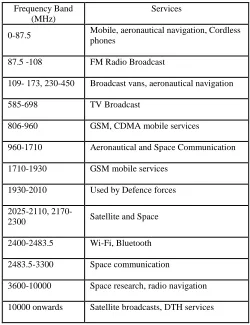
formulation of the frequency allocation plan, making recommendations on the various issues related to ITU and to sort out problems referred to the committee by various wireless users.Wireless communication systems are built based on the transmission of electromagnetic waves (or radio waves) with frequencies in the range of 3 Hz to 300 GHz. Radio waves with different frequencies have different propagation characteristics, each of which is suitable for a specific wireless application like space communication, mobile communication, broadcasting, radio navigation, mobile satellite service, aeronautical satellite services, defence communication etc. Licensed spectrum allocation for different services [1] in India is as shown in Table 1.
Table 1 Spectrum Allocations for different services in India
Frequency Band (MHz)
Services
0-87.5 Mobile, aeronautical navigation, Cordless phones
87.5 -108 FM Radio Broadcast
109- 173, 230-450 Broadcast vans, aeronautical navigation
585-698 TV Broadcast
806-960 GSM, CDMA mobile services
960-1710 Aeronautical and Space Communication
1710-1930 GSM mobile services
1930-2010 Used by Defence forces
2025-2110,
2170-2300 Satellite and Space
2400-2483.5 Wi-Fi, Bluetooth
2483.5-3300 Space communication
3600-10000 Space research, radio navigation
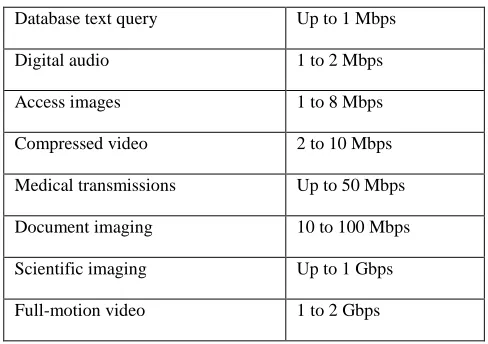
[image:1.612.316.566.384.709.2]Table 2 Data rate requirement of various applications
Database text query Up to 1 Mbps
Digital audio 1 to 2 Mbps
Access images 1 to 8 Mbps
Compressed video 2 to 10 Mbps
Medical transmissions Up to 50 Mbps
Document imaging 10 to 100 Mbps
Scientific imaging Up to 1 Gbps
Full-motion video 1 to 2 Gbps
1.2
Spectrum Scarcity
With the rapid growth in subscribers of wireless services available now in the market, the demand for additional spectrum is steadily increasing. High data rates are needed to meet QoS for different services. The data rate requirement for various services [2] is as shown in Table 2. With data applications consuming far more bandwidth than voice and with an increasing number of mobile users engaging in such applications, assignment of additional spectrum is imperative to continue expanding and upgrading the country’s wireless internet and broadband networks. Changing pace of modern lifestyle, economic growth and technical developments, greater device sophistication and new bandwidth hungry applications will continue to drive demand for mobile services and spectrum. Future spectrum requirements of the country, expected for milestones 2010, 2015 and 2020 are given in Table 3. Demand of increasing wireless applications is the driving force for such huge spectrum requirements.
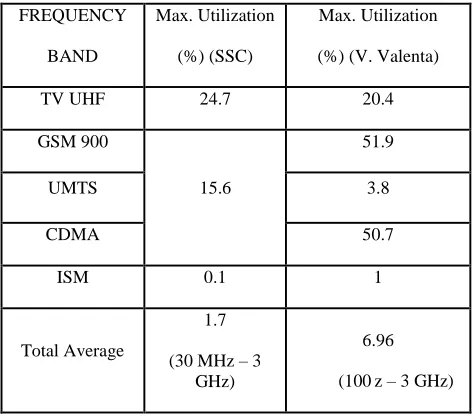
The unallotted spectrum shown in Table 1 will never be able to fulfill these needs of continuously increasing wireless applications and Service Providers. As a result, wireless operators have been loggerhead with each other for want of more and more spectra. However, on the other hand, actual studies [3-5] have revealed that much of the spectra is lying vacant in many of the bands utilized for wireless communication. Federal communication commission (FCC) reported only around 12 % daily usage of a dispatch channel that is most widely and steadily used [3]. Thus, FCC expects the other channels to have still lower spectral utilization. We present a complied report in Table 4, for the actual utilization of different frequency bands measured by shared spectrum company (SSC) [4] and V.Valenta et all [5]. Table clearly shows the poor spectrum utilization in many widely used frequency bands. This indicates that inefficient spectrum usage is the root cause for spectrum scarcity problem.
Spectrum is a very precious resource and thus underutilization of a large part of allocated spectrum is not affordable. It becomes clear from Table .4 that, in contradiction to the concept of spectrum shortage, it is still in abundance. The misconception of spectrum shortage might have grown because of existing
Table 3 Future Spectrum Requirements – Milestones: 2010, 2015, 2020
Demand Scenario Total spectrum Requirement (MHz)
2010 2015 2020
High Demand Setting
840 1300 1720
Low Demand Setting
760 1300 1280*
Source: ITU-R Report M.2078 (2006), Reproduced [2] *Decrease is due to deployment of more efficient systems beyond current and near-term IMT-2000 systems
regulatory policies of spectrum licensing. Hence, growing demands of spectra cannot be met if alternate regulatory schemes are not found. What is required is an approach where unlicensed users may operate in licensed spectra while accommodating the licensed/existing users at high priority. This study of abundant white space availability and increasing spectrum demand led the regulatory authorities like, FCC to issue a notice of proposed rule making (NPRM) for opening the underutilized bands for unlicensed use (Docket 04-113) [6]. Thus the need was felt for new types of devices operating in unlicensed bands without causing interference to licensed users called primary users (PU). NPRM of FCC classified such devices in two categories. First, the unlicensed “portable low power” devices that may like WLAN cards in Laptops and the second as “fixed high power” devices which may be used to provide commercial services like broadband internet access.
Cognitive radio is proposed as a solution satisfying these conditions. CR is a node with capability of sensing its environment to find spectrum opportunities, utilizing these spectrum holes to communicate wherever and whenever needed, and thus increasing spectrum utilization
CR allows the unlicensed wireless users to access the licensed bands from legal spectrum holders on a negotiated or opportunistic basis. It may provide a platform for wireless communication in which either a network or a wireless node modifies its transmission or reception parameters in order to communicate efficiently while avoiding interference with licensed or unlicensed users. The ability of a device to be aware of its environment and to adapt to enhance its performance, allows a transition from a manual, oversight process to an automated, device-oriented process. This ability has the potential to allow a much more intensive use of the spectrum by lowering of spectrum access barrier to entry for new devices and services.
2.
STATE OF ART IN COGNITIVE
RADIOS
2.1
Cognitive Radio: Definitions
[image:2.612.49.293.84.256.2] [image:2.612.318.564.106.213.2]Table 4 Occupancy for various frequency bands
FREQUENCY
BAND
Max. Utilization
(%) (SSC)
Max. Utilization
(%) (V. Valenta)
TV UHF 24.7 20.4
GSM 900
15.6
51.9
UMTS 3.8
CDMA 50.7
ISM 0.1 1
Total Average
1.7
(30 MHz – 3 GHz)
6.96
(100z – 3 GHz)
In 1999, J. Mitola and G. Q. Maguire [7] at first conceptualized Cognitive Radios. In 2001, Mitola defined CR [8] as follows.
“Cognitive radio is a goal-driven framework in which the radio autonomously observes the radio environment, infers context, assesses alternatives, generates plans, supervises multimedia services, and learns from its mistakes. This observe-think-act cycle is radically different from today’s handsets that either blast out on the frequency set by the user, or blindly take instructions from the network. Cognitive radio technology thus empowers radios to observe more flexible radio etiquettes than was possible in the past.”
Another widely referred definition was given by Simon Haykins [9] while presenting a thorough survey of CR, as below:
“An intelligent wireless communication system that is aware of its surrounding environment (i.e., outside world), and uses the methodology of understanding-by-building to learn from the environment and adapt its internal states to statistical variations in the incoming RF stimuli by making corresponding changes in certain operating parameters (e.g., transmit-power, carrier frequency, and modulation strategy) in real-time, with two primary objectives in mind:
· highly reliable communications whenever and wherever needed;
· efficient utilization of the radio spectrum.”
FCC [10] has defined a cognitive radio as:
“A radio that can change its transmitter parameters based on interaction with the environment in which it operates.”
James O’Daniell Neel, compiles many features of CR thought of by different researchers and given a new definition in [11] as:
“A cognitive radio is a radio whose control processes permit the radio to leverage situational knowledge and intelligent
processing to autonomously adapt towards some goal”.
Another definition of CR given in approved documentation by SDR forum [12] is as below.
“Radio in which communication systems are aware of their environment and internal state and can make decisions about their radio operating behaviour based on that information and predefined objectives. The environmental information may or may not include location information related to communication systems.”
These CRs are built on software defined radio (SDR) platform. The basic feature of an SDR is its reconfigurability in different attributes of physical layer thus, helping a CR to operate in changing environments. An SDR is defined in [12] as follows.
“Radio in which some or all of the physical layer functions are Software Defined. Software defined refers to the use of software processing within the radio system or device to implement operating (but not control) functions.”
Thus, we can say that an SDR is a reconfigurable system to dynamically control transmission parameters according to the communication specifications and requirements. This adaptability is achieved by software controlled signal processing algorithms [13]. Radio transceiver parameters can be changed as one of the following schemes:
Before the system is delivered to customer.
Occasionally eg. Structure change of network or new base station addition.
On connection basis. E.g. based on network availability, the user may choose from among different wireless access network (like GSM, Wi-Fi, Wi-MAX) based on performance, availability and price.
Dynamically changed on time slot basis. E.g. transmission power and frequency band adjustment for interference control.
The main functions of SDR as explained by Jondral [13] include multiband operation, multi standard support, multi service support and multichannel support.
2.2
Capabilities and Features
To optimize resource use, next generation networks require smart devices like CR to be able to model their location, their users, networks and the larger environment. Based on monitored set of these parameters, CR can adapt to appropriate frequency bands, protocols and interfaces. Mitola [7] represented the major functions to adapt the transmission parameters in changing environments through a Cognitive Cycle. This six stage cognition cycle is briefed as follows.
Observe: Know the information of operating environment through sensing and signaling mechanisms.
Orient: Evaluate this information to determine its significance and relevance.
Plan: Based on this evaluation, the radio determines its options or alternatives for resource optimization.
[image:3.612.53.290.86.294.2]Act: The radio implements the decisions taken for resource optimizations. These changes are then reflected in the interference profile presented by the cognitive radio in the outside world.
Learn: Throughout the process, the radio uses its observations and decisions to improve its own operation, creating new modeling states and alternatives.
In this technology to increase spectral efficiency in wireless communication, either a network or a wireless node changes its transmission or reception parameters to communicate efficiently avoiding interference with licensed or unlicensed users. This requires active monitoring of several factors in the external and internal radio environment, such as radio frequency spectrum, user behavior and network state.
A CR can reliably sense wide bandwidth, detect spectrum holes and use these holes for communication as and when required only if it does not interfere with PU. CR in this context is also referred to as an SU. The air interface for CR [14] is based on four main procedures: Spectrum sensing, Spectrum management, mobility and spectrum sharing.
2.2.1
Spectrum Sensing
In context of CR, spectrum sensing refers to the detection of spectrum holes with the help of spectrum sensing techniques as transmitter/energy detection, interference based detection, matched filters and cooperative detection. The ability of a CR network to coexist with other existing networks is predicated upon being able to sense the existence of other networks. Not only must the CR detect the spectrum holes, continuous monitoring of spectrum is also necessary to lookout for the return of PU. Accuracy, time and detection range are important considerations for sensing. Some associated problems in sensing are as follows:
False Alarm: While detecting the presence of PU in vicinity, CR detects the PU even if no PU is present. This is called false alarm.
Missed Alarm: If there is a PU present in the surroundings of CR and it does not observe its presence, this is known as missed detection.
2.2.2
Spectrum management
Spectrum management refers to acquiring the best available spectrum to meet user communication requirements. The function includes spectrum analysis and then selecting the band according to user requirements. A CR should make best use of the available resources or the ones it has identified for itself and should be able to adapt to the new found resources. CR needs to represent, organize, store and analyze the collected knowledge so that appropriate optimization routines can be evoked. Various operating parameters and transmission parameters need be continuously analyzed so that the best combinations of parameters might be tuned to maintain the QoS. A number of optimization techniques have been used including artificial intelligence and soft computing techniques.
2.2.3
Spectrum mobility
[image:4.612.312.576.154.469.2]Spectrum mobility or handover refers to the change of operating frequency or band. Mobility occurs when CR changes its frequency band upon detection of PU signal. CR needs to switch
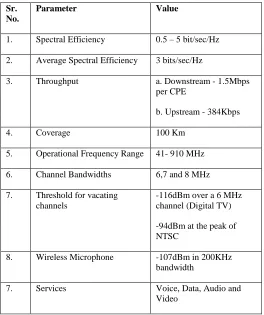
TABLE 5: SUMMARISED SERVICE PARAMETER VALUES FOR IEEE 802.22
to another frequency, maintaining seamless communication requirements during the transition to better spectrum. This is done to gain the best QoS possible. Data rate, throughput, SNR latency are some of the important parameters for deciding when handover is required for maintaining seamless connectivity.
2.2.4
Spectrum sharing
Once a CR knows its transmitting frequency, it informs its receiver about the band chosen so that a common communicating channel can be established. Besides, a fair spectrum scheduling method is to be provided. It can be regarded to be similar to generic MAC problems in existing systems.
2.3
Standardization and Implementation
With the wide spread popularity of CR, many organizations have come forward for standardization of CR’s reliable functionality and universal implementation. Some of such standards being developed are briefed along with their main features as following.
Sr. No.
Parameter Value
1. Spectral Efficiency 0.5 – 5 bit/sec/Hz
2. Average Spectral Efficiency 3 bits/sec/Hz
3. Throughput a. Downstream - 1.5Mbps
per CPE
b. Upstream - 384Kbps
4. Coverage 100 Km
5. Operational Frequency Range 41- 910 MHz
6. Channel Bandwidths 6,7 and 8 MHz
7. Threshold for vacating channels
-116dBm over a 6 MHz channel (Digital TV)
-94dBm at the peak of NTSC
8. Wireless Microphone -107dBm in 200KHz bandwidth
7. Services Voice, Data, Audio and
2.3.1
IEEE 802.22
In 2004, an IEEE 802.22 [15] standard committee was formed. This is a recent IEEE standard committee which aims at constructing Wireless Regional Area Network (WRAN) using Cognitive Radios and developing specification of its air interface. This network is formed by utilizing white spaces in already allocated TV frequency spectrum. Results on the studies of underutilization of TV bands, easy detection of its incumbents and no involvement in life critical application inspired TV band usage in WRAN.
WRAN can have an edge over other types of networks in regards to the coverage area as it targets to provide a coverage of about 100km as against 15km maximum coverage offered by largest WAN network [14]. WRAN proposes to have much larger coverage areas than today’s wireless networks. This may primarily be due to higher power and favourable propagation characteristics of TV bands. If power is not an issue, BS coverage can go up to 100 km. Some important parameters of this standard are summarised in Table 5.
2.3.2
IEEE 1900
In 2005, IEEE P1900 [16]-[17] standards committee was founded jointly by the IEEE Communications Society (ComSoc) and the IEEE Electromagnetic Compatibility (EMC) Society. The aim for this committee is to develop standards for next generation radio and advanced spectrum management. IEEE 1900 group has following three groups for standardization.
1900.1 - Definitions and terminology relating cognitive radio
1900.2 –Testing and verifying the operation of cognitive radios.
1900.3 –Approaches for qualifying software modules. 1900.4- Architectural Building Blocks Enabling Network-Device
Distributed Decision Making for Optimized Radio Resource Usage in heterogeneous Wireless Access Networks
1900.a – Regulatory certification of cognitive radios. The first draft 0f IEEE 1900 is now available [18].
Later, an IEEE Standards Coordinating Committee 41 (SCC 41) was formed in 2007 [19]. This committee consists of various IEEE 1900 working groups and is sponsored by ComSoc and EMC.
2.3.3
Other Organisations
Other major organisations and forums, working towards standardization and development of CRNs, include International Telecommunication Union (ITU) [20], Defense Advanced Research Projects Agency (DARPA) of DoD, U.S.A. [21] and Wireless World Research Forum (WWRF) [22-23] etc. Interested readers may refer to an overview of some of the activities of these standards as presented by Patricia Martigne [24].
3.
RESEARCH CHALLENGES
Depending on the parts of the spectrum available for cognitive radio, CR is distinguished in two ways:
Licensed Band Cognitive Radio: in which cognitive radio is capable of using bands assigned to licensed users, apart from unlicensed bands. The IEEE 802.22 working group is developing a standard for wireless regional area network (WRAN) which will operate in unused television channels.
Unlicensed Band Cognitive Radio: This can only utilize unlicensed parts of radio frequency spectrum. Focus of this type of CR functionality is mainly on coexistence between networks.
However, challenges for its realization are common for air interface as presented below.
3.1
Spectrum Sensing
The essential problem of Spectrum Sensing Cognitive Radio is in designing high quality spectrum sensing devices and algorithms for exchanging spectrum sensing data between nodes. A simple energy detector cannot guarantee the accurate detection of signal presence, calling for more sophisticated spectrum sensing techniques and requiring information about spectrum sensing to be exchanged between nodes regularly.
When operating on a single channel, the QoS of WRAN cells degrades due to sensing interruptions. This can be mitigated by DFH (Dynamic Frequency Hopping), where data transmission is performed without interruptions in parallel with spectrum sensing. However, in a bigger cluster of cells, frequency hopping could lead to significant problems if no coordination scheme is employed. Thus, concepts need be introduced for coordinating among cells so as to obtain better QoS and throughput behaviors.
A key fundamental problem in radio circuits is their non linearity and time variant nature. So, along with wanted signals, many unwanted harmonics and sidebands are also produced. Thus, there arises a need to address this problem and propose various solutions. Further, white space will usually not be concentrated in one particular area of spectrum. A more likely scenario is a spectrum, with a number of medium –to- narrowband white segments. A cognitive radio can select a single white segment, but is then bandwidth and capacity limited. Dynamic access of unused spectrum via cognitive radio asks for flexible radio circuits that can work at an arbitrary radio frequency. A powerful solution should focus on using several white segments in parallel.
3.2
Radio resource management
Seamless mobility i.e. shifting the frequency band from one to another as soon as the licensed user wants to use its allocated frequency should be considered. At the same time Switching from one application to another should also be seamless.Parameters such as traffic, data rates and processing speed are important and significant parameters while designing the algorithms for spectrum assessment and manipulation.
Apart from these, assessment of self interference and interference at other nodes is also an important factor to consider.
3.3
Spectrum Access
Dynamic Spectrum Access in wireless networks seems to outperform the fixed spectrum access counterpart for CR. It has been realized that spectrum agile radios produce superior airtime performance and blocking probabilities making them attractive option for next generation networks.
While the SDR (Software Defined Radio) platform envisioned for cognitive Radio technology is available now, the development of cognitive radio technology is still at a conceptual stage due to multitude of challenges in providing QoS assurances for primary users, spectrum sensing and feedback/estimation of channel/side information. Multiple secondary users have to independently monitor the licensed user activity and then exchange spectrum availability estimates. However, there has been limited research into designing suitable protocols for information exchange between sensing nodes in dynamic cognitive environment.
Various channel selection techniques need be explored for opportunistic spectrum access. Selection techniques such as frequency hopping, frequency tracking and frequency coding can be used. While frequency hopping is optimal in scenarios where primary user activity is highly dynamic, frequency tracking is more suited for relatively static cases. Frequency coding appears to have no significant throughput advantage over frequency hopping [19].
3.4
Regulatory Policies
One of the basic concerns for coexistence of heterogeneous wireless devices is autonomy vs. regulation. Licensing is found to be best suited for high duty cycle traffic whereas opportunistic access is optimal for low duty cycle traffic. Thus, there is a need to find how much licensing is optimal.
3.4.1
Tradeoffs
Two important but conflicting requirements for the standard being developed are satisfaction of QoS parameters and at the same time providing reliable spectrum sensing which is a tedious task. Optimum solution need be found for accurate sensing in minimum possible duration. Also the access delay, throughput and BER have to be in tolerable limits for successful communication. In addition, the numbers of handovers have to be seamless and optimized. On the other hand, it is has to be ensured that PU communication is interference free.
Thus, there is a need to focus on detailed specifications and analysis of protocols supporting CR and its architecture.
4.
APPLICATION AREAS FOR CR
With the introduction of the idea of CR, possibilities are being explored for exploiting its functionalities for various applications. Some of these applications are listed as follows.
4.1
Improved spectrum utilization
From section 2.2, it is clear that the increasing spectrum demand fostered the perception of lack of spectrum. However, spectrum is still in abundance but is poorly utilized. With the help of devices like CR operating on Opportunistic Spectrum Access (OSA), spectrum utilization will increase as it will fill the gaps by utilizing the spectrum holes.
Possible ways being researched for better radio resource management for situation based deployment is further expected to enhance spectrum utilization and in turn solving spectrum scarcity problem.
4.2
Interoperability
Information exchange between different networks or nodes with CR acting as a conduit between them is one such possibility. This has paved a way for new wireless applications that can exploit the abilities of different cognitive radio architectures to inter-operate, coexist, and work together seamlessly within the ecosystem. Interoperability provides an essential communications link within a wireless communications system which permits units from two or more different entities to interact with one another and to exchange information according to a prescribed method in order to achieve predictable results [25]-[26].
The Institute of Electrical and Electronic Engineers (IEEE) defines the generally accepted definition of interoperability [26] as:
"the ability of two or more systems or components to exchange information and to use the information that has been
exchanged."
There are two ways in which interoperability can be achieved. These are as briefed below.
i) Syntactic Interoperability
If two or more networks/systems are capable of communicating and exchanging data without the requirement of any intermediate node/system, they are said to exhibit syntactic interoperability. Specified data formats, communication protocols and the like are fundamental. In general, extensive markup language (XML) or structured query language (SQL) standards provide syntactic interoperability. Syntactical interoperability is required for any attempts of further interoperability.
ii) Semantic Interoperability
defined by the end users of both systems. To achieve semantic interoperability, both sides must defer to a common information exchange reference model. The content of the information exchange requests should be defined unambiguously.
4.2.1
Demonstrations for Interoperability
The first architecture exploiting these possibilities is a GNU Radio based platform. It implements a cognitive control mechanism using genetic algorithms [27]. Another architecture design is called the Plastic Project [28] and is a maximally reconfigurable software radio system. This is implemented by Centre for Telecommunications Value-Chain Research (CTVR). In another effort, CTVR and the Centre for Wireless Telecommunications (CWT) have undertaken a joint collaborative research effort to demonstrate and evaluate the interoperability possibilities using CR [29]. Key objectives of these projects are as:
Demonstration and evaluation of interoperability between two independently developed cognitive radio platforms.
Investigate the ability of these different architectures to share a common spectrum segment and coexist in an interference-free manner.
Develop a cognitive network and explore the potential of this network in a variety of scenarios.
Another work to develop a CR based interoperability platform is presented in [30] where a general method to reconfigure software defined radio (SDR) using a set of intelligent algorithms is developed. The authors use CR as a common reference model between two networks. The two networks considered in this experiment are Wi-Max and Wi-Fi. In the earlier works for coexistence between Wi-Max and Wi-Fi, the following have been demonstrated.
In 2004, J. Lansford [31] explored general methods for coexistence of Ultra Wide Band (UWB) with CR. In 2005, a reactive CR algorithm was proposed for coexistence between Fi and WiMax networks [32]. UWB Coexistence with Wi-Max is analyzed for interference and sensing thresholds in [33]. A Common Spectrum Coordination Channel etiquette protocol for coexistence between these two networks is employed and also compared with earlier results on reactive interference avoidance algorithms in [34]. An NS2 simulation model is developed to evaluate performance for representative system scenarios. Another work is proposed to establish common link on same shared frequency for both the networks, thus is based on semantic interoperability [35]. This design scenario comprises a Wi-Max subnet, Wi-Fi subnet, a CR and CBR applications to be shared among two subnets using CR as a common exchange reference. CR in this work helps two networks to coexist. Use of unlicensed spectra increases the probability of finding spectrum opportunity for the common exchange information at CR. Thus this work is based on semantic interoperability where CR acts as a common reference for information exchange between two networks which are otherwise incapable of communicating with each other.
4.3
Improved Technology
Other than then above two unique applications of CR, there are numerous applications attached to CR due to benefits obtained from the inbuilt technologies e.g., MIMO, beam forming,
OFDM, self organization or adaptability etc. Some of these are as follows:
Spectrum Policies: Due to the benefits of better spectrum utilization, it will tend to bring reforms in regulatory policies of spectrum allocation.
Link Quality: CRs are adaptable for its transmission power, modulation schemes and error corrections and cognition of learning from past experiences which helps provide better link quality.
4.4
Other Wireless Applications and
Services
There are numerous next generation wireless applications and services where CR capabilities are expected to be integrated. These include:
Next generation internet services supporting seamless QoS guarantee for a variety of multimedia
applications
Intelligent transportation systems to facilitate information exchange and processing to improve the efficiency of transportation by vehicles.
Improvement in wireless/mobile e-health service using CR seems promising in emergency situations
especially for the constraints of electromagnetic interference in such situations.
5.
CONCLUSION
Through this paper, we present interesting features and futuristic applications for CR. These devices are expected to form a basis of all next generation networks in totally or partially. This will help mitigate the spectrum scarcity problem and also on the restriction of using only assigned spectrum for transmission which may be extremely helpful during emergency situations. However, its implementation requires substantial research to device cost effective solutions to the challenges presented in this paper.
6.
REFERENCES
[1] Telecom Spectrum Allocation in India, Article. http://www.indiatelecomonline.com
[2] Telecom Regulatory Authority of India. Recommendations on Spectrum Management and Licensing Framework. May 2010. www.trai.gov.in
[3] Federal Communications Commission Spectrum Policy Task Force. FCC Report of the Spectrum Efficiency Working Group, November 2002. [Online] http://www.fcc.gov/sptf/files/SEWGFinalReport 1.pdf. [4] Shared Spectrum Surveys. [Online].
http://www.sharedspectrum.com/wp-content/uploads/Loring_Spectrum_Occupancy_Measureme nts_v2_3.pdf
[6] Federal Communication Commission (FCC), “Unlicensed operation in TV Broadcast Bands,” Notice for Proposed Rule Making, ET Docket No. 04-113, May 25, 2004. [7] Mitola, J., III; Maguire, G.Q., Jr. “Cognitive radio: making
software radios more personal,” Personal Communications, IEEE , Volume 6, Issue 4, Aug 1999 Page(s):13 – 18. [8] J Mitola, “Cognitive Radio for Flexible Mobile Multimedia
Communications,” Springer Mobile Networks and Applications, pp: 435-441, Vol 6, No. 5, September, 2001. [9] S. Haykin, “Cognitive radio: Brain-empowered wireless
communication,” IEEE Journal on Selected Areas in Communications, vol. 23, no.2, pp.201-220, Feb 2005. [10]Federal Communications Commission .ET Docket No.
03-108, March 11, 2005.
[11]James O’Daniell Neel, “Analysis and Design of Cognitive Radio Networks and Distributed Radio Resource Management Algorithms,” Ph.D dissertation, Virginia Polytechnic Institute and State University. September, 2006 [12]SDRF Cognitive Radio Definitions,
SDRF-06-R-0011-V1.0.0, Approved November 2007, online, www.sdrforum.org
[13]F. K. Jondral, “Software-defined radio–Basics and evolution to cognitive radio,” EURASIP Journal of Wireless Communications and Networking, 2005:3, pp. 275–283, August 2005.
[14]C. Cordeiro, K. Challapali, D. Birru, and S. Shankar, “IEEE 802.22: An Introduction to the first worldwide wireless standard based on cognitive radios,” Journal of Communications.Vol 1, no. 1, pp.38-47. April 2006 [15]IEEE 802.22, Working group on wireless regional area
networks (WRAN), [Online]. http://www.ieee802.org/22/
[16]IEEE P1900- wikipedia, [online]
http://en.wikipedia.org/wiki/IEEE_P1900.
[17]J. Hoffmeyer, “IEEE 1900 Committee: Next generation radio and spectrum management,” IEEE 1900 project
overview presentation,
http://grouper.ieee.org/groups/emc/emc/1900/files/1900_C ommittee_Overview.ppt
[18]Hiroshi Harada , Stanislav Filin, “White Space Communication Enabled by IEEE Standard 1900.4”, Feburary, 2009.
[19]IEEE Standards Coordinating Committee 41 (SCC 41), Dynamic Spectrum
Access Networks (DySPAN). http://www.scc41.org/. [20]International Telecommunication Unioin
Recommendations, http://www.itu.int.
[21]DARPA ATO, Next Generation Program, http://www.darpa.mil/sto/smallunitops/xg.html
[22]Wireless World Research Forum, “Cognitive radio and management of spectrum and radio resources in reconfigurable networks,” WWRF Working Group 6 White Paper, 2005.
[23]Wireless World Research Forum, “Cognitive Wireless Networks and Systems: Charter,” http://www.wireless-worldresearch.org
[24]Patricia Martigne, France Telecom R&D, “Overview of some standardization activities on Cognitive Radio,” September, 2007. Available online at www.etsi.org/website/document/Workshop/SoftwareDefine dRadio/SDRworkshop4-3PatriciaMartigne.pdf
[25]Federal Communication Commission, “Interoperability”.
[Online]. Available :
http://www.fcc.gov/pshs/techtopics/tech-interop.html [26]IEEE Standard Computer Dictionary. A Compilation of
IEEE Standard Computer Glossaries , New York, 1990. [27]Rieser, C.J.; Rondeau, T.W.; Bostian, C.W.; Gallagher,
T.M., ”Cognitive radio testbed: further details and testing of a distributed genetic algorithm based cognitive engine for programmable radios,” Military Communications Conference, 2004. MILCOM 2004. IEEE , vol.3, pp.1437- 1443 Vol. 3, 31 Oct.-3 Nov. 2004.
[28]Doyle, L.E., Nolan, K.E., Forde T.K. et al., ” A Platform for Dynamic Spectrum Experimentation”, in Proceedings of the 1st International workshop on Technology and Policy for Accessing Spectrum (TAPAS), Boston, August 1-5 2006.
[29]Nolan, K. E., Rondeau T.W., Sutton, P.D., Bostian, C. W., Doyle, L.E., “A Framework For Implementing Cognitive Functionality”, in Proceedings of the 51st SDR Forum General Meeting and 2006 Technical Conference, Nov. 13-17, 2006, Orlando, Florida.
[30]Scaperoth, D.; Le, B.; Rondeau, T.; Maldonado, D.; Bostian, C.W.; Harrison, S., “Cognitive Radio Platform Development for Interoperability” IEEE Military Communications Conference, MILCOM 2006. pp.1-6. 23-25 Oct. 2006.
[31]J. Lansford, “UWB coexistence and cognitive radio,” Proceedings of the International Workshop on Ultra Wideband Systems joint with Conference on Ultrawideband Systems and Technologies (Joint UWBST & IWUWBS 2004), 18-21 May 2004, pp. 35-39.
[32]X. Jing, S.-C. Mau, D. Raychaudri and R. Matyas, “Reactive cognitive radio algorithms for coexistence between 802.11b and 802.16a networks,” in Proceedings of GLOBECOM, November/December 2005, pp. 2465-2469. [33]K.-W. Kim, J. Park, J. Cho, K. Lim, C. J. Razzell, K. Kim,
C.-H. Lee, H. Kim, and J. Laskar, "Interference Analysis and Sensing Threshold of Detect and Avoid (DAA) for UWB Coexistence with WiMax," in Vehicular Technology Conference, 2007. VTC-2007 Fall. 2007 IEEE 66th, 2007, pp. 1731-1735.
[34]Xiangpeng Jing and Dipankar Raychaudhuri, “Spectrum Co-existence of IEEE 802.11b and 802.16a Networks using the CSCC Etiquette Protocol” First IEEE International Symposium on New Frontiers in Dynamic Spectrum Access Networks, DySPAN. Nov. 2005. pp. 243 – 250. [35]Prabhjot Kaur, Moin Uddin, Arun Khosla, “Cognitive
Radio as Common Information Exchange Reference Model for Interoperability between Heterogeneous Networks”, IEEE first UK-India International workshop on Cognitive wireless systems, UKIWCWS-2009. pp. 1-4. 11-12