Comparative Study on Efficient Localized Deployment
Algorithm for Wireless Sensor Networks
Shamily C.
Post Graduate Student Karunya University
Coimbatore, India
P. Anitha Christy Angelin
Assistant Professor Karunya UniversityCoimbatore, India
ABSTRACT
A Wireless Sensor Network (WSN) consists of spatially distributed autonomous sensors to cooperatively monitor physical or environmental conditions, such as temperature, sound, pressure, motion or pollutants. It is a platform for broad range of applications related to Security, surveillance, military, health care, environmental monitoring etc. WSN consists of large number of small size sensors which they can sense the environment and communicate with each other and processing the sensing data. Because of the deployment nature of the Wireless Sensor Network once it deployed we can’t recharge the battery. So energy conservation is one of the important factors. Under this constraint maintaining good coverage and connectivity is also important factor of designing WSN. In this paper we survey about the connectivity preservation property of our algorithm and simulation results on different deployment schemes such as full coverage, point of coverage or barrier coverage.
Keywords
Autonomous systems, connectivity, coverage, deployment, Mobile WSN.
1. INTRODUCTION
Sensor networks are envisioned as tiny power constrained devices, which can be scattered over a region of interest, to enable monitoring of that region for an extended period of time. The sensor devices are envisioned to be capable of forming an autonomous wireless network, over which sensed data can be delivered to a specified set of destinations. The nodes sense environmental changes and report them to other nodes over flexible network architecture.
Sensor nodes can be imagined as small computers, extremely basic in terms of their interfaces and their components. They usually consist of a processing unit with limited computational power and limited memory, a communication device, and a power source usually in the form of a battery. The requirement for infrastructure, in particular, limits the area that can be monitored and the frequency at which measurements can be taken and transmitted.
Focus on monitoring related technologies for WSNs in mission-critical environment: The connectivity issues in mission-critical monitoring and the solutions. The data collection in mission-critical monitoring are addressed. The data collection requires technologies that can guarantee performance such as timeliness, reliability, scalability and energy efficiency. It can be provided by designed routing, link scheduling and even cross- layer mechanisms. In mission-critical environment, dynamic network topology leads more difficulties in event detection. The related recent detection models and frameworks are addressed. A new promising way for mission-critical monitoring is to utilize wireless sensors.
The main challenge is to maintain connectivity from any sensors to the sink. Our first assumption is: all sensors are within communication range of each other at the beginning of the deployment. From the initial configuration, a sensor node may choose any direction to expand the network. This direction is linked to a deployment requirement. To avoid disconnection, the node has to maintain its connections to its neighbors that are parts of the Relative Neighborhood Graph (RNG) reduction.
After the first expanding process, some connections between the sensor and its previous neighbors are lost and deployment process continues in the same way. Every decision taken by sensors is based on local neighborhood information only, asynchronous and simple enough to take into account obstacles, or specific fields constraints.
Since the directions and the movements of a given node are only constrained by the connections to its RNG neighbors, the node’s direction can be governed by any requirement which allows our algorithm to adapt to different coverage schemes. We provide a localized deployment algorithm for mobile sensor networks.
This paper is organized as follows. Section 2 includes a discussion on key concepts in this paper; section 3 gives a comparative study and section 4 gives the conclusion on this paper.
2.
KEY CONCEPTS
This consist of several keywords about the connectivity preservation and coverage like Mobile WSN, Autonomous system, Coverage and Deployment.
2.1 Autonomous systems
An Autonomous System is a connected group of one or more Internet Protocol prefixes run by one or more network operators which has a single and clearly defined routing policy.
A multihomed Autonomous System provide connections between one or more AS. This allows the AS to make connection to the Internet in the event of a complete failure of one of their connections. But this type of AS would not allow pass traffic from one AS to another AS.
A stub Autonomous System maintains connection to only one other AS. This may be waste of an AS number if the network's routing policy is the same as its upstream AS's. But the stub AS may have peering with other Autonomous Systems that is not reflected in public route-view servers.
AS, it is referred to as Internal BGP (IBGP). When BGP runs between autonomous systems, it is called External BGP (EBGP).
2.2 Mobile WSN
Mobile WSN consists of collection of sensor nodes that interact with the physical environment. Mobile nodes have sensing ability, computing and communicating like static nodes. The main advantages of mobile sensor nodes have ability to repositioning and organizing the network. A mobile WSN start off with the initial deployment and the nodes can spread out to gather information.
Information gathered by a mobile node can be communicated to another node when they are within the communication range. A key difference between the mobile node and static node is data distribution. In static WSN data distributed using fixed routing. In mobile WSN data distributed using dynamic routing. Mobile sensor nodes can achieve higher degree of coverage and connectivity than static WSN.
2.3 Deplyment
The deployment scheme’s depends on the type of sensors, application and the environment. Nodes can be placed in deterministically or randomly. Deployment of sensors nodes in physical unattended environment is an important issue since the performance of wireless sensor networks largely depends on deployment of sensors nodes. The deployment of sensor nodes is divided into two fractions according to the function of networks and these fractions are coverage and connectivity.
2.4 Connectivity
The ability to report the Sink node is called as connectivity. A network is said to be fully connected if every pair of node can be communicated with each other either. Due to larger number of sensors in networks, the total cost whole network is high and the cost of the individual sensor is low.
Therefore it is important to find the minimum number of sensors for a WSN to achieve the connectivity. The connectivity of a graph is minimum number of nodes that must be removed in order to portion the graph in to more than one connected component. Connectivity affects the robustness and throughput of the wireless sensor network.
2.5 Coverage
A sensor network that has blind spots may fail to monitor events that happen at the location of such blind spots. The capability to monitor every coordinate on the sensor field has been termed the problem of coverage. A generalized version of the coverage-preserving problem requires a point to be covered by at least K sensors called the K-coverage problem. Each sensor node can detect the events with in some very limited distance from itself. That distance is called as sensing range.
The coverage schemes are classified into different groups. They are, Area coverage, Point of Interest coverage, and Path coverage. In area coverage the sensors are try to monitor the whole area of interest. In POI coverage, only some specific points of the sensor field need to be monitored and for the Path coverage, the goal is to minimize or maximize the probability of undetected penetration through the region.
3. COMPARATIVE STUDY
This section includes a study of deployment algorithm that has included connectivity and coverage as well.
3.1 Distributed Barrier Algorithm
Barrier coverage [7], which is guaranteed to detect movement crossing of barrier sensors termed as moving detection coverage and boundary guard. When sensors are randomly deployed this requires more sensor to achieve barrier coverage. In order to achieve barrier coverage it relocate the sensors and able to utilize fewer mobile sensor than stationary sensors. In this work, the problem of finding the best position of relocated sensors to minimize the moving energy consumption called minimum-energy barrier coverage. To address the problem of MEBC use the CBarrier algorithm this computes the position of relocated sensor in the centralized manner. For practicability and scalability the DBarrier algorithm has been designed based on locally obtained information.
The sensors cannot locally determine whether the area is barrier covered or not, it makes challenge to design distributed algorithm. To address the problem, the Virtual Force Model has been proposed, there a pair of sensors maintain repulsive force on the direction of X-axes and also maintain attractive force on the direction of Y-axes to relocate sensors. The main disadvantage is to minimize sensing coverage.
To control the fine tuning accuracy and convergence time, the virtual force moves sensor at a constant distance. A sensor moves left or right with distance ∆x along X-axes and moves up and down with distance ∆y along Y-axes. If the total repulsive force uses sensor point to left, moves to the left, otherwise it moves to the right. On the other hand, if the total attractive force uses sensors points up, moves up, otherwise it moves down. In conclusion, the adjusting rule as follows
Where and represent the sensor coordinates at step t. Based on adjusting rule sensor moves to
a new coordinates. Thus it relocates the sensors step by step using virtual force model.
3.2 Floor Based Schemes
In first phase, to establish connectivity, the sensors move towards the reference point and the second phase it determine the fixed nodes and remaining nodes are movable nodes which gives the freedom to relocate the coverage expansion. Finally the movable nodes expands their coverage area.
[image:3.595.83.271.227.357.2]The key idea of our floor-based method is to divide the field into floors of common height 2rs, and to encourage sensors to stay at the central floor lines of those floors, as shown in Fig.1. Now that sensors are separated by floors, the overlap of the sensing ranges is much reduced, and so the global network coverage can be improved. The main disadvantage is to increase the message overhead.
Fig.1: Sensor layout under FLOOR
3.3 Dynamic Repair Algorithm
The Connectivity is an important requirement for wireless sensor networks especially in real-time monitoring and data transfer applications. However, node movements and failures change the topology, which can result in partitioning of the communication graph. The motion of wireless sensor nodes cannot be controlled, but there are robots whose motion can be controlled by the wireless sensor nodes to maintain and repair the connectivity of the network. The main advantage is to provide more robust network and increase the throughput
between mobile nodes
.
In order to provide better connectivity, first introduce a new graph property [10], k-redundancy, to determine the communication characteristics of a dynamic wireless sensor network. This property provides a tool to identify low- connected parts of a communication. It is also important for the robustness of the network because of redundancy of nodes increase, the route between neighboring nodes increases. The disadvantage is to reduce connectivity.
3.4 Formation Morphing Algorithm
T
he performance of graph rearrangements is to preserve the connectivity of a robotic network. A connected graph describing the topology of the network, preserving a fixed set of edges while performing a coordination task guarantees that connectivity is maintained. However, the preservation of a fixed set of edges often results in suboptimal and over-constrained robot operation, which presents a distributed algorithm called Connectivity Maintenance algorithm [11] to perform graph rearrangements that allow the robotic network to transform its interconnection topology between any two trees. The Connectivity Maintenance algorithm create the formation morphing algorithm which is guaranteed to perform formation morphing while maintaining network connectivity and characterize its time complexity. The advantage of theproposed algorithm is to allow for on-line topological rearrangements of the tree in a distributed manner. However these two algorithms do not guaranteed the distribution correctness and does not explore the collision-free guarantee
on its execution
.
3.5 Neighbor-Every-Theta Graph
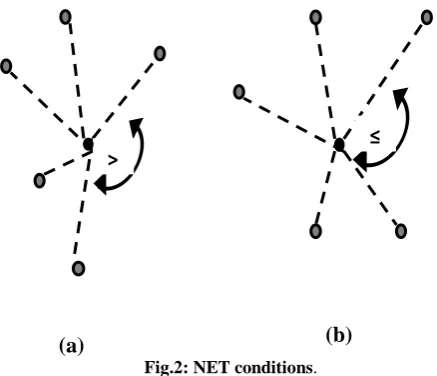
[image:3.595.320.539.338.526.2]In Neighbor-Every-Theta (NET) [4] graphs, each node has at least one neighbor in every theta angle sector of its communication range. It shows that , for an irregular communication range, NET graphs are guaranteed to have an edge connectivity of at least . In the controlled deployment of a mobile network, control over positions of nodes can be provided for constructing NET graphs with desired levels of network connectivity and sensing coverage. This implies that the condition depends on the angles between the neighbors of each node and holds for arbitrary edge lengths. This feature is applicable for sensor networks using low-power radios that have irregular communication range. For the special case with an idealized disk communication model, derives conditions for maximizing the sensing coverage area while satisfying the k-connectivity constraint and for obtaining proximity graphs such as the Relative Neighborhood Graph (RNG).
Fig.2: NET conditions.
Fig.2 shows the NET condition for a node embedded in the 2D plane is defined as requiring at least one symmetric neighbor in every sector of its communication range. Nodes A and B are symmetric neighbors if A can communicate to B and B can communicate to A. For finite networks, nodes on the network boundary cannot satisfy such a condition. The boundary of a network can be defined as a cycle of nodes such that every other node lies inside the cycle. A node that does not belong to the boundary is called an interior node. This Neighbor-Every-Theta graph only concentrate on connection not the coverage to avoid this the Relative-Neighborhood graph is used.
Now analyze the connectivity and coverage properties of NET graphs. For large networks where the number of boundary nodes is small compared to the network size, shows that NET graphs have an edge connectivity of at least , independent of the communication model. An upper bound on the sensing coverage is shown to be obtained from a symmetric arrangement of nodes and can be computed as a function of . NET graphs form a family of graphs based on the single parameter -as becomes smaller, the graphs become denser with an increasing level of connectivity.
>
ѳ
(a)
≤
ѳ
(b)
2rFloor line
Inter-floor
line
Floor line3.6 Sleep-Wakeup Algorithm
Global Barrier coverage requires fewer sensors than full coverage, which models on coverage for movement detection applications such as intrusion detection. Sensors cannot locally determine whether the deployment provides global barrier coverage, making it impossible to develop localized algorithms. The concept of local barrier coverage is to guarantee the detection of all movements to slice of the belt region of deployment. Prove that it is possible for individual sensors to locally determine the existence of local barrier coverage. Although local barrier coverage does not always guarantee global barrier coverage, that shows the thin belt regions, local barrier coverage almost always provides global barrier coverage. The local barrier coverage is to demonstrate using localized algorithms, it should develop a novel sleep-wakeup algorithm [8] for maximizing the network lifetime, called Localized Barrier Coverage Protocol (LBCP). LBCP provides close to optimal enhancement in network lifetime, while providing global barrier coverage most of the time.
Barrier coverage has several advantages over the full coverage model, First, barrier coverage requires much fewer sensors than full coverage. If the width of the deployment region is three times the sensing range, full coverage requires more than twice the density of barrier coverage. Saving in sensors grows linearly with width. Second, the sleep-wakeup problem, that determines a sleeping schedule for sensors to maximize the network lifetime, is polynomial-time solvable for barrier coverage even when sensor lifetimes are not equal. A major limitation of the barrier coverage model, unlike full coverage, individual sensors cannot locally determine whether a network does not provide barrier coverage.
3.7 Relative Neighborhood Graph
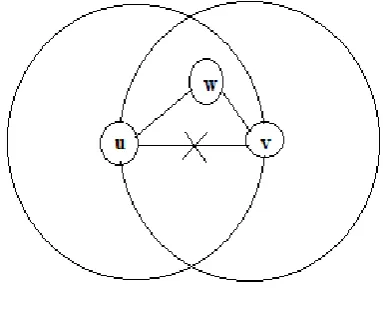
The Relative Neighborhood Graph (RNG) [1][2] is a graph reduction method. Given an initial graph G, the RNG extracted from G is a graph with a reduced number of edges but the same number of vertices. Let the sensors be the vertices of the initial graph and that there exists an edge between two vertices if the two sensors can communicate directly. We assume here that the communication between two sensors is possible only if the distance between them is less than a given communication range. To build a RNG from an initial graph G, an edge that connects two sensors is removed if there exists another node that is at a lower distance from both sensors.
[image:4.595.333.525.79.234.2]Fig. 3 shows an example of edge removal, where edge between sensors u and v is removed since there exists a sensors w that is closer to both u and v. The RNG can be deduced locally by each node by using only the distance with its neighbors. With positing system, nodes need to send periodically an HELLO message with their coordinates. In this way, each node maintains a neighborhood list with neighbor locations that allow determining whether or not an edge is in RNG [9]. In this case, we need only 1-hop information. We can observe that if nodes do not have positioning system, they can decide RNG edges if they are able to determine mutual distances. Every node sends in its HELLO message the list of its neighbors with distances. If the distance is greater than the transmission node then it can be ignored.
Fig. 3: RNG Edge Removal
Using the RNG reduction has two main advantages. First, the RNG reduction can be computed locally by each sensor since sensors only need the distances with its neighbors. Second, given that the initial graph is connected, the RNG reduction is also connected. These two properties are important for scalability issue and for connectivity preservation. Indeed, to preserve the connectivity of the whole network, each sensor has to only preserve the connectivity with its neighbors that are part of the RNG. We use these properties to preserve connectivity and avoid sensors from disconnecting the network.
And also it support three types of coverage schemes such as Area coverage, Barrier coverage and Point of Interest coverage. In the full coverage problem, sensors have to maximize the covered area, which uses virtual force based movement to increase the covered area. Barrier coverage [6] is an important way of covering area especially when considering intrusion detection. Since connectivity is independent from the direction computation, we can easily modify the direction while keeping the properties of our algorithm such as connectivity. Our deployment is focused on maintaining the graph connectivity while providing barrier coverage. In the POI coverage [5], only some specific points of the sensor field needs monitoring. Thus it provides both the coverage and connectivity.
4. CONCLUSION
5. REFERENCES
[1] J. Cartigny, F. Ingelrest, D. Simplot-Ryl, and I. Stojmenovic, “Localized LMST and RNG based minimum-energy broadcast protocols in ad hoc networks,” Ad Hoc Networks (Elsevier), vol. 3, no. 1, pp. 1–16, 2005.
[2] G. T. Toussaint, “The relative neighborhood graph of a finite planar set,” Pattern Recog., vol. 12, no. 4, pp. 261– 268, 1980.
[3] G. Tan, S. A. Jarvis, and A.-M. Kermarrec, “Connectivity-guaranteed and obstacle-adaptive deployment schemes for mobile sensor networks,” IEEE Trans. Mobile Comp., vol. 8, no. 6, pp. 836–848, Jun. 2009.
[4] S. Poduri, S. Pattem, B. Krishnamachari, and G. S. Sukhatme, “Using local geometry for tunable topology control in sensor networks,” IEEE Trans. Mobile Comp., vol. 8, no. 2, pp. 218–230, Feb. 2009.
[5] W. Cheng, M. Li, K. Liu, Y. Liu, X. Li, and X. Liao, “Sweep coverage with mobile sensors,” in Proc. Int. Parallel Distrib. Processing Symp. (IEEE IPDPS), 2008, pp.1-9.
[6] S. Kumar, T. H. Lai, and A. Arora, “Barrier coverage with wireless sensors,” in Proc. Int. Conf. Mobile Comp. Netw. (ACM Mobicom), 2005, pp. 284–298.
[7] C. Shen, W. Cheng, X. Liao, and S. Peng, “Barrier coverage with mobile sensors,” in Proc. Int. Symp. Parallel Architectures, Algorithms, Netw. (ISPAN), 2008, pp. 99–104.
[8] Chen, S. Kumar, and T. H. Lai, “Designing localized algorithms for barrier coverage,” in Proc. Int. Conf. Mobile Comp. Netw. (ACM Mobicom), 2007, pp. 63–74.
[9] J. Jaromczyk and G. Toussaint, “Relative neighborhood graphs and their relatives,” Proc. IEEE, vol. 80, no. 9, pp. 1502–1517, Sep.1992.
[10] Atay N. and Bayazit B. (2009) “Mobile wireless sensor network connectivity repair with k-redundancy,” Springer 57, 35–49.