Sensitivity Analysis in Radiological Risk Assessment
using Probability Bounds Analysis
Tazid Ali,
Dept. of Mathematics,Dibrugarh University, Dibrugarh-786004, India.
Hrishikesh Boruah,
Dept. of Mathematics,Dibrugarh University, Dibrugarh-786004, India.
Palash Dutta
Dept. of Mathematics,Dibrugarh University, Dibrugarh-786004, India
ABSTRACT
Sensitivity analysis is a study of how changes in the inputs to a model influence the results of the model. Engineers often perform sensitivity analysis to explore how changes in the inputs of a physical process or a model affect the outputs. Many techniques are available for use when the model is probabilistic. In this paper we consider a related problem of sensitivity analysis when the model includes uncertain variable that can involve both aleatory and epistemic uncertainty. In this study, we have used Probability Box (P-box) method to estimate the radiological risk of the radionuclide OBT due to ingestion.
Keywords
Probability bound analysis, Risk Assessment, Sensitivity Analysis,Uncertainty.
1. INTRODUCTION
It is important and interesting to examine how the conclusions of an analysis might change if the inputs or assumptions are changed. In general, such a process of exploring how changes in inputs affect outputs is called a sensitivity analysis. In other words sensitivity analysis is a method to assess the sensitivity of a model to changes to its input parameters. If small changes in an input parameter result in relatively large changes in a model’s output, the model is said to be sensitive to that parameter. Leamer, 1990 [8] has defined a (global) sensitivity analysis as a systematic study in which “a neighborhood of alternative assumptions is selected and the corresponding interval of inferences is identified”. Sensitivity analysis is the general term for quantitative study of how the inputs to a model influence the results of the model. Sensitive analysis has many manifestations in probabilistic risk analysis and there are many different approaches based on various measures of influence and response. When probabilistic analyses are generalized to address both epistemic and aleatory uncertainty, new methods of calculation are needed such as Dempster-Shafer theory (Evidence theory) and Probability Bounds Analysis (PBA) ([3], [7]). Sensitivity analysis are usually conducted to understand how the conclusions and inferences drawn from a calculation or an assessment depend on its inputs. It is also performed to focus on future empirical studies so that effort might be expended to improve estimates of inputs that would lead to the most improvement in the estimates of the output.
There are two fundamental reasons for conducting a sensitivity analysis: to understand the reliability of conclusions and inferences drawn from an analysis, which is
called sensitive analysis for decision robustness and to focus future information collection efficiently on those aspects to which the problem is most sensitive, which is called sensitive analysis for information prioritization [1]. As per EPA guideline several methods that can be used for sensitivity analysis in a probabilistic assessment (EPA, 2001, Section A). One among these sensitivity analysis methods that can easily be generalized to handle p- boxes is the computation of the percentage contribution from pathways to the total exposure or risk (EPA, 2001, Section A.2.11). This method estimates the sensitivity of an assessment result to a particular contaminant exposure pathway. For instance, an estimate of a percent contribution for drinking pathways might be
100x (HIdrinking / HI total)%
Where HIdrinking is the hazard index for some contaminant
associated with the exposure through the imbibitions pathway and HI total is the hazard index cumulated over all exposure
pathways. Analogous expressions for each of the exposure pathways in turn can be computed to obtain sensitivity measures for each pathway. These measures can be computed in a probability bounds analysis. The hazard indices in the numerator and denominator are computed from p-boxes [8].
1.1
Uncertainty
in
radiological
risk
assessment:
Uncertainty plays a critical role in the analysis for a wide and diverse set in various fields. Ideals and concepts of uncertainty have long been associated with gambling and games. There are two kinds of uncertainty. One kind arises as variability (or Aleatory uncertainty) resulting from inherent variability, natural stochasticity, environmental or structural variation across space or through time, manufacturing or genetic heterogeneity among components or individuals, and variety of other sources of randomness. It is also called randomness, Stochastic Uncertainty, objective Uncertainty, dissonance, or irreducible Uncertainty. The standard representation of variability is the probability distribution function. Another kind is called Epistemic Uncertainty. This is defined as uncertainty which arises from incompleteness of knowledge about the world. Sources of epistemic Uncertainty include measurement uncertainty, small sample size, detection limits and data censoring, ignorance about the details of the physical mechanisms and processes involved and other imperfection in scientific understanding.
assessment model in order to quantitatively characterize their variabilities and uncertainties. One of the advanced modeling approaches that may be used to conduct PRA studies is Probability Box (P-box).
2.
PROBABILITY
BOUNDS
AS
A
SENSITIVITY ANALYSIS
It is possible to represent both variability and imprecision separately using the formalism of credal sets of probabilities or imprecise probabilities, that extends traditional probability theory by allowing for interval or sets of Probabilities. In general, imprecise probabilities present computational challenges. Ferson and Donald [6] have developed a formalism called Probability Bounds Analysis (PBA) that facilitates computation; Berleant and collaborators independently developed a similar approach, and related methods were developed earlier for Dempster-Shafer representations of uncertainty. Although PBA is not quit as expressive as imprecise probabilities, it can still represent both variability and imprecision.
PBA represent uncertainty using a structure called a Probability-box, or P-box. A P-box is an imprecise cumulative distribution function (CDF). Upper and lower CDF curves represent the bounds between which all possible probability distributions might lie within this close region. The commercial available software RAMAS Risk Calc 4.0 [5] provides one implementation of PBA computations by discretizing the P-box. The algorithms are developed by Williamson and Downs for the binary mathematical operations of addition, subtraction, multiplication and division.
Several methods for sensitivity analysis commonly used by risk analysts can be extended to handle Probability boxes ([2], [4]). Besides the direct methods of estimating sensitivity such as computing partial derivatives or correlations, there are also various inferential techniques that estimate sensitivities by comparing the results of assessments performed under test conditions to those from base case. Authors in [9] described a straightforward approach for making such comparisons in the context of a probability bounds analysis [10].
The fundamental purpose of sensitivity studies requires estimating the value of additional empirical information. The value of additional information required may be predicted by comparing the uncertainty of the model before and after an operation called pinching. In this operation an input parameter is replaced by a value without uncertainty or by an uncertain number with less uncertainty. There are also multiple possible ways suggested by researchers to pinch uncertainty. The following strategies are usually followed in estimating sensitivities from comparative PBA assessments:
(i) replace an input with a point value,
(ii) replace an input with a precise distribution function,
(iii) replace an input with a zero-variance interval.
(iv) replace an input with an uncertain number with smaller uncertainty.
probability distribution the epistemic uncertainty is eliminated whereas the aleatory component remains. Replacing an input with a zero –variance interval eliminates the randomness of the input. Pinching can be applied to each input quantity in turn and the parameter for which there is maximum reduction of uncertainty is regarded as the most sensitive input of the model. This is because the estimate of the value of information for a parameter will depend on how much uncertainty is present in the parameter, and how it affects the uncertainty in the final results. The reduction or change in uncertainty could be computed with an expression like [3]
unc(T)
100 1
% ...(1)
unc(B)
Where B is the base value of the risk expression, T is the value of the risk expression computed with an input pinched, and unc(.) is a measure of the uncertainty of a p-box. The result is an estimate of the value of additional empirical information about the input in terms of the percent reduction in uncertainty that might be achieved in the expression when the input parameter is replaced by a better estimate obtained from future empirical study. Since uncertainty can be quantified in several ways, there are many possible ways to define the function unc(. ) in (1). In the context of PBA, one obvious measure is the area between the upper and lower bounds of the p-box. An analyst may also define unc() as variance or some other measure of dispersion, or perhaps the heaviness of the tails of the p-box. The measure of sensitivity is often the proportional effect of variability in each variable on the model, which is computed as the variance in the risk distribution from each of the simulations divided by the variance in the risk distribution from the base model results.
3. SENSITIVITY ANALYSIS FOR A
RADIOLOGICAL RISK MODEL
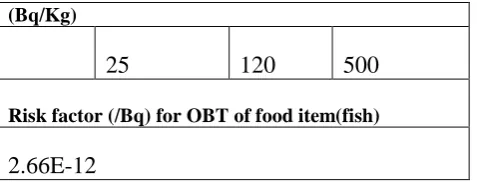
We have considered here a Risk Model. The risk is due to the radionuclide OBT through the pathway of Fish Ingestion. The uncertain parameters of the risk model are food intake and activity of radionuclide OBT in Fish. For this case study, we consider some hypothetical data. Suppose the data are available in terms of Minimum, Most likely and Maximum values as shown in Table 1 below. Using this data, we calculate the radiological risk for the radionuclide OBT by Probability bounds analysis.
Table 1: Intake of food, activity of radionuclide, risk factor of the radionuclide OBT
Intake of food item (Kg/Yr)
Food item
Values
Minimum
Most
likely
Maximum
(Bq/Kg)
25
120
500
Risk factor (/Bq) for OBT of food item(fish)
2.66E-12
We have considered the following model for the risk assessment
Risk due to ingestion of contaminated food:
Risk(/Yr) = Activity of radionuclide in food items(Bq/Kg) × Intake food(Kg/Yr) × Risk factor(/Bq)
Using Ramas Risk Calc 4.0 Software, we have calculated the risk. The range of the risk in the base case is [7.98e-10,
2.128e-08], the variance of the resultant P-box is [0,
7.5980774186e-17] and the mean lies in the interval
[3.9126215218e-09, 5.7533784781e-09].
Our model has only two uncertain inputs. So we examine which of the two inputs is more sensitive. We are using the sensitivity in the sense of contribution to total uncertainty to the output. In this study we have considered the unc(.) measure as the difference of the variance of the p-box. Since the variance of the resultant p-box is given by the interval [0,
7.5980774186e-17], we have unc(B) = 7.5980774186e-17.
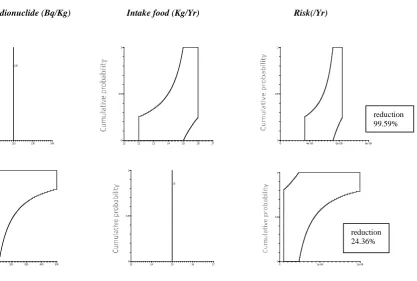
The top panel of Figure 2 shows the case where the first input is pinched to a point value of 120 in the place of P-box. The variance of the resultant P-box is [0, 3.0566591999e-19].The percentage reduction in this variance compared to that of the P-box on the base case is 99.59770623% (approx. 99.6%). This percent, represents the sensitivity measure for pinching the P-box (Activity) to a scalar value. The bottom panel of figure 2 shows the reduction of uncertainty (variance) for the resultant P-box after pinching the P-box (intake) to a scalar value 15. The variance of the resultant P-box is [0,
5.7471560999e-17].Compared to the base case, the variance
is reduced by 24.36039036% (approx. 24.36%). In this case, we observed that the reduction of uncertainty of the top panel is higher than the bottom panel.
Figure 3 shows a similar set of sensitivity analyses based on pinching P-boxes to precise distribution functions taking the
base value same as figure1. The top panel of figure 3 depicts pinching the P-box for the variable activity of radionuclide to a triangular distribution ( the most likely value is taken as mode in table 1). The variance of the resultant P-box of the top panel is [7.5556990671e-18, 2.5274420883e-17]. The percentage reduction in this variance compared to that of the P-box of the base case is 76.67999305% (approx. 76.68%). The bottom panel likewise shows the pinching for the variable intake of food by a triangular distribution. The variance of the resultant P-box is [0, 6.8465393886e-17]. The percentage reduction is 9.891160469% (approx 9.89%).
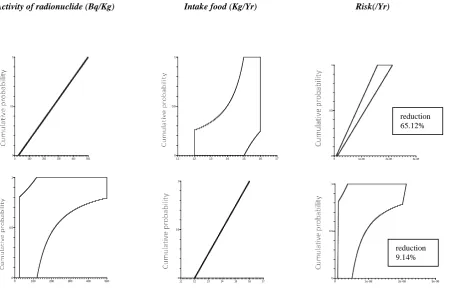
Figure 4 considers the case where P-boxes are pinched by uniform distribution (taking the minimum and maximum value in table1). The variance of the resultant P-box in the top and bottom panel of figure 4 are [1.509898306e-17,
4.16023458e-17] and [0, 6.9038529592e-17] respectively.
Similarly as above cases, compare with the base case, the percentage reduction are 65.11833023% (approx 65.12%) and 9.136843719% (approx.9.14%) respectively.
All the above three cases shows that the output of the two uncertain inputs of the model, activity of the radionuclide is more sensitive than food intake.
4. CONCLUSION
PBA provides a general approach for exploring the sensitivity of a decision problem that involves both probabilistic and imprecise information. Here we have examined the sensitivity of input parameters of a risk model related to the radionuclide OBT. When inputs of a model are tainted with uncertainty, the output model also exhibits uncertainty. In the matter of decision making it is always preferable to have minimum of uncertainty. So it is desirable that the uncertainty be minimized. Aleatory uncertainty as we know is not reducible, so we always try to minimize the epistemic uncertainties. But trying to reduce epistemic uncertainty, especially in the presence of too many inputs may not be cost-effective. So we try to find that input which has maximum uncertainty contribution to the output. Sensitivity analysis is a process in that direction. In this study we have made sensitivity analysis through three different pinching approaches. In all the cases we have observed that the activity of the radionuclide is more sensitive. So for this model we need to collect more information regarding that input so as to have made any realistic conclusion regarding the risk involved.
Activity of radionuclide (Bq/Kg) Intake food(Kg/Yr) Risk(/Yr)
Fig. 1 Base Case ofof the model.
0 100 200 300 400 500
0 0.5 1
11 12 13 14 15 16 17
0 0.5 1
0 1e-08 2e-08 3e-08
[image:3.595.50.289.71.162.2]CASE 1
Activity of radionuclide (Bq/Kg) Intake food (Kg/Yr) Risk(/Yr)
[image:4.595.53.522.85.766.2]
Fig.2 Sensitivity analysis by pinching a P-box to a point value
CASE 2
Activity of radionuclide (Bq/Kg) Intake food (Kg/Yr) Risk(/Yr)
Fig.3 Sensitivity analysis by pinching a P-box to a triangular distribution
100 110 120 130 140
0 0.5 1
120
11 12 13 14 15 16 17
0 0.5 1
0 4e-09 5e-09 6e-09
0 0.5 1
0 100 200 300 400 500 0
0.5 1
13 14 15 16 17
0 0.5 1
15
0 1e-08 2e-08
0 0.5 1
0 100 200 300 400 500 0
0.5 1
11 12 13 14 15 16 17
0 0.5 1
0 1e-08 2e-08 3e-08
0 0.5 1
0 100 200 300 400 500
0 0.5 1
11 12 13 14 15 16 17 0
0.5 1
0 1e-08 2e-08 3e-08
0 0.5 1
reduction 76.68%
reduction 9.89%
reduction 99.59%
[image:4.595.102.520.87.368.2]CASE 3
Activity of radionuclide (Bq/Kg) Intake food (Kg/Yr) Risk(/Yr)
[image:5.595.58.508.93.382.2]
Fig.4 Sensitivity analysis by pinching a P-box to a uniform distribution
5. ACKNOWLEDGEMENT
:
The authors would like to express their gratitude to the funding Agency Board of Research in Nuclear Sciences, Department of Atomic Energy, Govt. of India, for providing financial support under a Research Project.
6. REFERENCE:
[1] Aughenbaugh, J. M. and Paredis, Christiaan J.J.(2007): Probability bounds analysis as a general approach to sensitivity analysis in decision making under uncertainty. Society of Automotive Engineering Transaction, Journal of Passenger Cars- Mechanical systems.
[2] Ferson, S. and Tucker. W.Troy (2006) : Sensitivity analysis using probability bounding . Reliability Engineering and System Safety. Published by Elsevier Ltd
[3] Ferson, S. and Tucker. W.Troy (2006): Sensitivity in Risk Analyses with Uncertain Numbers, Sandia report, SAND2006-2801, Sandia National Laboratories.
[4] Ferson, S., Hajagos, J., and Tucker. W.Troy (2006): Probability bounds analysis is a global sensitivity analysis. Proceedings of the 4th International Conference on Sensitivity Analysis of model output,(SAMO 2004) Santa Fe, New Mexico, March 8-11,2004.
[5] Ferson,S. (2002):RAMAS Risk Calc 4.0 Software: Risk assessment with uncertain numbers. Lewis publishers, Boca Raton, Florida.
[6] Ferson, S., and Donald,S., (1998): “Probability Bounds Analysis”, Probabilistic Safety Assessment and Management, Mosleh, A. and Bari, R.A. ends., Springer-Verlag, New York, NY, pp 1203-1208
[7] Karanki Durga Roa, Kushwaha Hari Shankar, Verma Ajit Kumar, and Ajit Srividya (2009) : Uncertainty Analysis Based on Probability Bounds (P-Box) Approach in probabilistic Safety Assessment, Risk Analysis, vol. 29, no.5.
[8] Leamer, E., (1990): Let’s take the con out of econometrics, and sensitivity analysis would help. In: Modelling Economic Series, Clarendon Press, Oxford.
[9] Regan, H.M., B.K. Hope, and S. Ferson. (2002): Analysis and portrayal of uncertainty in a food web exposure model. Human and Ecological Risk Assessment 8: 1757-1777.
[10] W.Troy Tucker and Ferson Scott (2003): Probability bounds Analysis in environmental risk assessments. Applied Biomathematics, 100 North Country Road, Setauket, New York 11733.
0 100 200 300 400 500 0
0.5 1
11 12 13 14 15 16 17
0 0.5 1
0 1e-08 2e-08 3e-08
0 0.5 1
0 100 200 300 400 500
0 0.5 1
11 12 13 14 15 16 17
0 0.5 1
0 1e-08 2e-08 3e-08
0 0.5 1
reduction 65.12%