Munich Personal RePEc Archive
Operationalization and priority of joint
implementation projects
Zhang, ZhongXiang
University of Groningen, The Netherlands
February 1997
Online at
https://mpra.ub.uni-muenchen.de/12928/
February 1997
Operationalization and Priority of Joint Implementation Projects
1ZhongXiang Zhang
Department of Economics and Public Finance University of Groningen
P.O. Box 716 9700 AS Groningen
The Netherlands Tel: +31 50 3636882 Fax: +31 50 3637101
Email: [email protected]
The inclusion of joint implementation (JI) in the United Nations Framework Convention on Climate Change as a climate policy instrument is deemed a breakthrough for international cooperation on climate actions. It may provide a good opportunity for cooperation between industrialized and developing countries. Through an analysis
of the economic effects of carbon emission limits for China, this paper provides the economic rationale for the industrialized countries to invest in JI projects in developing countries like China, where the costs of abating greenhouse gas emissions are lower than trying to achieve an equivalent abatement within their own territories. Moreover, the paper addresses some operational issues of JI, consensus regarding which is a precondition for the
wide implementation of JI. Furthermore, the paper discusses the potential areas for JI projects that may be in China's interest. This discussion underlines that taking due consideration of local objectives and local conditions
in designing JI projects will enhance their possibility of success.
Introduction
In 1992, the Norwegian delegation introduced the concept of joint implementation into the negotiations for the Framework Convention on Climate Change (FCCC, hereafter also referred to as the Climate Convention) aimed, in the long term, at stabilizing greenhouse gas (GHG) concentrations in the atmosphere. At the United Nations Conference on Environment and Development in Rio de Janeiro in 1992, JI was put into the final text of Article 4.2 of the FCCC that over 150 countries have already ratified. This is deemed a breakthrough for JI as a climate policy instrument. The inclusion of JI in the Climate Convention can also be regarded as a first step towards a global regime of tradable emission permits.
countries, their climate policy would focus on the so-called win-win strategies unless the industrialized countries were willing to provide support for the developing countries to go beyond that. In this regard, JI may provide a good opportunity for cooperation between the industrialized and developing countries. By investing in JI projects in the developing countries where the costs of abating GHG emissions are lower than trying to achieve an equivalent abatement within the own territories, the industrialized countries can partly fulfil their emission abatement commitments and, at the same time, meet the developing countries' need for financial resources, technology and expertise in order to eradicate poverty and reform their inefficient energy sector and so on.
Economic Rationale
China's contribution to global CO2 emissions, which is high already, is expected to grow significantly, even
with large improvements in energy efficiency. Thus, advocates of controlling CO2 emissions call for substantial
efforts in China. However, the Chinese authorities know that China's CO2 emissions, though high in relation to
population size and energy use, so far have still been well below the world average level on a per capita basis, because of the low level of development of the Chinese economy. They are also aware that China is bound to rely mainly on coal as a fuel in the foreseeable future. Against this background, the Chinese authorities have claimed that China cannot be expected to make a significant contribution to solving the carbon emission problem, by arguing that ignoring the industrialized countries' responsibility for the majority of global CO2 emissions and
simply asking for special action on China's part would seriously harm China's economic development and improvement of living standards. What then are the economic effects of possible future carbon limits for China? How can we let China be part of the solution, given the global characteristics of climate change and China's importance as a source of future CO2 emissions in line with its rapid economic growth?
Using the newly-developed dynamic computable general equilibrium (CGE) model, we have analysed the implications of two scenarios under which China's CO2 emissions in 2010 will be cut by 20% and 30%
respectively relative to the baseline.2 The two emission targets are less restrictive in that they are not compared with the level of emissions in a single base year, but with the baseline CO2 emissions in 2010, the latter being 2.46
times that in 1990. The carbon tax required to achieve a 20% cut in CO2 emissions in 2010 relative to the baseline
is estimated to be US$ 18 at 1987 prices, while the corresponding figure necessary to achieve a 30% cut in CO2
emissions in 2010 is estimated to be US$ 35 at 1987 prices. This means that a larger absolute cut in CO2 emissions
will require a higher carbon tax. Higher tax also implies higher fuel-specific tax rates and hence higher prices of fossil fuels.
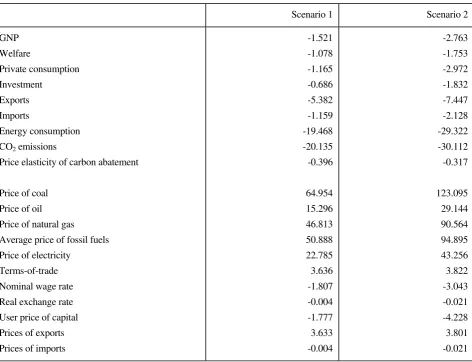
As shown in Table 1, even under the two less restrictive carbon emission scenarios, China's gross national product (GNP) drops by 1.5% and 2.8% respectively and its welfare measured in Hicksian equivalent variation drops by 1.1% and 1.8% respectively in 2010 relative to the baseline, indicating that the associated GNP and welfare losses tend to rise more sharply as the degree of the emission reduction increases. Given the fact that most studies surveyed by the IPCC (Intergovernmental Panel on Climate Change) second assessment report estimate
2 For a detailed description of the CGE model for China and its application, cf. ZhongXiang Z h a n g : The Economics of Energy Policy in China: Implications for Global Climate Change, New Horizons in Environmental Economics Series, Edward Elgar Publishing Limited, Cheltenham, England 1997; ZhongXiang Z h a n g : Macroeconomic Effects of CO2 Emission Limits: A Computable General Equilibrium Analysis for China, in:
that the economic losses under very restrictive carbon limits (e.g. stabilization or even 20% below 1990 levels in 2010) are reported not to exceed 2% of GNP for the OECD countries, our results also support the general finding from global studies that China would be one of the regions hardest hit by carbon limits.3 This, combined with the industrialized countries being responsible for the majority of global CO2 emissions, explains the Chinese
government stance on carbon abatement.
Table 2 shows the carbon tax levels across the countries and regions considered. It can be seen that there are significant differences in the carbon taxes required in order to achieve the same percentage of emission reductions relative to the baseline. This points to opportunities for joint implementation for abating CO2 emissions,
although it is not without conceptual and operational problems.
Then, between which parties should JI take place? As shown in Table 2, the carbon taxes would be much higher in the industrialized countries than in the developing countries. This is, among other things, due to their already relatively energy-efficient economies, their limited possibilities for substituting less polluting energy sources and their already high pre-carbon tax energy prices as a result of existing energy taxes. However, the differences between the industrialized countries are far less than those between the industrialized countries and developing countries. The question arising from this is whether such differences are large enough to justify every JI deal between the industrialized countries, not least due to the assumed transaction costs. But Table 2 clearly indicates that there is a large potential for JI deals between the industrialized countries and developing countries. In addition to their cost-effectiveness, there are other arguments in favour of such deals. For example, in the developing countries, there is a pressing need for reform of their energy sectors, on both environmental and economic grounds. Thus, there is a widespread need for transfers of financial resources, technology and expertise from the industrialized countries. Such transfers may be encouraged by JI. JI projects will also contribute towards reducing local environmental problems, which will benefit both the industrialized countries and the developing countries. For example, Japan is extremely concerned about cross-border pollution in the form of acid rain orig-inating from coal-fired power plants on the eastern coast of China. Clearly, JI projects for increased energy efficiency and fuel switches can make a positive contribution to this kind of problem.
Operationalization of JI Projects
In brief, JI means that the investor country invests in emission abatement projects in another (host) country where the costs of abating GHG emissions are lower than trying to achieve an equivalent abatement at home and is credited, in whole or in part, for emission abatements in its own GHG accounts. JI enables the investor countries to "shop around" for the lowest way to limit emissions. Thus, it offers potential for reducing the global costs of GHG abatement. This is the economic rationale for JI.
Then, how should JI be implemented? Because a number of countries were sceptical about JI during the negotiations for the Climate Convention, the Convention offers no specific guidance on the application of JI and leaves it to the Conference of the Parties (CoP) to lay down the rules. Now, as the pilot JI projects are being launched, attention is increasingly focused on the actual implementation of JI. Certainly, the implementation of JI
3 Cf. Intergovernmental Panel on Climate Change (IPCC): Climate Change 1995: Economic and Social
will face numerous challenges because so many operational aspects have to be addressed. Because of the space limitation, however, our discussion will focus on the following most important aspects.
Potential Benefits of JI
Greenhouse gases are uniformly mixed pollutants, i.e. one ton of a greenhouse gas emitted anywhere on earth has the same effect as one ton emitted somewhere else. Translated into the language of abatement strategies, this means that it does not matter whether greenhouse gas emissions are reduced in the United States or in China. What matters is whether we are able to reduce the emissions effectively on a global scale. This argument provides the environmental rationale for JI. The environmental argument in favour of JI is further supported by the following legal basis for JI. As stated in Article 3.3 of the FCCC, "efforts to address climate change may be carried out cooperatively by interested Parties". Moreover, Article 4.2(a) states the developed country Parties and other Parties included in Annex I (i.e. the OECD countries and countries with economies in transition) may implement ... policies and measures jointly with other Parties and may assist other Parties in contributing to the achievement of the objective of the Convention.4 Furthermore, the first CoP to the Convention in Berlin in April 1995 endorsed a pilot phase of JI referred to as activities implemented jointly (AIJ) among Annex I Parties and, on a voluntary basis, with non-Annex I Parties (i.e. developing countries). The pilot phase ends no later than the year 2000.
Until now, the most widely recognised benefit of JI is its potential to act to lower the costs of undertaking GHG abatement in the industrialized countries and hence to reduce the competitive disadvantage and carbon leakage associated with purely unilateral policies in these countries.5 Worldwide, this will achieve global abatement at a lower overall cost than would otherwise have been the case.
JI offers opportunities for the active involvement of the private sector, provided that financial or legal incentives to abate emissions are offered. This provides opportunities to attract additional funds from the private sector of the investor countries. Closely related to this, two points need to be made. First, the governments of Annex II countries (i.e. the OECD countries) should not regard private JI projects as a substitute for current official development assistance. Second, the first CoP decided that emission reductions achieved during the AIJ pilot phase are not allowed to be credited to current national commitments of investor countries under the FCCC. But crediting is an element unique to JI deals. Without crediting or other reward, JI projects are no different from traditional environmental aid and thus it is doubtful whether a large number of private JI projects will get off the ground. Indeed, since inception of the pilot phase, a relatively small number (currently around 40) of AIJ projects have so far been officially reported to the FCCC Secretariat as being accepted, approved or endorsed by the governments of the host and investor countries. Moreover, the geographical distribution of these projects is quite uneven, with very few AIJ projects being established in Africa and Asia. Given the short time horizon of the AIJ pilot phase and the lack of a diversified base of the current AIJ projects, there would not be enough practical experience to provide an empirical basis for a decision on whether to move forward beyond the pilot phase, if the current pattern continues.
As far as the developing countries are concerned, JI provides other positive environmental effects, since JI also helps to curb local pollution. The developing countries perspective on the benefits from a JI project is different
4 Articles 2.5 and 2.8 of the Montreal Protocol on Substances that Deplete the Ozone Layer can be viewed as a limited precursor to JI under the FCCC.
from those of the investor countries, the latter regarding abated global GHG emissions as the most important benefits from the project. Moreover, through participating in JI projects, the developing countries can get increased access to more advanced abatement technologies and additional funding. This will make it possible for the developing countries to lower energy use and hence emissions while achieving the same rate of economic growth (i.e. "technological leapfrogging"). Furthermore, the developing countries are even more vulnerable to climate change, and a broad commitment to JI would also reduce the damage potential from climate change in the developing countries themselves, since after all it is not only the industrialized countries whose climate will change if GHG emissions are not reduced.
Forms of JI
JI can be broadly defined as an attempt to reduce the global costs of meeting a particular GHG emission target. JI in a wider sense could cover more general cooperation between two or more countries on measures to abate GHG emissions, but this type of JI has up to now been addressed to only a limited extent in the international climate change debate. Unless otherwise specified, the following discussion is therefore based on the current dominant definition of JI at the project level.
There are three possibilities of introducing JI at the project level. The first is a multilateral approach to JI through an institution such as Global Environment Facility (GEF). Specifically, countries wishing to invest in JI projects pool their resources to an independent fund, whereas other countries offering JI projects compete for the funding resources. During the duration of the selected JI project, each investor country receives the credit proportional to its share of the project portfolio. The major advantage of the multilateral approach is risk-sharing because project risks can be spread among all the investor countries. On the other hand, there are some disadvantages. For the sake of reducing administrative overheads, the approach results in a preference for large-scale projects. Moreover, because of the multilateral characteristics, the approach disregards the diversified preferences of each investor country. All this will reduce the diversity of JI projects. Furthermore, because the project selection and approval cannot avoid the dangers of international bureaucracy and abuse of power, the approach would have serious drawbacks for both the efficiency and equity of the JI market.
Second, JI deals are through agreements between two governments. In this form, JI contracts are concluded at a government level and executing JI projects can be commissioned to public entities at a national, regional or municipal level, or to private companies and organizations. In either case, state authorities must be informed of the progress projects are making before issuing a certificate of approval. Moreover, in order to reduce administrative costs, an institution could be established to act on behalf of the countries concerned. This would represent a form of clearing house. Such a clearing house would deal with the tasks, such as the identification of JI projects, spreading risk, reducing transaction costs, and the close follow-up of individual projects. Clearly, this approach differs from the above-mentioned GEF approach because JI projects are not bundled together in a portfolio as in the GEF case.
technologies.6 This may be particularly true for large companies. To a lesser extent, the involvement of the private sector is also because of a fear of new regulations at home and a desire for a positive environmental profile.7 This type of JI provides opportunities to attract additional funds from the private sector. Given the limited amount of public funds available, this approach is considered particularly important in order to obtain the necessary investments in JI projects. Moreover, the approach can bypass inefficient bureaucracies from which public projects often suffer, thus keeping transaction costs to a minimum. In addition to the private sector involvement, non-governmental organisations (NGOs) should be given the opportunity to participate in JI projects, but their activities should focus on capacity building, monitoring and certification rather than pursuing JI projects per se. However, NGOs are strongly opposed to the concept of JI, and they have accused the industrialized countries of using JI as a means of buying their way out of responsibility for climate problems and at the same time postponing the radical changes in their own consumption patterns and passing the responsibility on to the developing countries.8 They will probably remain sceptical about JI unless they are convinced that clear criteria for JI have been established.
Criteria for JI
JI is a climate policy instrument that may lead to comprehensive transfers of resources from rich to poor countries. From the beginning, however, the developing countries, with the support of western environmental NGOs, are strongly opposed to the concept of JI. If the potential for cost effectiveness and the transfer of resources is so large, why has it aroused so much opposition in the developing countries? This debate on JI has underlined the need to establish general criteria and conditions defining how JI is to function.
According to the FCCC, the official criteria for JI will be laid down by the CoP. The type and size of the transaction costs of JI will depend on the criteria established by the CoP as well as the institutions and procedures designed to facilitate the development of JI projects.9 We think that the essential criteria for JI should include the following, at least from the developing countries point of view.
First, JI projects should be compatible with development priorities of the host countries. JI projects should bring about, in clear terms, real, measurable and long-term environmental benefits that would not have occurred in the absence of such projects. To this end, the prior acceptance, approval or endorsement by the national govern-ments involved is deemed important, although this would add to approval costs. This is also in line with the Berlin Mandate, which states that "all activities implemented jointly under the pilot phase require prior acceptance, approval or endorsement by the Governments of Parties participating in these activities". Closely related to this, if one JI project is not compatible with the development priorities of the host countries, it is doubtful whether it can
6 R. L o s k e and S. O b e r t h ü r : Joint Implementation under the Climate Change Convention, in: International Environmental Affairs, Vol. 6, 1994, No. 1, pp. 45-58.
7 Nordic Council of Ministers thinks that this is the main reasons why private companies, mainly in the US, have
carried out JI projects on a voluntary basis; cf. Nordic Council of Ministers: Joint Implementation as a Measure to Curb Climate Change: Nordic Perspectives and Priorities, TemaNord 534, Copenhagen 1995.
8 The Climate Network Europe and Greenpeace, for instance, hold a critical view on JI.
9 The transaction costs of JI consist of search costs, negotiation costs, approval costs, monitoring costs,
gain the host country's acceptance, because only countries as a whole are the Parties to the Convention, and because JI projects are tied to agreements between governments. This is unique to JI projects compared with traditional development projects. Parikh,10 for example, argues that reforestation projects should be rejected since they do not involve technology transfer and lead to potential conflicts with development priorities, especially land use. Moreover, it is not enough that JI projects be not harmful because harmless projects that are unrelated to development priorities divert limited resources away from priority activities and thus involve high opportunity costs for the host countries.
Second, funding for JI projects should be additional to the current official development assistance of Annex II countries. In addition to emissions additionality, which requires that emissions should be reduced from what they would have been in the absence of the projects, the intent of financial additionality is that the funding for JI projects should not come from traditional development budgets packaged under a new name, because the developing countries generally fear that Annex II countries will redefine existing development aid projects as JI projects and thus reduce their aid budgets accordingly, and because small developing countries particularly fear that Annex II countries will tend to turn their attention towards those developing countries with large economies and greenhouse gas emissions.
In order to make sure that any resources for JI are additional, the Annex II countries should at least allocate a certain percentage of their GNP to official development assistance (ODA).11 If such an agreed threshold cannot
be established, it is very important to keep the funds used for JI projects clearly distinguishable from those of the existing ODA. Limiting the contributions of JI to domestic GHG emission reduction obligations in Annex II countries as well as giving the Annex II only credit for part of the emission reduction achieved abroad may also help to reduce demand for JI projects12 and hence the incentives to shift the funding from the existing ODA, taking into account both the environmental effectiveness and economic efficiency. Otherwise, the developing countries would probably remain sceptical about JI.
Third, priorities should be given to JI projects for limiting emissions over projects for enhancing carbon sinks. In the proposed criteria from Canada, the Netherlands, Norway, and the USA, it has been stated that it should be possible for so-called sinks projects to become JI projects. Indeed, until now, projects for enhancing sinks through reforestation, afforestation or efficient forest use account for a large proportion of the existing projects that have been suggested to qualify in principle as officially recognizable JI projects. This is because projects of this type currently represent the least cost option. It may also be motivated by a concern to operate at a manageable level, with the goal of testing JI within the framework of the Climate Convention in order to gain concrete experience and to convince hitherto sceptical countries of the potential of JI projects.
10 J.K. P a r i k h : Joint Implementation and North-South Cooperation for Climate Change, in: International Environmental Affairs, Vol. 7, 1995, No. 1, pp. 22-41.
11 Cf. O. K u i k , P. P e t e r s and N. S c h r i j v e r (eds.): Joint Implementation to Curb Climate Change: Legal and Economic Aspects, Kluwer Academic Publishers, Dordrecht, The Netherlands 1994; R. L o s k e and S. O b e r t h ü r , 1994, op. cit.
By contrast, countries like Denmark have proposed that JI should not include sinks projects. The JI criteria from the Australian Pilot Phase JI Programme also suggest that JI projects should reduce net greenhouse gas emissions. Their objections to including sinks projects appear to be mainly practical considerations, because there are great uncertainties surrounding the true measures of carbon fixed, because there is the danger that countries may clear forests to have room for such JI projects later on, and because there are high risks associated with such long-term sink-enhancing JI projects.13 This may also be because sinks projects tend to merely postpone the problem of GHG emissions rather than solve it.
Faced with such sharp divergences in the proposed criteria, we think that priority should be given to JI projects for limiting emissions, at the same time not excluding JI sinks projects. This stance can be explained briefly as follows.
While the investor countries regard abated global GHG emissions as the most important benefits from JI projects, a large number of host (developing) countries regard local environmental problems as their own environmental priorities.14 They are more concerned with local pollutants, such as SO2, NOx and particulates from
fossil fuel burning, because emissions of these pollutants cause serious health hazards and large environmental damage. Sinks projects have a favourable climate effect, but do not contribute to the reductions of these local pollutants and thus to solving local environmental problems.
Moreover, the current emission stabilization target for industrialized countries is not sufficient to achieve the Climate Convention's ultimate objective of stabilizing GHG concentrations in the atmosphere at a level that would prevent dangerous anthropogenic interference with the climate system. Given the fact that developing countries are expected to experience emission increases in the coming decades and are not expected to make any new commitments going beyond the currently general ones under the FCCC which may hinder their economic growth and development, the achievement of the ultimate objective will rely on strengthened obligations for industrialized countries to limit their own emissions or on JI projects for limiting emissions. Since the former is considered too costly and not cost-effective by industrialized countries, which is the reason for JI, main reliance should thus be placed on JI projects for limiting emissions in order to achieve the Climate Convention's ultimate goal.
These arguments by no means exclude JI sinks projects. Take deforestation as an example. All forests store carbon, but deforestation will release carbon dioxide into the atmosphere that will contribute to the accelerated greenhouse effect.15 Brown and Pearce16 and Pearce17 have shown that the carbon storage value of forests is
13 Cf. P. B o h m : On the Feasibility of Joint Implementation of Carbon Emissions Reduction, in: A. A m a n o e t a l . (eds.): Climate Change: Policy Instruments and their Implications, Proceedings of the Tsukuba Workshop of IPCC Working Group III, Tsukuba, Japan 1994, pp. 181-198.
14 Cf. T. J o n e s : Operational Criteria for Joint Implementation, in: OECD: The Economics of Climate Change, Paris 1994, pp. 109-125.
15 The release rate of carbon dioxide differs, depending on the method of clearance and subsequent land use. 16 Cf. K. B r o w n and D. P e a r c e : The Economic Value of Non-Market Benefits of Tropical Forests: Carbon Storage, in: J. W e i s s (ed.): The Economics of Project Appraisal and the Environment, Edward Elgar, Aldershot, England 1994, pp. 102-123.
several times the domestic value. Thus, the sensitive, biologically diverse and rich forests of the developing countries could become a source of revenue not for timbering and clearing, but for preservation and enhancement. This, combined with global concern about tropical deforestation, suggests that avoiding deforestation through measures such as JI could become a potentially important means of reducing the greenhouse effect. Moreover, since tropical forests are generally located in tropical (developing) countries and since deforestation is mainly in those countries, opportunities for sink enhancement are generally largest in those countries, in which some industrialized countries, if not all, want to implement JI projects. Furthermore, avoiding deforestation is also in line with the national priorities of some of those countries. Thus, from the perspective of those countries, sinks enhancement for avoiding deforestation should not be excluded.
Fourth, guidelines should be established for the reporting of the performance of JI projects with respect to methodologies for calculating project baselines and actual emissions and for monitoring, verification and audit. The success of JI will critically depend on the ease with which JI projects can be arranged between interested parties. Standardizing the reporting procedures and requirements for JI projects would lower transaction costs and thus help to foster the development of JI projects. By placing emphasis on the documentation of all sources, methods, emission factors, and assumptions, it would also make it possible for an independent third party to validate the emissions estimates and project effects.
The Commitments of Annex I Countries
The extent to which non-Annex I countries would work together with Annex I countries in implementing JI projects depends on the Annex I commitments to be made at the upcoming third CoP to the FCCC scheduled to be held in Kyoto in December 1997. We think that such commitments should include the following:
First, Annex I countries should strengthen their existing commitments under the FCCC with respect to GHG emission targets and timetables, and transfers of financial resources, technology and expertise. Although much progress has been made since the 1992 Earth Summit in understanding the science of climate change, progress in the implementation of the FCCC has not been up to expectations. Indeed, most of Annex I countries continue to increase their emissions along an upward trajectory, which will result in their failing to meet their current commitments to returning their GHG emissions to their 1990 levels by the year 2000. Moreover, developing countries complain that Annex I countries have not lived up to the promise they made in Rio de Janeiro to help non-Annex I countries be greener. They continue to insist that Annex I countries must first meet their agreed commitments before non-Annex I countries will consider taking on additional commitments. The European Union (EU) broke the ice by offering a negotiation position of a 15% cut in emissions of a basket of three gases - CO2, CH4 and N2O - below 1990 levels by 2010. The proposed target is for the EU as a whole, with targets for
individual member states ranging from plus 40% for Portugal to minus 30% for Luxembourg. The EU proposal is the first formal one from Annex I countries, which contains a concrete target for emissions reductions. Although the proposal is just the EU negotiation position, not a commitment the EU will undertake on its own, it is seen by advocates of early action as a very crucial step in the right direction.
countries. Moreover, given the fact that many EU countries have still been on an upward trajectory of GHG emissions since 1990, the proposal has raised the question whether the proposed emission reductions within the suggested time-frame are realistic. Besides, the EU and the USA have been bickering. The USA, with the backing of Australia, Canada and Japan, has been critical of the EU insistence on mandatory policies and measures as well as short-term targets. Although the USA appears not to reject proposals for setting legally binding targets for emission reductions, it is unlikely to agree to any targets unless it knows what flexibility it could have. Here flexibility refers to the following:
would the carbon permits be issued as an emissions budget over a period?
can early-achievement be banked for future use and can under-achievement in the current period be fulfilled by the permits borrowed from a subsequent period?
can emission reductions be achieved "offshore" through emissions trading or joint implementation?
Clearly, the ongoing tension over the responsibilities of different parties to the FCCC suggests that if there were any concrete commitments and emission targets specified at the upcoming third CoP, they would only be the result of negotiation among the parties themselves.
Second, Annex I countries should provide adequate domestic incentives to encourage their private sector participation in JI projects. JI can only be successful if there is the active involvement of the private sector in project financing.
The Baselines
By definition, the baseline refers to the path of GHG emissions without any JI project. The baseline is deemed necessary in order to measure emission reductions resulting from JI projects and ensure correct crediting between the parties concerned. This is because, by establishing the baseline, we reduce the danger of the so-called double counting, where both investor and host parties claim the right to deductions on the basis of the same reduction volume. Moreover, by establishing the baseline, we reduce the free-rider effects. Otherwise, a JI deal might sanction a reduction that would have taken place anyway. Furthermore, establishing the baseline at the highest possible aggregated level, be it the national or even the international level, would reduce the leakage effects which occur when reduced GHG emissions in one place are counteracted by increased emissions elsewhere in the same host country or even in other countries as a direct or indirect effect of the JI project itself.18 From this, it therefore follows that the suggestion that the baselines are not needed for JI deals under the FCCC is suspect.19
For Annex I countries, the Climate Convention commits them to cut down emissions of CO2 and other
greenhouse gases to their 1990 levels by the year 2000. Since the baselines of Annex I countries are related to their
historical (1990) emission levels, there is little uncertainty about their future levels. However, for the developing countries with no abatement commitments under the FCCC, establishing their future national baselines is not a simple matter. First of all, this is because the baseline can never actually be observed. Put another way, it is impossible to observe what would have happened if JI deals had not been implemented.
Second, the definition of the baseline itself is not without conceptual problems. Given the fact that climate policy in the developing (host) countries is not so much about absolute emission reduction but about slowing the rate of growth of future GHG emissions, the host countries tend to "inflate" their baseline scenarios and regard any effort to reduce the growth of emissions as incremental. By contrast, the industrialized countries argue that the baselines in the host countries should be adjusted by eliminating projects that would have been carried out anyway by the host countries themselves and by subtracting emissions induced by energy subsidies and other economic distortions. As a result, they come to a much lower emissions baseline. Clearly, there is much controversy about the extent to which policy distortions and abatement projects should be included in the baseline. Thus, it is essential to come to a consensus on the baselines.
Third, there are great uncertainties surrounding the baseline. Fritsche20 shows that the variation in the baseline that is established for CO2 emissions in the European Union by different approaches is in the order of at
least 10% of the national emissions. The variation in the baseline tends to be even greater for CO2 emissions in the
developing countries and for emissions of other greenhouse gases than CO2. This underlines the need to establish a
common methodology on the baseline.
Fourth, from the point of view of strategic behaviour, the developing countries may even be unwilling to establish their baselines because doing so may convey the impression that they would bind themselves to these aggregate emission paths.
At present, no developing countries have established national emission targets. Moreover, it is unlikely that these countries will adopt binding targets in the near future. This underlines the great uncertainty of obtaining an accurate evaluation of emissions for JI deals. The question arising from this is whether JI projects should be limited to countries that have national emission targets. The argument in favour of JI projects between countries that both have emission targets is that the requirements for measurement and control of JI projects are in any case reduced. Moreover, there is a great certainty that such projects will contribute to the reduction in global emissions. On the other hand, the argument for not limiting JI only to countries with national emission targets is that the developing countries, where the potential for cheap emission abatement JI investments is far greater than in Annex I countries, will be not excluded. In this case, the baselines at project level at least have to be developed in order to suffice for JI arrangements.
The Verification of GHG Emission Reductions
Both the investor country and the host country have incentives to inflate the effect of JI projects. The investor countries may be tempted to inflate the volume of emission reduction from JI projects in order to receive greater credit than the JI projects merit, while the host countries may be tempted to inflate the potential for emission reduction from current JI projects in order to attract future JI projects given the fact that the investor countries attempt to get as much as possible out of their investment. Moreover, there are great uncertainties
associated with the measurement of the actual emission reduction of a given JI project itself. All this, combined with the complexities in establishing the baseline, underlines the need for the verification of the GHG emission reduction in order to ensure correct crediting.
Since both the investor party and the host party have an incentive to exaggerate the emission reduction, it is particularly desirable that the verification is carried out by an objective third party that should be agreed to by both partners. The verification is only responsible for deciding whether to accept the calculated GHG emission reduction or not. It is not the purpose of the verification to evaluate the acceptability of the JI project. It is up to the host and investor countries to decide what their definition of a JI project is.
For a given JI project, the extent of verification requirements depends on its characteristics and duration.
Ceteris paribus, the more intensive the verification, the higher the transaction costs associated with measurement and inspection of the JI project. In order to reduce the costs, it is therefore desirable to establish the standardized verification method for each category of JI projects and to make use of the existing, suitable institutional apparatus as much as possible.21
Since the pilot JI projects are just being launched, verifying the GHG emission reduction of JI projects is still at the initial stage. Moreover, great differences exist in the national conditions among the host countries. Thus, it is not surprising that a wide range of possible institutions from fairly decentralized to quite centralized have been suggested. In examining the roles for potential institutions in China, for example, Zhou and Li22 suggest that the
Energy Research Institute of the State Planning Commission could function as a third party to evaluate energy-related JI projects, and that the Chinese Academy of Environmental Sciences of the National Environmental Protection Agency could inspect those JI projects aimed at environmental control. Moreover, on the basis of sovereignty considerations, they do not believe that the Chinese government would react positively to international verification, although the limited involvement of some sort of United Nations' related team would be acceptable. Clearly, verification of this type is of a centralized structure. It would be preferred to a decentralized project-related verification because the former is carried out by means of the standardized procedure. However, the central solution at the national level cannot avoid the dangers of bureaucracy and abuse of power and is costly in comparison with a decentralized solution, because every JI project has to be evaluated by a single authority. On the other hand, it allows continuous improvement of the verification method by learning the lessons from failed JI projects.23
In verifying the GHG emission reduction, it is conceivable that the event of disagreement about the results of a verification could arise. Thus, it is essential for the CoP to establish a dispute settlement procedure that could be based on the FCCC multilateral consultative mechanism, or the independent panel model currently being used at the World Bank, or another mechanism. Whatever the procedure that is eventually established, it should be made available for all disagreements about the verification results brought by any host and investor parties. Once the dispute is settled, sanctions can therefore be imposed fairly on the parties for breaches of contract.
21 Cf. Nordic Council of Ministers, 1995, op. cit.
22 D.D. Z h o u and J.F. L i : Case Study of China, in: M. M a b e l , E. W a t t and J. S a t h a y e (eds.): Perspectives on the Institutional Needs of Joint Implementation Projects for China, Egypt, India, Mexico, and Thailand, Lawrence Berkeley Laboratory, Berkeley, California 1995, pp. 43-53.
Potential Areas for JI Projects with China24
The growing environmental concern built into both international and national programmes and China's rapid integration into the world economy tend to make China more amenable to international cooperation on the environment. Indeed, China has been supporting international cooperation on combating global warming in accordance with the principle of "common but differentiated responsibilities". China played an active role in preparing the FCCC and in the IPCC, co-chairing its Energy and Industry Subgroup of the Working Group III. At present, China is actively participating in a negotiating process aimed at producing a protocol or another legal instrument to deal with the threat of climate change in the post 2000 period in accordance with the Berlin Mandate. Until now, the Chinese government has ratified the FCCC and China's Agenda 21. A National Group of Co-ordination on Climate Change has been established with the involvement of 18 ministerial agencies. Its mission is to co-ordinate ministries and agencies in their efforts to address climate change, with the four working groups dealing with scientific assessment, impact assessment and response strategies, economic implications, and matters related to the Convention respectively. China has also made great efforts to abolishing current subsidies for energy consumption, reducing barriers to trade and to protecting intellectual property rights in order to facilitate the transfer and spread of economically viable low-carbon or carbon-free advanced energy technologies. All this at least indicates China's genuine concern about the potential impacts of climate change and its willingness to take all possible measures to limit the growth of its own per capita GHG emissions.
If Annex I countries have showed that they are really taking the lead in significantly reducing their GHG emissions within a short time-frame and are living up to their commitments to providing adequate transfers of financial resources, technology and expertise, and if the four-year AIJ pilot phase turns out to be a success, then an increasing number of developing countries will become more positive to the concept of JI. Only then will there be a reasonable prospect of joint implementation of abating GHG emissions between developed and developing countries, and China will no longer be sceptical about JI and tend to cooperate on JI projects. If this were the case, what then would be the potential areas in China's interest?
It is usually acknowledged that the success of JI premises an effective understanding of local (host country) development aspirations and the use of JI to push ahead with efforts to achieve these aspirations. Thus, in order to enhance their possibility of success, there is the need to take due consideration of local objectives and local conditions in designing JI projects. At present, the Chinese government has not approved any JI projects, and JI discussions have mainly remained confined to a very small circle of policymakers who are closely involved in climate change issues. Thus, at this stage, it is very difficult to say what the government preference is. Considering that the Chinese government is more concerned with local pollutants, such as SO2, NOx and particulates from coal
burning, and regards them as its own environmental priorities, however, we do not expect that the Chinese government would give priority to sink-enhancing JI projects. This at least indicates a preference for those JI
projects that reduce GHG emissions through increased energy efficiency and fuel switch. JI projects of this type not only have a favourable climate effect, but also contribute to the reduction of local pollutants. Then, specifically, what are the potential areas for JI projects that may be in China's interest? We think they could include those aimed at improving the efficiency of energy use, pushing the efficient use of coal, speeding up the development of hydropower and nuclear power and developing renewables. These emission-abating options, though aimed at reducing GHG emissions, will contribute to solving local environmental problems and thus will be beneficial to a more sustainable development of the Chinese economy.
Efficiency of Energy Use
Energy conservation is of vital importance to China, not only because it saves depletable energy resources and reduces pressure on transportation and environmental pollution, but mainly because severe shortages in energy supply have been inhibiting its economic development. It is estimated that China's energy demand in 2000 will be of the order of 1400 to 1700 million tons of coal equivalent (tce), even if energy conservation is taken into account, whereas the domestic supply will be likely only to meet 1400 million tce. Thus, if China's development plan is to materialize, the gap has to be filled through increased efforts directed at energy conservation and enhanced energy efficiency.
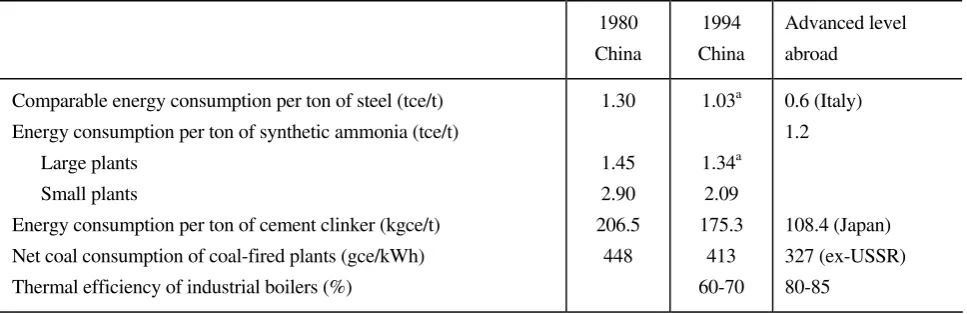
Indeed, the Chinese government has been placing great emphasis on energy conservation in the past decade. A series of measures has been implemented concerning the administrative, legislative, economic and technological aspects of energy policies. Great progress in decoupling its GDP growth from energy consumption has been made, with an annual growth of 9.9% for the former but 5.2% for the latter during the period 1980-95. This achievement corresponds to an income elasticity of energy consumption of 0.52, an accumulated energy savings of 630 million tce and to an annual saving rate of 4.3%. While China has enjoyed such a great success in energy conservation, its energy use per unit of GDP is still among the highest in the world. This high energy intensity in China reflects an unusually large share of energy-intensive industrial production in the Chinese economy, a large share of energy-intensive manufacturing in China's industry, a high proportion of coal consump-tion, and undervaluation of China's GDP. Concerning that direct cross-country comparison of energy use per unit of output value can provide only a rough picture of relative energy intensities in selected countries,25 comparing in physical terms the energy use of the major energy-intensive industries (i.e. iron and steel industry, chemical industry, building materials industry and power industry) and devices (i.e. industrial boilers that consume about one-third of the indigenous coal production) in China with those of other countries clearly indicates that the energy efficiency in China is also at the low end (see Table 3).
Pushing Efficient Use of Coal
Over the past few years, coal has accounted for more than 75% of China's primary energy consumption. The coal-dominant structure of energy consumption is not expected to change in the foreseeable future. Given this prospect and the serious environmental pollution arising from inefficient coal use, China's efforts to combat air
pollution must be directed at much more efficient use of coal. The policy measures that have been and will continue to be implemented include the following:
increasing the proportion of raw coal washed; energy efficiency studies show that power plant efficiency is decreased by 0.2% for each percentage increase in ash content. Given average ash reductions of 5-7% attributed to washing for steam coal and even higher reductions for coking coal, the overall efficiency savings could be substantial;
popularizing domestic use of coal briquettes; coal stoves using coal briquettes can reduce coal consumption by 20-30%, CO emissions by 70-80%, and SO2 emissions by 40-50% if sulphur-fixing additives are added to the
briquettes;
substitution of direct burning of coal by electricity through development of large-size, high-temperature and high-pressure efficient coal-fired power plants;
expanding district heating systems and developing cogeneration;
increased penetration of town gas into urban households; town gas from coal gasification plants is one of the only long-term options for displacing direct coal burning in China's residential sector;
development and diffusion of environmentally sound coal technologies; given China's huge coal reserves that are 12.7 times its proven recoverable oil and natural gas reserves combined, the development of clean coal technologies, such as circulating fluidized bed combustion boilers, coal-water slurry, and coal gasification com-bined cycle, must be part of China's long-term energy strategy.
Hydropower and Nuclear Power
China's hydropower potential is estimated to be the largest in the world, and its economically exploitable capacity totals 378 GW, corresponding to 1920 TWh of annual electricity production. By the end of 1994, however, the total capacity installed of hydropower plants was only 13% of the exploitable potential, considerably less than that of the industrialized countries and also below that of developing countries such as Brazil and India. Given China's abundant hydropower resources, their underdevelopment and their importance as an alternative to coal use for electricity generation, this current situation means that considerable efforts need to be devoted to speeding up hydropower exploitation in some river sections with favourable exploitation conditions. As for nuclear power, two power stations have been commissioned based on the most matured commercial pressurized-water reactors, specifically, Qinshan Nuclear Power Station in Zhejiang province and Daya Bay Nuclear Station in Guangdong province. This marks the start of the development of nuclear power in China.
Hydropower and nuclear power have so far provided the only proven methods with enormous potential for large-scale generation of electricity without a parallel production of CO2 emissions. In the short to medium term
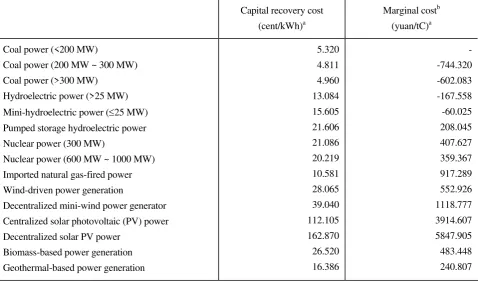
(before 2010), however, China has little alternative but to rely on coal for power generation because long leadtimes and high capital costs (see Table 4) pose difficulties for the expansion of both hydropower and nuclear power to meet the projected rapidly increasing electricity demand.26
Developing Renewables
China is abundant in renewables. This abundance, combined with energy shortages in China as a whole and in the rural areas in particular, suggests that attention should be paid to the development of renewables to supple-ment conventional energy resources in the long-term energy plan. However, as shown in Table 4, renewable energy plants, such as wind and PV plants, are still too costly in comparison with conventional coal and hydroelectric plants. Technically, they have yet to prove their feasibility for large-scale electricity production. Given the severe shortages of capital resources in China and the limitations of these renewable technologies themselves, renewables are expected to play only a limited role in the short to medium term (before 2010), altho-ugh total generating capacity of renewables is expected to be expanded at a faster
peace than those of coal-fired power.27
Conclusions
The industrialized countries are currently responsible for the majority of global GHG emissions, and must bear the major burden of the emission abatement. Thus, if the North, particularly Annex II countries, are really serious about tackling global warming by JI, they must demonstrate once and for all that they are really taking the lead in reducing their GHG emissions and providing adequate technology transfer and financing. This is the best means of encouraging developing country participation and convincing hitherto sceptical developing countries of JI as a cost-effective climate measure. Moreover, given the breadth of the subject of JI and its close linkage with national sovereignty, global political agenda, and national development priorities, a wide and successful implementation of JI will be conditional upon consensus on a variety of operational issues such as the form of JI, criteria for JI, the establishment of baselines against which the effects of JI projects can be measured, and the verification of emission reductions of JI projects. Even if such a consensus were reached, given the fact that AIJ/JI remains virtually unknown to the majority of social and economic sectors in China as in most developing countries, it is still unrealistic to expect that AIJ/JI projects with China work as smoothly and fast as the industrialized countries wish. This underlines the need to promote JI through pilot projects in China's interest and capacity building in China in order to make JI gain ground and provide mutual benefits to all the parties involved. Furthermore, the extent of China's cooperation on JI will to some extent depend on the certainties about climate change. This in turn underlines the need for the scientific community to continue its efforts to clarify the scientific basis for understanding the climate change problem in order to lower the uncertainties about its magnitude, timing and regional patterns.
27
Table 1
Main Macroeconomic Effects for China in 2010
(Percentage Deviations Relative to the Baseline; -: Declines)
Scenario 1 Scenario 2 GNP Welfare Private consumption Investment Exports Imports Energy consumption CO2 emissions
Price elasticity of carbon abatement
Price of coal Price of oil Price of natural gas
Average price of fossil fuels Price of electricity
Terms-of-trade Nominal wage rate Real exchange rate User price of capital Prices of exports Prices of imports
-1.521 -1.078 -1.165 -0.686 -5.382 -1.159 -19.468 -20.135 -0.396 64.954 15.296 46.813 50.888 22.785 3.636 -1.807 -0.004 -1.777 3.633 -0.004 -2.763 -1.753 -2.972 -1.832 -7.447 -2.128 -29.322 -30.112 -0.317 123.095 29.144 90.564 94.895 43.256 3.822 -3.043 -0.021 -4.228 3.801 -0.021
Sources: ZhongXiang Zhang: The Economics of Energy Policy in China: Implications for Global Climate Change, Edward Elgar Publishing Limited, Cheltenham, England 1997; ZhongXiang Zhang: Macroeconomic Effects of CO2 Emission Limits: A Computable General Equilibrium Analysis for China, in: Journal of Policy Modeling,
Table 2
Carbon Taxes across Regions in 2010
(at 1985 $ per Ton of Carbon)
USA Japan EEC Total OECD China World Scenario 1
Scenario 2
53.4 120.3
55.9 103.1
85.7 158.6
62.7 132.3
10.1 18.3
45.1 92.9
Sources: cf. Table 1.
Table 3
A Comparison of Unit Energy Consumption in Some Energy-Intensive Industries and Devices
1980 China
1994 China
Advanced level abroad
Comparable energy consumption per ton of steel (tce/t) Energy consumption per ton of synthetic ammonia (tce/t) Large plants
Small plants
Energy consumption per ton of cement clinker (kgce/t) Net coal consumption of coal-fired plants (gce/kWh) Thermal efficiency of industrial boilers (%)
1.30
1.45 2.90 206.5
448
1.03a
1.34a
2.09 175.3
413 60-70
0.6 (Italy) 1.2
108.4 (Japan) 327 (ex-USSR) 80-85
a
In 1990.
[image:20.595.72.556.337.494.2]Table 4
A Comparison of Alternative Power Plants at a 10% Discount Rate
Capital recovery cost (cent/kWh)a
Marginal costb (yuan/tC)a Coal power (<200 MW)
Coal power (200 MW ~ 300 MW) Coal power (>300 MW)
Hydroelectric power (>25 MW) Mini-hydroelectric power (≤25 MW) Pumped storage hydroelectric power Nuclear power (300 MW)
Nuclear power (600 MW ~ 1000 MW) Imported natural gas-fired power Wind-driven power generation
Decentralized mini-wind power generator Centralized solar photovoltaic (PV) power Decentralized solar PV power
Biomass-based power generation Geothermal-based power generation
5.320 4.811 4.960 13.084 15.605 21.606 21.086 20.219 10.581 28.065 39.040 112.105 162.870 26.520 16.386 - -744.320 -602.083 -167.558 -60.025 208.045 407.627 359.367 917.289 552.926 1118.777 3914.607 5847.905 483.448 240.807 a
Measured at 1990 prices, 1 yuan = 100 cent.
b
Coal-fired power of unit capacity of less than 200 MW has been chosen as the reference, whereas other options considered are regarded as abatement technologies. Marginal cost per ton of carbon abated by each abatement technology is measured against this reference.