© 2018, IRJET | Impact Factor value: 6.171 | ISO 9001:2008 Certified Journal | Page 2325
An Experimental Study on Floating Concrete Using Light Weight
Materials
Thousif Khan
1, Ibrahim Killedar
2, Sharu Malik H N
3, Muhathasheem R F
4, Jagannatha G M
5,
Dr. Shivakumara B
61234
UG Students, Dept. of Civil Engineering, S T J Institute of Technology Ranebennuru, Karnataka, India,
5Asst. Professor, Dept. of Civil Engineering, S T J Institute of Technology Ranebennuru, Karnataka, India,
6
Principal,
S T J Institute of Technology Ranebennuru, Karnataka, India.
---***---Abstract
- Floating concrete is a special type ofinnovative concrete whose density is less than 1000 kg/m³. Because of its low density and moderate range of compressive strength, it can be used in non-structural applications as of now. An attempt has been made in this study to develop a Floating concrete based on trials with an emphasis on overall density. Also, attempt has been made to obtain Floating concrete with considerable compressive strength. The primary aim of the project is to develop floating concrete and to achieve this, different mix proportions were adopted based on absolute volume concept. The successfully developed floating concrete was accomplished in different phases. The cement was used in combination with fly ash was in the range of 200-425 kg/m³. In this study, floating concrete was successfully developed for different densities using the ingredients whose specific gravity is less than that in the conventional concrete. Study reveals pumice and Thermocol beads could be successfully used as an alternative to coarse aggregate which in turn results in lower density when compared to conventional material used in concrete.
Key Words
: Cement, Fine aggregate, Thermocol,Coarse aggregate, Pumice Stones.
1. INTRODUCTION
1.1. GENERAL
Floating concrete is a composite material composed of cement, water, aggregates and admixtures (both physical and chemical). Unlike the traditional Portland cement concrete (whose Density is about 2400 kg/m³); floating concrete contains lightweight aggregates and certain admixtures which make the composite lighter. The density of the floating concrete ranges from 600 kg/m³ to 1000 kg/m³. Since its density is less than that of water (1000 kg/m³) the concrete in its hardened state can float in water. Due to its special ability to float, it can replace other less durable materials like wood in the applications where the material is desired to float. Also its lightweight property is suitable for use in non load bearing walls, thermal and sound insulation. Thus, floating concrete is a special type of concrete whose density is about 1/3rd compared to the conventional concrete.
a) By replacing the usual mineral aggregate by light-weight aggregate
With the use of lightweight aggregates concrete with low density has been achieved. Light weight aggregates such as pumice, perlite, vermiculite, sintered fly ash, bloated clay, expanded slag etc., have been used for achieving lower densities than that of a conventional concrete.
b) By introducing gas or air bubbles in mortar (Aerated concrete)
The "Aerated concrete" was perfected in the mid-1920, by Swedish architect and inventor Dr. Johan Axel Eriksson. Aerated concrete is a lightweight concrete which is made by introducing air or gas into a cement-based mortar. Though it is called aerated concrete, it is really not a concrete in the correct sense of the word since it is only a mixture of water, cement and finely crushed sand without coarse aggregate.
c) By omitting sand fraction from the aggregate (No-fines concrete)
No-fines concrete is a type of concrete from which the fine aggregate fraction has been omitted i.e. the concrete is made up of only coarse aggregate, cement and water. Very often only single sized coarse aggregates, of size passing through 20 mm retained on 10 mm has been used. Such a concrete, in addition to having large voids and hence light in weight, also offers architecturally attractive look.
1.2. OBJECTIVES
© 2018, IRJET | Impact Factor value: 6.171 | ISO 9001:2008 Certified Journal | Page 2326 have a far reaching effect in the sense that it could be
used in other applications than those mentioned.
The objectives of this project are :
1. To reduce the self weight of the concrete.
2. To characterize the materials required for developing floating concrete.
3. To develop a floating concrete based on trials.
4. To compare compressive strength and tensile strength of developed mixes.
2. METHODOLOGY AND MATERIALS
GENERAL
Laboratory investigations carried out on cement, coarse aggregates (Pumice stones, Thermocol beads) and also on concrete which are used for test specimens have been presented. The properties of thermocol beads and pumice stones as given by the manufacturers. This chapter of thesis contains physical properties of various materials used throughout the experimental work.
2.1 MATERIALS USED
The varies materials used in the experimental works are
1. Cement.
2. Fine aggregate(Pumice powder).
3. Coarse aggregate(pumice stone and thermocol beads).
4. Water.
5. Admixture.
2.1.1. CEMENT
A cement is a binder, a substance used in construction that sets and hardens and can bind other materials together. The most important types of cement are used as a component in the production of mortar in masonry, and of concrete- which is a combination of cement and an aggregate to form a strong building material. Portland cement is the most common type of cement in general use around the world.
Table No. 4.1 Properties of cement
SL.NO PROPERTIES OBTAINED
RESULTS
1 Standard
consistency 28%
2 Specific gravity 3.18%
3 Initial setting
time 34 min
4 Fineness 1.5%
5 Color Grey
2.1.2. Fine Aggregate
Fine aggregates play a very important role in concrete. The aggregate whose size is lesser than IS 4.75 mm and retained on lS 150µ is considered as fine aggregate. It manages to fill the voids between the coarse aggregates. It must be well graded from the particle point of view in order to guarantee filling of the voids. The fineness helps in increasing cohesion there by resisting segregation. In Floating concrete, pumice powder has been used as fine aggregates.
The size, shape and texture of aggregates control the workability cement content and drying shrinkage parameters. Generally smooth and rounded aggregates are preferred for concrete. Pumice stone of igneous origin is disintegrated into size less than 4.75 mm and is used as fine aggregate.
Here in this investigation study pumice powder has been used as fine aggregate.
2.1.3. Coarse Aggregate
The coarse aggregate constitutes the bulk of concrete mixture and gives the dimensional stability to concrete. Size of aggregates greater than 4.75 mm is considered as coarse aggregate. Generally aggregates of size between 4.75 mm to 20 mm are used in concrete. The size, shape and texture of aggregates control the workability; cement content and drying shrinkage parameters. Generally smooth and rounded aggregates are preferred for concrete. In this experimental study Pumice stones and thermocol beads have been used to reduce the density of concrete.
(a) Pumice stones
© 2018, IRJET | Impact Factor value: 6.171 | ISO 9001:2008 Certified Journal | Page 2327 capacity and aggregate strength ranges from very weak
and porous to stronger and less porous. Pumice stones passing through IS 20 mm are taken and Specific gravity of pumice stone used is 0.817, Density of pumice stone is 308.148 kg/m3 and it has been used throughout the experimental work.
Pumice stones
(b) Thermocol beads
Thermocol beads or EPS (Expanded polystyrene) beads is a rigid and tough, closed cell foam. It is usually white and made of pre-expanded polystyrene beads. The thermocol beads have density 10.07 kg/m3 and it has been used throughout the experimenta work.
Thermocol beads
2.2 MIX DESIGN PROCEDURE
Mix design is a process of selecting suitable ingredients and determining their relative proportions with the objective of producing concrete of having certain minimum workability, strength and durability as economically as possible.
Since there is no mix design procedure for floating concrete we considered our own mix design procedure based on absolute volume concept. Considering the total volume of concrete as one unit, the total volume of aggregates can be calculated by deducting the volume of paste and voids from the unit volume. The range of volume of fine aggregates was chosen between 15 to 25 % keeping in views both the strength and permeability requirements. Initially we had adopted 1:1:2(M25) as mix proportion. To minimize the quantity of cement which is the only denser material in the concrete we have adopted 1:1.5:3(M20) mix proportion.
2.3 COMBINATIONS
The experimentations are designed by replacing the coarse aggregates by thermocol beads and pumice aggregates in different percentage, such as
(100%, 0%), (90%, 10%),(80%, 20%),(70%,
30%),(60%, 40%),(50%,50%) respectively.
2.4 METHOD OF MIXING AND CASTING OF PROCEDURE
The method of mixing adopted in this study is the conventional method by hand mixing. Calculated quantities of the materials were mixed with calculated amount of water and kept aside in a measuring jar. Dry mix containing cement, fine aggregates and coarse aggregates was prepared and mixed for about 2 minutes. And then it is transferred into moulds kept on vibrator machine for a minute.
The following procedure is adopted to cast the specimens.
Place the moulds on the vibrating table and pour the wet concrete mix inside the moulds in three layers.
Vibrate the concrete both through table vibrator and by hand compaction using tamping rod.
Vibration should not be more, otherwise segregation will takes place.
After filling the moulds with wet concrete, level the surface and give the designation to each specimen, De-mould the specimen after 24 hours.
Demoulded specimen
2.5 TESTING PROCEDURE
2.5.1 WATER ABSORBTION TEST
© 2018, IRJET | Impact Factor value: 6.171 | ISO 9001:2008 Certified Journal | Page 2328 Water absorption of a concrete surface depends on many
factors including:
1. Concrete mixture proportions.
2. The presence of chemical admixtures and supplementary cementitious materials.
3. The composition and physical characteristics of the cementitious component and of the aggregates.
4. The entrained air content.
5. The type and duration of curing.
6. The degree of hydration or age.
7. The presence of micro cracks.
8. The presence of surface treatments such as sealers or form oil.
9. Placement method including consolidation and finishing.
10. In general, the rate of absorption of concrete at the surface differs from the rate of absorption of a sample taken from the interior. The exterior surface is often subjected to less than intended curing and is exposed to the most potentially adverse conditions.
In this work three full size blocks shall be completely immersed in clean water at room temperature for 24 hours. The blocks shall be then removed from the water and allowed to drain for one minute by placing them in air, visible surface water being removed with a damp cloth; the saturated and surface dry blocks are immediately weighed. After weighing all blocks shall be dried at room temperature for not less than 2 days and then the blocks are weighed.
2.5.2 SORPTIVITY TEST
Water ingress into a non-saturated concrete structure is due to sorption, driven by capillary forces. If the water is on top of the concrete surface, gravity also will play a role in the water penetration. Therefore, it is necessary to use the method more appropriate for the application of the concrete structure to be evaluated.
Because of the difficulties associated with the absorption tests, on the one hand, and, on the other, because permeability tests measure the response of concrete to pressure, which is rarely the driving force of fluids entering concrete, there is a need for another type of test. Such a test measure the rate of absorption of water
by capillary suction of unsaturated concrete placed in contact with water; no head of water exists. Essentially, the sorptivity test determines the rate of capillary–rise absorption by a concrete prism which rests on small supports in a manner such that only the lowest 30 mm of the prism is submerged. The increase in the water level of the prism with time is recorded.
Cube
Depth of the mark Water
30 min immersion Roller support
Sorptivity test on cube specimen
Where,
S = Sorptivity in mm/min0.5.
i = Depth of water level increased by capillary action, expressed in mm.
t = Time measured in minutes at which the depth determined.
2.6.2 STRENGTH TEST
2.6.2.1 COMPRESSIVE STRENGTH TEST
Compressive strength is the capacity of a material or structure to withstand loads tending to reduce size, as opposed to tensile strength, which withstands loads tending to elongate. It is measured in kN/mm2.
P 6mm plywood strip
Cylinder
150
6mm plywood
All dimensions in mm strip
© 2018, IRJET | Impact Factor value: 6.171 | ISO 9001:2008 Certified Journal | Page 2329
3. EXPERIMENTAL RESULTS
3.1 Near surface characteristic test results
3.1.1 Water absorption test results
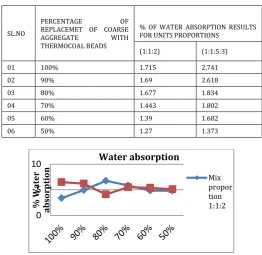
[image:5.595.305.563.56.252.2]Following table No. 5.1 gives the water absorption test results of concrete for different percentage replacement of coarse aggregate by pumice and thermocol beads for mix proportion 1:1:2 & 1:1.5:3. Fig. No. 5.1 shows the variation of water absorption graphically for mix proportion 1:1.5:3.
Table No. 3.1 Water absorption test results
SL.NO
PERCENTAGE OF REPLACEMET OF COARSE AGGREGATE WITH THERMOCOAL BEADS
% OF WATER ABSORPTION RESULTS FOR UNITS PROPORTIONS
(1:1:2) (1:1:5:3)
01 100% 1.715 2.741
02 90% 1.69 2.618
03 80% 1.677 1.834
04 70% 1.443 1.802
05 60% 1.39 1.682
06 50% 1.27 1.373
3.1.2 Sorptivity test results
Following table No. 5.2 gives the sorptivity test results of concrete for different percentage replacement of coarse aggregate by thermocol beads and pumice stones. Fig. No. 5.2 shows the variation of sorptivity.
Table No. 3.2 Sorptivity test results
SL.NO
PERCENTAGE OF
REPLACEMET OF
COARSE AGGREGATE
WITH THERMOCOAL
BEADS
Sorptivity (mm/min0.5) test for
mix proportionsss
(1:1:2) (1:1:5:3)
01 100% 3.377 6.481
02 90% 4.929 6.201
03 80% 6.755 4.10
04 70% 5.842 5.751
05 60% 4.83 5.385
06 50% 4.83 5.11
3.3 Strength tests
3.3.1 Compressive strength test results
Following tables give the compressive strength test results of floating concrete for different percentage replacement of coarse aggregate by thermocol beads and pumice stones. Following Fig. No. 5.3 shows the photographic view of compressive strength test and failure of specimen.
[image:5.595.29.292.254.509.2]
(a) Before test (B) After test (b)
Table : Overall results of compressive strength
% Replaceme nt of coarse aggregate by thermocol beds
Compressiv e strength of concrete (1:1:2) in MPa
%increase or decrease of
compressiv e strength w.r.t refrence mix
Compressiv e strength of concrete (1:1.5:3) in MPa
% increase or decrease of compressive strength w.r.t reference mix
100% (Reference
mix) 3.18 2.43
90% 3.26 2.51 3.12 28.39
80% 3.39 6.60 3.44 41.56
70% 3.85 21.06 3.65 50.20
60% 5.10 60.37 4.1 68.72
50% 5.60 76.10 4.95 103.7
0 5 10
%
Wat
er
ab
so
rp
ti
on
Water absorption
Mix propor tion 1:1:2
0 1 2 3
100% 90% 80% 70% 60% 50%
Sorpt
iv
it
y
(m
m
/m
in
0
.5
)
Water absorption
Mix proportio n 1:1:2
© 2018, IRJET | Impact Factor value: 6.171 | ISO 9001:2008 Certified Journal | Page 2330 Variation of compressive strength
3.2.2 Tensile strength test results:
Following tables give the tensile strength test results of floating concrete for different percentage replacement of coarse aggregate by thermocol beads & pumice. Following Fig. No. 5.5 shows the photographic view of tensile strength test and failure of specimen.
[image:6.595.56.279.343.470.2]
(a) Before failure (b) After failure
Table No: Overall results of tensile strength
% Replacement of coarse aggregate by thermal beads
Tensile strength of
concrete (1:1:2) Tensile strength of concrete (1:1.5:3)
100%
( Reference mix) 0.69 0.483
90% 0.724 0.701
80% 0.86 0.788
70% 0.976 0.879
60% 0.998 1.037
50% 1.11 1.141
Variation of tensile strength
OBSERVATIONS AND DISCUSSIONS
The following observations were made based on the experiments conducted on floating concrete using thermocol beads pumice aggregates.
1. It is observed that the water absorption of concrete goes on increase with increase in percentage of pumice stones, is due to the fact that the water is absorbed by the pumice stones present in concrete.It is also observed that the percentage of water absorption of water by the concrete of mix proportion 1:1.5:3 is more than that of 1:1:2.It can be concluded that the maximum the quantity of pumice stones present in the concrete, water absorption goes on increasing.
2. It is observed that the Sorptivity of concrete of mix proportion 1:1:2 has same value for mixes 50%, 60% and increases from 60% to 70% and has maximum Sorptivity for 80% and gradually decreases till 100%. For concrete of mix proportion 1:1.5:3, the Sorptivity value gradually increases from mix 50% to 70%, and decreases for 80% and increases from 80% to 90% and for 100%.
3. It is observed that the compressive strength of the concrete for mix proportion 1:1:2 has least compressive strength of 3.18 MPa for 100% replacement of coarse aggregate by thermocol beads and goes on increasing further upto 50% mix and has maximum compressive strength attained 5.6 MPa for 50% replacement of coarse aggregate by thermocol beads. It can be concluded that the maximum compressive strength is attained for 50%replacement of coarse aggregate by thermocol beads and pumice stones.
4. It is observed that the compressive strength of the concrete for mix proportion 1:1.5:3 has least compressive strength of 2.43 MPa for 100% replacement of coarse aggregate by thermocol beads and goes on increasing further upto 50% mix and has maximum compressive strength attained 4.95 MPa for 50% replacement of coarse aggregate
0 2 4 6
100% 90% 80% 70% 60% 50%
Com
pre
ss
iv
e
st
re
n
gt
h
(M
Pa)
% Replacement of coarse aggregate by thermocol beads
Compressive strength
mix proprotion 1:1:2
0 0.5 1 1.5
100% 90% 80% 70% 60% 50%
Te
n
si
le
s
tr
engt
h
(M
Pa)
% Replacement of coarse aggregate by thermocol beads
Compressive strength
© 2018, IRJET | Impact Factor value: 6.171 | ISO 9001:2008 Certified Journal | Page 2331 by thermocol beads. It can be concluded that the
maximum compressive strength is attained for 50% replacement o coarse aggregate b y thermocoal beads and pumice stones. It can be concluded that the compressive strength obtained is maximum for the mix proportion 1:1:2.
CONCLUSIONS
1. Based on the limited study done in the project, the following concluding remarks may be made
2. The mix proportioning based on absolute volume concept used in normal concrete can be successfully employed for achieving a floating concrete keeping the density of the mix less than 1000 kg/m3.
3.The volume of aggregates can be maintained in the range of 0.7 to 0.75 for achieving floating concrete.
4. Pumice and thermocol beads could be used as an alternative for coarse aggregates. Use of light weight aggregates like pumice and thermocol beads results in reduction of density and thus floating concrete could be easily developed.
5.Crushed pumice with a lower specific gravity could also be used as a replacement to sand with higher specific gravity. Use of a material with lower specific gravity leads to decrease in density and facilitates the development of floating concrete.
6. The ingredients used in floating concrete should be selected in such a way that the specific gravity of the materials chosen should be less than that used in conventional concrete.
7. The compressive strength results show that a floating concrete with strength upto 5.60 MPa can be achieved with by using the materials chosen in this study. The tensile strength results show that a floating concrete with strength up to 1.14 MPa can be achieved with by using the materials chosen in this study.
SCOPE FOR FUTURE STUDIES
1. Attempts can be made to develop floating concrete with higher compressive strength.
2. Attempts can be made to develop floating concrete with other cementitious materials having lower specific gravity.
3. Attempts can be made to develop floating concrete with lighter aggregates.
4. Attempts can be made to develop floating concrete of larger dimension.
REFERNCES
1. VSL floating concrete, VSL International Ltd. Berne / Switzerland, July2015.
2. Serkan Suba, “The effects of using fly ash on high strength lightweight concrete produced with expanded clay aggregate”, 2015.
3. E. Watanabe et al, “Very large floating structures: applications, analysis and design”, 2014.
4. Henry G. Russell, “Lightweight concrete-material properties for structural design”, 2011.
5. F. Falade et al, “Behaviour of lightweight concrete containing periwinkle shells at elevated temperature”, 2011.
6. Tommy Y. Lo et al, “Properties of green lightweight aggregate concrete”, 2010.
7. N. Raj et al, “Floating concrete by using thermocol”, 2010.
8. Lakshmi Kumar Minapu et al, “Experimental study on light weight aggregate concrete with pumice stone, silica fume and fly ash as a partial replacement of coarse aggregate”, 2009.
9. Sagar W. Dhengare et al, “Cellular lightweight concrete”, 2008.