A Fast-Multiplying PSO Algorithm for Real-Time
Multiple Object Tracking
Fakheredine Keyrouz
Notre Dame University - Louaize Zouk Mosbeh, Lebanon
ABSTRACT
The problem of real-time object tracking in live video sequences is of increasing importance today mainly due to higher security re-quirements for surveillance applications. In this study we present a novel particle swarm optimization (PSO) algorithm with addi-tional new features. The basic idea of PSO is to use one swarm or one hierarchical swarm of particles to find the best estimate or the global optimum for the object location in a given search space. Particles fly around, share information with each other, and opti-mize their behavior to find the global optimum. Until today, PSO was used to track one pre-classified pattern of objects. The existing algorithms apply only one swarm of particles to track predefined patterns. The algorithm we present in this paper extended the PSO algorithm to track different objects having non-predefined patterns: nswarms are used to track n objects, i.e. to findnlocal maxima in different parts of the search space. The proposed algorithm intro-duces two new components to PSO. A self-adapting component, which is robust against drastic brightness changes of the image sequence, and a self-splitting component, which decides to track the scene as one connected object, or as more stand-alone objects.
General Terms:
Swarm Intelligence, Tracking.
Keywords:
Object Tracking, Particle Swarm Optimization, Real-time per-formance, Self-splitting.ifx
1. INTRODUCTION
Real-time object tracking is having an increased importance by a number of applications today: elderly people surveillance, human-computer interaction, medical imaging, as well as secu-rity and entertainment systems. An emerging necessity to extract and track people or objects in live videos is strongly demon-strated in our everyday life.
Today’s tracking algorithms are able to find and follow single or multiple objects in a precise way under certain predefined condi-tions. However, if the brightness, intensity, and color conditions are continuously changing, or if the object’s velocity is not con-stant and the objects are occluded by other barriers, most track-ing algorithms fail to achieve a satisfytrack-ing tracktrack-ing performance. One common apporach to the multiple object tracking problem is the use of multiple trackers, in such a way that each tracker is tuned to follow one and only one object [6]. Other successful approaches use training sets and static templates to model the appearance of objects. While these techniques are usually com-putationally inexpensive and can be implemented for real-time tracking applications, their performance degrades considerably
when the object appearance undergoes changes beyond the train-ing set [1].
Acceptable experimental results for the special situations, where frequent oclusions and light variations are frequent, have been proposed in [5] where Hidden Markov Models (HMMs) pro-vide a solution to the particular problems at hand. Additionally, a popular approach to object tracking is the Kalman filter [11], where the data from the last rounds is used to predict the current position of the tracked object with discrete variables. Techniques like mean shift [4] and edge detection [2] are normally used as a pre-processing step to object extraction and tracking.
A Particle Swarm Optimization (PSO) tracking approach has been suggested in [10]. The basic PSO idea is to usen parti-cles or birds belonging to one swarm in order to find the best ob-ject position in a given parameter space. Every particle explores one part in the search space, and all the particles work concur-rently. Experimental results showed that existing PSO algorithms outperform other mathematical models, though with certain lim-itations, i.e. tracking of multiple completely independent objects without predefined patterns is not yet achieved [13, 10]. Recent studies use multiple particle filter trackers to track independent objects which do not interact with each other. However, when in-teractions happen between multiple objects, it is difficult to dis-tinguish and associate the correct image observations to the cor-responding trackers, especially for those objects that are similar in appearance. This makes the independent trackers fails more often than not [12]. The method introduced in [12] formulates the multiple interaction problem as a general optimization prob-lem and proposes a new hybrid PSO that incorporates a differ-ential evolution mutation operation with a Gaussian based PSO. Using one swarm along with multiple particle filters, this method successfully handles frequent occlusions and object interactions. In this study, we introduce a novel self-splitting PSO which is able to track completely stand-alone objects and their mutual interactions in real-time. this new PSO-based self-splitting and self-adapting algorithm is robust against changing light condi-tions, fast enough for real-time usage, and with the outstand-ing option to track two or more completely independent objects. When the objects are occluded by each other, only the swarm tracks all objects, ie.e only one tracking window will be as-signed. When the objects start moving apart, the algorithm au-tomatically splits the tracking window according to the number of objects in the image.
2. PARTICLE SWARM OPTIMIZATION
food and mates, optimize environmental parameters such as tem-perature.
The general idea of PSO is inspired by a flying swarm of birds searching for food: they will cooperatively search the area by continuously communicating their current positions and proxim-ity to one another. Every bird knows where the other birds are and what they have found. The reliability of a recently found food location is defined by a static evaluation function, the so called fitness function. In every round of the algorithm, birds cogitate whether it is appropriate to change their position to-wards the higher amount of food or to stay at their current po-sition. After many iterations, nearly all birds are at the peaks or close to the peaks of the search space where the food exists. In comparison with other stochastic optimization techniques like genetic algorithms (GAs) [7], PSO has fewer complicated op-erations, fewer defining parameters, and can be coded in just a few lines. Because of these advantages, it has received increas-ing attention in a variety of applications in recent years. Trainincreas-ing of artificial neural networks, finding optimal solutions for equa-tions, and localizing mobile robots in video sequences [9, 3] are few examples. Basically, PSO is usable for every problem defin-able with an n-dimensional search space, where every position in this search space has a testable value. In PSO, the particles are initialized with certain positions of the objects to be tracked. The influence the particles exercise on each other is based on chang-ing factors like the position of those particles, the direction they are flying to and their velocity.
The velocity of each particle is defined by
vx,y,z(t) =ω·vx,y,z(t−1) +c1·φ1·(pbestx,y,z
−px,y,z(t−1)) +c2·φ2·(gbest−px,y,z(t−1)) (1)
wherevx,y,z(t)denotes the velocity in thex,y, andzdirections
at time instantt,ωis a weighting factor,c1 andc2 are a-priori defined weighting factors,φ1,φ2are random numbers between 0 and 1,pis the position of the particle,pbestis the best position found by this particle andgbestis the best position found by all particles.
The position at the current timetfor a certain particle,px,y,z(t),
is updated as its previous positionpx,y,z(t−1)augmented by
its current velocityvx,y(t). This process is repeated after every
iteration of the PSO algorithm.
px,y,z(t) =px,y,z(t−1) +vx,y,z(t) (2)
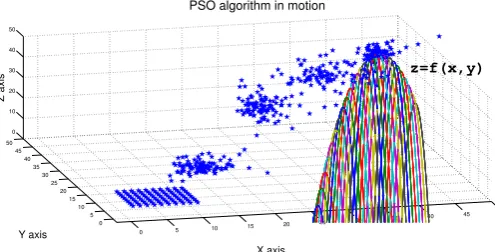
It is important that the search space shows convergent behavior, otherwise it is nearly impossible for the PSO to attain acceptable results. The PSO mechanism assumes that in most situations the peaks have smaller peaks around them. This concept is inspired by nature: If the highest mountain top is at a certain location, it is normally surrounded by lower mountain tops around that lo-cation. Thus, if one particle has found the current global best po-sition, all the other particles drift towards this best particle. The velocity and the accurate direction of a drifting particle changes from one frame to the other, it’s therefore not deterministic. Figure 1 illustrates a typical search scenario for the global best position in a three-dimensional space. The termz=f(x, y) de-notes a randomly generated function with peaks distributed ac-cording to random variablesxandy. In this context,(x, y)could pinpoint the position of the particle with respect to the object to be tracked, andf(x, y)denotes the grey value of the object at this position.The best position(x, y)corresponds to the highest point inf(x, y). All theNparticles assigned with a certain ob-ject to be tracked are communicating their current position and trying to find the global best position.
0 5 10 15 20 25 30 35 40 45 0
5 10 15 20 25 30 35 40 45 50
0 10 20 30 40 50
PSO algorithm in motion
X axis Y axis
Z axis
[image:2.595.317.565.99.225.2]z=f(x,y)
Fig. 1. Different time-snaps of one swarm of particles searching for the global best position in a three dimensional space.
3. PSO-BASED TRACKING FRAMEWORK
3.1 N Completely Independent Swarms
As previously mentioned, the basic idea in PSO is that one swarm is constantly searching for one certain kind of food. In this study, we have evolved the original idea by usingn inde-pendent swarms searching for the same or for a different kind of food, depending on the scenario at hand. If two swarms are far enough from each other, they would not meet, i.e. they will keep concentrating their search for their own kind of food. Even if one bird in the first swarm has found a much bigger amount of food corresponding to the second swarm, the birds in the second swarm would not notice that as long as they stay far away from the first swarm. This first idea is very important for our frame-work: When swarms are far enough from each other, they cannot distract each other. Take for example two swarm of birds living in two different places on earth: if one swarm lives in Califor-nia and the other lives in Munich and every bird knows only the positions and velocities of the members of his own swarm, they will never distract each other.
On the other hand, if swarms are very close to each other, they will mix together. Consequently, since every swarm is tracking one particular object, after the swarms mix together, the tracking behavior becomes totally unpredictable. To counter effect this tendency, we provide a solution completely inspired by nature. It takes into account the diversity between different species of birds living on earth. If the swarms don’t like the same food, i.e. their corresponding fitness functions are not matching, they naturally do not mix together. This means that the distribution of the particles corresponding to every swarm has its peaks and valleys naturally located at different places in the search space. Imagine a swarm of ravens and a swarm of starlings: They search for a different kind of food and will never mix together even if they come very close to each other.
Thus, when the swarms are far enough from each other, where ”far enough” depends on the size of the objects to be tracked, we will be successfully tracking multiple objects. If the two swarms are close to each other, the PSO has to adapt it’s fitness function to the situation at hand. This reasoning applies to a large number of swarms as well.
3.2 Implementation
3.2.1 Prerequisites. As a preprocessing step, we need to filter out the movements in the video frames, without affecting the overall real-time performance of the PSO algorithm. A sufficient operation for this task is to subtract the grayscale images at time instantstandt−1. Doing this, we obtain a search space with
and considering that no drastic camera movements is happening, one swarm finds absolutely no way to track the wrong object. To illustrate our idea using an example, consider having one red and one blue ball. In the initial round assuming that the balls are not moving, we make usage of an additional criteria like the hue value to initialize the tracking algorithm with the locations of the balls. The hue value is very sensitive to light changes, therefore it will only be used in the initial round or when the objects are very close to each other. Once both swarms have a starting position near the object they should track, the PSO algorithm uses only the grayscale values as long as a predefined minimum distance between the swarms is not undercut.
In the case where the two balls would have the same color, an edge detection operation along with a two-dimensional convo-lution to identify the number of connected components in the picture could be applied to initialize the PSO algorithm [2].
3.2.2 Self-Adapting Component. If objects are very close to each other, the grayscale values aren’t enough to separate the objects, i.e. the swarms. In this case, the ocean of zeros between the two objects disappears and the particles could start to track the wrong object. Thus we introduced an adapting mechanism to decide for the next round whether the grayscale values are enough or additional information is needed. This adapting com-ponent checks the position of the global best of every swarm in the last round. If two or more global bests from different swarms undercut the predefined minimum distance, the fitness function must change over time. This is only possible after a complete search procedure happens, i.e. it’s applicable to the next frame, otherwise the peaks would change their height in the search pro-cess and this is a very complex criteria for the PSO, comparable to drastic changes in the environment itself where the objects to be tracked are moving.
gbest 1
gbest 2
Swarm 1
Swarm 2
d
x
y
z
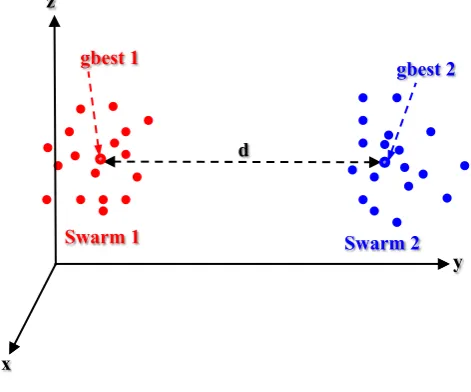
Fig. 2. Visualization example of a self-adapting scene.
[image:3.595.314.544.381.439.2]It is important to notice the difference between search rounds and PSO epochs. The PSO swarms explore the search space in up to 2000 epochs to find peaks. After this procedure is complete, the next round with framex+ 1,x+ 2andy+ 1,y+ 2can start. The algorithm requires the global best positions of all swarms from the last round and adaptively configures the fitness function for the next round, making it thus possible to react on different tracking situations.
Figure 2 shows how the self adapting process works: The parti-cles of each swarm are around their global best. Depending on the distance between the two global best positions, the fitness function will be adapted for the next round.
3.2.3 Self-Splitting Component. We have presented a solution for the case the objects are far away and close to each other, now we introduce a solution for the more complex case: when one of the objects hides partly or completely behind the others. Figure 3.2.3 illustrates a self-splitting situation in billiard scene where two billiard balls move apart from each other.
The self-splitting component checks the global best of every swarm after one round. In the case of a 2-dimensional search space, if the distance between two global bests is belowm pix-els, wheremdepends on the size of the objects, the two tracking windows will fuse into one window containing both objects. If the distance between the global best positions increases again, the search algorithm has to split the search window into two or more windows, depending on the number of moving objects in the video frames. The distance between two global bests is cal-culated using the following equations:
a=|gbestx−gbest2x| (3)
b=|gbesty−gbest2y| (4)
dgb1,gb2= p
a2+b2 (5)
wherea denotes the distance between the two global bests in thexdirection,bis the distance in theydirection,gbestx and
gbestyare the components from the global best from swarm 1,
gbest2xandgbest2yare thexandypositions from the global
[image:3.595.55.291.441.637.2]best from swarm 2 anddis the distance between the global bests calculated with the Pythagorean theorem.
Fig. 3. Self-splitting situation in a billiard scene.
4. 1-SWARM VERSUS N-SWARM PSO
4.1 PSO With Only One Swarm
The video frames used were captured with a MD-9035 digital camera having 25 fps and a resolution of 720x576 pixel (PAL). At first we tried to implement the standard PSO with only one swarm. We subtracted two frames to get a convergent behavior, i.e. the tracked object has a continuous flow of gray values. It was possible to find and track one object, but if the starting points of the particles were very far away from the object, the PSO algo-rithm never found the object. We have repeated the same proce-dure with two objects. Although one of the two objects had much higher peaks in the two-dimensional search space, the particles had absolutely no chance to find it if they started too far away. Hence, we have forced a swarm into a near local maximum when the global maximum is far away.
Current state of the art PSO techniques use patterns or masks [10] and only one swarm may be successfully assigned a specific object describable with a certain pattern. However, these techniques are not efficient for tracking two or more in-dependent objects, since the necessary pattern will continuously change after every time-step depending on the direction, veloc-ity, and location of the tracked object in the environment. Many trials to track two independent objects using one swarm have failed due to the fact that this kind of experiments conflicts with the theory of PSO, which aims at finding a unique solution or tracking a single object using many particles.
training experiments for every new tracking scenario. In addi-tion, multiple-model Kalman filters and particle filtering tech-niques used for multiple object tracking necessitate a training phase and become computationally loaded when the number of tracking objects increase, or when the movement models are not linear [11].
4.2 N-Swarm PSO With Self-Adapting Fitness
Function
In the initial round of the algorithm a median filter is used to reduce the noise of the first two video frames. All objects are extracted with standard image processing methods, a frame sub-straction along with a hue value is used in our case. After the initial round is executed every particle in the swarm is assigned a group of pixels corresponding to the object to be tracked. The size of this group of pixels depends on the size of the object, and on the distance between the tracked objects. The closer the ob-jects are to each other the smaller is the number of pixels in the group. Therefore the number of pixels assigned to a certain par-ticle changes from one round to the other. In our case, a total of 20 particles were sufficient for every swarm. The maximum number of training epochs per round was set to 2000. In every epoch every particle runs through (1) and (2) to get a new veloc-ity and a new position. A total of 500 rounds were enough for a successful training.
Other PSO parameters were initialized as follows. The value for the parameterc1, also called independent component, was set to 2 andc2, so called social component, was set to 2 as well. The weighting factorωwas initially set to a value of 0.9 and was decreased every round according to the following equation:
ω(i) = ((iw2−iw1)/(iwe−1))·(i−1) +iw1 (6) whereω(i)is the weighting factor at training roundi,iw2 and
iw1 are the starting and final values for the weighting factor, andiweis the number of rounds when the weight factor reaches
its final value. The particle velocity was limited to 20 pixels per round. More about the PSO parameters can be found in [3]. It is not necessary to analyze every video frame, for most prac-tical situations 12 fps should be enough. If the objects move around with extremely high velocity, the velocity of the parti-cles has to be adjusted or a higher frame rate becomes neces-sary. When one object is partly occluded by another object, this will not affect the particle’s tracking behavior since the shape of an object is not considered for tracking. The more complex case where one object is not visible anymore is dependent on the time the object is out of the picture: if the absence of the object is very short, the swarm finds the object again when it appears in the video sequence. This is a very complex issue with other tracking technologies like HMM or Kalman Filters.
In the case where both objects are far from each other, the fitness function takes the following form:
fx,y=f ramex,y (7)
wheref ramex,ydenotes the grayscale frame at coordinatesx
andyin the search space. When the objects start approaching each other, and the hue value of the pixels in the search space is consistent with the object to be tracked, the fitness function takes another form:
fx,y=α·f ramex,y (8)
whereαis a positive rational weighting factor greater than 1. In our case the value ofαincreases when hue value of the tracked object approaches the searched hue value. Thus if the point in the search space has the searched color or a color close to it, the fitness value will increase dramatically for this space. If two objects are very close to each other, the algorithm uses the color to separate the objects. A stand alone usage of the hue value is not recommended, as it is very sensitive to light changes. The
combination of the grayscale and hue values makes sure that the wanted object is distinguishable from other objects.
4.3 Comparison of Results
To examine our new algorithm, we have assigned every tracked object a tracking window. We then measured how accurate does
50 100 150 200 250 300 350 400 450 500 10
20 30 40 50 60 70 80 90 100
Distance Between Both Tracked Objects (in Pixel)
Tracking Accuracy (%)
[image:4.595.323.535.177.361.2]n−swarms PSO (constant illumination) HMM (constant illumination) n−swarms PSO (changing illumination) HMM (changing illumination)
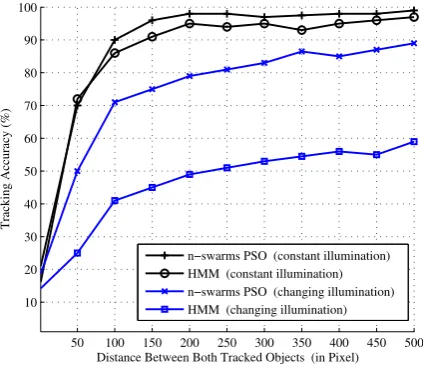
Fig. 4. Tracking accuracy of the n-swarm PSO algorithm as compared to HMMs under constant and changing light conditions.
the tracking window fit and follow the object. After every round of the algorithm, we compared the tracked object with the actual object. If the object is completely inside the window, an assess-ment value of 10 is achieved. When the assessassess-ment value is 8.6, only 86 percent of the object are found inside the boundaries of the tracking window. The lowest assessment value is 0 and corre-sponds to the case where the object is totally outside the tracking window. We tested our n-swarm PSO algorithm with two billiard balls randomly moving on a table.
In the first part of the experiment, the light conditions of the video recording did not change. The size of each ball in the video sequence was 40x40 pixels, thus if the distance between the 2 global best positions of the swarms is lower than 50 pixels, the tracking assessment is hard because one object hides behind the other. In such a case, we assessed only the visible part of the object. Hence, the tracking accuracy is lower when the distance between the two objects is less than 50 pixels. This is illustrated in the left part of the ”+”-marked line in figure 4.
1
2
3
4
5
6
[image:5.595.53.548.95.353.2]Fig. 5. Tracking of multiple subjects: The self-splitting PSO automatically generates new swarms to new or separating subjects in real-time.
Fig. 6. Tracking of multiple billiard balls: The self-splitting PSO instantaneously assigns new swarms to those scattering balls just after break-in.
algorithm for every scenario. Compared to the HMM results for tracking parts of people’s body in [5], our algorithm showed similar results for the head tracking experiment. Nevertheless, our algorithm was remarkably outperforming for the case where the light conditions and the velocity of the objects drastically changed.
Finally, we set our self-splitting n-swarm PSO to track several walking persons in a hallway, where occlusions and interactions occurs as illustrated in figure 5. It is seen that the tracker can robustly and accurately track the randomly moving subjects over all frames. One can observe how self-splitting is occuring when the two persons walking close to each other in frame 4 separate in frame 5. Furthermore, the tracker was applied to track the high-speed movement of different billiard balls on a pool table after break-in. The results are illustrated in figure 6. Even under high speed impact conditions, the n-swarm PSO algorithm was able to instentaneously create new swarms on-the-fly for each of those balls which separated from the assembly of the others balls immediatly after the break-in.
Table 1. Percentages of Correct Localization (%). Sequence Object 1 Object 2 HMM [5] Billiard (constant
illu-mination) 97.3 93.7 92.2
Marionette Balls
(changing illumination) 94.1 92.8 86.7 People walking
(chang-ing illumination) 95.6 98.2 87.3
5. CONCLUSION
[image:5.595.57.548.383.521.2]concur-rent object recognition and tracking, medical imaging, as well as machine learning.
Based on our approach to multiple object tracking, many venues for future work are to be considered. A valuable step in this direc-tion is to find a generalized form of an adaptive fitness funcdirec-tion suitable for every dimensions and every color of the objects to be tracked in real-time.
6. REFERENCES
[1] B. Babenko, M. Yang, and B. Belongie. Robust object track-ing with online multiple instance learntrack-ing. IEEE Trans-actions on Pattern Analysis and Machine Intelligence, 33(8):1619–1632, 2011.
[2] J. Canny. A computational approach for edge detection. IEEE Transactions on Pattern Analysis and Machine Intel-ligence, 8(6):679–698, 1986.
[3] A. Carlisle and G. Dozier. An off-the-shelf PSO. Proc. Workshop on Particle Swarm Optimization, Indianapolis, 2001.
[4] D. Comaniciu and P. Meer. Mean shift: a robust approach toward feature space analysis.IEEE Transactions on Pat-tern Analysis and Machine Intelligence, 24(5):603–619, 2002.
[5] D. Forsyth D. Ramanan and A. Zisserman. Tracking peo-ple by learning their appearance.IEEE Transactions on Pattern Analysis and Machine Intelligence, 29(1):65–81, 2007.
[6] X. Zhang et al. Multiple object tracking via species-based particle swarm optimization. IEEE Transactions on Cir-cuits and Systems for Video Technology, 20(11):1590– 1602, 2010.
[7] D. Goldberg. Genetic algorithms in search, optimiza-tion and machine learning. Reading, MA: Addison-Wesley, 1989.
[8] J. Kennedy and R. C. Eberhart. Particle swarm optimiza-tion. Proc. IEEE International Conference Neural Net-works, 4:1942–1948, 1995.
[9] J. Pugh and A. Martinoli. Inspiring and modeling mulit-robot search with particle swarm optimization. In Proc. IEEE Swarm Intelligence Symposium (SIS 2007), pages 332–339, 2007.
[10] M. Scheutz. Real-time hierarchical swarms for rapid adap-tive multi-level pattern detection and tracking. In Proc. IEEE Swarm Intelligence Symposium (SIS 2007), pages 234–241, 2007.
[11] G. Welch and G. Bishop. An introduction to Kalman filter. ACM SIGGRAPH 2001 Course #8., year =.
[12] Z. Zhang, H. Seah, and J. Sun. A hybrid particle swarm op-timization with cooperative method for multi-object track-ing.Proc. IEEE world Congress on Evolutionary Compu-tation (CEC), 4:1–6, June 2012.