103
ASSET MANAGEMENT SYSTEM FOR COMPUTER
LABORATORY
TANTY OKTAVIA1, RICHARD2, ALBERT WONGSO3
Bina Nusantara University, School of Information Systems, Jakarta – 11480, Indonesia
E-mail: [email protected]
;
[email protected]; [email protected]ABSTRACT
Asset has a very important role and significant value to support operational business. Although a number of organization prefer to use outsourcing and leasing services to manage the asset, but some organization prefer to buy their own and manage their assets. Currently maintaining asset is not an easy task, organization need to be considered about how to use the asset effectively. Information System can help the organization to manage assets, maintenance and repair of assets, calculate asset depreciation, and asset reallocation among divisions in organization. Information System as a media becomes very important to help the management of assets to be more coordinated. Laboratory ABC as part of the computer laboratory at university in Jakarta, is currently had many problems about asset management because there are a lot of devices to be maintained. The assets in computer laboratory are consists of hardware, software, and many other supporting devices. Based on these problems, the research is perform to analysis the process in asset management as well as to formulate and implement a framework of information system that suitable with the management of existing assets in laboratory ABC, so all data can be managed with the system. The method for this research is based on object-oriented analysis and design. The result of this research is an asset management system to support operational laboratory ABC process.
Keywords: Information System, Laboratory, Asset Management
1. INTRODUCTION
In general, most companies already have a system that is used as operational support, where the system consist of a set of components that interact, cooperate to form overall integration in order to achieve certain goals [1]. The system runs in an organization must be adapted to the procedures established by the company of any existing operations, so company need a coordinated information system that can help improve the efficiency and effectiveness of the running system, therefore the output can be produced in accordance with the organization’s target.
The role of information systems has become an important part of an organization to
support running business operations.
Implementation of information systems in an organization is not only carried out unilaterally, but will involve internal and external parties in the forming process. The definition of information systems according to Loudon and Loudon is components that are related and work together to collect, process, store and disseminate information
to support decision making and control of an organization [2]. Likewise, Bentley and Whitten which states that the information system is a unity of human, data, processes, and information technology that interact to collect, process, store, and provide information output that is necessary to support an organization [3]. Definition of information according to O'Brien, is the data that has been processed into meaningful and useful context to a particular end user. Surely the information generated within an organization will be supporting decision makers in analyzing direction and goals of the organization in the future [4].
104 within an organization [5]. Although not all of information system implementation should be computerized, in its execution most organizations today keep using it in order to stay ahead of the competitors. The basic components of information technology that supports the implementation of Computer Based Information System are:
Hardware
It consists of technical devices, such as processors, monitors, keyboards, and printers. Software is a program or set of programs that support the work of hardware in the data processing.
Database, is a file or table that contains the data and correlated each other. Each activity within the company will generate the data, which has specific value or meaning for the company [6], so it certainly needed a container that can integrate all the data. Network, is the connecting system that allows different computers share their resources. Procedure is the instruction that is used to combine the components above, which aim to process information and generate the desired output.
One of the units that hold a significant role in a university is the laboratory. Laboratory has a role in supporting learning activities that are practical. Practicum category often identified as learning activities undertaken by using device as supporting tool, so that the students can understand concretely how to practice the concepts acquired all this time by using tools as implementation guideline.
Laboratories that can be found in a university consists of various types, start from chemistry laboratory, physics laboratory, computer laboratory, information systems laboratory, etc. The entire laboratories are certainly adjusted to the majors, as well as the curriculum which is implemented in an organization or institution. Maintaining laboratory is not simple, because it is necessary to regulate and monitor the devices used in the lab activities that take place in a university, so as to satisfy the needs from teaching activities.
Devices used in a laboratory vary greatly from each other depending on the type of practicum that is carried out. The number of devices is not small because it must fulfill all activities that take place and the capacity of the number of students who take the course practicum, and adjusted to curriculum that is implemented in a university.
These devices need to be managed properly so that it can be used to support activities that are in the laboratory.
ABC Laboratory is one of the computer laboratory divisions that located in the leading universities in Jakarta. This laboratory is dedicated to support practicum from entire majors in the university. It has a huge capacity to accommodate all the students. Almost all majors that are in the university use this laboratory for the execution of practical activities. ABC Laboratory located in several campuses with capacity about 1836 seat, which is divided into 40 room. From the amount of space used, it can be estimated that the number of peripheral devices is certainly not a few because it must be able to meet the capacity of total students who take the practicum course. Based on these facts, it is necessary to take proper management for all assets, in this category is computer devices, so it can support all the operations that took place within the laboratory ABC.
In every beginning of each semester, the operational processes that occur within ABC laboratory began from scheduling activity and allocation of subjects that took place from each faculty and department that exist in the University. Then, all courses that are practical will be sent to the ABC laboratory in order to map laboratory with space capacity and devices in ABC laboratory. After the amount of usage is known, then the ABC laboratory will look at the software specification and hardware that will be used for supporting laboratory activities. If there is a difference of software or hardware, there will be request to the Division of Information Technology (IT). The entire device that will be used must be suitable with the requirement from practicum course, therefore upgrade or device replacement must be done frequently in order to fit the needs.
The entire operations for asset
management at ABC laboratory are complex because there are many devices that need to be monitored, such as monitors, CPUs, printers, notebooks, software, etc. It is not easy to organize the entire device is considering the amount and types are quite varied. Thus, ABC laboratory wants to build a system that can be used to support activities of assets management, so that the entire asset management operations and maintenance of
the laboratory, such as upgrades, devices
105 In assets control, maintenance cycle is necessary for maintenance of asset and the cost
calculations required for maintenance and
replacement of assets. There are several strategies that can be applied in deciding whether an asset is still feasible to be used or not, in which each of these strategies will determine how the costs and availability of assets. Asset maintenance can be either preventive or corrective action. Corrective action is to improve the wrong operational one, while preventive action is to keeping system from failure or prevent failures in the system. In general, maintenance activities can be performed on the broken asset, which affected by the schedule, the condition of the asset, or the risk of asset failure. [7]
2. RESEARCH METHOD
There are a lot of methods that can be used to build Asset Management Information System, but the important thing must be considered is the consistency the method with the operational process. The methods should be linear to align the functional system. Sometimes the methodology is referred to as structural approach and or otherwise, as object oriented. The pattern will have an impact when restructuring or remapping the process to identify considerable emphasis on initially putting the infrastructure and focus on delivering a solution that addresses a organization need. The structural approach runs sequentially for developing a few high level models. The object oriented approach begins with identify an object in business functional. The methodology comprises a set of stages, involving the analysis and design of the quality goal, the evaluation of the status, the analysis and improvement of this situation, and finally the re-evaluation of the target. The data from organization were analyzed following a content analysis structure. For this study, the structure can be defined for making inferences by systematically and objectively identifying shared common properties from class.
3. RESULT AND DISCUSSION
The research process begins with in-depth analysis of the processes running in the organization. After performing analysis, process continued by identifying problems that occur in the organization. Based on the results of the problem identification, the design of the centralized asset management web-based system will be proposed, which can facilitate users in managing data assets
that are in the ABC laboratory by object-oriented
approach. Object-oriented approach sees
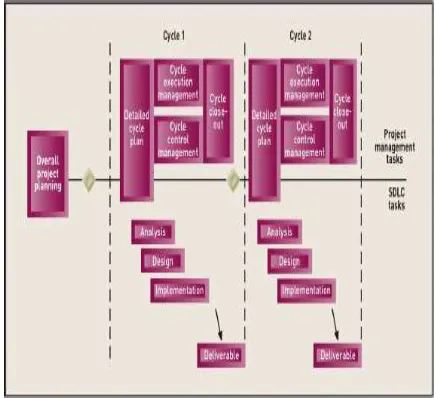
information system as a collection of objects that work together for completing the work (Satzinger et al, 2007). OOAD methods can be divided into two main phases, which are:
Object-oriented analysis
This phase is focused to object-oriented model formation of the problem domain. At this stage the identified object is represented as an entity object. Object-oriented system consists of a variety of objects that collaborate in doing the job.
Object-oriented design
[image:3.595.303.521.338.537.2]Design phase oriented to production of object-oriented model that is ready to be implemented and meets the system requirements. An analyst and developer should think to use the object terminology rather than as process or function.
Figure 1. Iterative Approach To The Analysis And Design System (Satzinger, 2007)
In the proposed business processes, first of all, operational staff will input all of the assets data owned by ABC laboratory. All data will be stored in accordance with the required attributes in the documentation, which consists of the asset name, description, specification, asset type, asset price, status, date in, vendors, and others. These data inputted by the operational staff and stored in a
database by asset processing applications.
106 the operational divisions. If the asset is not available, then operational staff will inform that the asset cannot be loaned because it's not available. In the process of asset returns, the user will come to the operational staff to return the borrowed assets, and staff will check the condition of the borrowed assets if the asset in good condition, then staff will update the data on assets status and assets will be stored in storage, but if the condition of assets are damaged, it will be sent directly for maintenance. In asset maintenance, the operational staff receiving requests for repair assets, then staff will check whether the assets are allowed for repair, if yes then operational staff will update the data on assets status and assets being repaired, otherwise assets is not repaired.
The following diagrams illustrate the operational processes to be performed on the proposed system:
Asset Management System Operational Manager
Save to database Input data
baru?
Yes
No
Input peminjaman?
Return asset?
Maintenance aset?
Reporting? Update data?
Delete data?
Display form
Input Data (asset/product/category/ Warehouse/staff/department)
Click Save Select tab
(asset/product/category/ warehouse/staff/department)
Click New Data
Click Save Select tab
(asset/product/category/ Warehouse/staff/department)
Display list data
Edit value data (aset/produk/kategori /gudang/staff/department)
Choose data Click edit data
Display form
Display list data
Confirm delete
Choose data Select Tab
(asset/product/category/ Warehouse/staff/department)
Delete data Display confirmation Click Delete Data
Yes
Yes No
Click Save Input Data Allocation
Select Tab Click New Data Display form
Select Allocation Tab
Display form Click Edit Data
Display list data
Click Save Edit value data
Choose Data
Display form
Input data maintenance
Click New Data
Click Save Select Maintenance Tab
Select Tab
(Asset/Allocation) Choose Export Export data ke excel No
No
No
No
No Yes
Yes
Yes
Yes
[image:4.595.308.506.190.374.2]Save to Database
Figure 2. Activity Diagram Of Asset Management System
Based on the formed activity diagram, there are classifications of the objects that have a role in the formation of the system, which is represented in the class diagrams. Here is a model of the proposed class diagram:
Figure 3. Class Diagram Of Asset Management System
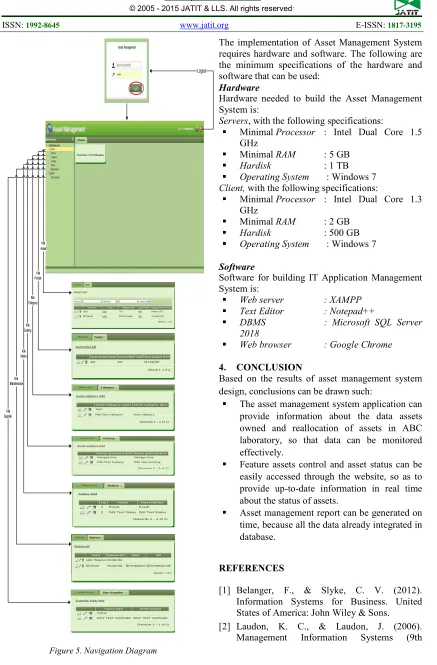
To help user to setup of assets management information systems, the following system design model:
[image:4.595.86.547.318.710.2][image:5.595.86.523.90.755.2]
107
Figure 5. Navigation Diagram
The implementation of Asset Management System requires hardware and software. The following are the minimum specifications of the hardware and software that can be used:
Hardware
Hardware needed to build the Asset Management System is:
Servers, with the following specifications:
Minimal Processor : Intel Dual Core 1.5
GHz
Minimal RAM : 5 GB
Hardisk : 1 TB
Operating System : Windows 7
Client, with the following specifications:
Minimal Processor : Intel Dual Core 1.3
GHz
Minimal RAM : 2 GB
Hardisk : 500 GB
Operating System : Windows 7
Software
Software for building IT Application Management System is:
Web server : XAMPP
Text Editor : Notepad++
DBMS : Microsoft SQL Server
2018
Web browser : Google Chrome
4. CONCLUSION
Based on the results of asset management system design, conclusions can be drawn such:
The asset management system application can provide information about the data assets owned and reallocation of assets in ABC laboratory, so that data can be monitored effectively.
Feature assets control and asset status can be easily accessed through the website, so as to provide up-to-date information in real time about the status of assets.
Asset management report can be generated on time, because all the data already integrated in database.
REFERENCES
[1] Belanger, F., & Slyke, C. V. (2012).
Information Systems for Business. United States of America: John Wiley & Sons.
[2] Laudon, K. C., & Laudon, J. (2006).
108 edition). United States of America: Pearson Prentice Hall.
[3] Bentley, L. D., & Whitten, J. L. (2007). System
Analysis & Design for the Global Enterprise 7 th Edition. New York: McGraw-Hill.
[4] O’Brien, G. H., & Hoopwood, W. S. (2009).
Introduction to Information System (15th edition). New York: McGraw-Hill.
[5] Rainer Jr., R. K., & Cegielski, C. G. (2013).
Introduction to Information Systems.
Singapore: John Wiley & Sons.
[6] Magal, S. R., & Word, J. (2009). Essentials of
Business Processes and Information Systems. United States of America: John Wiley & Sons. [7] Prescott, R. R., & Andrews, J. (n.d.). Review
of Infrastructure Asset Management Methods for