DATA PROCESSING METHODS IN MULTIMEDIA HOME
PLATFORM APPLICATIONS FOR EARTHQUAKE EARLY
WARNING OF POTENTIALLY TSUNAMI SERVICES BASED
INTERACTIVE DIGITAL TELEVISION
1SUHARTONO, 2ALI MAHMUDI
1Departemen of Information Technology, UIN Maulana Malik Ibrahim Malang, Indonesia
2Departemen of Information Technology, Institut Teknologi Nasional Malang, Indonesia
E-mail: [email protected], [email protected]
ABSTRACT
Earthquake early warning service for tsunami is important for the public. On one side the service cannot be easily accessed by the public especially television users. On another side the development of television technology, especially digital television, should be much easier to access. The purpose of this research is to make the method of processing data in Multimedia Home Platform (MHP) Applications for Earthquake Early Warning of Potentially Tsunami Services. Earthquake and weather data are taken from the web site Application Programming Interface (API) by The Meteorology, Climatology, and Geophysics (BMKG) in Indonesia. The research method is parsing techniques eXtensible Markup Language (XML) with the Document Object Model (DOM). The time interval for data collection from the Web site of BMKG uses the method of Systematic Sampling. Therefore, MHP applications can update Earthquakes and weather data in real-time in a specified interval. The results of XML parsing form of tsunami potential earthquake data are recorded by MHP applications into file storage. The findings show that MHP applications can display earthquake early warning of potentially Tsunami information to users of television accordance with BMKG website in real time.
Keywords: MHP application, eXtensible Markup Language, Document Object Model, Systematic Sampling
1. INTRODUCTION
The characteristic of interactive Digital TV (iDTV) is assuming a very important role in modern life. In fact, these features are being increasingly expanded, from simple signal decoders to sophisticated devices that allow the execution of interactive applications related to the content displayed, providing services of all kinds like internet access, Banking, Mail, TV-Commerce, Games and so on [1, 2].
Starting in the early of 2012, Indonesia through the Minister of Communications and Information Technology Regulation No. 05 in 2012, adopted digital television terrestrial broadcasting standard Digital Video Broadcasting - Terrestrial second generation (DVB-T2) develops a digital DVB-T standard previously.
Kandilli Observatory and Earthquake Research Institute (KOERI) of Bogaziçi University in
Istanbul was assigned to establish the Istanbul Earthquake Early Warning and Emergency Rapid Response System [3]. The construction of the system is realized by the GeoSIG and EWE consortium [3].
The Japanese national TV channel NHK began broadcasting earthquake and tsunami warning information through data casts, using DVB-S (Broad-casting Satellite) digital broadcasts, terrestrial digital broadcasts (ISDB-T), and terrestrial digital broadcasts for mobile receivers (1 seg) [4].
The research project of Pau etal. focuses on Cell Broadcast messaging services [6]. Hester et al. focused their research on the integration of information systems for post earthquake research response [7]; while Fortier etal. have developed an Early Warning System using IDEF0 and information modeling [8].
The purpose of this research is to facilitate the television users to get information on weather and tsunami potential earthquake. In general, television users get earthquakes and weather information through a news program. In light of this, television users get earthquakes and weather information at certain times only, not in real time.
2. METHODS
2.1 Experiment Data
The Research was conducted at the Computer Networks Laboratory, Department of Information Technology Maulana Malik Ibrahim UIN Malang, East Java, Indonesia and and the Non-Government Institution of the Meteorology, Climatology, and Geophysics (BMKG) in Indonesia ). The data of the study are taken from BMKG database in XML format in the URL address http://data.bmkg.go.id. XML format from BMKG web site contains weather data, earthquake data and data warning that can be accessed in real time.
[image:2.595.298.516.73.266.2]The data of weather, earthquake, and early warning for tsunami are obtained using the application of GetRSS that has the function to update weather data, earthquake data and early warning data from BMKG web site. The data are obtained through XML parsing from BMKG website. The data obtained from the results of xml parsing from BMKG website are available in Table 1.
Table 1:Wweather data, earthquake data and data warning from BMKG website
Id Name File Information
1. Weather Data
cuacaindo1.x ml
Date City Weather Minimum of weather Maximum of weather
2. Earthquake Data
autogempa.x ml
Date Hours Coordinate Latitude Longitude Magnitude
Depth Region1 Region2 Region3 Region4 Region5 Potential
3.
Early Warning Data
warning_pro pinsi_1.xml
Date Number of Data Region Contents of warning
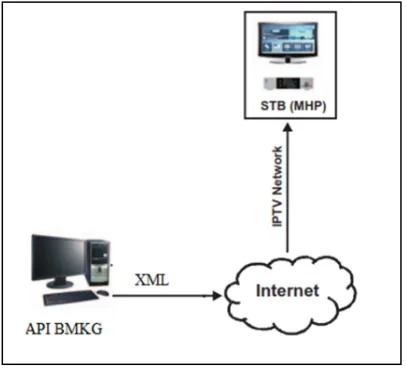
[image:2.595.304.507.330.516.2]The research design is available in Figure 1, a BMKG server is connected to the Internet via XML, and STB (MHP) on digital television is connected to the internet via IPTV Network.
Figure 1: Home Network based on MHP, API BMKG and XML.
The hardware used in this study includes a laptop with specs Processor Intel (R) Pentium (R) Dual CPU T2390 @ 1.86GHz (2 CPUs) and Memory 1014 MBRAM, Screen Monitor with a resolution of 1024 x 768.
The software used in this study includes Netbeans IDE 7.0, the programming language Java application, the Java Runtime Environment (JRE), the package environment for Java applications and XletTView, the environment for the application package MHP (Multimedia Home Platform) and OpenCable Application Platform (OCAP) for Xlets run.
2.2 DVB-J Application (Xlet)
the application programming interface (API). DVB-J application is designed in a special GUI for TV so that DVB-J application provides an opportunity for application developers [1].
DVB-J is used for interactive applications, especially applications using the return channel. API in DVB-J is truly defined from the first version to the new version. The MHP 1.1 has access to a smart card reader for e-commerce. Most MHP applications is being developed using the DVB-J, such as applications news, weather information, and others. DVB-J application is usually called Xlet, Xlet is a Java language program. Where the whole JVM running on Xlet.
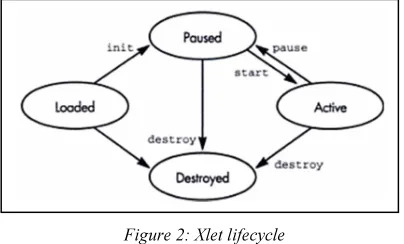
[image:3.595.87.289.532.654.2]There are some functions on the Xlet can be used to run the set-top box, one of the function on Xlet is used to close the set-top box service by running callSystem.exit that is available on Xlet interface. Xlet interface has several methods. InitXlet method has the function to initialize the Xlet using context parameters. XletContext method has the function to provide access to parameters, settings, and other data. StartXlet method has the function to give control to the application. PauseXlet method has the function to set the application in a wait state. It is useful when multiple applications are active and users switch between the Xlet. DestroyXlet method has the function to stop Xlet. DestroyXlet method can be used according to the desired conditions, in the condition that the application is forced to stop or not. The use of the method on Xlet interface can be explained by the model Xlet cycle, cycle Xlet has four states: loaded, paused, destroyed and actived, can be seen in Figure 2.
Figure 2: Xlet lifecycle
Application of MHP method in java is called DVB-J, in this case, the main elements on MHP method are removed since they are not necessary on context of television [10].
2.3 Extensible Markup Language (XML)
eXtensible Markup Language (XML) was developed in 1996 and recognized by W3C in
February 1998. XML technology is not a new technology, XML technology is a derivative of SGML, SGML was developed in the early 80s, SGML is commonly used for large project technical documentation.
When HTML was developed in 1990, XML developers adopt the most important part of SGML and refer to the development of HTML to generate markup language better than SGML [11]. Program code on XML has nested structure displayed in text. XML is a pattern that has the specific characteristics [12].
XML is consists of tag markup and contents, where tag markup and contents contribute to the value of information. XML helps a computer program to format the contents of the document for more comprehensive [13].
2.4 Document Object Model (DOM)
Document Object Model (DOM) is platform and language-neutral of application programming interfaces (API), DOM can access and manipulate information on XML and HTML. DOM is recommended by the World Wide Web Consortium (W3C), W3C is an organization that develops and promotes standards of the World Wide Web.
DOM is an object-oriented programming. DOM is modeled using objects, DOM describes document structure which has behavior; in this case, behavior has intents and purposes [14]. DOM has data structure called DOM Document Tree, DOM Document Tree is a tree-shaped structure. DOM Document Tree contains XML document. XML document has element type. Element type in XML document has attribute type. Attribute type in element type of XML document is comments shaped text using character type.
XML Parser is used to parse XML document, XML Parser is software libraries to provide services to read and retrieve data from an XML document. XML Parser determines specific Application Programming Interface (API) for interaction with the application. interaction is used to define the data from XML documents.
2.5 Systematic Sampling
of N elements, we divide the N elements in the population into n groups of k elements and then use the following rule:
We randomly select the first element out of the first k elements in the population, and then we select every k th unit afterward until we have a sample of
n elements.
For example, suppose k _ 20, and we need a sample of n _ 30 items. We randomly select the first item from the integers 1 to 20. If the random number selected is 11, then our systematic sample will contain the elements 11, 11 _ 20 _ 31, 31 _ 20 _51. . . and so on until we have 30 elements in our sample. A variant of this rule, which solves the problems that may be encountered when k is not an integer multiple of the sample size n (their product being N), is to let k be the nearest integer to N/n.
We now regard the N elements as being arranged in a circle (with the last element preceding the first element). We randomly select the first element from all N population members and then select every k th item until we have n items in our sample.
3. RESULTS AND DISCUSSION
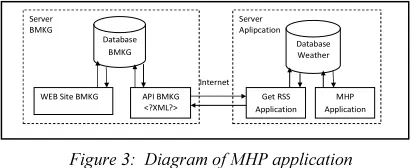
[image:4.595.84.290.537.621.2]This research uses a data processing method in MHP application for Potentially Tsunami Services Based on Interactive Digital Television. Data processing method in the application MHP is the method of data collection from BMKG website. BMKG website has an API in the form of an XML file, BMKG API web is http://data.bmkg.go.id. The XML file contains earthquake data, weather data and warning data. The diagram of MHP application is available in Figure 3.
Figure 3: Diagram of MHP application
The stages of development of MHP applications in this study were divided into three parts. The first part is the implementation of systematic sampling method, it is used to determine the time interval of data collection form BMKG website.
The second part is to build an application GetRSS, GetRSS application is used to retrieve data from BMKG website via an internet connection and store the data in a file format ".properties". The third part is to build MHP applications; MHP
application can display early warning data, weather data and earthquake data from file storage to television users.
3.1 Implementation of Systematic Sampling Method
MHP application displays early warning data, weather data and earthquake data to television users in real-time. The real time system is the system to generate the right response in the specified time. The method to determine the time interval in data collection uses systematic sampling method.
Implementation of systematic sampling method on MHP applications is divided into two stages. The first stage is to determine length of interval (k). To get a real-time system on MHP applications, k value is given specific value, k value depends on how important data are displayed to the user application. Determination of the interval length (k) in this research is divided in two phase, the first phase, length interval (k) for weather data is 6 hours,
Weather information is displayed to television user every 6 hours. The second phase, length interval (k) of earthquake data are given value of 5 minutes, earthquake information is displayed to television user every 5 minute. Tsunami potential earthquake happened a few hours after the earthquake. Earthquake data and information data of Tsunami potential earthquake are taken from BMKG website.
[image:4.595.305.508.628.667.2]K value for data retrieval Tsunami potential earthquakes is different from k value for data retrieval weather and earthquake information because Tsunami potential earthquakes data are uncertain and should be displayed in real time to compare weather and earthquake information. If there is Tsunami potential earthquake, then television user can immediately know Tsunami potential earthquakes information from MHP applications. The third phase is to determine initial of sample data (X0). Initial of sample data (X0) is start time of MHP application is running.
Figure 4: Period of data collection on Systematic Sampling Method
Figure 4. Shows the period of data collection on Systematic Sampling Method, sampling interval (k) is 5 (minutes). every interval 5 (in minutes) data changes automatically at MHP applications.
Internet Server Aplipcation Server
BMKG
WEB Site BMKG API BMKG <?XML?> Database
BMKG
Get RSS Application
Database Weather
3.2 GetRSS applications
[image:5.595.255.511.66.675.2]The GetRSS application is application based on java desktop, the GetRSSapplications function to collect data from http://data.bmkg.co.id (BMKG website). The data collection include earthquake data, weather data and warning data. The data collection is stored by MHP application. Data collection uses file warning_propinsi_0.xml and data are stored with file name datawarning.properties, program code using java language is available in Figure 5
Figure 5. Program code of proses of data store using java language
As is explained in Figure 5, method of collection data uses XML parsing methods. XML document
contained in
http://data.bmkg.go.id/warning_propinsi_0.xml
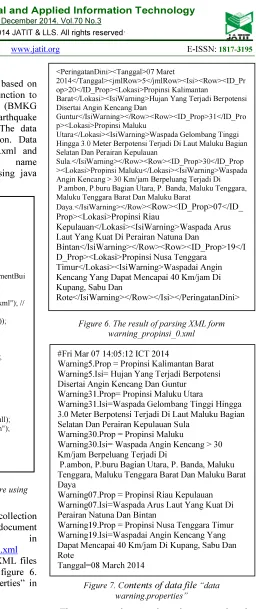
(BMKG website). The result of parsing XML files warning_propinsi_0.xml is available in figure 6. Contents of data file “data warning.properties” in figure 7.
[image:5.595.89.291.229.538.2]Figure 6. The result of parsing XML form warning_propinsi_0.xml
Figure 7. Contents of data file “data warning.properties”
The source code to retrieve data on earthquake and weather is almost the same as the source code to retrieve tsunami potential earthquake, the difference lies on the instruction for image download of location map where earthquake happens. How to run GetRSS application, double-public class AmbilDataWarning {
boolean logika = true; Properties properties;
public void writeNewsGempa() { try {
loaddata();
DocumentBuilder builder =
DocumentBuilderFactory.newInstance().newDocumentBui lder();
URL u = new
URL("http://data.bmkg.go.id/warning_propinsi_1.xml"); // your feed url
Document doc = builder.parse(u.openStream()); NodeList nodes =
doc.getElementsByTagName("Isi");
for (int i = 0; i < nodes.getLength(); i++) { Element element = (Element) nodes.item(i); properties.setProperty("Warning" + i + ".Lokasi",getElementValue(element,"Lokasi")); properties.setProperty("Warning" + i + ".Isi",getElementValue(element,"IsiWarning")); }//for
properties.store(new
FileOutputStream("D:/datawarning.properties"), null); System.out.println("Data Gempa Tersimpan"); }//try
catch (Exception ex) { ex.printStackTrace(); } }
<PeringatanDini><Tanggal>07 Maret
2014</Tanggal><jmlRow>5</jmlRow><Isi><Row><ID_Pr op>20</ID_Prop><Lokasi>Propinsi Kalimantan
Barat</Lokasi><IsiWarning>Hujan Yang Terjadi Berpotensi Disertai Angin Kencang Dan
Guntur</IsiWarning></Row><Row><ID_Prop>31</ID_Pro p><Lokasi>Propinsi Maluku
Utara</Lokasi><IsiWarning>Waspada Gelombang Tinggi Hingga 3.0 Meter Berpotensi Terjadi Di Laut Maluku Bagian Selatan Dan Perairan Kepulauan
Sula.</IsiWarning></Row><Row><ID_Prop>30</ID_Prop ><Lokasi>Propinsi Maluku</Lokasi><IsiWarning>Waspada Angin Kencang > 30 Km/jam Berpeluang Terjadi Di P.ambon, P.buru Bagian Utara, P. Banda, Maluku Tenggara, Maluku Tenggara Barat Dan Maluku Barat
Daya.</IsiWarning></Row><Row><ID_Prop>07</ID_ Prop><Lokasi>Propinsi Riau
Kepulauan</Lokasi><IsiWarning>Waspada Arus Laut Yang Kuat Di Perairan Natuna Dan
Bintan</IsiWarning></Row><Row><ID_Prop>19</I D_Prop><Lokasi>Propinsi Nusa Tenggara
Timur</Lokasi><IsiWarning>Waspadai Angin Kencang Yang Dapat Mencapai 40 Km/jam Di Kupang, Sabu Dan
Rote</IsiWarning></Row></Isi></PeringatanDini>
#Fri Mar 07 14:05:12 ICT 2014
Warning5.Prop = Propinsi Kalimantan Barat Warning5.Isi= Hujan Yang Terjadi Berpotensi Disertai Angin Kencang Dan Guntur
Warning31.Prop= Propinsi Maluku Utara
Warning31.Isi=Waspada Gelombang Tinggi Hingga 3.0 Meter Berpotensi Terjadi Di Laut Maluku Bagian Selatan Dan Perairan Kepulauan Sula
Warning30.Prop = Propinsi Maluku
Warning30.Isi= Waspada Angin Kencang > 30 Km/jam Berpeluang Terjadi Di
P.ambon, P.buru Bagian Utara, P. Banda, Maluku Tenggara, Maluku Tenggara Barat Dan Maluku Barat Daya
Warning07.Prop = Propinsi Riau Kepulauan Warning07.Isi=Waspada Arus Laut Yang Kuat Di Perairan Natuna Dan Bintan
Warning19.Prop = Propinsi Nusa Tenggara Timur Warning19.Isi=Waspadai Angin Kencang Yang Dapat Mencapai 40 Km/jam Di Kupang, Sabu Dan Rote
click file "GetRSS.jar" or through console: c: \> java-jar GetRSS.jar [enter]
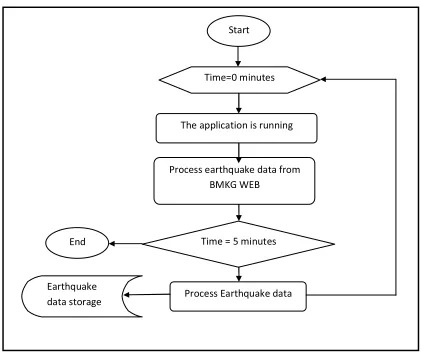
[image:6.595.82.293.227.408.2]Flow chart for data collection in GetRSS application is available in Figure 8. Data collection begins when GetRSS is active and MHP application is active. MHP application will process data collection from BMKG website; data collection is stored in file with extension .properties.
Figure 8: Flow chart for data collection in GetRSS application
3.3 MHP application analysis
To develop of MHP application requires MHP application analysis, MHP application analysis describes activities in system so system can run in line with expectations. MHP application analysis is designed using Unified Modeling Language (UML). The stages of MHP application analysis include use case diagram, activity diagram, sequence diagram and class diagram.
Use case diagram in MHP application consists four cases such as case of weather information, case of earthquake information, case of warning information, case of application information.
Activity diagrams describe activities flow in system, how each activity flow starts and ends. Activity diagram in MHP application consist three activities, Diagram Activity of Information of Weather, Diagram Activity of Information of Earthquake and Diagram Activity of Information of Early Warning.
Diagram Activity of Information of Weather starts when MHP application is active, MHP application will display main page menu. User of MHP application selects menu “weather”. Then, MHP application will display weather information
from file "datacuaca.properties" on application page.
Diagram Activity of Information of Earthquake starts when MHP application is active, Diagram Activity of information of earthquake starts when MHP application is active, MHP application will display main page menu. User of MHP application selects menu “information of earthquake”. MHP application will display earthquake information from file “datagempa.properties" on application page.
Diagram Activity of Information of Early Warning starts when MHP application is active, MHP application will display main page menu. User of MHP application selects menu “information of early warning”. MHP application will display earthquake information from file "datawarning.properties" on application page.
Sequence diagrams describe interaction between objects and environment (user, display and etc ) in the form of message with respect to time. Sequence Diagram in MHP application consist four Sequences, Sequence Diagram of Information of Weather, Sequence Diagram of Information of Earthquake, Sequence Diagram of Information of Early Warning and Sequence Diagram of Information of MHP Application.
Sequence Diagram of Information of Weather consists three objects, Weatherlet object as page of controller application, AboutPage object as page of information application and earthquakePage Objects as page of about weather information.
Sequence Diagram of Information of Earthquake consists three objects, Weatherlet object as page of controller application, AboutPage object as page of information application and earthquakePage Objects as page of about earthquake information.
Sequence Diagram of Information of Early Warningconsists three objects, Weatherlet object as page of controller application, AboutPage object as page of information application and WarningPage Objects as page of about warning information.
Sequence Diagram of Information of MHP Application consist three objects, Weatherlet object as page of controller application, AboutPage object as page of information application and UserPage Objects as page of about user.
Class Diagram of MHP application consists six classes, class WelcomePage as page of application main, Weatherlet class functions as page of controller application, class WeatherPage as page of
Time=0 minutes Start
Time = 5 minutes Process earthquake data from
BMKG WEB
Earthquake data storage
The application is running
information weather, class QuakePage as page of information earthquake, class WarningPage as page of information warning and class AboutPage as page of information application.
3.4 To develop MHP application with XletTView Emulator
MHP applications in this research use XletTView Emulator, after XletTView Emulator is installed in system, in directory "config" contained XML file (“applications.xml”). This file describes Xlets information. Xlet can be edited with GUI interface. The steps are select menu "Applications"> "Manage Applications ...” After MHP application displays page of "Manage applications", select folder "default group", then press "new application" for add new applications to be run.
There are some steps should be done, as follows : - The name is filled application name
- The path is filled directory of xlet file, an example is
D:\ Program\DesainXlet\build\classes\
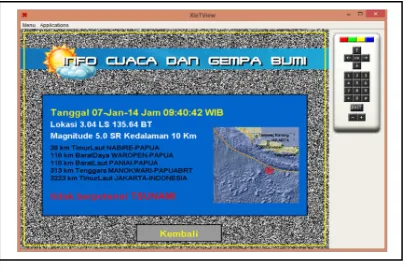
[image:7.595.86.289.524.659.2]- Xlet is filled name of Xlet name to be run. If column fields have been filled, MHP application can be run through menu "Applications" and select the application. MHP application can display Earthquake Early Warning of latest Potentially Tsunami in Indonesia. MPH application will display the date and time of occurrence. Coordinates of latitude and longitude of earthquake, area of earthquake, depth of earthquakes, scale of earthquakes, location image of earthquake and information about potential tsunami, as shown in Figure 9.
Figure 9: Page View of MHP applications
4. CONCLUSION
Methods of data processing in Multimedia Home Platform Applications for Earthquake Early Warning of Potentially Tsunami Based Interactive Digital Television has been created and tested. The
MHP application has advantages in effectiveness, since MHP application is based on digital television, then information of Earthquake Early Warning of Potentially Tsunami Services can be accessed by television users.
Based on test results, it can be concluded that method of data processing can display information of earthquake early warning of potentially tsunami in real time according to BMKG website. Earthquake information from data on MHP applications updates every 5 minutes.
MHP application can display current weather information and tomorrow according to BMKG website. Current weather information and tomorrow updates every six hours. Capabilities of MHP application displays information of earthquake early warning of potentially tsunami in real time runs well. Notification feature of earthquake early warning of potentially tsunami runs in real time.
REFERENCES:
[1] S. Morris and A. Smith-Chaigneau, Interactive TV Standards. A Guide to MHP, OCAP and
JavaTV. Focal Press, 2004.
[2] J. Piesing, “The dvb multimedia home platform (mhp) and related specifications,” in
Proceedings of The IEEE, jan 2006, pp. 237–
247.
[3] H. Alcik, O. Ozel, Y.-M. Wu, N. M. Ozel and M. Erdik, “An Alternative Approach for the Istanbul Earthquake Early Warning System,”
Soil Dynamics and Earthquake Engineering,
Vol. 31, No. 2, 2010, pp. 181-187. doi:10.1016/j.soildyn.2010.03.007
[4] Y. Nomoto, “Earthquake and Ttsunami Information Services via Data Broadcasting,” 2007 Annual Meeting, Tehran,30 October-1 November 2007.
[5] G. Rascioni, E. Gambi, S. Spinsante and D. Falcone, “DTT Technology for Rural Communities Alerting,” Proceedings of the 5th
International ISCRAM Conference, Washington
DC, May 2008.
[6] L. F. Pau and P. Simonsen, “Emergency Messaging to General Public via Public Wireless Networks,” Proceedings of the 5th
International ISCRAM Conference, Washington
DC, May 2008.
Proceedings of the 5th International ISCRAM
Conference, Washington DC, May 2008.
[8] S. C. Fortier and I. M. Dokas, “Setting the Specification Framework of an Early Warning System Using IDEF0 and Information Modeling,” Proceedings of the 5th International
ISCRAM Conference, Washington DC, May
2008.
[9] C. K¨oberl, “Xlet Resource Estimation,” Salzburg University, 2004
[10] K. K. Juz’an, “Desain Aplikasi Kuis Matematika Menggunakan MHP (Multimedia Home Platform) Untuk IDTV (Interactive Digital Television),” 2011
[11] R. Kurniawan, “Membangun Aplikasi Info Gempa dan Cuaca Berbasis Android,” Universitas Komputer Indonesia, 2012
[12] E. T. Ray, Learning XML. Massachusetts: O’Reilly Media, 2001.
[13] I. Luthfi, “XML, Implementasi Struktur Data Pohon dalam Bentuk Berkas untuk Web.” Bandung, 2008
[14] Marini, J, The Document Object Model:
Processing Structured Documents. New York: