ACTIVE VORTEX INDUCED VIBRATION CONTROLLER
AND NEURO IDENTIFICATION FOR MARINE RISERS
1MOHAMMED JAWAD MOHAMMED, 2INTAN Z. MAT DARUS
1
Faculty of Mechanical Engineering, UTM, Skudai, Johor, Malaysia-81310
1
Faculty of Electromechanical Engineering, University of Technology, Baghdad, Iraq
2
Faculty of Mechanical Engineering, UTM, Skudai, Johor, Malaysia-81310
E-mail: [email protected], 2
[email protected]
ABSTRACT
In this work, a vortex induced vibration controller within discrete time has been investigated on marine cylinder pipe risers which represented by using nonlinear neuron identification models namely NARX and NAR. Input-output data have been extracted from the experimental rig of vortex induced vibration marine riser. A proposed work in this paper is to create the nonlinear system identification model undergoing for vortex induced vibration of marine riser depends on Neural Network which didn’t represented before this time in this application and using PID controller to suppress the vibration. Two nonlinear system identification methods used to represent the models which are: Neural Network based on Nonlinear Auto-Regressive External (Exogenous) Input (NARX) and Neural Network based on Nonlinear Auto-Auto-Regressive (NAR). Also, the best model has been chosen based on the lowest value of Mean Square Error (MSE) between actual and predicted response. While, PID controller has been used to suppress the oscillation of pipe cylinder for all models and the comparison of the controller’s performance on each model by tuning the controller parameter (KP, KI and KD) using heuristic method. Finally, the outcomes show that the
NARX model performed better than the NAR model to predict the dynamic response of the system. On the other hand, PID controller has been managed to reduce the pipe cylinder fluctuation for all models specially the NARX model. Using particle swarm optimization (PSO) to improve the stability for marine riser on the parameters of PID controller are planned for future work.
Keywords: Neuro Identification, NARX Model, NAR Model, PID Controller, Vortex Induced Vibration
1. INTRODUCTION
Many researchers consider the phenomenon of Vortex Induced Vibration (VIV) is one of the main problems in the offshore engineering fields because of the elastically dynamic which is mounted on the rigid cylinder to extract the oil from the depths of the sea [1-2]. VIV happens because of the interaction between the body and the vortices shedding behind the structure. Whereas, the vortices behind of the structure create the forces which Working on fluctuation the cylinder from side to side in one or two directions [3].
The motion of the cylinder from the previous studies can divide into movements: firstly, when the cylinder motion in perpendicular (transverse) to the air or water crossflow generating force called lift force. Secondly, when the cylinder motion in same direction of stream flow (inline) generating force called drag force [4-5]. However,
there are two ways in this field can suppress the oscillation of a pipe cylinder under VIV which is: passive and active vibration control. The first method depends on adding stiffness or mass or changing the sectional area of the structure of the system to raise the natural frequency of the body without the need for external power signal. [6-7]. While, the other method its very used from the first attempt by Baz and Ro (1991) up to now because of this method is cheaper and produce a higher performance more than the passive method and its depend on using sensors and actuators as an external power signal to the system [8].
The initial goal in this work to create the model depends on nonlinear system identification methods then using discrete time PID controller.
In this work, the reduction process the effect of VIV on marine risers has been divided into four main sections: firstly, extracting the input-output data of the experimental setup from prior paper. Secondly, using NARX and NAR as a system identification method to predict the dynamic response of the system and validating the results during from MSE technique. Thirdly, study the effectiveness of PID controller discrete time on NARX and NAR models. Recently, discuss the outcomes that obtained from this work.
2. EXPERIMENTAL DATA
[image:2.595.303.513.75.255.2]
In this study, the input-output data extracted from previous paper by Shaharuddin and Mat Darus [11-12]. The researchers used the rigid cylinder with flexibly supporting in the crossflow vibration only. Table 1 showing the specification and the parameter values which estimated from experimental test.
Table 1. Obtained Parameters [11-12]
Parameter Symbol Value Unit
Cylinder Diameter
D 50 mm
Cylinder Length
L 1110 mm
Aspect Ratio L/D 22.2 Dimensionless
Cylinder mass
m 2.95 kg
Mass ratio m* 1.18 Dimensionless
Natural Frequency in
water
ƒw 1.11 Hz
Damping ratio in water
ζ 0.1007 Dimensionless
System Stiffness
k 265.34 N/m
Input (from accelerometer A) and output (from accelerometer B) data gotten from Shaharuddin and Mat Darus as shown in Figure 1 which included 33000 data for input and output data[11-12].
Figure 1. Accelerometer Positions For Detecting And Observing Data Of Experimental Setup Diagram [11-12]
[image:2.595.311.497.358.510.2]Accelerometer A represents the detected input data for system identification. While, accelerometer B is represents the observed output for system identification. In Figure 2 and 3 shown the relationship between the input and output amplitudes with the time
Figure 2. Detected Amplitude With Simple Time Series For Pipe Cylinder
Figure 3. Observed Amplitude With Simple Time Series For Pipe Cylinder
[image:2.595.313.508.546.684.2]In this work, the system identification methods Neural Network time series: Neural Network based on Nonlinear Auto-Regressive External (Exogenous) Input (NARX) and Neural Network based on Nonlinear Auto-Regressive (NAR) used to predict the dynamic response characteristics undergoing vortex induced vibration on the pipe cylinder.
2.1 Nonlinear Auto-Regressive Model (NAR)
NAR is one of the methods used to predict the output data for the nonlinear model by using the input or the output data only. The equation of NAR model is [13]:
yt f yt 1, … . , yt n 1
The n represents the previous value of the output. f is represents the nonlinear function which can be carried out by using intelligent methods such as neural network.
2.2 Nonlinear Auto-Regressive External Input Model (NRAX)
NARX model is employed for different purposes such as control and system identification. Also, it is able to forecast the output data in real time. The NARX algorithm can be defined as follows [14]:
yt షభ
షభ ut
షభ
షభ (2)
where
Az 1 a z ⋯ az (3)
Bz b b z ⋯ bz (4)
After neglecting the noise error and defining the Bz and Az :
yt f yt 1, … . , yt n, . . , ut
n, . . , ut n n 1 (5)
, are represent the previous value of input and output respectively. While, the represents the input delay. Finally, represents the nonlinear function which can be carried out by using intelligent methods such as neural network.
2.3 Neural Network Time Series
Neural Network is one of artificial methods which can be used for the nonlinear dynamic system identification. It is consists of a number of neurons arranged in numerous layers. According to Figure 4, Neural Network models include at least three layers which are input, hidden and output layers. The equations can be calculated as follows:
2.3.1 For hidden layer
v x w x w y w y w b (6)
v x w x w y w y w b (7)
Then
f ష౬భ (8)
షೡమ (9)
where
x , x are the actual input data of input network.
y , y are the actual output of input network.
w , w , w , w , w , w , w , wthe
weights between input and hidden layers.
b , b the bias weights for hidden layer
v , v the summation values for hidden layer
f , f the final values for hidden layer.
2.3.2 For output layer
v f w f w b (10)
f ష౬య (11)
where
w , w is the weights between the hidden and
output layers.
b is the bias weights for the output layer.
v is the summation values for the output layer.
Figure 4. Neural Network Architecture
2.4 Validation Technique
The verification process of the result is considered one of the important ways to measure the performance of the mathematical algorithms which used in this paper. Also, check the algorithm effectiveness to ensure that which one is best from the other. In this paper, Mean Square Error method (MSE) used to verify the results obtained in this work. The equation of Mean Square Error is [15]:
εt N yt 1
y t 12
where
yt is represents the actual output from experimental setup..
y t is represents the predicted output which obtained from system identification methods. The data which used in this paper are divided into two partitions. The first partition is used for testing and the other partition for validating.
4. SYSEM IDENTIFICATION SIMULATION
DESIGN
[image:4.595.312.499.341.631.2]
Depends on the Neural Network times series in MATLAB toolbox, number of neurons and number of delay considered the important variables to generate the nonlinear model for NARX and NAR models after specifying number of training, validating and testing data as shown in figure 5. The simulation procedure has been divided into three parts: firstly, 70% of data used for training, 15% of fata used for validating and 15% of data used for testing. Secondly, specify the number of neurons and delay with variant cases and finally create the model depends on the MSE values and find the best model as shown in figure 6.
Figure 5: Specify The Percentage Values For Training, Validating And Testing Data
(a)
(b)
Figure 6: Specify The Number of Neurons And Delay (a) and Block Scheme For System Identification Models
5. PID CONTROLLER
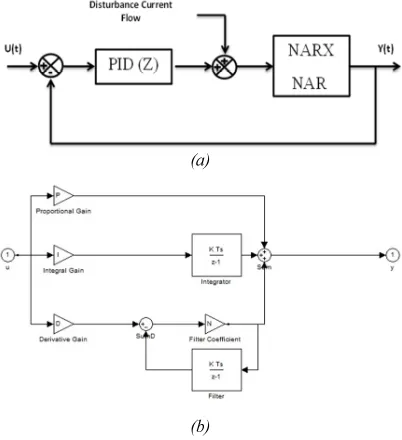
value of the error between the output measured and the desired set point under disturbance load as shown in Figure 7. The process required using a heuristic method to find and tunes the PID parameters (KI, KP and KD). Also, this method
depended on mean square error (MSE) technique to validate the gain values of the PID parameters under disturbed load which it's included three steps [16]: firstly, calculating the last proportional gain value (KP) by assuming different values until
reaching this gain to the lower MSE of the system when being the integral and derivative gain values equal to zero. Secondly, accounting for the last integral gain value (KI) by assuming different
values until reaching this gain to the lower MSE of the system when being the proportional gain equal to the last value for the first step and the derivative value equal to zero. Finally, calculating the last derivative gain value (KD) by assuming the
different values for this gain until reaching it to the lower MSE of the system when being the proportional and the derivative gain values equal to the last value of the first and second steps respectively. Figure 8 shown the block diagram for marine risers system which it's undergoes in the vortex induced vibration as a distributed load with PID controller discrete time.
(a)
(b)
[image:5.595.297.511.81.405.2]Figure 7: The Block Scheme For Controller And System Identification
Figure 5. The Block Scheme for Controller And System Identification
(a)
(b)
Figure 8: The Block Scheme for Controller With (A) System Identification (NARX) And (B) System
Identification (NAR)
6. RESULTS AND DISCUSSIONS
6.1 System Identification For NARX Model
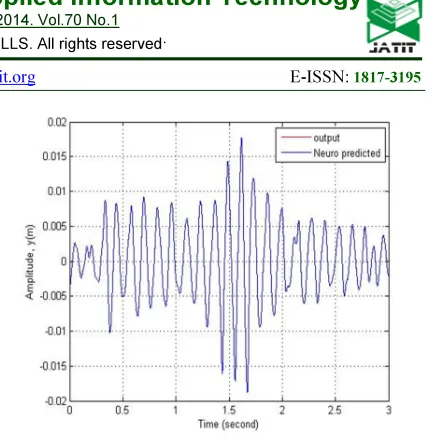
[image:5.595.304.507.225.388.2] [image:5.595.89.290.443.663.2]NE equal 8 and number of delay 2 for amplitude and error.
Table 2 Mean Square Error for NARX Model at Number of Delay 2
NE MSE for
training MSE validate d MSE tested MSE Overall
1 7.06994 ×10⁻⁷
7.03911 ×10⁻⁷
7.30382
×10-7 7.1048×10 -7
2 1.51825 ×10⁻⁷
1.46421 ×10⁻⁷
1.63488
×10-7 1.5353×10 -7
3 2.51148 ×10⁻⁹
2.53456 ×10⁻⁹
2.49492
×10-9 3.2278×10 -9
4 2.25323 ×10⁻⁸
2.10880 ×10⁻⁸
2.24574
×10-8 2.2795×10 -8
5 1.90786 ×10⁻⁹
1.88947 ×10⁻⁹
1.91908
×10-9 2.2781×10 -9
6 2.33170 ×10⁻⁸
2.42179 ×10⁻⁸
2.39115
×10-8 2.4056×10 -8
7 8.42986 ×10⁻⁸
8.52992 ×10⁻⁸
8.58115
×10-8 8.5672×10 -8
8 4.7337× 10⁻¹⁰
4.7219× 10⁻¹⁰
4.7699×
10-10 1.2714×10 -9
9 3.27642 ×10⁻⁹
3.31040 ×10⁻⁹
3.41665
×10-9 4.0278×10⁻⁹
10 6.28938 ×10⁻⁹
6.58235 ×10⁻⁹
6.65887
×10-9 6.7772×10 -9
11 1.60514 ×10⁻⁸
1.62700 ×10⁻⁸
1.75777
[image:6.595.87.292.179.446.2]×10-8 1.6682×10 -8
Table 3 Mean Square Error for NARX Model at Number of Hidden Neuron 8
No. of Delay MSE for training MSE validate d MSE tested MSE Overall
1 1.2692×
10-8 1.2709× 10⁻⁸ 1.3011× 10⁻⁸ 1.3078×10 -8
2 4.7337×
10-10 4.7219× 10⁻¹⁰ 4.7700× 10⁻¹⁰ 1.2714×10 -9
3 2.3379×
10-10 2.2933× 10⁻¹⁰ 2.3540× 10⁻¹⁰ 1.3273×10 -9
4 6.0016×
10-9 6.0448× 10⁻⁷ 5.9680× 10⁻⁷ 6.4521×10 -9
5 1.8549×
10-8 1.8502× 10⁻⁸ 1.8931× 10⁻⁸ 1.9537×10 -8
6 3.0966×
10-8 3.1253× 10⁻⁸ 1.0954× 10⁻⁸ 3.2182×10 -8
7 3.3785×
10-8 3.6127× 10⁻⁸ 3.4293× 10⁻⁸ 3.4956×10 -8
8 1.3636×
10-9 1.3966× 10⁻⁹ 1.3686× 10⁻⁹ 2.8229×10 -9
9 2.0855×
10-9 2.0098× 10⁻⁹ 1.9893× 10⁻⁹ 3.7473×10 -9
10 2.7858×
10-9 2.7113× 10⁻⁹ 2.8606× 10⁻⁹ 2.8790×10 -8
11 7.7023×
10-9 7.7061× 10⁻⁹ 8.0669× 10⁻⁹ 8.9183×10 -9
[image:6.595.311.507.331.463.2]Figure 9: The Amplitude Of Actual And Predicted Output Depends On NARX
Figure 10: The Error Of The Predicted Output Depends On NARX
6.2 System Identification For NAR model
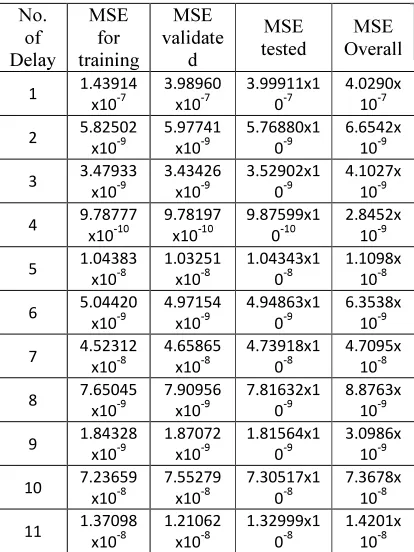
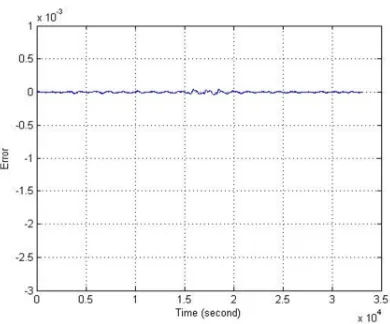
Neural Network based on Nonlinear Auto-Regressive model (NAR) has been utilized to get the dynamic response of the system. In this method, the equal numbers of data used for input, output, training, validating and testing for NARX method. Also, the same procedure of NARX model for numbers of neuron and number of delay used in NAR model. Based on the Table 4, the lowest MSE founded in neurons (NE) 6 is 6.6542×10⁻⁹
[image:6.595.86.293.477.739.2]Table 4 Mean Square Error for NAR Model at Number of Delay 2
NE MSE for
training MSE validate d MSE tested MSE Overall
1 1.21865x
10-8 1.23348x 10⁻⁸ 1.47379x 10⁻⁸ 1.3618x1 0-8
2 4.69192x
10-7 4.44050x 10⁻⁷ 5.13385x 10⁻⁷ 4.7309x1 0-7
3 6.160202
x10-8 6.42999x 10⁻⁸ 6.11500x 10⁻⁸ 6.2567x1 0-8
4 2.95893x
10-7 2.89721x 10⁻⁷ 3.12913x 10⁻⁷ 2.9778x1 0-7
5 1.01116x
10-8 1.02313x 10⁻⁸ 1.00981x 10⁻⁸ 1.0532x1 0-8
6 5.82502x
10-9 5.97741x 10⁻⁹ 5.76880x 10⁻⁹ 6.6542x1 0-9
7 9.52759x
10-8 8.19346x 10⁻⁸ 1.00706x 10⁻⁷ 9.4854x1 0-8
8 7.40069x
10-9 6.37130x 10⁻⁹ 6.98316x 10⁻⁹ 7.7572x1 0-9
9 2.54389x
10-8 2.79919x 10⁻⁸ 2.74169x 10⁻⁸ 2.9366x1 0-8
10 1.45673x
10-8 1.48914x 10⁻⁸ 1.48435x 10⁻⁸ 1.6209x1 0-8
11 9.78359x
10-8 8.76832x 10⁻⁸ 9.03277x 10⁻⁸ 9.5864x1 0-8
Table 5 Mean Square Error for NAR Model at Number of Hidden Neuron 6
No. of Delay MSE for training MSE validate d MSE tested MSE Overall
1 1.43914
x10-7 3.98960 x10⁻⁷ 3.99911x1 0-7 4.0290x 10⁻⁷
2 5.82502
x10-9 5.97741 x10⁻⁹ 5.76880x1 0-9 6.6542x 10⁻⁹
3 3.47933
x10-9 3.43426 x10⁻⁹ 3.52902x1 0-9 4.1027x 10⁻⁹
4 9.78777
x10-10 9.78197 x10⁻¹⁰ 9.87599x1 0-10 2.8452x 10⁻⁹
5 1.04383
x10-8 1.03251 x10⁻⁸ 1.04343x1 0-8 1.1098x 10⁻⁸
6 5.04420
x10-9 4.97154 x10⁻⁹ 4.94863x1 0-9 6.3538x 10⁻⁹
7 4.52312
x10-8 4.65865 x10⁻⁸ 4.73918x1 0-8 4.7095x 10⁻⁸
8 7.65045
x10-9 7.90956 x10⁻⁹ 7.81632x1 0-9 8.8763x 10⁻⁹
9 1.84328
x10-9 1.87072 x10⁻⁹ 1.81564x1 0-9 3.0986x 10⁻⁹
10 7.23659
x10-8 7.55279 x10⁻⁸ 7.30517x1 0-8 7.3678x 10⁻⁸
11 1.37098
[image:7.595.86.519.72.479.2]x10-8 1.21062 x10⁻⁸ 1.32999x1 0-8 1.4201x 10⁻⁸
Figure 11: The Amplitude Of Actual And Predicted Output Depends On NAR
Figure 12: The Error Of The Predicted Output Depends On NAR
6.3 PID Controller for NARX and NAR Models
PID controller has been utilized to reduce the pipe cylinder oscillation caused by VIV which is represented by using NARX and NAR system identification models after comparison of the results between system identification models. The PID parameters have been set during of the heuristic method which is consisted to find P gain value at lowest MSE, then finding PI gain values at lowest MSE and finally finding PID gain values at the Lowest MSE. Details of the results divided into two parts: firstly, Table 6 shown the outcomes for NARX which recorded the best magnitude for Kp =
-5 at lowest MSE equal 6.147x10⁻⁶. Also, the best magnitude for KI = -2.5 at lowest MSE equal
3.832x10⁻¹⁰. While the best magnitude for KD = -0.2
[image:7.595.306.503.318.470.2] [image:7.595.86.293.444.720.2]of VIV comparison with the system performance without controller.
Table 6 PID parameter setting for NARX model by using MSE
KP MSE KI MSE KD MSE
1 8.519x
10-4 1
9.15x
10-4 1
4.527x 10⁻⁴
-1 3.353x 10⁻⁴ -1
1.009x
10-9 0
3.832x 10⁻¹⁰
-2 4.027x
10-5 -1.5 5.633x 10⁻¹⁰ -0.1 3.714x 10⁻¹⁰
-4 6.718x 10⁻⁶ -2
4.211x
10-10 -0.15
3.682x 10⁻¹⁰
-5 6.147x 10⁻⁶ -2.5
3.832x 10⁻¹⁰ -0.2
3.669x 10⁻¹⁰
-6 5.687x 10⁻⁴ -3
4.353x
10-10 -0.25
[image:8.595.303.511.223.546.2]3.677x 10⁻¹⁰
Figure 13: NARX Model Performances With And Without PID Controller.
Figure 14: Error Between The Setting Reference Point And Desired Amplitude.
Secondly, Table 7 shown the outcomes for NAR which recorded the best magnitude for Kp =
0.24 at lowest MSE equal 1.9047x10⁻⁵. Also, the best magnitude for KI = 0.3 at lowest MSE equal
1.4020x10⁻⁸. While the best magnitude for KD =
0.03 at lowest MSE equal 1.3584x10⁻⁸. According to Figure 15 and 16, the results shown that the PID controller has been succeeded to suppress the effect of VIV comparison with the system performance without controller.
Table 7 PID parameter setting for NAR model by using MSE
KP MSE KI MSE KD MSE
-0.1 3.3027x 10⁻⁵ -0.1
2.3957x 10⁻⁴ -0.1
2.0069x 10⁻⁴
0.1 2.161x
10-5 0
1.9047x
10-5 0
1.4020x 10⁻⁸
0.2 2.0308x 10⁻⁵ 0.1
8.0051x 10⁻⁸ 0.01
1.3754x 10⁻⁸
0.23 1.9339x 10⁻⁵ 0.2
2.3745x 10⁻⁸ 0.02
1.3611x 10⁻⁸
0.24 1.9047x 10⁻⁵ 0.3
1.4020x 10⁻⁸ 0.03
1.3584x 10⁻⁸
0.25 1.9061x 10⁻⁵ 0.4
1.4519x 10⁻⁸ 0.04
[image:8.595.91.286.507.669.2]1.3697x 10⁻⁸
Figure 15: NAR Model Performance With And Without PID Controller.
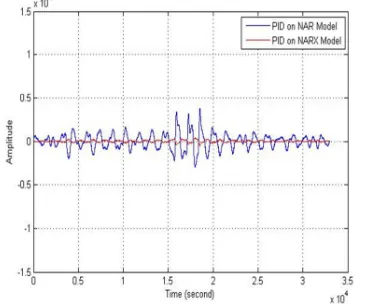
[image:8.595.315.506.580.725.2]According to all results above, the PID controller has ability to suppress the effect of VIV. But, the performance of PID controller for NARX model was better the NAR model where it's recorded the MSE equal 3.669x10⁻¹⁰ while the MSE for PID controller on NAR model equal 1.3584x10
-8
[image:9.595.97.281.316.468.2]. That’s mean that controller was able to reduce the vibrations around 97 % from the original case without using the controller for NAR model. From the other hand, the controller on the NARX model was able to reduce the vibrations for the marine riser around 99% from the original case without using the controller. Figure 17 has shown the performance of PID controller on NARX model against NAR model.
Figure 17: PID Controller Performance On NARX And NAR Models.
CONCLUSION
The performance of PID controller for NARX and NAR system identification models for oscillating pipe riser under vortex induced vibration has been investigated in this paper. The input-output data extracted from the experimental setup for priority research. NARX and NAR models employed to represent the dynamic response of the system after comparing the results for different number of hidden neurons and numbers of delay by using MSE technique. The PID controller proved to be effective to decrease the effect of vortex induced vibration of a pipe cylinder under disturbance load for all models. But the PID performance on NARX model was better than the NAR model which recorded the lowest MSE 3.669x10⁻¹⁰
while the MSE for PID controller for NAR model equal 1.3584x10⁻⁸.
ACKNOWLEDGMENT
Ministry of Education (MOE) and Universiti Teknologi Malaysia (UTM) for Research University Grant (Vote No.04H17).
REFRENCES:
[1] C. H. K. Williamson and R. Govardhan, “Vortex-Induced Vibrations,” Annu. Rev. Fluid Mech., vol. 36, no. 1, 2004, pp. 413–455. [2] T. L. Morse and C. H. K. Williamson,
“Prediction of Vortex-Induced Vibration Response by Employing Controlled Motion,” J. Fluid Mech., vol. 634, 2009, pp. 5-39.
[3] B. V. E. How, S. S. Ge, and Y. S. Choo, “Active Control of Flexible Marine Risers,” J. Sound Vib., vol. 320, no. 4–5, 2009, pp. 758– 776.
[4] F. Flemming and C. H. K. Williamson, “Vortex-Induced Vibrations of A Pivoted Cylinder,” J. Fluid Mech., vol. 522, 2005, pp. 215–252.
[5] L. Cheng, Y. Zhou, and M. M. Zhang, “Perturbed Interaction Between Vortex Shedding and Induced Vibration,” J. Fluids Struct., vol. 17, no. 7, 2003, pp. 887–901. [6] O. Streets and A. R. E. Formed, “Feedback
Control of Vortex Shedding From a Circular Cylinder by Rotational,” J. of Fluid and Structure, Vl. 15, 2001, pp. 23–37.
[7] L. Cheng, Y. Zhou, and M. M. Zhang, “Controlled Vortex-Induced Vibration on A Fix-Supported Flexible Cylinder in Cross-Flow,” J. Sound Vib., vol. 292, no. 1–2, 2006, pp. 279–299.
[8] J. Ro, “Active Control of Flow-Induced Using Feedback Vibrations Velocity Of A Flexible Cylinder Direct,” J. Sound Vib., vol. 146, no. 1, 1991, pp. 33–45.
[9] N. M. R. Shaharuddin and I. Z. Mat Darus, “Active Vibration Control of Marine Riser,” 2012 IEEE Conf. Control. Syst. Ind.
Informatics, Sep. 2012, .pp. 114–119.
[10] C.-M. Chang and B. F. Spencer, “Hybrid System Identification For High-Performance Structural Control,” Eng. Struct., vol. 56, 2013, pp. 443–456.
[11] N. M. R. Shaharuddin and I. Z. M. Darus, “Fuzzy-PID Control of Transverse Vibrating Pipe Due to Vortex Induced Vibration,” UKSim
15th Int. Conf. Comput. Model. Simul., Apr.
[12] N. M. R. Shaharuddin and I. Z. Mat Darus, “System Identification of Flexibly Mounted Cylindrical Pipe Due to Vortex Induced Vibration,” IEEE Symp. Comput. Informatics, Apr. 2013, pp. 30–34.
[13] V. L. Syrmos, “Nonlinear System Identification And Fault Detection Using Hierarchical Clustering Analysis and Local Linear Models,”
Mediterr. Conf. Control Autom., Jun. 2007, pp. 1–6.
[14] H. Peng, T. Ozaki, Y. Toyoda, H. Shioya, K. Nakano, V. Haggan-Ozaki, and M. Mori, “RBF-ARX Model-Based Nonlinear System Modeling And Predictive Control With Application to a Nox Decomposition Process,” Control Eng. Pract., vol. 12, no. 2, 2004, pp. 191–203. [15] A. R. Tavakolpour, I. Z. Mat Darus, O. Tokhi,
and M. Mailah, “Genetic Algorithm-Based Identification of Transfer Function Parameters for a Rectangular Flexible Plate System,” Eng. Appl. Artif. Intell., vol. 23, no. 8, 2010, pp. 1388–1397.
[16] M. A. Fadil, I. Z. M. Darus, M. S. Ammoo, and J. Bahru, “Iterative Learning Auto-tuned PID Controller for Micro-Unmanned Air Vehicle,”
Conf. on Instrumentation, Measurement,
Circuits and Systems, Apr. 2013, pp. 153–160.
![Table 1. Obtained Parameters [11-12]](https://thumb-us.123doks.com/thumbv2/123dok_us/8911512.959536/2.595.313.508.546.684/table-obtained-parameters.webp)