ISSN: 1992-8645 www.jatit.org E-ISSN: 1817-3195
163
WORD SENSE DISAMBIGUATION BASED ON YAROWSKY
APPROACH IN ENGLISH QURANIC INFORMATION
RETRIEVAL SYSTEM
1 OMAR JAMAL MOHAMED, 2 SABRINA TIUN Faculty of Information Science and Technology E-mail: [email protected], [email protected]
ABSTRACT
Word sense disambiguation (WSD) is the process of eliminating ambiguity that lies on some words by identifying the exact sense of a given word. In the natural languages, many words could yield multiple meaning based on the context. WSD aims to identify the most accurate sense for such cases. In particular, when translating one language to another, there would be a possibility to tackle an ambiguity among the translated words. Quran, which is the holy book for approximately billion Muslims, has been originally written in Arabic language. Apparently, when translating Quran to English language, several semantic issues have been caught by researchers. Such issues lies on the ambiguity of words such as ‘ارﺎﮭﻧو ﻼﯿﻟ’ and ‘بﺎﺴﺤﻟا مﻮﯾ’, which are translated into ‘day and night’ and ‘judgment day’. Such ambiguity has to be eliminated by determining the exact sense of the translated word. Several research efforts have been intended to disambiguate the sense of translated Quran. However, the process of identifying an appropriate method for WSD in translated Quran is still challenging task. This is due to the complexity of Arabic morphology. Hence, this study aims to propose an adaption for Yarowsky algorithm as a WSD method for Quranic translation. In addition, this study aims to develop an IR prototype based on the proposed adaption method in order to evaluate such method based on the retrieval effectiveness. In fact, the dataset that has been used in this study is a collection of Quranic content. Several pre-processing tasks have been performed in order to eliminate the irrelevant data such as stop-words, numbers and punctuation. Sequentially, two lists of senses for each ambiguity word will be created with their context. This would be performed in order to let the Yarowsky algorithm train on such example set. After that, a decision list will be constructed by the Yarowsky algorithm, which depicts the labelling sense of each word. The evaluation method that has been used in this study is the three IR evaluation metrics; Precision, Recall and F-measure. The experimental results have shown a 77% of f-measure. Such result seems to be weak in compared to the results of Yarowsky that have been applied in open domain. This is due to the lack of examples that could be extracted from Quran for both senses. Meanwhile, such result seems to be competitive in WSD of Quranic translation. Finally, it can be concluded that WSD has a significant impact on the IR system by improving the retrieval effectiveness.
Keywords: Word Sense Disambiguation, Yarowsky Algorithm, Information Retrieval, Natural Language Processing, Quran
1. INTRODUCTION
Languages have several kinds of ambiguity where many words can be comprehended in various aspects based on certain contexts [1]. For example, the word back in ‘back home’ and ‘my back’ has two meaning; the first refers to coming home and the second refers to a part of the body. Such ambiguity can be illustrated easily by the common sense of the human, while machine cannot distinguish the difference. Instead, it requires more complex computation and analysis in order to recognize the meaning, this process called Word Sense Disambiguation (WSD) [2]. Hence, assume
ISSN: 1992-8645 www.jatit.org E-ISSN: 1817-3195
164 word penna can be translated in English as feather, pen, or author depending upon the context [4].
The Quran is the holly book of the followers of Islam (also known as Muslims). It contains teaches of the Islamic religion. The scripts of the Quran are vowelized to prevent reciters (readers) from misspelling a word, and hence changing its meaning, which tremendously changed by the vowels. However, most researches in the field of Arabic Information Retrieval (IR) did not pay much attention to the problem of searching and retrieving vowelized text. Most accomplished works even suggested removing the diacritics in the preprocessing step and unifying the content of the inverted list [5].
Current research in information retrieval (IR) primarily relies on processing tokens in text, without performing any deeper semantic analysis. Recently, utilizing natural language processing has a significant impact on enhancing the performance of information retrieval in terms of analyzing the semantic of the text. Hence, this study aims to propose an adaption for Yarowsky algorithm as a WSD method for Quranic translation. In addition, this study aims to develop an IR prototype based on the proposed adaption method in order to evaluate such method based on the retrieval effectiveness.
2. RELATED WORK
There are many approaches have been presented for word sense disambiguation for instance, Ahmed & Nurnberger [6] have proposed a WSD approach for machine translation from Arabic to English using a large parallel corpus. Basically, the proposed approach consists of two phases; first phase aims to utilize Natural Language Processing (NLP) techniques in order to analyse Arabic morphology. In fact, AraMorph toolkit which introduced by Hajic et al. [7] has been used in this phase in order to eliminate the inflectional derivation from the words. After that, each word will be measured based on its occurrence, so that similar words with different sense can be identified using the most likely method based on the occurrence. Then previous information will be used as a training dataset for Naïve Bayes classifier in order to classify word sense. In the same manner, Ahmed et al. [8] have proposed a WSD method based on statistical using parallel corpora for translating query from Arabic to English. In fact, the proposed method handle any query by translating it using AraMorph toolkit. Apparently, if the query contains ambiguous word, the proposed method will perform a matching process between
any word from the query and the words from Arabic corpora using string-similarity measure. Finally, the proposed method will associate the ambiguous word with the most appropriate sense from the training data based on occurrences.
On other hand, Merhbene et al. [9] have proposed an unsupervised WSD method for Arabic using context-matching approach which aims to measure the semantic coherence score between words. The authors have firstly built the corpus by collecting online documents that contain ambiguous words. Then they have created a dictionary contains all clues for the ambiguous words. Secondly, they have applied TF-IDF on each word from the corpus in order to identify its importance. Finally, they applied a context-matching algorithm in order to match each word with the most likely sense. Moreover, Hammo et al. [10] have proposed a novel retrieval method from Quran based on WSD. In fact, the proposed method has been adopted to facilitate the process of query expansion from Quran. The authors have used WordNet as a synonym dictionary in order to match query words with its potential sense.
Eventually, Shoaib et al. [11] have proposed a relational model for semantic search of Quran. Basically, the authors started with analyzing the query itself in order to generate possible synonyms, in other word, the verse that has been queried will be match with corresponding or relevant verses. This has been performed by using WordNet as a synonym dictionary. Then, the authors have created a tree relational model in order to classify each terms with its level as child or parent node. This has been performed in order to distinguish between terms and topics in Quran which have different levels of semantic.
ISSN: 1992-8645 www.jatit.org E-ISSN: 1817-3195
165 syntactic problem that translators usually encounter in translating the Holy Quran.
3. PROPOSED METHOD
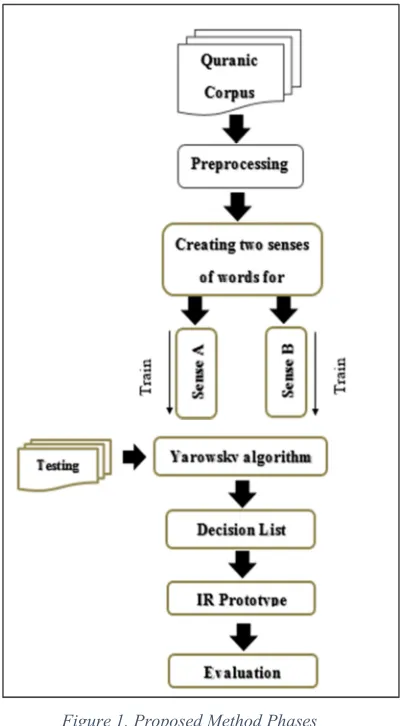
The proposed method consists of six main phases as shown in Fig 1 which are Corpus, Preprocessing,
Creating sense lists, Applying Yarwosky algorithm,
Developingan IR prototype and Evaluation. Corpus
phase describes the process of the data collection and the type of data that has been used in this study. Whereas, preprocessing phase aims to illustrate the tasks that have been took a place before carrying out the proposed method including eliminating the unwanted and irrelevant data. While creating sense lists phase aims to construct the example training set in order to let the proposed method train upon it which leads to extract patterns. Applying Yarwosky algorithm phase aims to carry out the proposed method in order to classify word’s sense based on the training example set. Furthermore, an Information Retrieval prototype will be developed in order to evaluate the proposed method. Finally, evaluation phase which aims to evaluate the proposed method based on the common information retrieval metrics; Precision, Recall and F-measure.
3.1. Corpus
[image:3.612.323.523.139.502.2]The dataset that has been used in this study is The Quran Concordance which has been introduced by Kassis et al. (1983). This dataset contains all the indexing English words in Quran translation. Table 1 shows the description of such corpus.
Table 1. Corpus Description
Details Number
Details Number
Capacity 7.98 MB
Number of pages 1485
3.2. Preprocessing
The pre-processing phase aims to turn the data into an appropriate form by removing the irrelevant data such as punctuation (e.g. #$*%&), numeric data (e.g. 23493) and stop-words (e.g. to, of, in,
etc.). This irrelevant data hinders the processing of text so that it has to be eliminated. In addition, preprocessing phase aims to tokenize the data, in other word, dividing words from text into clusters
[image:3.612.91.297.489.533.2]of consecutive morphemes, one of which typically corresponds to the word stem.
Figure 1. Proposed Method Phases
3.3. Creating Two Senses lists For Training
ISSN: 1992-8645 www.jatit.org E-ISSN: 1817-3195
[image:4.612.95.521.410.708.2]166
Table 2. Example Of Generating Two Senses Of Giving Word
The word ‘Day’
Sense A Sense B
Covers the day with the night which is in haste to follow it
The Day the Trumpet is blown and you come in droves.
And a sign for them (human beings) is the night. We strip it of the day and they are in darkness
An unbeliever will be brought on the Day of Resurrection and will be asked
Hast thou not seen how God merges the night into the day and merges the day into the night
On the Day the sky is like molten brass and the mountains like tufts of colored wool
As shown in Table 2, the word ‘Day’ has to senses; first, it refers to the sequence of day and night, second it refers to the judgement day. In fact, in the sense A, all the verses that contain the word ‘Day’ with the meaning of day and night will be inserted to a list. As well as, all the verses that contain the word ‘Day’ with the meaning of judgment day will be inserted to another list. Hence, Yarowsky algorithm can be adopted to train on such lists.
3.3.1 Training Mechanism
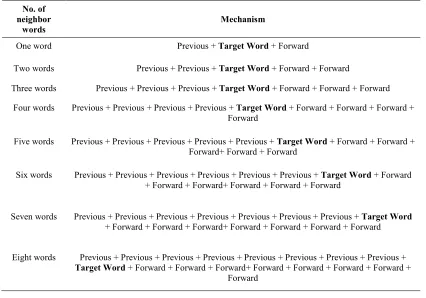
The training mechanism that Yarowsky algorithm would follow can be illustrated as addressing the neighboring words. First, it aims to address the two words; previous and forward words that surround the targeted word (required word in terms of sense identification). If the algorithm fails to identify the sense of given word based on the previous and forward words, an extension of the sequence of words will be addressing for both the previous and forward sides. The number of words that would be addressed is ranged from 2-10. Table 3 depicts this task.
Table 3. Mechanism Of Training
No. of neighbor
words
Mechanism
One word Previous + Target Word + Forward
Two words Previous + Previous + Target Word + Forward + Forward
Three words Previous + Previous + Previous + Target Word + Forward + Forward + Forward
Four words Previous + Previous + Previous + Previous + Target Word + Forward + Forward + Forward + Forward
Five words Previous + Previous + Previous + Previous + Previous + Target Word + Forward + Forward + Forward+ Forward + Forward
Six words Previous + Previous + Previous + Previous + Previous + Previous + Target Word + Forward + Forward + Forward+ Forward + Forward + Forward
Seven words Previous + Previous + Previous + Previous + Previous + Previous + Previous + Target Word + Forward + Forward + Forward+ Forward + Forward + Forward + Forward
Eight words Previous + Previous + Previous + Previous + Previous + Previous + Previous + Previous + Target Word + Forward + Forward + Forward+ Forward + Forward + Forward + Forward +
ISSN: 1992-8645 www.jatit.org E-ISSN: 1817-3195
167
Nine words Previous + Previous + Previous + Previous + Previous + Previous + Previous + Previous + Previous + Target Word + Forward + Forward + Forward+ Forward + Forward + Forward +
Forward + Forward + Forward
Ten words Previous + Previous + Previous + Previous + Previous + Previous + Previous + Previous + Previous + Previous + Target Word + Forward + Forward + Forward+ Forward + Forward +
Forward + Forward + Forward + Forward + Forward
3.4. Applying Yarowsky Algorithm
Yarowsky algorithm is a semi-supervised machine learning technique which adopted to train on a small portion of example set [15]. Apparently, Yarowsky algorithm is totally relying on the predefined examples that have been constructed in the Training phase where a small number of seed collocation representative of each sense have been identified for each word. Then a decision list will be created by the algorithm in order to label each word with the exact sense. The process of labeling each word can be described in the following equation:
Pr |
Pr |
In fact, Yarowsky works by identifying a value for each word in a giving sentence. For instance, assume a sentence S with a sequence of words w={w_1,w_2,…,w_3}. One of these words will be the targeted word that Yarowsky aims to identify its sense, this word called T. So that, Yarowsky will assign a value V for the other words. Such value refers to the degree of multiple senses which can be determined as follow:
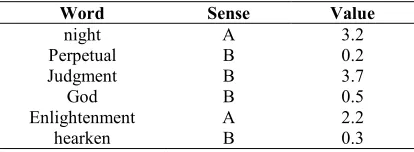
[image:5.612.86.293.621.697.2]In order to illustrate the above equation, given a verse of ‘night perpetual day judgment god enlightenment hearken’, the target word T that intended to provide its sense is day where it yield two meanings which are ‘day and night’ and ‘judgement day’. Therefore, Yarowsky will assign each word with a value V. This value indicate the rate of sense. Table 4 shows each word with its sense.
Table 4. Assigning Values For Each Word By Yarowsky
Word Sense Value
night A 3.2
Perpetual B 0.2
Judgment B 3.7
God B 0.5
Enlightenment A 2.2
hearken B 0.3
As shown in Table 4, each word has been annotated with a value that refers to the sense. Hence, Yarowsky considers the maximum value as the sense of word. The maximum value was obtained by the word ‘Judgement’ by achieving 3.7 thus; the sense of the word would be B according to the highest value. Although this process of selection is useful but in this case the selection was incorrect where the actual sense is A. This is due to Quran commonly contains various semantics in the same verse. Therefore, our study suggest an adaption that may enhance the results. Such adaption can be viewed as a summation process rather than selecting the maximum. Based on the previous example, the values of sense A will be sum as well as the values of sense B. Hence, the highest value would be an indication for the sense as follows:
! 3.2 % & 2.2 ' % ( 5.4
+ 0.2 - ./ 0 & 3.7 203 ( & 0.5 4 3 & 0.3 % .5 4.7
As shown in the above equations, Sense A has achieved a value greater that Sense B thus; the sense of word day will be assigned as A.
3.5. IR Prototype
In order to evaluate the use of Yarowsky algorithm, a prototype has been implemented to evaluate the effectiveness of retrieval. In fact, the prototype enables the user to enter a Quranic verse and then retrieve the relevant verses based on the sense of words. The prototype utilize the Yarowsky algorithm by generating the decision list in order to identify the sense of words from the typed verse (that has been entered by the user). Then based on the sense, the relevant verses will be retrieved. For example, suppose the user entered a Quranic verse as the following:
‘Those who (in charity) spend of their goods by night and by day, in secret and in public, have their reward with their Lord: on them shall be no fear, nor shall they grieve’.
ISSN: 1992-8645 www.jatit.org E-ISSN: 1817-3195
168 Table 5 shows the results of retrieving verses that relevant to the previous verse.
Table 5. Sample of Prototype results (Sense A)
No. Sense of ‘day and night’ verses
1. Thou causest the night to gain on the day, and thou causest the day to gain on the night; Thou bringest the Living out of the dead, and Thou bringest the dead out of the Living; and Thou givest sustenance to whom Thou pleasest, without measure.
2. A section of the People of the Book say: \"Believe in the morning what is revealed to the believers, but reject it at the end of the day; perchance they may (themselves) Turn back
3. Or else did they feel secure against its coming in broad daylight while they played about (care-free)
4. They celebrate His praises night and day, nor do they ever flag or intermit
5. And He it is Who makes the Night as a Robe for you, and Sleep as Repose, and makes the Day (as it were) a Resurrection
As shown in Table 5, the prototype has retrieved all the verses that contain the word ‘day’ with the sense of ‘day and night’. However, suppose the user has entered a verse as follow:
“The day it arrives, no soul shall speak except by His leave: of those (gathered) some will be wretched and some will be blessed”
In such verse the word ‘day’ has different sense which is ‘judgement day’ thus, the prototype will retrieve all the verses that contain the word ‘day’ with the same sense as shown in Table 6.
Table 6. Sample Of Prototype Results (Sense B)
No. Sense of ‘judgement day’ verses
1. There is not a population but We shall destroy it before the Day of Judgment or punish it with a dreadful Penalty: that is written in the (eternal) Record.
2. And the curse shall be on thee till the day of Judgment
3. Master of the Day of Judgment
4. Till the Day of the Time appointed
5. He said: \"Give me respite till the day they are raised up
As shown in Table 6, all the verses that contain the word ‘day’ with the sense of ‘judgement day’ have been retrieved.
3.6. Evaluation
The common information retrieval evaluation metrics Precision, Recall and F-measure have been implemented to evaluate any information retrieval system [16]. It is computed using the contingency which measure the level of truth of certain hypothesis. Such table is represented as follow:
Table 7. Contingency table
True False
Positive TP FP
Negative TN FN
(TP) is the set of correct retrieved items, (FP) is the set of incorrect retrieved items, (TN) is the set of truly non-retrieved items, and (FN) is the set of falsely non-retrieved items. Based on the previous explanation, the equations of Precision, Recall and F-measure are calculated as follows:
-. - |6-| & |7-| .|6-|
8 8 |6-| & |79| .|6-|
7 |6-| & |79| & |6-| & |7-|2 : |6-| 2 : - : 8- & 8 .
4. RESULTS
ISSN: 1992-8645 www.jatit.org E-ISSN: 1817-3195
[image:7.612.99.510.106.583.2]169
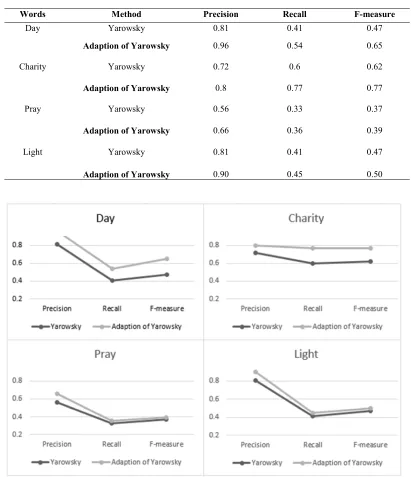
Table 8. Experimental Results
Words Method Precision Recall F-measure
Day Yarowsky 0.81 0.41 0.47
Adaption of Yarowsky 0.96 0.54 0.65
Charity Yarowsky 0.72 0.6 0.62
Adaption of Yarowsky 0.8 0.77 0.77
Pray Yarowsky 0.56 0.33 0.37
Adaption of Yarowsky 0.66 0.36 0.39
Light Yarowsky 0.81 0.41 0.47
Adaption of Yarowsky 0.90 0.45 0.50
Figure 2. Comparison Between The Basic Yarowsky And The Proposed Adaption Of Yarowsky
As shown in Table 4.8 and Figure 4.1, the highest results have been achieved by the word ‘Charity’ by obtaining 80%, 77% and 77% of precision, recall and f-measure respectively. Subsequently, the second highest results have been achieved by the word ‘Day’ by obtaining 96%, 54% and 65% of precision, recall and f-measure respectively. Afterwards, the word ‘Light’ has achieved 90%, 45% and 50% of precision, recall
and f-measure. Finally, the lowest results have been achieved by the word ‘Pray’ by obtaining 66%, 36%, and 39% of precision, recall and f-measure respectively.
5. DISCUSSION
ISSN: 1992-8645 www.jatit.org E-ISSN: 1817-3195
170 applied in open-domain word sense ambiguity applications such as the study of Bergsma et al. [17]. This is due to multiple reasons. (i) First, the application of Yarowsky in this study has been performed for specific-domain which is Quran. This leads to limited examples that could be extracted from the verses which leads to reduce the training examples for Yarowsky. (ii) Second, the successive words in Quran, that have been analyzed in order to identify the sense of words, have a weak impact on distinguishing the sense of words. This is due to Quran use complex semantic. (iii) Third, Yarowsky algorithm requires that the two senses of a particular word should be the same in terms of syntactic. For example, the word day has two senses meanwhile; both of these senses are noun. This hinders the process of examining many words that yield senses that are syntactically different. However, our experimental results can be seen as competitive by comparing it with WSD approaches for Quran. This has been proved by the enhancement of retrieval that have been accomplished using Yarowsky algorithm in this study compared to other studies such as [12, 18].
6. CONCLUSION
This research has proposed an adaption of Yarowsky algorithm as a WSD method for Quranic English translated. The experimental results have shown that the proposed adaption of Yarowsky has enhanced the effectiveness of retrieval based precision, recall and f-measure. However, the main drawback of this study lies on the lack of training set that can be extracted from Quran due to its complex morphology.
7. ACKNOWLEDGEMENT
This research project is funded by Malaysian Government under research Grant ERGS /1/2013/ ICT07/UKM/03/1.
REFERENCES
[1] Roberto Navigli, "Word sense disambiguation: A survey," ACM Comput. Surv., vol. 41, pp. 1-69,
2009.doi:10.1145/1459352.1459355Retrieved from.
[2] Mark Stevenson and Yorick Wilks, "Word sense disambiguation," The Oxford Handbook
of Comp. Linguistics, pp. 249-265,
2003Retrieved from.
[3] Nancy Ide and Jean Véronis, "Introduction to the special issue on word sense disambiguation: the state of the art," Computational linguistics,
vol. 24, pp. 2-40, 1998Retrieved from.
[4] Tim Berners-Lee, James Hendler, and Ora Lassila, "The semantic web," Scientific
american, vol. 284, pp. 28-37, 2001Retrieved
from.
[5] Tim Buckwalter, "Buckwalter {Arabic} Morphological Analyzer Version 1.0," 2002Retrieved from.
[6] Farag Ahmed and A Nurnberger, "Arabic/English word translation disambiguation approach based on naïve Bayesian classifier," in Computer Science and Information Technology, 2008. IMCSIT 2008.
International Multiconference on, 2008, pp.
331-338.doi:Retrieved from.
[7] Jan Hajic, Otakar Smrz, Tim Buckwalter, and Hubert Jin, "Feature-based tagger of approximations of functional Arabic morphology," in Proceedings of the Fourth Workshop on Treebanks and Linguistic Theories
(TLT 2005), 2005, pp. 53-64.doi:Retrieved from
http://citeseerx.ist.psu.edu/viewdoc/download?d oi=10.1.1.93.880&rep=rep1&type=pdf.
[8] Farag Ahmed, Andreas Nürnberger, and Marcus Nitsche, Supporting arabic cross-lingual
retrieval using contextual information: Springer,
2011.
[9] Laroussi Merhbene, Anis Zouaghi, and Mounir Zrigui, "Ambiguous Arabic words disambiguation," in Software Engineering
Artificial Intelligence Networking and
Parallel/Distributed Computing (SNPD), 2010
11th ACIS International Conference on, 2010,
pp. 157-164.doi:Retrieved from.
[10] Bassam Hammo, Azzam Sleit, and Mahmoud El-Haj, "Effectiveness of query expansion in searching the Holy Quran," 2007Retrieved from.
[11] Muhammad Shoaib, M Nadeem Yasin, UK Hikmat, M Imran Saeed, and Malik Sikandar H Khiyal, "Relational WordNet model for semantic search in Holy Quran," in Emerging Technologies, 2009. ICET 2009. International
Conference on, 2009, pp. 29-34.doi:Retrieved
from.
[12] Sabrina Tiun, Hamed Zakr, Masnizah Mohd, Norazlinda Zainal Abidin, and Ahmad Irfan Ikmal Hisham, "Word Sense Disambiguation for English Quranic IR System," 2013Retrieved from.
ISSN: 1992-8645 www.jatit.org E-ISSN: 1817-3195
171 [14] Abobaker Ali, M Alsaleh Brakhw, Munif
Zarirruddin Fikri Bin Nordin, and Sharifah Fazliyaton Shaik, "Some Linguistic Difficulties in Translating the Holy Quran from Arabic into English," International Journal of Social
Science and Humanity, vol. 2, p. 588,
2012Retrieved from.
[15] Mirella Lapata, Bayesian Word Sense Induction, WSD Supervised, and WSD Unsupervised, "Natural Language Understanding," 2014Retrieved from.
[16] Mikalai Yatskevich, "Preliminary evaluation of schema matching systems," 2003Retrieved from.
[17] Shane Bergsma, David Yarowsky, and Kenneth Church, "Using large monolingual and bilingual corpora to improve coordination disambiguation," in Proceedings of the 49th Annual Meeting of the Association for Computational Linguistics: Human Language
Technologies-Volume 1, 2011, pp.
1346-1355.doi:Retrieved from.
[18] Sarah Abdul-Ameer Mussa and Sabrina Tiun, "A Novel Method of Semantic Relatedness Measurements for Word Sense Disambiguation on English AlQuran," Bulletin of Electrical
Engineering and Informatics, vol. 4,