(
If
Protocol Conversion
Systems:
Market Overview
In this report: Synopsis
Market Overview ... -
102
Editor's NoteThis report focuses on the protocol
Market Leaders ... -
102
conversion systems market.
Itde-scribes the industry's origins, the
Future
market leaders, and market trends.
Directions ...
-103
For information on the technology of
protocol conversion, see "Protocol
Conversion Systems: Technology
Overview" (Report C23-010-201).
Comparison columns listing detailed
characteristics of more than 120
con-version products from 33 different
vendors can be found in "Protocol
Conversion Systems: Comparison
Columns" (Report C23-010-301).
Highlights
Protocol conversion technology
pro-vides a way to link incompatible host
computers and devices. A major
por-tion of this market addresses
incom-patibilities between IBM
(synchronous) and non-IBM
(asyn-chronous) hosts, displays, and
print-ers. Conversion is also necessary for
device and host access to
packet-switching networks; communications
between PCs or LANs and host
com-puters; and connection of devices
-By Martin Dintzis Assistant Editor
@ 1991 McGraW-Hili. Incorporated. Reproduction Prohibited. Datapro Research Group. Delran NJ 08075 USA
using different physical interfaces,
data codes, and communications
speeds.
Until IBM entered the market in
1982, other vendors of protocol
con-version products flourished. Another
setback to the industry has been the
shift away from host-controlled
dis-play terminals in favor of personal
computers configured for terminal
emulation.
The traditional protocol converter
has largely given way to
communica-tions controllers capable of linking
multiple environments and devices.
Niche markets, such as
Macintosh-to-IBM connectivity, also provide
the most inventive vendors with
fresh avenues for business.
Analysis
Market Overview
The market for protocol conversion systems
devel-oped as a solution to the incompatibility problems
between IBM and non-IBM display terminals,
printers, and hosts. IBM made its part of the world
synchronous, while other vendors made theirs
asynchronous. Connecting peripheral equipment
from other vendors to IBM hosts spawned a new
industry dedicated to smoothing out the
differ-ences between the two worlds. Since asynchronous
displays were generally less expensive than IBM
products, protocol conversion also became a
popu-lar means to inexpensively connect popu-large numbers
of displays to an IBM system.
After recognizing the need for
asynchronous-to-synchronous transmission solutions, KMW
Sys-tems of Austin, TX (now known as
Andrew/KMW)set out to fill the void, thereby establishing itself in
1971 as the pioneer of the protocol conversion
market. Thereafter, other companies, such as Local
Data (now known as Andrew Corp.), Micom
Com-munications, and Netlink, entered the market,
each bringing its own expertise to that field.
These protocol conversion manufacturers
flourished until 1982, when they received a setback
initiated by IBM. Presumably acting under the
dic-tum, "If you can't beat them, join them," IBM
re-leased its own line of protocol converters.
The proliferation of private and public
pack-et-switching networks in the latter half of the
1980s increased the need for conversion between
the CCITT X.25 packet data mode and IBM BSC,
IBM SNAlSDLC, and asynchronous transmission
modes. As a result, some vendors of
asynchro-nous-to-IBM protocol conversion products,
in-cluding Memotec Data, Micom, and Plantronics
Futurecomms, also offer to-IBM and
X.25-to async connectivity.
The increasing need to link mUltiple
incom-patible computers and devices has spawned the
JANUARY 1991
development of other conversion products,
includ-ing software for front-end processors, emulation
cards, interface adapters, multifunction
communi-cations controllers, and gateways.
Market Leaders
Andrew Corp. acquired Local Data, a leading
pro-tocol conversion manufacturer, in 1987. Local
Data had developed the DataLynx, InterLynx, and
VersaLynx product lines, which provide
conver-sion between asynchronous and IBM BSC or
SNAISDLC environments for displays, printers, and
PCs emulating displays. These devices are still
marketed under Andrew's name.
Within the past two years, Andrew has
re-leased a steady stream of conversion products for
both IBM mainframe and midrange environments,
including the InterLynx/400 Protocol Converter
and the Newport/Coax and Newport/Twinax
syn-chronous adapters for Hewlett-Packard LaserJet
printers. InterLynx/400 allows up to seven
asyn-chronous display terminals, printers, or personal
computers emulating displays to access an IBM
AS/400or System/3X host.
Andrew's protocol converters and display
ter-minal adapters provide concurrent user access to
both synchronous and asynchronous computers.
The vendor's printer adapters allow a display- or
PC-attached printer to be shared by both a host
computer and the workstation user.
Andrew/KMW (formerly KMW Systems,
which was acquired by Andrew Corp. in 1990)
con-tinues to blaze trails in the protocol conversion
market by offering Macintosh connectivity
prod-ucts. Last year, the vendor introduced NetAxcess,
the first adapter board that transforms a
Mac-intosh II personal computer into a gateway capable
of linking an entire AppleTalk network with an
IBM midrange host. Macintosh workstations
ap-pear as IBM 52XX or 31XX displays, while Apple
printers emulate IBM 52XX printers. Each
Mac-intosh user has access to up to seven concurrent
IBM midrange host applications and any number
of Macintosh-resident applications.
Andrew/KMW also supports Macintosh
ac-cess to IBM midrange environments through its
TwinAxcess Series II (multiport) and TwinAxcess
Series III (single port) protocol converters. Series II
(multiport) and Series III (single port) products for
(
(
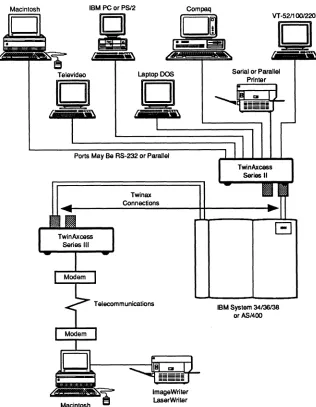
IBM PC or PS/2
Ports May Be RS-232 or Parallel
Twinax Connections
VT -52/1 00/220
[image:3.612.108.424.77.484.2]Serial or Parallel Printer
Figure 1.
AndrewlKMW's TwinAxcess Protocol Converters
TwinAxcess Series II accom-modates up to seven local or remote asynchronous de-vices. including IBM-compatible and Macintosh personal computers. display terminals. and serial or par-allel printers. TwinAxcess Series III is a one-port ver-sion of the TwinAxcess Se-ries II unit.
IBM System 34136138
or ASI400
3270 (IBM BSC, SNNSDLC, and RJE)
connectiv-ity form another part of the vendor's product line.
IBM provides bidirectional conversion for
both synchronous and asynchronous devices
through the 3174 Establishment Controller, which
also provides token-ring gateway functionality.
IBM also continues to market the 3708 Network
Conversion Unit and the 7171 Protocol Converter.
The 3708 converts a 3270 datastream to and from
ASCII code, allowing asynchronous devices to
ap-pear as 3270 displays and printers to an IBM SNA
host. The 7171 can support from 16 to 64
asyn-chronous ASCII devices via an RS-232-C interface
to the block multiplexer channel of an IBM host.
Micom Communications markets the Micom
BoX Type 3 unit, a network processor that can be
configured, through a selection of software
car-tridges, for operation as an async-to-SNNSDLC or
@ 1991 McGraw-Hili. Incorporated. Reproduction Prohibited. Datapro Research Group. Delran NJ 08075 USA
async-to-BSC protocol converter; an async, SNA/
SDLC, BSC, or multiprotocol (async/SNA or
async/BSC) packet assembler/disassembler (PAD);
or an X.25 packet switch or switching PAD.
Netlink offers SNA-Gate, a versatile product
that can function as a protocol converter, a cluster
controller, a line concentrator, and a remote job
entry station facility. Connecting to an IBM 37XX
communications controller, SNA-Gate provides
async-to BSC, async-to-SNNSDLC, or
BSC-to-SNA/SDLC conversion, accommodating up to 250
devices over multidrop lines.
Future Directions
Replacing older display terminals with
microcom-puters configured for terminal emulation has
be-come a common practice. Users want access to
more than one computer system but do not want
two terminals taking up space on their desks. By
the early 1980s, organizations confirmed their
preferences for micros over display terminals,
in-stalling them at a rapid rate and benefiting from
their programmability. The shift from host-based
systems to local area networks has heightened this
trend, thereby weakening both the display terminal
and protocol conversion industries.
The need for protocol conversion remains
strong, however, because of the increasing need to
link multiple dissimilar environments.
Microcom-puters have encouraged the development of new
terminal emulation hardware and software
prod-ucts, including LAN gateway solutions. Products
that link Macintoshes to IBM host environments,
for example, are in demand, as evidenced by the
product introductions of Apple Computer,
Andrew/KMW, and other vendors.
JANUARY 1991
While the sale of traditional protocol
convert-ers is on the decline, vendors throughout the IBM
display system market, including AT&T, Apertus
Technologies (formerly Lee Data), IBM, IDEA
Courier,and Memorex Telex, have been successful
in marketing large communications controllers
ca-pable of transparently linking multiple IBM hosts
with large numbers of devices distributed across
IBM 3270/5250, asynchronous, and tokring
en-vironments. Some of these systems also provide
enhanced functionality, such as multiple sessions
with windowing for attached display terminals.
As businesses continue to expand and merge,
the use of packet-switching networks to link
multi-ple remote IBM and non-IBM environments
re-mains a widespread practice. The sale of
multiprotocol PADs, therefore, will continue to be
a major source of revenue to many vendors of
pro-tocol conversion products . •
Protocol Con version
Systems:
Market Overview
Synopsis
Editor's Note
This report focuses on the market for
protocol conversion systems. For
information on the technology of
protocol conversion, see "Protocol
Conversion Systems: Technology
Overview," Report C23-0 10-20
1.For detailed comparison column
list-ings of protocol conversion products,
see Report C23-01O-301.
Highlights
The market for protocol conversion
systems developed as a solution to
the asynchronous/synchronous
prob-lem reflected by the incompatibility
of non-IBM terminals with IBM
hosts. IBM made its significant part
of the world synchronous while other
vendors made theirs asynchronous.
Connecting peripheral equipment
from other vendors to IBM hosts
spawned a new industry dedicated to
smoothing out the differences
be-tween the two worlds.
After recognizing the need for
IBM-compatible synchronous
transmis-sion solutions, KMW Corporation of
Austin, Texas set out to fill the void,
thereby establishing itself in 1971 as
the pioneer of the protocol
conver-sion market. Since that time, other
companies, notably Renex, Andrew
@ 1990 McGraw-Hili, Incorporated. Reproduction Prohibited. Datapro Research. Delran NJ 08075 USA
Corporation, and Netlink, have
en-tered the market, each bringing its
own expertise to the industry.
Protocol conversion manufacturers
flourished until 1982 when they
re-ceived a setback initiated by IBM.
Presumably acting under the dictum,
"If you can't beat them,join them,"
IBM released its own line of protocol
converters.
At present, IBM offers the 3708
Net-work Conversion Unit and the 7171
Protocol Converter. The 3708
con-verts a 3270 datastream to and from
ASCII code, allowing asynchronous
devices to appear as 3270 displays
and printers to an IBM SNA host.
The 7171 can support from 16 to 64
asynchronous ASCII devices via an
RS-232-C interface to the block
mul-tiplexer channel of an IBM host.
Although protocol conversion
ven-dors do not enjoy the thriving
mar-ket they once did, they continue to
enhance their product lines.
Analysis
In addition to IBM's entrance into the protocol
conversion market, the practice of businesses
re-placing older terminals with microcomputers
strongly hampered the growth of the standalone
protocol conversion industry. By the early eighties,
organizations confirmed their preferences for
mi-cros over terminals, installing them at a rapid rate
and benefiting from their internal conversion
de-vices.
Contributions to softening the market have
also come from other areas. Some vendors are
of-fering data switches that incorporate protocol
con-version capabilities. PBX vendors are marketing
products that perform protocol conversion at the
board level to link ASCII devices in back of the
switch into synchronous networks.
These developments challenged the ingenuity
of vendors, some of whom took a page from the
books of plug-compatible mainframe
manufactur-ers and produced a product that acted like an IBM
controller, but cost considerably less. Some
ven-dors market devices that emulate an IBM cluster
controller, but deliver greater functionality to the
user at a lower price. Going the cluster controller
route enabled vendors to design products that
per-form both conversion and emulation.
Although the market has dwindled, the need
for protocol conversion has not. Aware that the
need still exists, vendors have added new
capabili-ties to their products and increased their
capaci-ties.
The Cx-8J from Commtex. Inc. provides asyn-chronous ASCII displays. printers. and PCs with access to two IBM mainframes.
JANUARY 1990
Activity in 1989
Andrew Network Products
Andrew Corporation acquired Local Data, a
lead-ing protocol conversion manufacturer, in 1987 •.
Local Data, now part of Andrew Network
Prod-ucts, offered the DataLynx, InterLynx, and
Versa-Lynx lines of conversion products. These devices
are now marketed under Andrew's name.
In 1989, Andrew expanded the product
fain-ily with the introduction of TruLynxJ400. When
used with the InterLynx 5251 protocol converter,
TruLynX/400 provides a PC interface that is
simi-lar in many aspects to the IBM twinax card. The,
product enables users to access PC programs on an
AS/400 or System/3X through a number of
asyn-chronous devices.
Andrew also produces the MALIBU/Coax
protocol converter, which uses National
Semicon-ductor's DP8344 Biphase Communications
Pro-cessor. The MALIBU/Coax device allows PC and
mainframe users to share an ASCII printer and
dispenses with manual intervention.
Apple Computer
In 1989, Apple entered the protocol conversion
business with a serial card, the Apple Serial NB
Card, which is a board-level controller within the
Macintosh. The card enables the Macintosh to link
to remote systems via RS-232-C, X.21, and V.35
protocols. An on-board Motorola 68000
micropro-cessor handles protocol conversion between the
Macintosh and IBM computers.
An expansion card enables Macintosh lIs to
connect to an IBM SNA network as ifthey were
3270s. When operating with MacDFT, the card
allows users to access mainframe applications just
as they would from terminals. The card features a
twinax connector for 5250 emulation.
Commtex Inc.
In June 1989, Commtex Inc. announced the release
ofCx-81, a five-port ASCII-to-3270 protocol
con-verter. The product enables asynchronous ASCII
displays, printers, and PCs to access two IBM
mainframes. Each device can conduct up to five
concurrent sessions with one, or bothhQsts.
~achhost communication line can independently sllJr
port BSC or SNNSDLC protocols.
Emulating 3174 control units, the Cx-81
al-lows asynchronous devices to be directly ,connected
@ 1990 McGraW-Hili. Incorporated. Reproduction Prohibited. Oa1apro Research.
(
via nine-pin "D" connectors at speeds up to 38.4K
bps. Users can also remotely connect the devices
via dial-up or leased lines. The Cx-81 supports
over 250 terminal emulations. Bundled software
enables the user to add support for new terminals
or customize those already supported.
Recently, Commtex has increased the density
of its large controller to 50 ports, but Donald
Parker, president ofCommtex, observed, "We
didn't want to forsake the small remote office so
we distilled Cx-80 essentials into an inexpensive
five-port unit."
KMWSvstems
KMW continues to blaze trails in the protocol
con-version market. In September 1989, the company
announced a new capability for its TwinAxcess line
of protocol converters. Both models, the Series II
and Series III, allow the new Apple Macintosh
Por-table to communicate locally or remotely with an
IBM AS/400 or IBM System/34, /36, or /38.
When equipped with an optional internal
mo-dem, the Macintosh Portable can access files on
the IBM midrange computers from any location
over a telephone line. A modem attached to the
TwinAxcess protocol converter at the host site
completes the connection. An alternative approach
with an external modem attached to the Macintosh
computer provides the same functionality.
@ 1$90 McGrll~·HHI. Incorporllted. Reproduction Prohibited. Datapro Research. DiIIrIIn NJ 08075 USA
TwinAxcess Series II (multiport) and
TwinAxcess Series III (single port) perform
termi-nal emulation and file transfer between the
Porta-ble and the IBM midrange. The Macintosh can
emulate either an IBM 5251 or 5291 terminal
when connected to an AS/400 or System/3X. File
transfer can occur when KMW's TwinAxcess
LINK software runs on the Macintosh Portable in
conjunction with a TwinAxcess protocol converter
and file transfer software on the host.
Renex Corporation
An active participant in protocol conversion since
1980, Renex originally produced converters that
replaced controllers. The company's newest
offer-ing, the Protocol-Converting Multiplexer (PCM),
performs SNA protocol conversion through
exist-ing controllers, without makexist-ing use of PC
con-verter cards. The product enables ASCII devices to
dial up or directly access an IBM mainframe by
means of IBM 3X74 controllers.
The latest Renex release pares down
operat-ing costs by eliminatoperat-ing the need to buy PC cards
to support new network users. This innovative
ap-proach of plugging directly into the controller
in-stead of replacing it infuses new life into the
market. An additional bonus for users is PCM's
support of dial-up access, a feature not found on a
PC card . •
(
Protocol Conversion Systems
The term protocol conversion means far more than simply translation from one protocol to another. The process may encompass numerous products, including protocol converters, emulation devices, gateways, and packet assemblers/disassemblers (PADs), that allow compatibil-ity among communications devices, local area networks, packet switched networks, or computer operating systems. Available products range from microprocessor-based cir-cuit boards to front-end processors (FEPs) capable of per-forming conversion functions through software applications. Some devices perform only code or interface conversions, while others handle protocol conversion, de-vice emulation, and/or code and interface translations in the same unit.
This report focuses on standalone hardware products that perform conversions to allow equipment from one manu-facturer to communicate with another manumanu-facturer's equipment. The largest market segment for these products addresses incompatibilities between IBM's synchronous mainframes and asynchronous ASCII terminals.
For information on software packages performing conver-sion and emulation, consult the Datapro Directory of Soft-ware and the Datapro Directory of Microcomputer Software. For coverage of micro-to-mainframe conversion products, see Report C22-0lO-301, "Microcomputer-to-Host Communications Products," in this volume. We now cover PADs in a separate report, C20-0lO-301.
PROTOCOLS
Protocols govern the format of a data exchange, recogni-tion of a remote connecrecogni-tion, identificarecogni-tion of the trans-mitting and receiving locations, the transmission sequence, the handling of interruptions, error-checking methods and control, methods of blocking data, and
secu-Protocols, whether employed in a military chain of command or in data communications, define procedures necessary to assure mutual under-standing. Protocol conversion systems include protocol converters, terminal controllers and em-ulators. packet assembler/disassemblers (PADs), gateways, and network processors. Using the Open Systems Interconnection (051) seven-layer model for data communications as a reference point, we present various conversions that can occur in a network.
A vendor list and two sets of comparison columns follow this report. The comparison columns present specifications for protocol conversion systems and code. speed. and interface convert-ers.
REPORT HIGHLIGHTS: PAGE
THE 051 MODEL ... ... ... 102
PROTOCOL CONVERTERS ... 104
THE MARKET ... 105
rity procedures. They range from single character-by-character communications with no error checking to complex algorithms moving data among many devices.
In general, protocols specify three major areas:
• The method in which data is to be represented or encoded-the code set. Most data processing systems today use either the American Standard Code for Infor-mation Interchange (ASCII) or IBM's Extended Binary Coded Decimal Interchange Code (EBCDIC).
• The method in which the codes are transmitted and received-asynchronous or synchronous. In asynchro-nous transmission, data is sent with start and stop bits between individual characters; data is sent at random intervals and does not require specific timing. In syn-chronous transmission, characters or bits are sent at a fixed rate; transmitting and receiving devices are syn-chronized, eliminating the need for start/stop bits.
• The nondata exchanges of information by which the two devices establish control, detect failures or errors, and initiate corrective action.
Through hardware or software, the sending device auto-matically formats the data and adds the required bits before transmitting each block. The receiving device auto-matically checks each of the appended bits before ac-knowledging receipt of data. Upon detecting any failures, the protocol initiates error-control procedures.
Byte-oriented protocols require transmission of data in eight-bit blocks; an acknowledgment is required after each transmitted block before the next block can be sent. Bit-oriented protocols allow data to be transmitted in blocks of any length up to a specified maximum; an acknowledg-ment may take place after one or several blocks have been sent, depending on the protocol. Some of the most com-mon protocols are as follows:
• ASCII or TTY -an asynchronous protocol that uses the ASCII code set. It provides very little error checking. Transmission is in the form of a start bit, a number of data bits (usually five to eight), and one or more stop bits. Data in ASCII protocol enters the communications line at any time; the end of the link is synchronized through the specifications of a common line speed and detection of the start bits and the beginning of the char-acter transmission. ASCII requires an acknowledgment after each block is sent. ASCII protocol, often referred to as Teletype (TTY) protocol, traditionally relates to tele-typewriter equipment and services.
• IBM's Synchronous Data Link Control (SDLC)-a bit-oriented synchronous protocol that uses a synchronized series of frames. Each frame has a synchronization flag, followed by an address field, a control field that tells the purpose of the transmission, the data itself, then a frame-check field, and finally a trailing flag. The flag character marks synchronization. SDLC permits up to 127 frames to be outstanding before an acknowledgment is required. Because SDLC supports full-duplex trans-mission, users can send multiple blocks of data on one acknowledgment. SDLC is used in private-line net-works.
• IBM Binary Synchronous Communications (BSC)-a character-oriented synchronous protocol, also referred to as bisync. Binary synchronous data and control char-acters consist of eight-bit bytes. A transmission in BSC consists of a number of synchronizing (SYN) characters that ensure synchronization at both ends of the commu-nications link. These are followed by a start-of-text (STX) character, an eight-bit block of text, an end-of-text (ETX) character, and a block error-checking charac-ter (BCC). BSC does not supporl1 full-duplex transmission, nor is it supported by IBM's Systems Net-work Architecture (SNA). An acknowledgment must fol-low each block of data. The BSC protocol works in multipoint applications over private lines.
Other communications protocols include High-Level Data Link Control (HDLC), a CCITT-specified,
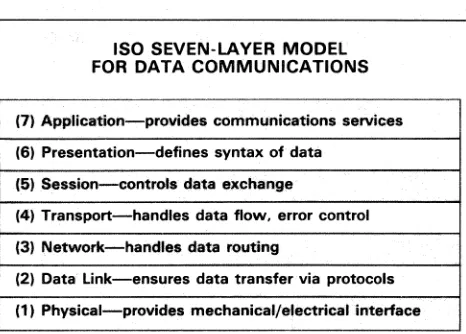
bit-ISO SEVEN-LAYER MODEL FOR DATA COMMUNICATIONS
(7) Application-provides communications services
(61 Presentation-defines syntax of data (5) Session-controls data exchange
(41 Transport-handles data flow, error control (3) Network-handles data routing
(21 Data Link-ensures data transfer via protocols (11 PhVsical-provides mechanical/electrical interface
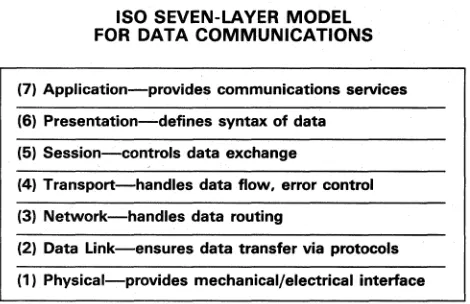
Figure 1. Layers One through Three define the interface be-tween the host computer and the network. Layers Four through Seven provide compatibility to data format and ex-change.
oriented protocol upon which most other bit-oriented pro-tocols are based; Univac U200, CDC UT200, and Burroughs Multipoint Poll Select, which are similar to IBM BSC but can run on both synchronous and asynchro-nous links; and Digital Equipment Corporation's Digital Data Communications Message Protocol (DDCMP), a byte-oriented protocol that can handle up to 255 unac-knowledged transmissions.
THE OSI MODEL
The International Standards Organization (ISO) Open Systems Interconnection reference model provides a framework for understanding the differences in conver-sion products. Each of the model's layers defines a partic-ular aspect of the entire data communications process. Figure 1 illustrates the seven-layer hierarchy.
• Layer I-Physical Connection provides mechanical and electrical specifications and procedures to establish, maintain, and end physical connections. This layer de-fines interface, code, speed, and synchronization func-tions. Interface, code, and asynchronous-to-synchronous converters fall into this category.
• Layer 2-Data Link Control ensures that the data passes without error from one c:omputer to another. This pro-cess involves protocols that specify the format for data transmission. Protocol· converters are the devices that handle conversions in this layer. Parameters such as modem control, ring signaling, and dedicated connec-tions fall into this category.
• Layer 3-Network Layer lets two systems exchange data. This layer defines packet addressing and data rout-ing to final destination. Units that handle conversion in this layer include gateway devices, such as pack;et assemblers/disassemblers that provide access to X.25 networks or between local area networks. Front-end
pro-COPYRIGHT © 1988 McGRAW-HILL,INCORPORATED. REPRODUCTION PROHIBITED DA T APRO RESEARCH, DELRAN NJ 08075 USA
[image:10.612.317.550.66.233.2]I(
(
cessors (FEPs) that include protocol conversion in their functions also fall into this classification.
o Layer 4-Transport Layer handles end-to-end error and
flow control to ensure that the communications ex-change is orderly and reliable. PAD devices, a type of gateway product, are the major products in this layer. Note that PADs affect both the Network and Transport layers.
o Layer 5-Session Layer provides the structure for a data
exchange by managing connections between application processes, establishing and terminating connections, and sending end-to-end messages and controller dialogs. There are currently few conversion products in this cat-egory.
o Layer 6-Presentation Layer both defines the way in
which data is put together and provides a systematic arrangement for the communications exchange to occur. This layer defines functions to translate coded data and convert it into display formats for terminal or micro-computer screens, printers, and other peripherals. In this layer, data is expanded or compressed and structured for file transfer or command translation. Devices called em-ulators, which allow one type of terminal to appear as another type of terminal, fall into the Presentation Layer category. Products in this category include ASCII-to-3270 emulators, interfaces that let personal computers act as 3270-type devices or access public networks, and word processor interfaces that handle conversions be-tween dissimilar word processors.
o Layer 7-Applications Layer supports user and
applica-tion tasks and provides the communicaapplica-tions services that are available to specific computer applications. In essence, this layer provides the meaning to the message. Conversion devices that we discuss in this report do not provide conversions on this layer.
Converters must often provide translations on more than one level in the model. Conversion at one layer generally implies a need for compatibility in lower layers. For ex-ample, a protocol converter working on Level 2 functions also assumes responsibility for compatibility in the inter-face, code, and synchronization functions.
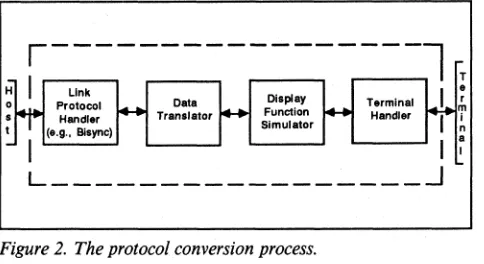
,---l
H I Link
I!
o Protocol... Oa.. Dlspl~y Terminal . ; . ~ • ~ Handlor Translator ~ Funcllon
i+-t
HandlerI
it (e.g .• Bisync) Simulator ~
I
I
IL _________________ ~
Figure 2. The protocol conversion process.
The Mechanics of Protocol Conversion
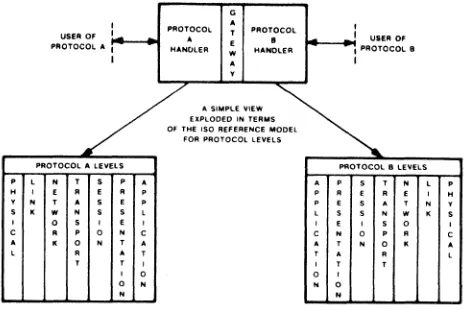
Protocol converters perform translations for dissimilar de-vices simulating the appropriate protocol for each. As Figure 2 shows, this gives protocol converters a. distinc-tive, double-ended structure. For each end of the conver-sion process, a local protocol handler uses the protocol required by the attached device. Connecting these han-dlers is a gateway task that provides for the movement of user data between the handlers. If all communication pro-tocols were structured in accordance with the OSI Refer-ence Model, the converter would implement a set of seven-layer OSI protocols joined by the gateway task. Be-cause the central task of a fully structured OSI protocol is to isolate users from the communiltation environment, a protocol converter dealing exclusively with full OSI-model protocols would be fairly simple to develop and would operate with few restrictions. With non-OSI proto-cols, such as those commonly in use in today's networks, the following issues complicate the conversion process:
o The format of the user data. If the data is easily
sepa-rated from communication and device control proto-cols, it is more easily transferred to another environment. Special features like data compression, complicate protocol conversion if they do not exist in the other protocol.
o The degree of layering in the protocols. Even though full
compliance with the OSI model is unlikely in the proto-cols being considered for conversion today, any amount of OSI-like layering in the protocols will aid in the separation of useful data from control information that must not be introduced into the other environment.
o The availability of corrtmon functions in the protocols
involved. Data exchange between the users requires a
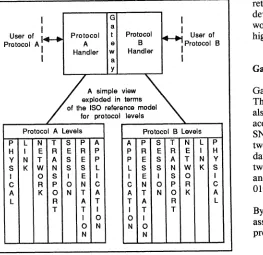
degree of synchronization between the two foreign pro-tocols. For example, most older protocols operate in half-duplex mode-only one station at a time may send information. It is necessary for converters operating be-tween half-duplex protocols to insure that both stations are not given permission to send at the same moment, since neither could receive under those circumstances. When protocol converters allow devices to simulate other devices, device control protocol translation may be needed. IBM's popular 3270 series of terminals is often emulated using lower cost asynchronous devices, but the 3270 has special features, such as the ability to return only modified fields to the host computer. This ability must be emulated within the protocol converter. Figure 3 shows the structure of a terminal emulator protocol converter .
[image:11.612.63.305.602.734.2]Protocol Conversion Systems
Interface,· Code, and Asynchronous-to-Synchronous Converters
An intelface provides the physical connection between two devices. Interface conversion offers the lowest level of established compatibility. Data and control lines from devices terminate at a connector that handles assigned signal functions. For example, the RS-232-C interface con-nector has 25 pins-l pin per function. The interface also prescribes voltage levels for electrical signals passing over the data and control lines.
Interface converters serve as adapters for differing inter-faces, accept the connectors of two different interinter-faces, and/or translate signals and voltage levels of one interface to another. Interface conversions commonly occur be-tween RS-232-C and MIL-STD-188 or bebe-tween RS-232-C and V.35.
Code converters translate one communications code to another. The most common codes are ASCII, EBCDIC, and Baudot. Conversion from one code to another may be simple, involving only the addition or deletion of control bits or the alteration of parity. A more complex code conversion might require changing the data character's bit pattern.
Basic code conversion hardware consists of two universal synchronous/ asynchronous receiver/transmitters (USARTs), a translation table contained in ROM, and control circuitry. Characters received by the USART in one code are mapped in the ROM table into a
correspond-,
G,
,
aI User of Protocol t Protocol
User of , . . . .
A e B
~protocol
B Protocol A,Handler w Handler
,
a,
y
A··m .. -
exploded in terms~
of the ISO reference model for protocol levels
Protocol A Levels Protocol B Levels P L N T S P A A P S T N L P H I E R E R P P R E R E I H
Y N T A S E P P E S A T N Y
S K W N S S L L S S N W K S I 0 S I E I I E I S 0 I C R P 0 N C C N 0 P R C A K 0 N T A A T N 0 K A
L R A T T A R L
T T I I T T
I 0 0 I 0 N N 0
[image:12.612.66.329.444.699.2]N N
Figure 3. Inside a terminal emulator.
ing character in the destination device's code. Converted data goes to the other USART, which transmits it to the destination device.
Asynchronous-to-synchronous converters perform conver-sion of data from asynchronous terminals for use on syn-chronous facilities.
PROTOCOL CONVERTERS
Protocol converters, one of the largest categories of con-version devices, perform changes at the Data Link Layer to ensure device compatibility. Protocol converters con-nect incompatible peripheral devices to hosts utilizing mi-croprocessors. A protocol converter actually changes one protocol to another by separating control characters from data and assembling the new datastream according to new specifications.
During the conversion sequence,· the converter accepts blocks of data, adds or deletes the necessary control char-acters, reformats the block, and calculates the required check characters so the receiving device receives charac-ters formatted according to its requirements. For example, in an ASCII-to-SDLC conversion, the converter accepts a character string, eliminates start and stop bits, assembles characters into a block, and adds headers and trailers to create complete frames. In a BSC-to-SDLC conversion, the converter changes the first four SYN bits of the bisync algorithm to the first flag bit of the SDLC algorithm. Since protocol converters must stop, store, process, and retransmit data, they usually increase response time. The device generally accepts low-speed input in the buffer; works with the data; and then transmits it out in short, high-speed bursts.
Gateways and PADs
Gateways and PADs perform conversions on OSI Layers Three and Four (the Network and Transport Layers) and also perforni lower layer functions. Gateway devices allow access to incompatible networks, for example, between SNA and DECnet, or between SNA and Ethernet, or be-tween a data communications device and an X.25 public data network. Gateways also provide compatibility be-tween network architectures' inherent protocols, codes, and interfaces. We cover these products in Report Cll-010-301, "Local Area Network Products."
By far the largest subset of gateway products are packet assembler/disassemblers (PADs). We now cover these products in a separate report, C20-010-301.
COPYRIGHT © 1988 McGRAW-HILL, INCORPORATED. REPRODUCTION PROHIBITED DATAPRO RESEARCH,. DELRAN NJ 08075 USA
(~
Emulation Devices
While protocol converters resolve incompatibility prob-lems between devices, an emulator resolves incompatibil-ities including differences in protocol, code, interface, device characteristics, and link characteristics. To the em-ulator, protocol conversion is secondary.
Many-but not all-protocol converters today provide both protocol conversion and emulation, whereas all em-ulation devices provide protocol conversion. Commonly, devices performing protocol and emulation translations are called value-added terminal controllers, remote cluster controllers, or terminal emulators.
An IBM 3271 serves up to 32 IBM 3277-type terminals on a multipoint line. Data moving in this configuration is blocked out in 1,920-character screen images (blocks of data). If a user wants to replace IBM 3277 terminals with asynchronous ASCII devices, the ASCII units must ap-pear as IBM 3277s to the IBM host. A terminal controller/ emulator solves the problem by accumulating an asynchronous datastream in its buffer until a 1,920-character screen image is filled, or until the emulator receives an end-of-record, end-of-block control character. The terminal controller converts the ASCII terminal pro-tocol to the host propro-tocol (i.e., BSC); rearranges the data format to appear as if it comes from an IBM 3271; and then transfers the screen image to the host, which recog-nizes the data of an IBM 3277-not an asynchronous ASCII terminal. The terminal controller performs all functions of the device it replaces, including data concen-tration; poll/select; flow control; buffering; error detection and correction; and interfacing of multiple, attached ter-minals.
Sometimes the emulating device connects to an IBM clus-ter controller rather than replacing it. It then, in effect, performs the conversion between the terminal and the IBM controller instead of between the controller and the host. The purpose of these emulators is to allow the user to integrate incompatible equipment into an existing ter-minal cluster.
During an emulation/conversion/transfer sequence, the emulator interprets control sequences from a terminal to simulate the emulated terminal's operations. The equiva-lent control sequence for one terminal and another differs widely. For example, no asynchronous ASCII keyboard provides all of the special 3270 function keys.
Many users install terminal controllers to allow non-IBM devices in remote locations to access IBM mainframes. Many remote controllers have one synchronous line for
3270 access and two or more minicomputer interfaces. Local users can switch between hosts depending upon application.
Although most protocol conversion systems perform ASCII-to-IBM conversions, other products provide con-version between IBM BSC protocols and IBM SDLC pro-tocols. Users of older IBM BSC equipment planning to migrate to an SNA/SDLC environment benefit from these products without replacing their old equipment. BSC-to-SDLC conversions generally occur between BSC 2780/ 3780 RJE or 3270 BSC protocols and SDLC protocols.
THE MARKET
The market for standalone protocol conversion systems emerged in the mid-1970s and grew fairly rapidly until the beginning of the 1980s. At this time, businesses began replacing older terminals with microcomputers, which supported internal conversion devices. This dampened the need for standalone conversion products considerably. During the late seventies and early eighties, IBM intro-duced its own protocol converters, seriously affecting the market positions of a number of small companies that had carved out lucrative market niches in the field. IBM dealt a final blow to the market when it introduced the 3174 cluster controller, which supports direct connection of ASCII terminals.
The future of the protocol conversion systems market is not bright. In response to IBM's 3174 announcement, protocol conversion vendors lowered prices on their prod-ucts, sometimes more than 25 percent. Vendors in the conversion market must now adapt their products for special applications or align themselves with vendors sell-ing complete systems, which complement conversion units. In this year's comparison columns, we note that more vendors are supporting Burroughs and Honeywell applications and moving away from the ASCII-ta-IBM product line.
COMPARISON COLUMNS
The columns that accompany this report present listings of the key characteristics of approximately 73 protocol conversion systems and 50 code, speed, interface, and async/sync converters.
In July and August 1988, Datapro surveyed 108 firms known or believed to manufacture some type of hardware conversion device.
The absence of any company from the
columns means that the company either failed to respond
to our request by the survey deadline, did not produce a
hardware conversion product, or chose not to be listed.
(
Protocol Conversion System Vendors
Arkansas Systems 890 I Kanis Road
Little Rock, AK 72205 (501) 227-8471 Commtex Inc.
1655 Crofton Boulevard, Suite 300 Crofton, MD 21114 (301) 721-3666 Computer Communications, Inc. 2610 Columbia Street
Torrance, CA 90503 (213) 320-9101 Datagraf, Inc.
8305 Highway 71 West
Austin, TX 78735 (512) 288-0453 Digital Controls Corp.
3495 Newmark Drive
Miamisburg, OH 45342 (513) 435-5455 Gandalf Data, Inc.
1020 S. Noel Avenue
Wheeling, IL 60090 (312) 541-6060 INCAA Datacom b.v.
Amerfoortseweg 15
7313 AB Apeldoom, Holland Instrumentation Services Inc. 957 Winnetka Avenue North
Minneapolis, MN 55427 (612) 544-8916 JBM Electronics Co.
6020 N. Lindbergh Boulevard
Hazelwood, MO 63042 (314) 731-7781 Jupiter Technology, Inc.
78 Fourth Avenue
Waltham, MA 02154 (617) 890-4555 KMW Systems Corp.
100 Shepherd Mountain Plaza
Austin, TX 78730-5014 (512) 338-3000 Lemcom Systems, Inc.
2104 W. Peoria Avenue
Phoenix, AZ 85029 (602) 944-1543 Local Data, Inc.
2771 Plaza Del Amo
TCDrrance, CA 94086 (213) 320-7126
Memotec Data Inc. 600 McCaffrey
Montreal, PQ, Canada H42 INI (514) 738-4781 Micom Systems, Inc.
4100 Los Angeles Avenue
Simi Valley, CA 93062 (805) 583-8600 Netlink, Inc.
3214 Spring Forest Road
Raleigh, NC 27604 (919) 878-8612 Renex Corp.
1513 Davis Ford Road
Woodbridge, VA 22192 (703) 494-2200 Shaffstall Corp.
7901 E. 88th Street
Indianapolis, IN 46256 (317) 842-2077 Software Results Corp.
2887 Silver Drive
Columbus, OH 43211 (614) 267-2203 Trax Softworks, Inc.
10801 National Boulevard
Los Angeles, CA 90064 (213) 475-8729 Wall Data Inc.
17769 NE 78th Place
Redmond, WA 98052 (206) 883-4777 Western DataCom
5083 Market Street
Youngstown, OH 44512 (216) 788-6583 Unisync Inc.
508 N. First Avenue
Upland, CA 91786 (714) 985-5088
VENDORS OF CODE, SPEED, AND INTERFACE CONVERTERS
Com/Tech Systems 10 Halyard Road
Valley Stream, NY 11581 (516) 791-1175 DCC Corp.
7300 N. Crescent Boulevard
Pennsauken, NJ 08110 (609) 662-7272
Digital Controls Corp. 3495 Newmark Drive
Miamisburg, OH 45342 (513) 435-5455 Gandalf Data, Inc.
1020 S. Noel Avenue
Wheeling, IL 60090 (312) 541-6060 General DataComm Industries, Inc. Route 63
Middlebury, CT 06762 (203) 574"1118 INCAA Datacom b.v.
Amerfoortseweg 15
7313 AB Apeldoom, Holland
Method Systems, Inc. 3511 Lost Nation Road, 202
Willoughby, OH 44094 (216) 942-2100 Shaffsta1l Corp.
7901 E. 88th Street , Indianapolis, IN 46256 (317) 842-2077 Teleprocessing Products Inc.
4565 E. Industrial Street, Suite 7-K Simi Valley, CA 93063 (803) 522-8147 Wall Data Inc.
17769 NE 78th Place
Redmond, W A 98052 (206) 883-4777 0
COPYRIGHT @ 1988 McGRAW-HILL~ INCORPORATED, I:IEPRODUCTION PROHIBITED DATAPRO RESEARCH. DELRAN NJ 08075 USA
~ ..
(
(
(
All About Protocol Conversion Systems
The Local Data Datalynx/3174. first available in January 1987. is an asynchronous ASCII to SNA/SDLC protocol con-verter that transmits data up to 19.2K bps.
Today's data communications networks generally fall into two broad categories: older networks and newer, techno-logically advanced ones; but each device in these two types of networks has its own communications protocols. Many organizations having networks with older terminals are reluctant to move towards newer network architectures because of the high cost of replacing their installed base of terminals. A significant barrier in the use of older devices with newer devices is incompatibility between communica-tions protocols, an issue with little relevance to the user's applications, but a potentially insurmountable technical barrier. Protocol conversion is often the solution to the problem.
Simply stated, protocol conversion is the process of trans-lating a protocol native to an end-user device, such as a terminal, into a different protocol to allow the end-user to communicate with another device that it normally would be incompatible with, such as a computer. Protocol conver-sion can be performed by a dedicated device, a software package loaded onto an existing system, or by a value-added network, like Telenet.
The complexity of a protocol is related to the complexity of the communications environment. Only very simple, char-acter-by-character protocols are needed to effect a text exchange between human terminal operators, because hu-man judgement can be applied at both the sending and receiving end of the communications link. However, when one of the users is a computer, or when speed and volume of information exchange makes character-by-character re-view impractical, more complex protocols are necessary. In data communications, the solution to the problem of incompatibility lies in special hardware and software prod-ucts that perform some type of conversion that translates the communications system of one device into that of another. Today, there are growing numbers and varieties of these products to handle many types of incompatibilities in the data communications network. These products range from microprocessor-based circuit boards to front-end pro-cessors with the ability to handle conversion functions through software applications programs. Available conver-sion devices may handle only one, or more than one, type
Just as a group of people conversing have to agree to sets of rules or limits in language and flow of speech to assure a level of mutual understanding, so do devices within networks or between net-works need a common set of rules. In the data communications world. a rule that sets proce-dures for establishing and controlling transmis-sions is called a protocol.
In this report. we discuss protocol conversion sys-tems. which include a wide variety of devices, such as code and interface converters, protocol converters. terminal controllers and emulators. packet assembler/disassemblers (PADs). gate-ways. and network processors. Using the Open Systems Interconnection (OSI) seven-layer model for data communications as a reference point, we discuss the various types of conversions that can take place in a network. A discussion of the mechanics of protocol conversion in the "real world" follows. Also included are a discussion of IBM's importance in the protocol conversion mar-ketplace. a review of current trends in the conver-sion market, and recommendations for selecting conversion products.
Following the textual portion of this report are three groups of comparison columns. listing device specifications for protocol conversion systems, X.25 packet assembler/disassemblers (PADs), and a sampling of interface. code. speed, and async/sync converters. For your convenience. we have listed the names and addresses of ven-dors whose equipment is represented in the com-parison columns at the end of this report.
of conversion. For example, some devices handle only code or interface conversions, while others handle protocol con-version, device emulation and code and interface translations.
This report concentrates on hardware conversion devices, particularly "black box" protocol converters/emulators and terminal controllers that perform some type of conver-sion. We are aware that software packages for conversion and emulation are an extremely important part of the market; however, this reference service is primarily cerned with hardware. Readers interested in software con-version products should consult the Datapro Directory of
Software and the Datapro Directory of Microcomputer
Software.
For coverage of the micro-to-mainframe segment of the market, see Report e22-0lO-lOI, An Overview of
Micro-computer Communications, in this volume.
t>
MAY 1987 © 1987 DATAPRO RESEARCH CORPORATION. DELRAN. NJ 08075 USA1:>
In this report, we focus attention on the ways in which devices must be compatible in order to communicate. Using the Open Systems Interconnection (OSI) seven-layer model for data communications as a guide, we explain the various kinds of conversions that can take place between devices. We.then discuss the mechanics of protocol sion, the various products that handle particular conver-sions, and the ways in which conversions occur. The report also containsa
discussion about conversion in the IBM 3270 environment, since solving problems of incom-patibility between ASCII devices and IBM hosts is of particularly high interest to many readers. Also included are discussions about current trends in the conversion marketplace, including SNA to X.25 PADs, and some tips for selecting conversion products. At the end of the report is a list of vendors that provide various kinds of conversion products; their addresses and phone numbers are included.PROTOCOLS
The exchange of information is vital to users of data communications equipment, and the process of exchange is similar in many ways to human conversation. As stated previously, individuals in conversation must agree to sets of rules-protocols-in language and flow of speech in order to understand one another.
A protocol is a fixed set of rules that specifies the format of a data exchange. The rules govern the recognition of a connection with a remote point, the identification of the transmitting and receiving location, the transmission se-quence, the handling of interruptions, methods of error checking and control, methods of blocking data, and securi-ty procedures.
Communications protocols cover a wide spectrum: they range from single character-by-character communications with no error checking to complex rules for moving large amounts of data among many devices.
In general, three major areas comprise a communications protocol:
• The method in which data is to be represented or en-coded-the code. set. Most data communications today use either the American Standard Code for Information Interchange (ASCII) or IBM's Extended Binary Coded Decimal Interchange Code (EBCDIC).
• The method in which the codes are transmitted and received-asynchronous or synchronous. In asynchro-nous transmission, data is sent with start and stop bits that encapsulate individual characters; data is sent at random intervals and does not require specific timing. In synchronous transmission, characters or bits are sent at a fixed rate, with the transmitting and receiving devices synchronized. Synchronous transmission eliminates the need for start/stop bits.
• The nondata exchanges of information by which the two devices establish control, detect failures or errors, and
converter any
to be used in standard IBM 3270 applications. It emulates an IBM 3287 or 3262 system printer when attached directly to any IBM control unit via Type A coax.
initiate corrective action. These sequences establish the context in which data can be exchanged.
The physical manifestation of the protocol is a series of characters in bit combinations that are appended to each block or frame of transmitted data. Through hardware or software, the sending device automatically formats the data and adds the required bits before transmitting each block. The receiving device automatically checks each of the appended bits before signalling an acknowledgement that data has been received. If any established condition is not met, the protocol initiates error control procedures. Data communications protocols are either bit-oriented or byte-oriented. Byte-oriented protocols require that data be transmitted in eight-bit blocks; an acknowledgement is required after each transmitted block before the next block can be sent. Bit-oriented protocols allow data to be trans-mitted in blocks of any length up to a specified maximum; an acknowledgement may take place after one or several blocks have been sent, depending on the protocol. Some of the most common protocols are as follows:
• ASCII or TTY -an asynchronous protocol that uses the ASCII code set. Provides very little error checking. Transmission is in the form of a start bit, a number of data bits (usually five to eight), and one or more stop bits. Data in ASCII protocol can enter the communications line at any time; the end of the link is synchronized through the specifications of a common line speed and detection of the start bits and the beginning of the charac-ter transmission. ASCII requires an acknowledgement after each block is sent. ASCII protocol is often referred to as Teletype (TTY) protocol, since it is traditionally associated with teletypewriter equipment and services. • IBM's SDLC (Synchronous Data Link Control)-a bit-oriented synchronous protocol that uses a synchronized series of frames. Each frame has a synchronization flag, followed by an address field, a control field that tells the purpose of the transmission, the data itself, then a frame-check field, and finally a trailing flag. The flag character is used to achieve the synchronization. SDLC permits up to 127 frames to be outstanding before an acknowledgement is required. Because SDLC works in full-duplex mode, a
1:>
© 1987 DATAPRO RESEARCH CORPORATION. DELRAN. NJ 08075 USA REPRODUCTION PROHIBITED-FOR REPRINTS. CALL 1-800-328-2776
MAY 1987
-(
(
t>
user can send multiple blocks of data on one acknowled-gement. SDLC is used in private-line networks. • IBM BSC (Binary Synchronous Communications)-acharacter-oriented synchronous protocol that is also re-ferred to as bisync. Binary synchronous data and control characters consist of eight-bit bytes. A transmission in BSC consists of a number of synchronizing (SYN) charac-ters that ensure synchronization at both ends of the communications link. These are followed by a start-of-text (STX) character, an eight-bit block of start-of-text, an end-of-text (ETX) character, and a block error-checking charac-ter (BCC). BSC lacks the capability to handle full-duplex data, and does not comply with IBM's System Network Architecture (SNA) concept. Blocks of data can only be sent one at a time because each block must be acknowl-edged before the next can be sent. The BSC protocol works in multipoint applications over private lines. Other communications protocols include HDLC (High-Level Data Link Control), a CCITT-specified, bit-oriented protocol upon which most other bit-oriented protocols are based; Univac U200, CDC UT200, and Burroughs Multi-point Poll Select, which are similar to IBM BSC but can run on both synchronous and asynchronous links; and Digital Equipment Corporation's DDCMP (Digital Data Commu-nications Message Protocol), a byte-oriented protocol that can handle up to 255 unacknowledged transmissions. Protocols are often application-dependent. This depen-dence, combined with the increasing importance of the computer and the increasing use of intelligent worksta-tions, has resulted in a trend toward more complex protocols.
Typically, equipment manufacturers have viewed proto-cols in much the same way as they have viewed other products-they have introduced their own protocol rather than adopt that of a competitor. Many terminals in opera-tion today use a vendor-established protocol; no industry-wide standard exists. Because of this, many terminals that perform the same functions cannot be used on the same system because they do not use the same protocols. For example, minicomputer users who have purchased
asyn-ISO SEVEN-LAYER MODEL FOR DATA COMMUNICATIONS
(2) Data Link-ensures data transfer via protocols
(1)··Pfuosica~i.$.~~b_~~~.I~~.I'tlt.ti'j~;·i;'i
Figure 1. Layers One through Three define the interface be-tween the host computer and the network. Layers Four through Seven provide compatibility to data format and exchange.
chronous terminals from different vendors have discov-ered that even though the code set, speed, and transmission method are the same, communication with different termi-nals from the same computer port may not be possible. This is because each type of terminal has a set of commands or sequences of special characters that it recognizes and uses to perform functions such as cursor positioning and screen editing. Terminals of different manufacturers do not typically execute the same commands.
INCOMPATIBILITY IN DATA COMMUNICATIONS
We have said that data communications devices can be incompatible with one another in several ways. The Inter-national Standards Organization (ISO) Open Systems In-terconnection reference model-a seven-layer hierarchy that defines the electrical characteristics, communications standards, and software applications for computer sys-tems-provides a framework for understanding the ways in which devices differ. Each layer of the model defines a particular aspect of the entire data communications pro-cess. Refer to Figure 1 for a representation of the seven-layer hierarchy.
• Layer 1 is the Physical Connection, which provides me-chanical and electrical specifications and procedures to establish, maintain, and end physical connections. This layer defines interface, code, speed, and synchronization functions. Interface, code, and asynchronous-to-synchro-nous converters fall into this category.
• Layer 2 is the Data Link Control, which insures that the data passes without error from one computer to another. This process involves protocols that specify the format for data transmission. Protocol converters are the devices that handle conversions in this layer. Parameters such as modem control, ring signalling, and dedicated connec-tions fall into this category.
• Layer 3 is the Network Layer, which lets two systems exchange data. This layer defines packet addressing and data routing to final destination. Units that handle con-version in this layer include gateway devices, such as packet assemblers/disassemblers that provide access to X.25 networks or between local area networks. Front-end processors (FEPs) that include protocol conversion in their functions also fall into this classification.
• Layer 4 is the Transport Layer, which handles end-to-end error and flow control to ensure that the communications exchange is orderly and reliable. PAD devices, a type of gateway product, are the major products in this layer. Note that we classify PADs in both the Network and Transport layers.
• Layer 5 is the Session Layer, which provides the structure for a data exchange by managing connections between application processes, establishing and terminating con-nections, and sending end-to-end messages and control-ler dialogues. There are currently few conversion prod-ucts in this category; Protocom's P2500 PAD device!>
[image:19.612.71.306.574.722.2]. - -
-
--
- ---
-- --
--
- - - ,I
"..
I
I
[image:20.612.57.290.81.133.2]1...- _ _ _ _ _ _ _ _ _ _ --1
Figure 2. The protocol conversion process
t>
handles conversion on the Session Layer, but is one of the few products that does so.• Layer 6 is the Presentation Layer, which both defines the way in which data is put together and provides a system-atic arrangement for the communications exchange to occur. This layer defines functions to translate coded data and convert it into display formats for terminal or micro-computer screens, printers, and other peripherals. In this layer, data is expanded or compressed and structured for file transfer or command translation. Devices called em-ulators, which allow one type of terminal to appear as another type of terminal, fall into the Presentation Layer category. Products in this category include ASCII-to-3270 emulators, interfaces that let personal computers act as 3270-type devices or access public networks, and word processor interfaces that handle conversions between dissimilar word processors.
• Layer 7 is the Applications Layer, which supports user and application tasks and provides the communications services that are available to specific computer applica-tions. In essence, this layer provides the meaning to the message. Conversion devices that we discuss in this report do not provide conversions on this layer. For devices to communicate with one another, they must be compatible on the interface, code, and protocol levels and must be alike according to link characteristics, device type, and device characteristics. Therefore, to connect in-compatible equipment, converters must often provide translations on more than one of the levels in the network model. Conversion at one layer generally implies that compatibility in the layers below it in the model must also be accomplished. For example, a protocol converter work-ing on Level 2 functions also assumes responsibility for compatibility in the interface, code, and synchronization functions.
Later in this report, we discuss the various products that handle conversion functions. These include interface, code, and asynchronous-to-synchronous converters; protocol converters; gateway devices, including PADs; protocol con-version in front-end processors; and terminal emulation/ controllers and remote cluster controllers that let one de-vice appear as another.
The Mechanics of Protocol Conversion
The earlier comparison of data communication and human conversation is useful in understanding the structure of protocol conversion. If two people speaking different
lan-guages wish to communicate, they may use a translator . The translator talks to each in the correct language and internally repackages the ideas for presentation in the correct form to the other party. A protocol converter performs a similar task; it sits on the communication path between the communicating devices and simulates the appropriate protocol for each. As Figure 2 shows, this gives protocol converters a distinctive double-ended structure. For each end of the conversion process, there is a local protocol handler that acts as a communicator and uses the protocol required by the attached device. Connecting these handlers is a gateway task that provides for the movement of user data between the handlers. If all communication protocols were structured in accordance with the OSI Ref-erence Model, the converter would implement a set of seven-layer OSI protocols joined by the gateway task. Because the central task of a fully structured OSI protocol is the isolation of the user from the communication environ-ment, a protocol converter dealing exclusively with full OSI-model protocols would be fairly simple to develop and would operate with few restrictions. With non-OSI proto-cols, such as those commonly in use in today's networks, the task of conversion may be complicated by the following issues:
• The format of the user data. If the data is easily separated from communication and device control protocols, it is more easily transferred to another environment. Use of special features, such as data compression, will normally complicate protocol conversion because such facilities do not necessarily exist in the other protocol.
• The degree of layering in the protocols. Even though full compliance with the OSI model is unlikely in the proto-cols being considered for conversion today, any amount of OSI-like layering in the protocols will aid in the separation of useful data from control information that must not be introduced into the other environment.
• The availability of common functions in the protocols involved. Data exchange between the users requires a degree of synchronization between the two foreign proto-cols. For example, most older protocols operate in half-duplex mode-only one station at a time may send information. It is necessary for converters operating be-tween half-duplex protocols to insure that both stations are not given permission to send at the same moment, since neither could receive under those circumstances. Where a protocol converter is used to allow a terminal of one type to simulate the operation of another type device, some form of device control protocol translation may be needed. IBM's popular 3270 series of terminals is often emulated using lower cost asynchronous devices, but the 3270 has special features, such as the ability to return only modified fields to the host computer. This ability must be emulated within the protocol converter, making converters of this type look almost like a small computer system. Figure 3 shows the structure of a terminal emulator proto-col converter.
t>
© 1987 DATAPRO RESEARCH CORPORATION, DELRAN, NJ 08075 USAREPRODUCTION PROHIBITED-FOR REPRINTS, CALL 1-800-328-2776
MAY 1987
. _ _ . _
-(