AN INVESTIGATION ON THE VIABILITY OF USING IOT
FOR STUDENT SAFETY AND ATTENDANCE MONITORING
IN IRAQI PRIMARY SCHOOLS
1AMMAR KHALEEL 2SALMAN YUSSOF
1
Department of Network, Information Technology Research and Development Center, University of Kufa, Iraq.2Department of Systems and Networking, College of Information Technology, Universiti Tenaga
Nasional, Selangor, Malaysia
E-mail: [email protected], [email protected]
ABSTRACT
In Iraq, many student abduction cases are reported due to the lack of safety mechanisms and the lack of law enforcement. Educational institutions such as primary schools are looking for a better mechanism to monitor the student attendance so that the safety of the students can be better monitored. Currently, student attendance in schools is done in a traditional manner where the teachers will manually check and record the attendance of students in their class. However, this traditional method has many drawbacks such as it can only be taken at certain time interval and therefore cannot monitor students in real time. The main aim of this study is to investigate the viability of using Internet of Things (IoT) approach to monitor student attendance and their presence in the school compound in real time in order to ensure their safety. A quantitative data collection using questionnaire with 113 working staff from Iraqi primary schools was conducted to identify the current challenges of student monitoring and the viability of using IoT to address these challenges. The results of the questionnaire analysis show that the use of IoT could improve the safety environment of primary schools by being able to monitor student attendance accurately in real time.
Keywords: IoT, Primary Schools, Students, Attendance Monitoring, Safety.
1. INTRODUCTION
Iraq’s infrastructure has been degraded due to 25 years of nearly continuous conflict from 1980 until the present time. From 1980 to 1988, Iraq was at war with Iran fighting over border and territorial disputes. It is estimated that the war with Iran costs Iraq $100 billion in terms of economic loss. In August 1990, Iraq invaded neighbouring Kuwait and was defeated by a United Nations’ (UN) coalition, led by the United States. After the conflict, the UN imposed economic sanctions on Iraq, which caused additional neglect to the infrastructure due to the slow growth of its economy. The UN Security Council imposed resolutions on Iraq that restricted weapons of mass destruction, long-range missiles, and the requirement to comply with UN inspections. In March 2003, a U.S.-led invasion force entered and removed Hussein’s political regime after he failed to comply with many of the UN resolutions. Due to military action and simple neglect, Iraq’s 25 years of nearly continuous conflict has caused the country’s infrastructure to degrade to a level that cannot adequately support its population [1],[2]. According to UN reports, the weak safety situation
in Iraq caused many safety challenges in various environments such as education institutions [3]. For example, there are many abduction cases involving schools students. The primary school students are the main targets for the terrorist activities of abductions. The main reasons behind the abductions cases are revenge or ransom.
The Iraqi schools today are still using the traditional methods of monitoring student attendance, which is manually monitored by the school staff. However, the traditional method of monitoring student attendance is not able to capture attendance in real-time. Therefore, the school does not know when students are absent from classes, or are taken away by abductees. Thus, it is necessary to adopt modern technology to cope with the challenges of student attendance monitoring to ensure their attendance.
technology that can potentially be used in various purposes such as Smart Meter, public secu mcrity, and intelligent building. Zhu et al. [5] says “IOT Gateway plays an important role in IOT applications, which facilitates the seamless integration of wireless sensor networks and mobile communication networks or Internet, and the management and control with wireless sensor networks”. This research aims to investigate the viability of using IoT for the purpose of Students’ Safety and Attendance Monitoring in Iraqi Primary Schools.
2. LITERATURE REVIEW
This section presents an overview of IoT concepts, components, and related works in order to evaluate the viability of using IoT in school environment for the purpose of student safety and attendance monitoring.
2.1 Internet of Things (IoT)
IoT is described as a system in which items in the physical world and sensors within, or attached to these items are connected to the Internet via wireless and wired Internet connections [5]. These sensors can use various types of local area connectivity such as Radio-Frequency Identification (RFID), Near Field Communication (NFC), Wireless Fidelity (Wi-Fi), Bluetooth, and Zigbee. They can also use wide area of connectivity such as Global System for Mobile (GSM), General Packet Radio Service (GPRS), Universal Mobile Telecommunications System (UMTS), and Long-Term Evolution (LTE) [6].
IoT may be a hot topic in the industry but it is not a new concept. In the early 2000’s, Kevin Ashton [7] was laying the groundwork for what would become IoT at the Auto-ID Center at Massachusetts Institute of Technology (MIT) [8]. Ashton was one of the pioneers who conceived this notion as he searched for ways that Proctor and Gamble (P&G) Company could improve its business by linking RFID information to the Internet [9]. The concept was simple but powerful. If all objects in daily life were equipped with identifiers and wireless connectivity, these objects could be communicating with each other and be managed by computers [10].
Recently, many of IoT obstacles have been solved especially on the size and cost of wireless radios. Internet Protocol version 4 (IPv4) and Internet
Protocol version 6 (IPv6) allow us to assign a communication address to billions of devices. Electronic companies are building Wi-Fi and cellular wireless connectivity into a wide range of devices. While not perfect, battery technology has improved and solar recharging has been built into numerous devices. There will be billions of objects connected to the network within the next several years. Cisco’s Internet of Things Group (IoTG) predicts that there will be over 50 billion connected devices by 2020 [11].
The most common communication techniques used in IoT are RFID and Wireless Sensor Network (WSN). RFID is a technology that has risen to prominence over the past decade. The clear advantages of this technology over traditional identification methods, along with mandates from supply chain giants like Wal-Mart and the Department of Defence (DoD), led to a large number of research and commercialization efforts in the early 2000s. RFID is a wireless technology that allows automated remote identification of objects. The major components of an RFID system are tags, or transponders that are affixed to objects of interest and readers or interrogators that communicate remotely with the tags to enable identification. RFID systems exist in various flavours that can be classified based on the frequency of operation, power source of the tag and the method of communication between the reader and the tags [12]. On the other hand, WSN refers to deeply networked systems of low-powered wireless motes with a tiny amount of CPU and memory, and large federated networks for high-resolution sensing of the environment [13].
There are at least three major benefits of IoT that will impact every environment, which include communication, control and cost savings. Things are physical items that can be connected to both the Internet and people via sensors. Sensors give things a “voice”: by capturing data, sensors enable things to become context-aware, providing more experiential information to help people and machines make relevant and valuable decisions [14]. For example, smart sensors are being used today in bridges to monitor temperature, structural integrity, and traffic density in real time.
implications for learning and the potential to help transform educational practices such as monitor the students’ daily activities inside the universities and schools.
2.2 Related Works
Welbourne et al. [16] developed a suite of Web-based, user-level tools and applications designed to empower users by facilitating their understanding, management, and control of personal RFID data and privacy settings. The developed system is applied in University of Washington in order to understand the RFID implications and users commitment of using tags that are connected to RFID readers. Welbourne et al. [16] proposed a system called RFID Ecosystem which uses 44 RFID readers that are distributed over an area of size 8000 square meters (computer science and engineering colleges). The RFID readers were supported by 161 antennas to enable the reading of signals from tags. Volunteers (students) carry RFID tags as badges and attach tags to personal objects. The experimental results of the RFID Ecosystem show that the RFID readers are effective to track and store the students’ daily activities in web server such as the number of students that visit the college library per day. On the other hand, most of students are able to carry the tags in their daily activities. Pursula et al. [17] compared the distance of tag reading based on tag types in order to evaluate the distance that can be effectively covered by an RFID system. A simulation was performed to test the coverage of batteryless wireless tags. The simulation result shows that the various types of batteryless wireless tags are effective to send data within 7-9 square meters area. Sung and Tsai [18] proposed particle swarm optimization (PSO) method to increase the measurement precision of multi-sensors data fusion in IoT system. Critical IoT technologies consist of a wireless sensor network, RFID, various sensors and an embedded system. For multi-sensor data fusion computing systems, data aggregation is the main concern and can be formulated as distributed a RFID system based on particle swarm optimization approaches. Rohokale et al. [19] developed a cooperative IoT approach for health monitoring and control of rural and poor human being's health parameters like blood pressure (BP), hemoglobin (HB), blood sugar, abnormal cellular growth in any part of the body.
It is clear that the potential of the wireless sensor networks (WSN) paradigm will be fully unleashed once it is connected to the Internet, becoming part
of the Internet of Things (IoT). Agrawal and Das [20] mentioned that the integration between WSN and RFID technologies as IoT system is effective to support indoor and outdoor positioning services such as home appliances (i.e. switch off the lights when no one is around), track supply chain items (i.e. track distributing containers), and monitoring the weather conditions. Al-Turjman et al. [21] developed a delay-tolerant framework for integrated WSNs in IoT. The main aim of this framework is to enable WSN to be more delay tolerant under IoT. Al-Turjman et al. optimized the delay-tolerant approach for Integrated RFID-sensor. The results show that they were able to reduce the delay time of RFID reading from sensors and WSN reading from RFID. Zhu et al. [5] investigated the technical and application strategy for IoT. They found out that the integration between RFID and WSN is useful to monitor and manage the services of distributed systems such as supply chain items, identify the need products in various store markets and track the containers that distributed the items. Hodge et al. [15] investigated the roles of WSN in the monitoring the railway infrastructures. According to their investigation, WSNs can be used for monitoring the railway infrastructure such as bridges, rail tracks, track beds, and track equipment along with vehicle health monitoring such as chassis, bogies, wheels, and wagons. Condition monitoring reduces human inspection requirements through automated monitoring, reduces maintenance through detecting faults before they escalate, and improves safety and reliability.
3. DATA COLLECTION
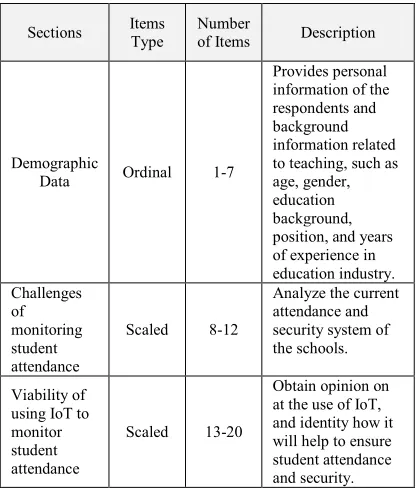
The main purpose of this study is to analyze the challenges of student attendance monitoring in the Iraqi primary schools and the viability of using IoT in monitoring student attendance in order to improve the safety of schools environments. Thus, data collection done using a questionnaire survey was conducted to gain information about two main questions which are: Are there problems in current attendance monitoring methods practiced in Iraqi Primary schools? Can IoT be an effective approach to address these problems? The questions used in the questionnaire are given in Table 1.
ensure the item’s coherency and clarity. The first version of the questionnaire was distributed to ten school staff in Iraq. The data analysis of pilot questionnaire shows that the questionnaire responses are valid to support the research idea.
Table 1: Questionnaire Sections and Items
Sections Items Type
Number
of Items Description
Demographic
Data Ordinal 1-7
Provides personal information of the respondents and background information related to teaching, such as age, gender, education background, position, and years of experience in education industry. Challenges
of monitoring student attendance
Scaled 8-12
Analyze the current attendance and security system of the schools.
Viability of using IoT to monitor student attendance
Scaled 13-20
Obtain opinion on at the use of IoT, and identity how it will help to ensure student attendance and security.
The final version of the questionnaire was distributed to 150 working staffs at Alkhawarizmi, Alnoor, Alquds and Dijlah schools in Iraq. The data was collected in the second semester of 2014/2015 academic year. The participants in this study consist of 113 working staffs in these schools. Thus, the data was collected from 75% of school staff community. According to Glenn [23], the collected sample is enough to represent the community of the selected schools.
4 DATA ANALYSIS
The software SPSS version 20.0 was used to analyze the collected data due its efficiency in quantitative data analysis. The demographic variables were analyzed to ensure the validity of questionnaire responses. The reliability of the questionnaire is confirmed through Coefficient Alpha test. The responses of the 5- Likert Scale are measured through the means of descriptive analysis based on responses frequencies analysis. The correlation between challenges of monitoring student attendance and the viability of using IoT to monitor student attendance is tested using Pearson correlation analysis.
4.1 Demographic Data
This section presents a general profile of the respondents’ demographic characteristics on seven aspects namely gender, age, educational qualification, marital status, year of experience, employment status and job positions. The demographic data analysis will give an overview of the respondents with respect to their backgrounds.
The data distribution for gender reveals that the number of male respondents is slightly more than female respondents. The distribution, in terms of percentage, between male and female respondents is 58% and 42% respectively. Based on this percentage the collected data is well-balanced because it reflects the opinions of both genders.
For the age of the respondents, there are 48 respondents who fall between 30-39 years (42%) followed by 36 respondents between 40-49 years (32%) then 16 respondents between 20-29 years (14%) and lastly only 13 respondents are more than 50 years (12%). In other words, the respondents represent various age generations which enrich the usefulness of the provided responses due to various life experiences and visions.
In terms of educational qualification, the majority of respondents are bachelor holders. There are 63 (56%) participants who have Bachelor degree. The participants who have diploma qualification are 29 (26%). The participants who have postgraduate qualification are 14 (12%). The participants who have high school qualification are 7 (6%). Thus, most of the participants are educated enough to provide adequate responses based on good understanding of schools’ needs.
With regards to the respondents’ marital status, there are more married than unmarried respondents in this study. The number of married respondents is 74 (65%) while the number of single respondents is 39 (35%). Therefore, most of the participants are parents who support the idea of children or student attendance monitoring.
Regarding respondents’ years of experience, there are 33 participants who have experience between 5-10 years (29%). The participants who have experience between 16-20 years are 27 (24%). The participants who have experience less than 5 years are 20 (18%). The participants who have experience more than 20 years are 17 (15%). The participants who have experience between 11-15 years are 16 (14%). Thus, most participants have good experience to provide responsible responses that are related to student attendance.
From the perspective of the respondents’ employment status, the number of respondents who work as full time is 96 (85%) while the number of respondents who work as part time is 17 (15%). This shows that most respondents are involved in the school activities for long hours which allow them to provide practical responses based on their daily working activities.
4.2 Questionnaire Reliability
Coefficient Alpha is the most frequently used method for calculating the internal consistency that is used as a measure of reliability for the three variables of the questionnaire, in which when a > 0.7, indicates satisfactory internal consistency reliability. Reliability is assumed as a consistent, stable and objective method which reflects the reliability of measures [24].
It can be noted from Table 2 that the Cronbach’s Alpha score for all the 13 items is 0.771, which is higher than 0.7. In other word, the collected data is considered as reliable data and can reflect the real community situation.
Table 2: Reliability Statistics
Cronbach's Alpha
Number of Responses
Number of Scaled Items
0.77 113 13
4.3 Descriptive Analysis
The researcher uses the Descriptive Analysis (means and frequencies) to analyze the two main factors, challenges of monitoring student attendance and viability of using IoT in monitoring student attendance. In order to clarify the Descriptive Analysis dimensions, the responses were collected based on 5-likert Scale: 1 for Strongly Agree (SA), 2 for Agree (A), 3 for Neutral (N), 4 for Disagree (D), and 5 for Strongly Disagree (SD). Table 3 shows the verbal interpretation of the mean interval values used in this research [25].
Table 3: Means 5-point Likert Scale
Mean Interval Verbal Interpretation
1- less than 1.5 Very High
1.5- less than 2.5 High
2.5- less than 3.5 Moderate
3.5- less than 4.5 Low
4.5-5.0 Very Low
4.3.1 Challenges in monitoring student
attendance
This section analyzes the challenges of monitoring student attendance in primary schools. As shown in Table 4, the respondents agree with items number 8 (Non-attendance is a common problem in the school), 9 (The school is facing difficulty in monitoring student attendance due to the lack of system in place), and 11 (Parents of students are dissatisfied with the current monitoring system of students attendance in the school). On the other hand the participants disagree with items number 10 (the current monitoring system in the school is efficient and effective) and 12 (teachers willingly play their role to ensure students attendance).
In conclusion, there are real challenges in monitoring student attendance using the traditional methods such as observation by teachers. Thus, the current method of monitoring the student attendance is not satisfactory for the parents and schools. The architecture of school facilities and the large number of students represent the main difficulties for monitoring student attendance using traditional method.
4.3.2 Viability of using IoT to monitor the
student attendance
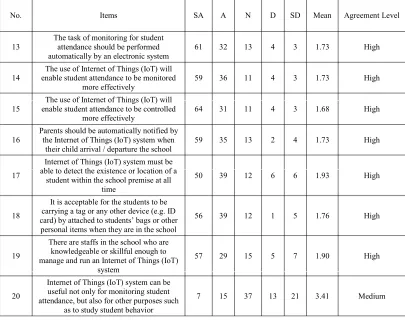
premise at all time), 18 (It is acceptable for the students to be carrying a tag or any other device (e.g. ID card) by attached to students’ bags or other personal items when they are in the school), and 19 (There are staffs in the school who are knowledgeable or skillful enough to manage and run an Internet of Things (IoT) system). On the other hand, the participants are neutral with item number 20 (Internet of Things (IoT) system can be useful not only for monitoring student attendance, but also for other purposes such as to study student behavior). Table 5 summarizes the descriptive analysis of IoT viability of monitoring students’ attendance.
From Table 5 it can be concluded that the electronic approach such as IoT could be useful to monitor student attendance. The use of IoT in monitoring student attendance provide many benefits, such as tracking the exact point of a student’s current position, and allowing the schools and parents to know whether students are within the school premise. Likewise, IoT gives the school managers the ability to track student movements inside the school environment. Furthermore, there are school staffs who have good computing knowledge which can motivate the schools to adopt the IoT approach. However, the staff may not be aware that the IoT is also applicable for complex management activities such as analyzing the students’ behaviors in the schools.
4.4 Correlations Between The Challenges of
Student Attendance Monitoring and The Viability of Using IoT
The correlation analysis has been conducted to illustrate the consistency of opinions regarding the various computed items. The correlation test among the questions shows if they influence one another and consistently converge into specific conclusions. It also tends to illustrate the strength of their relevance through a coefficient of correlation β [26].
The single asterisk sign stands for significance with p value 0.05. The p value of 0.05 indicates that with 95% confidence the relation illustrated by the coefficient of correlation (β) is significant i.e. reliable. The double asterisk sign stands for significance with p value 0.01. Therefore, with 99% confidence the coefficient is reliable. The value of coefficient of correlation (β) illustrates the effect size i.e. relation between the two variables. Higher coefficient value indicates stronger relation.
Positive or negative sign before the coefficient value illustrates whether the relation is positive or negative [26].
The result presented in Table 6 shows that there is a strong, positive correlation between the challenges of students attendance monitoring and the viability of using IoT to monitor student attendance (r = .551, n = 113, p < .0005). In other words, there is a significant relationship between the challenges of monitoring the student attendance and the possibility to apply IoT to cope with these challenges. The participants see that the implementations of IoT are viable to cope with the current challenges of monitoring student attendance in primary schools in Iraq.
Table 6: Correlation between Students Mentoring Challenges and IoT Viability
5 FINDINGS DISCUSSION
The findings of the questionnaire analysis confirm the viability of the proposed IoT model to monitor student attendance in primary schools. There are critical problems in monitoring student attendance in Iraq primary schools based on traditional methods which was agreed by many other studies of student attendance monitoring such as [27],[28],[29].
On the other hand, IoT is considered as an important and useful method to overcome the challenges of monitoring student attendance in Iraqi primary schools. IoT can provide many services that could increase the level of student monitoring such as to track the students’ movements inside the school boundary, which is agreed by many other studies of student attendance monitoring such as [21], [30], [27].
Challenges IoT
Viability
Challenges Pearson Correlation 1 .551**
Sig. (2-tailed) .000
N 113 113
IoT
Importance
Pearson
Correlation
.551** 1
Sig. (2-tailed) .000
N 113 113
6. CONCLUSION
This study presents the data analysis of the questionnaire that was conducted with primary school staff in Iraq. The main aim of this questionnaire is to analyze the current challenges of student attendance monitoring and the viability of using IoT to monitor student attendance in Iraqi primary schools. The results of the questionnaire analysis show that the use of IoT is viable to improve the safety of primary school students through its ability to monitor the student attendance accurately in real time. Therefore, it can be concluded that IoT could be an effective solution to overcome the current challenges of student attendance monitoring in Iraqi primary schools.
REFERENCES
[1] Copson, Raymond W. The Iraq War:
Background and Issues. Nova Publishers,
2003.
[2] Thompson, Alexander. Channels of power:
The UN Security Council and US statecraft in Iraq. Cornell University Press, 2015.
[3] UN. Children and armed conflict Report of the Secretary-General. Report by United Nations. General Assembly Security Council. (2015) A/69/926*–S/2015/409*.
[4] Xiaocong, Qian, and Zhang Jidong. "Study on the structure of “Internet of Things (IOT)”
business operation support platform."
In Communication Technology (ICCT), 2010
12th IEEE International Conference on, pp.
1068-1071. IEEE, 2010.
[5] Zhu, Qian, Ruicong Wang, Qi Chen, Yan Liu,
and Weijun Qin. "Iot gateway:
Bridgingwireless sensor networks into
internet of things." In Embedded and
Ubiquitous Computing (EUC), 2010
IEEE/IFIP 8th International Conference on,
pp. 347-352. IEEE, 2010.
[6] Berghella, L., A. Depari, P. Ferrari, A.
Flammini, Stefano Rinaldi, Emiliano Sisinni, and A. Vezzoli. "Low-power wireless interface
for handheld smart metering devices."
In Sensors Applications Symposium (SAS),
2014 IEEE, pp. 317-322. IEEE, 2014.
[7] Ashton, Kevin. "That ‘internet of things’ thing." RFiD Journal 22, no. 7 (2009): 97-114.
[8] Manches, Andrew, Pauline Duncan, Lydia
Plowman, and Shari Sabeti. "Three questions
about the Internet of things and
children." TechTrends 59, no. 1 (2015): 76-83.
[9] Michael, Katina, and Luke McCathie. "The pros and cons of RFID in supply chain management." In Mobile Business, 2005.
ICMB 2005. International Conference on, pp.
623-629. IEEE, 2005.
[10] Barker, Leon, Martin White, Mairead Curran, Zeeshan Patoli, Benji Huggins, Tudor Pascu, and Natalia Beloff. "Taxonomy for Internet of
Things-Tools for Monitoring Personal
Effects." In PECCS, pp. 67-71. 2014.
[11] Nahrstedt, Klara. "Internet of mobile things: challenges and opportunities." InProceedings of the 23rd international conference on
Parallel architectures and compilation, pp.
1-2. ACM, 2014.
[12] Want, Roy. "Enabling ubiquitous sensing with RFID." Computer 37, no. 4 (2004): 84-86. [13] Anastasi, Giuseppe, Eleonora Borgia, Marco
Conti, and Enrico Gregori. "A hybrid adaptive protocol for reliable data delivery in WSNs with multiple mobile sinks." The Computer
Journal 54, no. 2 (2011): 213-229.
[14] Pretz, Kathy. "The next evolution of the internet." IEEE Magazine The institute50, no. 5 (2013).
[15] Hodge, Victoria J., Simon O'Keefe, Michael Weeks, and Anthony Moulds. "Wireless sensor networks for condition monitoring in the railway industry: A survey." (2014).
[16] Welbourne, Evan, Leilani Battle, Gregory
Cole, Kyle Gould, Kyle Rector, Samuel Raymer, Magdalena Balazinska, and Gaetano Borriello. "Building the internet of things
using RFID: the RFID ecosystem
experience." Internet Computing, IEEE 13, no. 3 (2009): 48-55.
[17] Pursula, Pekka, Nadine Pesonen, Ilkka
Marttila, Jian Song, and Ville Viikari. "Achieving long reading ranges with passive wireless intermodulation sensors." In RFID Technology and Applications Conference
(RFID-TA), 2014 IEEE, pp. 131-134. IEEE,
2014.
[18] Sung, Wen-Tsai, and Ming-Han Tsai. "Data fusion of multi-sensor for IOT precise measurement based on improved PSO algorithms." Computers & Mathematics with
Applications 64, no. 5 (2012): 1450-1461.
[19] Rohokale, Vandana Milind, Neeli Rashmi
Prasad, and Ramjee Prasad. "A cooperative Internet of Things (IoT) for rural healthcare
monitoring and control." In Wireless
Communication, Vehicular Technology,
VITAE), 2011 2nd International Conference on, pp. 1-6. IEEE, 2011.
[20] Agrawal, Sarita, and Manik Lal Das. "Internet of Things - A paradigm shift of future Internet applications." In Engineering (NUiCONE),
2011 Nirma University International
Conference on, pp.1-7.
[21] Al-Turjman, Fadi M., Ashraf E. Al-Fagih, Waleed M. Alsalih, and Hossam S. Hassanein. "A delay-tolerant framework for integrated RSNs in IoT." Computer Communications 36, no. 9 (2013): 998-1010.
[22] Waters, E. (2002). The Goodness of Attachment Assessment: There Is A Gold Standard But It Isn't As Simple As That. Retrieved October 22, 2013,
[23] Glenn, I." Determining Sample Size". Online Google Books. (2013).
[24] Bernstein, Ira H., and J. C. Nunnally.
"Psychometric theory." New York: McGraw-Hill. Oliva, TA, Oliver, RL, & MacMillan, IC (1992). A catastrophe model for developing service satisfaction strategies. Journal of
Marketing 56 (1994): 83-95.
[25] Qawasmeh, Farid M., and Ziad S. Al-Omari. "The Learning Organization Dimensions and Their Impact on Organizational Performance: Orange Jordan as a Case Study." Arab
Economic and Business Journal 8, no. 1
(2013): 38-52.
[26] Cohen, P. "Applied multiple regression /
correlation analysis for the behavioral
sciences. Hillsdale." (2003).
[27] Ashida, N., Y. Ashida, S. Sagawa, S. Suto, T. Higashi, K. Makimoto, and T. Kawahara. "Safety Management and Crime Prevention by IC Tags–Cases of practical use of IC tag in
medical and welfare fields–." APAMI
2006 (2006): 858.
[28] Carver, Alison, Anna Timperio, and David
Crawford. "Playing it safe: The influence of neighbourhood safety on children's physical activity—A review."Health & place 14, no. 2 (2008): 217-227.
[29] Kitzinger, Jenny, and Paula Skidmore.
"Playing safe: Media coverage of child sexual abuse prevention strategies." Child Abuse
Review 4.1 (1995): 47-56.
Table 4: Descriptive Analysis of Challenges of Monitor Students’ Attendance
No. Items SA A N D SD Mean Agreement Level
8 Non-attendance is a common problem in the
school 53 35 13 8 4 1.89 High
9
The school is facing difficulty in monitoring student attendance due to the lack of system
in place
46 45 11 7 4 1.92 High
10 The current monitoring system in the school
is efficient and effective 4 9 19 38 43 3.95 Low
11
Parents of students are dissatisfied with the current monitoring system of students
attendance in the school
54 34 17 4 4 1.85 High
12 Teachers willingly play their role to ensure
students attendance 7 6 22 36 42 3.88 Low
Table 5: Descriptive Analysis of IoT Viability in Monitor Students’ Attendance
No. Items SA A N D SD Mean Agreement Level
13
The task of monitoring for student attendance should be performed automatically by an electronic system
61 32 13 4 3 1.73 High
14
The use of Internet of Things (IoT) will enable student attendance to be monitored
more effectively
59 36 11 4 3 1.73 High
15
The use of Internet of Things (IoT) will enable student attendance to be controlled
more effectively
64 31 11 4 3 1.68 High
16
Parents should be automatically notified by the Internet of Things (IoT) system when
their child arrival / departure the school
59 35 13 2 4 1.73 High
17
Internet of Things (IoT) system must be able to detect the existence or location of a
student within the school premise at all time
50 39 12 6 6 1.93 High
18
It is acceptable for the students to be carrying a tag or any other device (e.g. ID card) by attached to students’ bags or other
personal items when they are in the school
56 39 12 1 5 1.76 High
19
There are staffs in the school who are knowledgeable or skillful enough to manage and run an Internet of Things (IoT)
system
57 29 15 5 7 1.90 High
20
Internet of Things (IoT) system can be useful not only for monitoring student attendance, but also for other purposes such
as to study student behavior