
ANALYSIS ON COGNITIVE WIRELESS NETWORK MAC
PROTOCOL ACCESS MODE BASED ON NS2
HAIBO GAO1, WENJUAN ZENG2
1Department of Computer Science and Technology, Hunan International Economics University, Changsha
410205, China
2Department of Educational Administration, Hunan International Economics University, Changsha 410205,
China
ABSTRACT
Aiming at the same frequency interference, in the channel increased frequency recognition function before the consultation and put forward based on the frequency of perception multiple channel CC-MMAC agreement, simulation verification protocol can effectively reduce the co-channel interference. Channel quality changes with time by the effects of the decline and dispersion, thus cause a certain impact to the network performance, therefore the Gauss channel and the fading channel MAC protocol model are established; In study of rate based on adaptive control, performance analysis take to the rate adaptation leave C protocol, put forward based on the chance rate adaptive OAR DCA channel protocol can improve the network throughput effectively. In the study of multipath routing protocol based on AODV introduce next hop routing layer thought to the MAC layer and proposed the establishment of a plurality of next hop MNH a MMAC protocol; On improving AODV routing protocol establish non-connection limit NDL AODV routing protocol and then make simulation analysis and comparison to the NDL AODV+MNH-MMAC agreement with the original AODV+AODV+MNH-MMAC protocol, it can be in the frequency resource more nervous conditions improve the performance of the network.
Keywords:NS2, MAC, Cognitive Wireless Network, Access Mode
1. INTRODUCTION
Due to the growing demand for broadband services wireless mobile communication forward
broadband, IP development, and is the
communication domain application and the research's hot spot. Wireless MESH network called wireless mesh network (wireless Mesh Networks Abbreviation WMN) is a new type of broadband wireless network, in the flexible networking, improve the network coverage rate, increase network capacity, reduce the prophase investment and many other aspects of show great advantages by having a different from the traditional characteristics of a wireless network, especially in the absence of cable cyber source of broadband wireless access and coverage. The wireless Mesh net has been the international academic circles and industrial circles at present and is getting more and more extensive application.
With the vigorous development of broadband wireless communications business the number of mobile users grows with each passing day, data
In wireless mesh network nodes can be divided into two categories: Mesh routing and Mesh client node, the Mesh client node is the communication terminal and has a routing function but cannot serve as a gateway and a network bridge. As the gateway and the Mesh router allows mesh network and other wireless network integration, user node in wireless ad hoc multi-hop way implementation and gateway link, and through the gateway can access the Internet.
Compared with the traditional wireless communication network point to point network structure, wireless mesh network has high reliability, good coverage of the market, scalability and low initial investment etc. In the civil and commercial field it has a wide application prospect.
2. COGNITIVE WIRELESS MESH
NETWORK PROTOCOL SYSTEMS
According to the characteristics of cognitive wireless Mesh network, cognitive wireless Mesh network should be support for multiple channels and multiple interfaces, single card that supports multiple channels or multiple NICs channel network. Mesh network can achieve a single card multi channel protocol or multiple NICs channel protocol, because of the network node has one or more radio interface ( such as Ethernet ), it can be connected to one or more wireless channel, node wireless environment with sensing function, and it can determine the use of channel, corresponding to the selected channel access. It is the prominent characteristic to make cognitive wireless Mesh network hardware and protocol design and traditional wireless Mesh network a big different. This section is based on cognitive radio protocol system and Mesh network (WMN) protocol to establishment of cognitive wireless Mesh network protocol system; it is based on the general OSI/ISO protocol stack structure and the reference structure model as shown in Figure 1. This protocol stack structure only definition on physical layer and data link layer, aiming at the typical CWMN entity: router node and a client node, based on the IEEE802.n [1, 2] standard modify the established protocol system.
2.1 Hierarchical Structure
(1)Physical layer
The CWMN physical layer has the transmission environment perception function, increase the spectrum sensing functions and channel estimation module. System of cognition between the user
control and sensing channel is through a common control channel to realize transmission.[3]
Spectrum sensing: detection time, frequency, space on the available spectrum, to determine the present can be used for transmitting and receiving channel, through the local spectrum sensing technologies and distributed detection, and using the spectrum hole detection method to reliably perceived large bandwidth within each sub channel is occupied, if for the authorized frequency band, so that cognitive users the main user system without causing interference access idle frequency band, make full use of limited spectrum resources; unauthorized band, capable of dynamic frequency selection, to ensure CWMN network working frequency band from the other types of equipment interference effects, but also reduce the interferences to other devices, that is to solve the problems of coexistence. Channel estimation: estimating the communication between the user channel quality, emission parameters (power, bit rate, coding mode); the establishment of the link, through the analysis of the communication process the received data packet to estimation of channel quality.
(2)Data link layer
Cognitive wireless Mesh network logical link control sub layer is mainly responsible for cognitive communication between users to build and link maintenance, such as network layer addressing, sorting, flow control and error control. Acknowledge link layer based on perceptual information, channel estimation or user / regulatory requirements, select a group of sub channel to build links. In physical layer perception to the main user intentions to use these channels, the link layer to change to the new channel so as not to affect the primary users and maintain their communication.
2.2 Cross Layer Design
demand, route design needs to design MAC layers together to increase the connection stability and throughput, spectrum switch need to transport layer congestion combined to provide high-end communication performance. Cognitive wireless Mesh networks needs each layer of cross layer design and cognitive wireless Mesh networks cross-layer design is a very important issue. The third chapter research on spectrum sensing cognitive wireless Mesh network multi channel protocol is the physical layer and MAC layer between the cross layer designs; Chapter fifth is based on the perception of the cognitive wireless Mesh network routing multiple channel protocol, routing layer and MAC layer between the cross layer designs.
3. COGNITIVE WIRELESS NETWORK
MAC PROTOCOL DESI
Spectrum sensing cognitive radio is the basic function of the system, and is the realization of spectrum management, the premise of spectrum sharing. According to the spectrum resource management, application and interference effects, the frequency spectrum is divided 3 cases: Authorized frequency band, strict management and not interference frequency band; Authorized frequency band, at a certain time or extent for the unauthorized use and can have certain interference; Non authorized frequency band, unlimited unauthorized use. Based on spectrum sensing cognitive wireless Mesh network, it hopes in second cases using. Therefore, the user must first carry on the spectrum sensing, detect on the ambient electromagnetic characteristics, in the time domain, frequency domain and spatial domain multi-dimensional space, make spectrum detection to the main user band constantly, to quickly and accurately determine the available frequency band, and according to the test results, intelligent decision, automatic adjustment device transmitting and receiving parameters, inaccurate or delay spectrum detection result will give the user to bring harmful interference. When it is in detection, a variety of detection algorithms are based on the two basic assumptions: Physical layer above the protocol must ensure that user in the detection of this period of time to remain silent, so that can ensure the air only spectral power is composed of a main user emitted; must assume the worst comes to the worst, whereby the user 's receiver and transmitter is the main user of non line of sight ( NLOS ). On the primary user detection must achieve 99.9% success
rate, or the main user is not willing to share the spectrum.
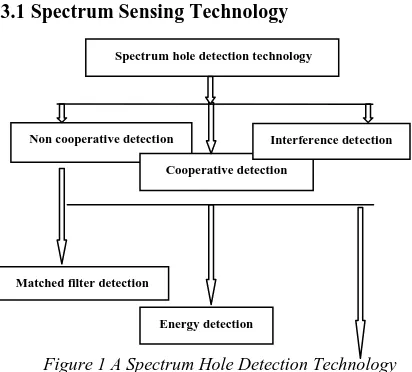
[image:3.612.313.519.123.309.2]3.1 Spectrum Sensing Technology
Figure 1 A Spectrum Hole Detection Technology Classification
Cognitive radio technology is introduced into the wireless Mesh network MMAC protocol, proposed a spectrum sensing of multi-channel MAC protocol, the nodes in a public channel competition can also perceive the authorized channel, thereby selecting with minimal disturbance of the channel transmission, it can improve the network frequency resource utilization rate significantly. CWMN MMAC protocol at run time, the time can be divided into fixed length beacon interval (beacon interval); each beacon interval is divided into four windows. When a node joins the network, it should to N authorization channel for a full scan, the scan results are stored in a node PSS [4].
In the beacon window, all nodes using competitive sent to control channel transmitting beacon (beacon) to realize time synchronization, in which the beacon data including the current node clock. When synchronization is complete, the node on the authorized channel usage were detected, but due to time constraints, it is not possible to all channels are detected. Each node will randomly select a few channels are detected, and according to the results of the node is updated in the PSS.
In the H spectrum consultation window have the node spectrum information sharing. The spectrum of consultation window is divided into n time slots; each slot represents a data channel. Due to the realization of time synchronization, so that each node can monitor slot to know other nodes on the channel is detected results. When the node PSS is 1, the node in the corresponding time slot sends the busy signal, when the other nodes listen to the busy signal, they will compare with his PSS, and
Non cooperative detection
Cooperative detection
Interference detection Spectrum hole detection technology
Matched filter detection
marking the channel is busy; when PSS 0, the node is maintained to monitor, when the PSS is marked as 1 channel will not be used for communications. Through the method to ensure that the main user activity channel security, minimize the possibility to the primary user cause by undetected.
In the first 1V data transmission window, completed the ATIM negotiation node will remain active until the completion of the data transfer, and the other nodes will enter hibernation until the next beacon intervals arrival, data transmission according to the conventional 802.11DCF.
The cognitive radio technology is introduced the wireless mesh network DCA protocol, and put forward based on spectrum sensing in cognitive radio network Mesh double network card multi channel CWMN DCA protocol. DCA MAC protocol is a dedicated control channel, a two RF channel left C protocol. Each CU terminal has 2.5
duplex transceiver, which control the transceiver
and a data transceiver, so that the nodes in a dedicated control channel competition can also perceive the authorized channel, thereby selecting multi-hop range with minimal disturbance of the channel transmission and make every node can efficiently select the appropriate channel and parallel transmission data eventually. Each simulation, spectrum sensing of double NIC multi-channel MAC protocol (CWMN DCA) program can improve the performance of networks significantly.
3.2 Working Principle
Control channel is formed by periodic time interval, the interval has the same length of time, and synchronization. The control channel is divided into two periods: channel perception stage and negotiation channel phase [5].
According to the spectrum sensing channel number M in Channel sense stage, the channel sensing stage is divided into the corresponding M mini slot, if the I mini Slot is detected in the busy, user CUL channel using the table, corresponding to the I channel will be marked on the CUL (I) =1, I channel will is this the user out of communication; so the user detects the I channel is idle, the I mini Slot sends a beacon report, otherwise do not send. For each mini slot time, then to the M channel, time required for the user perception of time is Tms=MTms, the perceptual results recorded in the list of CUL channels, leading to the formation of FCL free channel list.
In agreement (Negotiation) channel phase, when the users have data packets to send, it is in the
dedicated control channel, by sending the RTS, CTS and RES to negotiate data channel, with the DCA agreement negotiated channel process.
Data transfer phase. Begin transmitting data in the negotiation of the data channel.
User using the spectrum hole is the main user temporarily unused spectrum, user using this spectrum premise is not on the primary user interference. In the traditional wireless networks, node communication prior to listen only channel, the channel free circumstances will transmit data. The main users of the channel to take relative to the time the user has priority, once it has a transmission task, it will immediate transmission, without the authorization channel to listen, but in fact, it authorized channel may be a user, therefore, user in the data transmission process will exist and the main the user may also use some collision, therefore we need some measures to ensure that once the main user appears, it should out of the channel immediately, secondary users in the transmission process must be readily detected in the primary users appear. A relatively ideal method is time the user in a data signal and also receives the same frequency band signal, the received signals after demodulation and signal to judge whether or not the main user appear. However, in the current technical conditions, a wireless transceiver device is also unable to realize this function. The following 2 kinds of feasible plan can effectively solve this problem.
4. ROUTING BASED ON WIRELESS MAC
PROTOCOL PERCEPTUAL COGNITION
protocol multi next hop MAC protocol MNH MMAC protocol, accordingly improve AODV, put forward no connection limit NDL AODV protocol, and with the original MMAC protocol for analysis and comparison, in the frequency resource more nervous condition, to improve network performance.
4.1 Router perception classification
Router can be divided into multi criteria multi channel routing, routing, multipath routing, hierarchical routing, routing, routing and QoS routing based on geographic location information according to the routing system to points.
Many routing protocols are used as the criterion of minimum hop count routing on several typical routing criterion: expected transmission times, round trip time, data on the delay time were studied, the results show that: for the two node to meet minimum hop criterion, in the majority of cases are not effective; and a single routing criteria are difficult to reflect the quality of the link to each the impact of performance index, that can be drawn through the multi routing criterion to solve this contradiction.
In wireless Mesh networks, using multiple channels are single transceiver multi channel, multi transceiver multiple channel, that can improve the throughput of network greatly through experimental and theoretical analysis.
In wireless Mesh networks, all nodes through sharing cyber source routing protocol, routing protocol must satisfy the requirement of load balancing this requirement. Multipath routing technology can avoid single path routing network shocks well, and also can make full use of bandwidth and other cyber source at the same time, to realize load balance routing fault-tolerant.
Along with the network scale increasing, the traditional use of broadcast mechanism for routing lookup will consume a lot of cyber source. Through the hierarchical routing thought, in between intra-cluster and inter-intra-cluster routing using different classification techniques and play a variety of routing advantages respectively in order to achieve large-scale wireless Mesh network routing.
Routing protocol of wireless Mesh network cross layer design can also be called routing protocol adaptive routing protocol design, cross layer design to break the existing hierarchical design philosophy and to dig out some of the potential advantages of wireless Mesh network the maximum possible, so as to find more reliable, efficient and excellent performance of the path.
To provide users with a QoS guarantee is a hotspot of current routing, QoS route 's main idea is to choose to meet user requirements of QoS arrive at the destination node in the path.
4.2 Key problem
In wireless Mesh networks, network topology is dynamic and need adopts distributed control method, network expandability is poor and with a unidirectional wireless channel and short survival time. Therefore, the wireless Mesh network needs to use some special methods to solve the routing technology in wireless Mesh network, the routing technology is the key problem of:
In wireless Mesh networks, nodes exchange information is limited; there is no uniform management center, so the routing protocol should adopt distributed operation.
1.Loop avoidance
If we don't take any measures, there will be data packets in the network of endless forwarded. The survival time (TTL, Time TO live) can solve this problem to some extent, but the wireless Mesh network routing must consider loop avoidance problem.
2.On-demand routing
Wireless Mesh network is not between any two nodes at any time will the packet transmission demand, therefore, there is no need to maintain each node to other nodes in the routing, and should according to the actual flow demand for route discovery and establishment reasonably. In the bandwidth resource, energy of nodes under the condition of limited especially should adopt on-demand routing.
3.Proactive routing
length greater than or equal to Tq, received RREQ packet discarding.
5. EXPERIMENTAL SIMULATION
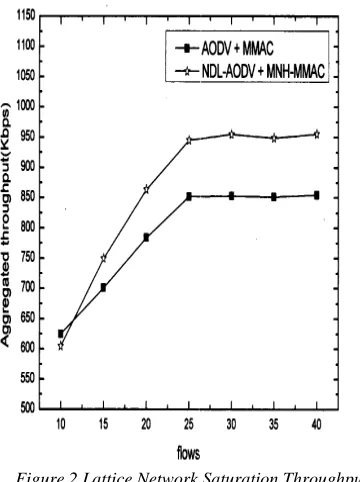
[image:6.612.318.513.192.662.2]In the simulation experiment, each site communication range is set to 250mx250m, network topology used for all sites distribution in 7*7 49 nodes of the lattice network, communication nodes by CBR flow, application layer protocol for the UDP protocol, random selection of source, destination node; packet length 512 bits; each simulation CBR stream number from 10 to 40, spaced 5; each flow 100 packets per second. Simulation of the operation will be the site of the length of the buffer and the data frame arrival rate is set to a very large value, so that when the site sends a data frame immediately after there will be a new frame of data waiting for transmission, using 5 channel, beacon interval 100ms, ATIM window length using 20ms, MNH using a MMAC MAC protocols and NDL AODV routing protocols, each simulation time is 40s.
Figure 2 Lattice Network Saturation Throughput Compared
Compared the AODV routing protocol and MMAC protocol network and a routing protocol AODV and NDL-MNH MMAC protocol can drawn: when the congestion hour, two protocol performance is similar, but with increased congestion, our proposed protocol performance much better than the original, when the network has higher load, through the plurality of next hop can obviously increase the throughput of the network.
Compared the AODV routing protocol and MMAC protocol consisting of network and NDL AODV routing protocol and MNH MMAC protocol average delay can draw: new agreement end-to-end delay decreases, this is because if a link failure, packets will change the routing and reducing the retransmission times and restart the routing broadcast number of times.
Figure 3 Lattice Network Average Delays In Comparison
Figure 4 Lattice Network Delivery Rate Comparisons
[image:6.612.104.284.366.607.2]high delivery rate and lower packet loss rate. In short, the new agreement on throughput, delay, packet success arrival rate are improved, this is because the new protocol increases packet transmission probability of success, reducing the retransmission times and restart the routing broadcast times, thereby reducing network for routing broadcast caused by increasing competition problems. Router perception for prolonging the survival time of the network, reducing the interference of communications, to improve the efficiency of C and routing protocols is important. This chapter in the study of based on mufti-channel MAC protocol, the routing layer judge the next hop functions transferred to the MAC layer, so that the original only for single diameter of multi-channel MAC protocol with multi-path function, put forward based on multi-path routing protocol multi next hop MAC protocol MNH-MMAC, on the road from layer using AODV routing protocol, and accordingly the AODV protocol is improved, and provides a connection limit NDL AODV routing protocols for wireless Mesh network, and the distribution of grid network and the random network environment, the new protocol for simulation analysis and comparison, the new protocol than the original protocol in network in resource comparison of tension, network congestion in cases of relatively large, can improve the performance of the network.
6. CONCLUSION
Cognitive radio for wireless Mesh networks, to the multi-channel MAC protocol, based on spectrum sensing, based on channel sensing and routing based on perceptual cognitive wireless Mesh network MAC protocol make in-depth study, this thesis work innovation and main contribution lies in the following aspects:
The study of cognitive wireless Mesh network multiple channel protocol and put forward dedicated control channel of multi-channel MAC protocol model, it contains Bernoulli model and M/M/K model, Bernoulli model is mainly used for single node on the control channel avoidance behavior modeling, M/M/K queuing model is mainly used for processing large amounts of data channel to be node occupancy behavior, and through the simulation proves the validity of the model.
Based on the spectrum sensing in cognitive radio Mesh network multiple channel CWMN MMAC protocols and CWNM DCA protocol has established the main user utilization rate model,
stochastic perceptual strategy dynamic channel detection mathematical model, simulation results show that under the same main user channel utilization ratio, with the increase in the number of users, the throughput of the network gradually approach fixed value, user number, the main user interference is greater.
According to the two jump in user use the same channel, it will cause co-channel interference inevitably, in order to reduce the interference in the same frequency and frequency perception proposed CC-MMAC protocol, in the channel before the consultation increased frequency recognition function in order to select the optimum frequency for data transmission, through the simulation of CWMN MMACAC protocol can reduce the same frequency interference effectively.
The rate adaptive method for channel quality perception cognitive wireless Mesh network CWMN MMAC agreement, according to the Gauss channel and the fading channel under the maximum retransmission limit the rate adaptation protocol performance analysis, in view of the different channel quality with a rate adaptive, channel of good quality can be obtained with high transmission rate, put forward based on the chance rate adaptation multi channel OAR DCA protocol, simulation results show that can improve the network throughput effectively.
The introduction of Mesh network router perception in the MAC protocol, MAC protocol is introduced in multi path concept, put forward based on the perception of the wireless Mesh network routing MAC channel CWMN MMAC protocol, and the AODV routing protocols are improved accordingly, put forward NDI. AODV routing protocol. For wireless Mesh network distribution grid network and the random network environment of the new protocol make simulation analysis, the simulation results show that the new protocol is better than the original protocol in network resource more nervous, network congestion in cases of relatively large can improve the performance of the network.
ACKNOWLEDGEMENTS
REFERENCES:
[1] J. Mitola, “Cognitive radio: making software
radios more personal”, Proceedings of
International Conference on Communications,
IEEE communication Publishing Services, February 13-18, 1999, pp. 1882-1886.
[2] J. Mitola, “Cognitive radio: an integrated agent architecture for software defined radio”, Proceedings of International Conference on
Network Computing and Applications, IEEE
Conference Publishing Services, April 27-30, 2000, pp. 171-178.
[3] N. Clemens, “Intelligent power allocation strategies in an unlicensed spectrum”, Proceedings of International Conference on
Parallel and Distributed Systems, IEEE
Conference Publishing Services, September 27-30, 2005, pp.37-42.
[4] J. Mirkovic, “Source-end DDoS defense”, Proceedings of International Conference on
Network Computing and Applications, IEEE
Conference Publishing Services, April 24-27, 2003, pp. 172-176.
[5] Wei Wang, “List-coloring Based Channel Allocation for Open-Spectrum Wireless
Networks”, Proceedings of International
Conference on Communications, IEEE
![Assessment of Physiological Health Status in Relations to Different Anthropometric and Cardio respiratory Measures of Head Supported Load Carrying Male Porters of Sikkim, India [Article Retracted]](data:image/gif;base64,R0lGODlhAQABAIAAAP///wAAACH5BAEAAAAALAAAAAABAAEAAAICRAEAOw==)