
AN ENHANCED EARLY DETECTION METHOD FOR ALL
ZERO BLOCK IN H.264
1CONG-DAO HAN
1School of Electrical and Electronic Engineering,
Shanghai Institute of Technology Shanghai, 201418, China
E-mail: [email protected]
ABSTRACT
Transformation and quantization are important steps for changing spatial residual data into frequency signal component. All-zero block (AZB) detection is an efficient means to reduce calculation times of transformation and quantization. In order to raise the efficiency of all-zero block detection and avoid error judgment, an enhanced all-zero block detection approach is proposed by using the base matrixes in this paper. Firstly, the base matrixes of integer transformation coefficients are analyzed. It can be found that all elements in the same sub-area are equal or inverse to each other. Considering this distribution property, we can deal with the elements within the same sub-area together and deduce a looser judgment criterion for all-zero block. Consequently, a larger proportion of all-all-zero blocks can be detected in advance. The experiments results demonstrate that the proposed algorithm outperforms other methods in the detection rate.
Keywords: All-Zero Block (AZB), Transformation and Quantization, Base Matrix, Integer Transform.
1. INTRODUCTION
H.264 video encoding system is a popular compression alteration for its high efficiency and little decrease in reconstruction frame quality [1][7]. However, complex mode selection process and heavy calculation task may affect the encoding time. The integer transformation and quantization will be performed on the 4x4 residual block produced by motion estimation. Many of these 4x4 blocks will become all-zero blocks when their coefficients produced by transformation and quantization are all zeros. In recent years, the investigation aiming at the early detection of all-zero block becomes a hot topic in H.264 encoding area.
According to the statistics opinion, the all-zero blocks are most probably emerged in two cases. One is that the current macroblock to be encoded is situated at the static background; another is the current block lies within the video object which is moving as an unity. Many researchers have paid their attention on the preliminary detection of all-zero blocks to relieve the heavy burden of transformation and quantization.
Sousa put forward a precise sufficient condition for AZB detection by inverse analysis on the quantized transformation coefficients [2]. Moon proposed a three step judgment method on the base of Sousa's work [3]. Su expanded Moon's idea, developed a revised three step method, and provided a looser judgment threshold which can bring about higher rate of early AZB detection [4]. Zhang looked back the realization process of Su's work, and presented a better judgment criterion for AZB detection [5].
In this paper, we proposed a more efficient detection algorithm for AZB depending on the analysis of base matrixes. Judgment strategy is chosen according to the site of element in quantization result matrix. It can relieve the calculation task in encoding process, and thus save the total encoding time.
Section 6. Finally the conclusion is drawn and future investigation direction is put forward in Section 7.
2. BACKGROUND OF AZB DETECTION
The core realization in Integer Cosine Transformation (ICT) can be described as [6]:
3 3
0 0
( , ) ( , , , )
( , , , ) ( , ) ( , ) ( , ) u v
W x y H x y u v
H x y u v C x u b u v G v y
= =
=
=
∑∑
(1)Where b(u, v) corresponds to the element in residual matrix X, W(x, y) denotes the transformation result at site (x, y), C(x, u) and G(v, y) are elements in matrixes C and G respectively.
1 1 1 1
2 1 1 2
1 1 1 1
1 2 2 1
C
− −
=
− −
− −
, G=CT (2)
The quantization procedure can be denoted as [7]:
( , ) ( , ) / 2
( , ) ( , )
qbits Z x y K x y
K x y MF W x y f
=
= ⋅ +
(3)
Because the results coming from transformation are integer, assuming Z x y( , ) equals 0, then:
K x y( , )<2qbits (4)
If the multiplier factor MF is rewritten as QB[row][col], then formula (4) can be expressed as:
( , ) (2 )
[ ][ ]
qbits f W x y
QB row col −
< (5)
Where, QB is a two-dimension constant quantization coefficient matrix.
Therefore, when formula (5) is satisfied, the corresponding result ( , )QT x y coming from the quantization of W(x, y) will become 0. In other words, the minimum of the adopted step in quantization can be denoted as [7]:
( ) (2 )
[ ][ ]
qbits f M QP
QB row col −
= (6)
If the 4x4 residual block becomes all-zero block, then all coefficients ( , )T x y Q coming from transformation and quantization should be zero. In
this case, for any x and y, the following condition must be satisfied.
W x y( , ) <M QP( ) (7)
To cope with the problem of AZB detection, Zhou devised a simple AZB detection method, and put forward a sufficient judgment condition listed as follows [6].
4 4 (0) 1
(0) (2 ) / [ ][0]
4 x
qbits
SAD T
T f QB row
<
= × −
(8)
Where SAD4x4 represents sum of the absolute value of each element in 4x4 residual block.
3. DIVISION OF BASE MATRIX
For formula (1), we can analyze the elements in matrix W according to the value of variable col.
Considering col=2-(x%2)-(y%2), when col equals 0, the possible value of (x, y) can be (1, 1), (1, 3), (3, 1) and (3, 3). Take an instance, when (x, y) equals (1, 1), the following equations can be deduced from formula (1).
1 2 3 4
1
2
3
4
(1,1)
4
2
2
(0, 0)
(0, 3)
(3, 0)
(3, 3)
(0,1)
(0, 2)
(3,1)
(3, 2)
(1, 0)
(1, 3)
(2, 0)
(2, 3)
(1,1)
(1, 2)
(2,1)
(2, 2)
W
I
I
I
I
I
b
b
b
b
I
b
b
b
b
I
b
b
b
b
I
b
b
b
b
=
+
+
+
=
−
−
+
=
−
−
+
=
−
−
+
=
−
−
+
(9)
Take out the final coefficients ahead of each b(x, y), then the following new matrix can be formed.
1 2 2 1
3 4 4 3
3 4 4 3
1 2 2 1
u u u u
u u u u
U
u u u u
u u u u
− −
− −
=
− −
− −
(10)
Where, u1=4 , u2 =2 , u3=2 and u4 =1 . Matrix U is defined as the base matrix of the element W(1, 1).
Similarly, the base matrix of other elements can be drawn. When col equals 0, (x, y) has four possible combinations, therefore it corresponds to 4 base matrixes. In the same way, there are 8 base matrixes when col is equal to 1, while 4 base matrixes exist when col equals 2.
base matrix into different zones according to the following matrix P.
1 2 2 1
3 4 4 3
3 4 4 3
1 2 2 1
P
=
(11)
Where, the number in matrix P represents the zone label. The elements in each base matrix can be divided into four zones. Check all base matrixes. It can be found that elements having the same zone label are equal or inverse to each other. For example, when (x, y) equals (1, 1), from formula (10) and (11), four elements in the third zone are 2, -2, -2 and 2 respectively. Utilizing such a property, the elements within the same zone can be processed concurrently, and it will enhance the calculation efficiency. 4. CONSTITUTION OF AZB JUDGMENT CRITERIA In this section, the AZB judgment condition will be analyzed in three cases. (1) col = 0 According to formula (9) and the property of inequality, the following formula can be deduced. 1 2 3 4 1 2 3 4 (1,1) 4 2 2 (0, 0) (0, 3) (3, 0) (3, 3) (0,1) (0, 2) (3,1) (3, 2) (1, 0) (1, 3) (2, 0) (2, 3) (1,1) (1, 2) (2,1) (2, 2) a a a a a a a a W A A A A A b b b b A b b b b A b b b b A b b b b ≤ + + + = − − + = − − + = − − + = − − + (12) Similarly, the following expressions can be drawn. W(1, 3) ≤2Aa1+4Aa2+Aa3+2Aa4 (13)
W(3,1) ≤2Aa1+Aa2+4Aa3+2Aa4 (14)
W(3, 3) ≤Aa1+2Aa2+2Aa3+4Aa4 (15)
Let Ma =Aa1+Aa2+Aa3+Aa4 , the above expressions can be described as: W(1,1) ≤2Ma+2Aa1−Aa4 (16)
W(1, 3) ≤2Ma+2Aa2−Aa3 (17)
W(3,1) ≤2Ma+2Aa3−Aa2 (18)
W(3, 3) ≤2Ma+2Aa4−Aa1 (19)
When col equals 0, the following conclusion can be drawn from formula (7). If the quantized transformation coefficients all become 0, the right sides of the expressions from (16) to (19) should be less than (2qbits− f) /QB row[ ][0] . The expression 1 (2 ) / [ ][0] 4 qbits f QB row × − is usually denoted as T(0), so the all-zero predetermination condition corresponding to col=0 can be written as follows: 4 1 3 2 2 3 1 4 2 4 (0) 2 2 4 (0) 2 2 4 (0) 2 2 4 (0) 2 a a a a a a a a a a a a M T A A M T A A M T A A M T A A < + − < + − < + − < + − (20)
Therefore, 4 1 3 2 1 1 2 (0) min , , 2 2 a a a a a M < T + A −A A −A 2 3 1 4 1 1 , 2Aa Aa 2Aa Aa Tha − − = (21)
Define the sum at the right side of the inequality (21) as threshold Tha. (2) col = 1 Like formula (10), the base matrix of the element W(0, 1) is:
2 1
1
2
2 1
1
2
2 1
1
2
2 1
1
2
U
−
−
−
−
=
−
−
−
−
(22)We can deduce: 1 2 3 4 1 2 3 4 (0,1) 2 2 (0, 0) (3, 3) (0, 3) (3, 0) (0,1) (3, 2) (0, 2) (3,1) (1, 0) (2, 3) (1, 3) (2, 0) (1,1) (2, 2) (1, 2) (2,1) b b b b b b b b W A A A A A b b b b A b b b b A b b b b A b b b b ≤ + + + = − + − = − + − = − + − = − + − (23)
Because the effects of inequality expansion in
(0, 3)
W and W(3, 0) can replace W(1, 2) ,
(2, 3)
W and W(3, 2) in the effect of inequality
expansion respectively.
In the same way, the following expressions can be drawn.
W(1, 0)≤2Ab1+2Ab2+Ab3+Ab4 (24)
W(0, 3)≤ Ab1+2Ab2+Ab3+2Ab4 (25)
W(3, 0)≤ Ab1+Ab2+2Ab3+2Ab4 (26)
Define Mb as Ab1+Ab2+Ab3+Ab4 , then the above expressions can be written as: W(0,1) ≤2Mb−Ab2−Ab4 (27)
W(1, 0) ≤2Mb−Ab3−Ab4 (28)
W(0, 3)≤2Mb−Ab1−Ab3 (29)
W(3, 0) ≤2Mb−Ab1−Ab2 (30)
When (x, y) equals (0, 1), if the quantized transformation coefficient becomes 0, the right side result of the inequality (27) should be less than (2qbits− f) /QB row[ ][1] . Denote the expression 1 (2 ) / [ ][1] 2 qbits f QB row × − as T(1), then the all-zero predetermination condition corresponding to col=1 can be written as: 2 4 3 4 1 3 1 2 2 2 (1) 2 2 (1) 2 2 (1) 2 2 (1) b b b b b b b b b b b b M T A A M T A A M T A A M T A A < + + < + + < + + < + + (31)
Therefore,
{
2 4 3 4 1 3 1 2}
1 (1) min 2 , , , b b b b b b b b b M <T + A +A A +A A +A A +A{
1 4}
{
2 3}
1
1
(1)
min
,
min
,
2
b b2
b b bT
A
A
A
A
Th
=
+
+
=
(32) The right side result of the inequality (32) is defined as the threshold Thb. (3) col = 2 Like the processing in the cases col =1 and 2, the following inequality can be drawn. 1 2 3 4 1 2 3 4 (0, 0) (0, 0) (3, 3) (0, 3) (3, 0) (0,1) (3, 2) (0, 2) (3,1) (1, 0) (2, 3) (1, 3) (2, 0) (1,1) (2, 2) (1, 2) (2,1) c c c c c c c c W A A A A A b b b b A b b b b A b b b b A b b b b ≤ + + + = + + + = + + + = + + + = + + + (33) LetMa =Aa1+Aa2+Aa3+Aa4, the above formula can be written as: W(0, 0) ≤Mc (34)The item (2qbits ) / [ ][2] f QB row − is defined as threshold T(2), then the all-zero predetermination condition corresponding to col=2 can be denoted as: Mc ≤T(2) (35)
Generalize three cases col=0, 1 and 2, the sufficient condition of all-zero block detection is that three conditions should be satisfied simultaneously. (2) a a b b c M Th M Th M T < < < (36)
5. THE PROPOSED AZB ALGORITHM
The proposed AZB detection algorithm utilizing the character of base matrix is summarized as follows:
Step 1: According t formula (8), if SAD4X4 is less than T(0), then the current 4x4 residual block is considered as AZB, and terminate the detection process. Otherwise, perform step 2.
Step 2: According to formula (21), if Ma ≥Tha, the current block is judged as the non-AZB. Otherwise, perform step 3.
Step 3: According to formula (32), if Mb ≥Thb, the current block is judged as the non-AZB. Otherwise, perform step 4.
Step 4: According to formula (35), if Mc≥T(2), the current block is judged as the non-AZB. Otherwise, the current block is processed as AZB.
Step 5: The AZB detection process terminates.
6. EXPERIMENTS AND RESULTS
In order to test the performance of the proposed algorithm, many CIF video sequences are processed on H.264 reference software JM10.1. When the inter-frame mode selection is conducted on the macroblocks in P frames, motion estimation will be performed in different block sizes. The luma residual 4x4 blocks will undergo the process of transformation and quantization. The AZB detection is performed before transformation. The structure of tested frame sequence is IPPPP…, the number of total frames for each sequence is 200. the AZB detection is conducted for luma residual 4x4 blocks on P frames, the evaluation parameter is defined as the detection rate Chkrat.
1
2
100%
N Chkrat
N
= × (37)
Where, N1 is the times that all-zero blocks are successfully checked out, N2 is the times that all-zero blocks are emerged actually.
[image:5.612.326.509.246.386.2]The proposed algorithm is compared with Su's and Zhang's algorithms. The static results are summarized in Table 1.
Table 1: Comparison Of AZB Detection Rate With Different Methods
Sequence QP Su Zhang Ours
Mobile
26 45.2 51.7 75.7 30 48.4 54.3 79.5 34 52.7 59.3 84.0 38 60.5 68.0 90.3
Tempete
26 51.4 57.3 80.5 30 55.6 61.8 85.3 34 62.3 69.1 89.7 38 72.0 78.5 94.5
Paris
26 49.8 56.7 81.0 30 61.5 67.4 87.1 34 70.7 75.9 90.9 38 78.6 83.1 94.4
News
26 76.1 80.8 93.2 30 83.3 86.7 95.9 34 88.2 90.8 97.3 38 92.0 94.2 98.7
Foreman
26 63.3 71.1 90.3 30 78.5 84.0 95.7 34 87.2 91.1 97.9 38 92.9 95.4 99.1
From Table 1, the proposed method has a higher detection rate for AZB compared with Su's and Zhang's methods. Meanwhile, with the increase of quantization parameter QP, the detection rate will enhance with different degrees. The high detection
rate of the proposed algorithm is benefit from its wider threshold range of judgment.
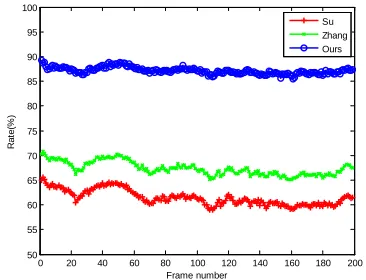
Figure. 1 shows the AZB detection rates of different methods for each frame in sequence Paris.
From Figure. 1, the detection rate of the proposed algorithm outperforms those of two other methods. The proposed algorithm especially adapts to the encoding environment which has great quantization parameter and low bit-rate. For different sequences, it can check out a larger proportion of all-zero blocks in sequences with low motion.
0 20 40 60 80 100 120 140 160 180 200 50
55 60 65 70 75 80 85 90 95 100
Frame number
R
at
e(
%
)
Su Zhang Ours
Figure. 1 The AZB Detection Rate Comparison With Different Methods For Sequence Paris (QP=30).
7. CONCLUSIONS
In this paper, a novel all-zero block detection algorithm is proposed. The elements in luma residual 4x4 blocks are processed concurrently according to the division zone. The simulation results reveal that the proposed algorithm can attain higher AZB detection rate compared with Su's and Zhang's method.
[image:5.612.103.295.416.658.2]ACKNOWLEDGMENTS
This work was supported by grant YJ2012-5 from Startup Foundation for Doctors in Shanghai Institute of Technology.
REFERENCES
[1] T. Wiegand, G.J. Sullivan, G. Bjontegaard, and A. Luthra, "Overview of the H.264/AVC video coding standard", IEEE Trans. on Circuits and Syst. for Video Technol., Vol. 13, No. 7, 2003, pp. 560-576.
[2] L.A. Sousa, "General method for eliminating redundant computations in video coding", Electronics Letters, Vol. 36, No. 4, 2000, pp. 306-307.
[3] Y.H. Moon, G.Y. Kim, and J.H. Kim, "An improved early detection algorithm for all-zero blocks in H.264 video encoding", IEEE Trans. on Circuits and Syst. for Video Technol., Vol. 15, No. 8, 2005, pp. 1053-1057.
[4] C.Y. Su, "An enhanced detection algorithm for all-zero blocks in H.264 video coding", IEEE Trans. on Consumer Electronics, Vol. 52, No. 2, 2006, pp. 598-605.
[5] M. Zhang, T. Zhou, and W. Wang, "Adaptive method for early detecting zero quantized DCT coefficients in H.264/AVC video encoding", IEEE Trans. on Circuits and Syst. for Video Technol., Vol. 19, No. 1, 2009, pp. 103-107. [6] T. Zhou, M.J. Zhang, S.H. Liu, and Z.H. Xiong,
"Overview of Prediction Mode Selection Based on All-zero Block in H.264/AVC", Computer Engineering, Vol. 35, No. 24, 2009, pp. 232-235.
[7] T. Wiegand, "Draft ITU-T Recommendation and Final Draft Int. Standard of Joint Video Specification", in JVT-G050r1.doc, Joint Video Team of ISO/IEC MPEG and ITU-T VCEG, 2003.
[8] B.Q. Zhu, X. Tong, D. An, and Y. He, "An efficient all-zero-block detection method for general orthogonal transformations", IEEE Trans. on Consumer Electronics, Vol. 55, No. 4, 2009, pp. 2195-2203.
[9] Z.G. Xie, Y. Liu, W.J. Liu, T.J. Yang, "Early detection of AZB in H264 based on Gaussian distribution model", IEEE Int. Midwest Symp. on Curcits and Syst., Vol. 2, 2006, pp. 119-122.
![Assessment of Physiological Health Status in Relations to Different Anthropometric and Cardio respiratory Measures of Head Supported Load Carrying Male Porters of Sikkim, India [Article Retracted]](data:image/gif;base64,R0lGODlhAQABAIAAAP///wAAACH5BAEAAAAALAAAAAABAAEAAAICRAEAOw==)