ANALYSIS AND APPLICATION OF RIGID BODY
DYNAMICS THEORY IN BILLIARDS SPORT
1JIANFENG WU, 2LIN GUO
1Panzhihua University, Panzhihua 617000, Sichuan, China
2Sichuan Technology And Business College, Dujiangyan 611830, Sichuan, China E-mail: [email protected] , [email protected]
ABSTRACT
This article conducts mechanical analysis of billiards and studies its motion laws. For convenience, only situations as the ball arm bats the billiards in the horizontal direction are considered. Besides, collision between one billiard ball and another or between a ball and the “KEXING” is assumed to be elastic. The following cases are quantitatively analyzed based on the rigid body dynamics theory: the “Safety zone” to prevent the slider and rod drop when the ball arm hits the cur ball; the principle and function of fixed rod ball, push rod ball, tie rod ball and side spinning ball; the relative motion between the white billiard and the mesa; the Kinematic relation when the white billiard collides with the aim billiard; the Kinematic relation when the white billiard collides with the “KEXING”. By analyzing the dynamic characteristics of billiards sport, this article provides guidance for players with a scientific batting and helps to correct the misunderstanding in billiards theory. Except for providing theoretical material for this popular indoor recreation project, this study can also offer a mathematical model of billiards for the future designers and developers of billiards games to make it closer to the real motion.
Keywords: Safety Zone, Conservation of Momentum, Elastic Collision, Sliding Friction
1. INTRODUCTION
Billiards has an extensive mass base in China, whether from the range of age or from the scope of social stratification. There are many styles for billiards, such as snooker, 8 balls, and 9 balls. Billiards is widely accepted among people not only because it is an indoor sport with small fields and free from the influence of natural environment, but also because it benefits to cultivate people’s sentiment, fitness and educational purpose. Ding Junhui often plays high-level billiards in competition, as can be seen from television, not only with an accurate power point and a quasi power angle, but also leaving a favorable position for the next shot [1]. There are many other excellent players that can play such high level shot as Ding. The outstanding performance reflects the hardworking in training on one hand, and reflects the degree of professional knowledge and scientific idea on the other hand [2-6].
This article is aimed at analyzing the scientific theory of billiard movement by means of the rigid body dynamics science. Expounded research on the Safety zone of billiards shot and the rotary motion of the white billiard is conducted applying the fundamental mechanics knowledge. Besides, a
detailed analysis of the billiards movement by rigid body dynamics is carried out [7-10].
2. THE SYSTEM THAT BALL ARM IMPACTS THE WHITE BILLIARD
2.1. Force Analysis in the Process of Ball Arm Impact the White Billiard
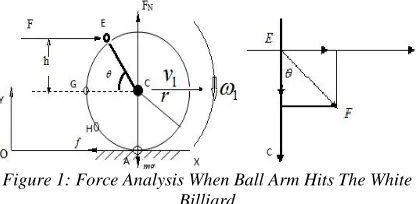
[image:1.612.314.524.593.695.2]As Figure 1 shows, a homogeneous entity billiard ball (weight, m; radius, r) is relatively motionless to the desktop. And the ball arm strikes the white billiard with an instantaneous impulsion. The point of action between the leather cue tip (spherical) and the white billiard (point E in Figure 1) is named as hitting point.
2.2. Quantitative analysis of the Safety zone
Both the white billiard and the leather cue tip have a spherical surface. As a result, the phenomenon of slider tends to happen likely when the leather cue tip hits on the marginal area of the white billiard. The area that is not easy for slider is called Safety zone in this article.
As can be seen from the force analysis of the hitting point in the right sketch map in Figure 1, the component force of
F
in the direction of EC is the positive pressure between the leather cue tip and the white billiard surface; the component force ofF
in the vertical direction of EC is the maximum friction force produced between the leather cue tip and the white billiard surface. Therefore, formula (1) should be appropriate in Safety zone:θ
µ
θ
θ
µ
tan
sin
cos
1 1
≤
∴
≤
F
F
(1)
In the formula:
µ
1 is the dynamic frictioncoefficient;
So the maximum hitting angle of Safety zone is
(
−
arctan
µ
1,
arctan
µ
1)
。2.3. Analysis Of The Finishing Moment Of Ball Arm Hitting The White Billiard
Billiard ball is a homogenous symmetrical rigid body and the center of mass, also the geometric center, is right the centre of the sphere. When the ball arm hits the white billiard, the white billiard’s center of mass forms a translational motion according to the principle of rigid body dynamics. And this process meets the momentum theorem, i.e., the impulse of the ball arm on the white billiard is equal to the momentum change of the translational motion of the center of mass of the white billiard, shown in Figure 1. When the white billiard is motionless, the translational velocity of the centric after ball arm hits the ball is exactly the velocity variation, and there is formula (2):
1
mv
v
m
Fdt
P
=
∫
=
∆
=
(2) In the formula:
P
is the impulse and∆
v
is the velocity variation of the white billiard;If the force received by the white billiard does not pass the centroid, there is rotation except for transitional motion. The motion state of the white billiard is a result of the combination of the two
kinds of motion. By means of motion decomposition as shown in Figure 1, analyze the rotation after
F
impact on pointE. The impulsive moment the white billiard suffered is the variation of its angular momentum according to the angular momentum theorem. And the variation of angular velocity is the white billiard’s initial angular velocity when the white billiard receives a impulse at static state. So there is formula (3):1 2
5
2
ω
ω
mr
J
Fhdt
=
∆
=
∫
(3)
In the formula:
J
means the rotational inertiaand equals to
2
5
2
mr
,
∆
ω
is the variation of the angular velocity;Combining formula (2) and formula (3), the linear velocity of the white billiard at the contacting point A of the desktop can be expressed as:
1 2 1
1
2
5
1
v
r
h
r
v
v
A
−
=
−
=
ω
(4) The motion state of the white billiard varies as the height (h) and force of batting vary. Shown in Figure 1, there will be three different situations when the same acting force F hits on three different point E, G, and H [11-12]:
When acting on point E and h is a positive value, the ball will begin clockwise rotation and
ω
1>
0
, i.e. push rod, commonly mentioned when playing; push rod has the effect of the white billiard trailing the aim billiard after the white billiard hits the aim billiard;When acting on point G and h is 0, the ball does not receive a impulsive moment and
ω
1=
0
, i.e.fixed rod, commonly mentioned when playing. The result of a fixed rod ball is the translational motion of the white billiard and it accords with the law of reflection in the process of white billiard hits a aim billiard;
3. THE RELATIVE MOTION SYSTEM OF WHITE BILLIARD AND MESA
3.1. The White Billiard’s Motion Before Hitting The Aim Billiard
In the coordinated system in the left scheme map in Figure 1, suppose that motion along the forward direction of axis x is positive;
v
1>
0
and meansthe translational velocity of the centric of the white billiard;
ω
1>
0
means clockwise rotation;f
isthe friction force of mesa on the white billiard;
µ
2means the sliding friction force between the white billiard and the mesa.
Analysis:
The sliding friction force between the white billiard and the mesa:
2
µ
mg
f
=
(5)1)If the linear velocity of point A
v
A>
0
, thedirection of
f
is along the negative direction of axis x:In this situation, the friction force of mesa on the white billiard is negative. The transitional motion of the centroid of the white billiard will always receive an impulse from a constant force (sliding friction force). And the rotation of the ball will get a dynamic moment impulse from the sliding friction. It will tend to that the translational motion decreases and the rotation increases. Judging from formula (2), (3) and (4), there will be a moment
1
t
thatv
A=
0
, meaning the sliding frictionbetween the mesa and the white billiard disappears. As the force of rolling friction is very tiny, it can be thought that the white billiard keeps a translational motion state. However, in other cases the white billiard could already hit the aim billiard in the process, which does not impact the analysis.
According to formula (4):
g
r
v
t
2 1 1 17
)
(
2
µ
ω
−
=
(6)
At
t
1:7
2
5
1 12 2
ω
ω
v
r
r
v
=
=
+
(7)
When
t
<
t
1, the translational velocity and theangular velocity are accordingly:
+
=
−
=
t
r
g
gt
v
v
2
5
2 1 2 1µ
ω
ω
µ
(8)When
t
>
t
1, the translational velocity equals tothe angular velocity. The white billiard will stop move gradually or hit the aim billiard under the force of rolling friction
If the linear velocity of point A
v
A=
0
, thevalue of
f
is 0;By analysis, the white billiard’s motion when
v
A=
0
is exactly the motion whent
>
t
1at 1).3)If the linear velocity of point A
v
A<
0
, thedirection of
f
is along the positive direction of axis x;By analysis, the sliding friction force is in the positive direction of axis x. So the translational velocity accelerates uniformly and the rotation angle velocity decelerates uniformly. Via formula
(4), there is a
moment
g
v
r
t
2 1 1 27
)
(
2
µ
ω
−
=
that
v
A=
0
; the whitebilliard’s motion state when
t
>
t
2is the same withthe motion when
t
>
t
1in 1).When
t
<
t
1, the translational velocity and theangular velocity are accordingly:
−
=
+
=
t
r
g
gt
v
v
2
5
2 1 2 1µ
ω
ω
µ
(9) In conclusion, supposing that the white billiard will not hit a aim billiard, there be a moment that
v
A=
0
, and the white billiard will continue toroll and move till stopping under the effect of force of rolling friction.
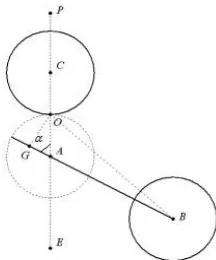
Assuming that the white billiard and the aim billiard are both elastic balls of the same weight and the same figure, so there will be no energy loss after collision. The principle of velocity transfer of direct impact of the two balls is shown in Figure 2. It can be seen that the component of white billiard’s translational velocity v in the direction of principle axis y is transferred to the aim billiard and the aim billiard starts to move in a velocity of
v
cos
α
. The white billiard only reserves the translational velocityv
sin
α
in the direction of principle axis x. the white billiard’s motion state after collision in the batting style of push rod is analyzed below. The translational velocity and angular velocity of the white billiard in the direction of principle axis y are respectively:v
y=
0
andω
y=
ω
cos
α
; the [image:4.612.320.524.60.198.2]translational velocity and angular velocity of the white billiard in the direction of principle axis x are respectively:
v
x=v
sin
α
andω
x=
ω
sin
α
.Figure 2: The Analysis Graphic When The White Billiard Collides An Aim Billiard
Decomposition of the white billiard’s motion in the direction of principle axis x and y, and the analytical method are basically the same with (3.1-1)-2)-3)), so it is not discussed here.
3.3. Error Analysis Of White Billiard Batting
Figure 3: Sketch Map Of Batting Error
[image:4.612.372.480.362.492.2]When the location of white billiard is below line MN, it is possible to hit the ball C into the bag. When the center of the white billiard and aim billiard is in the same line with the center of the bag, a score is at hand by hitting the aim billiard aiming at the center of it. When the centers of white billiard, the aim billiard and the bag are not on the same line, the collimation direction should offset a certain angle from the target center line and the collimation point should be near the central point of the aim billiard. Figure 3 shows a wrong way of hitting the ball [1-2].
Figure 4: Sketch map of correct batting
Design a hypothetical ball, shown as a dotted line ball in Figure 4. Only when the centers of the hypothetical ball, the aim billiard and the bag are collinear that it is possible to hit the aim billiard into the bag. Players need to make the white billiard’s position right through the zone of hypothetic ball.
→
BO
is a wrong batting direction in Figure 3 to make the three points O,A, B collinear, thinking that the centroid connection line is batting point connection line, because it neglects the shape of the billiard and the positional relation among the white billiard, aim billiard and the bag. [image:4.612.107.248.362.486.2]distance is called as error length,
L
errorand
R
L
error=
α
sin
. Players can estimate the track line and position of the white billiard based on some training data from experience.
4. ANALYSIS OF THE COLLISION BETWEEN THE WHITE BILLIARD AND THE “KEXING”
[image:5.612.329.494.319.426.2] [image:5.612.104.264.370.482.2]The surface of billiard table is often covered with woolen cloth. The edge of the table shore, lined with rubber strip, is usually named “CUSHING” in English, and “Ku” or “KEXING” in Chinese, which is the Chinese of the English pronunciation. “KEXING” is used to stand for the edge of the table shore in this article. The billiard’s motion state after colliding with the “KEXING” is related to its velocity before the collision. The velocity can be divided into two parts: the translational velocity of the centric and the rotational velocity of the billiard surface.
Figure 5: Sketch Map Of Collision Between Billiard And “KEXING”
As shown in Figure 5, the billiard collides with “KEXING” with a velocity of v and a incident angle of
α
; the billiard is rebounded from the “KEXING” with a velocity ofv
′
and a reflection angle ofβ
, the decomposition of the velocity on the “KEXING” direction and vertical “KEXING” direction is shown in Figure 5.4.1. Law of Reflection in Billiards Sport
When there is no rotational momentum of the billiard at the incident moment, there is no friction between the billiard and “KEXING” as well. The collision process accords with the law of reflection and meets the following formula:
′
′
=
=
=
′
=
∠
=
∠
⊥ ⊥
// //
tan
tan
v
v
v
v
v
v
β
α
β
α
(10)
4.2. Analysis of Collision of Sinisterly Ball and Dextral Ball with “KEXING”
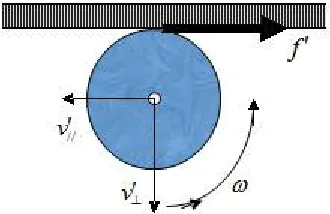
When there is rotational momentum of the billiard, the motion style of the partial rod ball is analyzed first. A partial rod ball is a batting style that ball arm hits on the left part or the right part of the billiard. Motion analysis after the billiard in such motion state collides with “KEXING” is shown in Figure 6.
Figure 6: Sketch Map Of Reflection Of A Partial Rod Ball
As the mode of motion shown in Figure 6, the billiard suffers a instantaneous impulse from a friction when reflected and reduces the
v
//, as aresult, the value of
v
//′
decreases. As ⊥⊥
=
v
′
v
,∠
α
<
∠
β
in Figure 5. So the billiardrebound process no longer simply meets the law of reflection.
4.3. Analysis of Collision of Topspin Ball and Under Spin Ball with “CUSHING”
When rotation exists in the mode of motion of billiard, the analysis of push rod ball and tie rod ball is needed. The situation of push rod tie rod has been discussed in the former text and the following is mainly to analyze the velocity variation of the push rod ball after collides with the “KEXING”. A friction will be generated when a topspin ball collides with “KEXING” and the motion in two directions are both changed as the friction force can be divided into two direction component. As the friction force in this situation is in the same direction with the billiard’s velocity before collision,
v
//′
increases andv
⊥′
decreases,therefore
∠
α
>
∠
β
; in the case of under spin,∠
α
<
∠
β
5. CONCLUSIONS
Billiards athletes should pay attention to the study of theoretical knowledge in the training process. The improvement of techniques and movement should be confirmed by scientific principle to make billiards sport more complete; the analysis of billiards movement can be realized by decomposition of velocity and from two aspects: translational motion and rotational motion. The translational process of billiard’s centric accords with the theorem of momentum and law of conservation of momentum; the rotational process follows the theorem of moment of momentum.
The determination of Safety zone when ball arm hits white billiard is based on the dynamical friction, which is a reflection of both’ physical attribute. Normally, rod drop phenomenon will not occur with a hitting angle ranging from [-53o, 53o].
The collimation of white billiard and aim billiard has collimation error and the drift angle meets the
formula
R
L
error=
α
sin
.
The aim of collision between white billiard and aim billiard includes: to hit the aim billiard into the bag and to create a favorable position for the next shot. It requires taking control of the white billiard’s drift angle issue as well as hitting force, to achieve a better position for the white billiard after collision; the research on billiards sport can explain the sport item more authentically. Description and
control of the billiards is the objective of the research, which is also the theoretical basis for the designing and developing of computer games. REFERENCES:
[1] Li J., “Declination equation of billiards impact”, Middle school mathematics journal (senior), Vol.2, 2000, pp.30-31.
[2] Dai J, Fu H.L, et al., „A bouncing ball model with an oscillating border”, Journal of Yangzhou University (Natural Science Edition), Vol.7, No.4, 2004, pp.27-31.
[3] Li D.S.,
“The Billiard physical problem”, Physics Teaching In Middle School, Vol.31, No.1, 2002, pp.28-34.
[4] Liu Z.L., “The Billiard mathematics”, Mathematics teaching, Vol.5, 2005, pp.23-29.
[5] Liu W.M, Han B, Li X.M., “Physical Principle in the Activity of Billiards”, Science & Technology Information, Vol.29, 2009, pp.8-9. [6] Yan Z.L, Wang W.S, Zeng G.W, et al., “Study on the Effect of Strength Exercises on the Single Soldier Tactics Action”, Journal of Beijing Sport University, Vol.33, No.1, 2010, pp.143-144.
[7] Ma W.H, Shi J.Z, Wang C., “Theoretical mechanics analysis of technology of snooker”,
Journal of Wuhan Institute of Physical Education, Vol.43, No.4, 2009, pp.48-51. [8] Liu W.R, Earl Don Tan, “An analysis of the
motion of billiards under the action of impulsive force”, College Physics, Vol.23, No.2, 2004, pp.25-27.
[9] Wang Y.Y., “Some mechanical problems in the billiard sport”, Journal of Tianjin Normal University, Vol.16, No.3, 1996, pp.65-69. [10] Zeng Wen, “Discussion on Angle of Attack in
the Main Phase of Crawl Paddling”, Journal of
Southern Institute of
Metallurgy,Vol.12,No.1,2011, pp.22-27. [11] Shuzo m urakam i, “cfd a nal ysis of win d
environm ent around a human body”, J win d en gineering, Vol.83, 1999, pp.393-408. [12] Hide ki t akagi, Yukimaru shim izu, “Norihisa