JULY-AUG 2016, VOL-4/25 www.srjis.com Page 2427 EFFECT OF UP AND DOWNHILL SURFACES TRAINING PROGRAMME ON
PERFORMANCE IN 5000M LONG DISTANCE RUN
G. K. Dhokrat, Ph. D.
Asso. Prof B.P.C.A’S College of Physical Education, Bharatiya Krida Mandir, Naigaon X
road, Wadala, Mumbai-31
The present study was planned to investigate the effect of up and downhill running regime on 5000-meter running performance of boy’s athletes. To conduct the study, 50 male athletes who competed in district level athletic competitions were selected as sample. The age range of the selected subjects was between 16 to 18 years. These selected subjects then divided into two groups i.e. experiment and control group with equal number of subjects assigned randomly in each group. The subjects of experimental group underwent up and down hill running as per the training schedule of eight weeks along with usual exercises whereas subjects of control group did not perform up and down hill running. Results indicate that eight weeks of up and downhill running during training period has been instrumental in improved performance in 5000m timings of athletes from experimental group as compared to athletes constituting the control group. It was concluded that up and downhill running should be included in training programme for athletes taking part in 5000m athletic event.
Keywords: Uphill running, downhill running, training, boy’s athletes, 5000m event
Background and Rationale
A common long distance running event in track and field event is 5000 metres or 5000-meter run. The 5000-meter run demands a great deal of aerobic endurance apart from speed. The 5000 meter run is basically an aerobic or endurance event. Hence aerobic capacity with speed is major components as far as elevated performance in 5000-meter track and field event is concerned. In this relation lactic tolerance and increased carbohydrate oxidative capacity plays a vital role. To attain desired outcomes training methods plays a vital role. To overload runner’s aerobic capacity, intensity, duration and frequency of running sessions are important. Track running performance require powerful exercise regime that includes equal distribution of energy contribution both from aerobic and anaerobic source.
In this context, researchers opined that combined uphill and downhill training improves performance, but these claims are not proven scientifically [Dintiman (1974),
Scholarly Research Journal's is licensed Based on a work at www.srjis.com
JULY-AUG 2016, VOL-4/25 www.srjis.com Page 2428 Costello (1976), Kunz and Kaufmann (1981), Paradisis et al. (1988), Paradisis and Cooke (2001)]. These researchers contended that uphill running is used to increase leg strength in sprinters. In uphill running quadriceps and calves do most of the work, so they get maximum benefit. The benefits of uphill running is scientific because while running upwards athletes drive their arms more vigorously as compared to when they are running on flat surface. Downhill running increase stride length and quick turnover and this practice naturally carries over to the flat surface by the athlete. The main advantage of uphill and downhill training includes development of power and muscle elasticity, improvement in stride frequency and length, improved coordination and correct use of arm action. It also improves control, stabilisation and speed. It is useful in strength endurance and lactate tolerance.
Although importance of running on uphill and downhill slopes in the field of athletics has been documented well but scientific studies regarding this are scanty. In a study of Paradisis and Cooke (2001) they have shown that six week combined uphill-downhill sprinting training improves step rate. But so far no such study has been conducted in India in which effect of eight weeks combined training on uphill and downhill slopes has been assessed on 5000m performance of boys athletes, hence the present study was planned. Objective of the Study
The main objective of the present study is to find out the effect of eight weeks uphill and downhill training programme on 5000 meter running performance of boys athletes. Hypotheses
In was hypothesized that eight weeks training schedule of running on uphill and downhill slope will result in improved performance of boy’s athletes in 5000m track and field event.
Methodology
(i) Research Methodology:
JULY-AUG 2016, VOL-4/25 www.srjis.com Page 2429 uphill and downhill training programme on 5000 meter running performance is to be ascertained, hence this design is suitable for the present study.
(ii) Population and Sample :
Population sampling is the process of taking a subset of subjects that is representative of the entire population. In the present study 5000 meter runners from Baba Sports Club, Saivan, Virar were considered as population. To conduct the study, 50 male athletes who competed in district level athletic competitions were selected as sample. The age range of the selected subjects was between 16 to 18 years. These selected subjects then divided into two groups i.e. experiment and control group with equal number of subjects assigned randomly in each group.
Tools and Techniques
5000 meter running is measured by performance in minutes and second. The administration of this test was done by the researcher through standard protocol.
The uphill and downhill training programme was framed by investigator after consultation with experts in the field of athletics. The training programme is as follows: Uphill training programme :
- The same leaning forward position as on the flat surface - Run with shorter steps and a bit higher stride frequency.
- The body weight must be on the balls of the feet and pull the feet from the ground under the hips.
- Get comfortable with the perception of shorter stride length and with the necessity to increase the stride frequency.
Downhill training programme :
- Keep the body straight. Just above the point of support on the ball of the foot as it on a flat surface as a running pose.
- Keep the feet strictly under the body and never extend them out or leave the behind. Training Schedule:
Weeks 1 2&3 4&5 6&7 8
Intensity 45%-55% 55%-65% 65%-75% 75%-85% 45%-55%
Exercise R
e p T T R e s R e p T T R es R e p T T Re s R ep
TT R
e s R e p T T R e s Up Hill
& Down Run
4 7 4 5 6 2.
30
6 5 2 7 5 0
. 5 0
4 7 4
JULY-AUG 2016, VOL-4/25 www.srjis.com Page 2430 Procedure:
The performance of each subject on 5000m running was recorded before the start of study period. The subjects of experimental group then underwent up-down hill running as per the training schedule. It includes 10 minute warm up, 40 minutes of up and then down hill running and 10 minutes for cool down. Boys athletes constituting control group performed their usual exercise routine during study period. After study period timings on 5000m run were once again recorded for each subject belonging to experimental and control group. Gain score (Post-pre test) was computed for experimental as well as control group to find out the changes in scores on 5000m running performance during study period. The obtained gain scores for both the groups were then compared with the help of paired sample ‘t’ test. ANCOVA was also applied to equal out the pre test scores. The results are presented in table no. 1, 2, 3 and 4 respectively.
[image:4.595.126.470.394.497.2]Results
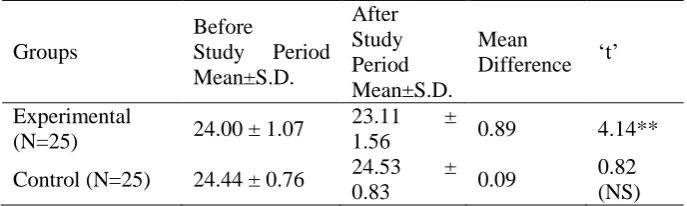
Table No. 1 Pre and Post-Test Statistics of 5000m Timings in Selected Boys Athletes of Experimental and Control Group
Significant at .01 level; NS - Not Significant
Statistical entries depicted in table 1 indicate no significant change in 5000m running timings of boys athletes belonging to control group (t=0.82, p>.05) but 5000m running performance of boys athletes have improved significantly (less timings in post test as compared to pre test) after eight weeks of combined up-and downhill running programme. (t=4.14, p<.01)
The changes in timings on 5000m track and field event of subjects belonging to experimental and control group during study period was tested with the help of gain score (Post test-pre test). The statistical calculation is presented in table 2.
Groups
Before
Study Period
Mean±S.D.
After Study Period Mean±S.D.
Mean
Difference ‘t’
Experimental
(N=25) 24.00 ± 1.07
23.11 ±
1.56 0.89 4.14**
Control (N=25) 24.44 ± 0.76 24.53 ±
0.83 0.09
JULY-AUG 2016, VOL-4/25 www.srjis.com Page 2431 Table No. 2 Comparison of Gain Score on 5000m timings between Experimental and
Control Group
A perusal of entries reported in table 2 indicate that time taken to complete 5000m run has decreased significantly in subjects belonging to experimental group (M = - 0.89) as compared to subjects of control group (M = 0.09).
In order to verify this result and as a way to exerting statistical control over pre-existing difference, ANCOVA technique was also applied to find out the efficacy of uphill and downhill training on 5000m running performance of boy’s. The ANCOVA results are presented in table 3 and 4 respectively.
Table 3 Analysis of Co-variance of Subjects Post Test Performance on 5000m Run on the Basis of their Pre-Test Scores
Source df Sum of Mean F Sig.
Squares Squares
Pre 40.454 1 40.454 54.57 .01
Groups 11.596 1 11.596 15.64 .01
Error 34.837 47 0.741
Total 28475.229 50
Table 4 Adjusted Mean Scores of Boys Athletes on 5000m Running Performance after Controlling Pre-Test Scores
Groups Adjusted Mean
Experimental Group 23.32
Control Group 24.31
Covariates appearing in the model are evaluated at the following values Pre test = 24.22 A closer look at entries shown in table 3 and 4 clearly indicate a statistically significant difference in adjusted mean scores in 5000m running performance between experimental (M=23.32) and control group (M=24.31). This fact is verified by obtained F=15.64 which is statistically significant at .01 level. [F(1,47)=15.64 at .01 level] The results also justify the findings presented in table 3 in the form of gain score.
Discussion
The results clearly indicate a beneficial effect of combined uphill and downhill running programme on 5000m performance. The findings of present study scientifically prove that uphill and downhill training is beneficial in increasing stride length, quick turn
Experimenta
l Group
(N=25)
Control Group (N=25)
‘t’ Sig.
Gain
[image:5.595.73.525.384.472.2]JULY-AUG 2016, VOL-4/25 www.srjis.com Page 2432 over, strength endurance and lactate tolerance as has been claimed by many sports scientists in the past. Hence due to well structured uphill and downhill running program, boys athletes took less time in completing the 5000m event.
Conclusion
On the basis of results and associated discussion it was concluded that running on uphill and down-hill slope under training programme of certain duration is beneficial in improving the performance of boys athletes as far as 5000m track and field event is concerned.
References
Costello, F. (1976). Resisted and assisted training to improve speed. Track Field Q Rev., 81:27. Dintiman, G. S. (1974). What research tells the coach about. Washington DC: AAHPER publications;
1974.
Kunz, H. and Kaufmann, D. (1981). Biomechanics of hill sprinting. Track Technique,; 82:2603–2605. Paradisis, G. and Cooke, C.B. (2001) Kinematic and postural characteristics of sprint running of
sloping surfaces. J Sports Sci.; 19:149–159.