Copyright © 2017, Scholarly Research Journal for Interdisciplinary Studies
A REVIEW OF NEW PUBLIC MANAGEMENT PRACTICE IN DEVELOPING COUNTRIES
Ajay Kumar Gautam
PhD Research Scholar, Centre for the Study of Law and Governance, Jawaharlal Nehru University, New Delhi 110067 [email protected]
Introduction of New Public Management (NPM) in public sector organizations typically results in an overhaul of the existing traditional management system, with renewed emphasis on improving efficiency and performance of the public sector organization. Public sector organizations and countries suffering from corruption, non-performance, bureaucracy, incompetence and high operational costs were in dire need of a new management system that would assist in bringing down operational costs, help manage resources and budget, minimize bureaucracy, eliminate corruption and improve the overall performance of the sector. NPM pertains to several strategies that can be adopted, such as decentralization and delegation of leadership, minimization of bureaucracy, privatization, human resource management, customer satisfaction, accountability, transparency, adoption of latest technology, resources and budget management and performance oriented management style. Several countries around the world have implemented NPM strategies among their public sectors, in order to deal with the growing rate of corruption and incompetence, lowering national morale and waste of resources, with mixed results. Sectors with highly complex workforce, multiple and highly ambiguous mission goals and objectives and efficient utilization of information, resources and budget, need new public management strategies for effective management.
Keywords: New Management Practice (NPM), bureaucracy, performance.
1.1 INTRODUCTION
1.1.1 About New Public Management practice and where it is used
New Public Management (NPM) paradigm indicates the inadequacies and failures of the
public sector organizations over time in addition to pointing out the various processes which
led to such failures. The concept of NPM had been introduced as a means of reorganizing
public sector organizations on lines of business management practices. The scope of NPM is
extensive as it addresses a variety of issues like size of the government, accountability
mechanism, resource management, and bureaucratic structure etc. (Kalimullah, Alam, and
Nour 2012a).
The NPM movement had started in the UK and the US but later its adoption has not been
Copyright © 2017, Scholarly Research Journal for Interdisciplinary Studies
Japan, Australia, Portugal, Netherlands and Norway but in 1990s many developing countries
in Asia, Africa and Latin America also came forward for NPM implementation. The range of
NPM adoption even extends to the poorest countries of Africa like Zimbabwe, Malawi,
Uganda, Zambia, as well as Ghana. But the concept implementation has not been the same
everywhere as the different components of NPM are adopted in different countries and that
too in different degrees. A number of principles which NPN promotes such as market
competition, customer orientation, and value-for-money are not observed in countries across
the world reinforcing the idea that NPM is emerging as a global concept (Haque 2003).
NPM mainly revolves around implementation of strategies inspired by management of
private sector into the field of public administration (Osborne 2006). The private sector
strategic approach is deployed in public sectors through NPM with the primary objective of
augmenting value and competencies of varied services provided by them. Thus NPM
proposes to bring about professionalism within public administration organizations (Leicht et
al. 2009). NPM is based upon the supposition that private organizations are comparatively
efficient than public service organization (Ehsan and Naz 2003).
One the most important features of NPM which differentiates it from traditional formats is
that NPM postulates promotion of professionalism and modernization based upon
individual’s experiences through a gradual process rather than just burdening it on
organizations (Leicht et al. 2009). Thus NPM is about developing a culture that would
support breeding of such qualities which in the long run would trigger creation of a
professionally managed public administration organization (Leicht et al. 2009). Another
feature of NPM is that it concentrates on development of entrepreneurial qualities amongst
people within public administration organization by motivating them to take leadership
through innovative approaches. People are educated and motivated to be flexible to new ideas
and thus foster innovation espousal (Damanpour and Schneider 2008).
NPM also advocates the presence of a two-way system wherein inputs in the form of quality
and quantity of resources are provided importance along with outputs provided by them. Thus
NPM provides for a mechanism to measure performances of varied resources used for
achieving the desired targets by setting performance benchmarks and auditing performances
to compare actual with desired ones (Osborne 2006). One of the distinctive features of NPM
is that it provides for a foundation wherein differing activities related to a public service are
Copyright © 2017, Scholarly Research Journal for Interdisciplinary Studies
administration companies to concentrate on management of costs and thus augment
efficiency levels through cost optimization. NPM has also established its effectiveness in
dealing with issues that is to a larger extent adversely affecting sustainability of public
service organizations. Some of these issues are intensification of competition amongst
companies for delivering services within public service organizations and determination of
contracts for allocating resources.
Current research work aims at reviewing the relevance of New Public Management, the extent of NPM implementation in developing countries and the challenges involved as such. 1.2 Literature Review
1.2.1 Emergence of need for NPM
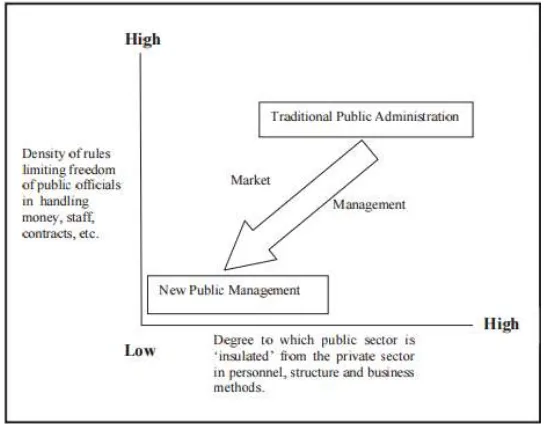
NPM is a contemporary management practice, not an inert phenomena but a budding one.
NPM is related with the rationality of economics holding fundamental public values. The
customary theories of public administration have been transmuted to deal with the evolving
geo-politics. Moreover, the emergence of New Public Management was grounded on the
basis of the superior starring role of the administration until the 1960s in socio-economic
revolution, reforms related to market, production, endowment and supervisory actions came
under harsh denunciation as there were monetary crunch, authoritative bureaucracy, meager
performance and absence of responsibility in public organizations, extensive corruption,
variations in public anticipation and appearance of better alternative forms of service
[image:3.595.162.435.495.707.2]distribution.
Copyright © 2017, Scholarly Research Journal for Interdisciplinary Studies Source: Kalimullah, Alam, et al. (2012)
Talking about the scenario in the western countries, Diefenbach (2011) asserted that an
unaffordable budget deficit occurred in western countries after the economic recession in late
70s. In order to handle such situation, the alternatives available were to curb the public
expenditure, raising the tax levied and to curb down the cost of performance and work in a
better way. This was possible with the advent of New Public Management in the public
sector. The worldwide managerial modification movements in public management of past
centuries have been determined largely by the administration’s reaction to the economic
crises fetched by variations in the global financial crises and by the requirements for
management services and strategies in the political arrangements.
Bakvis & Jarvis (2012) cited that the reason behind the emergence of NPM may be attributed
to the problems in realization of the potential of the public sector organizations. However, in
NPM the impression of giving up regulation to more independent public servants was
perilous.
1.2.2 Benefits/ relevance of NPM
NPM is the transmission of corporate and market ideologies and administrative practices
from the private into the public sector, associated with and constructed on a neo-liberal
consideration of state and economy. The ultimate aim of NPM therefore is at rimmed,
condensed, trifling state in which any public doings is dwindled and, if at all, employed
according to corporate doctrines of efficacy. The problems prevailing in the public sector can
be resolved and their functioning can be improved by way of NPM. NPM upsurge the aspects
of responsibility in the strategy process and a more assertive and commanding instruction for
public organizations. With the help of NPM, more realistic strategic planning is being done
for the long as well as medium term. The prominence is to make governments smaller and
well-organized by bringing about superior use of marketplaces, rivalry, shrinking out and
setting target for better performance. Through NPM, customers are provided satisfactory
services at both local and central level (Raju 2007).The importance of NPM in public sector
was highlighted by Paradeise et al. (2009) as the public expenditure is reduced to a
considerable extent by its implementation.
Mongkol (2011) averred that NPM brings reforms in public sector by way of improving the
Copyright © 2017, Scholarly Research Journal for Interdisciplinary Studies
effectiveness of government organizations and making implementation of policy more
operative.
Haynes (2015) has asserted that through New Public Management, some purposeful
transformations are made in the frameworks and operations of the public sector companies.
By implementing New Public Management, public sector companies can better allocate their
resources as NPM calls for customer driven alterations. New Public management is a
transformation from command and expert officialdom to a more supervisory and market
based system. It is the implementation of corporate and private sector philosophies on public
sector organization thereby benefiting these organizations in the day to day operations
(Haynes 2015).
1.3 Discussion
1.3.1 Approaches of NPM
Approaches to NPM can be specified as the varied line of actions that is pursued in order to
effectively implement this management perspective and reap maximized benefits. Different
scholars and researchers over a period of time have provided multiple approaches to NPM. In
order to develop a superlative topology of NPM, Ferlie et al. (1996) determined four major
approaches to NPM in the form of four models. These models are namely, the efficiency
drive model, downsizing and decentralization model, search of excellence model and service
orientation model.
The efficiency drive approach as highlighted by Ferlie et al. (1996) and Ehsan & Naz (2003)
is based upon adoption of strategies that are mainly driven from private sector management
into the area of public management and administration. In another study by Osborne (2006) it
was clearly postulated that efficiency drive of NPM is basically related to determination of
competent tactical approaches as deployed in private organizational sector which can also be
executed in public administration to augment its existing efficiency levels. The second
approach to NPM that is downsizing and decentralization model, as identified by Ferlie et al.
(1996) is based upon the principle of augmenting organizational flexibility and effective
integration of activities pursued at differing levels. Accordancing to O’Flynn (2007), public
administration organizations lack effectiveness due to duplication of work as well as lower
productivity of employees who are subjected to limited responsibilities.
Search of excellence model as per Ferlie et al. (1996) is related to augmenting organizational
Copyright © 2017, Scholarly Research Journal for Interdisciplinary Studies
that focuses on innovation and change. Bockel & Noordegraaf (2013) in lieu of developing
an excellent organizational culture suggested overhauling of compensation schemes for
employees in public administration sector. Service orientation model as identified by Ferlie et
al. (1996) is an approach in which public sector organizations indulge in providing values to
customers. It is thus also specified as value-driven approach.
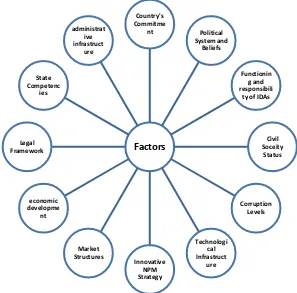
1.3.2 Determining factors for implementing NPM in developing countries
Sarker, (2006) in his study asserted that an array of factors are to be considered while
implementing NPM primarily as these factors very strongly affect success quotient of NPM
execution. These factors played identified were extent of economic development experienced
by the country, presence of formal and appropriate market structures, legal rules and related
framework, highly developed state of administrative infrastructure and overall competency of
a state. Gautam, (2008) identified factors which influenced NPM implementation adversely
in the sphere of public administration as adoption of ineffective process for policy
reformations, prevalent political circumstances, strong and stringent bureaucratic code of
[image:6.595.156.453.403.696.2]conduct and path dependency attributes.
Figure 3: Factors Affecting NPM Implementation Source: Author Factors Country's Commitme nt Political System and Beliefs Functionin g and responsibili
ty of IDAs
Copyright © 2017, Scholarly Research Journal for Interdisciplinary Studies 1.3.3 Challenges of implementing NPM in developing countries
Polidano (1999) argued the appropriateness of NPM in developing countries in his research
by stating that usually it is perceived that NPM is not suitable for such countries because of
popular stories of its failure. Larbi (2003) while talking about the challenges of implementing
new public management in developing countries cited that many countries blindly follow the
blueprints while implementing NPM which leads to failure. Elias Sarker (2006) explored and
analyzed the various factors that are responsible for the success and failure of NPM
ingenuities in developing countries. It was found that Bangladesh is lagging far behind
resulting in little achievement in NPM reforms.
Chittoo et al. (2009) also attempted to throw light on the obstacles in implementing NPM in
developing countries. It was found that the reforms never passed their implementation stage
despite of their urgent need to make reforms because of globalization and need to be
competitive in the international markets.
Rosta (2011) instituted that NPM is being discouraged by many experts in developing
nations. He asserted that a proper approach is not adopted by the developing nations due to
lack of a causative environment and institutional system. Rahman et al. (2013) while talking
about Brazilian perspective stated that Brazil saw sequential failure in the management
reform in the federal government. The main reason behind the failure was found to be the
dilemma of control. It was further observed that there was dearth of cooperation of the
strategic actors which was required for the purpose of monetary adjustment and the
institutional alteration.
In the same year, Engida & John Bardill (2013) expounded thatdeveloping countries were
also found to be highly guarded by feeble capacity and supply restrictions which impede
applications of plans and programs for enhancement and development of services.
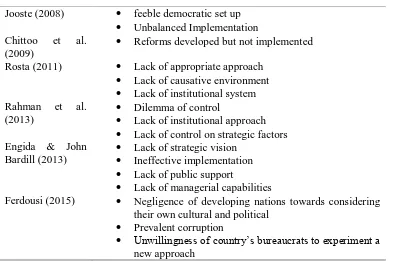
Author Name Challenges
Polidano (1999) Lack of expertise
Poor information systems
Corruption and nepotism in governments
Ineffective control management
Larbi (2003) Developing countries blindly following developed
countries
Improper sequencing of reforms
Elias Sarker
(2006)
Inadequate level of financial growth
Presence of unofficial market economy,
Legal Issues
Copyright © 2017, Scholarly Research Journal for Interdisciplinary Studies
Jooste (2008) feeble democratic set up
Unbalanced Implementation
Chittoo et al.
(2009)
Reforms developed but not implemented
Rosta (2011) Lack of appropriate approach
Lack of causative environment
Lack of institutional system
Rahman et al.
(2013)
Dilemma of control
Lack of institutional approach
Lack of control on strategic factors
Engida & John Bardill (2013)
Lack of strategic vision
Ineffective implementation
Lack of public support
Lack of managerial capabilities
Ferdousi (2015) Negligence of developing nations towards considering
their own cultural and political
Prevalent corruption
Unwillingness of country’s bureaucrats to experiment a
new approach
Table Error! No text of specified style in document..1 Summarizing Challenges of NPM Source: Author
1.4 Conclusion
On the basis the discussion above it can be determined that NPM has been by far considered
to be one of the significant approaches that is adopted by most of developed countries which
is motivating developing countries to follow suit. An overhaul of public administration sector
across the globe is the need of the hour. In spite of failures experienced while implementing
NPM in many circumstances it can be yet specified that it is one of the most modernized
approaches that will support public sector companies to overcome inefficiencies to a larger
extent. Overall, NPM could be concluded as, a new management practice offering advantages
and improvement in existing sectors in the form of better management practices, decrease in
bureaucracy, budget and resource management, increased creativity and initiation among
employees for jobs and lastly clear delegation and decentralization of leadership among the
personnel. New Public Management strategies in public sector are based more on outcomes,
focus on provision of efficient services to the public, accountability and an overall
governance approach (Casey and Mitchell 2007). Based on these observations in the present
study it could be concluded that NPM has certain primary objectives like improving
management and hierarchy practices within the system, improving budget and resource
management, decentralization and delegation of leadership and finally improving decision
[image:8.595.105.516.85.346.2]Copyright © 2017, Scholarly Research Journal for Interdisciplinary Studies References
Bakvis, Herman, and Mark D. Jarvis. 2012. From New Public Management to New Political Governance: Essays in Honour of Peter C. Aucoin. London: MQUP.
Bockel, Jeroen van, and Mirko Noordegraaf. 2013. “Identifying Identities: Performance‐ driven, but Professional Public Managers.” International Journal of Public Sector Management, April. Emerald Group Publishing Limited.
Casey, John, and Margaret Mitchell. 2007. “Requirements of Police Managers and Leaders from Sergeant to Commissioner.” Training and Education, no. March:1–18.
Chittoo, Hemant B., Needesh Ramphul, and Bhissum Nowbutsing. 2009. “Globalization and Public Sector Reforms in a Developing Country.” Culture Mandala: Bulletin of the Centre for East-West Cultural & Economic Studies2 8 (2):30–51.
Damanpour, F., and M. Schneider. 2008. “Characteristics of Innovation and Innovation Adoption in Public Organizations: Assessing the Role of Managers.” Journal of Public Administration Research and Theory 19 (3):495–522. https://doi.org/10.1093/jopart/mun021.
Diefenbach, Fabian Elias. 2011. Entrepreneurship in the Public Sector: When Middle Managers Create Public Value. Heidelberg: Springer Science & Business Media.
Ehsan, M., and Naz. 2003. “ORIGIN, IDEAS AND PRACTICE OF NEW PUBLIC MANAGEMENT: LESSONS FOR DEVELOPING COUNTRIES.” Asian Affairs 25 (3):30–48.
Elias Sarker, Abu. 2006. “New Public Management in Developing Countries.” International Journal of Public Sector Management 19 (2). Emerald Group Publishing Limited:180–203. https://doi.org/10.1108/09513550610650437.
Engida, Tadesse Getacher, and John Bardill. 2013. “Reforms of the Public Sector in the Light of the New Public Management: A Cases of Sub-Saharan Africa.” Journal of Public Administration and Policy Research 5 (1):1–7.
Ferdousi, F. 2015. “Factors Affecting Implementation of New Public Management in Bangladesh.” International Journal of Management Sciences 5 (5):315–28.
Ferlie, E., A. Pettigrew, L. Ashburner, and L. Fitzgerald. 1996. The New Public Management in Action. New York: Oxford University Press.
Haque, M Shamsul. 2003. “New Public Management: Origins, Dimensions, and Critical Implications.” Public Administration and Public Policy I.
Haynes, Philip. 2015. Managing Complexity in the Public Services. 2nd ed. London: Routledge. Jooste, Stephan F. 2008. “A New Public Sector in Developing Countries.” California.
Kalimullah, Nazmul Ahsan, K. Alam, and M. Nour. 2012a. “New Public Management: Emergence and Principles.” BUP Journal 1 (1):1–22.
Kalimullah, Nazmul Ahsan, Kabir M. Ashraf Alam, and M. M. Ashaduzzaman Nour. 2012b. “New Public Management: Emergence and Principles.” BUP JOURNAL 1 (1):1–20.
Larbi, G. 2003. “OVERVIEW OF PUBLIC SECTOR MANAGEMENT REFORM.” 112.
Leicht, K. T., T. Walter, I. Sainsaulieu, and S. Davies. 2009. “New Public Management and New Professionalism across Nations and Contexts.” Current Sociology 57 (4):581–605. https://doi.org/10.1177/0011392109104355.
Mongkol, Kulachet. 2011. “The Critical Review of New Public Management Model and Its Criticisms.” Research Journal of Business Management 5 (1):35–43. https://doi.org/10.3923/rjbm.2011.35.43.
Copyright © 2017, Scholarly Research Journal for Interdisciplinary Studies https://doi.org/10.1111/j.1467-8500.2007.00545.x.
Osborne, S. 2006. “The New Public Governance?” Public Management Review 8 (3):377–87.
Paradeise, Catherine, Emanuela Reale, Ivar Bleiklie, and Ewan Ferlie. 2009. University Governance: Western European Comparative Perspectives. Berlin: Springer Science & Business Media. Polidano, C. 1999. “The New Public Management in Developing Countries.” 13.
Rahman, Md. Mizanur, Leslie Sue Liberman, Vincentas Rolandas Giedraitis, and Tahmina Akhte. 2013. “The Paradigm from Traditional Public Administration to New Public Management System in Bangladesh: What Do Reform Initiatives Stand For?” Advances in Economics and Business 1 (3):297–303.
Raju, K. D. 2007. Genetically Modified Organisms: Emerging Law and Policy in India. New Delhi: The Energy and Resources Institute (TERI).