R E S E A R C H
Open Access
Inadequate description of educational
interventions in ongoing randomized controlled
trials
Cécile Pino
1*, Isabelle Boutron
1,2,3and Philippe Ravaud
1,2,3Abstract
Background:The registration of clinical trials has been promoted to prevent publication bias and increase research transparency. Despite general agreement about the minimum amount of information needed for trial registration, we lack clear guidance on descriptions of non-pharmacologic interventions in trial registries. We aimed to evaluate the quality of registry descriptions of non-pharmacologic interventions assessed in ongoing randomized controlled trials (RCTs) of patient education.
Methods:On 6 May 2009, we searched for all ongoing RCTs registered in the 10 trial registries accessible through the World Health Organization International Clinical Trials Registry Platform. We included trials evaluating an educational intervention (that is, designed to teach or train patients about their own health) and dedicated to participants, their family members or home caregivers. We used a standardized data extraction form to collect data related to the description of the experimental intervention, the centers, and the caregivers.
Results:We selected 268 of 642 potentially eligible studies and appraised a random sample of 150 records. All selected trials were registered in 4 registers, mainly ClinicalTrials.gov (61%). The median [interquartile range] target sample size was 205 [100 to 400] patients. The comparator was mainly usual care (47%) or active treatment (47%). A minority of records (17%, 95% CI 11 to 23%) reported an overall adequate description of the intervention (that is, description that reported the content, mode of delivery, number, frequency, duration of sessions and overall duration of the intervention). Further, for most reports (59%), important information about the content of the intervention was missing. The description of the mode of delivery of the intervention was reported for 52% of studies, the number of sessions for 74%, the frequency of sessions for 58%, the duration of each session for 45% and the overall duration for 63%. Information about the caregivers was missing for 70% of trials. Most trials (73%) took place in the United States or United Kingdom, 64% involved only one centre, and participating centers were mainly tertiary-care, academic or university hospitals (51%).
Conclusions:Educational interventions assessed in ongoing RCTs of educational interventions are poorly described in trial registries. The lack of adequate description raises doubts about the ability of trial registration to help patients and researchers know about the treatment evaluated in trials of education.
* Correspondence:[email protected]
1INSERM, U738, Paris, France
Full list of author information is available at the end of the article
Background
The International Committee of Medical Journal Editors (ICMJE) has promoted the registration of clinical trials to meet the challenge of research transparency, includ-ing the ability to adequately address publication bias and selective reporting, and reduce the amount of wasted re-search [1-4]. Since 2005, the ICMJE has required registration of all clinical trials as a condition of consid-eration for publication [1].
At present, agreement exists on the minimum protocol information that should be registered for a trial, that is, the 20-item World Health Organization (WHO) Trial Registration Data Set [5,6]. One item of this dataset is devoted to the intervention. However, recommendations for the reporting of this item focus on pharmacologic treatments. No clear guidance is provided for descrip-tions of non-pharmacologic interventions in trial registries.
Nevertheless, reporting non-pharmacologic treat-ments is important but difficult. Non-pharmacologic interventions, such as educational interventions, are usually complex interventions involving several components [7] and so are difficult to describe, standardize, reproduce and administer consistently to all patients [8]. In addition, these interventions usu-ally strongly depend on the context of care, such as the care provider’s expertise [9].
The frequency of noncommunicable diseases is in-creasing, and determining ways to support people with chronic illness is a strong focus of healthcare agendas [10]. Patient education through various educational interventions plays an essential role for adequately understanding and managing chronic diseases [11]. Thus, results from a growing number of randomized controlled trials (RCTs) assessing educational interven-tions have been published in the last 10 years and cur-rently represent about 20% of the published results of RCTs [12].
We aimed to evaluate the quality of descriptions of interventions assessed in RCTs registered in the WHO International Clinical Trials Registry Platform (ICTRP). We focused on descriptions of the intervention and the context of care in the field of patient education.
Methods Search strategy
On 6 May 2009, we searched for all ongoing RCTs asses-sing an educational intervention that were registered in the 10 registries accessible by the WHO search portal [13]: Australian New Zealand Clinical Trials Registry, Chinese Clinical Trial Register, ClinicalTrials.gov, Clin-ical Trials Registry – India, German Clinical Trials Register, Iranian Registry of Clinical Trials, ISRCTN.org, Sri Lanka Clinical Trials Registry, The Netherlands
National Trial Register and EU Clinical Trials Register. We used this platform because it allows access to all pri-mary registries meeting the WHO criteria. We searched for the intervention “education” for ongoing trials cur-rently recruiting subjects.
Eligibility criteria
Eligibility criteria were an ongoing randomized clinical trial (recorded as “randomized” or described as rando-mized in the description of the intervention), evaluating an educational intervention (that is, designed to teach or train patients concerning their own health [11]) and dedi-cated to participants (healthy or sick), their family mem-bers or home caregivers. We excluded interventions involving health workers if the intervention was integrally delivered to them and curative interventions designed to treat mental disorders, such as psychotherapy.
Two reviewers independently screened all potentially eligible studies. All disagreements were resolved by con-sensus and with a third reviewer if necessary.
From the selected records, we randomly chose a sam-ple of 150 records (50%).
Data collection
We developed a data extraction form and two reviewers (CP, IB) independently tested it with a sample of 20 studies. The agreement rate between the reviewers ran-ged from 0.7 to 1.
Then, a single reviewer (CP) used the standardized data extraction form to collect data from 1) the record in the WHO International Clinical Trials Registry Plat-form, 2) the record in the primary registry (for example, ClinicalTrials.gov, Netherlands National Trial, Australian New Zealand Clinical Trials Registry (. . .)) and 3) the website included in the record or previous publications listed in the record. All materials mentioned were searched. We did not search the Internet or write to the investigators for additional data. We collected the fol-lowing data.
General characteristics
We recorded the primary registry, date of registration, study design, comparator, sample size, number of arms and number of experimental arms. We also noted the type of patients enrolled (healthy or sick), mode of re-cruitment, age of study participants, and centres involved (country, number of centers, type of center).
New Zealand Clinical Trials Registry). We considered that the number was not reported if we could not find at least one result in the fields mentioned above. We classi-fied the trial “unclear multicentric” if the term multi-centric was used to describe the trial with no details on the centers involved.
Intervention
We recorded the type of intervention (for example, grammed interaction with a therapist, Web-based pro-gram, use of educational material (DVD, booklet) or other type of intervention), and the involvement of other people closely related to the patient in the educational intervention.
We assessed whether items related to the intervention were reported according to the recommendations of the
Consort Statement extension for trials of
non-pharmacologic treatment [8]. We first determined whether qualitative data were reported and whether the record included information on the mode of delivery (for example, group or individual), care providers and how the intervention was standardized. We determined whether the content of educational sessions was 1) clearly described (that is, all key components reported),
2) available in a publication or on a website referenced in the record, or 3) not reported (that is, many import-ant pieces of information were missing).
We assessed the reporting of quantitative data, such as the number, frequency and duration of sessions and the course period (that is, the period when participants received the intervention).
If several interventions were assessed, we reported the best-described intervention in the data extraction form.
Statistical analysis
We used descriptive statistics for continuous variables: median [interquartile range], minimum and maximum values. Categorical variables were described with fre-quencies and percentages. Data analyses involved use of R for Windows, release 2. 9.
Results Studies selected
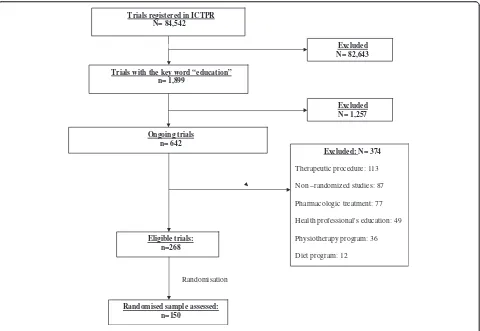
Figure 1 describes the trial selection process. We selected 268 of 642 potentially eligible ongoing studies, then randomly selected and appraised 150 studies (56% of the eligible sample).
Trials registered in ICTPR N= 84,542
Trials with the key word “education” n= 1,899
Excluded N= 82,643
Ongoing trials n= 642
Excluded N= 1,257
Eligible trials: n=268
Excluded: N= 374
Therapeutic procedure: 113 Non –randomized studies: 87 Pharmacologic treatment: 77 Health professional's education: 49 Physiotherapy program: 36 Diet program: 12
Randomised sample assessed: n=150
[image:3.595.59.539.389.720.2]Randomisation
Participants and setting
All selected trials were registered in four registers, mainly ClinicalTrials.gov (60.7%). The median target sample size was 205 [100 to 400] patients. The com-parator(s) were mainly usual care (47%) or an active treatment (47%). Of these, most concerned other edu-cational interventions [14].
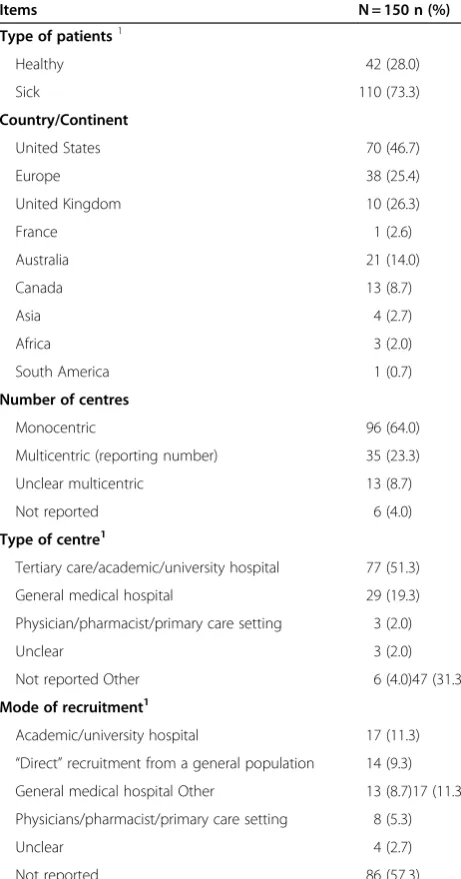
Study characteristics are summarized in Table 1. In total, 70 trials (47%) were taking place in the United States and 38 (26%) in Europe; no study involved low-income countries. When centres were reported, most trials (64%) involved only one centre. Participating cen-tres were mainly tertiary-care, academic or university hospitals (51%).
Intervention
Most studies (84%) used programmed interaction (that is, education sessions or phone calls); 30% used educa-tional material (that is, DVD or booklet) and 11% an Internet program (Table 2). Of 150 interventions studies, 38 (25%) involved other people closely related to the participant.
[image:4.595.57.288.279.719.2]A minority of records (17%, 95% CI 11 to 23%) reported an overall adequate description of the interven-tion (that is, descripinterven-tion that reported the content, mode of delivery, number, frequency, duration of sessions and overall duration of the intervention. For most reports, qualitative data were not reported. For 88 (59%) studies, the content of the educational sessions was not reported. The content was clearly described for 30% (n = 45) of the Table 1 Study characteristics
Items N = 150 n (%)
Type of patients1
Healthy 42 (28.0)
Sick 110 (73.3)
Country/Continent
United States 70 (46.7)
Europe 38 (25.4)
United Kingdom 10 (26.3)
France 1 (2.6)
Australia 21 (14.0)
Canada 13 (8.7)
Asia 4 (2.7)
Africa 3 (2.0)
South America 1 (0.7)
Number of centres
Monocentric 96 (64.0)
Multicentric (reporting number) 35 (23.3)
Unclear multicentric 13 (8.7)
Not reported 6 (4.0)
Type of centre1
Tertiary care/academic/university hospital 77 (51.3)
General medical hospital 29 (19.3)
Physician/pharmacist/primary care setting 3 (2.0)
Unclear 3 (2.0)
Not reported Other 6 (4.0)47 (31.3)
Mode of recruitment1
Academic/university hospital 17 (11.3)
“Direct”recruitment from a general population 14 (9.3)
General medical hospital Other 13 (8.7)17 (11.3)
Physicians/pharmacist/primary care setting 8 (5.3)
Unclear 4 (2.7)
Not reported 86 (57.3)
1
[image:4.595.303.538.303.688.2]Multiple answers were possible, so the total does not equal 100%.
Table 2 Description of the intervention
Items N = 150 n (%)
Components1
Programmed interaction 126 (84.0)
Internet program 16 (10.7)
Educational material 45 (30.0)
Other 7 (4.7)
Not reported 5 (3.3)
Involvement of other people closely related to the patient
38 (25.3)
Reporting of
Mode of delivery2(n = 126) 65 (51.6)
Number of sessions/calls/contact2(n = 134) 100 (74.2)
Frequency of sessions/calls/contact2(n = 134) 78 (58.2)
Duration of each sessions/calls/contact2(n = 137) 61 (44.5)
Overall duration of the intervention 94 (62.7)
Description of the content of the intervention
Reporting all the key components 45 (30.0)
Content referenced and available 17 (11.3)
Content not reported or much information missing 88 (58.7)
Reporting of
Information about care provider2(n = 146) 44 (30.1)
Methods of standardization2(n = 135) 9 (6.7)
Reference(s) to previous publication(s) 42 (28.0)
Availability of a website that provides additional data
Yes - free and accessible 17 (11.3)
Yes - but not free access 4 (2.7)
Yes - but not accessible 5 (3.3)
No 124 (82.7)
1
Multiple answers were possible, so the total does not equal 100%.
2
studies and the description of the content was available in a publication for 28% (n = 42). In total, 11% (n = 17) of reports referenced a website that provided access to edu-cational materials; none of the other 89% of reports pro-vided additional materials.
Information about the care providers administering the intervention was available for 30% (n = 44) of the trials and methods of standardization were specified for 7% (n = 9).
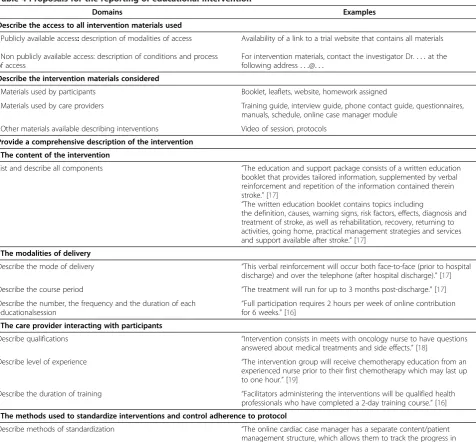
The mode of intervention delivery was reported for 52% (n = 65) of the studies, the number of sessions for 74% (n = 100), the frequency of sessions for 58% (n = 78), the duration of each session for 45% (n = 61) and the overall duration of the intervention for 63% (n = 94) (Tables 3 and 4).
Discussion
This study assessed information included in trial regis-tration for a representative random sample of 150 on-going RCTs assessing an educational intervention, a non-pharmacologic treatment, in the WHO Inter-national Clinical Trial Registry Platform. For most trials (59%), interventions were insufficiently described in terms of educational content, modes of delivery and care providers’ qualifications. Most trials (73%) took place in the United States or the United Kingdom, 64% involved only one centre, and participating centres were mainly tertiary-care, academic or university hospitals (51%). The lack of adequate description in such trials raises doubts about the ability of trial registration to help patients and researchers know about the treatment evaluated.
Prospectively registering clinical trials, by placing key protocol information about the trial in the public do-main, has been promoted to prevent misconduct in trials, specifically selective reporting [21]. The lack of ad-equate reporting of the interventions in registries raises several problems for patients, clinicians and researchers. First, knowing precisely the content of an experimental intervention is a preliminary step for patients who wish to participate in an ongoing trial. As well, clinicians and researchers need to have a clear description of interven-tions that are currently assessed when they plan new trials. Finally, researchers performing meta-analyses need to precisely identify ongoing studies meeting their inclu-sion criteria.
Our findings may be explained in part by the lack of consideration of the specifics of non-pharmacologic interventions in guidelines for trial registration. For ex-ample, guidelines for the item dedicated to the interven-tion in the WHO Trial Registrainterven-tion Data Set are “If the intervention consists of several separate treatments, list them all (e.g., "low-fat diet, exercise"). For each interven-tion, describe other intervention details as applicable (dose, duration, mode of administration, etc.)”. These recommendations are appropriate for drugs but not for non-pharmacologic treatments. Indeed, educational interventions are complex, involve several components [7] and are, therefore, difficult to describe, standardize, reproduce [8].
[image:5.595.54.538.486.736.2]Space constraints in both scientific journals and trial registration databases may restrict the full reporting of interventions [22]. Potential solutions to providing
Table 3 Some examples of missing and reported elements of interventions
Intervention's description Reported and missing elements
Title:“Arthritis Self-Management Education Program”
“Participants will receive two weeks, lay led, workshop focusing on goal setting, problem solving, and content specific to disease management.”[15]
Reported elements:
overall duration: two weeks
Missing elements:
mode of delivery, number, frequency, duration and content of sessions, care provider's qualification, standardization method
Title: Evaluation of an Online Fatigue Self-management Group Intervention for Adults with Multiple Sclerosis
“This 7-week intervention will follow the published protocol outlined in Managing Fatigue (Packeret al., 1995).
Full participation requires 2 hours per week of online contribution. Each session is highly structured and includes an education session, practice activities, discussions and homework assignment. The topics include the importance of rest, communication and body mechanics, organizing work stations, setting priorities and standards, balancing schedules and setting goals. All teaching content, worksheets, and homework assignments are provided online. Also participants can share information, express their ideas or feelings and offer advice or support to one another.
Facilitators administering the interventions will be qualified health professionals (occupational therapists, nurses or social workers) who have completed a 2-day training course.”[16]
Reported elements:Content: quickly described but referenced overall duration: six weeks
number: six sessions frequency: weekly
duration of sessions: two hours mode of delivery: online
standardization methods: highly structured sessions care provider's qualification: occupational therapists, nurses or social workers trained for two days
Missing elements:
complete descriptions include Internet hyperlinks to add-itional information and educational materials, establishing a stable “intervention bank” where materials and proce-dures are made available [22] and the use of graphics to depict the flow and timing of sessions of treatment [23].
However, the complete reporting of items in trial registries raises issues related to intellectual property. Research teams that developed these interventions have invested time and money and are entitled to protect their data before the publication of the study results.
Our results are consistent with those of previous studies investigating the quality of reporting in trial registries
[21,24-26]. As well, previous studies demonstrated inad-equate descriptions of non-pharmacologic treatment in published articles [11,27-29]. Glasziouet al.[27]. reported that about 70% of reports of trials evaluating non-pharmacologic treatment provided insufficient information on the intervention to allow for replication in practice.
[image:6.595.60.537.95.537.2]The inferences from this study are limited by the in-herent limitations of trial registries. The search strategy may not have identified all studies evaluating educational interventions. Registries have limited advanced search capabilities; contrary to search strategies for databases of published articles, such as MEDLINE or the Cochrane Table 4 Proposals for the reporting of educational intervention
Domains Examples
Describe the access to all intervention materials used
•Publicly available access:description of modalities of access
•Non publicly available access: description of conditions and process of access
Availability of a link to a trial website that contains all materials
For intervention materials, contact the investigator Dr.. . .at the following address. . .@. . .
Describe the intervention materials considered
•Materials used by participants Booklet, leaflets, website, homework assigned
•Materials used by care providers Training guide, interview guide, phone contact guide, questionnaires,
manuals, schedule, online case manager module
•Other materials available describing interventions Video of session, protocols
Provide a comprehensive description of the intervention
•The content of the intervention
List and describe all components “The education and support package consists of a written education
booklet that provides tailored information, supplemented by verbal reinforcement and repetition of the information contained therein stroke.”[17]
“The written education booklet contains topics including
the definition, causes, warning signs, risk factors, effects, diagnosis and treatment of stroke, as well as rehabilitation, recovery, returning to activities, going home, practical management strategies and services and support available after stroke.”[17]
•The modalities of delivery
Describe the mode of delivery “This verbal reinforcement will occur both face-to-face (prior to hospital
discharge) and over the telephone (after hospital discharge).”[17]
Describe the course period “The treatment will run for up to 3 months post-discharge.”[17]
Describe the number, the frequency and the duration of each
educationalsession “
Full participation requires 2 hours per week of online contribution for 6 weeks.”[16]
•The care provider interacting with participants
Describe qualifications “Intervention consists in meets with oncology nurse to have questions
answered about medical treatments and side effects.”[18]
Describe level of experience “The intervention group will receive chemotherapy education from an
experienced nurse prior to their first chemotherapy which may last up to one hour.”[19]
Describe the duration of training “Facilitators administering the interventions will be qualified health
professionals who have completed a 2-day training course.”[16]
•The methods used to standardize interventions and control adherence to protocol
Describe methods of standardization “The online cardiac case manager has a separate content/patient
management structure, which allows them to track the progress in terms of readings, educational activities and patient self-report data.”[20]
Central Register of Controlled Trials, search strategies of registries have not been evaluated. In addition we did not write to the investigators for clarification.
Conclusions
We show that educational interventions assessed in on-going RCTs are poorly described in trial registration. The lack of adequate description raises doubt about the ability of trial registration to help patients and research-ers know the treatment evaluated.
Abbreviations
ICMJE: International Committee of Medical Journal Editors; WHO: World Health Organization; CONSORT: Consolidation of the standards of reporting trials; RCTs: Randomized controlled trials; ICTRP: International Clinical Trials Registry Platform.
Competing interests
The authors declare that they have no competing interests.
Authors’contributions
CP participated in the study concept and design, the literature search and identifying relevant trial records and the acquisition of data from included records; performed the statistical analysis; and participated in the analysis and interpretation of data and drafted the manuscript. IB participated in the study concept and design, the literature search and identifying relevant systematic reviews, the analysis and interpretation of data, the critical revision of the manuscript for important intellectual content and the study supervision. PR participated in the study concept and design, the analysis and interpretation of data and the critical revision of the manuscript for important intellectual content; and supervised the study. CP is guarantor and has full access to all of the data in the study and takes responsibility for the integrity of the data and the accuracy of the data analysis. All authors read and approved the final manuscript.
Acknowledgements
We thank Laura Smales who edited this manuscript.
Funding
This study was funded by a grant“Recherche infirmière–offre de formation doctorat”of the“Assistance Publique - Hôpitaux de Paris”.
Author details
1INSERM, U738, Paris, France.2AP-HP (Assistance Publique des Hôpitaux de
Paris), Hôpital Hôtel Dieu, Centre d’Epidémiologie Clinique, Paris, France.
3
Université Paris Descartes, Faculté de Médicine, Paris, France.
Received: 4 November 2011 Accepted: 23 March 2012 Published: 18 May 2012
References
1. De Angelis CD, Drazen JM, Frizelle FA, Haug C, Hoey J, Horton R, Kotzin S, Laine C, Marusic A, Overbeke AJ, Schroeder TV, Sox HC, Van Der Weyden MB:Is this clinical trial fully registered? A statement from the International Committee of Medical Journal Editors.Haematologica2006, 91:293–295.
2. Dwan K, Altman DG, Arnaiz JA, Bloom J, Chan AW, Cronin E, Decullier E, Easterbrook PJ, Von Elm E, Gamble C, Ghersi D, Ioannidis JP, Simes J, Williamson PR:Systematic review of the empirical evidence of study publication bias and outcome reporting bias.PLoS One2008, 3:e3081.
3. Scherer RW, Langenberg P, von Elm E:Full publication of results initially presented in abstracts.Cochrane Database Syst Rev2007,
18(2):MR000005.
4. Chalmers I, Glasziou P:Avoidable waste in the production and reporting of research evidence.Lancet2009,374:86–89.
5. WHO:World Health Organization international clinical trials registry platform, New standards for registration of human medical research. Geneva: World
Health Organization; 2006. http://www.who.int/mediacentre/news/rele?ases/ 2006/pr25/en/.
6. Laine C, Horton R, DeAngelis CD, Drazen JM, Frizelle FA, Godlee F, Haug C, Hébert PC, Kotzin S, Marusic A, Sahni P, Schroeder TV, Sox HC, Van der Weyden MB, Verheugt FW:Clinical trial registration: looking back and moving ahead.Lancet2007,369:1909–1911.
7. Hutchinson L:Evaluating and researching the effectiveness of educational interventions.BMJ1999,318:1267–1269.
8. Boutron I, Moher D, Altman DG, Schulz KF, Ravaud P:Extending the CONSORT statement to randomized trials of nonpharmacologic treatment: explanation and elaboration.Ann Intern Med2008, 148:295–309.
9. Halm EA, Lee C, Chassin MR:Is volume related to outcome in health care? A systematic review and methodologic critique of the literature.Ann Intern Med2002,137:511–520.
10. WHO:Reducing Risks, Promoting Healthy Life. Geneva: WHO Report; 2002. 11. Coster S, Norman I:Cochrane reviews of educational and
self-management interventions to guide nursing practice: a review.Int J Nurs Stud2009,46:508–528.
12. Hopewell S, Dutton S, Yu LM, Chan AW, Altman DG:The quality of reports of randomised trials in 2000 and 2006: comparative study of articles indexed in PubMed.BMJ2010,340:c723.
13. World Health Organization: International Clinical Trials Registration Platform Search Portal.http://apps.who.int/trialsearch/Trial.aspx? TrialID=NCT01231620. Accessed on May 6, 2009.
14. Pino C, Boutron I, Ravaud P:Outcomes in registered ongoing Randomized Controlled Trials in patient education.Submitted to Plos One2011. 15. Arthritis Self-Management Education Program.NCT00467064.http://
clinicaltrials.gov/show/NCT00467064. Accessed on May 6, 2009. 16. Evaluation of an Online Fatigue Self-management Group
Intervention for Adults with Multiple Sclerosis.ACTRN12608000553370. http://www.anzctr.org.au/ACTRN12608000553370.aspx.
Accessed on May 6, 2009.
17. Evaluation of a post-discharge education and support package for stroke clients and their carers: Randomised control trial
(Does providing information after stroke help?).ACTRN12608000469314. http://www.anzctr.org.au/ACTRN12608000469314.aspx.
Accessed on May 6, 2009.
18. A trial of a non-medical treatment for menopausal symptoms in women with breast cancer MENOS1.ISRCTN13771934.http://isrctn.org/ ISRCTN13771934. Accessed on May 6, 2009.
19. Meeting the information needs and improving the quality of life of patients beginning chemotherapy treatment.ACTRN12606000178549. http://www.anzctr.org.au/ACTRN12606000178549.aspx.
Accessed on May 6, 2009.
20. Randomised control trial of an internet-based outpatient cardiac rehabilitation program eOCR.ACTRN12609000166279.
http://www.anzctr.org.au/ACTRN12609000166279.aspx. Accessed on May 6, 2009.
21. Viergever RF, Ghersi D:The quality of registration of clinical trials.PLoS One2011,6:e14701.
22. Glasziou P, Chalmers I, Altman DG, Bastian H, Boutron I, Brice A, Jamtvedt G, Farmer A, Ghersi D, Groves T, Heneghan C, Hill S, Lewin S, Michie S, Perera R, Pomeroy V, Tilson J, Shepperd S, Williams JW: Taking healthcare interventions from trial to practice.BMJ2010, 341:c3852.
23. Perera R, Heneghan C, Yudkin P:Graphical method for depicting randomised trials of complex interventions.BMJ2007, 334:127–129.
24. Liu X, Li Y, Yu X, Feng J, Zhong X, Yang X, Li J:Assessment of registration quality of trials sponsored by China.J Evid Based Med 2009,2:8–18.
25. Moja LP, Moschetti I, Nurbhai M, Compagnoni A, Liberati A, Grimshaw JM, Chan AW, Dickersin K, Krleza-Jeric K, Moher D, Sim I, Volmink J:Compliance of clinical trial registries with the World Health Organization minimum data set: a survey.Trials2009,10:56.
26. Zarin DA, Tse T, Ide NC:Trial Registration at ClinicalTrials.gov between May and October 2005.N Engl J Med2005,353:2779–2787.
28. Warsi A, Wang PS, LaValley MP, Avorn J, Solomon DH:Self-management education programs in chronic disease: a systematic review and methodological critique of the literature.Arch Intern Med2004, 164:1641–1649.
29. Weingarten SR, Henning JM, Badamgarav E, Knight K, Hasselblad V, Gano A Jr, Ofman JJ:Interventions used in disease management programmes for patients with chronic illness-which ones work? Meta-analysis of published reports.BMJ2002,325:925.
doi:10.1186/1745-6215-13-63
Cite this article as:Pinoet al.:Inadequate description of educational interventions in ongoing randomized controlled trials.Trials201213:63.
Submit your next manuscript to BioMed Central and take full advantage of:
• Convenient online submission
• Thorough peer review
• No space constraints or color figure charges
• Immediate publication on acceptance
• Inclusion in PubMed, CAS, Scopus and Google Scholar
• Research which is freely available for redistribution