warwick.ac.uk/lib-publications
A Thesis Submitted for the Degree of PhD at the University of Warwick
Permanent WRAP URL:
http://wrap.warwick.ac.uk/101476
Copyright and reuse:
This thesis is made available online and is protected by original copyright.
Please scroll down to view the document itself.
Please refer to the repository record for this item for information to help you to cite it.
Our policy information is available from the repository home page.
THE LABOUR PROCESS AND TRADE UNIONISM: A STUDY
OF THE RISE OF UNIONISATION IN THE BOOKMAKING
INDUSTRY.
CLIFFORD GEOFFREY ALLUM.
THESIS SUBMITTED FOR THE DEGREE OF PhD WITHIN THE SCHOOL OF INDUSTRIAL AND EUSINESS STUDIES, UNIVERSITY OF WARWICK.
THESIS SUMMARY:
The thesis critically examines the main theories of union growth,
especially white-collar unionism, and argues they have inadequately
analysed the labour process and its precise importance in understanding
the development of unionization. It is suggested that unionization
is better understood through analysing (a) the various pressures which
imply changes in the labour process; (b) the impact of these changes
on the relationships between employees and not just those between
employer and employees; (c) how this shapes the patterns of employees
experience and their response in terms of collective organization and
action. This allows a clearer understanding of how certain conjunctural
influences may affect union organization and activity; in particular,
the role of employers policies, state intervention and the autonomy of
trade unions from the labour process. These arguments are developed
in the context of a detailed analysis of the Bookmaking Industry, the
rise of The Union of Bookmakers Employees (TUBE) in the early 1970s,
TABLE OF CONTENTS
PAGE Introduction
PART ONE: THEORETICAL CONSIDERATIONS
1-31 Chapter 1: The Basis of Trade Unionism
2 (a) Orthodox approaches to understanding trade unionism.
22 (b) Marxist approaches to understanding trade unionism.
32-80 Chapter ¿\ Trade Unionism and tne Labour Process
34 (a) General approach to trade unionism
34 (i) The concept of interests
40 (ii) Wage-labour, the labour-process and the
structuring of common interests.
(1) The socialisation of production:
the interdependence of capitalist economy
(2) The Devaluation of labour-power.
50 (iii) Common interests, workplace, activity, and
trade unionism.
55 (b) Divisions within wage-labour: An alternative to
the 'white-collar' - 'blue-collar' distinction:
class ambiguity and collective interests.
56 (i) Productive and Unproductive labour
63 (ii) The ambiguity of class position.
75 (c) The labour-process and managerial control: the
focus for analysing the development of trade
unionism.
1
PART TWO: THE DEVELOPMENT OF THE BOOKMAKING INDUSTRY AND THE RISE OF TUBE.
Chapter 3 :
88 (a)
95 (b)
95
101
111 (c)
111
111
114
125
134
134
154
168 Note
170 Note
The historical 'development of the labour process in Bookmaking
Bookmaking in the nineteenth century: the
transition from sidestake wagering to a personalized
service; and to the brink of a capitistically
based industry.
The two-fold development of bookmaking in the
first half of the twentieth century: legal credit
offices and illegal street pitches.
(i) The pattern of development
(ii) The dual expansion of bookmaking and the
labour process
The expansion of legalised cash betting in the post
1960 period:
(i) The initial expansion
1« Legalisation of cash betting
2. The pattern of post-legislative expansion
3. The labour process in the period of initial
expansion.
(ii) Bookmaking as retailing: the growth of betting
chains.
1. The pattern of expansion in the period of
betting chains.
2. The labour process in the period of retailing
bookmaking.
1: The Principles of Bookmaking.
2: The Jewish influence on the development of the
Bookmaking industry: individual achievement and
PAGE PART TWO (cont'd)
173-218 Chapter 4: The context of workers experience: the strenqths and weaknesses of labour process explanations.
178 (a) The labour process and the structuring of work
experience.
178 (i) The wage labour relationship and the
centrality of work
180 (ii) The changing labour process and the context
of experience
187 (iii) The labour process, experience and forms of
action.
198 (b) The limits and possibilities of the labour process
as a source of workers grievances, demands and action.
199 (i) The labour process as a basis for understanding
employee grievances and demands.
210 (ii) The labour process and forms of workers action:
the origins of TUBE
219-274 Chapter 5: A short history of The Union of Bookmakers Employees.
220 (a) Formation: Birth of a New Union.
230 (b) Expansion: September 1971 - December 1972: the
development of a national organisation.
243 (c) New policies: January 1973-March 1973: A new Militancy
249 (d) Decline: March 1973 - September 1973: the collapse
of the branch structure.
260 (e) The Road to Amalgamation: September 1973 - September,
1974.
269 Appendices
5.1. Minutes of Inaugural Meeting of The Union of
Bookmakers Employees. 7th September, 1971.
5.2. Elections to the Executive Council of TUBE 1973.
Resume of Candidates.
5.3. TUBE Balance Sheet 31st December 1972.
PAGE Chapter 5 - Appendices (cont'd).
275-350 Chapter 6 : The development of TUBE: the importance of the labour process approach and the limits and possibilities of union autonomy.
286 (a) The labour process and the course of unionisation
286 (i) The unevenness of capital accumulation and the _
expansion of TUBE.
293 (ii) Industrial Rationalisation, uneven patterns of
accumulation, and the implications for TUBE.
301 (b) Extent and limits of Union Autonomy: the role of organising
policies in union growth.
301 (i) TUBE: Union Growth and Organisation: the influence
of organising policies.
302 1. Job tasks
306 2. Sex differentiation.
308 3. Geographical Distribution.
312 4. Firm-based Differentiation.
314 (ii) The TGWU: Organising policy in the Bookmaking
Industry,and the impact on union growth.
317 1. Where to build membership?
327 2. What membership was organised?
330 3. Power relationships within the TGWU: Organising
policies and the implications for union growth.
339 (c) Concluding Discussion.
351-395 Chapter 7 : Employers Policies and the implications of the labour process approach: the Bookmaking employers and TUBE.
356 (a) Concentration and Centralisation: the Growth of the major
PAGE Chapter 7 (cont'd)
356
359
363
366
366
368
372
374
378
387
389
396-399
403
408
408
410
(a) (i) Employers and TUBE: The Refusal of Recognition.
(ii) The bases of anti-unionism.
(iii) Policy and Strategy.
(b) Rationalisation within the major firms: employers
policies and TUBE in the period from 1973.
(i) Employers and TUBE: The continued refusal of
recognition.
(ii) The bases of anti-unionism.
1. Improvements in the substantive conditions
of employment.
2. The processing of grievances.
3. The reconstruction of the relationships between
employer and employee at the political and
ideological level.
(iii) The strategic use of policy.
(c) Conclusions.
475 Chapter 8 : The impact of state intervention on union organisation and activity.
(a) The state in capitalist society: a discussion of views of
the state.
(b) General contradictions in state activity: Bookmaking
and Labour Legislation.
(c) The role of the state in the procedurisation of industrial
relations; the impact on union growth, organisation and
activity.
(i) The role of state procedures
(ii) The recognition and unfair dismissal procedures
in the IRA 1971; a brief comparison with the
EPA 1975.
-PAGE Chapter 8 (cont'd)
413 (c) (iii) The overall impact of procedural reform.
432 (iv) Aspects of state procedurisation.
432 1. Time periods: the length of procedures.
444 2. The impact of legislation on union activity.
458 3. Legislation and worker solidarity.
464 4. Legislation and union dependency.
473 (v) Concluding comments on TUBE and the procedurisation
of Industrial Relations through state intervention.
476 PART THREE: CONCLUSIONS.
477 1. Social Antagonisms in Capitalist Production:
interests reconsidered.
483 2. Unionization and Formal and Real Subordination.
493 3. Skill, the Labour Process and Workers Resistance.
493 (a) The concept of skill
494 (b) Braverman and deskilling
495 (c) Eiger's critique
497 (d) Rubery: skill and bargaining strength
500 (e) Crompton and 'double proletarianization'.
510 - Bibliography. 520
-LIST OF TABLES FIGURES AND DOCUMENTS
(1) TABLES
Introduction
(i): Union membership and Density by Sector in the UK, 1974.
PAGE
115
117
121
136
138
141
153
155
157
304
307
415
417
Chapter 3 :
3.1: Permits and Licences in Force on 1st June in England,
Scotland, and Wales, 1961-1978.
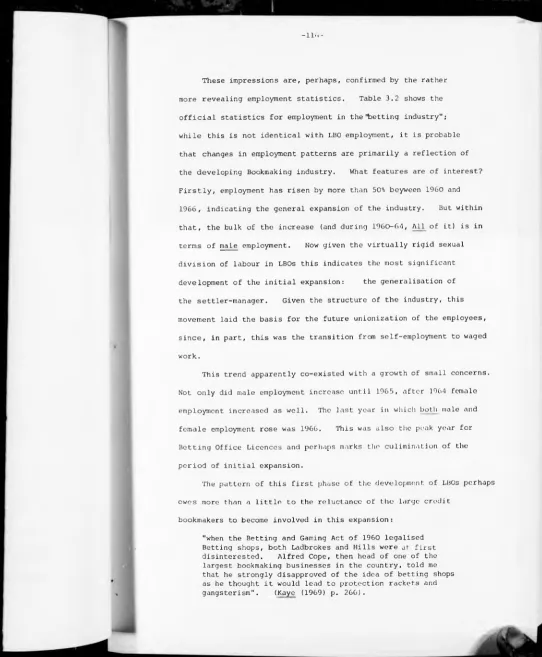
3.2: No. of employees in Employment in the "Betting Industry"
1959-68 (UK).
3.3: Horseracing Fixtures and Racecourse Attendances in England,
Scotland and Wales, 1961-73.
3.4: Betting duties: taxed stakes 1964-1976.
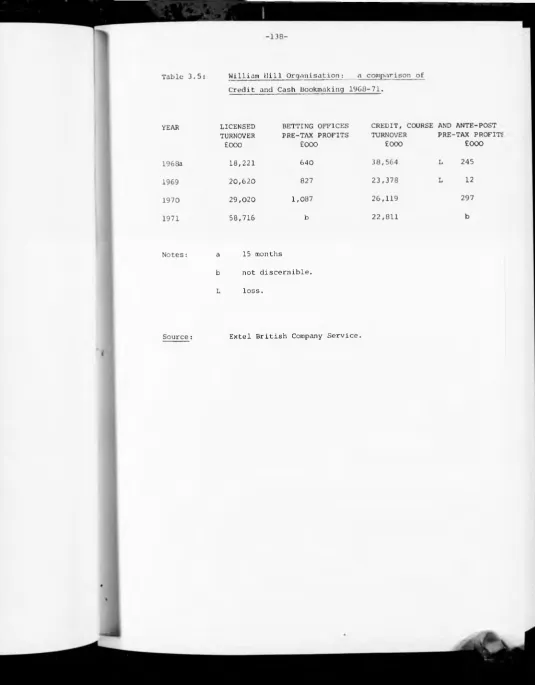
3.5: William Hill Organisation: a comparison of credit and
cash bookmaking 1968-71.
3.6: A comparison of the Four main bookmaking firms 1970-1975.
3.7: The development of the Ladbroke Group 1963-1974.
3.8: No. of employees in Employment in "Betting and Gambling"
1969-1973 (G.B.).
3.9: No. of employees in Employment in "Betting and Gambling"
1971-1973 (G.B): Full-time and Part-time workers.
Chapter 6 :
6.1: TUBE membership and support in the William Hill Organisation.
6.2: TUBE Local Branch Officials by sex.
Chapter 8 :
8.1: TUBE and Formal Recognition 1971-1974: Details of
Recognition Attempts.
8.2: References on the Betting Industry made to the CIR
concerning recognition under section 46 of the Industrial
Relations Act, 1971.
TABLES (Cont'd)
PAGE
423-425
426
434
435
463
(2)
126
161
(3)
228
231
236
238
242
252
263
Chapter 8 (Cont'd)
8.3: TUBE and the use of Industrial Tribunals 1971-1974.
8.4: Analysis of Industrial Tribunal Cases involving
TUBE members.
8.5: TUBE and Formal Recognition 1971-1974: Details of
firms taken through the legal procedure.
8.6: TUBE and the use of legal recognition procedures:
the length of procedures involved.
8.7: TUBE and Agency Shop Applications 1971-1974.
FIGURES
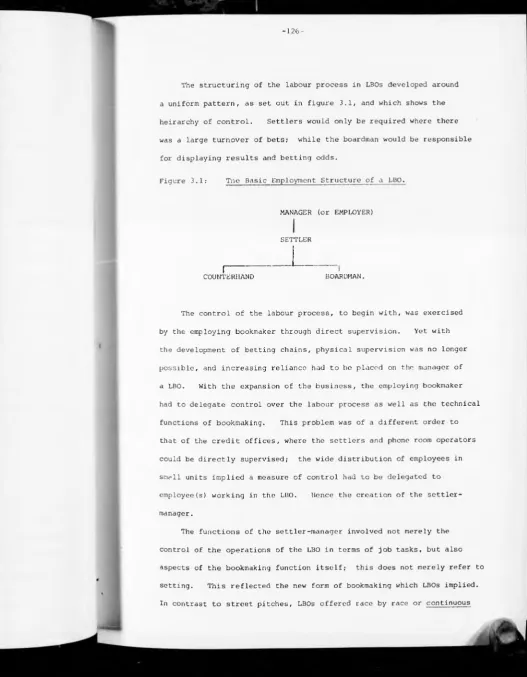
3.1: The Basic Employment Structure of a LBO.
3.2: The Administrative Structure of the J.Coral Group.
DOCUMENTS AND EXTRACTS.
The Objectives of the Union of Bookmakers Employees as set out
in the Minutes of the Inaugural Meeting, 7.9.1971.
Sawford's dismissal reported in the 'Sporting Life' 16.9.71.
Handbill: T.U.B.E. comes to Liverpool.
TUBE Certificate of Registration as a Trade Union under the
Industrial Relations Act 1971.
TUBE Ballot Paper for the Executive Council Elections, 1973.
TUBE Minimum Wage Scale for Employees in the London Area - July 1973
The dispute within the TUBE leadership over the John Hobbs
dismissal: the Chairman orders the Secretary to ensure the
union offices are available for use.
-(3)
PAGE
266
268
321
370
DOCUMENTS AND EXTRACTS (Cont'd)
Result of the ballot concerning the amalgamation of TUBE
with the TGWU.
Instrument of Amalgamation between TUBE and the TGWU.
Campaign leaflet - TUBE in the TGWU.
Power-holders in Personnel: The Four Main firms in the 1970s.
KEY TO ABBREVIATIONS
ACAS Advisory,Conciliation and Arbitration Service
ACTSS Association of Clerical, Technical and Supervisory Staffs
APEX Association of Professional,Executive,Clerical and
Computer Staffs.
ASSET Association of Supervisory Staffs, Executives and Technicians.
ASTMS Association of Scientific, Technical and Managerial Staffs
CAC Central Arbitration Committee.
CCOG Churches Council on Gambling.
CIR Commission on Industrial Relations.
EAT Employment Appeals Tribunal.
EPA 1975 Employment Protection Act 1975.
ERS Electoral Reform Society.
GMWU General and Municipal Workers' Union.
HBLB Horserace Betting Levy Board.
IRA 1971 Industrial Relations Act 1971.
IT Industrial Tribunal.
LBO Licensed Betting Office.
LPSNA London and Provincial Sporting News Agency.
NALGO National and Local Government Officers' Association.
NBPA National Bookmakers Protection Association.
NIRC National Industrial Relations Court
RC Royal Commission
TGWU Transport and General Workers Union
TUBE The Union of Bookmakers' Employers
WHO William Hill Organisation.
-INTRODUCTION
Author's Preface and Acknowledgements.
"He does more than treat them when they are
ill; he is the objective witness of their
lives. They seldom refer to him as a witness.
They only think of him when some practical
circumstance brings them together. He is in
no way a final arbiter. That is why I chose
the rather humble word clerk: the clerk of
their records.
He is qualified to be this precisely because of
his privilege. If the records are to be as
complete as possible - and who does not at times
dream of the impossible ideal of being totally
recorded? - the records must be related to the
world at large, and they must include what is
hidden, even what is hidden within the
protagonists themselves."
(Berger (1969) p.109).
John Berger's description of one facet of the life of a country
doctor has more than a passing resemblance to the activity of the social
researcher: the recognition of the efforts of people to cope with the
world in which they find themselves, of trying to effect change within
their society; while simultaneously developing an understanding of the
sources and implications of those activities within the wider framework
and structure of society. But here perhaps the similarities end.
The doctor can offer something more to his patients: his recording and
recognition of their existence combine to assist medical diagnosis to
provide help and hope for their future. The researcher too often
utilises the information received from workers and ordinary people
against them at a later stage; and in any case may provide little
in return for their efforts. The researcher is parasitic, and why
anyone should assist someone involved in research remains a very pertinent
question.
Nevertheless, in this respect I have been lucky and have received
extensive and often welcoming co-operation from those people actively
involved in the area I have researched. They are too numerous to mention,
but many of them appear regularly in the text of this thesis. However,
I would like to give particular thanks to George Sawford, the former
TUBE General Secretary for his immense help and encouragement and for
providing the vast range of historical material which now comprises the
main part of the TUBE A r c h i v e . ^ In addition, Bernard Weston in
Birmingham and Roy Brown in Scotland gave me much appreciated assistance
in my research in those regions. I would like to think this thesis in
recounting the struggles of bookmaking employees will in some small way be
a contribution in return.
But merely to acknowledge the very important practical assistance
given by those involved in the Bookmaking industry is insufficient. It
is always of interest to learn why someone looked at a particular subject
in the way they did since it necessarily informs any understanding of what
they have produced. My personal interest in bookmaking should be made clear.
Both of my parents (and one grandparent and other members of my family)
have worked in Bookmaking most of their lives. I also worked in the
industry on a casual basis during the period which preceded the formation
of TUBE.
!• See Bibliography for the detailed contents of the TUBE records.
-This lifelong connection with the industry has been combined
with a developing interest in why trade unionism developed and the
potential which the emergent debate on the labour process could
provide in this direction. When I began my research Braverman's
'Labour and Monopoly Capital' had just resurrected the significant
chapters of Marx's 'Capital' in connection with the labour process.
Soon afterwards Carchedi's contribution on class ambiguity was produced.
During the subsequent five years a whole range of literature has appeared
in this area, with titles resplendent in the use of the 'labour process'.
But the general inspirational sources have been those mentioned above.
Finally it remains to acknowledge the assistance of those who have
experienced the many ups and downs of my thesis. Many friends have
given me general encouragement over the years. In particular I would
like to thank Richard Hyman, my supervisor, who has received and read
many drafts at different stages and given me invaluable help and encouragement
at crucial moments of writing-up. Yet most of all I must thank
Jill Hardman, without whose support, encouragement and constructive
criticisms of both my field research and draft chapters this thesis would
not have been written. I am also indebted to Norma Bainbridge for
her excellent typing of an often straggly hand-written original.
Methods and Problems of Research.
The reader may be interested to kndw precisely how the material
used in this thesis was obtained for there must essentially be certain
biases in what is written according to the source and manner of
obtaining the information. I used four particular methods of research:
(1) Participant observation
In retrospect my periods of employment in Bookmaking during the
summers of 1968-71, provided an essential background to my understanding
of unionization. This comprised, in total, a period of twelve months
working in different LBOs in London for a range of employers when major
changes in the industry were taking place. Since I had no intention
at that time of doing any research in the industry, there are no records
of my experiences - only what I can recall.
(2) Formal Interviews
One problem of the research was the general lack of information
on Bookmaking and its history. It was essential to gain an historical
perspective if the connections between the labour process and unionization
were to be established or discounted. In consequence a good deal of
the initial period of fieldwork was spent in merely talking to the
representatives of a number of bodies who could provide general background
information on the industry. This shortened the time available for formal
interviews of union activists and employers, but nevertheless the
following interviews were secured:
(i) TUBE activists for their accounts of how the union had begun,
developed, and operated. Total - 15 interviews.
(ii) TGWU representatives in the West Midlands area, using a
(iii) TGWU Full-time officers who were involved in areas
where there had been TUBE membership and/or current
TGWU membership. Total - iO interviews.
(iv) National Bookmaking Employers (i.e. all the 'Big Four'
some more than once) , and some local employers in various
parts of the country. Although the National Companies
were at different times extremely co-operative, many
smaller employers refused any communication. Total -
12 interviews.
(v) Representatives or past members of other bodies such as
the CIR, ACAS, HBLB, and the CCOG.'
With the exception of the West Midland interviews, the research
involved widespread travelling throughout England and Scotland which
necessarily restricted the number of interviews; nevertheless in no
sense were the number of interviews inadequate or disadvantageous, except
where key employers declined to reply to my requests.
(3) Continual Association
The inherent inadequacies of formal interviews necessary demanded
closer contact with union activists in order to discover how the union
operated. During a period of some three years, 1974-1977, I maintained
a regular liaison with union activists in different parts of the country.
These continuing associations cannot be called formal interviews and they
are listed separately:
(i) Regular contact with TUBE activity in the West Midlands
between 1975-1977, involving membership recruitment,
union meetings, industrial tribunal cases, etc.
(ii) In depth case study on Connor and Forbes Ltd Liverpool in
(iii) Detailed study of the Ladbroke dispute in Glasgow,
1975.
(iv) Working with the TGWU on their submission to the Royal
Commission on Gambling, 1976-1977.
(v) Involvement in the initial stages of the campaign to
gain recognition in the J.Coral Group, 1977.
All of these activities involved continuing contact with members
of the union at all levels as well as employers and other bodies.
(4) Use of archival material
During the research I was given the bulk of the documentary
records of TUBE which now comprise the main part of the TUBE Archive.
These records, the details of which are set out in the Bibliography,
proved an invaluable source of information and reference as to how the
union developed and most of the precise dating prior to 1974 is derived
from them.
Thesis introduction
"In the trade union world, all marriages are apparently blessed,
however bigamous or unnatural; but all births are now illegitimate"
Turner (1962) p.308.
In 1971 a group of workers decided to form a union in the Bookmaking
Industry. It has scarcely been noted as a major event of trade union
history, which perhaps tells us something about labour historians and
industrial relations writers. Try finding a reference to The Union
of Bookmakers' Employees (TUBE) in any account of trade unionism in the
1970s. Yet the foundation of TUBE was an event of particular interest:,
the formation of a new union in an area of employment without any
traditions of union organization.
Why the lack of interest in the development of unionization in an
industry of 100,000 potential members? Ignorance? Possibly but why
are people aware of some things and not others? The answers lie
elsewhere: Bookmaking is not to be taken seriously. It is not
central to the economy. The workers are not in trade unions. It is
therefore not worth attention. The chroniclers of the labour movement
too often reflect those sections who are only interested in 'organized'
labour and ignore the'unorganized1.
This thesis is an attempt in some small way to rectify that imbalance;
to consider the problems of workers in one sector of employment not
in the mainstream of 'normal' trade union traditions; to understand
how unionization developed amongst the workers; and to gain some insights
into the role of the labour movement, the employers, and state agencies
in relation to this process.
Areas such as bookmaking are normally treated as being part of the
growth of 'white-collar' unionism, which has arguably been the major
feature of the expanding union membership in the post-war period. ^
Bookmaking, in the official classification, is part of the 'private
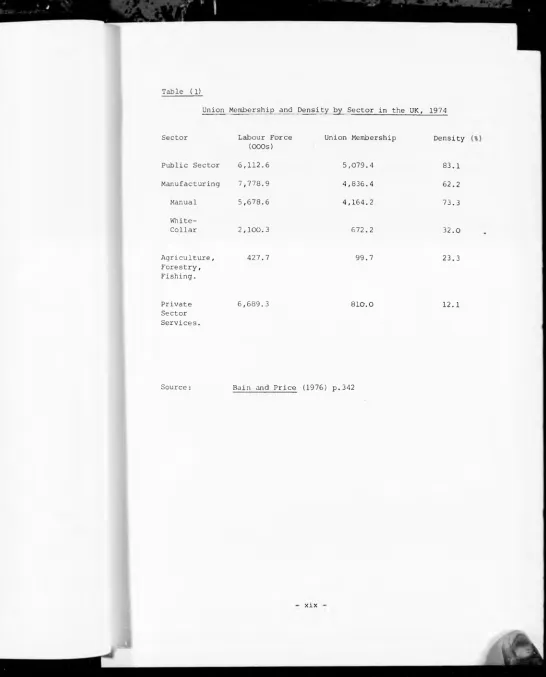
sector services'. This, as Table (1) shows, is the great area of
non-union labour, where only 12% of workers are in unions; but the
potential, in terms of numbers, is larger than in the whole of the
public sector.
The extent of this potential depends, of course, on how private sector
services are defined. The above figures, from Bain and Price, are
based on the Department of Employment classification, where private
sector services comprise:
"... professional services; hotels and catering; entertainment and media services; insurance, banking, and finance; distribution; business services; and miscellaneous services (hairdressing, laundries, dry-cleaning, motor repairs, boot & shoe repair, and betting and gambling)". (1)
Such a collection of activities illustrates the breadth of the term
"service sector" - which raises immediate problems. Firstly, how to
specify the "service sector"? Presumably the intention is to
differentiate manufacturing from services, physical products from
intangible commodities. Yet what is virtually the same task may be
classified in either manufacturing or services depending on the context of (2)
the work.
This underlines the descriptive basis of the above distinction between
manufacturing and private sector services; there appears no coherent
analytic division, merely a lumping together of the bits and pieces which
do not seem to fit into the public sector or manufacturing. This raises
a second question: does the categorisation of 'service sector' in this way
obscure divisions that might be made otherwise? Within the Department of
Employment list of 'services' some definitely operate in a different way
to others in relation to capitalist economy:
1* Bain and Price (1976) p. 342. See Braverman (1974) pp. 360-1 for a fascinating discussion of the classification of the service sector in U.S. Government statistics.
Table ( 1)
Union Membership and Density by Sector in the UK, 1974
Sector Labour Force (OOOs)
Union Membership Density
Public Sector 6,112.6 5,079.4 83.1
Manufacturing 7,778.9 4,836.4 62.2
Manual 5,678.6 4,164.2 73.3
White-Collar 2,100.3 672.2 32.0
Agriculture, Forestry,
427.7 99.7 23.3
Fishing.
Private 6,689.3 810.0 12.1
Sector Services.
Source : Bain and Price (1976) p.342
[image:22.601.29.575.0.678.2]"The function of middle-men, which expands in the course of the growing social division of labour and which can be ascribed in capitalism to enterprises dealing with trade, transport, storage, credit, banks and insurance, only constitutes a part of (the so-called services) sector, which sociologists and bourgeois political economists make into a pot-pourri of the most various activities, stretching from pure commodity producers (gas, water and power production) to parasites and crooks."
(Mandel (1976) pp. 383-4 F/N) .
So in approaching the problem of the lack of unionization amongst
the private sector services, the problem itself must be reformulated
since the category of private sector services remains conceptually
inadequate. Can the various dimensions of those activities grouped
under this heading point to the questions that could be raised?
Firstly, developing Handel's position, there is the important 'middle-man'
function, those activities which lubricate the wheels of capitalist economy.
Mandel's formulation reflects an important distinction in Marxist theory:
that between the sphere of production and the sphere of circulation.
While the former is concerned with the expansion of value through
production, the latter concerns the realisation of value through the sale
of products and the provision of finance for new periods of production.
This leads to a second general distinction: that between productive
and unproductive labour. In the sphere of production, labour can be
seen as productive since it creates surplus value, while in the sphere of
circulation, value is not created, only redistributed, hence labour is
unproductive. Can this provide a basis for understanding differences
in the degree of unionization?^
A second possibility concerns the characterisation of large sections of
the service sector as white-collar. Given white-collar workers are less
unionised than manual workers, can this distinction serve as basis for
(2)
understanding the lack of unionization in private sector services?
1. The terms 'productive' and 'unproductive' are given, following Marx,a specific meaning in terms of the production (or non-production) or surplus value. See below Chapter 2.
Thirdly, can any explanations be put forward to lower levels of
analysis? Is the problem with private sector services the fact
that they are private, that public sector employers are more
supportive of trade unionism, while private employers are more
hostile? Or do, perhaps, the various activities have particular
occupational characteristics which tend to promote or inhibit trade
unionism? While such aspects may be important, it would be difficult
to sustain them as influences explaining general tendencies in
unionization. They might be useful in explaining individual differences
around a general level, but not the general rise in unionization itself. ^
In this brief discussion some wide-ranging questions have been raised
about approaching an understanding of unionization in the private
sector services; and, in doing so, the usefulness of the categorisation
has been queried. But the implications go further than this. Once
the specification of 'private sector services' has been questioned
the whole basis of the general categorizations between sectors of
employment becomes problematic. Thus to approach the development
of unionization amongst any group of employees, whether in private
sector services or not, demands an understanding of the general basis
of trade unionism and any subsequent justifications for drawing
generalised analytic distinctions within the structure of the labour
force. 1
1. It would be highly circular to "explain" trade unionism in terms of employers' attitudes and policies towards trade unionism; and it would be equally nonsensical to explain trade unionism in terms of the strength or lack of occupational solidarity. Such explanaations must be considered in the context of general tendencies towards the growth of unionization.
The first part of :he thesis is devoted to just this task. In
Chapter 1 the various approaches aimed at explaining the growth of
trade unionism are considered, both in general terms and in relation
to explanations of general divisions across the workforce. The
latter receive disproportionately greater attention given the particular
c . . ( 1 )
concern witn tne oasis of those division.
In Chapter 2, an attempt is made to overcome the inadequacies of
these various approaches and reformulate a general approach to trade
unionism within, broadly, a Marxist perspective, including an analysis
of potential divisions which may be useful in understanding unionizaticc,
and putting forward the labour-process as the central feature. 1
The second part of the thesis explores the usefulness of this approach
by applying it to 1the growth of unionization in the Bookmaking
industry. This c:tnsiders the changes of the’ labour process in the
historical develop!tent of the industry and derives an understanding of
unionization withii the framework. Subsequently the impact of formal
union organizations, the employers, and the State are considered in
the context of the labour process approach.
The final part of tthe thesis consists of a concluding discussion which
returns to some of the themes developed in Part One and offers an
appraisal of how t:le evidence of the Bookmaking industry has specific
implications for tlle general proposition that unionization must be
understood in relattion to the labour process.
1. Therefore there is an accentuated focus on Bain (1973) and Lockwood (196C as the main preponents of an orthodox approach to white-collar unionism, while Klingender (1935) is considered at some
length as representative of a Marxist tradition in this area.
1
-Chapter 1 : The Basis of Trade Unionism
The initial problem is two-fold. To understand the
development of unionization amongst particular groups of employees
requires a prior consideration of the general basis of trade unionism.
This necessarily demands an answer which can explain not differences
between levels of unionization, but the existence of trade unionism
as a widespread social phenomenon. Nevertheless, there are wide
differences in the level of unionization across different employee
groups, which raises a second question: is it necessary to suggest
specific explanations for certain groups of workers in understanding
how trade unionism develops? And if so, how can these be specified?
One starting point is to consider the work of previous contributors
to the debate on trade unionism. These, broadly speaking, can be
divided into two categories: on the one hand, the so-called "orthodox"
approaches which depend on divergent strands of theoretical ancestry,
but which all can be criticised in not considering the specific nature
of capitalist society and the consequent implications for understanding
trade unionism.
On the other, there are a number of approaches which attempt to
overcome this problem and which are termed "Marxist" in that they broadly
follow a class analysis of society within an historical materialist
perspective. These tend to emphasise the importance and specifity of
wage-labour as the basis for understanding trade unionism.
There are limitations with both general approaches. In consequence,
an attempt is made to reformulate an understanding of trade unionism
within a Marxist perspective. This necessarily involves a more precise
specification of the problems in terms of union growth, organisation,
and activity. And it is within this context that the labour process
(a) Orthodox approaches to understanding trade unionism.
The way in which problems are defined informs relevant areas
of concern and structures modes of explanation. Looking at American
and British traditions in approaching trade unionism, it might be
generally concluded that American writers have focussed rather more
on trade union growth, while their British counterparts have emphasised
union activity. In consequence, the American literature embraces
grandiose schemes of wideranging 'variables' which 'explain' union
growth; the British writing, in contrast, has become channelled within
a fairly narrow institutionalism which concentrates on'bargaining
arrangements' between employers and trade unions. In consequence,
the problem of 'why trade unionism' is not of equal concern or
importance in these different traditions.
Despite their best endeavours, the concern of American industrial
relations theorists, particularly in the early post war period, has not
generated a coherent theoretical model of union growth. A host of
'variables' have been 'established' as 'significant' in 'explaining'
union growth, but these cover a wide variety of influences. ^ Of
these approaches, perhaps of most pervasive influence has been the work
of Dunlop.
Having briefly surveyed a variety of approaches to union growth,
Dunlop (1948) brings these various strands together:
"The labour movement,or any similarly complex social organisation, may be fruitfully explored by an examination of four interrelated factors: technology, market structures and the character of competition, community institutions of control, and ideas and beliefs." (ibid,p . 174). 1
Dunlop, who is seeking to explain the origin, growth, and
goals of the labour movement in America as well as the psychology of
individual nemcers, is unwilling to present these variables as other
than a "comprehensive scaffolding"; this "method of approach does
not ir. itself trust it .t-: a t o .try ;f the lab cur r.tv r. at" it:.! p . 17 5) .
That, it subsequently appears, arises from the interaction of
these variables ibid p.192) .
In effect, Dunlop argues that trade unions are merely another form
of "complex social organisation (s " which require no special explanation.
The pattern of the overall blueprint for exploring such organisations
fits very neatly - it merely remains to apply it. Such a position
is entirely consistent with Dunlop's advocacy of organisation theory
and is subject to the appropriate criticisms^ . It might also be
added, that tner. is absolutely no basis presented as to why these
variables should be selected and not others. This is arguably due
to the inability .or refusal?) to consider the specific nature of
capitalist society.
The British tradition in approaching trade unionism has shown
rather less interest in union growth; increasingly, emphasis has been
placed on how trade unions conduct their activities, with particular
stress on tne processes or collective bargaining. To a large
extent this is a partial and distorted inheritance of the work of the
Webbs. The descent of the Oxford School of the 1960s can be traced
directly. That of the Fabian movement even more so. All of which
suggests the importance of the way the Webbs have influenced mainstream
1. See Herding (197i) pp.65-69 for a brilliant criticism of organisation theory and which is discussed later in this chapter.
2. Given the generally high level of manual (and now'white-collar1) unionism in Britain, it is, perhaps, not altogether surprising that issues of union growth have taken a back seat in favour of union activity.
1-emphasises the significance of their definition of trade unions:
"A trade union, as we understand the term, is a continuous association of wage-earners for the purpose of maintaining or improving the conditions of their working lives".
(Webb (1920) p. 1) .
Closer examination shows two aspects in that succinct definition.
Firstly, trade unions are seen in terms of a continuing organisation
of wage-earners. For the Webbs spasmodic collectivism was an insufficient
criterion for defining a trade union, while collective organisation
by non-wage earners was considered qualitatively distinct. Secondly,
the objectives of trade unions, while widely defined, concerned the
substantive conditions of those wage-earners.
These two aspects were brought together through collective
negotiation with employers, commonly known as collective bargaining.
The continuity of bargaining between the employer and his employees,
represented as a collectivity, was predicated on a continuity of
union organisation itself, while collective bargaining was the means
of negotiating the wages and conditions of the employees.
While for the Webbs collective bargaining was only one aspect of
trade union activity, the subsequent inheritors of their position
have placed collective bargaining as a central feature of 'industrial
relations'. This is an important shift. The focus has now moved
to definitions of 'industrial relations' rather than 'trade unions',
while the accenuated portrayal of collective bargaining minimises the
substantative conditions of employe s, in favour of the method of
agreeing such conditions. This is evident in Flanders' concept of
'job regulation', which also underpins Bain's approach to white-collar
unionism. ^ 'Job regulation' is developed within the notion of an
1. See especially Flanders (1975)pp.38-47 . My emphasis.
bargaining issues between management and unions. 1 ^
Such a position necessarily implies a narrower view of
employer-employee relations (as well as relationships within these groupings):
"Most experts on industrial relations would treat it as virtually self-evident that certain kinds of relations in industry should be disregarded and that they should concentrate their attention on, for example, the collective bargaining activities of trade unions". (Hyman (1975) p.9).
Emphasis shifts to management-union bargaining relationships
rather than those between employer and employees, accentuating the
institutional arrangements of industrial relations to the detriment of
the wider economic and social processes involved. This necessarily
obscures how and why trade unionism develops, for the answer to that
question lies outside the institutional patterns of industrial
relations. Approaches which develop from a collective bargaining
perspective tend to assume that trade unionism already exists. The
development of trade unions thus becomes an increasingly irresolvable
•• ¡lem, yet simultaneously a less important one, since the source
(2)
of trade unionism has become separated from trade union activity.
If the British tradition has steered away from general explanations
of union growth in recent years, nevertheless those same theorists have
had to come to terms with the dramatic growth of unionisation amongst
'management' - the development of 'white-collar' unionism. Attention
has specifically been turned to this problem with the result that
'explanations' of 'white-collar' unionism have been put forward
despite the absence of a generally accepted framework of union growth.
1. Flanders' theory of union growth is penetratingly analysed by Pickard (1978). For a partial discussion of his model see below Che . Only Bain of the main preponents of Pluralist Industrial Relations has decided to pursue the avenue of Union Growth with any vigour.
2. This contrast, however, between American and British industrial relations thought must not be overdrawn. There are strong links between these
traditions, perhaps best exemplified in Flanders adoption of the concept of the 'industrial relations system' as developed by Dunlop.
• I .—
Two major contributions stand out in offering explanations of
•white-collar' unionism: one is that of George Bain who stands within
the institutional traditions of British industrial relations, yet
nevertheless also draws on the North American notions of organisation
theory; the other is that of David Lockwood who, in contrast, relies
almost exclusively on the work of Max Webber in tne manner of European
sociology. Can these explanations provide insights on the specific
problems involved? Since Bain, in some sense, writes in opposition
to the sociological approach of Lockwood, it seems appropriate to
consider Lockwood's position first.
Lockwood's analysis of the 'Blackcoated' worker remains the most
widely influential work on the development of trade union organisation
amongst clerical w o r k e r s . ^ As such, he set the framework for
(2)
future research and debates which ensued at the beginning of the 1970s.
It is important to note the historical context of Lockwood's contribution.
The Blackcoated Worker was first published in 1958. Taking issue
with the crude proletarianisation thesis of K l i n g e n d e r ^ , Lockwood,
at the height of the 'cold war', sought to discredit the notion that
clerical workers possessed a 'false' class consciousness. Yet Lockwood
set out not to criticise Klingender within the Marxist tradition, but to
refute the relationship between a Marxist definition of class and the
development of clerical unionism. The distinction of ownership/non-
ownership as the fundamental class division is "insufficient to explain the
problem of false class consciousness which it poses". (Lockwood (1966) p.213)
1. Lockwood (1966). As Crompton (1976) p.409-9 comments: "Any account of the sociological tradition of analysis in this field must begin with the work of David Lockwood ... Lockwood's work has profoundly influenced research and theorizing in the study of white-collar unionism ..."
Lockwood instead tries to reformulate the relationship between
class and trade unionism. He introduces three elements which
comprise his notion of 'class position': firstly"market situation”
which embraces the economic position of the clerk in terms of income,
job security, and possibilities cf promotion; "work situation" which
is concerned with social relationships at work deriving from the
division of labour; and, thirdly, "status situation", which relates to
the position of the individual in the wider s o c i e t y . I t seems
that "status situation" is relatively unimportant in relation to trade
unionism; for Lockwood eventually concludes that while variations in
the degree of blackcoated unionization are related to "work situation",
the "market situation" accounts for variations in union character, (ibid
pp. 211-12).
Lockwood develops this reconstruction of the link between class
and trade unionism in identifying 'bureaucratisation' as the driving
force which generates the conditions for unionization in the "work
s ; :nation":
"It would not be straining the facts excessively to argue that the unionization of blackcoated workers has been very closely associated with what may be called 'bureaucratization'. By the latter is simply meant the process by which bureaucratic
rules come to predominate in administrative organisation” , (ibid p.141)■
Lockwood juxtaposes two 'ideal-types' of office organisation: on
the one hand Paternalistic administration where working conditions are
"determined by the personal relations of employers and clerks,-" (ibid p.141)
and, on the other, bureaucratic organisation where working conditions
are "regulated by impersonal rules which strictly exclude all forms of
personal consideration between employer and clerk"; (ibid p . 141).
Adding that bureaucratization may be associated with a "blockage of clerical
promotion" and the"isolation of a separate clerical class" (ibid p .142),
Lockwood concludes:
"Thus defined, bureaucratization represents a set of conditions extremely favourable to the growth of collective action among clerical workers. It is not too much to argue that in fostering black-coated solidarity bureaucratization has played a role analogous to that of the factory and labour market in the case of manual workers". (ibid p. 142) .
Lockwood's position has been strongly criticised, not simply by
the institutionalism of Bain who denies the importance of linking class
and trade unionism, but from sources who see Lockwood's reformulation
of that link as inadequate. While Lockwood in fact argues that the
combination of 'market situation' and 'work situation' amounts to what
Marx "essentially understood" as 'class position' (ibid pp 15-16), his
model is developed within a Weberian framework - not a Marxist one.
This provides the case for Crompton's critique:
"Lockwood's account of social class ... is essentially a Neo- Weberian market-oriented approach, and, because such an
approach fails systematically to take into account the structures and relationships underlying work and market situations, explanations deriving from this approach to social class can only be partial. That is, Lockwood may or may not have established a more or less accurate correlation between trade union membership ... and social class - as he has defined social class. However, his analysis fails to explain why the white-collar market situation is as it is, or why the white-collar work situation is as it is - and provides no guidance or explanation as to why they have changed recently". (1)
The 'market situation' and the 'work situation' "can only be fully
understood if they are seen as being mediated through capitalist
production relationships". (Crompton (1976) p.409).
Hence, through not realising the primacy of production relations 1
-9-in the determ-9-ination of class, Lockwoods formulation is itself
inadequate in understanding class and the link between class position
. . . . (1)
and trade unionism.
Leaving this discussion to one side for the moment, it is initially
useful to look more critically at the internal consistency of Lockwood's
model, rather than its general inadequacy. This implies some
consideration :: his pt of . ir lucratisati n »nd its rt : :ugs. 1. Crompton, however, fails to draw the full ii lications of her critique. In her argument, while class position determines whether a collective response is made by employees, the ambiguities in class position are responsible for the "varying and often contradictory nature of much white- collar collective representation..." .Crompton (1976) p.422). Consequently, some white-collar workers opt for unions and others for staff associations; the use of class ambiguity overcomes any theoretical problems of false consciousness:
"That some white-collar workers should see their interests us being best fulfilled by co-operation with management (or the capitalist function) - for example, in staff associations - and others in the same occupation see their collective interests as being best served by identification with the labour function - in trade unions - is, I would argue perfectly compatible with their ambiguous class situation", (ibid.p.422)
This seems to be the main gist of Crompton's argument. Class is the important determinant of trade union organisation, but white-collar workers may possess contradictory class positions hence their collective response may be contradictory and take different institutional forms.
This is a brave attempt by Crompton to overcome the fruitless debate between the 'sociologists' and the 'industrial relations' schools. In order to do so, she attempts to synthesise an orthodox Marxist approach to the capitalist mode of production, and recent theoretical enunciations on the potentiality of contradictory class positions, with her own inheritance from industrial sociology. The result, however, is not entirely convincing. There are some very real problems. The most immediate and, indeed, surprising is her persistent use of 'white-collar', which she manages to haul right through the sociology-industrial relations debate and into her Marxist framework with scarcely a misgiving. At one point she does appear to see something of a diffict '.ty:
"... the approach I have been developing has revealed considerable variations in class situation within the
'white-collar' sector as a whole - in fact, perhaps it is misleading to refer to the class situation of white-collar workers" (ibid, p.420).
Perhaps it is. Perhaps it is also misleading to refer to white- collar workers at all. This reticence in discarding concepts more
- I P
"As the class situation (she means structural class position otherwise it does not make sense) of technicians has become less ambiguous - as they have been truly 'proletarianiscd' so have their market and work situations changed in the manner described". (ibid p. 421. Who or what is
'proletarinized' - the technicians or their class position?)
So Lockwood's 'work' and 'market situations' rise from the ashes, somehow determined by the changing class situation of the technicians. This is merely a false separation. As the technicians increasingly began to perform the function of the collective labourer rather than acting as agents of capital, their class position changed; yet in
-11-There seems a particular ambiguity regarding form and content in
the concept of bureaucratization. It is not at all clear whether
merely the imposition of impersonal rules is involved or
if the content of those rules is relevant. There seems an emphasis
on bureaucratic rules p er se - which can give no indications on the
important question of the content of the rules. In fact, while
Lockwood attempts to employ bureaucratization in a technical sense
within his framework, at the same time it serves to cover over all
the various changes which occur within Lockwood's defined'work situation'
as a result of that process. In that sense bureaucratization serves
as a blanket term to condense the experiences of employees, as wage-
labourers, into one amorphous mass. One aspect which Lockwood
thus successfully obscures constitutes a second point: the way in
which the control of the employees and their work is subsumed within
bureaucratic, impersonal rules. The imposition of control by the
employer or management on work activity and the way in which the employees
experience it are both neatly glossed over.
Thirdly, Lockwood's use of bureaucratization is unable to pinpoint
the differential impact that it might have on employees. The loosely
defined category of 'clerks' are seen less as workers performing
different job tasks within a labour process, than a mass of undifferentiated
labour. Through abstracting from the concrete processes of work Lockwood
eliminates the question of the contradictory effects of bureaucratization.
Hence all 'clerks' are seen to experience bureaucratization in the same
way and with blanket consequences.
In the light of the above discussion, what understanding of the
development of unionization amongst blackcoated workers does Lockwood's use oi
powers or Lockwood's overall approach, so bureaucratization can be
seer, to explain little.
efforts to pose a link between class and trade unionism, Bain is,
perr.ars, the foremost critic of the class based view of trade unionism
A-.ar. Flanders, and Hugh Clegg 1 . Hence while Lockwood emphasises
consequence, Bair, has sought to play down the central position of clas
within the' sociologists' approach. He has, in fact, addressed part
In Bair. 19~3) he attempts to show, armed with an extensive
collection of counter examples and empirical data, that the connection
between social stratification and union membership and character is
inadequately formulated by the sociological approach and that social
stratification constitutes an inadequate explanation of unionization.
He concludes, firstly:
".... no matter how wide and various were the definitions of social position, there was no easy correlation between them and patterns of union growth". (Bain (1973) p.154).
Secondly:
"... there is no close and simple relationship between the social position of an organisation's membership and that organisation's goals or behaviour", (ibid p .154)
and finally:
"no easy equation could then reasonably bo expected between social position, social imagery and trade unionism".
(Ibid p.154) 1
ton used the inadequacies of Lockwood's
mere tea .e empirical legacies of the Webbs, G.D.H. Cole
the s tess-ts which generate unionization, Bain focusses on
oral arrangements in explaining the same phenomenon .n
.< soe
- 1 <
-These conclusions are, however, scarcely controversial. Even
the 'sociologists' against whom they are aimed would not wish to
contest then; for Bain's approach, attempting as it did to draw
together many strands of the sociological position, only managed to
set up a 'straw man’. This meant that his general model of the
sociologists explanatory framework was far too simplistic. v*
And in consequence his criticisms can be deflected for, so
generalised, they merely constitute misrepresentations of particular
(2)
positions.
But the crudities of Bain's theoretical challenge must not hide
two important aspects of the institutionalist-sociologist debate.
Firstly, the empirical evidence cannot be as easily shrugged off as
the theoretical argument. Crompton, a self-confessed heretic of the
sociological tradition, takes the point:
"Although I would broadly reject the industrial relations critique of the sociological approach, their criticisms do reveal some serious weaknesses. In particular, the countless examples provided by Bain et al in order to contradict or destroy the relationship between class position and trade union membership or character, which the sociological approach seeks to establish, cannot simply be dismissed as the exceptions which prove the rule. For the pattern of white-collar union membership and activity does show many inexplicable variations which are sociologically embarrassing if we are seeking to establish a more or less coherent relationship between union membership, character, and social class". (Crompton (1976) p.412).
1. As Mann (1974) p.323 comments:
"... it is a 'demolition job' on some of the crudest sociological arguments I have ever encountered".
2. As Crompton (1976) argues :
-14-The sheer force of Bain's empirical weaponry thus makes some
impression on the sociologists position. Yet the substance of the
disagreement is not entirely obvious; what is the status of the
debate? Consider Bain's alternative to a class understanding of
trade unionism:
"What is being suggested here is that possibly union growth can more fruitfully be explained by concentrating on the properties of trade unions as organisations rather than on the properties of the individuals or groups which they seek to organize". (Bain, (1973) p.159).
Within this perspective, Bain enlists the assistance of the
Flanderian notion of 'job regulation' which is defined as the "making
and applying of rules to employment relationships". (ibid p.159-160).
Union growth now "becomes predominantly a function of union participation
in job regulation (ibid p.150).
This, however, does not place Bain in fundamental opposition to
the sociological position: the debate really turns on the centrality
of different concepts, rather than the incompatibility of different
theoretical frameworks.^ This is shown in Bain's view of the
relevance of social stratification in his approach to white-collar
unionism :
"If the relationship between social stratification and
trade unionism is to be adequately understood, then it must be fitted into a much wider approach to the study of trade unionism". (Bain (1973) p.157).
Social stratification does have a part to play in Bain's analysis,
but not a central part. Instead, he focusses on job regulation as the 1
1. As Mann (1974) observes (p.324):
motive force within a framework of institutional influences.
Those influences Bain had identified in an earlier work, making
extensive use of econometric m e t h o d s . ^ Basing his analysis on
white-collar workers in British Manufacturing industry, Bain
concluded there were three significant factors: firstly, the degree
of employment concentration; secondly, the degree to which employers
are prepared to recognize unions representing white-collar employees;
and, thirdly, the extent of government action which promotes union
recognition. The limitations to Bain's institutionalism are, perhaps,
more aptly expressed in a more general discussion of the limits of
the orthodox approaches. 1
1. Bain (1970); in utilising econometric methods Bain appears as far
less arbitrary than his N.American predecessors, such as Dunlop, in
identifying variables; but the establishing of a negative theoretical
The limitations of the orthodox approaches.
Having considered some of the general approaches which seek to
explain union growth and activity and, in some depth, those writers
who have sought to explain 'white-collar' unionism as a specific
area of unionization, what can bo concluded? Firstly, some writers,
within the broad traditions of different strands of thought, have
seen 'white-collar' unionism as an area of concern requiring specific
explanations. Not only that, but they have derived different, even
opposing opinions as to why 'white-collar' unionism has grown - although
this is partially explained by the way they have posed the 'problem'. ^ 1
1. The distinction between Lockwood and Bain is related to how they conceptualise the 'problem' they try to explain. Lockwood is trying to tackle a social phenomenon and understand the processes involved; starting with workers and a Weberian perspective of 'authority' relations, he aims to explain the conditions under which white-collar unionism develops. In contrast, Bain begins with the 'problem' of a growing membership of 'white-collar' unions, emphasising patterns of unionization, and treats workers as subsidiary. In this he shows a definite positivist orientation, very much in accordance with Durkheim's principle that:
"Sociological Method ... rests wholly on the basic principle that social facts must be studied as things, that is, as realities external to the individual." Durkheim (1970). pp. 37-38.
Do these approaches assist in understanding how trade unionism
develops. ^ Lockwood and Bain do point to important questions:
Lockwood raises the issue of the significance of social class in
understanding trade unionism, while Bain correctly emphasises the
role of institutional arrangements. The main limitation is, however,
the same in both approaches: the failure to consider the specific
nature of the capitalist mode of production. This has profound effects
on the explanatory power of their conceptual frameworks.
Lockwood, it will be remembered, was criticised by Crompton for
not considering class position as primarily mediated by production
relations. This failure to understand the primacy of production
relations is related to a more general failure to grasp the nature of
the capitalist production process as a whole.
Following Marx, the predominant feature of capitalist production
is wage-labour; this implies the potential of exploiting the wage-labourer
through the expropriation of labour beyond that for which the labourer
is paid. This enables the capitalist to expand the value of his
capital (valorisation) through appropriating the surplus value created
by the wage-labourer. Surplus-value is therefore created in the sphere
of production; yet the surplus is also contingent on what is paid for
wage-labour which is determined not in the sphere of production, but
circulation. This is a crucial question for Marx. Does money change
into capital (as self-expanding value) in the sphere of production or
circulation? The answer is both: 1
1. In this respect Bain and Lockwood can be considered as
n
-"This whole course of events, this transformation of money into capital, both takes place and does not take place in the sphere of circulation. It takes place through the mediation of circulation because it is conditioned by the purchase of labour power in the market; it does not take place in circulation because what happens there is only an introduction to the valorization process, which is entirely confined to the sphere of production". (Marx (1976) p.302)
While the sphere of production is determinant, the production
of surplus value is dependent on the interrelationship between the
spheres of production and circulation. Within a Marxist framework,
therefore, not only is it inadmissable merely to lump together, as
Lockwood does, supposedly distinct components of class position; it
is not possible to make that differentiation in the first place. The
purchase of labour-power and the utilisation of labour-power (which
Lockwood parallels with market and work situation respectively) are
essentially interrelated in the very logic of capitalist production.
The implication must be that in ignoring this connection, Lockwood
cannot fully comprehend the relationship between the capitalist production
process, the structural formation of class, and the emergence of trade
unionism.
Such inadequacies in his overall approach are reflected in his
utilisation of key concepts within his framework, most notably that of
bureaucratization. For Lockwood, it describes a process - the content
of which has already been questioned - but it is a process without any
historical or material basis. Why does bureaucratization emerge?
Other than references to the size of organisation or the development
of modern industry, there is no answer. Why does it emerge when it