warwick.ac.uk/lib-publications
A Thesis Submitted for the Degree of PhD at the University of Warwick
Permanent WRAP URL:
http://wrap.warwick.ac.uk/110009
Copyright and reuse:
This thesis is made available online and is protected by original copyright.
Please scroll down to view the document itself.
Please refer to the repository record for this item for information to help you to cite it.
Our policy information is available from the repository home page.
T H E B R I T I S H L I B R A R Y D O C U M EN T SUPPLY CENTRE
TITLE
The Effects of the Use of Full Potentials in the Calculation
of X-Ray Absorption Near-Edge Structure
by the Multinle-Scattered-Wave X-aloha Method
David Laurence Foulis,
Attention is drawn to the fact that the copyright of
this thesis rests with its author.
This copy of the thesis has been supplied on condition
that anyone who consults it is understood to recognise
that its copyright rests with its author and that no
information derived from it may be published without
the author’s prior written consent.
AUTHOR
^ 2 T5 r* ~ r s
cms.
THE BRITISH LIBRARY
D O C U M E N T SU PPLY C E N T R E Boston Spa, W etherby
W est Yorkshire
United Kingdom R E D U C T IO N X
The Effects of the Use of Full Potentials in the Calculation
of X-Ray Absorption Near-Edge Structure
by the Multiole-Scattered-Wave X-alpha Method
by
David Laurence Foulis, B.Sc. (Hons.)
A thesis submitted
to the University of Warwick,
for the degree of Doctor of Philosophy;
describing research conducted
as an external student of the Department of Physics
at the Hamburg Outstation of the
European Molecular Biology Laboratory
and at the Frascati National Laboratories
of the Istituto Nazionale di Fisica Nucleare.
REPRODUCED
FROM THE
BEST
I. CONTENTS
Section Page
I: Contents ii
IIS Acknowledgements iv
III: Declaration vi
IV: List of Tables viii
V: List of Illustrations ix
VI: Notation« Units and Abbreviations xi
VII: Summary xiv
CHAPTER 1: INTRODUCTION 1
1.1: X-Ray Absorption Spectroscopy and XANES 1
1.2: Scope and Plan of Thesis 7
CHAPTER 2 : MUFFIN-TIN BASED CALCULATIONS OF XANES 11
2.1: General Approximations to the Schrodinger
Equation 11
2.2: The ’’Muffin-Tin" Approximation 16
2.3s Survey of Ab Initio XANES Calculations 18
2.if: Calculations for Chromium Hexacarbonyl 20
2.3: Discussion and Review 30
CHAPTER 3: EXTENDED SCATTERED-WAVE THEORY 34
3.1: The Partition of Molecular Space 34
3.2: Secular Equation in the Bound-State Case 35
3.3: Secular Equation in the Continuum Case and the
Calculation of Photoionization Cross-Sections 4?
3.4: Inclusion of Molecular Point Symmetry 51
CHAPTER 4: MODELLING THE POTENTIAL 56
4.1: Initial Potential Generating Program MLPSHX
56
Section Page
Discussion 66
CHAPTER 5 : FULL-POTENTIAL SCATTERED-WAVE PROGRAMS AND
RESULTS 7k
5.1: The Energy Eigenvalue Search Program ENESHX
7
I+5.2: Testing EN ESHX with the Hydrogen Molecular Ion 81
5.3: ENESHX Results for Chromium Hexacarbonyl 90
5»bl The Continuum Photoabsorption Cross-Section
Program CNTSHX 95
5.5: CNTSHX Results for Chromium Hexacarbonyl 99
CHAPTER 6 : CONCLUSIONS 107
6.1: Main Results, Discussion and
Future Directions 107
Appendix A: Mathematical Formulae 110
Appendix B: List of Programs 116
II. ACKNOWLEDGEMENTS
The work reported in this thesis was done under the supervisi
on of Dr. Robert F. Pettifer, at the Hamburg Outstation of the
European Molecular Biology Laboratory (EMBL-HH) and at the Labor-
atori Nazionali di Frascati dell'Istituto Nazionale di Fisica
Nucleare (INFN-LNF). It is a pleasure to acknowledge the wider
friendship that has grown out of our shared fascination with the
subject of Physics, and to thank Robert for his continued support
and encouragement and for the hospitality and kindness shown to
me by himself and his family.
The work was also done in collaboration with Dr. C.R. "Rino"
Natoli of the INFN-LNF and I should like to express my gratitude
for his interest and support especially during my time as his
guest worker in Frascati.
I should like to thank the EMBL for the provision of a three-
and-a-half year pre-doctoral fellowship at the Hamburg Outstation
and the INFN-LNF for their hospitality and financial support dur
ing my sixteen month stay. I also thank the European Molecular
Biology Organization (EMBO) for the provision of a short-term
fellowship to visit EMBL-HH for tv/o weeks in October 1987«
Of the many people in Hamburg whose friendliness and assistan
ce made my stay such an enjoyable and fruitful one, I should like
to make particular mention of, and thank, the following:
Dr. J. RBhler and his group who provided the experimental spectr
um of chromium hexacarbonyl used in this thesis, and Dr. D. Fong
who helped with the associated computer problems; P. Bendall, S.
McLaughlin, D. Dainton and F. Golding who helped with many of the
programming problems that arose in the course of my work; the lab
and unofficial, made life much easier for a Briton living in a
foreign country; Dr. K. 'Wilson for his assistance as Head of Out-
station at EMBL-HH; and my colleague Dr. C. Hermes whose discuss
ions of the experimental side of X-ray absorption spectroscopy
helped broaden my understanding of the subject. Cf the people in
Frascati I should like to acknowledge the many interesting discu
ssions of the work with Dr. M. 3enfatto, Dr. C. Erouder, T. Tyson
and P. Sainctavit. In the Physics Department at Warwick Universi
ty I wish to thank Dr. B. Holland for his critical appraisal of
my work on several occasions; Prof. H. Mykura for his administra
tive assistance; and Dr. P.V. Smith for his careful reading of
the draft of this thesis.
I should like to acknowledge the patience and assistance of my
family during the last, difficult phase of thesis-writing, parti
cularly that of my mother Mrs. M. Foulis and my aunt Mrs. S. Kil
patrick. Finally, I should like to express a special thanks to
Mile. Nathalie Pipon, v/hose personal support during the last
three years has been a significant factor leading to the complet
XII. DECLARATION
This thesis represents work done as part of a continuing and
wider collaboration between Dr. R.F. Pettifer (RFP), Dr. C.R.
Natoli (CRN), Dr. M. Benfatto (MB) and myself. The aim of my part
was to apply the non-muffin-tin theory set out in the Natoli et
al. (
1986
) paper, to calculate X-ray absorption near-edge structure for some model systems. This was to be done by modifying the
muffin-tin-based programs (deriving ultimately from those of
Smith and Johnson (1969) and Natoli et al. (
1980
)) according tothe new theory. To this end in March 1981* CRN sent me copies of
the old programs so that I could familiarize myself with them.
This was followed in May
198
*4
- by a month-long visit to INFN-LNFto consult with CRN and MB in which I was provided with early
drafts of their
1986
paper and much advice. I developed the nonmuffin-tin programs at EMBL-HH with advice from RFP until March
1 9 8 7
, and then at INITI-LNF with advice from CRN and MB until July 1988.The direction of the work has not turned out entirely as plan
ned. Firstly I had to develop and clarify some points of the the
ory. In particular, this involved the theory for bound states
(Sec. 3»2) which, although really only a minor adaptation of the
continuum case given in Natoli et al. (1986), is not quite strai
ghtforward} the atomic t-matrix symmetry theorem (
3
*68
) which webelieve to be new; and some work (not included herein) on the
treatment of molecular point symmetry in the non-muffin-tin case.
The development of the computational approach and the writing and
testing of the new programs is my own work and the results are
entirely original. The only qualifications to this statement are
numerical methods for the program MLPSHX in particular; CRN help
ed to debug the main programs ENESHX and CT'TSHX; the decision
about the best way to implement the numerical scheme for the int
erstitial T-matri:: integration was greatly clarified by discussi
ons with CRN and M3; the interpretation of the new non-muffin-tin
results in Chapter 5 owes much to RFP and CRN; and the actual new
programs contain a certain amount of code taken over directly
from the old ones (see App. B) , although unfortunately a lot less
than was originally hoped.
Of the material presented here some has been published or dis
played elsewhere. Calculations with the old muffin-tin programs
for zinc selenide, supporting the conclusions of Sec. 2.^, were
presented as a poster to the conference "Progress in X-ray Studi
es by Synchrotron Radiation" (April 1985 Strasbourg, France).
Some of the chromium hexacarbonyl results from Secs. 2,k and k,2
were presented to the conference "EXAFS and Near-Edge Structure
IV" (July 1986 Fontevraud, France) and published in the conferen
ce proceedings (Foulis et al. (
1986
)). In the near future we intend to submit the results in Chapter 5 for publication.
This thesis was prepared according to the guidelines given in
IV. LIST OF TABLES
Table Page
5.1 Comparison of exact eigenvalues for H^+ v/ith those
calculated by the programs ENERGY and ENESHX. 83
5.2 ENESHX energy eigenvalues for with the two
empty-sphere partitions. 86
5.3 Summary of details of the partitions used for the
H^"1” system.
87
5.^ CPU-times and memory requirements for ENESHX with
the H^+ ion. -9
5.5 Core levels for Cr(CO)g from ENESHX. 91
5.6 Filled valence levels for Cr(CO)g from ENESHX
using the partition of Chapter 92
5.7 Filled valence levels for Cr(CO)g from ENESHX
using empty interstitial spheres. 9^
5.8 CPU-times and memory requirements for ENESHX with
the Cr(CO)g molecule. 95
5.9 CPU-times and memory requirements for CNTSHX with
Figure
1.1 A schematic XAS transmission experiment.
1.2 Typical features of an absorption edge.
2.1 MT potentials of 3 final states used for CONTNM.
2.2 Comparison of experimental XANES of Cr(CO)g with
the theoretical values from CONTNM.
2.3 Cr(CO)g Cr K-edge XANES comparison between experi
ment and theory tor
3
final states in the case oftouching spheres.
2,k MT potentials of the 3 final states used, in the
overlapping-sphere and empty-interstitial-sphere
cases, for CONTNM.
2.5 Cr(CO)g Cr K-edge XANES comparison between experi
ment and theory for
3
final states in the case ofoverlapping spheres.
2.6 Cr(CO)g Cr K-edge XANES comparison between experi
ment and theory for
3
final states in the case ofempty interstitial spheres.
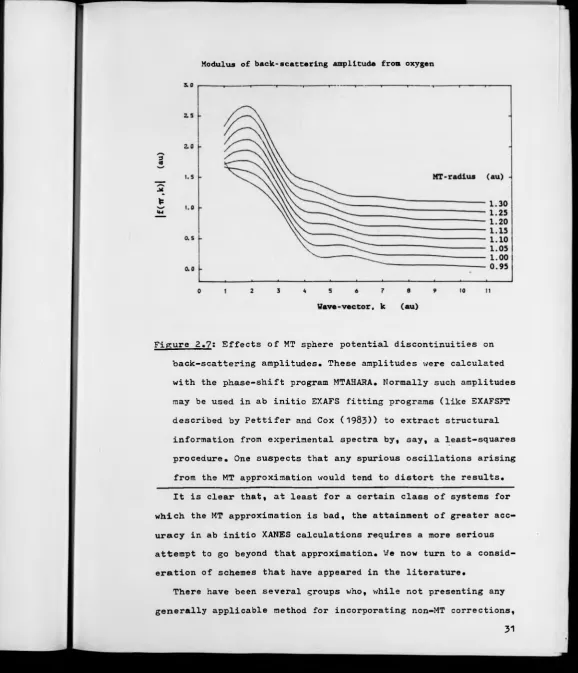
2.7 Effects of MT sphere potential discontinuities on
backscattering amplitudes.
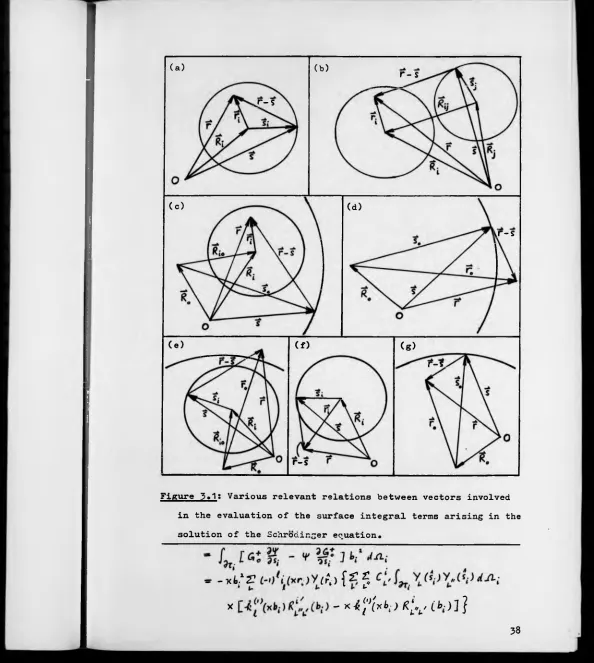
3.1 Various relevant relations between vectors involv
ed in the evaluation of the surface integral terms
arising in the solution of the Schrodinger eqn.
if
.1
Truncation error for 1=9 SHXs of 2/R potential.if.2 Cr(CO)g electron density resulting from the super
position of free-atom densities.
if.3 CrCCO), total potential from the superimposed V. LIST OF ILLUSTRATIONS.
Page
2
3
23
23
25
27
28
29
31
38
63
Page
free-atom electron densities.
68
if.if Residual truncation error for expansion of Cr(CO)^
potential. 70
if .5 CriCO)^ potential radial functions for the IP (+
SMR) and the Cr atoa. 71
if
.6
Cr(CO)^ potential radial functions for the G and 0atoms.
72
5.1 Photoionisation cross-sections for Li^+ from the
CNTSHX program compared with exact analytic
values. 93
5.2 CNTSHX results with INa potential for Cr(C0)g. 100
5.3 CNTSHX results with IITb potential for Cr(C0)g. 101
5.if CNTSHX results with Z+1a potential for Cr(C0)g. 10if
5.5 CNTSHX results with Z+1b potential for Cr(C0)g. 105
In this work we do not introduce any new notation. We have not
tried particularly to follow the conventions in the literature,
although our notation for the derivation of the full-potential
scattered-wave (FP-SU) secular equations owes much to Johnson
(1973) and Natoli et al. (1986). 3earing in mind the large number
of equations presented here, and the means at our disposal, we
have decided to write them by hand. The mathematical notation th
at we used is standard, although several particular conventions
should be noted. An integration in which the region is not speci
fied should be taken over the whole region of the variable invol
ved. For a vector f~ vie denote its magnitude by •” H I M and the
corresponding unit vector by r = ( V 1") •" . A matrix (finite or
infinite) is denoted by M . The use of set theory notation, i.e.
set inclusion C
.1
, membership6
- , union U , intersection H ,boundary 3 , complementation , and the empty set ^ ; is int
ended as no more than a convenience for the compact specification
of the various regions of the molecular partition.
The physical units used herein are the theoretical "atomic
units", in which the electron mass, the Bohr radius, the positron
charge and Planck's (reduced) constant all have unit magnitude.
Only two units in this system have special names; these being the
Bohr of length and the Hartree of energy. Any other unit is deno
ted simply by "au"; although occasionally, to avoid ambiguity, we
also indicate its composition in terms of the fundamental quanti
ties of mass (M), length (L), time (T) and electric charge (C).
In conformity with the literature of this branch of physics howe
ver, we use also several non-standard units. Instead of the Hart
Hartree). In addition, but mainly in connection with experimental
spectra or molecular structures, we use the electron-volt (eV),
O O
the megabarn (Mb) and the Angstrom (A). V/e list below the values
(taken from Cohen and Taylor (1987)) of some fundamental constan
ts and conversion factors, in SI and atomic units. As usual, the
numbers in brackets within a value refer to the estimated (one
standard deviation) uncertainty in the last digits of the mantis
sa. If no uncertainty is quoted, then the value is to be interpr
eted as being exact by definition.
Electron mass, m g = 9.1093897(5l+)x10
” 3 "1
kg = 1 au(M). —1
oBohr radius, a^ = oC=
0
.5291772
if-9
(2
i+)x10
m= 1 Bohr (au(L)).
Atomic time unit, a
02
m e/ii = a^/c oC = 2.itl888It33( 22)x10 s= 1 au(T).
Positron charge, e - 1 ,60217733(i*9)x10 ^ C = 1 au(C).
_ -Zk
Planck's (reduced) constant, IS =
1
.05^57266(63)x10 J s=
1
au(ML2
T"’"') .8
■■1
Speed of light in vacuum, c = 2.99792l+58x10 m s
= 137.0359895(61) au(LT_1).
—7
—1
Permeability of vacuum, = k'tr x10 H m
= 6.69176350(60)x10_if au(MLC- 2 ).
Permittivity of vacuum, = 1/y
4
,Q c2
=8
.85
^1 8 7 8 1 7
...x10 12F m1
= e2/ % lie« =
1
/kVT au(M"1
L~3
T2
C2).Fine-structure constant, oL = 1/137.0359895(61).
—11
3
—1
-2
Newton's gravitational constant, G = 6.67259(85)x10 m kg s
= 2.l+0000(32)x10'Jf3au(M_1L3T-2).
Rydberg energy, mec
2
ot2/2 = 2.17987^1(13)x10 J= 1/2 Hartree (auiML2!-2)) »
1 3
.6056981
(^1
) eV.Megabarn, 1 Mb = 10
-2 2
m2
= 3.57106431(33)x10- 2
Bohr2 .this work and we give a glossary of them below
ASR Atomic sphere region (of molecular partition).
EMR Extra-molecular region (of molecular partition).
(E)XAFS (Extended) X-ray absorption fine structure.
FP Full potential.
FWHM Full width at half maximum.
IR Interstitial region (of molecular partition).
Xrrep Irreducible representation (of a group).
LHS Left-hand side (of an equation).
LRO Long-range order (theory of XAFS).
(M)SW (Multiple) scattered-wave (method/theory)•
MT Muffin-tin (potential approximation).
OS Outer sphere (enclosing a molecule).
RHF Restricted Hartree-Fock (hamiltonian/method).
RHS Right-hand side (of an equation).
SCF Self-consistent field.
SHX Spherical harmonic expansion.
SRO Short-range order (theory of XAFS).
SSR Spherically symmetric region (= an ASR or the EMR)
XANES X-ray absorption near-edge structure.
VII. SUMMARY
In this work we describe the effects of the relaxation of the muffin-tin (MT) potential approximation (and the consequent use of full potentials (FPs)) in the ab initio calculation of X-ray- absorption near-edge structure (XANES) by the multiple-scattered- wave (MSW) Xod method. In doing so we demonstrate the validity and computational feasibility of the extended FP-HSW theory due to Natoli et a l . (1986). Vie describe certain refinements to this theory and the development of a practicable computational approa ch for its realization. With the results of the newly-developed computer programs for certain model systems we show that the FP- MSW method leads to much higher accuracies in both bound-state energy eigenvalues and in photoionization cross-sections near the threshold. Our FP-MSW XANES calculations for the chromium hexa- carbonyl (Cr(CO)g) system therefore demonstrate, because the res ults are still significantly different from the experimental spe ctrum (although closer than the MT case), that there remain other deficiencies in the physical model. Although beyond the scope of this work, we strongly suspect that the bulk of the remaining error would be accounted for by a better treatment of inelastic loss and (to a lesser extent) exchange-correlation. Our final conclusion is that the use of FPs is necessary (and now feasible) for the accurate calculation of XANES.
We begin with an introduction to X-ray absorption spectroscopy (XAS) and then concentrate on XANES giving the motivation in ter ms of its structural significance and describing the necessity and difficulty of accurate ab initio calculations. The central part of XANES calculations is the solution of Schrodinger's equa tion for the initial and final molecular states in the absorption process, and we summarize the approximations to the full many- body equation that make it tractable. This leads to a discussion of the MT approximation and an illustration of its deficiences. We review various remedies that have been proposed and concentra
te on the FP-MSW theory of Natoli et al. (1986). We then give a detailed presentation of the theory and develop the necessary representation of the potential in terms of spherical harmonic expansions (SHXs). It is shown that, for symmetric molecules with up to two coordinating shells of atoms, five to ten partial waves per prototype atom serve to make the SHX representation from one to three orders of magnitude more accurate than the MT case.
The development of the FP-SW bound-state eigenvalue program ENESHX is described and the program tested with the hydrogen mol
ecular ion (H_ ). By comparison with the MT results we find that
the error is reduced to less than '\2% in the worst case (the gro
und state) and less than 0.2% for the highest levels. Calculatio
ns for the Cr(CO)g system do show changes of as much as -O.k Ryd.
for the valence levels (stemming mostly from the better treatment of the interstitial region). The successfully-tested ENESHX is
then adapted to produce the FP-SW continuum photoionization
2
+cross-section program CNTSHX which is then tested with a Li ion
pseudo-cluster whose exact analytic cross-sections are known. Above about 1 Ryd. from threshold, the CNTSHX cross-sections are
within 1& of the exact values, compared to 7% for the MT case.
Chapter 1. INTRODUCTION.
Section 1.1: X-Ray Absorption Spectroscopy and XANES.
This thesis is concerned with the relaxation of the "muffin-
tin" (MT) approximation in the ab initio calculation of X-ray-
absorption near-edge structure (XANES). While treating the theor
etical foundations in detail, and including some further elabora
tions, our main emphasis is on the development of the computatio
nal approach and the results obtained for model systems.
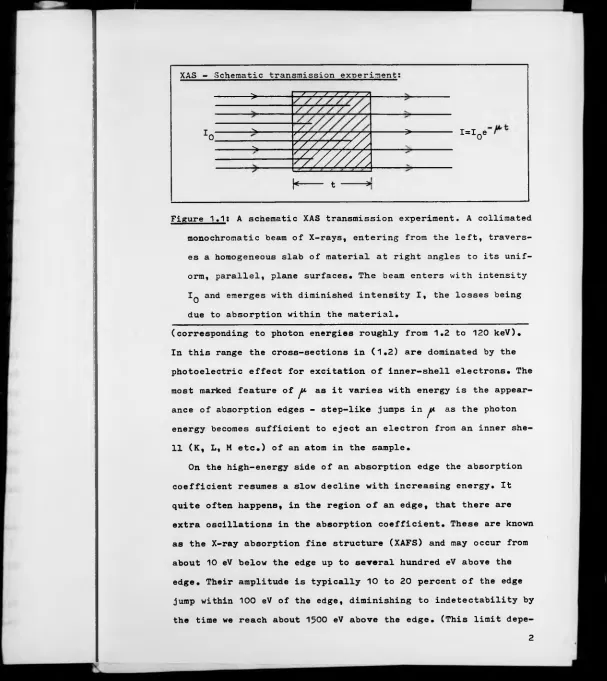
Consider X-ray absorption spectroscopy (XAS) in its simplest
form as follows. Fig. 1.1 gives a schematic representation of the
experimental situation. A monochromatic beam of X-rays of initial
intensity I
0
traverses a material sample of thickness t , emerging with an intensity I given by Beer's law:
from absorption and scatter. In practice, the detectors of the
transmitted beam usually have a wide enough angle of acceptance
that the small-angle scatter (which dominates the scattering pro
cess) is captured. The scatter not detected is then negligible
where C- is the total cross-section for a given type of absorber
function of energy. The particular energy range we consider is in
the X-ray region with photon wavelengths from about 10 A to 0.1
(
1.
1),
in which consists of contributions
and yu. is identified with photoelectric absorption. This absorpt
ion coefficient is a function of the photon energy £", and may be
expressed as
l , and H.* is the number density of that absorbing species with
in the sample.
The main business of experimental XAS is to measure it as a
O
>
XAS - Schematic transmission experiment:
— 7— 7— 7"7"~7 7— 7I
--- > ■ - ■
---T ^
xo
v,
¿ Z Z Z
tZ Z .
*
I=IoeW
Z ^ T
z? ,
h — t — *
Figure 1.1: A schematic XAS transmission experiment. A collimated
monochromatic beam of X-rays, entering from the left, travers
es a homogeneous slab of material at right angles to its unif
orm, parallel, plane surfaces» The beam enters with intensity
IQ and emerges with diminished intensity I, the losses being
due to absorption within the material.
(corresponding to photon energies roughly from 1.2 to 120 keV).
In this range the cross-sections in (1.2) are dominated by the
photoelectric effect for excitation of inner-shell electrons. The
most marked feature of
p
as it varies with energy is the appearance of absorption edges - step-like jumps in
^
as the photonenergy becomes sufficient to eject an electron from an inner she
ll (K, L, M etc.) of an atom in the sample.
On the high-energy side of an absorption edge the absorption
coefficient resumes a slow decline with increasing energy. It
quite often happens, in the region of an edge, that there are
extra oscillations in the absorption coefficient. These are known
as the X-ray absorption fine structure (XAFS) and may occur from
about 10 eV below the edge up to several hundred eV above the
edge. Their amplitude is typically 10 to 20 percent of the edge
jump within 100 eV of the edge, diminishing to indetectability by
[image:20.643.15.622.13.694.2]nds on the atoms surrounding the absorbing atom and the temperat
ure of the specimen.) Within a few eV of the edge the absorption
coefficient may oscillate by more than
100
?£ of the edge jump,giving rise for example to so-called "white lines".
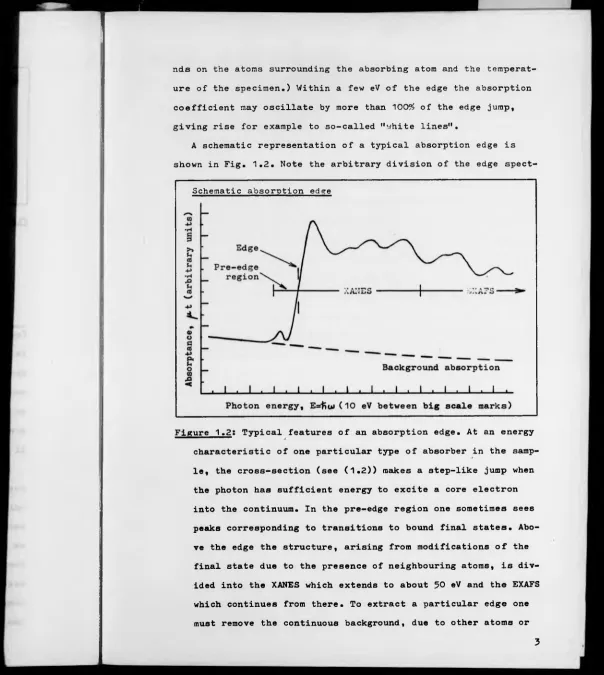
A schematic representation of a typical absorption edge is
shown in Fig. 1.2. Note the arbitrary division of the edge
spect-Schematic absorption edge
Figure 1.2: Typical features of an absorption edge. At an energy
characteristic of one particular type of absorber in the samp
le, the cross-section (see (
1
.2
)) makes a step-like jump whenthe photon has sufficient energy to excite a core electron
into the continuum. In the pre-edge region one sometimes sees
peaks corresponding to transitions to bound final states. Abo
ve the edge the structure, arising from modifications of the
final state due to the presence of neighbouring atoms, is div
ided into the XANES which extends to about 50 eV and the EXAFS
which continues from there. To extract a particular edge one
[image:21.648.12.616.12.687.2]other edges on the same atom, by extrapolating upwards in ene
rgy some asymptotic form fitted to a smooth region below the
edge.
rum into various regions; the pre-edge region, the XANES and the
extended X-ray absorption fine structure (EXAFS). Although there
is no exact boundary between the XANES and the EXAFS, the two are
commonly divided at about 50 eV above the edge, for reasons we
now discuss.
The first publication of a measured X-ray absorption spectrum
vías that of M. de Broglie (1913) and the first published observa
tions of fine structure above an edge were those of H. Fricke
(1920). Following the advent of modern wave mechanics it was fai
rly quickly realized that the fine structure resulted from the
modification of the electron's final state by the presence of
neighbouring atoms; and soon after Kronig (1931,1932a,1932b) laid
the foundations of the present theoretical understanding of XAFS.
In the ensuing *tO years the development of the theory was pursued
along two separate lines; the long-range order (LRO) theory based
on the attribution of the fine structure to variations in the
electron's density of states due to allowed and forbidden bands
in a crystal; and the short-range order (SRO) theory based on
scattering of electron waves by neighbouring atoms. In this time
many necessary further elements were included in the theoretical
treatment and by the mid-1970s the SRO theory was found to be the
more appropriate, since the fine structure is determined by near
neighbours of the photoionized atom rather than all atoms in the
solid. It is on the basis of the SRO theory that most modern tre
atments of XAFS are based. One should see Azaroff's (1963) review
for an account of the earlier history of the field, together v/ith
(1982)). The detailed theory is given by Lee and Pendry (1975)
and Ashley and Doniach (1975). and most later treatments are bas
ed on their work. (Note however, that Muller and co-workers have
developed a successful LEO theory for periodic systems (see e.g.
Muller and Wilkins (198^)).)
It is from a consideration of the theory that the division
between XANES and EXAFS arises. This theory is formulated in ter
ms of scattering of the photoelectron wave by various neighbours
before returning to its source at the excited atom to cause inte
rference leading to the observed variations in cross-section. In
the EXAFS region, in which the photoelectron energy is above 50
eV, the scattering from individual atoms tends to be concentrated
in the forward and backward directions. Furthermore, the mean
free path of the excited electron is reduced because of inelastic
losses such as coupling to plasmons or electron-hole pairs. Both
of these effects mean that EXAFS is dominated by events in which
the photoelectron is scattered only once and then returns to the
source (or, in some cases, by a limited number of multiple-scatt
ering paths). Because of this, the theoretical description of
EXAFS has been much more successful than that of XANES.
In the XANES region the scattering of electrons away from the
forward and backward directions is much stronger, and this is
coupled with the fact that the mean free path is much greater
since the inelastic losses are weaker. This all means that the
XANES is dominated by multiple scattering and its theoretical
description is correspondingly more difficult. Also the energy of
the excited electron becomes comparable to the fluctuations of
the crystal or molecular potential (arising from covalent bonds
for example) in the XANES region; thus complicating the descript
Because of its dependence on the coordination geometry of the
excited atom and the atomic selectivity inherent in an X-ray abs
orption edge, XAFS is potentially a highly flexible, structural
probe for all kinds of materials. This potential has in fact been
partially realized, primarily for the EXAFS region (see Hayes and
Boyce (1982) for further references) by virtue of its treatment
in terms of single scattering events. A concomitant limitation
however, is that the analysis of SXAFS (by empirical means or the
fitting of first-principles calculations) has mainly provided on
ly radial distances of neighbouring atoms and sometimes their id
entities. (Although note for example recent results of Pettifer
et al. (
1986
) giving orientational information from a multiplescattering analysis of EXAFS.)
XANES, on the other hand, should provide information about the
detailed local geometry around the absorbing site; particularly
relative orientations and bond angles. Analysis of XANES is attr
active also for practical reasons. Primarily this is because the
amplitude of the XANES is usually greater than for EXAFS and thus
easier to measure. This is partly because the existence of disor
der (either thermal or static) tends to wash out EXAFS at higher
photoelectron momenta, but also because the backscattering from
atoms diminishes as well.
The main drawback involved in the analysis of XANES is its
considerable complication. T h e only approach possible in this
region is the use of first-principles (ab initio) calculations of
the cross-sections and subsequent comparison with experiment. It
is in the general area of accurate ab initio calculations of
XANES that this thesis is intended as a contribution. In particu
lar, we consider calculations within the framework of the so-
called multiple-scattered-wave (MSW) method and show what happens
•■/hen the MT approximation to the one-electron potential is dropp
ed. Although v/e only treat the MSW theory, the MT approximation
is widely used in other theoretical approaches to XANES and cons
equently our results have much wider implications.
Section 1.2; Scope and Plan of Thesis.
The main scope of the thesis is the implementation of a non-MT
extension to the scattered-wave (SVJ) method for the calculation
of XANES, with the purpose of answering questions about the size
and importance of non-MT corrections and the feasibility of the
computations. Even this seemingly direct task turned out to be
much larger and more complicated than it appeared at first sight.
V/e found, at each stage of the work, that there were many more
ramifications and important new questions than could be treated
within the framework of a thesis. Therefore we have presented the
work as a direct logical progression that v/e summarize in this
section. The detailed developments given are only those sufficie
nt to support the final conclusions, while other important points
are just outlined or mentioned in passing.
In Chapter 2, we summarize the main approximations to the full
many-body Schrodinger equation that bring it into a more tractab
le form. The muffin-tin approximation is then introduced and v/e
briefly review the present state of XANES calculations that make
use of it. We then restrict ourselves to considering the SW meth
od as the one most amenable to the incorporation of non-MT poten
tials (and the only one for which such an extension was available
in the literature). At this point we introduce our model compound
chromium hexacarbonyl (Cr(CO)g) and present some MT-based SW cal
culations of its XANES at the chromium K-edge. This is done to
approximation and the inadequacy of the usual ad hoc schemes that
are used to try to ameliorate them. 'While we have sufficient ext
ra material to present a full-scale survey of all aspects of MT
deficiencies in the SW method, the volume of this material is
prohibitive. We nevertheless discuss these deficiencies and revi
ew the literature of serious means that have been proposed for
going beyond the MT approximation. This leads up to the introduc
tion of the Natoli et al. (
1986
) paper as our theoretical foundation.
In Chapter 3 we develop the full-potential scattered-wave (FP-
SY/) theory. The derivation of the (unpublished) bound-state equa
tions is given in detail, while the continuum case from Natoli et
al. (
1986
) is merely sketched. The programs that we have developed to apply the theory,rely heavily on the use of molecular point
symmetry and group theory to reduce the size of the secular matr
ices and consequently the computational effort involved. Vie have
only outlined the associated theory and there is a considerable
amount of further detail that would be needed to make it a rigor
ous treatment. In fact, the full details are not yet completely
worked out for the FP case. Even for the MT case (as described by
Diamond (1973)) there are some deficiencies, and we intend to
present a full treatment, in the framework of the FP-SW method,
at a later date.
The greater part of the work reported in this thesis was the
development of the computer programs that realise the theory of
Chapter 3» hut this has not been reflected in our presentation of
it. Vie describe only the main computational means whereby the
particularly new features of the FP-SW method are incorporated.
The first of the programs, MLPSHX, is described in Chapter if. He
potential accurately, in a form that is usable by the main FP-SW
programs. Ultimately we should test in detail the sensitivity of
the results from the later programs to the accuracy with which
the potential is modelled. For the purposes of this thesis we
content ourselves with the demonstration that the resulting pote
ntial model is a much closer representation of the real case than
the MT approximation. Presumably therefore, the greater part of
any benefits that may come from the use of a FP at all will resu
lt from our model without further adjustment of parameters.
In Chapter 5 v/e describe the development of the main FP-SU
programs and the results that they give for some model systems.
Although our interest is in XANES calculations, we wrote first
the program ENESHX that applies the FP-SU theory for bound stat
es. This was because the theory is simpler for bound states and,
with the hydrogen molecular ion results, we have an absolute test
of both the program and the theory. The XANES program CNTSHX,
that applies the continuum wavefunction theory, is sufficiently
similar that the well tested parts of ENESHX may be taken over
almost directly. The main thing lacking from our treatment of the
program results is an analysis of their sensitivity to various
parameters used in the potential model and the wavefunction expa
nsions. There are also many different numerical integration, int
erpolation and special function routines used in the programs,
and a detailed mathematical error analysis of them all is beyond
the scope of this thesis. Our approach to such questions is to
create a sufficient margin of accuracy, by taking various expans
ion parameters and integration meshes well beyond the usual val
ues, so that any remaining inaccuracies are dominated by those
stemming from the physical model itself.
pter are sufficient for us to be able to answer the limited main
questions posed; namely those about the extent of the changes in
going from MT to FP, the correctness of our theoretical approach
and the feasibility of the calculations themselves at least for a
limited class of systems with modest computational resources.
With the most serious approximation disposed of we then comment
on the future steps that need to be taken towards accurate XANES
Chanter 2. MUFFIN-TIN 3ASED CALCULATIONS OF XANES
Section 2.1: General Approximations to the Schrodinger Equation.
The main part of all XANES calculations is the solution of the
appropriate dynamical equations for the interacting assembly of
nuclei and electrons that comprises a molecule. At the energies
that we consider in XAS the inner structure of the nuclei is qui
te irrelevant and all particles may be considered as point-like
masses with a given intrinsic spin. Also the possibility of anni
hilation and creation of even the electrons does not arise. Ther
efore, since our most ambitious requirements for accuracy would
be, say, one percent in the cross-sections, the whole apparatus
of quantum field theory (in particular QED) may be safely ignor
ed*
The first non-trivial question to arise is whether a relativi
stic treatment is necessary. Certainly, the electrons can have
speeds which are a significant fraction of the speed of light,
especially for the core electrons in heavy atoms. The nuclei,
being several thousand times more massive than the electrons,
tend to move much more slowly and a non-relativistic treatment of
them would be adequate. In fact it is usual to make the so-called
Born-Oppenheimer approximation in which the nuclei are taken to
be stationary (see e.g. Schiff (1968) p . ^ ? ) * The dynamical prob
lem for the electrons is then solved separately in what is thus
the fixed, external field of the nuclei. If desired the behavio
ur of the nuclei, under the influence of the cloud of electrons,
may be treated as a perturbation. Under certain circumstances the
Born-Oppenheimer approximation does break down with the excitati
on of rotational and vibrational modes, at high momenta. This is
temperature independent provided no phase transition occurs.
Vie are still left with the problem of whether to treat the
electron motion relativistically or not. There is in fact a large
body of evidence to show that the neglect of relativistic effects
can lead to significant errors. For example, Loucks (196?) shows
that the inclusion of relativistic effects is necessary in the
calculation of band-structures for solids containing heavy atoms.
A review of this general question is given by Desclaux (1980).
For our purposes, considering the degree of accuracy in XANES
calculations, we can reasonably neglect relativistic effects as
long as we restrict our attention to low-Z atoms (i.e. the 3d
transition elements or lower). Since relativistic effects will
be serious only for the deep-lying core levels and not so much
for the slowly propagating states near the ionization threshold,
their main result in X-ray absorption will be to change the ioni
zation threshold position rather than the details of the XAFS.
(See also Kutzler et al. (
1980
))(We note here in passing that there has been developed a rela
tivistic version of the scattered-wave (SW) method for molecules.
This is given in Yang and Rabii (1975) and Yang (1978), and a
calculation for uranium hexafluoride (UFg) presented by Case and
Yang (1980) (ground state only). More interesting from our point
of view are the calculations of Arratia-Perez and Yang (
1985
) forthe ground states of certain metal hexacarbonyls, including our
model compound Cr(CO)g. They indicate that, even in W(CO)g, rela
tivistic effects are qualitatively unimportant for the valence
levels. While a full treatment of the electron dynamics requires
the inclusion of relativistic effects, their importance in our
systems is expected to be small and we do not consider them furt
'¡e must now use the many-body Schrodinger e~uaticn for M ele
ctrons in the Coulomb fields of the N nuclei. The wavefunction
then satisfies the time-independant equation at energy £ :
i
pd " i j. m i -i j .‘ j*' k ; - | r ; - r | J
•.-.’here the electron positions are r^ and the fixed nuclear posit-
ions and charges are R- and 2- respectively. Note that the wav—
efunction is a function also of the spins S- of the electrons;
i.e. 4^ (T. S r S ... r S ), and must be anti-symmetric under
the exchange of any tv/o electron indices. The hamiltonian in
(2.1) has no terms involving spin and in fact we ignore all spin
effects except those arising from the Pauli exclusion principle.
Since there can be several hundred electrons even for quite
small molecules, the solution of (2.1) is quite intractable with
any known analytic or numerical method presently available. The
crucial approximation that we make now is the so-called one-
electron approximation in which each electron is treated as movi
ng in an average field due to the nuclei and the probability den
sity of the other electrons. The usual way this approximation is
implemented is the self-consistent-field Hartree-Fock method (see
for example McWeeny and Sutcliffe (198*0 and references therein).
It may be developed by assuming that the wavefunction is an anti-
symmetrized product (a Slater determinant) of one-electron orbit
als and then using the variational principle to optimize them. In
other words we assume that
M
t r f . ? ■ ) = ( M i ) 2 T x h » n (fK ).n U . ( V ( i ) ) ( 2 . 2 ) ;
1 , 1 I f U ( S I
where the individual spin-orbitals
Ui(j) s 4 i (rj ) X i (*j) (
2
.3
)are mutually orthogonal and normalized. We further restrict the
form of the wavefunction (2.2) by assigning the electrons two at
orthogonal spin parts
The use of the hamiltonian of (2.1) with the variational cons
traints (2.2,3) leads to the restricted Hartree-Fock (RHF) equat
ions for the orbitals
[ - 7 * + VN ( r ) + Vc ( r ) ] < p j r ) + fVf (r,s)4>Js)M, s - £m<
l>
n( r ) ( z . k ) ;
which has the form of a one-electron equation for each orbital
with a potential made up of the nuclear Coulomb field
II
I
(2.5)
the electrons' Coulomb term
V
( O = ¿ 2 ' jC J
<P* (s) 4> (i).^
*1
-V I »— v J (2
.6
) and the non-local exchangeV ^ r J )
= -term1
(2.7)While (2.4) has in fact been used successfully (see McWeeny and
Sutcliffe (198*0 again), the non-local term makes it very unwiel
dy for anything other than atoms. A further approximation is then
made to replace (2.7) by a simpler, local potential. The most
common one is that derived from the theory of the free-electron
gas, and introduced by J.C. Slater (see especially his review -
Slater (1972)) under the name "Xei.". For the local electron
dens-p ( f ) =
i j ? 4> y> * J r >
( 2 . 8 ) ,
this potential is
v xx (r) = -
6
* [ O A n O p t f f) ] 0
(2.9)where OL is a parameter chosen (for free atoms at least) so that
the total energy matches that of the full RHF method (Schwarz
(1972)). The XOC method has been fairly successful in several
calculational schemes for the ground states of various solid-state
and molecular systems. Its validity for excited or ionized states
is rather questionable (see for example Pettifer and Cox (1983))
the RHF method itself. A general review of the X oC method in var
ious calcuiational schemes is given by Gadiyak et al. (
1982)0
In making the one-electron approximation we do in fact ignore
several non-trivial many-body aspects of the photoionization pro
cess. The existence of many other excitation channels than the
promotion of a core electron to a continuum final state, often
modifies substantially the photoabsorption cross-section. The
dynamical effects of the core hole, the possibility of "shake up"
or "shake off" effects (in which additional electrons are excited
to bound or continuum states respectively), and inelastic effects
which shorten the outgoing electron's lifetime (such as the exci
tation of plasmons or electron-hole pairs), should all be includ
ed in a proper treatment. (See discussions in Hayes and Boyce
(1982) and Pendry (1983) for example.) Much effort has been made
to incorporate a description of these effects into the one-elect
ron scheme in an approximate way by, for example, the use of com
plex potentials. Questions then arise about which are the correct
one-electron states to use (Stern and Rehr (1983)). It is clear
that much work remains to be done in this area before a satisfac
tory general approach is developed. (The recent work of Bardysze-
wski and Hedin (198?) seems to be an important step in the right
direction.)
So far nothing has been said about how the interaction with
the radiation field is to be treated. There has been no indicati
ons that the usual time-dependant perturbation theory approach is
inadequate for XANES calculations. The use of the dipole approxi
mation (see e.g. Schiff (
1968
) p.^O^f) is usually sufficient, although Hahn et al. (1982) have reported the detection of non-triv
ial features in the pre-edge region arising from quadrupole tran
It will be clear from the foregoing that there are various
possible sources of inaccuracy in the approximations that v/e have
already made. In this work v/e do not consider them in any detail,
but take them as something to be held constant while v/e dispose
of the most serious approximation that we introduce in the next
section. Nevertheless they should be eventually considered and v/e
make some comments about this in Chap.
6
.Section 2.2; The "Muffin-Tin" Approximation.
We are now left with solving an effective one-electron Schrod-
inger equation for the orbitals, with a potential which is the
sum of (2.5,6 and 9). (The last two involve the orbitals •themsel
ves so that the equation is really a set of non-linear, coupled
equations. However, it is usual to take an iterative approach so
that the potentials are derived from a previous set of approxima
te orbitals and the solution of the equations gives a more accur
ate set of orbitals. It is then hoped that this process will con
verge quickly to a self-consistent-field (SCF) solution to the
original equations. The original approximate potentials are usua
lly derived from an electron density of a superposition of free-
atom densities.)
Wherever it comes from the one-electron potential is complica
ted function of position and the solution of the associated Schr-
odinger equation is still very difficult. In general however, the
potential tends to have certain characteristics. Near an atomic
nucleus it is dominated by the Coulomb singularity and, within a
distance of the order of one Bohr, it does not depart very much
from spherical symmetry about the nucleus. Furthermore, in the
region between the atoms, the potential is not very deep and var
ies quite slowly. With these characteristics in mind, and for the
sake of mathematical tractability, it is common tc make the so-
called ’’muffin-tin" (MT) approximation for the functional form
of the potential. In this approximation the atomic nuclei are
enclosed by non-overlapping MT spheres and the potential is taken
to be spherically symmetric inside them. The mathematical separa
tion of the Schrodinger equation in a central field can then be
made and the remaining difficult part is the solution of the rad
ial equation. In the interstitial region between the spheres the
potential is taken to be flat so that the electron motion is gov
erned by the free-particle equation whose solutions are well kno
wn. The main problem is now the matching of the solutions in the
various regions according to the relevant boundary conditions.
Since its introduction by Slater (1937) (in the context of the
augmented plane-wave method) the MT approximation has been used
with varying degrees of success in a wide range of calculations
of things such as band structures, molecular electronic structur
es and photoabsorption cross-sections. It tends to be more accur
ate for close-packed systems such as metals and less so for open,
covalently bonded systems where the concentration of electron
density along the bonds is badly modelled by spherically symmetr
ic atoms and a flat interstitial region.
A typical prescription for the construction of an initial MT
potential is that of Mattheiss (196*0 in which we use free-atom
electron densities (from Clementi and Roetti (197*0 or Herman and
Skillman (1963)) superimposed at the appropriate positions. For
each atom we first solve Poisson's equation for the Coulomb part
of the potential. This is quite easy since each atomic density is
spherically symmetric. Using the formalism of Lowdin (1956), the
overlapping part of the neighbouring atom potentials is spheric
interstitial region the sum of all the atomic Coulomb potentials
is volume e.veraged to give a constant potential. A similar proce
dure is then followed with the electron density and (
2
.9
) used togive the Xet part of the MT potential.
Section 2.3: Survey of Ab Initio XANES Calculations.
The use of the MT approximation underlies virtually all of the
current types of calculations of XANES. V.'e briefly review the
most successful, general methods that are now in use. These meth
ods fall into two categories i.e. band-structure based methods
and multiple-scattering methods.
The band-structure methods are exemplified by the results of
Muller and co-workers (see Muller and Wilkins (198*0 and further
references therein). Their approach is based on the use of the
linear augmented plane-wave method of Andersen (1975) and has
given very impressive results for
3
d and *td transition metals.Because of its restriction to periodic systems and the calculati
on of the final states in the ground-state potential with no core
hole, the applicability of this method seems rather limited. Also
its successes are associated only with metals for which the MT
approximation is not so bad. There appears to be no immediate
prospect that the formalism can be easily generalized to accomod
ate non-MT potentials.
A more general approach is provided by the multiple-scattering
methods of which there are two main types. These are not restric
ted to periodic systems and, indeed, are most frequently applied
to molecules or clusters of atoms taken from crystalline or amor
phous solids (wherein lies their great utility).
The first of these methods is due to Durham and co-workers
This method is an extension of the usual single—scattering EXAFS
theory (e.g. that of Lee and Penary (1975)) to she near-edge reg
ion. It takes into account explicitly the details of the scatter
ing of the excited electron by the atoms of the cluster and has
been reasonably successful at reproducing qualitatively features
of the HANES of a variety of systems, nevertheless it is tied to
the MT approximation for the potential and is still less than
satisfactory for open, covalently bonded clusters.
The other multiple-scattering method is an adaptation of the
band-structure formalism of Korringa (19*0), Kohn and Rostoker
(195*0, to clusters. Under the name "multiple-scattered-wave Xot
method" it v/as developed by Johnson and co-workers (see Johnson
(1966), Smith and Johnson (
1969
), Slater and Johnson (1972),Johnson and Smith (1972), Johnson (1973) (a review of the theory
and main applications) and Johnson (1975) (a complete review of
applications) for bound states, and by Dill and Dehmer (197*0 for
continuum states and photoionization. Applications to XANES were
made by Natoli et al. (
1980
) and by Kutzler et al. (1980), withsimilar results to those of Durham and co-workers. It is somewhat
more cumbersome than their method and uses likewise the MT appro
ximation. However, as we describe later, its greater generality
allows it to be adapted for more realistic, non-MT potentials;
and it is for this reason that we restrict our attention from now
on to this method.
It may turn out to be possible to incorporate non-MT potentia
ls into the other XANES methods, but this has not been demonstra
ted and we do not consider them further. A general overview of
the problems of XANES may be seen in Pendry (
1983
) and Doniach etSection Z.'-ri Calculations for Chromium .-'exacarbonyl.
To get an idea of the kind ox results that the MT-based scatt
ered-wave (SW) method gives, we performed some calculations for a
model compound chromium hexacarbonyl CriCO)^. This molecule was
chosen because (a) it has high symmetry reducing the computation
al effort; (b) many of its electrons are involved in bonds, part
icularly in the CO ligands; and (c) it has been extensively stud
ied (see Arratia-Ferez and Yang (1985) and references therein) by
different methods as a prototype for CO bonding to metals» It
consists of a central chromium atom coordinated by six carbonyl
ligands in an octahedral configuration such that the carbon atoms
are adjacent to the chromium atom. The point group is thus 0, for h
which there are ten irreducible representations (irrsps) denoted
A
1
g*A1u’
A2
g ’ A2
u> V V T1
g ’ T1
u ’ T2
g andT2
u
accordinS to the Mulliken (1955) scheme. Chromium hexacarbonyl is a white,_3
crystalline solid at room temperature of density 1.77 g cm . It
crystallizes according to the Pnma space group with four molecul
es per unit cell and cell dimensions: a = 11.769(12) A, b =
11.092(11) A and c = 6.332(6) A (V/hitaker and Jeffery (1967)).
The mean bonding distances (uncorrected for thermal vibration)
are 1.909(3) A (3*6075(57) Bohr) for chromium-carbon and 1.137(^)
A (2.1^86(75) Bohr) for carbon-oxygen.
There have been many electronic structure calculations perfor
med for this molecule, particularly the SW-Xot ones of Johnson
and Klemperer (1977) and the relativistic SW ones of Arratia-
Perez and Yang (1985). These are of course only bound-state calc
ulations and there seems to have been no previous application of
the S'./ method to the XANES of chromium hexacarbonyl.
Our SV/ calculations for Cr(C0)g follow the general scheme giv
the sane programs, given to us by CRN, as viere mentioned above.
In brief, the program suite operates as follows. Given the struc
ture of some molecule the program MOLPOT uses superinnosed free-
atom charge densities to generate an initial approximation to the
one-electron molecular potential. For molecules with point symme
try, the program MOLSYM generates the linear combinations of sph
erical harmonics at the atomic sites which transform according to
the irreps of the point group. (The use of these linear combinat
ions reduces the size of the secular matrices arising in the SVJ
formalism. Although point symmetry is not a necessity, this part
icular group of programs is optimized to use them.) The initial
potential is passed to the program ENERGY which searches for the
bound-state eigen-energies. Having found these energies the prog
ram SCF iterates on the successive densities arising from the
one-electron bound-states in the successive potentials until it
reaches self-consistency. The self-consistent final potential nay
be the ground state, a bound excited state or an ionized state,
depending upon the previously specified occupation numbers of the
one-electron states found by ENERGY. The program CONTTJM then cal
culates the photoionization cross-sections from a core level in
the SCF ground state to either discrete, bound final states or to
the continuum of the ionized state.
The form of the potential used by these programs is of course
restricted to the MT form, and one must decide upon the various
parameters of the approximation beforehand. Firstly, we choose
the Oi values in the Xoi potential for each atom in the molecule
from Schwarz's (1972) paper. This means oC(Cr) = 0.71352, oi(C) =
0.75928 and flt(O) = 0 , 7 ^ ^ 7. For the volume outside the atoms we
take a -weighted average of these as C.7
1
+892. The more importantouter sphere enclosing the molecule. There is a certain degree of
arbitrariness in this choice, but often it is chosen tc minimize
the potential discontinuities at the sphere boundaries. For
Cr(CO)g we chose the C and 0 spheres so that they touched and so
that the potential was matched at the contact point. The Cr sphe
re was then increased tc touch the C spheres and the outer sphere
(OS) brought in to be tangent to the 0 spheres. This meant that
the sphere radii were: b(OS) = 6.315 Bohr, b(Cr) = 2.5177 Bohr,
b(C) = 1.0397 Bohr and b(0) = 1.0588 Bohr. For each sphere we had
also to decide on the maximum / for the partial waves in the
wavefunction expansion. For the bound-state part of the calculat
ions (ENERGY and SCF) these were i (max) = 5(0S), S(Cr), 3(C) and
3(0); somewhat more than would usually be taken. For the XANES
calculations vie took £ (max) = 9(0S), 9(Cr), 5(C) and 5(0). These
choices stem from earlier experience with the programs, for a wi
de variety of systems, of the appropriate /-truncations at which
the expansions tend to be well converged.
The usual way of calculating XANES with CONTNM is to take the
dipole matrix element between the core wavefunction in the self-
consistent ground state and the continuum wavefunction in the
self-consistent ionized state. However, vie shall consider two
further cases. The first uses the initial overlapped free-atom
potential from MOLPOT for the initial and final states. The seco
nd uses this potential for the initial state, but a variety of
"Z+1" potential (see e.g. Pendry (1981)), constructed by MOLPOT,
for the final state. In our version of the Z+1 potential, we use
the wavefunctions of manganese for the excited chromium, with a
1
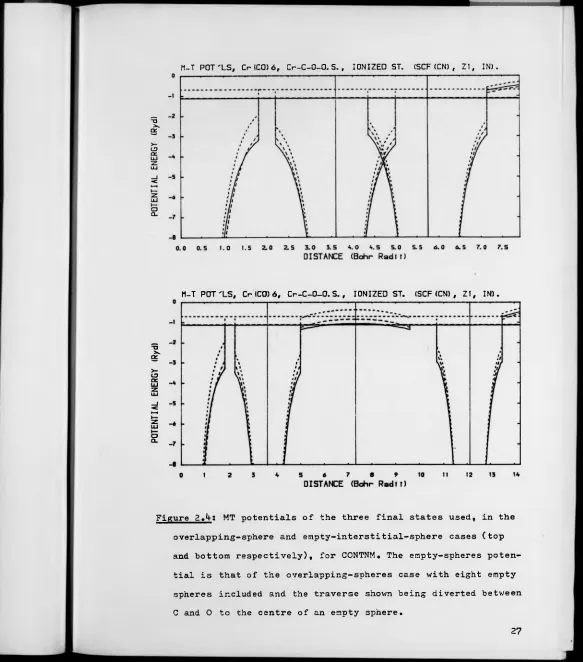
s electron removed to model the core hole.A plot of the three different final-state potentials may be
C
RO
S
S
S
E
C
T
IO
N
l(
1
b
)
PO
T
E
NT
IA
L
E
N
E
R
G
Y
(R
ydl
H-T POTENTIALS, Cr (CO) 6, Cr (0) -C <1 ) -0
12)
-0. S , (SCF, Z+1, IN).(solid line), Z+1 (fine broken 1.), IN (coarse br. 1.) Values
along traverse (L to R) from Cr nucleus, through C and 0 nucl
ei (vertical lines), to just outside outer sphere.
Figure 2.2: Comparison of experimental XANES (dotted line) of
chromium hexacarbonyl with the theoretical values (solid line)
from CONTNM. The broken vertical line shows the continuum thr
[image:41.641.22.603.9.681.2]all three cases, at the C and 0 sphere boundaries. Here the pote
ntial jumps suddenly by 3 to ^ Ryd., comparable with the range of
photoelectron energies in XANES. These extreme values stem from
the short length of the C-0 triple bond, combined with the large
volume of the interstitial region making the average potential
high relative to the potentials at the edges of the atomic spher
es.
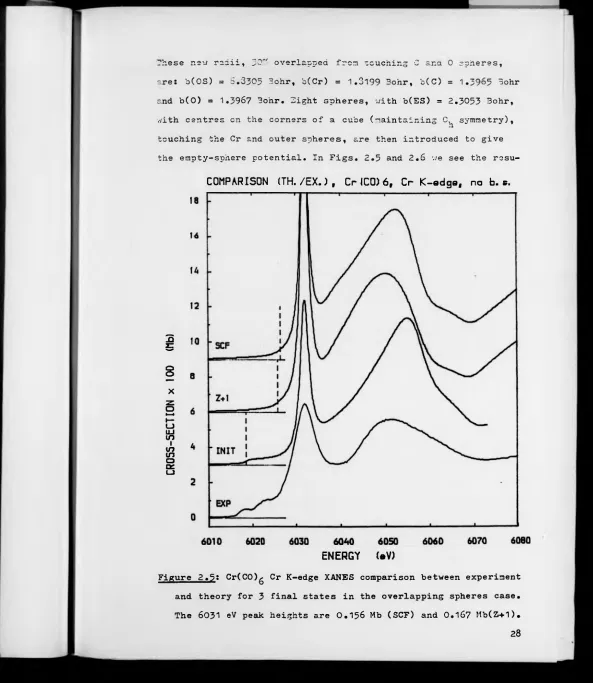
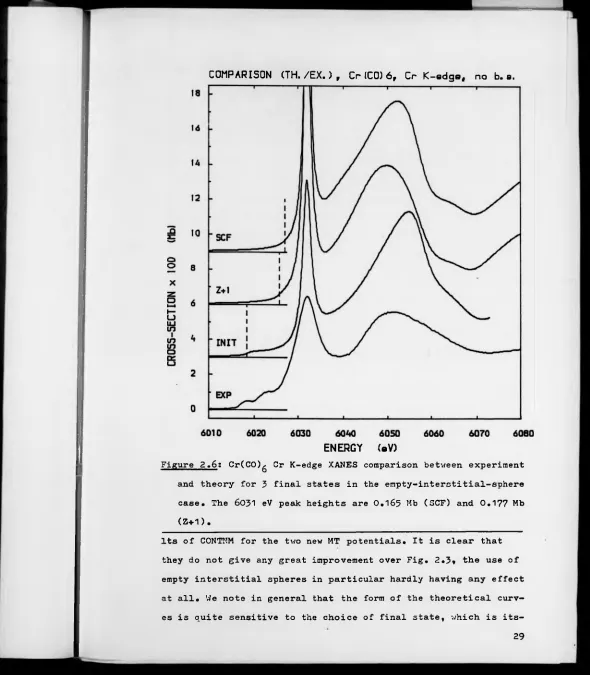
In Fig. 2.2 we see the comparison between theory and experime
nt for the Cr K-edge XANES of chromium hexacarbonyl. The theoret
ical curve results from the use of CONTNM with self-consistent
ground-state and ionized potentials. It has been convoluted with
a Lorentzian of 1.5 eV full width at half maximum (FWHM) to model
the effects of core-hole lifetime and instrumental resolution (as
in Natoli et a l . (1980)). The position of the ionization thresho
ld should, in principle, be obtained from the difference between
the total energies of the ground and ionized states given by SCF.
The resulting value in this case is about ^39 Ryd. (= 5973 eV),
but this is not a good enough estimate because the fundamental
approximation to the hamiltonian is not sufficiently accurate.
Therefore we shift the theoretical curve so that the first conti
nuum peak is aligned with the corresponding experimental one.
The experimental curve was from a crystalline powder sample at
room temperature (prepared by RFP) and was measured by J . Röhler
and his group (Köln University) on the Kiel EXAFS beam-line in
HASYLAB (DESY, Hamburg) in April 1985» The energy resolution of
the experiment was about 1 eV. Since absolute cross-sections are
not normally available for experimental curves, we have (followi
ng a suggestion of RFP) normalized it to the edge jump of **2.03
kb for chromium from the tables of McMaster et al. (1969)* to get
an approximate idea of how good the theoretical values v/ere.