ORIGINAL RESEARCH
SPINE
Clinically Feasible Microstructural MRI to Quantify Cervical
Spinal Cord Tissue Injury Using DTI, MT, and T2*-Weighted
Imaging: Assessment of Normative Data and Reliability
XA.R. Martin,XB. De Leener,XJ. Cohen-Adad,XD.W. Cadotte,XS. Kalsi-Ryan,XS.F. Lange,XL. Tetreault,X A. Nouri, XA. Crawley,X D.J. Mikulis,XH. Ginsberg, andX M.G. Fehlings
ABSTRACT
BACKGROUND AND PURPOSE: DTI, magnetization transfer, T2*-weighted imaging, and cross-sectional area can quantify aspects of spinal cord microstructure. However, clinical adoption remains elusive due to complex acquisitions, cumbersome analysis, limited reliabil-ity, and wide ranges of normal values. We propose a simple multiparametric protocol with automated analysis and report normative data, analysis of confounding variables, and reliability.
MATERIALS AND METHODS: Forty healthy subjects underwent T2WI, DTI, magnetization transfer, and T2*WI at 3T in⬍35 minutes using standard hardware and pulse sequences. Cross-sectional area, fractional anisotropy, magnetization transfer ratio, and T2*WI WM/GM signal intensity ratio were calculated. Relationships between MR imaging metrics and age, sex, height, weight, cervical cord length, and rostrocaudal level were analyzed. Test-retest coefficient of variation measured reliability in 24 DTI, 17 magnetization transfer, and 16 T2*WI datasets. DTI with and without cardiac triggering was compared in 10 subjects.
RESULTS: T2*WI WM/GM showed lower intersubject coefficient of variation (3.5%) compared with magnetization transfer ratio (5.8%), fractional anisotropy (6.0%), and cross-sectional area (12.2%). Linear correction of cross-sectional area with cervical cord length, fractional anisotropy with age, and magnetization transfer ratio with age and height led to decreased coefficients of variation (4.8%, 5.4%, and 10.2%, respectively). Acceptable reliability was achieved for all metrics/levels (test-retest coefficient of variation⬍ 5%), with T2*WI WM/GM comparing favorably with fractional anisotropy and magnetization transfer ratio. DTI with and without cardiac triggering showed no significant differences for fractional anisotropy and test-retest coefficient of variation.
CONCLUSIONS: Reliable multiparametric assessment of spinal cord microstructure is possible by using clinically suitable methods. These results establish normalization procedures and pave the way for clinical studies, with the potential for improving diagnostics, objectively monitoring disease progression, and predicting outcomes in spinal pathologies.
ABBREVIATIONS:CSA⫽cross-sectional area; DCM⫽degenerative cervical myelopathy; FA⫽fractional anisotropy; MCL⫽maximally compressed level; MT⫽ magnetization transfer; MTR⫽magnetization transfer ratio; SC⫽spinal cord; TRCOV⫽test-retest coefficient of variation
T
he era of quantitative MR imaging has arrived, allowing in vivo measurement of specific physical properties reflecting spinal cord (SC) microstructure and tissue damage.1,2Suchmea-sures have potential clinical applications, including improved
di-agnostic tools, objective monitoring for disease progression, and prediction of clinical outcomes.3 However, technical
chal-lenges such as artifacts, image distortion, and achieving accept-able SNR have led to limited reliability. Specialized pulse se-quences and custom hardware have advanced the field but incur costs of increased complexity and acquisition time while creating barriers to portability and clinical adoption. Further-more, quantitative MR imaging metrics often show wide ranges of normal values and confounding relationships with subject characteristics such as age,4-8for which most previous
studies have not accounted.3
Among the most promising SC quantitative MR imaging tech-niques are DTI and magnetization transfer (MT).1-3 These
provide measures of axonal integrity and myelin quantity that correlate with functional impairment in conditions such as de-generative cervical myelopathy (DCM)5-7,9and MS,3,9albeit with Received October 20, 2016; accepted after revision January 28, 2017.
From the Division of Neurosurgery, Department of Surgery (A.R.M., D.W.C., S.K.-R., L.T., A.N., H.G., M.G.F.), and Department of Medical Imaging (A.C., D.J.M.), University of Toronto and the University Health Network, Toronto Western Hospital, Toronto, Ontario, Canada; Polytechnique Montreal (B.D.L., J.C.-A.), Montre´al, Quebec, Canada; Functional Neuroimaging Unit (J.C.-A.), Cen-tre de recherche de l’Institut universitaire de ge´riatrie de Montre´al, Universite´ de Montre´al, Montre´al, Quebec, Canada; and University of Groningen (S.F.L.), Groningen, the Netherlands.
Please address correspondence to Michael G. Fehlings, MD, SCI-CRU, 11th Floor, Toronto Western Hospital, 399 Bathurst St, Toronto, M5T 2S8, ON, Canada; e-mail: [email protected], [email protected]; @DrFehlings
Indicates open access to non-subscribers at www.ajnr.org
limited physiologic specificity (eg, fractional anisotropy [FA] re-flects both demyelination and axonal injury).10,11 SC
cross-sectional area (CSA) computed from high-resolution anatomic images can measure atrophy (eg, in MS)12or the degree of SC
compression in DCM.13T2*-weighted imaging at 3T or higher
field strengths offers high resolution and sharp contrast between SC WM and GM, allowing segmentation between these structures similar to that in phase-sensitive inversion recovery.14,15T2*WI
also demonstrates hyperintensity in injured WM,16-18reflecting
demyelination, gliosis, and increased calcium and nonheme iron concentrations.19T2*WI signal intensity is not an absolute
quan-tity, so we normalize its value in WM by the average GM signal intensity in each axial section, creating a novel measure of WM injury: T2*WI WM/GM ratio.20
We propose a multiparametric approach to cervical SC quantitative MR imaging with clinically feasible methods, in-cluding acceptable acquisition times, standard hardware/pulse sequences, and automated image analysis. Our protocol yields 4 measures of SC tissue injury (CSA, FA, MT ratio [MTR], and T2*WI WM/GM), for which this study establishes normative values in numerous ROIs. We characterize the variation of these met-rics with age, sex, height, weight, cervical cord length, and rostrocau-dal level and propose normalization methods. Finally, we assess test-retest reliability of FA, MTR, and T2*WI WM/GM and compare our DTI results against those with cardiac triggering.
MATERIALS AND METHODS
Study Design and SubjectsThis study received approval from the University Health Network (Toronto, Ontario, Canada), and written informed consent was obtained from all participants. Forty-two subjects were recruited between October 2014 and December 2016 with a broad range of ages and balance between sexes. A physician (A.R.M.) assessed all subjects to rule out symptoms and signs of neurologic dysfunc-tion, and T2WI was screened for abnormalities suggestive of
mul-tiple sclerosis, tumor, or severe cord compression. Two subjects were excluded from the study with clinical and imaging findings of DCM, leaving 40 healthy subjects for analysis. Data from 18 patients with DCM were included for analysis of test-retest reli-ability, and 6 patients with DCM were included in a cardiac-trig-gering comparison, but subjects with DCM were excluded from other analyses.20
MR Imaging Acquisitions
MR images were acquired on a 3T clinical scanner (Signa Excite HDxt; GE Healthcare, Milwaukee, Wisconsin). Peak gradients were 50 mT/m; slew rate, 150 T/m/s with a body coil for transmis-sion and the top 2 elements of a standard 8-element spine coil (Pre-mier III Phased Array CTL; USA Instruments, Aurora, Ohio) for reception. Subjects were positioned head-first and supine with the head tightly padded to prevent movement and the neck flexed to straighten the cervical SC.
The MR imaging protocol was developed on the basis of meth-ods previously used by one of the authors (J.C.-A.).16,17,21T2WIs
used sagittal FIESTA-cycled phases with 0.8-mm3isotropic
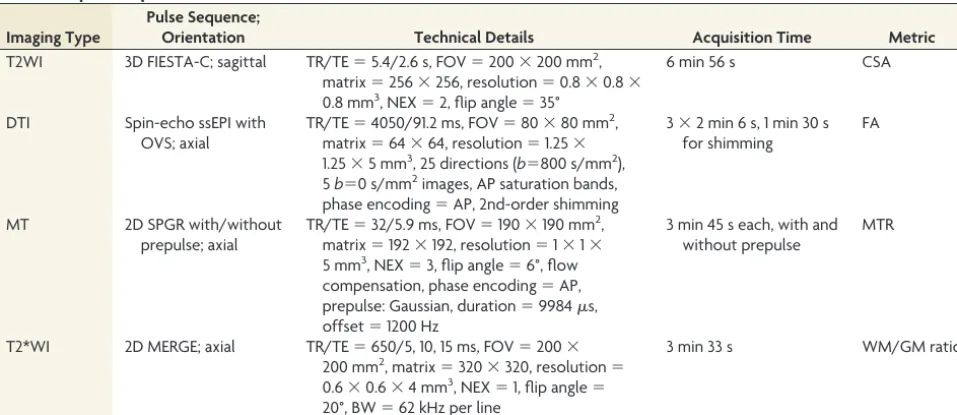
reso-lution covering the brain stem to T4. DTI, MT, and T2*WI had 13 axial sections positioned perpendicular to the spinal cord (at C3), covering C1–C7 by using a variable gap, alternating between the mid-vertebral body and the intervertebral disc. Parameters for each sequence are listed inTable 1. DTI used a spin-echo single-shot EPI sequence with an 80⫻80 mm2FOV to minimize
sus-ceptibility distortions, anterior/posterior saturation bands to achieve outer volume suppression, and no cardiac triggering. Sec-ond-order localized shimming was performed before DTI by po-sitioning a VOI encompassing the SC from C1–C7. T2*WIs used the multiecho recombined gradient-echo sequence, with 3 echoes that are magnitude-reconstructed and combined by using a sum-of-squares algorithm.18Each session required 30 –35 minutes,
[image:2.594.55.534.55.262.2]in-cluding subject positioning, section prescription, prescanning, and shimming.
Table 1: Acquisition protocola
Imaging Type
Pulse Sequence;
Orientation Technical Details Acquisition Time Metric
T2WI 3D FIESTA-C; sagittal TR/TE⫽5.4/2.6 s, FOV⫽200⫻200 mm2,
matrix⫽256⫻256, resolution⫽0.8⫻0.8⫻ 0.8 mm3, NEX⫽2, flip angle⫽35°
6 min 56 s CSA
DTI Spin-echo ssEPI with OVS; axial
TR/TE⫽4050/91.2 ms, FOV⫽80⫻80 mm2,
matrix⫽64⫻64, resolution⫽1.25⫻ 1.25⫻5 mm3, 25 directions (b⫽800 s/mm2),
5b⫽0 s/mm2images, AP saturation bands,
phase encoding⫽AP, 2nd-order shimming
3⫻2 min 6 s, 1 min 30 s for shimming
FA
MT 2D SPGR with/without prepulse; axial
TR/TE⫽32/5.9 ms, FOV⫽190⫻190 mm2,
matrix⫽192⫻192, resolution⫽1⫻1⫻ 5 mm3, NEX⫽3, flip angle⫽6°, flow
compensation, phase encoding⫽AP, prepulse: Gaussian, duration⫽9984s, offset⫽1200 Hz
3 min 45 s each, with and without prepulse
MTR
T2*WI 2D MERGE; axial TR/TE⫽650/5, 10, 15 ms, FOV⫽200⫻ 200 mm2, matrix⫽320⫻320, resolution⫽
0.6⫻0.6⫻4 mm3, NEX⫽1, flip angle⫽
20°, BW⫽62 kHz per line
3 min 33 s WM/GM ratio
Note:—AP indicates anteroposterior; BW, bandwidth; FIESTA-C, FIESTA-cycled phases; MERGE, multiecho recombined gradient echo; OVS, outer volume suppression; SPGR, echo-spoiled gradient echo; ssEPI, single-shot echo-planar imaging.
a
Test-retest reliability was assessed by removing the subject from the scanner and repositioning before rescanning. This was performed in a subset of subjects (DTI: 17 healthy, 9 with DCM; MT: 13 healthy, 4 with DCM; T2*WI: 5 healthy, 11 with DCM) extemporaneously, depending on scanner availability and subject willingness. Reliability was not assessed for SC CSA measurement due to time constraints.
A comparison of DTI with and without cardiac triggering was also performed in 10 subjects (4 healthy, 6 with DCM). Cardiac-triggered DTI was performed with pulse oximetry triggering, trigger delay of 310 ms, window of 250 ms, and TR⫽7 R-R interval. Two acquisitions were performed that were analyzed individually for test-retest coefficient of varia-tion (TRCOV) and then concatenated and averaged for com-parison with nontriggered DTI.
Image Analysis Techniques
Imaging data were analyzed by using the Spinal Cord Toolbox, Version2.3 (SCT; https://www.nitrc.org/projects/sct/).22Each
ax-ial image was visually inspected by 1 rater (A.R.M.) and excluded if low signal or artifacts (motion, aliasing) were present. SC segmentation was automatically performed by using native T2WIs and T2*WIs, the mean diffusivity map for DTI, and the MT image with a prepulse. Segmentation errors were resolved by providing seed points for automatic segmentation or manual
ed-iting. Images were nonlinearly regis-tered to the MNI-Poly-AMU template/ atlas in SCT.23 T2WIs were used to
automatically calculate cervical cord length (from the top of C1 to the bottom of the C7 vertebral levels) and SC CSA. DTI was motion-corrected with regular-ized registration, and diffusion tensors were calculated with outlier rejection by using the RESTORE (robust estimation of tensors by outlier rejection) method.24
MT images with and without prepulses were coregistered, and MTR was com-puted. T2*WI data were further analyzed with automatic segmentation of GM and WM,25which was used to refine the
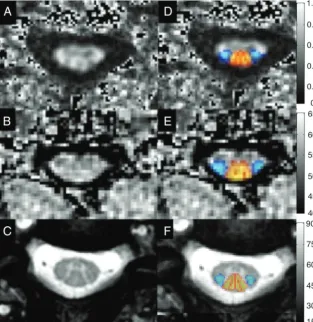
registration of T2*WI to the template. FA, MTR, and T2*WI WM/GM ratios were extracted from various ROIs by using the SCT probabilistic atlas with automatic correction for partial volume effects by using the maximum a posteri-ori method.26 ROIs included the SC,
WM, and GM and the left/right lateral corticospinal tract, fasciculus cuneatus, fasciculus gracilis, and spinal lemniscus in each axial section (Fig 1). Metrics were averaged at rostral (C1–C3), mid-dle (C4 –5) or maximally compressed (MCL, subjects with DCM), and caudal (C6 –C7) levels.
Statistical Analysis
Statistical analysis was performed with R statistical and computing software, Version 3.3 (http://www.r-project.org/). Normative data were summarized with mean, SD, and inter-subject coefficient of variation. Relationships between MR im-aging metrics (averaged from C1–C7) and patient characteris-tics (age, sex, height, weight, cervical cord length) were assessed with Pearson correlation coefficients and backward stepwise linear regression to determine significant indepen-dent relationships and their coefficients. Differences by rostro-caudal level were assessed with ANOVA. If differences were found, we calculated Spearman coefficients (between mean values and numbered levels) to identify monotonic relation-ships. To determine whether nonlinear relationships were present, we performed a likelihood ratio test on linear regres-sion models with and without a 5-knot restricted cubic spline. Pairedttests compared WM and GM differences, and ANOVA was used to identify differences among individual WM tracts (averaged bilaterally). Reliability was assessed by using test-retest coefficient of variation, and differences between healthy subjects and those with DCM were assessed with Welchttests, as were pair-wise comparisons between techniques at each ros-trocaudal level. Statistical significance was set toP⫽.05 and was not corrected for multiple comparisons due to the explor-atory nature of this study.
[image:3.594.59.373.49.371.2]RESULTS
Subject Characteristics
Characteristics of 40 healthy subjects and 18 with DCM included in this study are listed inTable 2.
Image Acquisition
Acceptable image quality was achieved in all subjects and tech-niques. For DTI, 27 of 520 axial images (5.2%) were excluded due to artifacts or poor signal. For MT and T2*WI, 6 (1.2%) and 4 (0.8%) sections were excluded due to artifacts, respectively.
Automated Analysis
Automated segmentation was frequently successful, with manual editing required in 8 T2WI datasets (20%), 14 MT datasets (35%), 4 DTI datasets (10%), and 20 T2*WI datasets (50%). Manual segmentation editing was usually restricted to a small number of sections and required⬍5 minutes per dataset. Automatic regis-tration to the template and data extraction were successful in all cases.
Normative Values for MR Imaging Metrics
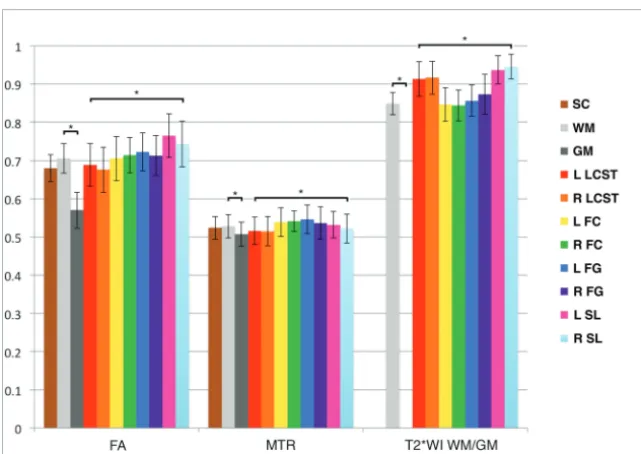
Normative data extracted from C1–C3 showed that T2*WI WM/GM had the smallest intersubject coefficient of variation at 3.5% (0.848⫾0.028), compared with 5.8% for MTR (52.8⫾ 3.1%), 6.0% for FA (0.706⫾0.042), and 12.2% for CSA (78.5⫾
9.6 mm2) (Fig 2). The strongest contrast
between WM and GM was found for T2*WI signal intensity (mean GM-WM difference⫾standard error⫽83.9⫾ 4.72,P⫽3⫻10⫺20), which exceeded
that of FA (⫺0.110⫾0.0083,P⫽2⫻ 10⫺15) and MTR (⫺2.1⫾0.28,P⫽4⫻
10⫺9). Individual WM tracts showed
significant variations for T2*WI WM/GM (ANOVA,P⫽2⫻10⫺9), FA
(P⫽3⫻10⫺7), and MTR (P⫽.01).
Variations with Subject Characteristics
Univariate relationships between MR imaging metrics and subject characteris-tics included the following: CSA in-creased with cervical cord length (P⫽
8⫻10⫺4), weight (P⫽.03), and male
sex (P ⫽ .03); FA decreased with age (P ⫽ .009); and MTR decreased with height (P⫽.008), weight (P⫽.01), and male sex (P⫽.006) (Table 3). Trends were also present for CSA, increasing with height (P ⫽.06), and for T2*WI WM/GM, increasing with age (P⫽.06) and weight (P⫽ .06). In multivariate analysis, CSA varied only with cervical cord length (⫽ ⫹5.3690); FA, with age ( ⫽ ⫺0.0012053); and MTR, with height (⫽ ⫺0.17410,P⫽.001) and age (⫽ ⫺0.074131,P ⫽.01), while T2*WI WM/GM did not require nor-malization. Following linear corrections, intersubject coefficient of variation decreased to 4.8% for MTR, 5.4% for FA, and 10.2% for CSA.
Metrics by Rostrocaudal Level
ANOVA detected significant differences (P⬍.05) across rostro-caudal levels for all metrics. Monotonic variations were present (P⬍.05) for MTR (⫽ ⫺0.98), FA (⫽ ⫺0.90), and CSA (⫽
⫺0.55), which all decreased from rostral to caudal levels, whereas T2*WI WM/GM showed a trend toward increasing (⫽0.53,P⫽
.06) (Fig 3). CSA, FA, and T2*WI WM/GM showed nonlinear rostrocaudal variation (P⬍.05), whereas MTR did not (P⫽.58).
Reliability
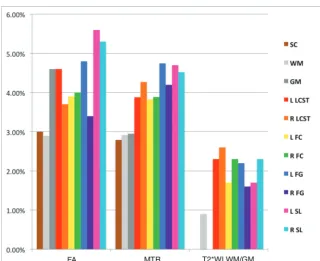
The T2*WI WM/GM ratio was the most reliable metric (pooled TRCOV: rostral, 0.9%; MCL, 2.9%; caudal, 2.6%), comparing favorably with FA (rostral, 2.6%; MCL, 3.6%; caudal, 3.2%) and MTR (rostral, 2.4%; MCL, 3.7%; caudal: 4.2%), though these dif-ferences were only significant for rostral metrics (P⬍.05) (Table 4). Reliability measures were comparable between healthy sub-jects and those with DCM rostrally (C1–C3), but subsub-jects with DCM trended toward increased TRCOV for MCL MTR (6.1% versus 3.2%,P⫽.08) and caudal FA (4.6% versus 2.2%,P⫽.07). The reliability of data from individual WM tracts was acceptable
FIG 2. Normative data in the rostral cervical cord for FA, MTR, and T2*WI WM/GM ratios. Metrics are extracted from SC, WM, GM, and key WM tracts averaged over rostral sections (C1–C3). Values are displayed as mean⫾intersubject SD (error bars). TheasteriskdenotesP⬍.05 with pairedttests between WM and GM and ANOVA among WM tracts. L indicates left; R, right; FC, fasciculus cuneatus; FG, fasciculus gracilis; SL, spinal lemniscus; LCST, lateral corticospinal tract. Table 2: Subject characteristicsa
Characteristic Healthy Subjects (n= 40) Subjects with DCM (n= 18) Age (yr) 47.1⫾15.3 (range, 19–79) 56.4⫾11.0 (range, 36–76)
Sex 21 men, 19 women 11 men, 7 women
Height (cm) 171.4⫾8.6 172.8⫾8.9
Weight (kg) 74.6⫾11.5 79.0⫾15.1
Cervical cord length (cm) 10.6⫾1.0 11.1⫾0.9 a
[image:4.594.55.376.149.376.2](TRCOV⬍5%) except for FA of the right and left spinal lemnis-cus (5.3%, 5.6%, respectively;Fig 4).
Cardiac Triggering in DTI
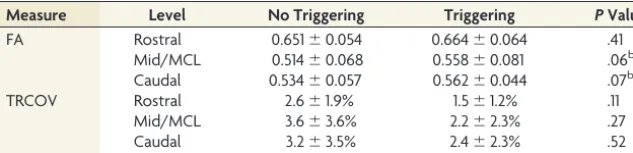
FA did not differ significantly among DTI acquisitions with and without cardiac triggering, though triggering showed a trend toward higher FA at MCL (0.558 versus 0.514,P⫽.06) and caudal (0.562 versus 0.534,P⫽.07) levels (Table 5). No significant differences in TRCOV were observed, though
cardiac-triggered DTI provided approximately 1% lower TRCOV at all levels.
DISCUSSION
Summary of FindingsThis study establishes a multiparametric MR imaging protocol and analysis framework to assess the microstructure of the entire cervical SC by using simple methods that are feasible for clinical adoption, requiring only 20 minutes of acquisition
[image:5.594.53.533.145.581.2]FIG 3. Variations by rostrocaudal level. MR imaging metrics displayed for each vertebral and intervertebral level from C1 to C7. FA, MTR, and T2*WI WM/GM ratios are extracted from WM. ANOVA shows significant differences by level for all metrics. Monotonic variations are present for CSA, FA, and MTR.
Table 3: Univariate relationships of MRI metrics with healthy subject characteristicsa
Metric Age Sex (M vs F) Height Weight Cervical Cord Length
CSA (mm2
) r⫽ ⫺0.25 (P⫽.12) 80.0⫾11.2 vs 73.5⫾8.5 (P⫽.03b
) r⫽0.31 (P⫽.06c
) r⫽0.34 (P⫽.03b
) r⫽0.51 (P⬍.001b
) FA r⫽ ⫺0.43 (P⫽.009b
) 0.658⫾0.037 vs 0.663⫾0.034 (P⫽.75) r⫽ ⫺0.02 (P⫽.89) r⫽ ⫺0.26 (P⫽.12) r⫽0.11 (P⫽.53) MTR r⫽ ⫺0.25 (P⫽.11) 48.8⫾2.5 vs 51.4⫾2.7 (P⫽.006b) r⫽ ⫺0.41 (P⫽.008b) r⫽ ⫺0.40 (P⫽.01) r⫽ ⫺0.18 (P⫽.26)
T2*WI WM/GM r⫽0.31 (P⫽.06) 0.863⫾0.034 vs 0.858⫾0.031 (P⫽.64) r⫽ ⫺0.12 (P⫽.48) r⫽0.31 (P⫽.06c
) r⫽ ⫺0.09 (P⫽.55)
a
Values for sex are reported as mean⫾SD, and other values are Pearson correlation coefficient. FA, MTR, and T2*WI WM/GM ratios are extracted from WM, while CSA of the spinal cord is measured, averaged across C1–C7.
b
Significance (P⬍.05).
time in addition to anatomic imaging. Image acquisition was successful in all subjects, and automated analysis provided ro-bust readouts from multiple ROIs, with the results validated by acceptable reliability data. Our results establish normative data for CSA, FA, and MTR that are consistent with previous re-ports at 3T,12,21,27-29in addition to our novel T2*WI WM/GM
metric. T2*WI WM/GM, FA, and MTR all showed strong gray-white contrast and differences between individual WM tracts. FA and MTR showed moderate intersubject and test-retest variability, with similar or better reliability than in previous reports despite differences in acquisition and analysis tech-niques.8,27-31T2*WI WM/GM demonstrated low intersubject
and test-retest variability, which are favorable statistical
prop-erties because they make it more likely that a subject with pathology will show abnormal results (confirmed by en-couraging results reported in a com-panion article20). CSA showed greater
intersubject variation than other met-rics, though this improved slightly fol-lowing normalization with cervical cord length. Reliability of the CSA measurement was not assessed due to time constraints, but it likely surpasses that of our other measures because it has been previously reported to have TRCOV under 0.5% by using similar techniques.12 Reliability was greatest
in the rostral region for all techniques, where healthy subjects and patients with DCM showed similar results. In contrast, patients with DCM showed trends toward diminished reliability at MCLs and caudal levels, likely related to distorted anatomy, increased partial volume effects, increased susceptibil-ity artifacts, and less accurate registra-tion to the SCT template. However, these differences were not significant, and pooled reliability results were all considered acceptable (TRCOV⬍ 5%). Our clinically feasible multipara-metric approach provides 4 unique quantitative measures in multiple ROIs that reflect aspects of macro-structure and micromacro-structure, with the benefit that these measures cross-vali-date each other to overcome the limi-tations (reliability, intersubject vari-ability, sensitivity to pathology) of each individual technique. We antici-pate that this multivariate approach can accurately characterize tissue in-jury in various SC pathologies, which could enable quantitative MR imaging of the SC to achieve clinical translation in the near future.
Normalization for Confounding Factors
It is essential that quantitative readouts reflect pathologic changes and eliminate confounding effects as much as possible to move toward clinical use of SC quantitative MR imaging. In keeping with prior reports, significant relationships were found between age and FA5,7,8and MTR,8but not CSA.8,23However, we also
identified univariate relationships between MR imaging metrics and sex, height, weight, and cervical cord length, for which we are not aware of previous reports. The relationship between CSA and cervical cord length likely indicates that CSA is related to overall body size because height and weight also showed positive (non-significant) correlations. It is unclear why MTR decreases with height, but weak negative trends were also seen with weight and
[image:6.594.52.381.54.161.2]FIG 4. Test-retest coefficients of variation of FA, MTR, and T2*WI WM/GM extracted from SC, WM, GM, and key WM tracts in rostral sections (C1–C3) are displayed. T2*WI WM/GM ratio shows better reliability than FA and MTR. Metrics derived from the SC and WM show TRCOV⬍3%, while GM and key WM tracts show TRCOV⬍5% except for FA of the spinal lemniscus. FC indicates fasciculus cuneatus; FG, fasciculus gracilis; SL, spinal lemniscus; LCST, lateral corticospi-nal tract; R, right; L, left.
Table 4: Test-retest reliability across rostrocaudal levelsa
Level Metric Healthy DCM PValue Pooled
Rostral (C1–C3) FA 2.5⫾2.0% 2.8⫾1.8% .71 2.6⫾1.9% MTR 2.7⫾1.9% 1.3⫾0.5% .17 2.4⫾1.9% T2*WI WM/GM 0.9⫾0.6% 1.0⫾0.7% .77 0.9⫾0.7%b
Midcervical (C4–C5) or MCL
FA 3.0⫾2.2% 5.0⫾5.7% .21 3.6⫾3.6% MTR 3.2⫾3.0% 6.1⫾0.9% .08c 3.7⫾3.2%
T2*WI WM/GM 1.4⫾1.1% 3.5⫾2.2% .11 2.9⫾2.2% Caudal (C6–C7) FA 2.2⫾1.6% 4.6⫾4.7% .07c 3.2⫾3.5%
MTR 4.4⫾3.8% 3.1⫾3.9% .56 4.2⫾3.7% T2*WI WM/GM 3.4⫾3.0% 2.2⫾2.1% .37 2.6⫾2.4% a
TRCOV⫾SD is displayed for healthy subjects and those with DCM at rostral (C1–C3), midcervical (C4 –5), or maximally compressed levels in subjects with DCM, and caudal (C6 –C7) levels. Sample size was 26 subjects (17 healthy, 9 with DCM) for DTI, 17 subjects (13 healthy, 4 with DCM) for MT, and 16 subjects (5 healthy, 11 with DCM) for T2*WI.
b
Significant differences (P⬍.05) between pooled TRCOV of metrics at each level.
c
[image:6.594.55.376.245.506.2]cervical cord length, suggesting that MTR (reflecting myelin den-sity) is negatively related to overall body size. However, no rela-tionship was present between MTR and CSA in a post hoc test (r⫽0.01,P⫽.94). Strong relationships were also found among all 4 metrics and the rostrocaudal level, with the CSA, FA, and MTR showing nonlinearity (Fig 3). CSA increased between the C3 and C6 vertebral levels, reflecting the cervical enlargement that contains increased GM for C5–T1 neurologic levels, and our CSA measurements were highly similar to those in previous re-ports.32,33WM FA peaked at C2 and locally at C7, where the
orientations of axons are almost purely rostrocaudal. In contrast, decreases were seen at C1 (likely due to decussation of corticospi-nal fibers) and in the cervical enlargement (where a fraction of axons turn and form synapses within the GM). The T2*WI WM/GM ratio was nearly invariant from C1 to C6 but increased at C7, likely due to increased susceptibility artifacts from the lungs, decreased SNR, and respiratory motion. We suggest a normalization scheme in which CSA, FA, and MTR are linearly corrected for relationships (cervical cord length, age, and age/height, respectively) and all met-rics are converted tozscores per rostrocaudal level, as proposed by Uda et al4for DTI metrics. Although normalization procedures add
complexity to data postprocessing, these methods facilitate fair com-parisons, decrease nuisance variability, and produce more accurate biomarkers of SC tissue injury.
Quantitative MR Imaging Techniques: Specificity, Accuracy, Feasibility
The rapidly evolving field of quantitative MR imaging includes a rich array of acquisition techniques, including strict quantitative methods that attempt to measure a specific physical property, such as quantitative MT, longitudinal relaxation rate, and appar-ent transverse relaxation rate mapping.27,34,35 However, such
techniques are inherently complex and require specialized pulse sequences, while typically requiring lengthy scan times. Further-more, these methods face challenges in achieving acceptable SNR and reliability, particularly in the SC, which is considerably more difficult to image than the brain due to magnetic field inhomoge-neity and physiologic motion. Similarly, reduced FOV DTI has become available, offering increased SNR and reduced distortions but often requiring increased acquisition times and involving proprietary pulse sequences.31Our protocol purposefully used
standard sequences available from all major MR imaging vendors, making it an attractive approach for multicenter studies and clin-ical use. A recent study comparing reduced FOV with outer volume suppression for cervical SC DTI found only minimal
dif-ferences in reliability (intersubject coef-ficient of variation: reduced FOV ⫽ 3.98% versus outer volume suppres-sion⫽4.59).31Unfortunately, this study
did not reportPvalues for these compari-sons, and it did not assess intrasubject re-liability, but the findings suggest that outer volume suppression provides acceptable reliability.
Cardiac-Triggered DTI
Previous research suggests that cardiac triggering reduces variance in diffusion time-series by acquiring data during the quiescent phase of cardi-ac-related SC motion.36However, to our knowledge, no studies
have directly compared the test-retest reliability of SC DTI acqui-sitions with and without cardiac triggering, particularly in the context of multiple acquisitions and outlier rejection during post-processing. Our pilot data in 10 subjects suggest roughly equiva-lent results with and without triggering, though trends toward higher FA and lower TRCOV (approximately 1%) were observed with triggering. Further investigation is needed, but the ungated acquisition used in this study is validated by its acceptable reliabil-ity. This simpler approach avoids difficulties with triggering such as variable TR and cardiac irregularities (arrhythmias, tachycar-dia) that are more common in older or critically ill patients.
Limitations
Further studies with larger sample sizes would allow greater accu-racy for normative data, influences of confounding variables, and differences in DTI with and without cardiac triggering. The nor-mative data are specific to our methodology, and cross-site and cross-vendor validation is required. Our use of automated analy-sis aimed to reduce bias, but manual editing of segmentations was frequently required. Other DTI metrics were not analyzed due to an a priori decision to focus on FA, due to its consistent results in previous studies.3Our test-retest reliability experiment does not
account for scanner drift, but this is unlikely a large source of error because the 2 metrics are ratios rather than absolute signal-inten-sity values. Neurologically intact subjects with mild SC compres-sion were considered healthy subjects; these changes are evident in 8%–26% of asymptomatic individuals.32,37Moreover, we think
that the spectrum of “normal” includes this subgroup, but previ-ous studies have excluded such subjects.
CONCLUSIONS
[image:7.594.55.372.56.132.2]Reliable multiparametric assessment of the SC microstructure is possible with standard hardware, acceptable acquisition times, and automated analysis that provide high-fidelity readouts of tis-sue injury from numerous ROIs. Normalization procedures can be implemented to mitigate confounding effects such as age, height, cervical cord length, and rostrocaudal level, producing more meaningful quantitative metrics. Our clinically suited ap-proach paves the way for translational studies to evaluate poten-tial uses such as improved diagnostics, monitoring of disease pro-gression, and prediction of outcomes.
Table 5: DTI with and without cardiac triggeringa
Measure Level No Triggering Triggering PValue
FA Rostral 0.651⫾0.054 0.664⫾0.064 .41
Mid/MCL 0.514⫾0.068 0.558⫾0.081 .06b
Caudal 0.534⫾0.057 0.562⫾0.044 .07b
TRCOV Rostral 2.6⫾1.9% 1.5⫾1.2% .11
Mid/MCL 3.6⫾3.6% 2.2⫾2.3% .27
Caudal 3.2⫾3.5% 2.4⫾2.3% .52
a
Pairedttests were used to compare FA values extracted from WM at rostral (C1–C3), midcervical (C4 –5, healthy subjects), or MCL (subjects with DCM), and caudal (C6 –C7) levels between no triggering vs triggering in 10 subjects (4 healthy, 6 with DCM). Welchttests were used to compare test-retest coefficient of variation between no triggering (n⫽26) and triggering (n⫽10).
b
ACKNOWLEDGMENTS
This research received funding support from Rick Hansen Insti-tute, as part of the Riluzole in Spinal Cord Injury Study (RISCIS), which is also supported by AOSpine North America, AOSpine International SCI Knowledge Forum, and the North American Clinical Trials Network (NACTN) of the Christopher and Dana Reeve Foundation. This research also received support from the Dezwirek Foundation, the Sherman Clinical Research Unit, and the Gerald and Tootsie Halbert Chair in Spinal Cord Research. Dr. Martin received post-doctoral fellowship support from Cana-dian Institutes of Health Research.
Disclosures: Allan R. Martin—RELATED:Grant: Rick Hansen Institute, AOSpine North America, North American Clinical Trials Network of the Christopher and Dana Reeve Foundation, the DeZwirek Foundation, the Sherman Clinical Re-search Unit, and the Gerald and Tootsie Halbert Chair in Spinal Cord ReRe-search*; Dr. Martin received post-doctoral Fellowship funding from Canadian Institutes of Health Research (CIHR) that included $50,000 (CDN) annual salary support and $5,000 annual research allowance that enabled this research. Sukhvinder Kalsi-Ryan—UNRELATED:Consultancy: Neural Outcomes Consulting;Royalties: GRASSP. *Money paid to the institution.
REFERENCES
1. Wheeler-Kingshott CA, Stroman PW, Schwab JM, et al.The current state-of-the-art of spinal cord: applications.Neuroimage2014;84: 1082–93CrossRef Medline
2. Stroman PW, Wheeler-Kingshott C, Bacon M, et al.The current state-of-the-art of spinal cord imaging: methods.Neuroimage2014; 84:1070 – 81CrossRef Medline
3. Martin AR, Aleksanderek I, Cohen-Adad J, et al.Translating state-of-the-art spinal cord MRI techniques to clinical use: a systematic review of clinical studies utilizing DTI, MT, MWF, MRS, and fMRI.
Neuroimage Clin2016;10:192–238CrossRef Medline
4. Uda T, Takami T, Tsuyuguchi N, et al.Assessment of cervical spondy-lotic myelopathy using diffusion tensor magnetic resonance imaging parameter at 3.0 Tesla.Spine2013;38:407–14CrossRef Medline
5. Mamata H, Jolesz FA, Maier SE.Apparent diffusion coefficient and fractional anisotropy in spinal cord: age and cervical spondylosis-re-lated changes.J Magn Reson Imaging2005;22:38 – 43CrossRef Medline
6. Budzik JF, Balbi V, Le Thuc V, et al.Diffusion tensor imaging and fibre tracking in cervical spondylotic myelopathy.Eur Radiol2011; 21:426 –33CrossRef Medline
7. von Meyenburg J, Wilm BJ, Weck A, et al.Spinal cord diffusion-tensor imaging and motor-evoked potentials in multiple sclerosis patients: microstructural and functional asymmetry. Radiology
2013;267:869 –79CrossRef Medline
8. Taso M, Girard OM, Duhamel G, et al.Tract-specific and age-related variations of the spinal cord microstructure: a multi-parametric MRI study using diffusion tensor imaging (DTI) and inhomoge-neous magnetization transfer (ihMT). NMR Biomed 2016;29: 817–32CrossRef Medline
9. Oh J, Zackowski K, Chen M, et al.Multiparametric MRI correlates of sensorimotor function in the spinal cord in multiple sclerosis.Mult Scler2013;19:427–35CrossRef Medline
10. Harrison NA, Cooper E, Dowell NG, et al.Quantitative magnetization transfer imaging as a biomarker for effects of systemic inflammation on the brain.Biol Psychiatry2015;78:49 –57CrossRef Medline
11. Vavasour IM, Laule C, Li DK, et al.Is the magnetization transfer ratio a marker for myelin in multiple sclerosis?J Magn Reson Imag-ing2011;33:713–18CrossRef Medline
12. Kearney H, Yiannakas MC, Abdel-Aziz K, et al.Improved MRI quan-tification of spinal cord atrophy in multiple sclerosis.J Magn Reson Imaging2014;39:617–23CrossRef Medline
13. Nouri A, Tetreault L, Zamorano JJ, et al.Role of magnetic resonance imaging in predicting surgical outcome in patients with cervical spondylotic myelopathy.Spine2015;40:171–78CrossRef Medline
14. Grabher P, Mohammadi S, Trachsler A, et al.Voxel-based analysis of grey and white matter degeneration in cervical spondylotic myelop-athy.Sci Rep2016;6:24636CrossRef Medline
15. Datta E, Papinutto N, Schlaeger R, et al.Gray matter segmentation of the spinal cord with active contours in MR images.Neuroimage
2017;147:788 –99CrossRef Medline
16. Cohen-Adad J, Buchbinder B, Oaklander AL.Cervical spinal cord injection of epidural corticosteroids: comprehensive longitudinal study including multiparametric magnetic resonance imaging.
Pain2012;153:2292–99CrossRef Medline
17. Cohen-Adad J, Zhao W, Keil B, et al.7-T MRI of the spinal cord can detect lateral corticospinal tract abnormality in amyotrophic lat-eral sclerosis.Muscle Nerve2013;47:760 – 62CrossRef Medline
18. White ML, Zhang Y, Healey K. Cervical spinal cord multiple sclerosis: evaluation with 2D multi-echo recombined gradient echo MR imaging.J Spinal Cord Med2011;34:93–98CrossRef Medline
19. Cohen-Adad J.What can we learn from T2* maps of the cortex?
Neuroimage2014;93(pt 2):189 –200CrossRef Medline
20. Martin AR, De Leener B, Cohen-Adad J, et al.A novel MRI bio-marker of spinal cord white matter injury: T2*-weighted white matter to gray matter signal intensity ratio.AJNR Am J Neuroradiol
2017 Apr 20. [Epub ahead of print]CrossRef Medline
21. Cohen-Adad J, El Mendili MM, Lehe´ricy S, et al.Demyelination and degeneration in the injured human spinal cord detected with diffu-sion and magnetization transfer MRI.Neuroimage2011;55:1024 –33
CrossRef Medline
22. De Leener B, Le´vy S, Dupont SM, et al.SCT: Spinal Cord Toolbox, an open-source software for processing spinal cord MRI data. Neuro-image2017;145(pt A):24 – 43CrossRef Medline
23. Fonov VS, Le Troter A, Taso M, et al.Framework for integrated MRI average of the spinal cord white and gray matter: the MNI-Poly-AMU template.Neuroimage2014;102:817–27CrossRef Medline
24. Chang LC, Jones DK, Pierpaoli C.RESTORE: robust estimation of tensors by outlier rejection. Magn Reson Med 2005;53:1088 –95
CrossRef Medline
25. Asman AJ, Bryan FW, Smith SA, et al.Groupwise multi-atlas seg-mentation of the spinal cord’s internal structure.Med Image Anal
2014;18:460 –71CrossRef Medline
26. Le´vy S, Benhamou M, Naaman C, et al.White matter atlas of the human spinal cord with estimation of partial volume effect. Neuro-image2015;119:262–71CrossRef Medline
27. Samson RS, Ciccarelli O, Kachramanoglou C, et al.Tissue- and col-umn-specific measurements from multi-parameter mapping of the human cervical spinal cord at 3 T.NMR Biomed2013;26:1823–30
CrossRef Medline
28. Smith SA, Jones CK, Gifford A, et al.Reproducibility of tract-specific magnetization transfer and diffusion tensor imaging in the cervical spinal cord at 3 Tesla. NMR Biomed 2010;23:207–17 CrossRef Medline
29. Ellingson BM, Salamon N, Grinstead JW, et al.Diffusion tensor im-aging predicts functional impairment in mild-to-moderate cervical spondylotic myelopathy.Spine J2014;14:2589 –97CrossRef Medline
30. Kerkovsky´ M, Bednarik J, Dusˇek L, et al.Magnetic resonance diffu-sion tensor imaging in patients with cervical spondylotic spinal cord compression: correlations between clinical and electrophysi-ological findings. Spine (Phila Pa 1976)2012;37:48 –56CrossRef Medline
31. Samson RS, Le´vy S, Schneider T, et al.ZOOM or non-ZOOM? As-sessing spinal cord diffusion tensor imaging protocols for multi-centre studies.PLoS One2016;11:e0155557CrossRef Medline
32. Cadotte DW, Cadotte A, Cohen-Adad J, et al.Characterizing the location of spinal and vertebral levels in the human cervical spinal cord.AJNR Am J Neuroradiol2015;36:803–10CrossRef Medline
34. Levesque IR, Giacomini PS, Narayanan S, et al.Quantitative magne-tization transfer and myelin water imaging of the evolution of acute multiple sclerosis lesions.Magn Reson Med2010;63:633– 40
CrossRef Medline
35. Freund P, Weiskopf N, Ashburner J, et al.MRI investigation of the sensorimotor cortex and the corticospinal tract after acute spinal cord injury: a prospective longitudinal study.Lancet Neurol2013; 12:873– 81CrossRef Medline
36. Summers P, Staempfli P, Jaermann T, et al.A preliminary study of the effects of trigger timing on diffusion tensor imaging of the hu-man spinal cord.AJNR Am J Neuroradiol2006;27:1952– 61Medline