ISSN Online: 2169-9631 ISSN Print: 2169-9623
DOI: 10.4236/ojer.2018.71002 Feb. 11, 2018 28 Open Journal of Earthquake Research
On the Dynamical Analysis in Aftershock
Networks
Woon-Hak Baek
1, Kyungsik Kim
1*, Ki-Ho Chang
2, Seung-Kyu Seo
2, Jun-Ho Lee
3*, Dong-In Lee
4*1Department of Physics, Pukyong National University, Busan, Korea
2Applied Forecast Meteorology Research Division, National Institute of Meteorological Sciences, Seogwipo, Korea 3Trainning Ship Administrative Center, Pukyong National University, Busan, Korea
4Department of Environmental Atmospheric Sciences, Pukyong National University, Busan, Korea
Abstract
We investigate the dynamical behavior of aftershocks in earthquake networks, and the earthquake network calculated from a time series is constructed by contemplating cell resolution and temporal causality. We attempt to connect an earthquake network using relationship between one main earthquake and its aftershocks from seismic data of California. We mainly examine some to-pological properties of the earthquake such as the degree distribution, the characteristic path length, the clustering coefficient, and the global efficiency. Our result cannot presently determine the universal scaling exponents in sta-tistical quantities, but the topological properties may be inferred to advance and improve by implementing the method and its technique of networks. Par-ticularly, it may be dealt with a network issue of convenience and of impor-tance in the case how large networks construct in time to proceed on earth-quake systems.
Keywords
Earthquake Network, Aftershock, Characteristic Path Length, Clustering Coefficient, Global Efficiency
1. Introduction
Scientists have treated emerging problems in order to cover the basic concept and the important principle or clearly describe the scientific phenomenon. In several drifts of the complex system, they have pursued and settled many scien-tific phenomena [1] [2] [3] [4] [5] such as agent-based model, economic net-work, social interaction, neural and cerebral networks, world wild web, and eco-How to cite this paper: Baek, W.-H., Kim,
K., Chang, K.-H., Seo, S.-K., Lee, J.-H. and Lee, D.-I. (2018) On the Dynamical Analy-sis in Aftershock Networks. Open Journal of Earthquake Research, 7, 28-38.
https://doi.org/10.4236/ojer.2018.71002
Received: December 17, 2017 Accepted: February 8, 2018 Published: February 11, 2018
Copyright © 2018 by authors and Scientific Research Publishing Inc. This work is licensed under the Creative Commons Attribution International License (CC BY 4.0).
DOI: 10.4236/ojer.2018.71002 29 Open Journal of Earthquake Research system, which we have been able to recognize exactly in the past. Furthermore, the research of complex systems has recently been applied to the method and its technique of studying the various financial time series [6] [7], wavelet transform approaches [8] [9], transport networks [10] [11], social network [12] [13], mul-tilayer networks [14] [15] and earthquake phenomena [16].
Particularly, the remarkable potential to calculate and analyze the dynamical behavior of complex systems has gradually been an increasing trend in new fields of research in the natural, engineering, medical, social sciences over the last two decades. In the network theory, small-world and scale-free network models [17] [18] have been studied widely in various applications of these scien-tific fields and played a crucial role in understanding complex phenomena [19] [20] [21]. Researchers have as yet concentrated on statistical and stochastic problems that the degree distribution for scale-free networks follows a power law, while that for random networks decays faster than exponentially. In com-plex seismic time series [22] [23] [24] [25] [26], the shallow earthquake has con-structed and analyzed the form of distributions in the relevant region that leads to many aftershocks [27] [28] [29]. The Gutenberg-Richter law [24] has used to measure the number of aftershocks, and the slip-size of faults or the seismic moment has followed a power law. The Omori-Utsu law [25] has analyzed the calculation of earthquakes by a theoretical formula, and the frequency of after-shocks has decayed in a power law. Nanjo et al. [30] have investigated the seis-micity modeled by the Gutenberg-Richter law and the Omori-Utsu law in M6.5 quake of Kumamoto 2016. They speculated the reduction of the occurrence of larger shocks causing the notable increase in the b value and the large p value.
Abe and Suzuki have analyzed the spatio-temporal properties of seismicity from the viewpoint of the Tsallis entropy under appropriate constraints [31]. They have argued the spatial distance and the time interval between two succes-sive earthquakes in the characteristic of the nonextensucces-sive statistical mechanics [29]. The correlation function has particularly been a main issue in theoretical and numerical investigations of aftershock phenomena. Several theoretical for-mulae have been used to carry out the calculation of earthquakes. It has been suggested to construct complex network from seismic data by Abe and Suzuki [16]. Baek et al. have studied the earthquake network by considering the cell res-olution and the temporal causality based on earthquake activity data for the Ko-rean Peninsula [32]. They mainly estimated and analyzed several global network metrics. Min et al. have performed the numerical computations for network me-trics from seismic time series data taken in Japan [33]. They have investigated the topological robustness of the earthquake network against the spatial shift and the scale after constructing the earthquake network in a cubic cell.
DOI: 10.4236/ojer.2018.71002 30 Open Journal of Earthquake Research networks find the universal property and the regular feature. In the future, we think that this is an important problem coming to a settlement. In this paper, we study and analyze the topological property and its feature in the aftershock network. After constructing an aftershock network, we mainly examine some topological properties such as the mean degree, the degree distribution, the characteristic path length, the clustering coefficient, and the global efficiency from seismic data of California. Section 2 describes the theoretical method of complex networks. In section 3, we treat the numerical calculation and its re-sult, and our case is particularly compared to both the Abe and Suzuki net-work and the random netnet-work in earthquake netnet-works. Our result is summa-rized in section 4.
2. Theoretical Method
In this section, we mainly consider the theoretical background of the several global network metrics. First of all, there are some important ingredients of complex networks, and these are different from ingredients of random networks. The mean degree k is defined as
1 1 N m m k k N =
=
∑
, (1)where km is the degree of a node m, and N is the number of total degrees. The random network is that it constructed by randomizing the earthquake network under fixed links and nodes. From our method for constructing network, a newly creating node of the growing earthquake network is linked with preferen-tial attachment probability. A network generated with this rule characterized by power-law connectivity distribution. The degree distribution that is the proba-bility distribution function as a function of degrees k is represented in terms of
( )
~P k k−γ, (2)
where
γ
is the degree exponent. Theoretically, the scaling exponentγ
of the scale free network [18] [33] is in the range between 2 to 3. The clustering coeffi-cient Ci for a node i is defined as the fraction of links that exists among its near-est-neighbor nodes to the maximum number of possible links among them. The clustering coefficient of a node with degrees k follows the scaling law( )
~C k k−β, (3)
where the scaling exponent β is a hierarchy coefficient. The network with the mentioned feature of Equations (2) and (3) is called the scale free network.
The characteristic path length is defined the statistical quantity that the sum of all the shortest path length between two nodes is divided by all links of nodes. We introduce the characteristic path length L given as
(
)
1 1 1 2 1 N N mn m m iL L
N N −
= = + =
−
∑ ∑
, (4)DOI: 10.4236/ojer.2018.71002 31 Open Journal of Earthquake Research that the diameter of the network is the largest of all the shortest path lengths. If the averaged shortest path length is proportional to logN, it can be ascertained that the property of a network is satisfied the small-worldness. The average clus-tering coefficient C is calculated as 1 1
N m m
C= N
∑
=C . Here, the clustering coef-ficient Cm for a node m is defined as the fraction of links that exist among its nearest neighbor nodes to the maximum number of possible links among them. The global clustering coefficient Cg is defined as the transitivity ratio that is the fraction of the closed triangles over the whole triangles.The global efficiency is defined as the average of inverses of the global distance for all nodes [35]. We calculate the global efficiency as
(
)
1 1 1 2 1 1 N N gi j i ij
E
N N L
−
= = + =
−
∑ ∑
. (5)When we construct a network for the neighbors of node m, the local efficiency Elc can be calculated to be the average value of the efficiencies of node as
1
1 N
lc m m
E = N
∑
= E , where Em is the subgraph efficiency of the neighbors of the m-th node.From Equations (1)-(5), we mainly calculate and analyze the topological measures in the complex network in next section. These methods and tech-niques are able to be treated in the study of the diverse earthquake models. Fur-ther result of oFur-ther phase metrics will appear in a future publication.
3. Numerical Calculations and Results
The aftershocks have a trend occurring during definitive time intervals after one main earthquake occurs. If an aftershock is larger than the main shock, then the aftershock is considered as the role of the main shock and the previous main shock is designated as a foreshock. Aftershocks are formed as the crust around the displaced fault plane adjusts to the effects of the main shock. Hence, we sug-gest our method to construct complex network using the property of after-shocks. An earthquake network is constructed by segmenting the whole region into three-dimensional cubic cells and making a link between consecutive events. Each cubic cell is regarded as node of a network, and the network con-structed in that manner is basically directed, but we transform it into an undi-rected one because we focus on the topology of the network.
be-DOI: 10.4236/ojer.2018.71002 32 Open Journal of Earthquake Research comes a main shock. 4) If two consecutive events belong to the same cubic cell, then their link is disregarded. 5) The number of links, if two directed links form between two cubic cells. 6) Hence, we regard the links made by all events be-longing to the cubic cell with others in another cubic cell as links of a network, by considering each cubic cell as a node. Next, the method of Abe-Suzuki is as follows: 1) We segment the whole region into N-by-N-by-L cubic cells, each of which has the same size. 2) We link two earthquakes occurring consecutively. 3) If two consecutive events belong to the same cubic cell, their link is disregarded. 4) If two directed links form between two cubic cells, the number of links is counted as one. 5) By considering each cubic cell as a node, we regard the links made by all events belonging to the cubic cell with others in another cubic cell as links of a network.
We construct and analyze seismic data collected from California of USA. The data sources are USGS [36] that the time intervals are between 20th May 2001 and 19th May 2010. The region covered is 32˚N - 37˚N latitude and 115˚W - 120˚W longitude to the depth of 797 km on California. The maximal magnitude is 7.2, and the data for the total numbers of events is 147,193. We configure two different earthquake networks, that is, the OAS and the ASN. We have formed 11 networks with various cubic cell scales from (1˚/10) × (1˚/10) × 10 km3 to ((1˚/20) × (1˚/20) × 10 km3.
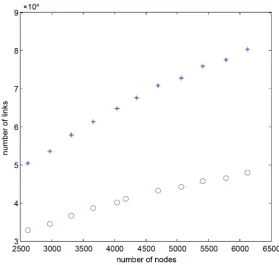
In Figure 1, the number of links versus the number of nodes plots in the OAS and the ASN. Due to the different method to construct the network, our after-shock networks have smaller links than the ASN, compared to Table 1. Figure 2
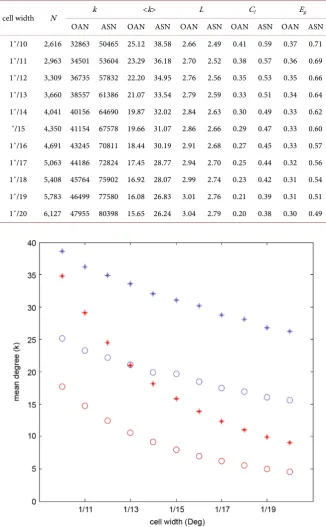
[image:5.595.233.513.430.695.2]DOI: 10.4236/ojer.2018.71002 33 Open Journal of Earthquake Research Table 1. Numerical computation of statistical quantities performed from seismic time se-ries data taken in Japan. The statistical quantities N, k, <k>, L, Cl , and Eg denote the
number of nodes, the number of links, mean degree, characteristic path length, average clustering coefficient, and global efficiency, respectively. We summarize the values of these statistical quantities at the 11 cell widths from 1˚/10 degree and 1˚/20 degree, and the depth is 10 km. Here, the two networks are our aftershock network (OAS) and Abe-Suzuki network (ASN).
cell width N k <k> L Cl Eg
OAN ASN OAN ASN OAN ASN OAN ASN OAN ASN 1˚/10 2,616 32863 50465 25.12 38.58 2.66 2.49 0.41 0.59 0.37 0.71 1˚/11 2,963 34501 53604 23.29 36.18 2.70 2.52 0.38 0.57 0.36 0.69 1˚/12 3,309 36735 57832 22.20 34.95 2.76 2.56 0.35 0.53 0.35 0.66 1˚/13 3,660 38557 61386 21.07 33.54 2.79 2.59 0.33 0.51 0.34 0.64 1˚/14 4,041 40156 64690 19.87 32.02 2.84 2.63 0.30 0.49 0.33 0.62
˚/15 4,350 41154 67578 19.66 31.07 2.86 2.66 0.29 0.47 0.33 0.60
1˚/16 4,691 43245 70811 18.44 30.19 2.91 2.68 0.27 0.45 0.33 0.57 1˚/17 5,063 44186 72824 17.45 28.77 2.94 2.70 0.25 0.44 0.32 0.56 1˚/18 5,408 45764 75902 16.92 28.07 2.99 2.74 0.23 0.42 0.31 0.54 1˚/19 5,783 46499 77580 16.08 26.83 3.01 2.76 0.21 0.39 0.31 0.51 1˚/20 6,127 47955 80398 15.65 26.24 3.04 2.79 0.20 0.38 0.30 0.49
[image:6.595.210.537.163.691.2]DOI: 10.4236/ojer.2018.71002 34 Open Journal of Earthquake Research plots the mean degree as a function of the cell width in our aftershock network and the ASN. We show that the mean degree of the earthquake network be-comes relatively smaller than that of random network as the cell width ap-proaches to small values.
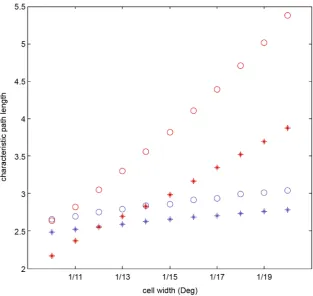
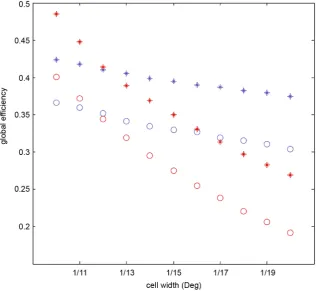
In Figure 3, the characteristic path length plots in the OAS and the ASN. We also show that the average shortest path length of the earthquake network is rel-atively smaller than that of random network, as the cell width approaches to smaller value. Figure 4 shows the average clustering coefficient as a function of the cell width, and the global efficiency is plotted as a function of the cell width in Figure 5. Since the random network constructs from mixed or shuffled time series data, it is certain that the values of the global efficiency and the average clustering coefficient are different from those of the regular network. In the OAS and the ASN, both the global efficiency and clustering coefficient are larger than those of random networks.
[image:7.595.218.532.397.693.2]We find that the scaling exponent in the degree distribution [32] has 1.53 and 1.60 (1.37 and 1.36) in the case of (1˚/20) × (1˚/20) × 10 km3 and (1˚/10) × (1˚/10) × 10 km3 in the OAS (the ASN), respectively. Table 1 summarizes the numerical computation of statistical quantities in various scales performed from seismic time series data taken in California of USA. We compare the OAS to the ASN, and these are the values of these statistical metrics at the 11 cells from 1˚/20 to 1˚/10 and 10 km of the depth.
DOI: 10.4236/ojer.2018.71002 35 Open Journal of Earthquake Research Figure 4. Average clustering coefficient in the OAS (blue circle) and the ASN (blue cross). The red circle (red cross) denotes our (Abe-Suzuki) random network.
[image:8.595.218.533.64.353.2] [image:8.595.217.534.401.692.2]DOI: 10.4236/ojer.2018.71002 36 Open Journal of Earthquake Research
4. Summary
In this paper, we have calculated and analyzed the fundamental network metrics such as the mean degree, degree distribution, characteristic path length, average clustering coefficient, and global efficiency from seismic data of California. We have compared the OAS and the ASN to their random networks. Through other works, the seismicity has taken the features of complex network for the average clustering coefficient. Min et al. have found the values of average clustering coef-ficient between 0.85 and 0.90 in the cell widths between 60 km and 100 km [33]. We show that the average clustering coefficient in our case has smaller values than that of ASN in the cell widths between 1˚/20 and 1˚/10.
We have novelly treated the network of aftershocks in the field of complex networks. In the future, we think that this method will extend and measure its topological metrics to other earthquake networks how to show a universal prop-erty in networks of other regions. We conclude from the results of the calcula-tion that our aftershock network is a scale free network and has the hierarchical structure. Particularly, our method is able to perceive one way to construct the aftershock network, significantly different from the constructing method of the ASN.
The results of this investigation may provide useful and effective information for prediction of scaling behaviors under the impacts of earthquake network changes in other earthquake regions. Our findings support that a recent network approach to earthquake analysis is very useful and reliable in three-dimensional cells. In order to argue our suggestion, a further work about the calculation of network constructions in other nations is needed. It is anticipated that the for-malism of our analysis can be extended to both discrimination and the characte-rization of various aftershocks and earthquakes.
Acknowledgements
This work was supported by a Research Grant of Pukyong National University (2017).
References
[1] Mörner, N.A. (2017) Converting Tsunami Wave Heights to Earthquake Magni-tudes. OpenJournalofEarthquakeResearch, 6, 89-97.
https://doi.org/10.4236/ojer.2017.62005
[2] Riga, G. and Balocchi, P. (2016) Seismic Sequence Structure and Earthquakes Trig-gering Patterns. OpenJournalofEarthquakeResearch, 5,Article ID: 63538. https://doi.org/10.4236/ojer.2016.51003
[3] Yao, X., Feng, Z., Teng, Y., Wang, Y. and Zheng, Q. (2017) Geomagnetic Variations Associated with Strong Earthquakes in Yunnan Area. Open Journal of Earthquake Research,6, 228-237. https://doi.org/10.4236/ojer.2017.64015
DOI: 10.4236/ojer.2018.71002 37 Open Journal of Earthquake Research [5] Riga, G. and Balocchi, P. (2016) How to Predict Earthquakes with Microsequences and Reversed Phase Repetitive Patterns. Open Journal of Earthquake Research,5, Article ID: 68107. https://doi.org/10.4236/ojer.2016.53012
[6] Liu, R., Matteo, T.D. and Lux, T. (2008) Multifractality and Long-Range Depen-dence of Asset Returns: The Scaling Behaviour of the Markov-Switching Multifrac-tal Model with Lognormal Volatility Components. AdvancesinComplexSystems, 11, 669-684. https://doi.org/10.1142/S0219525908001969
[7] Lim, G., Kim, S.-Y., Lee, H., Kim, K. and Lee, D.-I. (2007) Multifractal Detrended Fluctuation Analysis of Derivative and Spot Markets. Physica A: Statistical Me-chanics and its Applications, 386, 259-266.
https://doi.org/10.1016/j.physa.2007.07.055
[8] Gallegati, M., Giulioni, G. and Kichiji, N. (2003) Complex Dynamics and Financial Fragility in an Agent-Based Model. AdvancesinComplexSystems, 6, 267-282. https://doi.org/10.1142/S0219525903000888
[9] Debbal, S.M. and Bereksi-Reguig, F. (2007) Complementary Analysis to Heart Sounds While Using the Short Time Fourier and the Continuous Wavelet Transforms. Bio-medicalEngineering: Applications, BasisandCommunications 19, 331-339.
https://doi.org/10.4015/S1016237207000434
[10] Cardillo, A., Zanin, M., Gomez-Gardenes, J., Romance, M., Garcia del Amo, A.J. and Boccaletti, S. (2013) Modeling the Multi-layer Nature of the European Air Transport Network: Resilience and Passengers Re-Scheduling under Random Fail-ures. The European Physical Journal Special Topics,215, 23-33.
https://doi.org/10.1140/epjst/e2013-01712-8
[11] Criado, R., Romance, M. and Vela-Perez, M. (2010) Hyperstructures: A New Ap-proach to Complex Systems. International Journal of Bifurcation and Chaos, 20, 877-883.
[12] Wasserman, S. and Faust, K. (1994) Social Network Analysis. Cambridge University Press, Cambridge.
[13] Scott, J. (2000) Social Network Analysis: A Handbook. Sage Publications, London. [14] Boccaletti, S., Bianconi, G., Criado, R., del Genio, C.I., Gomez-Gardenes, J.,
Rom-ance, R., Sendina-Nadal, I., Wang, Z. and Zanin, M. (2014) The Structure and Dy-namics of Multilayer Networks. Physics Reports, 544, 1-122.
https://doi.org/10.1016/j.physrep.2014.07.001
[15] Min, B. and Goh, K.-I. (2014) Multiple Resource Demands and Viability in Multip-lex Networks. Physical Review E, 89, Article ID: 040802.
[16] Abe, S. and Suzuki, N. (2006) Complex-Network Description of Seismicity. Nonli-near Processes in Geophysics, 13, 145-150.
[17] Kim, D.-H. and Jeong, H. (2005) Systematic Analysis of Group Identification in Stock Markets. Physical Review E, 72, Article ID: 046133.
[18] Barabasi, A.-L. and Albert, R. (1999) Emergence of Scaling in Random Networks. Science, 286, 509-512.https://doi.org/10.1126/science.286.5439.509
[19] Yook, S.-H., Yun, Y.-K. and Kim, Y. (2010) Biased Random Walk Sampling on As-sortative Networks. Journal of the Korean Physical Society, 56, 990-993.
[20] Kong, J. (2009) Designing Grid Network Resource Management System for e-Science Applications. Journal of the Korean Physical Society, 55, 2248-2252. [21] Jeong, H.-D.J. (2009) A Platform of Future Internet Services for the Massively Data
DOI: 10.4236/ojer.2018.71002 38 Open Journal of Earthquake Research [22] Abe, S. and Suzuki, N. (2009) Scaling Relation for Earthquake Networks. PhysicaA,
388, 2511-2514.https://doi.org/10.1016/j.physa.2009.02.022
[23] Telesca, L., Lapenna, V. and Macchiato, M. (2005) Multifractal Fluctuations in Seismic Interspike Series. PhysicaA, 354, 629-640.
https://doi.org/10.1016/j.physa.2005.02.053
[24] Utsu, T. (1961) A Statistical Study on the Occurrence of Aftershocks. The Geophys-ical Magazine, 30, 521-605.
[25] Omori, F. (1894) On After-Shocks of Earthquakes. Journal of the College of Science, Imperial University of Tokyo, 7, 111-200.
[26] Deyasi, K., Chakraborty, A. and Banerjee, A. (2017) Network Similarity and Statis-tical Analysis of Earthquake Seismic Data. PhysicaA, 481, 224-234.
https://doi.org/10.1016/j.physa.2017.04.050
[27] Abe, S. and Suzuki, N. (2003) Law for the Distance between Successive Earthquakes. Journal of Geophysical Research, 108, 2113.
[28] Abe, S. and Suzuki, N. (2005) Scale-Free Statistics of Time Interval between Succes-sive Earthquakes. PhysicaA, 350, 588-596.
https://doi.org/10.1016/j.physa.2004.10.040
[29] Tsallis, C. (1988) Possible Generalization of Boltzmann-Gibbs Statistics. Journal of Statistical Physics,52, 479-487.
[30] Najo, K.Z. and Yoshida, A. (2016) Anomalous Decrease of Relatively Large Shocks and Increase of the p and b Values Preceding the April 16, 2016 M7.3 Earthquake in Kumamoto, Japan.
[31] Abe, S. and Suzuki, N. (2004) Scale-Free Network of Earthquakes. Europhysics Let-ters, 65, 581-586.
[32] Baek, W.H., Lim, G., Kim, K., Choi, Y.-J., Chang, K.-H., Jung, J.-W., Yi, M., Lee, D.-I. and Ha, D.-H. (2012) Analysis of Topological Properties in a Seismic Network. PhysicaA, 391, 2279-2285.https://doi.org/10.1016/j.physa.2011.11.047
[33] Min, S., Chang, K.H., Kim, K. and Lee, Y.S. (2016) Feature of Topological Proper-ties in an Earthquake Network.PhysicaA, 442, 268-275.
https://doi.org/10.1016/j.physa.2015.08.062
[34] Watts, D.J. and Strogatz, S.H. (1998) Collective Dynamics of “Small-World” Net-works. Nature, 393, 440-442.https://doi.org/10.1038/30918
[35] Latora, V. and Marchiori, M. (2001) Efficient Behavior of Small-World Networks. Physical Review Letters, 87, Article ID: 198701.
https://doi.org/10.1103/PhysRevLett.87.198701