Minimum Penalized Hellinger Distance for Model
Selection in Small Samples
Papa Ngom*, Bertrand Ntep
Laboratoire de Mathematiques et Applications (LMA), Universite Cheikh Anta Diop, Dakar-Fann, Senegal
Email: *[email protected], [email protected] Received May 27,2012; revised June 25, 2012; accepted July 10, 2012
ABSTRACT
In statistical modeling area, the Akaike information criterion AIC, is a widely known and extensively used tool for model choice. The φ-divergence test statistic is a recently developed tool for statistical model selection. The popularity of the divergence criterion is however tempered by their known lack of robustness in small sample. In this paper the penalized minimum Hellinger distance type statistics are considered and some properties are established. The limit laws of the estimates and test statistics are given under both the null and the alternative hypotheses, and approximations of the power functions are deduced. A model selection criterion relative to these divergence measures are developed for parametric inference. Our interest is in the problem to testing for choosing between two models using some informa-tional type statistics, when independent sample are drawn from a discrete population. Here, we discuss the asymptotic properties and the performance of new procedure tests and investigate their small sample behavior.
Keywords: Generalized Information; Estimation; Hypothesis Test; Monte Carlo Simulation
1. Introduction
A comprehensive surveys on Pearson chi-square type statistics has been provided by many authors as Cochran [1], Watson [2] and Moore [3,4], in particular on quad-ratics forms in the cell frequencies. Recently, Andrews [5] has extended the Pearson chi-square testing method to non-dynamic parametric models, i.e., to models with covariates. Because Pearson chi-square statistics provide natural measures for the discrepancy between the ob-served data and a specific parametric model, they have also been used for discriminating among competing models. Such a situation is frequent in Social Sciences where many competing models are proposed to fit a giv-en sample. A well know difficulty is that each chi-square statistic tends to become large without an increase in its degrees of freedom as the sample size increases. As a consequence goodness-of-fit tests based on Pearson type chi-square statistics will generally reject the correct specification of every competing model.
To circumvent such a difficulty, a popular method for model selection, which is similar to use of Akaike [6] Information Criterion (AIC), consists in considering that the lower the chi-square statistic, the better is the model. The preceding selection rule, however, does not take into account random variations inherent in the values of the
statistics.
We propose here a procedure for taking into account the stochastic nature of these differences so as to assess their significance. The main propose of this paper is to address this issue. We shall propose some convenient asymptotically standard normal tests for model selection based on φ-divergence type statistics. Following Vuong [7,8] the procedures considered here are testing the null hypothesis that the competing models are equally close to the data generating process (DGP) versus the alterna-tive hypothesis that one model is closer to the DGP where closeness of a model is measured according to the discrepancy implicit in the φ-divergence type statistic used. Thus the outcomes of our tests provide information on the strength of the statistical evidence for the choice of a model based on its goodness-of-fit (see Ngom [9]; Diedhiou and Ngom [10]). The model selection approach roposed here differs from those of Cox [11], and Akaike [12] for non nested hypotheses. This difference is that the present approach is based on the discrepancy implicit in the divergence type statistics used, while these other ap-proaches as Vuong’s [7] tests for model selection rely on the Kullback-Leibler [13] information criterion (KLIC).
Beran [14] showed that by using the minimum Hellin-ger distance estimator, one can simultaneously obtain asymptotic efficiency and robustness properties in the presence of outliers. The works of Simpson [15] and
Lindsay [16] have shown that, in the tests hypotheses, robust alternatives to the likelihood ratio test can be gen-erated by using the Hellinger distance. We consider a general class of estimators that is very broad and contains most of estimators currently used in practice when form-ing divergence type statistics. This covers the case stud-ies in Harris and Basu [17]; Basu et al. [18]; Basu and Basu [19] where the penalized Hellinger distance is used.
The remainder of this paper is organized as follows. Section 2 introduces the basic notations and definitions. Section 3 gives a short overview of divergence measures. Section 4 investigates the asymptotic distribution of the penalized Hellinger distance. In Section 5, some applica-tions for testing hypotheses are proposed. Section 6 pre-sents some simulation results. Section 7 concludes the paper.
2. Definitions and Notation
In this section, we briefly present the basic assumptions on the model and parameters estimators, and we define our generalized divergence type statistics. We consider a discrete statistical model, i.e X X1, 2, , Xn
1,
X
T1, ,
p p
,
m;m
p
T
:
P P
0:
H PP
an inde-pendent random sample from a discrete population with
support . Let m be a
probability vector i.e.PΩm where Ωm is the simplex of
probability m-vectors,
,m
m p
,i1, , .m
P
1,p2, 1
i i 1, i m
p p 0We consider a parameter model
1, , P p pm
P
which may or may not contain the true distribution P, where Θ is a compact subset of k-dimensional Euclidean space (with k < m− 1). If P contains P, then there exists a θ0Θ such that 0 and the model P is said to
be correctly specified.
We are interested in testing (with true pa-rameter 0) versus H1:Pm–P .
By
0
p
1,
i
T0
m
:
P
we denote the usual Euclidean norm and we interpret probability distributions on X as row vectors from ℝm. For simplicity we restrict ourselves to unknown
true parameters θ0 satisfying the classical regularity con-ditions given by Birch [20]:
1) True θ0 is an interior point of and i0 for
. Thus 0 is an interior
point of the set m.
,m
P
pi 0, , p2) The mapping m is totally differentiable at
θ0 so that the partial derivatives of piwith respect to each
θj exist at θ0 and pi(θ) has a linear approximation at θ0 given by
1
0
k
i i
j
p p
o
0
0 0
i
j j
j
p
where o
0
denotes a function verifying
0
0 0
limo 0
. 3) The Jacobian matrix
0 1
0
0 1
i
i m j
j k
p P
J
1:
P P
. P
is of full rank (i.e. of rank k and k < m).
4) The inverse mapping is continuous at 0
: m
P
5) The mapping is continuous at every point
P P
.
Under the hypothesis that P P, there exists an un-known parameter θ0 such that 0
0
T
1 , , , p2 m
P p p
and the problem of point estimation appears in a natural way. Let n be sample size. We can estimate the distribution
by the vector of ob-
served frequencies Pˆ pˆ1,,pˆm n
X
on Xi.e. of meas-urable mapping m.
This non parametric estimator Pˆ pˆ1,,pˆm
is de- fined by ˆ jj
p N
n
1
n
i i
i
j j
N T X
1 if0 otherwise
i i
j i
, where
X j
T X
(2.1)
We can now define the class of φ-divergence type sta-tistics considered in this paper.
3. A Brief Review of
φ
-Divergences
Many different measures quantifying the degree of dis-crimination between two probability distributions have been studied in the past. They are frequently called dis-tance measures, although some of them are not strictly metrics. They have been applied to different areas, such as medical image registration (Josien P.W. Pluim [21], classification and retrieval, among others. This class of distances is referred, in the literature, as the class of φ, f
or g-divergences (Csisza’r [11]; Vajda [22]; Morales et al. [23]; the class of disparities (Lindsay [16]). The di-vergence measures play an important role in statistical theory, especially in large theories of estimation and testing.
introduced by Csisza’r [30].
Recently, Broniatowski et al. [31] presented a new dual representation for divergences. Their aim was to introduce estimation and test procedures through diver-gence optimization for discrete or continuous parametric models. In the problem where independent samples are drawn from two different discrete populations, Basu et al. [32] developed some tests based on the Hellinger dis-tance and penalized versions of it.
Consider two populations X and Y, according to classi- fication criteria can be grouped into m classes species
1, , ,2 m
x x x
1, 2, , m
P p p p
and with probabilities
and
respec-tively. Then
1 2 m
Q q
, , ,
y y y
1, , ,q2 qm
1
m i i
i i
, p
D P Q q
q
0,
(3.2) is the-divergence between P and Q (see Csisza’r, [30]) for every in the set Φ of real convex functions defined on . The function (t) is assumed to verify the following regularity condition: : 0, R
is convex and continuous, where 0 0 00
and
lim u
0 0
u
p
.
Its restriction on 0,
1 1is finite, twice continuously differentiable in a neighborhood of u = 1, with
and
1 1
0 (cf. Liese and Vajda [33]).
We shall be interested also in parametric estimators ˆ
ˆ ˆ
n
Q Q P
P
(3.3) of 0 which can be obtained by means of various point estimators
n : n
P
ˆ ˆ
of the unknown parameter 0.
It is convenient to measure the difference between ob-served and expected frequencies 0. A minimum Di-vergence estimator of θ is a minimizer of D P P
ˆ,
ˆ
P 0
where is a nonparametric distribution estimate. In our case, where data come from a discrete distribution, the empirical distribution defined in (2.1) can be used.
In particular if we replace
4 1
1
2 x
ˆ P
1 x x
in (3.2) we get the Hellinger distance between distribu-tion and Pθ given by
1 1
1 2 1 2 :
ˆ,
D P P
1
1 2
ˆ 2
, ˆ
m
i i
i
D P P H
p p
(3.4)Liese and Vajda [33], Lindsay [16] and Morales et al.
[23] introduced the so-called minimum φ-divergence es-timate defined by
ˆ, ˆ
min Θ
ˆ,
;D P P D P P (3.5)
Θ
ˆ argmin D P Pˆ, ;
log 1
(3.6) Remark 3.1. The class of estimates (3.4) contains the maximum likelihood estimator (MLE).
In particular if we replace x x
1
ˆ arg min ,ˆ
ˆ
arg min log
m
KL m
m
i
i i
KL P
P ML
p P
E
Θ ˆ
arg ;
ˆ min ,
H HD P P
ˆ P
we get
where KLm is the modified Kullback-Leibler divergence.
Beran [14] first pointed out that the minimum Hellin-ger distance estimator (MHDE) of θ, defined by
(3.7) has robustness proprieties.
Further results were given by Tamura and Boos [34], Simpson [15], and Basu et al. [35] for more details on this method of estimation. Simpson, however, noted that the small sample performance of the Hellinger deviance test at some discrete models such as the Poisson is somewhat unsatisfactory, in the sense that the test re-quires a very large sample size for the chi-square ap-proximation to be useful (Simpson [15], Table 3). In order to avoid this problem, one possibility is to use the penalized Hellinger distance (see Harris and Basu, [36]; Basu, Basu and Basu, [19]; Basu et al. [32]). The penal-ized Hellinger distance family between the probability vectors and Pθ is defined by:
2
1 1
2 2
ˆ,
ˆ
2 C
m m
i i
i h
i i P P
p PH
p h p
D
(3.8)
where h is a real positive number with
i p: ˆi 0 and
c
i p: ˆi 0
Note that when h = 1, this generates the ordinary Hel-linger distance (Simpson, [15]).
Hence (3.7) can be written as follows
Θˆ argmin h ˆ,
PH PHD P P (3.9)
One of the suggestions to use the penalized Hellinger is motivated by the fact that this suitable choice may lead to an estimate more robust than the MLE.
proximating model and the generating or true model. Estimation of Kullback’s information (see Kullback- Leibler [13]) is the key to deriving the Akaike Informa-tion criterion AIC (Akaike [6]).
Motivated by the above developments, we propose by analogy with the approach introduced by Vuong [7,8], a new information criterion relating to the φ-divergences. In our test, the null hypothesis is that the competing models are as close to the data generating process (DGP) where closeness of a model is measured according to the discrepancy implicit in the penalized Hellinger diver-gence.
4. Asymptotic Distribution of the Penalized
Hellinger Distance
Hereafter, we focus on asymptotic results. We assume that the true parameter 0 and mapping P: m
T1 , , m P p p
satisfy conditions 1 - 6 of Birch [20].
We consider the m-vector , the m k Jacobian matrix
jl
j1, , ; 1, ,m lk
J J with l jl jJ p
the m × k matrix
1 2
diag P J
D and the k k Fisher information matrix
TD D
1
, 1, ,
1 m
j j
j j r s r s k
p p p
I where
1 2
1
diag diag 1 , , 1
m P p p P . The above defined matrices are considered at the point
θΘ where the derivatives exist and all the coordinates
pj(θ) are positive.
The stochastic convergences of random vectors Xn to a
random vector X are denoted by Xn X L
and
n
X X
c
(convergences in probability and in law, respectively). Instead P 0
nXn for a sequence of
positive numbers cn we can write o cp n1
X .
This relation means:
limx lim supx
c Xn n x
0.ˆ
An estimator P of P0 is consistent if for every 0 Θ
the random vector
1
tends in prob-ability toˆ , ,
ˆ m
p p
p10, , pm0
, i.e. if
ˆ 0
limx P P 0 for all 0 We need the following result to prove Theorem 4.3. Proposition 4.1. (Mandal et al. [37])
Let Φ, let p:Θ → Ωm be twice continuously
dif-ferentiable in a neighborhood of 0 and assume that
conditions 1 - 5 of Section 2 hold. Suppose that I0
ˆ is the
k k Fisher Information matrix and PH satisfying (3.7).
ˆPH 0
Then the limiting distribution of n
0
1
0,
N I
as n +is .
Lemma 4.2. We have
ˆPH0
0,
P0 n
N
0
1 0 0
ˆ ˆ , , ˆ
m
P P P an estimator of where
0 10, , m0
P p p defined in (2.1) with
0 0 0 0T
diag
P P P P
Proof. Denote
0
1 1 , , m 1m
N np N np
V n n n i
j i j
N
T where and
1 si0 otherwise j
i i
i X X j
T
0 0 0 0 1 1 1 1 1 1 1 1 1 1 ; ; 1 1 ( ; ; n n i i m m n n i i m m i i i i
V T np T np
n n
n T p n T p
n n
and applying the Central Limit Theorem we have
0 0
0
1 1
, , m m 0, P
p p
N n N n
n n
N
where
0 0 0 0T
diag .
P P P P
(4.10)
ˆ ˆ, h HFor simplicity, we write D P PPH instead
ˆ, ˆ
h PH
PHD P P .
Theorem 4.3. Under the assumptions of Proposition
(4.1), we have
ˆ, ˆPH
0, 0n P P
N
0 0 0 0 0 0 0 0 0
T T
.
where
M M M M
0 0 0
T 1
0
1 2
diag
M J I P
0 P0 (4.11)
0 0
T 0 0 ˆ PH J ˆ ˆ PH PH P P o (4.12)
In the same way as in Morales et al. [28], it can be es-tablished that:
0 00
0 1 T0
ˆ diag
ˆ
PH I D P
o P P
0 T 1 2 P Pˆ
(4.13)
From (4.12) and (4.13) we obtain
1 2
ˆ 0
TP P P
ˆ ˆ PH P P
0
1ˆ m P
P
0 0 0 0
0
1 T
ˆ 0 diag
ˆ
PH
P P J I D
o P P
therefore the random vectors
0
0 2m1
P P
M0 2m m
and I
where I is the mm unity matrix, have the same asymp-totic distribution.
Furthermore it is clear (applying TCL) that
ˆ ˆPH
n P P
0
0,
N
0
Being the mm matrix diag
P0 P P0 T0.
im-plies
0 0
T
,
n 0 I M
0 0 ˆ 2 1 ˆ 0, PH m
P P I
M
P P
N
therefore, we get
0 ˆ
0 ˆ 0 ˆ ˆ 0,PH n P PPH
0 0 0
T T
n P P n P P
N (4.14)
0 0 0M 0 M 0 0 M M
The case which is interest to us here is to test the hy-pothesis H0:PP. Our proposal is based on the follow- ing penalized divergence test statistic DHh
P Pˆ, ˆPH
ˆ
where P and ˆPH have been introduce in Theorem (4.3) and (3.7) respectively.
P
ˆ, ˆPH
hH
D P
n P
Θ
1 arginf ,
h
PHD P P
Using arguments similar to those developed by Basu [17], under the assumptions of (4.3) and the hypothesis
H0:P = P, the asymptotic distribution of
2 is a chi-square when h = 1 with derees
m −k − 1 degrees of freedom. Since the others members of penalized Hellinger distance tests differ from the or-dinary Hellinger distance test only at the empty cells, they too have the same asymptotic distribution.
Considering now the case when the model is wrong i.e. H1:P P. We introduce the following regularity
as-sumptions
(A1) There exists
1 ˆ as PH P P such that: 11 12 21 22 * Λ Λ Λ Λ 11 p
when n +
(A2) There exists 1; , with
Λ in (4.10) and Λ12 Λ21 such that
0 0 ˆ ˆ 0, PH P P P P n N .
Theorem 4.4. Under H:P P and assume that
condi-tions (A1) and (A2) hold, we have:
1
2
ˆ ,
ˆ , 0,
h h
H PH H P
n D P P D P P N
2,P T 11 T 12 T 12 T 22
where
H H H J J H J J
(4.15)
T
1, , m
H h h with
1 2 1 1 2 1 ,, , 1, ,
h
i H
i p p p p
h D p p i m
p
T1, , m
And J j j with
1 2 1 1 2 2 ., , 1, ,
h
i H
i p p p p
j D p p i m
p
Proof. A first order Taylor expansion gives
1 1
1 T ˆ T ˆ ˆ
ˆ, , ˆ
ˆ PH PH PH h h H H
D P P D P P H P P
J P o P P P P P
(4.16)
From the assumed assumptions (A1) and (A2), the re-sult follows.
5. Applications for Testing Hypothesis
The estimate ˆ, ˆ
PH
h H
D P P
ˆ, ˆ
hH
D P P
can be used to perform sta-tistical tests.
5.1. Test of Goodness-Fit For completeness, we look at
PH
in the usual
way, i.e. as a goodness-of-fit statistic. Recall that here
PH
is the minimum penalized Hellinger distance esti-mator of . Since
ˆ, ˆPH
h H
,
h H
D P P , the null hypothesis when using the statis-
of
tic DHh
P Pˆ, ˆPH
is :
,
0h
o H P P
H D or equivalently,
Ho:P = P.
Hence, if Ho is rejected so that one can infer that the
parametric model P is misspecified. Since DHh
P P,
is non-negative and takes value zero only when P = P,
the tests are defined through the critical region.
2 ˆ, ˆPH ,
PH
h
H P P qk
: h , 0
o H P P
C nD
where q,k is the (1 − )-quantile of the 2-distribution
with m – k – 1 degrees of freedom.
Remark 5.1. Theorem (4.4) can be used to give the following approximation to the power of test
H D .
Approximated power function is
ˆ
, ˆ 2 , 1 2 h P n
nD P P
q n , , 2 , PH H k h k H P q
D P P
n
(5.17)where q,k is the (1 – )-quantile of the 2-distribution
with m – k – 1 degrees of freedom and n is a sequence
of distribution function tending uniformily to the stan-dard normal distribution
x . Note that if
: h P P, 0
o H , then for any fixed size the
prob-ability of rejection
H D
: h , 0
o H P P
ˆ , 2 , PH H D
ˆ hwith the rejec- tion rule nDH P P qk tends to one as n.
Obtaining the approximate sample n, guaranteeing a power for a give alternative P, is an interesting appli- cation of Formula (5.17). If we wish the power to be equal to *, we must solve the equation
, h
k H
q D P P
, , 1 1 2 P n n .
It is not difficult to check that the sample size n*, is the solution of the following equation
22
2
2 1 *
, , , 1 h h H H P
n D P P n
n
D P P
, , 2 2 k k q q
The solution is given by
22
2 ,
a a b
D P P
2 1 1
h H
a b
n
with a,P
2 and Dh
P P,
,k H
b q
and the required size is
0 1
n n , where
de-notes “integer part of”.
5.2. Test for Model Selection
As we mentioned above, when one chooses a particular
-divergence type statistic
ˆ, ˆPH
ˆ, ˆPH
h h
H H
D P P PHD P P
ˆ
with PH the corresponding minimum penalized
Hel-linger distance estimator of , one actually evaluates the goodness-of-fit of the parametric model P according to
the discrepancy Dh
P P,
H between the true
distribu-tion P and the specified model P. Thus it is natural to
define the best model among a collection of competing models to be the model that is closest to the true distribu-tion according to the discrepancy Dh
P P,
H .
In this paper we consider the problem of selecting be-tween two models. Let be another
model, where is a q-dimensional parametric models P.
In a similar way, we can define the minimum penalized Hellinger distance estimator of and the corresponding discrepancy
(.| ;
G G
,
h
DH P G for the model G.
Our special interest is the situation in which a re-searcher has two competing parametric models P and G,
and he wishes to select the better of two models based on their discrimination statistic between the observations and models P and G, defined respectively by
ˆ,
h
D P Pˆ
PH
H and H ˆPH
Let the two competing parametric models P and G
with the given discrepancy
ˆ,
h
D P P
,. . h H D P . Définition 5.2.
0 : , ,
eq h h
H H
H D P P D P P means that the two
models are equivalent,
: h , h ,
H
Hp DH P P D P P means that P is better
than G,
: h , h ,
G H H
H D P P D P P means that P is worse
than G.
Remark 5.3. 1) It does not require that the same di-
ˆ, ˆPH
hH
D P P vergence type statistics be used in forming
ˆ, ˆPH
h H
D P P . Choosing, however, different dis- and
crepancy for evaluating competing models is hardly juti- fied.
2) This definition does not require that either of the competing models be correctly specified. On the other hand, a correctly specified model must be at least as good as any other model.
The following expression of the indicator
,
,
h h
DH P P DH P P is unknown, but from the pre-vious section, it can be estimated by the difference
ˆ, ˆPH
ˆ, ˆPH
h h
H H
n D P P D P P
thesis 0
eq
H , but converges to a strictly negative or posi- tive constant when HP and HG holds.
Th justify the use of
ˆPH PH H
as a model selection
indi-cator and common procedure of selecting the model with highest goodness-of-fit.
ese proper actually
ˆ,
h
D P P
ke into account t
ˆ,
h
D P P
ties
ˆ, ˆ
hH
D P P
As argued in the introduction, however, it is important to ta he random nature of the difference
ˆPH PH H
so as to assess its signific-
ance. To do so we consider the asymptotic distribution
ˆ
ˆ,h H
D P P
of
, ˆPH
h
H P
ˆ
ˆ, ˆ
PH
h H
n D P P D P under H0eq. Our major task is to propose some tests for model se-lection, i.e. for the null hypothesis 0
eq
H against the al-ternative HP or HG. We use the next lemma with
ˆ
PH
an d ˆPH as the corresponding minimum pena- lized Hellinger distance estimator of and .
Using P and P defined earlier, we consider the vector
T
k1, , m
K k where
1 2 1 2 1 , with , h i Hi P P P P
k D P P
p
i1, , m
T
1, , m
Q q q
where
1 2 1 2 2 , w , h i Hi P P P P
q D P P
p
ith i1, , m
Lemma 5.4. Under the assumptions of the Theorem
(4.4), we have
(i) for the model P
ˆ T ˆ , , 1 PH PH h h H H pD P P D P
P
Q P o
T
ˆ P K Pˆ,P
Tˆ K Pˆ,P
;
(ii) for model G
ˆ T ˆ , , 1 PH PH h h H H pD P P D P G
G
Q G o
Proof.
The results follow from a first order Taylor expan-sion.
We define
T2 K K Q; Q K
K Q Q
1 ˆ PH P P P P
which is the variance of
T;
KK Q Q .
Since K, K, Q, Q, and * are consistently estimated
by their sample analogues Kˆ, Kˆ, Qˆ, Qˆ and *,
hence 2 is consistently estimated by
T
2
ˆ ˆ ˆ
ˆ ˆ ˆ ˆ ˆ ˆ
ˆ K K Q; Q K K Q; Q
Next we define the model selection statistic and its asymptotic distribution under the null and alternative hypothesis.
Let
ˆ, ˆ ˆ, ˆ
ˆ PH PH
h h h
H H
n
HI D P P D P P
where HIh stands for the penalized Hellinger Indicator.
The following theorem provides the limit distribution of HIh under the null and alternatives hypothesis.
Theorem 5.5. Under the assumptions of Theorem (4.4),
suppose that 0, then
0 , 0 1 .,
eq h
H HI
N
P
H
G
H
1) Under the null hypothesis
2) Under the null hypothesis in probabil-ity.
3) Under the null hypothesis in prob-ability.
Proof.
From the Lemma (5.4), it follows that
ˆ ˆ T T T T ˆ ˆˆ, ˆ,
ˆ ˆ , , 1 PH PH PH PH h h H H h h H H p
D P P D P P
D P P D P G K P P K P P
Q P P Q G G o
0 : eq
H P G and ˆ ˆ
Under PPH GPH we get
1 ˆ ˆ T T T T ˆ ˆ Tˆ, ˆ,
ˆ ˆ
1
; ˆ 1
PH PH PH PH PH h h H H p p
D P P D P P
K P P K P P
Q P Q P o
P K
P
K Q Q P
P P o P
Finally, applying the Central Limit Theorem and as-sumptions (A1) and (A2), we can now immediately obtain
0,1 .h
HI
N .
6. Computational Results
6.1. Example
To illustrate the model procedure discussed in the pre-ceding section, we consider an example. We need to de-fine the competing models, the estimation method used for each competing model and the Hellinger penalized penalized type statistic to measure the departure of each proposed parametric model from the true data generating process.
the family of Geometric distribution. The Poisson distri-bution P() is parameterized by and has density
exp
! ,
x
x
f for
x
x
for
p x
and zero otherwise.
The Geometric distribution G(p) is parameterized by p
and has density
1, 1 x
G x p p
and zero otherwise. We use the minimum penalized Hel-linger distance statistic to evaluate the discrepancy of the proposed model from the true data generating process.
We partition the real line into m intervals
Ci1,Ci ,i1, ,Λm
where C00 and Cm .The choice of the cells is discussed below.
The corresponding minimum penalized Hellinger dis-tance estimator of and p are:
2c
m
i i
1 2 1 2
ˆ arg min ˆ,
arg min h
PH H
m
i i
i
D P P
f p p
1 2 1 2
ˆ
ˆ arg min ,
arg min h
PH H
i i
i p
p D P
2
c
m m
ip i P
f p h p
p
i and pip are probabilities of the cells
i1 i
under the Poisson and Geometric true distribution re-spectively.
,
C C
We consider various sets of experiments in which data are generated from the mixture of a Poisson and Geomet-ric distribution. These two distributions are mixture of a Poisson and Geometric distribution. These two distribu-tions are calibrated so that their two means are close (4 and 5 respectively). Hence the DGP (Data Generating Process) is generated from M(π) with the density
π π
4 1π
Geom
0.2m Pois
where π (π [0, 1] is specific value to each set of ex-periments. In each set of experiment several random sample are drawn from this mixture of distributions. The sample size varies from 20 to 300, and for each sample size the number of replication is 1000. In each set of ex-periment, we choose two values of the parameter h = 1 and h = 1 2, where h = 1 corresponds to the classic Hel-linger distance. The aim is to compare the accuracy of the selection model depending on the parameter setting chosen. In order a perfect fit by the proposed method, for the chosen parameters of these two distributions, we note that most of the mass is concentrated between 0 and 10. Therefore, the chosen partition has eight cells defined by
Ci1,Ci i 1,i i, 1, , 7
and
C C7, 8
7,
represents the last cell. We choose different values of π
which are 0.00, 0.25, 0.535, 0.75, 1.00.
Although our proposed model selection procedure does not require that the data generating process belong to either of the competing models, we consider the two limiting cases π = 1.00 and π = 0.00 for they correspond to the correctly specified cases. To investigate the case where both competing models are misspecified but not at equal distance from the DGP, we consider the case π = 0.25, π = 0.75 and π = 0.5 second case is interpreted si-milarly as a Geometric slightly contaminated by a Pois-son distribution. The former case correspond to a DGP which is Poisson but slightly contaminated by a Geomet-ric distribution. In the last case, π = 0.535 is the value for which the Poisson DHh
P Gˆ, ˆPH
and the Geometric
ˆ
PH
H p family are approximatively at equal
di-tance to the mixture m(π) according to the penalized Hel-linger distance with the above cells.
ˆ,
h
D P G
ˆ
Thus this set of experiments corresponds approxima-tively to the null hypothesis of our proposed model se-lection test h. The results of our different sets of
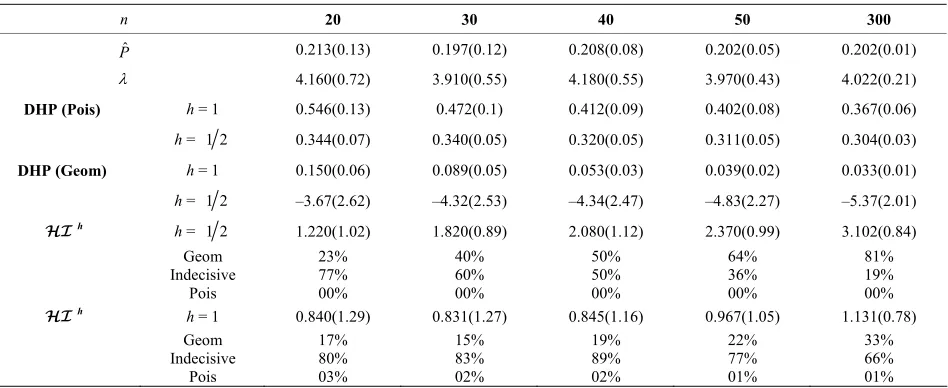
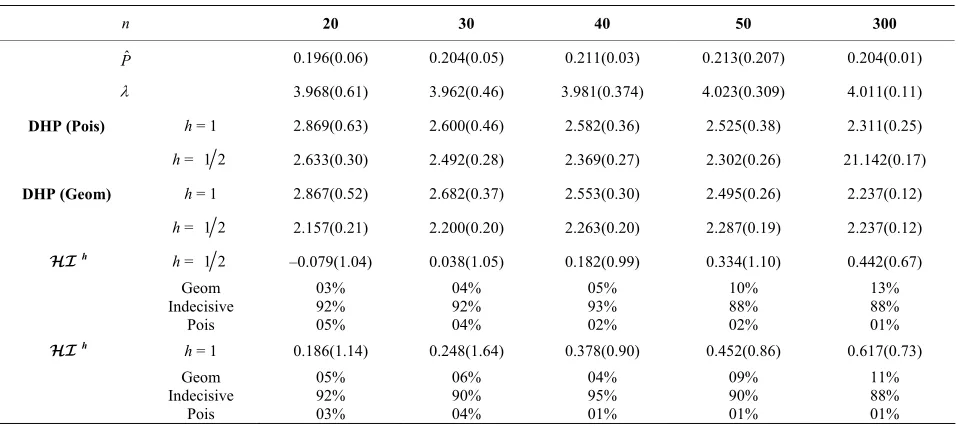
experiments are presented in Tables 1-5. The first half of each table gives the average values of the minimum pe-nalized Hellinger distance estimator PH and pˆPH, the penalized Hellinger goodness-of-fit statistics
ˆ, ˆPH
h H
D P G and DHh P Gˆ, pˆPH
ˆ
, and the Hellinger indicator statistics h. The values in parentheses are
standard errors. The second half of each table gives in percentage the number of times our proposed model se-lection procedure based on h favors the Poisson
model, the Geometric model, and indecisive.
The tests are conducted at 5% nominal significance level. In the first two sets of experiments (π = 0.00 and π
= 1.00) where one model is correctly specified, we use the labels “correct, incorrect” and “indecisive” when a choice is made. The first halves of Tables 1-5 confirm our asymptotic results.
They all show that the minimum penalized Hellinger estimators PH
and ˆPH converge to their pseudo-true values in the misspecified cases and to their true values in the correctly specified cases as the sample size in-creases. With respect to our h, its diverges to – or
+ at the approximate rate of
p
n
except in the Table 5. In the latter case the h statistic converges, as
ex-pected, to zero which is the mean of the asymptotic N(0, 1) distribution under our null hypothesis of equivalence.
With the exception of Tables 1 and 2, we observed a large percentage of incorrect decisions. This is because both models are now incorrectly specified. In contrast, turning to the second halves of the Tables 1 and 2, we first note that the percentage of correct choices using
h statistic steadily increases and ultimately
Table 1. DGP = Pois(4).
n 20 30 40 50 300
ˆ
P 0.210(0.03) 0.195(0.03) 0.197(0.02) 0.205(0.02) 0.201(0.01)
3.950(0.40) 4.090(0.4) 4.015(0.31) 4.015(0.28) 4.0115(0.13)
DHP (Pois) h = 1 0.133(0.07) 0.081(0.05) 0.059(0.03) 0.042(0.03) 0.037(0.01)
h = 1/2 0.096(0.04) 0.064(0.03) 0.048(0.02) 0.034(0.02) 0.03(0.01)
DHP (Geom) h = 1 0.391(0.28) 0.348(0.12) 0.208(0.09) 0.282(0.10) 0.271(0.05)
h = 1 2
0.278(0.07) 0.262(0.08) 0.242(0.06) 0.236(0.06) 0.231(0.03)
h h = 1 2
–3.67(2.14) –4.32(2.69) –4.34(2.38) –4.83(2.52) –4.97(2.18) Correct
Indecisive Incorrect
77% 23% 00%
87% 13% 00%
92% 08% 00%
96% 04% 00%
100% 00% 00%
h h = 1 –3.61(3.03) –3.98(2.48) –3.73(2.29) –4.16(2.35) –4.25(1.87)
Correct Indecisive
Incorrect
70% 30% 00%
79% 21% 00%
83% 17% 00%
86% 17% 00%
[image:9.595.53.535.117.659.2]93% 07% 00%
Table 2. DGP = Geom(0.2).
n 20 30 40 50 300
ˆ
P 0.196(0.04) 0.213(0.03) 0.203(0.02) 0.203(0.02) 0.201(0.01)
3.920(1.0) 4.206(0.89) 4.109(0.67) 4.009(0.58) 4.035(0.34)
DHP (Pois) h = 1.0 0.356(0.14) 0.309(0.10) 0.271(0.09) 0.253(0.08) 0.244(0.07)
h = 0.5 0.281(0.1) 0.273(0.07) 0.254(0.07) 0.246(0.07) 0.237(0.02)
DHP (Geom) h = 1 0.150(0.06) 0.089(0.05) 0.053(0.03) 0.039(0.02) 0.033(0.01)
h = 1 2
0.103(0.04) 0.267(0.03) 0.044(0.02) 0.035(0.02) 0.027(0.98)
h h = 1 2
1.880(1.43) 2.560(1.37) 3.020(1.25) 3.340(1.14) 3.40(1.03) Correct
Indecisive Incorrect
36% 64% 00%
62% 38% 00%
77% 23% 00%
84% 16% 00%
92% 08% 00%
h h = 1 1.710(1.07) 2.260(1.05) 2.760(0.96) 3.01(0.65) 4.19(0.32)
Correct Indecisive
Incorrect
36% 64% 00%
62% 38% 00%
77% 23% 00%
84% 16% 00%
[image:9.595.65.539.539.733.2]92% 08% 00%
Table 3. DGP = 0.75 × Geom(0.2) + 0.25 × Pois(4).
n 20 30 40 50 300
ˆ
P 0.213(0.13) 0.197(0.12) 0.208(0.08) 0.202(0.05) 0.202(0.01)
4.160(0.72) 3.910(0.55) 4.180(0.55) 3.970(0.43) 4.022(0.21)
DHP (Pois) h = 1 0.546(0.13) 0.472(0.1) 0.412(0.09) 0.402(0.08) 0.367(0.06)
h = 1 2 0.344(0.07) 0.340(0.05) 0.320(0.05) 0.311(0.05) 0.304(0.03)
DHP (Geom) h = 1 0.150(0.06) 0.089(0.05) 0.053(0.03) 0.039(0.02) 0.033(0.01)
h = 1 2
–3.67(2.62) –4.32(2.53) –4.34(2.47) –4.83(2.27) –5.37(2.01)
h h = 1 2
1.220(1.02) 1.820(0.89) 2.080(1.12) 2.370(0.99) 3.102(0.84) Geom
Indecisive Pois
23% 77% 00%
40% 60% 00%
50% 50% 00%
64% 36% 00%
81% 19% 00%
h h = 1 0.840(1.29) 0.831(1.27) 0.845(1.16) 0.967(1.05) 1.131(0.78)
Geom Indecisive
Pois
17% 80% 03%
15% 83% 02%
19% 89% 02%
22% 77% 01%
Table 4. DGP = 0.75 × Pois(4) + 0.25 × Geom(0.2).
n 20 30 40 50 300
ˆ
P 0.213(0.03) 0.212(0.03) 0.210(0.02) 0.206(0.02) 0.203(0.01)
4.110(0.43) 4.090(0.31) 3.970(0.28) 4.020(0.26) 4.019(0.17)
DHP (Pois) h = 1 1.779(0.45) 1.634(0.30) 1.650(0.28) 1.570(0.24) 1.520(0.21)
h = 1 2 1.443(0.24) 1.473(0.21) 1.520(0.20) 1.500(0.18) 1.483(0.14)
DHP (Geom) h = 1 2.055(0.35) 1.870(0.25) 0.053(0.03) 0.039(0.02) 0.033(0.01)
h = 1 2
1.640(0.15) 1.660(0.15) 1.700(0.14) 1.690(0.13) 1.632(0.10)
h h = 1 2
–2.40(1.27) –2.44(1.1) –2.49(1.08) –2.77(1.01) –2.89(0.92) Geom
Indecisive Pois
00% 38% 62%
00% 37% 63%
00% 32% 68%
00% 27% 83%
00% 21% 79%
h h = 1 –2.18(1.37) –2.37(1.33) 2.31(1.16) –2.66(1.18) –2.83(1.06)
Geom Indecisive
Pois
00% 48% 52%
00% 45% 55%
00% 46% 54%
00% 30% 70%
[image:10.595.61.540.344.557.2]00% 24% 76%
Table 5. DGP = 0.535 × Pois(4) + 0.465 × Geom(0.2).
n 20 30 40 50 300
ˆ
P 0.196(0.06) 0.204(0.05) 0.211(0.03) 0.213(0.207) 0.204(0.01) 3.968(0.61) 3.962(0.46) 3.981(0.374) 4.023(0.309) 4.011(0.11)
DHP (Pois) h = 1 2.869(0.63) 2.600(0.46) 2.582(0.36) 2.525(0.38) 2.311(0.25)
h = 1 2 2.633(0.30) 2.492(0.28) 2.369(0.27) 2.302(0.26) 21.142(0.17)
DHP (Geom) h = 1 2.867(0.52) 2.682(0.37) 2.553(0.30) 2.495(0.26) 2.237(0.12)
h = 1 2
2.157(0.21) 2.200(0.20) 2.263(0.20) 2.287(0.19) 2.237(0.12)
h h = 1 2
–0.079(1.04) 0.038(1.05) 0.182(0.99) 0.334(1.10) 0.442(0.67) Geom
Indecisive Pois
03% 92% 05%
04% 92% 04%
05% 93% 02%
10% 88% 02%
13% 88% 01%
h h = 1 0.186(1.14) 0.248(1.64) 0.378(0.90) 0.452(0.86) 0.617(0.73)
Geom Indecisive
Pois
05% 92% 03%
06% 90% 04%
04% 95% 01%
09% 90% 01%
11% 88% 01%
The preceding comments for the second halves of Ta-bles 1 and 2 also apply to the second halves of TaTa-bles 3 and 4.
In all Tables 1-4, the results confirm, in small samples, the relative domination of the model selection procedure based on the penalized Hellinger statistic test (h = 1 2
) than the other corresponding to the choice of classical Hellinger statistic test (h = 1), in percentages of correct decisions. Table 5 also confirms our asymptotics results: as sample size increases, the percentage of rejection of both models converges, as it should, to 100%.
In Figures 1, 3, 5, 7 and 9 we plot the histogram of datasets and overlay the curves for Geometric and Pois-son distribution. When the DGP is correctly specified
Figure 1, the Poisson distribution has reasonable chance of being distinguished from geometric distribution.
Similarly, in Figure 3, as can be seen, the Geometric distribution closely approximates the data sets. In Figures 5 and 7 two distributions are close but the Geometric (Figure 5) and the Poisson distributions (Figure 7) does appear to be much closer to the data sets. When = 0.535, the distribution for both (Figure 9) Poisson dis-tribution and Geometric disdis-tribution are similar, while being slightly corresponding to the ordinary Hellinger distance. As expected, our statistic divergence h di-
Figure 1. Histogram of DGP Pois(4) with n = 50.
Figure 2. Comparative barplot of h depending n.
Figure 3. Histogram of DGP-Geom(0.2) with n = 50.
[image:11.595.315.535.319.506.2]Figure 4. Comparaison barplot of h depending n.
Figure 5. Histogram of DGP = 0.75 “Geom + 0.25” Pois with n = 50.
the fact that these two distributions are equidistant from the fact that these two distributions are equidistant from the DGP and would be difficult to distinguish from data in practice.
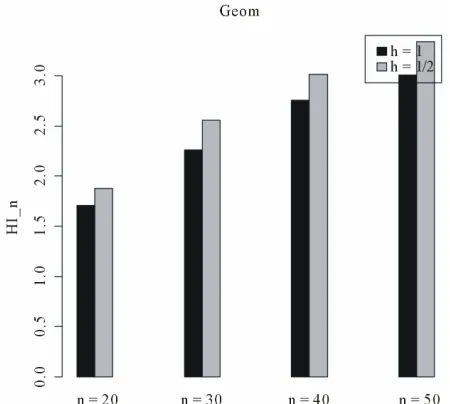
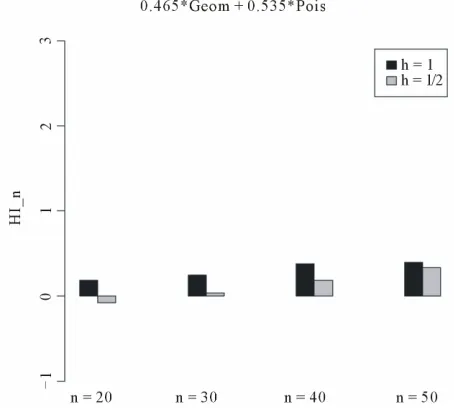
The preceding results in tables and the Theorem (5.5) confirm, in Figures 2, 4, 6 and 8, that the Hellinger indi-cator for the model selection procedure based on panel-ized hellinger divergence statistic with h = 0.5 (light bars) dominates the procedure obtained with h = 1 (dark bars) when we use the penalized Hellinger distance test than the classical Hellinger distance test. Hence, Figure 10 allows a comparison with the asymptotic (0, 1) ap-proximation under our null hypothesis of equivalence. Hence the indicator 1/2, based on the penalized Hel-linger distance is closer to the mean of (0, 1) than is the indicator 1.
N
N
[image:11.595.62.285.529.721.2]Figure 6. Comparative barplot of h depending n.
Figure 7. Histogram of DGP = 0.25 × “Geom + 0.75” Pois with n = 50.
[image:12.595.70.280.310.488.2]Figure 8. Comparative barplot of h.
Figure 9. Histogram of DGP = 0.465 “Geom + 0.535” Pois with n = 50.
Figure 10. Comparative barplot of h depending n.
7. Conclusion
In this paper we investigated the problems of model se-lection using divergence type statistics. Specifically, we proposed some asymptotically standard normal and chi-square tests for model selection based on divergence type statistics that use the corresponding minimum pe-nalized Hellinger estimator. Our tests are based on test-ing whether the compettest-ing models are equally close to the true distribution against the alternative hypotheses that one model is closer than the other where closeness of a model is measured according to the discrepancy im-plicit in the divergence type statistics used. The penalized Hellinger divergence criterion outperforms classical cri-teria for model selection based on the ordinary Hellinger distance, especially in small sample, the difference is
[image:12.595.310.537.317.521.2] [image:12.595.66.278.527.718.2]