COSC460
Research Project
Department of ;computer Science
University of!Canterbury
AN INCIDENT REPORTING AND INFORMATION RETRIEVAL
SYSTEM FOR THE FIRE SERVICE.
INDEX
ACKNOWLEDGEMENTS
1.
INTRODUCTION
2.
THE STRUCTURE OF THE N.Z. FIRE SERVICE
3.
THE CHRISTCHURCH FIRE SERVICE
4.
INCIDENT REPORTING
5.
THE N.Z. FIRE COMMISSION
6.
THE PROBLEM AREAS
7.
A LOOK AT OTHER SYSTEMS
8.
INITIAL IDEAS
9.
AN EXPERIMENT
10.
A POSSIBLE SOLUTION
ACKNOWLEDGEMENTS
1/
1. INTRODUCTION
1. 1 Overview
This year the
st~dentsof COSC203 were involved with
Dr R.E.M. Cooper and the Christchurch Fire Brigade in designing
and implementing an on-line mobilising system for the Christchurch
Fire Brigade.
It
1was envisaged that the data collected and
output by this mobilising system as well as data collected from
other sources could be assembled into a data base.
From this
incident data base meaningful statistics could be obtained
for a variety of uses.
The research project involved analysing the present
incident reporting system, identifying its requirements and
current difficulties.
If the problems of the present system
warranted it, then a new incident reporting approach would
have to be designed.
Initially, because the approach was from the local
Christchurch Fire Brigade and later on, because of communication
difficulties with the ·Fire Commission (in Wellington), both
the mobilising and the incident reporting schemes were discussed
and developed in conjunction with the local brigade.
Although
it was necessary to deal with many different people in the
brigade most of the work was done with and most of the liaison
done through Station Officer K. Wayman and in conjunction with
him, the Deputy Chief Fire Officer G. Roberts.
1.2 Fire Service Subsystems
It is important to identify the various systems that
operate in the Fire Service and how they relate to the
~ncidentreporting system.
The aim of the Fire Service is to attend calls as quickly
and efficiently as possible.
Therefore it becomes clear that
the mobilising or "turn out" procedure is the central and
most important process of the whole system.
The present
mobilising system is entirely manual, it receives the alarm
calls and is responsible for turning out the necessary
appliances to the incident.
The system has to keep a constant
check on the progress of the incident, recording what is
2/
If we look at the system structure we can see some of the
subsystems involved.
In order to be able to turn out to incidents, the
mobilising system needs certain information.
For example it
needs to know what personnel are on duty at any time, and
which appliances are available or committed and where they
are located.
Therefore the mobilising system makes use of
information provided by these other subsystems.
Oh the other hand the incident reporting system is one
that collects data after the inc-ident rather than provide
information necessary for incident turnout.
The incident
reporting system gathers data from, among other sources, the
mobilising system.
It uses this data to complete a full
2. THE STRUCTURE OF THE NEW ZEALAND FIRE SERVICE
Until recently, fire brigades used to be administered
locally,! that is by urban fire authorities.
This involved
277 local fire services.
Now, however, all fire brigades in
the country have been amalgamated into a single national
organisation, the New Zealand Fire Service.
The existing 277 fire districts are still the basic
local units.
These fire districts have been grouped into
22 fire areas (for mainly operational purposes) with each
/3
Area headed by an Area Commander.
The fire Areas themselves
have been grouped into 6 fire Regions (mainly for administrative
purposes) and each Region is headed by a Regional Commander.
The administrative head of the Fire Service is the Fire
Service Commission in Wellington which controls all the
4/
3. THE CHRISTCHURCH FIRE SERVICE
TherChristchurch Fire Service is designated 5A-01 that is,
it is district 1 of Area
A
in Region 5.
The service has eleven
stations in this district, made up of both permanent and
volunteer brigades.
·
The service consists of four divisions:
1.
The operational division
2.
The administrative division
3.
The training division
4.
The Fire Safety division
5/
4. INCIDENT REPORTING
4.1 Collection of Incident Data
At present the headquarters brigade handles the incident
reporting for all the brigades in its district.
When an incident is attended, the control room operator
begins filling out a report on the incident.
He can do this
as the incident progresses.
The data that the control room
operator requires is either available in the control room
(for example the type of alarm) or it is relayed to him by
radio from the appliance.
Data is collected on the actual
fireground by the attending officer who records details
of the incident using the form FSC-3 (Appendix A).
From both the control room working report and the
fireground notes, the control room operator completes the
Christchurch Fire Service "Christchurch Fire Report"(Appendix
B).
For most incidents this basic report is all that is necessary,
however for some major incidents extra details must be included
on Fire Continuation sheets.
For example progress messages on
the incident, backup appliance movements, adjoining property
damage, any injuries or fatalities (Appendix C).
In general the incident report is completed shortly
after the actual incident.
However in some cases (approximately
4-5 times a week) in order to determine properly the cause of
the fire or where a by-law infringement has occured or where
the fire is regarded as suspicious, then extra investigation has
to be done by the Fire Safety Division before the report can
be fully completed.
The Christchurch Fire Report is kept as a record of the
districts operations.
It is important that this report be an
exact and accurate account of the incident as it is sometimes
necessary to produce it as a legal document.
The incident data is processed locally both for the
districts own information requirements and also to collect
data that the Fire Service Commission requires.
4.2 Local Analysis of Incident Data
The statistical analysis of incident data and preparation
of reports at the district level is handled by the Fire Safety
Division of the brigade.
The reports produced are of two types:
1.
A
periodic summary of brigade operations,
and annual.
This type of
re~ort
consists
a large extent of a statistical breakdown
month's or year's incidents (Appendix D).
example, what type of calls were received,
they were received, who attended, what was
damage.
monthly
to
6/
At present the gathering and analysis of
information necessary for these reports is taking
a considerable amount of time and effort.
Most
of the relevant data is not obtained from the
actual incident reports but in fact from various
different areas in the brigade.
For example
information on the number and type of alarms is
obtained from the Alarms Officer.
2.
The Fire Safety Division also prepares detailed
reports on exceptional incidents (either in scale
or type).
In the case of a large fire, a report
might discuss in detail
the structure of the
property and its fire defenses as well as documenting
in detail the methods used and problems encountered
in extinguishing the fire.
As well as the two typeB of report, there is a third area
that the Fire Safety Division handles which is directly related
to incident reporting.
This is the retrieval of specific facts
on incidents that are not produced as a matter of course.
An '
example would be the question -
how many electric blanket fires
have there been this winter and who manufactured those blankets
?
This form of gen·eral enquiry is the most difficult of all.
This is because the Fire Safety Division has no general data
base on past incidents therefore to obtain information of this
kind, it is necessary either to look through the monthly or
annual reports or search through the actual incident reports
themselves.
4.3 Data Collected for the Fire Commission
The data that is processed for the Fire Commission in
Wellington is of two types:
1.
The routine relaying of local incident reports
to the Fire Commission.
This report (FSC 2A
Appendix E) is an almost exact copy of the
Christchurch brigade's usual incident report.
·These incident reports for the Fire Commission are
completed by brigade members and simply involve the
transcribing of the local report on to the Fire
Commission report.
2.
The data that is collected on special incidents
which the Fire Commission requires extra details on.
This is handled by the local Fire Safety Division.
One such report is the Building Research Association
of New Zealand (B.R.A.N.Z.) report which is
completed for every incident that meets the
specifications laid down.
That is, for every
property fire that involved:
1.
Fatalities
2.
Sprinklers that failed to control the fire
3.
Four or more deliveries (Wellington district
7/
4. Six or more deliveries (elsewhere)
5. Spread to $econd compartment
6. Multi-storey building (greater than 5 storeys)
7. Significant quantities of plastics
8/
5.
THE NEW ZEALAND FIRE COMMISSION
5
1
The
ncident
The Fire Commission is situated in Wellington and its
Fire Safety Division Dandles the incident reporting.
Incident
reports from all the brigades in the country are gathered
there.
Currently the system for analysing them is almost
entirely manual and is detailed below.
A count of the incident reports received is recorded for
each district.
This is a check tdtal for balancing purposes.
These reports are partially coded in a primitive code.
These
coded reports are handed over to the State Services Commission
computer department where they are processed into machine
readable form and input to the computer.
The computer program
then generates the annual statistics for the Fire Commission's
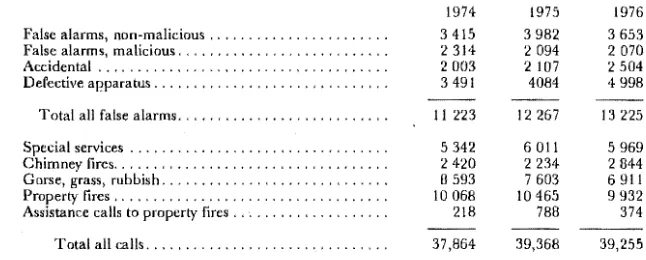
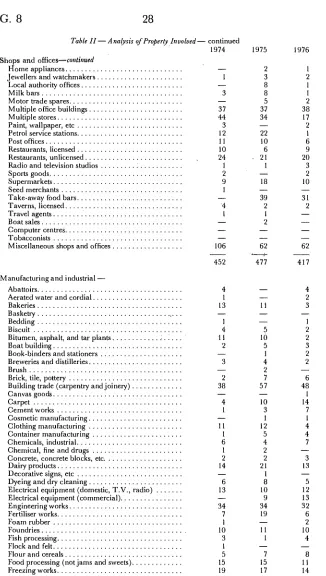
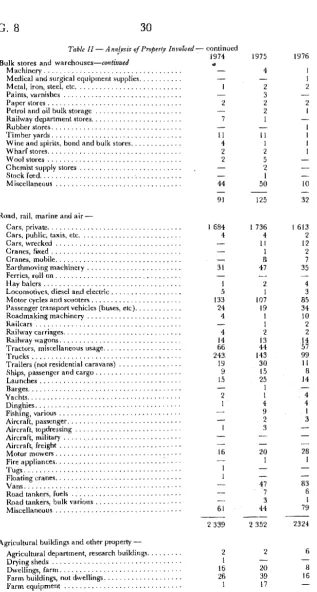
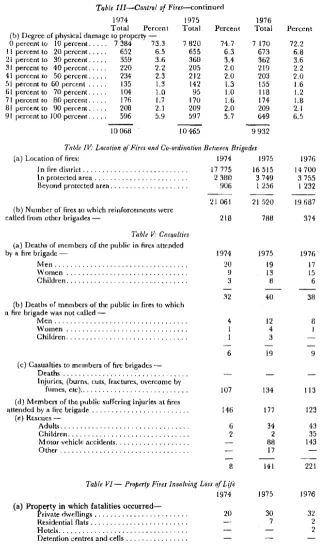
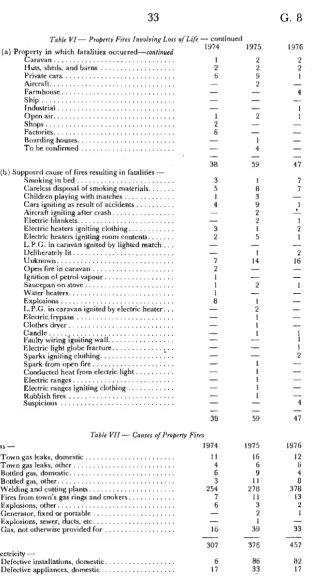
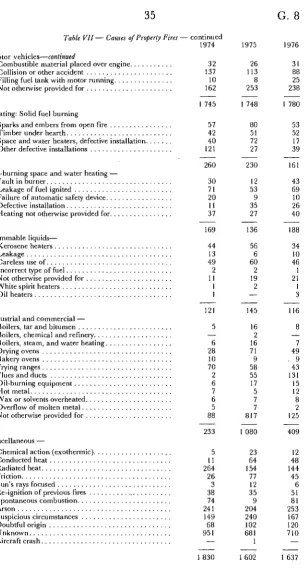
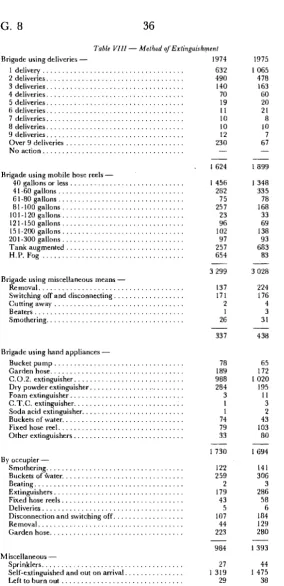
report to Parliament (Appendix F).
The program does not
output the statistics in a form that can be directly copied
for printing, in fact some manual work is necessary to obtain
the correct statistics and present them in an acceptable form
5.2 Informatiori Retrieval
The original incident reports are stored away in a
set of boxes arranged to enable easy retrieval of incidents
using certain keys such as type of incident or individual
brigade.
Where an incident may belong to two or more types
of file (for example to a normal property fire file and to
a file dealing with fatalities) physical copies are made of the
actual incident report and a copy kept in each file.
If there is a request for
~specificpiece of information
then the Fire Safety Division can attempt two approaches to
obtain it:
1.
To search through the computer listing (produced
using the coded reports) for any relevant data.
2.
To try and retrieve the information from the
actual incident report using the box-type of
information retrieval system.
Needless to say, any such request(for example the
9/
6. THE PROBLEM AREAS
6.1 Local Difficulties
When looking at the incident reporting and information
retrieval systems at t.he local level, we can identify several
major problems and inadequacies.
1.
The~localbrigade is doing a considerable amount
of work in the filling out of reports (especially
for the F
e Commission) and is getting no direct
benefit from it.
2.
There
a lack of cons
ency and accuracy in
the way that data is recorded.
3.
There is a duplication of work in the filling
out of Commission reports.
4.
There is a heavy workload imposed upon the Fire
Safety D
ision which is brought about by:
a)
A
eat deal of effort going into the
production of annu
/monthly reports when this
information has already been recorded.
b)
An even greater effort which is required to
answer specific questions on previous
incidents.
5.
The br
ade is not be
presented with and is
not able to get the type of information that
it considers relevant and useful.
6.2 Fire Comm
ies
The Fire Commission has several problems in its Fire
Safety Division in the handling of incident reports.
1.
The system does not collect enough data.
In fact
there is indecision as to what type of data
should be captured, how it is to be captured and
how much is necessary.
2.
What data is captured (locally) loses some of
its accuracy and becomes more generalised because
inadequate coding structure.
3.
It requires a great deal of effort by the Fire
Safety Division to produce their annual reports
because the computer program is inadequate which
means that there is a duplication of manual and
computer work.
4.
There is a duplication of work at the local and
national level in that they both produce the same
sort of annual reports.
That is the local reports
are just a breakdown of the analysis of the
10/
7.
A LOOK AT OTHER SYSTEMS
7.1 The,N.F.P.A. Uniform Code
In
1969 the National Fire Protection Association (NFPA)
of America established a committee on fire reporting.
This
committee developed and published the NFPA
90L or "Uniform
Coding for Fire Protection" standard.
The standard consists
11/
of definitions, standard terminology and a classification system
for data pertaining to fire brigade incidents.
It allows fire
departments to classify the data they collect in a uniform
manner throughout the country.
The NFPA structure is made up of five basic areas:
1.
Property Class if icat ion (which identifies the
type of property and its ?ccupancy type, that is
the use it is put to).
2.
Pre-fire Information (which assesses the relative
fire risk of a specific property.)
3.
Ignition Characteristics (which identify those
factors which are important in starting fires.)
4.
Incident Report (which records the incident,
including the situation on arrival, the action
taken and the extent of damage).
5.
Injury and Loss (which assesses information on
injuries to.people).
codes for the data.
Some
The standard provides numeric
categories of data in the standard
detail (for example Occupancy type
encode the maximum level of detail
to three digits in the code.
are broken down into greater
or fixed property use.)
To
may require the use of up
For example the Occupancy code is grouped into nine
broad categories:
1.
Public Assembly Property
2.
Educational Property
3.
Institutional Property
4.
Residential Property
5.
Store, Office Property
6.
Basic Industry, Utility, Defence Property
7.
Manufacturing Property
8.
Storage property
12/
Educational Property can itself be further detailed.
21'
Non boarding school
22.
Boarding school
23.
Trade, Business school
24.
University
And finally, the last level of detail gives the exact type
of occupancy for say, a non-boarding school:
211. Nursery
212
Kindergarten
213
Primary School
214
Intermediate school
215
High School
This pyramid type of coding structure means that data on
say property use can be coded in as much detail as required.
To
enclode the maximum amount of detail, all the digits are used,
but if less detail is required, then the code has been designed
so that the last digit or two digits can be dropped, leaving
a "coarser" form of data.
7.2 Two NFPA Incident Reporting Systems
The NFPA have developed two incident reporting systems for
fire services that are based on the NFPA coding standard.
1.
An
incident reporting system designed primarily
for the collection of data at a community level
which can be aggregated at state and national
levels.
2.
The Uniform Fire Incident Reporting System
(UFIRS) which was developed by the NFPA for the
Department of Housing and Urban Development.
The first system consists of two input forms (the
Basic Incident Report 902F and the Basic Casualty Report
902G (appendix F).
The American Government is promoting the
use of this system at the state level and is planning to
aggregate data at a national level.
For every incident a Basic Incident Report is filled out
and if the incident involved casualties, then the Basic Casualty
Report is also completed.
Each incident report is basically the
same regardless of the type or scale of the incident.
If
13/
The system is designed so that the smaller fire departments
can manually aggregate data periodically for analysis.
It can
also be handled by computer and NFPA have developed some computer
programs tG edit data from these forms and to build a data base.
The UFIRS system was also designed for lnstallation at
the local level and is marketed with computer software to build
a local data base and report from that data base periodically.
The input forms consist of an Alarm Report (FD 100)
Field Incident Report (FD 200), Resources Utilization Report
(FD 200A), Company Incident Report (FD 300), Fire Investigation
Report (FD 400) and Casualty Report (FD 500). (Appendix H).
The
Alarm Report and the Field Incident Report form the basic system
and the use of other reports is optional.
A reasonable size fire
department would probably use the FD 100, FD 200, FD 300, and
FD 500 input reports.
The basic system generates twelve output
reports periodically including company activity breakdown, resource
usage by district, casualties by incident, source of alarms and
property type by district.
7.3 Acceptability of NFPA to New Zealand
When considering the acceptability of these systems in
New Zealand we have to consider both the coding structure and
the reporting procedures.
The coding scheme to be used is very important.
to have a code that is
It is necessary
1.
Comprehensive enough to cover all possible
situations.
2.
Not too general, so as to be useless because of
the lack of details.
3.
Not too complex, so the details cloud the
important data.
4.
Relatively simple and easy to encode incident
reports with.
The NFPA standard meets most of these requirements and is
a very suitable coding scheme.
However it is obviously American
in origin, and it would have to be extensively adapted to suit
New Zealand.
Both the reporting systems are well designed.
However the
number of forms and amount of work confronting the user of UFIRS
is rather daunting, especially when considering volunteer brigades.
On the other hand, the first system based on forms 902F and 902G
seems to be the basis of a highly workable system.
It is
14/
Looking at the form itself, it is an improvement over
the current New Zealand form.
Its visual appearance is pleasing
and the block structure readily identifies which sections have
to be completed for which incidents.
Obvio'usly modifications would have to be made to both
the coding standard and to the reporting procedure before they would
be acceptable in N.Z.
However they are a good basis to work
15/
8. INITIAL IDEAS
8.1 The Proposed Mobilising System
As has already been mentioned, the mobilising system is
the central process of the Fire Service system.
Therefore, when
designing an Incident Reporting system it was decided that it
was important to consider and perhaps incorporate the proposed
computerized mobilising system into the Incident Reporting system.
Before going any further it is important to understand
exactly how the proposed computerized mobilising system will work.
It would consist of a mini computer with about 64 K of main
memory as the processing unit and would have disk drives for
secondary storage.
For input and output there would be two
visual display unit
(VDU) terminals and a printer.
All alarms for the Fire Brigade go through a control room
and are handled by control room operators who turn out the
necessary appliances to the incident and monitor the progress
of all incidents in their area.
The mobilising syst.em is a 24 hour, on line system that
handles all alarms that are received by the Fire Brigade.
When
an alarm occurs, the control room operator immediately enters
either the address of the call of the Private Fire Alarm (PFA)
number ( a unique identifier for private fire alarm systems).
If the call is a PFA then this could be handled by either of
two ways.
The mobil ising system could inform the control room
operator of any special considerations that need to be taken for
this particular incident.
These might include notifying the
Police or M.E.D. or recommending which appliances should be
despatched.
Alternatively this could be handled by a micro-fiche
retrieval system (possibly connected directly tofue alarm
receiving equipment) since this information is essentially
static.
The control room operator can then turn out those
appliances that are required, logging this on the mobilising system.
The control room operator is kept informed about the general
situation by various status displays.
He can look at the number,
type and disposition of appliances for every station in the
district.
Or he can review all the current incidents and the
appliances committed to them.
The mobilising system records all appliance movements and
is capable of warning the control room operator when certain
11
Zones" or areas have less than the recorrunended number of
appliances available.
The system also keeps track of the progress
on any incident (by logging coded messages) and maintains an
8.2 The Reporting System
By incorporating the mobilising system the incident
reports could be generated by a four stage process;
'
1
l
B
l
1
<--
J L
16/
1.
The turn out data is handled by the mobilising
system and saved in a data base.
17/
2.
Then, after (or even during) the incident, the
remaining non-mobilising data (for example cause of
fire, property damage, equipment used) can be
entered directly into the computer's data base.
3.
The reports have to-be coded before processing, and
this can be done at any stage.
4.
Finally, the fully "written" incident report can
be produced and the monthly/annual statistical
reports can be output.
There is still the need for a manual system not only for
backup purposes but because only a few stations would have the
computerised mobilising system and the other stations would need
some method of storing tqeir incident data in the data base if
they were to benefit from the computerized processing of incident
data.
Also there must be provision for simple editing and
retrieval of incident reports because there are often additions
or corrections to be made to the report.
8.3 Conclusions
one:
This system would enjoy several benefits over the present
1.
By making use of the mobilising system, it ensures
that data that is captured by the mobilising system
does not have to be recorded again.
2.
It reduces the amount of work involved in producing
the incident report.
3.
I t
obviates the necessity of duplicating reports
(for the Fire Commission) by hand.
4.
And it constructs a data base on incidents which
is available for querying.
However, it must be realised that the computerised mobilising
system described above was only a pilot system running on the
University's B6700 computer.
The exact form of the mobilising
system had not been decided on, and in any event the Fire Service
had no suitable mini-computer to implement the mobilising system
on at that stage.
Therefore it was necessary to design an alternative system
that relied on the present manual mobilising system and see whether
the difficulties of the Fire Service could be overcome in some
18/
9
AN EXPERIMENT
9.1. Initial Proposals
It was .decided to set up a simple reporting system on the
University'~
86700 computer as an experiment.
While this was
only an experiment on the local level, it still reflected
accurately the situation both at local and Commission level.
It was hoped that from thi.s experiment that some insight
could be gained into what was required to set up and run the
reporting system on computer and the difficulties that could
arise:
Specifically there were three areas that would be
covered by the experiment:
1.
The
fi~alreports.
2.
The data capture and coding.
3.
The preparation of data in machine-readable
form and the processing of the data.
9.2 The Final Reports
In order to decide on
tbe
format of the final reports output
it was necessary to decide what sort of information is to be
produced.
This was a major difficulty encountered throughout the
project, of the information retrieval system by the Fire Service
in the way of information.
Despite repeated inquiries, the Fire
Service (even at Commission level) still seems unclear as to what
it wants.
Therefore an arbitrary decision was made to collect all the
data necessary to produce the monthly/annual types of report and
output reports of this format.
The computer output report
consists of:
1.
An analysis of structure fires (for example
type of building, damage, causes of fire).
2.
A summary of all incidents (for example
incident type, action taken, alarm type
station attendance).
The computer output report was a monthly report (Appendix L).
9.3
Data Capture and Coding
In order to capture and code the incident data it was
19/
The coding scheme was taken mainly from a version of the
NFPA code that had been adapted specifically for the N.Z. Fire
Service by the Fire Safety Division in Wellington.
The modifications
made to the New Zealand adapted version for the experiment were
mainly simplifications (for example the property use code was
condensed from three to one digit).
I
For the purposes of the experiment it was decided to
process the incident rep9rts for the first three months of this
year.
It was thought that this would provide a better idea as
to how long it would take to fill out and code the reports
than if the incidents had to be processed as they happened.
Therefore the input form was used solely for the purpose of
capturing the necessary data from the existing Christchurch
Fire Service reports.
The data capture and coding was done by two local firemen.
It took them approximately
on~man week to complete a month's
incidents (about 300-350).
Once they had been shown how the
input forms were to be completed (taking about 15 minutes) there
were few problems associated with filling out the forms.
9.4 Data Preparation and Processing
The preparation of punched-cards presented few problems.
The accuracy of the data· was good especially considering the
limited time the experiment involved.
And the time taken to
prepare a month's incidents was about two- three days.
It must
be realised that this card punching was done by only one operator
and that she was doing other work at the same time so a more
accurate estimate of the time taken to prepare the incidents
would certainly be less than the two - three days actually taken.
The design of the processing programs and the processing
of the data proved to be a straightforward task (Appendix K).
For the purposes of the experiment a
prop~rdata base was not set
up, but instead a file consisting of the incidents was set up for
processing:
The file consisted of:
1. Data common to all incidents
2. A pointer to an array of addresses
3. A pointer to an array of appliances used
4. A pointer to an array of property fire data
(if it was a property fire).
There are two programs designed:
1. An editing program which read in the punched cards, did
some elementary error checking and set up the
incident file.
2. An analysing program which read in the incident file,
analysed the data and output the record.
/20
9.5 The Results
The experiment achieved what it was intended to do,
that is,
~heproduction of statistical reports in a straight-forward
manner.
However, there were some difficulties revealed by
the experiment:
1. There were interpretational problems with the
firemen Jilling out the reports until it was
explained clearly and demonstrated to them, the
correct way of completing them.
2. Volunteer stations tend to give a false impression
with manning figures (say ten per appliance rather
than the normal three to four).
3. There was no special provision made for vehicle
fires and accidents although the firemen felt that
this was a type of incident that was occuring
relatively frequently.
4. The major difficulty was the inadequacy of the
equipment· used section:
a)
Only one type of equipment used was allowed
for on the form whereas several types were
often used.
b)
A lot of the equipment in the code is
infrequently or never used.
c)
There was no coding provision for other special
equipment (for example rescue gear, breathing
apparatus) or for everyday equipment that
/21
10.
A
POSSIBLE SOLUTION
10.1
Introduction
The experiment in incident reporting showed that the duplication
and complexity of the present system (at both the local and Fire
Commission level) can be handled in a more simple and straightforward
manner.
Much of the work that has been taking the Fire Safety
Division in Wellington and Christchurch a great deal nf time and
effort effectively was done by two firemen, one punch card operator
and a few seconds of computing time.
Therefore it is recommended that the New Zealand Fire Service
overhaul their entire incident reporting system.
There are five
areas that have to be examined.
1.
The general data flow and data processing system
2.
The data collection and information required
3.
An incident report form
4.
A coding scheme
5.
A central data base and enquiries to it.
10.2 The General System
At present the processing of data at the Fire Safety Division
in Wellington is awkward and time consuming.
There is also the
duplication of this work by the local brigades.
It would be much
better if there was one integrated information system to handle
the information requests of all levels of the Fire Service.
All
the data processing of incident reports should be done on computer
at the Fire Safety Division in Wellington.
There would be several stages to this system:
1.
Data 9hould be captured, recorded on standard
report forms and coded, all at the local level
and sent to Wellington.
2.
These reports can then be prepared in
machine-readable form directly from the reports.
3.
Then the incidents can be analysed by computer
to produce national and local statistical information
for monthly or annual reports and to set up a
It is important that the computer program do most of the
data processing.
That is, apart from the preparation of the
/22
data into machine-readable form, all the processing can be done by
the canputer, including
1.
data verification and validation
2.
Statistical analysis of data
3.
Output of reports in a format suitable
for direct publication.
10.3 Data Collecti
The existing system collects a reasonable amount of raw
data but is not producing much information from it. And it is
obvious that the local brigades are not being given information
which they consider useful in preventing or extinguishing fires.
The solution is not to collect a great deal more data but to
analyse the data that is available much more deeply and carefully.
In fact, there is no need to collect much more data than is already
captured.
There should be two levels of data capture.
1 .
Capture the minim urn of data that is r e 1 evant
on all incidents.
2.
For those few incidents in which it is necessary
to collect extra data, special reports (for
example the BRANZ report) can be used.
It is jmportant to realise that if a great deal more data
than is collected at present is wanted (as has been suggested by
the Fire Service) then not only will it be hard to get Fire
Service personnel to collect this data but it will also result in
a great deal of inaccurate data being recorded.
10.4 The Incident Report
The design of the incident report form is very important.
It should be straightforward to fill out and require the minimum
amount of relevant data.
It is obvious that the input forms
proposed by the Fire Safety Division in Wellington (Appendix
~Dare definitely not suitable.
A lot of unnecessary data is asked
for and the structure of the forms is inadequate.
The form should be designed along the lines of the NFPA
incident forms.
It should be structured in blocks so that the
minimum amount of work is done for most incidents.
There should
be provision on the form for written and coded data.
A suggested
incident report form is included in Appendix 0.
10,5 A Coding Scheme
/23
The terminology is not suitable and the code needs-to be
extended in certain areas, notably in Fire Service equipment.
Some suggested extensions to the code are included in Appendix P.
10.6 A' Pata Base
All the data processing for the Fire Service should be done
by computer in Wellington.
This processing consists of:
1.
Producing periodic reports (for the Fire
Commission and for local brigades).
2.
Satisfying other requests for information that
is not produced as a matter of course.
At the same time that national statistics are being produced
for the Fire Commission individual brigade statistics can also be
produced.
This would remove the duplication in processing that
is present now.
There is also the necessity to set up and maintain an
incident data base for the other requests for information not
normally produced.
Although for most national processing a
sequential data base would be all that was necessary, these other
requests would be from individual brigades.
This means that
it would be more efficient to organise a hierarchical data base
sorted on individual brigades and fire districts.
All requests for
information by local brigades would have to go through the
BIBLIOGRAPHY
1.
The U.S. Department of Housing and Orban Development
"The Uniform Fire Incident Reporting System - Volume 1
An Overview".
2.
The National Fire Protection Association
"Uniform Coding for Fire Protection 1976".
3.
The National Fire Protection Association
"Fire Reporting Field Incident Manual 1976".
· 4.
The Building Research Association of New Zealand
!
~OTESFOR FIRE REPORT
Call No ... ..Dale Time of call: ... .
,I ow c~ll transmitted: ... . . )mccr in Charge: ...
Name and Address of Occupier: ...
Name and Address Q.[ Owner if different from above:
Distance, if beyond fire district:.
false alarm reason and defects if any: ...
:. ~If false alarm no further details are required.)
'
I'crsonncl or Equipment from other Brigades, etc.:
IF VEHICLE, make, type, and reg'n No.:
F BUILDING, size: ... .
No. and construction of floors:: ...
Internal partitions:. Roof:.... .. ... . Occupancy: ..
F.S.C.-3
Sprinklers, automatic alarms, etc. (make and type): ... . ... , ... ~.\ ... .
~'·l No. of sprinkler heads operated: ...
ip PLANTATION, crop and acreage:
P.T.O.
P.S.C.-3
Supposed cause: ... .
.
...
,_ ...Where fire started: ... .
... ... .
Extent of damage: ...
How extinguished: ...
Persons dead, injured, or rescued (name, address, age and
sex): ...
How rescued :
Salvage: ...
Special Service details:
Time last appliance returned to Station; ... ..
I'II::VV L I::J-\.LJ-\.1'1 U r l
n
1:: i:>l:: rl V 1\..1::CHRISTCHURCH FIRE REPORT -
CONFIDENTIAL
1st ATTENDANCE:
2nd:
CALL No. DAY AND DATE: TIME OF CALL: HRS.
ADDRESS OF INCIDENT: AREA:
NAME OF OWNER/OCCUPIER:
ADDRESS·
111 Em. Service: Street Alarm (State Code No.): Running Call:
Exchange Tel: Private Alarm (State Code No.): Other Means*:
F.A. Good Intent: Special Service*: KEYS No. Removed at:
F.A. Malicious: Chimney Fire: Returned at:
F.A. Accidental: Rubbish Grass Scrub: Off i/c 1st Att:
F.A. Def. App. Property Fire*: Off i/c.
Attendance Out Arrived Returned Attendance Out Arrived Returned
Police: Electricity: Alarm Co.:
Traffic: Gas: City Engineer:
Ambulance: Water: Fire Safety:
CD Control: Bldg. Owner:
Description of Property:
Occupancy:
Were Sprinklers Installed? YES/NO No. Heads Operated:
Were Auto Fire Detectors Installed? YES/NO Other Auto. Devices:
SUPPOSED CAUSE:
WHERE FIRE STARTED;
Unit Involved (2) Percentage of Damage to Unit:
DAMAGE: (1)
Done Room
0
0-10%051 -60%
0
One Floor0
Single Occupancy011-20% 021-30%
0
D
D
Single Building
31-40%
0
Range of Buildings041-50%
061-70% 071-80% 81- 90%
D
91- 1oo%How Extinguished:
Total Hose Used: metres. Hose Reel: litres used
B.A. Used: -Normalair: Draeger:
Loss of Life, Injuries, Rescues:
NEW ZEALAND FIRE SE
Vt6€
INVESTIGATION~
.... __________________ .... __/~
CHRISTCHURCH FIRE REPORT -
CONFIDENTIAL
• i ~ .. _ - . ~ ...tst
ATTENDANCE:'
lf-,2_3
2nd:
~-:7
CALL No.
3
2_
~-:s
DAY AND DATE:WEDNESDAY, 9 N 0
v
1977
TIME OF CALL: HRS.ADDRESS OF INCIDENT:
NAME OF OWNER/OCCUPIER:
L
c-,:e.ci,-e{. (
-
I-
' <111 Em. Service:
t><
1 Street Alarm (State Code No.): Running Call:Exchange Tel: Private Alarm (State Code No.): Other Means •:
F.A. Good Intent: Special Service*: KEYS No. Removed at:
F.A. Malicious: Chimney Fire: Returned }It:
F.A. Accidental: Rubbish Grass Scrub: /Off i/c 1st Att:
-:::=;{
0
r(£
C~
c-d 5
F.A. Def. App. Property Fire*:
~
Off i/c. u.c~~::_ D.Attendance Out Arrived Returned Attendance Out Arrived Returned
f
r
f
~
:4
5
{ "l
::2....
'f
I~"01.
-rf
I
(
:s~-0I
3~-~ (4-s~'
(
')_r
~ .2...~
r
~:k4-
/4-V'f
t=-tf..
i
.J
Sr
{~~7rc.+-"-?
t--+-}
t1~1R
rr
(·~3o
r
::,~oP?.'!
I ~.::;,-7f
~er( 44-
f
.?..)
f
3 ).(
f~.l9
I:::.-.!:Ff
~/"A
( 3.!:>-1
{Li-e{
f<+..=<..(l i
'~~7
r3~
r
( b
45:"£(.
-t-~t".3~7
i
133o
I:::;-b'J
ICj-
(~7..7
r"3.sr
( (4.':::,--s-i::
3
11
:Su
1'3)0·
I( '-1-'+'2..
t(~
I
:5
~
<{"'
r3~a
(447
,:: :t
f
.S<.f-0
,
~4~I<.+<+-::>
..::.
f
f
~ ~=<
f
.s
~()tb~<f-
t/~(tt~>)
t
bl"7f
'=.:2.:;;,-
r<6•-,
Police:
r
s
~3. Electricity:I
~.:{
; ) - Alarm C:o.:Traffic: r3:<.~ Gas: City Engineer:
IS~.)
-
FireSafety:?f?o /Lfe¥
Ambulance: Water:
CD Control: Bldg. Owner:
J..-0
v5.-"'~rtc.f',
ct....:...,. (
'-1-:(!!,.-Descri tion of Pro ert :
-If
luot:>:
d
a:
""-rt
:br,ck-
-h> ..
fdt.-...r1
1!1+'::2..
IA)-eoc{+f
~~
a.be:>uTOccupancy:
Were Sprinklers Installed?
~NO
No. Heads Operated:Were Auto Fire Detectors Installed? NO Other Auto. Devices:
SUPPOSED CAUSE:
WHERE FIRE STARTED;
DAMAGE: ( 1) Unit Involved (2) Percentage of Damage to Unit:
Done Room
0
One FloorD
Single Occupancy0
0-10%011·
20% 0 2 1 · 30%051 . 60%
':!
How Extinguished:
h·-071.80%
Total Hose Used:
<67 :)..._
metres.j
Hose ReeLSB.A Used: -Normalair: /.;;;
Loss of Rescues:
D
Single Building0
31-40%0
81.90%h-
c(,-a ...
1 - t . <.)litres used
D
Range of BuildingsJ SISTANCE MESSAGE 1: TIME:
f'1Z7
HRS. FROM:D{o
S-r1
c..k-...qf:.
~T:
Ca.
"(~<!!-ell-~( Cra~
..---..
cu-
s;;.cLer·<S:,(
c.C\.
eS-r-e,-
os;;_
f'r
ql~e
r
~-r
1-)
r
al~'-'\.
J. SISTANCE ME~AGE 2: :riME:
(S~7
HRS. FROM:1""-=0RMATIVE MESSAGE 1: TIME:
Is)
C. HRS. FROM:3
rd
EJ
C
-e{...-
•
~T:
Ct:;-f.h..et:lr-CL(
c;;-q._...
..-....a.-,..,.sc~( c~~-r..er ~-r.
C(b-...fd.,;:_c(
II :oRMATIVE MESSAGE 2: TIME: HRS. FROM:
K-p.-~
---~---STOP MESSAGE: TIME:
;Lf;:;-
HRS. FROM:f::::.C
FO
s
)P FOR:Ca--rl...e4ra.!C-a~ ~a.-
!!Sc:k&-6(
cL.
.e
$.--r.e,-
s:'(
k
-1.
-H Min. Occurrence
-' '3
t.,~1.!-,o'-"'
.s(
0..DC?.
._l--c
./2~
VV\.~
ke
·1
add,
-reD-'\. Cl_ (~v
...
rJ
lcPr
~~
~s...u-e
. ...--{-
~4-J5
y.6
CJC£0
IV\. C{._t:::tr']-c:.
o+
op.er-C(.-.:,
o ...
1
h ./-0 '-
1--\.._ Ci-r
f "~
J_ ' ([ ... _
I
b~.{cl.
.-..c1.J ;
a ....
cf~
-~
~q.£::x:
l:::-D ..,... Ct+r
&>V·-$.3o
tz"
1 VI.\}IS,{
IJ .ec( 1 A.f_.
l,-e_
I
ro
gA
$e>-r:S Ct-_.._cf.4
--:T
e
-r-..s
I -1.uSc.
3
57
{,a..._
C
CFo
..
.
fi/af~e
:<.V").-d
4fa,-r--..._
-f'-+
(\ril\.fll•~a"'in.J-c:. ~C-o~ ~
i-:::a _
a'7 Ca-r.Lt
eJ~-c:J
C-cr~o·-£c
~&-G
(C
h.e0-e,-
S-,_
C1b
·->- ..(d
I '"1.~
C1
be
-.s I~ox=<o
-"""
fa-..cf
:z
+ (
~l---s.
l,ecnJ.(y
1
V\u
o(u-'iad
f '"'\?
i. ;:--e
-·7 Te
-rS
crV"Ld
.(Sl)
jV\.'>S.e.
j4-
-:<q
tro~
..d0
-Wc.:'
k
-e
c:
Cc~o
-r
Bacl.o
v\. 0 \...)c fo$ed
FIRE
REPORT
CONTINUATION SHEET
Call No.
Day and Dote:
-WEDNESDAY, 9
NOV
1977
! I
•4-:5/.o
0
( -e
v"\.I._:)
I
c."'
\•
~.
n ... ..,.
c._Lt
!l l-..~-...Jr.S:
il
l.e
Co.-..-;c__
Su:-b
d
l'-'
r
vt.-e,~
· · · " - - · · · " · - - - - · · · · " " " ' ' " " " " " " " ' ' " ' ' " " " ' " " " " " ' " " " " " '
!-<ea--rs
FIRE
REPORT CONTINUATION
SHEET
I
No.
-
3 .:z
~~
I
Day and Date:
WEDNESDAY,
9
NOV
1977
!Min.
Occurrence
I
!(
~(
.
Wa
... £
...
.. ,
I
6q"1 Dll
f-<s.,
~q
3'd
(){t,~e,r
L?e:-F:o .
..
t-=1~ i}-.k.~~
.
I
'r
K.._,
~
.s
e-1!
..
I
'1l:::-k~·~1
I
Vt
~ hsU~
,,
..•
r
,,
lC"-e..-..C{ • ...-\
"
Ncu"""' e
~
a+
p
-e
;-S.o>~~-
""\.e(
fS)v-..p '-'-..--..
p
.$.-!
(P ...Vo/uVI."!ee..-
5~a-<c..:~,or;
I
r'\.o\ 0.-'\[,\-e.
qrc...:-_,_c.f
,
...
fe
q
£06
k.
...
J
I
.. , ... \···---·
I
...
I
...
I
I
-·-~·
I
"'"'"
I
...
. I
I
...
I
I
...
I
I
...
..J
I
...
I
...
I
...
r ... --~~~-._ ...
REPORT NO 8
CHIEF FIRE OFFICERS REPORT FOR THE MONTH OF AUGUST 1977
(1) BRIGADE OPERATIONS
.
'
a) Smnmary of calls Received and Reception Methods
Telephone
Str
Pvt
Running
Other
Total
111
Exch
Alarm
Alarm
Calls
Means
False Alarms
Good Intent
29
26
1
4
1
4
65
(45)
Malicious
22
1
4
27
(19)
Accidental
1
21
1
23
(16)
Defective
2
1
39
1
43
(53)
Special Services
8
14
1
15
38
(19)
Actual Fires
Chimney
41
7
1
1
50
{30)
Rubbish, Grass
15
7
3
25
(16)
Property
82
6
1
1
1
91
(66)
TOTAL:
200
61
2
70
3
26
362
(264)
Corresponding figures for August 1976 are shown in brackets, an overall increase of
98 calls.
b)
Total calls to 31.8.76
=
2400
31.8.77
=2458
c) Station Attendance to Calls
1st
In
Total
Hose
HMFuel
Attend
Support
Used
Run
Used
Headquarters station.
105
69
174
3540
26993
2421/1747
No 2 station, Sydenham
47
29
76
625
909
-/414
No 3 Station, St Albans
48
25
73
250
1330
718
No 4 station, Woolston
38
16
54
1875
1261
668
No
5station, Sock burn
5714
71
1975
1457
664
No 6 station, Harewood
27
26
53
325
795
441
No 7 station, New Brighton.
29
1
30
425
287
302
No 8 Station, Sumner
5 5100
208
94
No 9 Station
1Lyttelton
5 517
5204
232
No 10 Stat. Diamond Harbour
37
36
No 11 Station, Brooklands
1
1
2
110
80
TOTAL:
362
118
543
9290
33591
5656/2161
d) Property Fires
Total for month:
91Year:
574
)
Property Affected
Dwellings
Total for month:
56
Year:
302
Manufacturing and Industrial
II II2
II37
Shops and Offices
II II6
II21
Places of Public Assembly
II II1
II11
Bulk stores and Warehouses
II II :... II5
Agricultural buildings
II II2
II7
Miscellaneous buildings
II II II3
. Transport
II II12
II126
(2)
FIRE SAFETY AND PREVENTION
a) Inspections and Reports
i)
Hotels, Taverns, Licensed Restaurants
ii) Places of Assembly, Apartment Buildings
iii) Registered Childrens Homes
iv)
Private Hospitals, Old Peoples Homes
b) Fire Services Act
Evacuation schemes for buildings
Draft fire safety schemes for approval
without amendment
Exemptions from regulations
Evacuation drills
Inspections for firefighting purposes
Fire prevention surveys, advice
c) Factories Amendment Act 1971
Fire Safety inspections at request of
Local authority
q)
Miscellaneous Activities
i) Alleged Fire Risk Investigations
ii) Post Fire Investigations
iii) Investigations - Suspected By-Law
Infringements
iv) Building Plan inspections
v)
Routine inspections
vi) Lectures:
Brigade personnel
Service clubs, Community Organisations
National Safety Assn courses
Government departmental courses
Industrial, commercial
Schools
TafALS
(3)
WATER
Hydrant Inspection
Christchurch City
Waimairi County
Paparua County
N.Z. Railways
Areas Inspected
No
Christi!hurch
Month
19
221
630
923
4
5
1 1 1 24
326
Inspected
985
133
i86
2
Year
223
452
6
24
1171
36
212
366
11125
20
24
31
10
27
7
3 816
1773·
Fire Safety
Inspectorate
Month
3 1 4Year
94216
11
4
2 3 11 33 415
2 3 1 1392
1Faults Reported
60
10
2
(4)
ALARMS
a) Attendance to Automatic Fire Alarm systems
Total for month:
Causes:
Fires
Good intent
Malicious
Accidental
Defective App.
b) Street Alarms
70
2 2
4
23
39
Total number installed
56
Total number tested
98
c)
Automatic Alarms Connections
Total,for month:
5
d) Automatic Alarm Disconnections
Total for month:
4
(5) PLANT AND EQUIPMENT
a) Receipt of New Equipment
Year:
649
Protectus
128 pr 70mrn couplings
128 pr 45mrn couplings
256 70mm hose defenders
256 45mm hose defenders
Hawkes wood
II
Cable Price
Alex Farrar
24 Syd. standpipe washers
6 pr safety goggles
10 ft 3/16 Galv. chain
1 metal tool box
b) Workshop Activities
All equipment tested in accordance with Fire Service Commission requirements
and found satisfactory. Repairs were carried out as required ..
(6)
The following appliances were returned to Brigade workshops for repair
and servicing: 2, 8, 9, 13, 16, 19, 21, 23, 27, 28, 32, 33, 34, FWP No 1,
Amberley FWP, Lyttelton trailer, TTL ex Auckland, Rakaia land rover 24.
STAFF
Resignations - Permanent staff
1Appointments - Permanent staff
1Disciplinary Action
Nil
Appointments - Volunteer staff
1
Resignations - Volunteer staff
1
Promotions
Nil
cant/ •••
-/4 .
(7)