http://www.scirp.org/journal/jamp ISSN Online: 2327-4379
ISSN Print: 2327-4352
DOI: 10.4236/jamp.2018.62039 Feb. 28, 2018 418 Journal of Applied Mathematics and Physics
Efficient Iterative Method for Solving the
General Restricted Linear Equation
Xiaoji Liu
1, Weirong Du
1, Yaoming Yu
2, Yonghui Qin
3* 1Faculty of Science, Guangxi University for Nationalities, Nanning, China 2College of Education, Shanghai Normal University, Shanghai, China3College of Mathematics and Computing Science, Guilin University of Electronic Technology,
Guilin, China
Abstract
An iterative method is developed for solving the solution of the general re-stricted linear equation. The convergence, stability, and error estimate are given. Numerical experiments are presented to demonstrate the efficiency and accuracy.
Keywords
Linear Equation, Iterative Method, Error Estimate
1. Introduction
Let m n r
×
be the set of all m n× complex matrices with rank r. For any
m n r
A∈ × , let A2,
( )
A , and ( )
A be matrix spectral norm, range spaceand null space, respectively. Let ρ
( )
A be the spectral radius of the matrix A.For any m n
r
A∈C × , if there exists a matrix X such that XAX=X, then X is called a {2}-inverse (or an outer inverse) of A[1].
The restricted linear equation is widely applied in many practical problems [2] [3][4]. In this paper, we consider the general restricted linear equations as
, ,
Ax=b x∈T (1)
where m n
r
A∈ × and T is a subspace of n. As the conclusion given in [2], (1)
has a unique solution if and only if
( ) { }
, 0 .
b∈AT T∩ A = (2)
In recent years, some numerical methods have been developed to solve such as problems (1). The Cramer rule method is given in [2] and then this method is developed for computing the unique solution of restricted matrix equations How to cite this paper: Liu, X.J., Du,
W.R., Yu, Y.M. and Qin, Y.H. (2018) Effi-cient Iterative Method for Solving the Gen-eral Restricted Linear Equation. Journal of Applied Mathematics and Physics, 6, 418- 428.
https://doi.org/10.4236/jamp.2018.62039
Received: January 7, 2018 Accepted: February 25, 2018 Published: February 28, 2018
Copyright © 2018 by authors and Scientific Research Publishing Inc. This work is licensed under the Creative Commons Attribution International License (CC BY 4.0).
http://creativecommons.org/licenses/by/4.0/
DOI: 10.4236/jamp.2018.62039 419 Journal of Applied Mathematics and Physics over the quaternion skew field in [5]. An iterative method is investigated for finding some solution of (1) in [6]. In [7], a subproper and regular splittings iterative method is constructed. The PCR algorithm is applied for parallel computing the solution of (1) in [8]. In [4], a new iterative method is developed and its convergence analysis is also considered. The result on con- densed Cramer’s rule is given for solving the general solution to the restricted quaternion matrix equation in [9]. In [10] [11], authors develop the deter- minantal representation of the generalized inverse ( )1
,
T S
A for the unique solution of (1). The non-stationary Richardson iterative method is given for solving the general restricted linear equation (1) in [4]. An iterative method is applied to computing the generalized inverse in [13]. In this paper, we develop a high order iterative method to solve the problem (1). The proposed method can be implemented with any initial x0∈T and it has higher-order accuracy.
The necessary and sufficient condition of convergence analysis also is given, which is different the condition given in [14]. The stability of our scheme is also considered.
The paper is organized as follows. In Section 2, an iterative method for the general restricted linear equation is developed. The convergence analysis of our method is considered, an error estimate is also given in Section 3. In Section 4, some numerical examples are presented to test the effectiveness of our method.
2. Preliminaries and Iterative Scheme
In this section, we develop an iterative method for computing the solution of the general restricted linear Equation (1).
Lemma 1 ([1]) Let m n
A∈ × and T and S be subspaces of n and m, respectively, with dimT =dimS⊥= ≤t r. Then A has a {2}-inverse (or an outer
inverse) X such that
( )
X =T and ( )
X =S if and only if,
m
AT⊕ =S
in which case X is unique ( denoted by ( )2 ,
T S
A ). Proposition 2 ([2]) Let m n
A∈ × and T and S be subspaces of n and m, respectively. Assume that the condition (2) is satisfied, then the unique solution of (1) can be expressed by
( )2 , .
T S
x=A b (3)
Let L and M be complementary subspaces of m, i.e., m
L⊕M= , the
projection PL be a linear transformation such that P xL =x x, ∈L and
0,
L
P y= y∈M.
Lemma 3 ([12]) Assume that m n
A∈ × and B∈m n× with m≤n. Then the n eigenvalues BA are the m eigenvalues of AB together with n m− zeros.
In this paper, we construct our iterative scheme as follows:
( ) (
)
(
)
1 1
2
1 1 1
1 1
1 ,
,
t t
k t k k k
k k k k
Z tI C Z A Z A Z
x x Z b Ax
− −
− − −
− −
= − + + −
= + −
DOI: 10.4236/jamp.2018.62039 420 Journal of Applied Mathematics and Physics where k=1, 2, 3,, t∈, and t≥2. Here, we take the initial value Z0=βY
in our scheme (4), where β is a relaxation factor. Thus, if t=2, then (4) de- generates to the non-stationary Richardson iterative method given in [4].
Lemma 4 Let A∈m n× , T and S be subspaces of n and m, respectively.
Assume that Z0=βY and
( )
Y ⊆T , where β is a nonzero constant andn m
Y∈× . For any initial x0∈T, the iterative scheme (4) converges to some
solution of (1) if and only if
(
PT Z A0)
1,ρ − <
where a projection PT from
m
onto T.
Proof. The proof can be given as following the line of in [4]. □
3. Convergence Analysis
Now, we consider the convergence analysis of our iterative method (4).
Theorem 5 Let m n
A∈ × , T and S be subspaces of n and m, respec-
tively. Assume that m
AT⊕ =S and nm
Y∈ satisfies
( )
Y ⊆T and( )
Y ⊆S , where dimT =dimS⊥. If b∈AT, for the given initial value
0 , 0
Z =β βY ≠ and x0∈T, then the sequence
{ }
xk generated by iteration (4) converges to the unique solution of (1) if and only if ρ(
PT−Z A0)
<1, whereT
P is a projection. In this case, we have
(
)
10 0
lim k T .
k x I P Z A Z b
−
→∞ = − + (5)
Further, we have
( )
11
0 0 0 .
1
k t t
t k
q
x x q x Z b Z b
q
− − ∞
− ≤ − +
−
(6)
where q=PT−AZ0.
Proof. For any x∈T∩N A
( )
, we have Ax=0. By AT⊕ =S m and Lem-ma 1, there exists a matrix X such that
( )
X =T and XAX=X . Now,assume that m
y∈ satisfies x=Xy, we have
( ) { }
0, 0 .
x=Xy=XAXy=XAx= T∩N A =
If b∈AT, then (2) is satisfied. Therefore, by ([4], Lemma 1.1), the scheme (4)
converges to the unique solution of (1).
Since
( )
Y ⊆T , P ZT 0=Z0, and then by (4), we obtain P ZT k =Zk. Since0
x ∈T, P xT k =xk by (4b), and therefore
(
)
(
)
1 1 1.
k k k k k T k k
x =x− +Z b−Ax− =Z b+ P −Z A x− (7)
If P WT =W , then
(
I−Zk−1A W)
=(
PT −Zk−1A W)
. (8) By (4) and (8), we obtain( )
(
)
1(
)
1
1 1 1
1 0
1 ,
t t
i i
i i
k t k T k k
i i
Z A C Z A P Z A Z A
− −
− − −
= =
=
∑
− =∑
−(
)
(
1)
(
0)
.k
t t
T k T k T
DOI: 10.4236/jamp.2018.62039 421 Journal of Applied Mathematics and Physics By induction on k, it leads to
(
)
(
)
(
)
1 1 1 1 2 2 2 1 0 1 0 1 1 0 0 0 2 0 0 , k k k t itk T k
i
t t
t t
T T k
i i
i i
k
Z A P Z A Z A
P Z A P Z
Z Z A S A A − − − − − = − − − = = = − = = − −
∑
∑
∑
(10)where 1
(
0)
0 : . k t i k T i
S P Z A
−
=
=
∑
− From b∈AT, w T∈ , we have b=Aw and itimplies that Z bk =Z Awk =S Z Awk 0 =S Z bk 0 . By (9), we have
(
)
(
)
(
)
(
)
1 1(
)
10 0 1
1 1
0 0 1 0 0 0
0 0 0
1 1
0 0 0 0
0
. k
k j k i
k k i k
t
k k T k
i k
k
t t
k T k i T
i j i
t t t t
k
t t
T k i T
i
x S Z b P Z A x
S Z b P Z A S Z b P Z A x
P Z A S Z b P Z A x
− − + + − + − − − − − = = = − − − − − = = + − = + − + − = − + −
∑∏
∏
∑
(11)Note that
(
PT−Z A S0)
k =Sk(
PT −Z A0)
,(
0)
(
0)
.k t
T k T
I P Z A S I P Z A
− − = − −
From (11), we obtain
(
)
(
)
1(
) (
)
10
1 1
0 0 0 0 0.
k k
k T
t t t t
t t
T T T
P Z A
I P Z A Z b I P Z
I x
A P Z A x
+− +− − − − −
= − − + − − − (12)
If ρ
(
PT−Z A0)
<1, then I−(
PT−Z A0)
is invertible and it implies that xk converges as k→ ∞. For convenience, let its limit denote by x∞. Thus, we have(
T 0)
0I P Z A x∞ Z b
− − =
. Since T is closed and xk∈T, we have x∞∈T and
T
P x∞=x∞. Thus, Z0
(
Ax∞−b)
=0 and( )
0( )
{ }
0Ax∞− ∈b Z ∩AT= Y ∩AT⊆S∩AT= . Note that x∞ is the
unique solution of (1) and
(
)
10 0
T
x∞=I− P −Z A − Z b. From (4), it follows that
(
)(
) (
)
(
)
(
)
1 1
1
1 1 0 0 0 .
k t
t
k T k T
t
x x P Z A x x P Z A x x
+− −
+ − ∞ = − + − ∞ = − − ∞ (13)
From Lemma 4, we have ρ
(
PT −Z A0)
<1 and(
)
( )
1(
(
)
(
(
)
1)
)
1
0 0 0 0 0 .
k t t k t T T
x x P Z A x Z b I I P Z A Z b
− − − ∞ − = − − − − − + Therefore,
( )
(
)
(
)
( )
1 1 10 0 0
1 1
0 0 0 ,
1 k k t t t k t t t
x x q x Z b I I q Z b
q
q x Z b Z b
q − − − ∞ − − − ≤ − + − − ≤ − + −
where q=PT−AZ0. □
Remark If
( )
Y ⊆S in Theorem 5 is removed and t=2, then the result degenerates into that given in ([4], Theorem 3.2). However, the sequence{ }
xk given in (4) does not converse to ( )2,
T S
DOI: 10.4236/jamp.2018.62039 422 Journal of Applied Mathematics and Physics Proposition 2. Here, it can be tested by the following example:
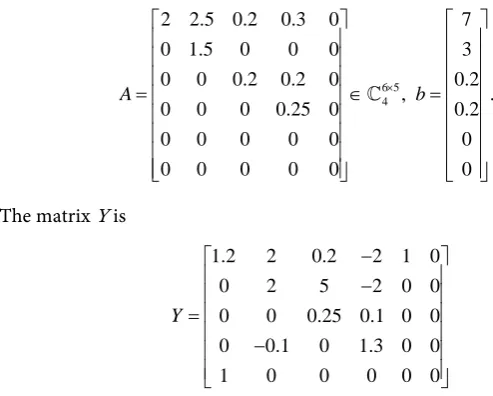
Let A and b of the general restricted linear Equation (1) be
6 5 4
2 2.5 0.2 0.3 0 7
0 1.5 0 0 0 3
0 0 0.2 0.2 0 0.2
, .
0 0 0 0.25 0 0.2
0 0 0 0 0 0
0 0 0 0 0 0
A × b
= ∈ =
(14)
The matrix Y is
1.2 2 0.2 2 1 0
0 2 5 2 0 0
0 0 0.25 0.1 0 0
0 0.1 0 1.3 0 0
1 0 0 0 0 0
Y − − = −
Note that R Y
( )
⊂T, but ( )
Y ⊆/S. If take β =0.16, then(
PT Z A0)
1ρ − < . Here, we choose t=2 in (4). Thus, it can be seen as the method given in [4]. The errors Axk−b2, xk−xk−1 2, and
( )2 ,
2
k T S
x −A b of
(4) with t=2 and β=0.16 are presented in Table 1. Numerical results given in Table 1 show that Axk−b2→0, but
( )2 ,
2 0
k T S
x −A b . Thus, the limit of
k
x is not the solution of (1) presented by Proposition 2.
Theorem 6 Under the same conditions as in Theorem 5. The iterative scheme (4) is stable for solving (1), where PT −Z A0 <1.
Proof. Let ∆k and δk be numerical perturbations of xk and Zk given in (4), respectively. Thus, we can express as xk=xk+δk,, Zk =Zk+ ∆k. If
T k k
P∆ = ∆ , PTδk =δk, then P xTk =xk, P ZTk =Zk. Here, we formally neglect quadratic terms containing ∆kAδh, ∆ ∆kA k. Since Z AZk k =Z AZk k, we get
(
) (
)
(
)
1, t t t .
k k k k k k k k k
Z A∆ = ∆ AZ Z A+ ∆ A = Z A + ∆t A Z A −
By (4), we derive
( )
(
)
( ) (
)
(
)
(
)
1 1
1 1 1
2
2 1
1 1 1
2 1 1 1 1 1 1 . t i i i
k k t k k k
i t
i
i i
t k k k
i
t
k T k k
Z Z C Z A t
i C A Z A Z
Z t P Z A
− − − − − = − − − − − = − − − = + − + + − − = + ∆ − ∆ ∆ ∆
∑
∑
(15)From (9) and (4), we have
(
)
10 0
k t k
k t PT Z A
−
[image:5.595.217.464.105.303.2]∆ = − ∆ and
Table 1. Error results of (4) with t=2, β =0.16. 2
k
Ax −b xk−xk−1 2
( )2 , 2
k T S
x −A b
k = 11 3.3871e−10 8.3702e−09 21.8430
DOI: 10.4236/jamp.2018.62039 423 Journal of Applied Mathematics and Physics
(
)
1(
) (
)
0 0 1 1.
k t k
k k T k k k
x =x +t P −Z A − ∆ b−Ax− + −I Z A
δ
−Therefore, we obtain
(
)
1(
) (
)
0 0 1 0 1.
k k
t t
T k k
k
k t P Z A b Ax PT Z A
δ
−δ
− −
∆
= − − + − (16)
By (4), we have
(
0)
k t k
I−AZ = I−AZ . Similarly, we have
(
)(
) (
)
11(
)
1 0 0 .
k
t t
k k k
t
b Ax I AZ b Ax I AZ b Ax
+
− − −
− = − − = − − (17)
By (17) and (16), we derive
(
)
1(
) (
) (
)
1
0 0 0 0 0 1.
k
k t t k
t t
k
t
k t PT Z A I AZ b Ax PT Z A k
δ − − δ
− −
= − ∆ − − + − (18)
Thus, by ∆0
(
I−AZ0) (
= PT−Z A0)
∆0, we have(
)
(
)
(
)
(
)
(
)
(
) (
)
1 1 1 1 2 1 1 10 0 0
0 0
1 2 1
1 1
0 0 0 0 0.
1 k k k k k t t k k t k T
t t t T
k t t t t
t t
T T
t t t P Z A b Ax
P Z A
t t
P Z A b Ax P Z A
t δ δ δ + − + + − + − − + + + + − + − − − = + + + − ∆ − + − − − ∆ − + − − = (19)
If PT −Z A0 <1, then
1
1 2 1
1 0
lim 0
1
k
k t t
t T
k
t t
P Z A
t + + − + − →∞ − − =
− and for any k,
(
)
(
)
0 0 0 0 ,
k K b Ax
δ
≤ ∆ − +δ
where
1 1
1 2 1
1 1
0 max 0 , 0
1
k k
k t t t t
t t
T T
t t
K P Z A P Z A
t + + + − + − − − − = − − −
. It follows that the
iterative method (4) is asymptotically stable. □
4. Numerical Examples
In the section, we give an example to test the accuracy of our scheme (4), which is implemented by our main code given in Appendix, and make a comparison with the method given in [4]. We also apply our scheme to solve the restricted linear system (1) with taking different t and intial value.
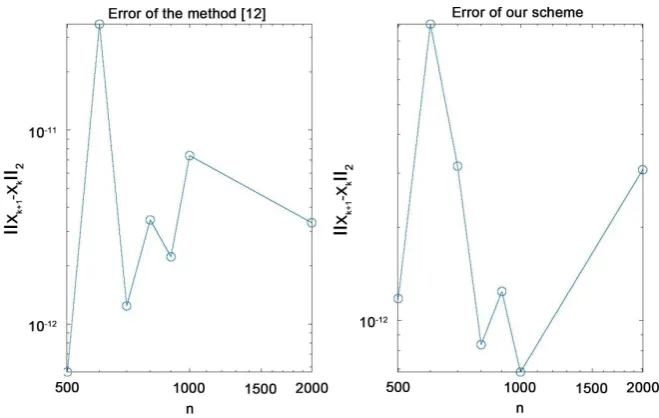
Example 1 Consider the restricted linear system (1) with a coefficient matrix being random A=randn
( )
n of order n n× , where n=800, 900, 1000, 2000 of index one and random vectors b∈AT. Let E=randn( )
n be a randommatrix. Take T
Y=AEE , Z0=βY, and a random vector x0∈T. Here, we make
a comparison the mean CPU time(MCT) and error bounds of our scheme (4) with those given by the method of [4]. The stopping criteria used is given as in [4] by
{
2 1 2}
max Axk−b , xk−xk− ≤5.26e 15.−
DOI: 10.4236/jamp.2018.62039 424 Journal of Applied Mathematics and Physics Table 2. The mean CPU time (MCT) and error in Example 1.
method of [4]
n n× t MCT [4] Axk−b2 xk−xk−1 2
800 800× 2.221434 1.4613e−12 3.4439e−12
900 900× 3.412709 1.5764e−13 2.2203e−12
1000 1000× 4.249560 9.7132e−13 7.3896e−12
2000 2000× 14.14631 4.5823e−13 3.3269e−12
Our Scheme
n n× t MCT Axk−b2 xk−xk−1 2
800 800× 6 0.438568 9.2913e−13 8.3698e−13
900 900× 7 0.742810 1.3444e−12 1.2432e−12
1000 1000× 8 1.336598 1.4786e−12 6.8270e−13
[image:7.595.207.540.91.311.2]2000 2000× 10 13.361577 4.3165e−12 3.0732e−12
Figure 1. Error in example 1.
Example 2 Consider the general restricted linear Equation (1), where A and b
is given as in (14). Here, we use the scheme (4) to solve the example. Let 5
T= ,
[
]
{
T}
span 0 0 0 0 0 1
S= . Take
0
1 1 0 0 0 0 0
1.2 2 0.2 2 1 0
2 0 1 0 0 0 0
0 2 5 2 0 0
1 0 0 1 0 0 0
, , .
0 0 0.25 0.1 0 0
0.2 0 0 0 1 0 0
0 0.1 0 1.3 0 0
0 0 0 0 0 1 0
0 0 0 0 0 0
0 0 0 0 0 0 1
T
Y x P
−
−
= = =
−
Obviously, 6
AT⊕ =S ,
( )
Y ⊆T , ( )
Y ⊆S, b∈AT , and x0∈T.To verify the accuracy of our method, we present the generalized inverse ( )2 ,
T S
[image:7.595.217.530.595.717.2]DOI: 10.4236/jamp.2018.62039 425 Journal of Applied Mathematics and Physics Figure 2. The MCT in Example 1.
Table 3. Error for (4) in Example 2 with t=2,3.
t β k Axk−b2 xk−xk−1 2
( )2 , 2
k T S
x −A b
0.13 11 2.0035e−08 3.1905e−08 3.1905e−08 12 9.9495e−16 6.1815e−16 3.6906e−15
2 0.14 11 5.1443e−09 8.1923e−09 8.1923e−09
12 5.9511e−17 2.2204e−16 1.8243e−15 0.15 11 1.3203e−09 2.1026e−09 2.1026e−09 12 8.8861e−16 4.5776e−16 3.9315e−15
t β k Axk−b2 xk−xk−1 2
( )2 , 2
k T S
x −A b
0.13 11 0 0 4.1466e−15
12 0 0 4.1466e−15
3 0.14 11 0 0 2.0562e−15
12 0 0 2.0562e−15
0.15 11 0 0 3.9440e−15
12 0 0 3.9440e−15
( )2 ,
0.5 0.7 0.5 0.6 0 0
0 0.6 0 0 0 0
0 0.6 5 0 0 0
0 0 0 4 0 0
0 0 0 0 0 0
T S
A
− −
=
To ensure ρ
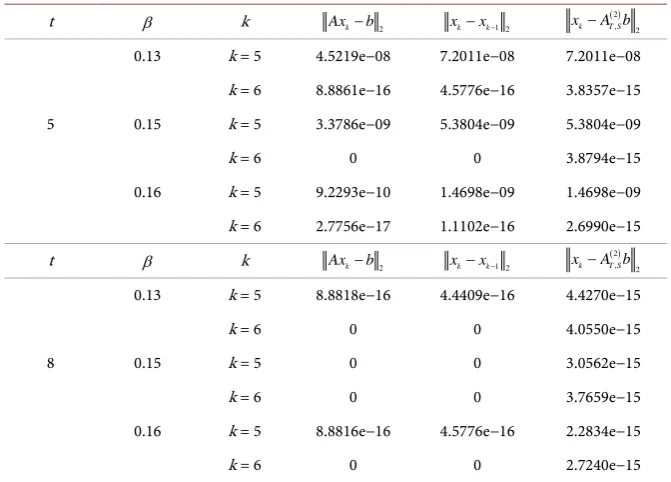
(
PT−AZ0)
<1, we take parameter β=0.13, 0.14, 0.15 in Table3 and β =0.13, 0.15, 0.16 in Table 4, respectively. We present the errors
k
Ax −b, xk−xk+1, and
( )2 ,
k T S
x −A b in 2-norm as t=2, 3 in Table 3 and 5,8
DOI: 10.4236/jamp.2018.62039 426 Journal of Applied Mathematics and Physics Table 4. Error for (4) in Example 2 with t=5,8.
t β k Axk−b2 xk−xk−1 2
( )2 , 2
k T S
x −A b
0.13 k = 5 4.5219e−08 7.2011e−08 7.2011e−08 k = 6 8.8861e−16 4.5776e−16 3.8357e−15
5 0.15 k = 5 3.3786e−09 5.3804e−09 5.3804e−09
k = 6 0 0 3.8794e−15
0.16 k = 5 9.2293e−10 1.4698e−09 1.4698e−09 k = 6 2.7756e−17 1.1102e−16 2.6990e−15
t β k Axk−b2 xk−xk−1 2
( )2 ,
2
k T S
x −A b
0.13 k = 5 8.8818e−16 4.4409e−16 4.4270e−15
k = 6 0 0 4.0550e−15
8 0.15 k = 5 0 0 3.0562e−15
k = 6 0 0 3.7659e−15
0.16 k = 5 8.8816e−16 4.5776e−16 2.2834e−15
k = 6 0 0 2.7240e−15
From the numerical results given in Table 3 and Table 4, we can see that the scheme (4) has high order accuracy and these results given with t=3,8 are
better than those obtained by t=2, 5, respectively.
5. Conclusion
The high order iterative method has been derived for solving the general restric- ted linear equation. The convergence and stability of our method also have derived. Numerical experiments have presented to demonstrate the efficiency and accuracy.
Acknowledgements
This work was supported by the National Natural Science Foundation of China (No. 11061005, 11701119, 11761024), the Natural Science Foundation of Gua-ngxi (No. 2017GXNSFBA198053), the Ministry of Education Science and Tech-nology Key Project (210164), and the open fund of Guangxi Key laboratory of hybrid computation and IC design analysis (HCIC201607).
References
[1] Ben-Israel, A. and Greville,T.N.E. (2003) Generalized Inverses. Volume 15 of CMS Books in Mathematics/Ouvrages de Mathématiques de la SMC, 2nd Edition, Sprin-ger-Verlag, New York.
[2] Chen, Y.L. (1993) A Cramer Rule for Solution of the General Restricted Linear Eq-uation. Linear and Multilinear Algebra, 34, 177-186.
https://doi.org/10.1080/03081089308818219
Ge-DOI: 10.4236/jamp.2018.62039 427 Journal of Applied Mathematics and Physics
neralized Inverse ( )2 , T S
A and Rectangular Systems. International Journal of Com-puter Mathematics, 77, 401-424. https://doi.org/10.1080/00207160108805075
[4] Srivastava, S. and Gupta, D.K. (2015) An Iterative Method for Solving General Re-stricted Linear Equations. Applied Mathematics and Computation, 262, 344-353.
https://doi.org/10.1016/j.amc.2015.04.047
[5] Song, G.J., Wang, Q.-W. and Chang, H.-X. (2011) Cramer Rule for the Unique So-lution of Restricted Matrix Equations over the Quaternion Skew field. Computers & Mathematics with Applications, 61, 1576-1589.
https://doi.org/10.1016/j.camwa.2011.01.026
[6] Chen, Y.L. (1997) Iterative Methods for Solving Restricted Linear Equations. Ap-plied Mathematics and Computation, 86, 171-184.
https://doi.org/10.1016/S0096-3003(96)00180-4
[7] Wei, Y.M., Li, X.Z. and Wu, H.B. (2003) Subproper and Regular Splittings for Re-stricted Rectangular Linear System. Applied Mathematics and Computation, 136, 535-547. https://doi.org/10.1016/S0096-3003(02)00078-4
[8] Yu, Y.M. (2008) PCR Algorithm for Parallel Computing the Solution of the General Restricted Linear Equations. Journal of Applied Mathematics and Computing, 27, 125-136. https://doi.org/10.1007/s12190-008-0062-3
[9] Song, G.-J. and Dong, C.-Z. (2017) New Results on Condensed Cramer’s Rule for the General Solution to Some Restricted Quaternion Matrix Equations. Journal of Applied Mathematics and Computing, 53, 321-341.
https://doi.org/10.1007/s12190-015-0970-y
[10] Cai, J. and Chen, G.L. (2007) On Determinantal Representation for the Generalized Inverse ( )2
, T S
A and Its Applications. Numerical Linear Algebra with Applications,
14, 169-182. https://doi.org/10.1002/nla.513
[11] Liu, X.J., Zhu, G.Y., Zhou, G.P. and Yu, Y.M. (2012) An Analog of the Adjugate Matrix for the Outer Inverse ( )2
, T S
A . Mathematical Problems in Engineering, Article
ID: 591256.
[12] Roger, A.H. and Johnson, C.R. (2013) Matrix Analysis. 2nd Edition, Cambridge University Press, Cambridge.
[13] Liu, X.J., Jin, H.W. and Yu, Y.M. (2013) Higher-Order Convergent Iterative Method for Computing the Generalized Inverse and Its Application to Toeplitz Matrices.
Linear Algebra and Its Applications, 439, 1635-1650.
https://doi.org/10.1016/j.laa.2013.05.005
[14] Srivastava, S., Stanimirović, P.S., Katsikis, V.N. and Gupta, D.K. (2017) A Family of Iterative Methods with Accelerated Convergence for Restricted Linear System of Equations. Mediterranean Journal of Mathematics, 14, 222.
DOI: 10.4236/jamp.2018.62039 428 Journal of Applied Mathematics and Physics
Appendix
function hocigrlscm(A X P Z b ktmax, , , , , )
( )
,1zn=size A ; id=speye z
( )
n ; fprintf(' Num. of iterative2
k
Ax −b xk+1−xk 2 CPU time n′) fprintf('---BEGING---n′)
max 1 2
it = e ; tol=5.26e−15; cnvs=0;
for it=1:itmax,
tic; za= ∗A Z; X0 =X ; ZY= 0;
for tk =2 :ktmax
( )
1(tk1)(
max,)
k
zc= − − ∗nchoosek kt t ;
( )
(tk 1)ZY=ZY+zc∗ za − ; % compute Zk+1
end
(
max)
Z = ∗Z kt ∗ +id ZY ;
(
)
X = X+ ∗ − ∗Z b A X ; %Xk− − >Xk+1
clear ZY;
0;
ermk= X−X L= ∗ −A X b;
( )
(
:)
;ermk=sqrt ermk ′∗ermk
(
)
;erml=sqrt L′∗L itm = toc;