Probability Elicitation in Influence Diagram Modeling by
Using Interval Probability
Xiaoxuan Hu1,2, He Luo1,2, Chao Fu1,2
1School of Management, Hefei University of Technology, Hefei, China
2Key Laboratory of Process Optimization and Intelligent Decision-Making, Ministry of Education, Hefei, China
Email: [email protected]
Received May 29, 2012; revised July 31, 2012; accepted August 10,2012
ABSTRACT
In decision modeling with influence diagrams, the most challenging task is probability elicitation from domain experts. It is usually very difficult for experts to directly assign precise probabilities to chance nodes. In this paper, we propose an approach to elicit probability effectively by using the concept of interval probability (IP). During the elicitation process, a group of experts assign intervals to probabilities instead of assigning exact values. Then the intervals are combined and converted into the point valued probabilities. The detailed steps of the elicitation process are given and illustrated by constructing the influence diagram for employee recruitment decision for a China’s IT Company. The proposed approach provides a convenient and comfortable way for experts to assess probabilities. It is useful in influ-ence diagrams modeling as well as in other subjective probability elicitation situations.
Keywords: Influence Diagram; Probability Elicitation; Interval Probability; Decision-Making
1. Introduction
An influence diagram (ID) [1] is a directed acyclic graph for modeling and solving decision problems under un- certainty. It provides a more compact way to represent complex decision situations than a decision tree does. In recent years, influence diagrams have been used as ef- fective modeling tools for Bayesian decision analysis.
The work of constructing an influence diagram can be divided into two sub-works: The first one is to build the influence diagram structure; the other one is to assign parameters to all kinds of nodes, including assigning conditional probabilities for chance nodes, acquiring the utilities for value nodes and generating decision al- terna-tives for decision nodes. The whole work is chal- lenging and time consuming, and a number of difficulties may be faced. Bielza et al. have discussed the important issues in modeling with influence diagrams [2-4].
During the entire construction process, the assignment of conditional probabilities for chance nodes is consid- ered the most difficult problem. There are two common used solutions to get probability values: learning from data or acquiring from experts. In the machine learning community, many algorithms have been presented to learn probabilities from data [5-7]. However, in many real-world applications, we do not have available data set and have to elicit probabilities from experts. The prob- abilities are thus called subjective probabilities.
To deal with the imprecision and inconsistence of sub- jective probabilities, quite a few methods are developed to guide experts correctly giving probabilities, such as using visual tools like probability scale [8], probability wheel [9] and scaled probability bar [10], adapting Ana- lytic Hierarchy Process (AHP) [11]. Wiegmann gives an overview of the popular elicitation methods [12].
In this paper, we focus on probability elicitation for influence diagrams. We present a new approach to elicit probabilities from experts. Our approach does not require experts to give point-valued probabilities but to give in- terval-valued probabilities instead. Because in daily life, it is unrealistic to expect experts to provide exact values of many probabilities. They are used to describing prob- abilities by verbal or other inexact expressions, such as “possible”, “rare” or “likely”. Each expression is an im- precise or fuzzy description of probability that actually means an interval of probability. Cano and Moral pointed out that imprecise probability model such as interval probability is more useful than exact probability model in many situations [13]. The experts would be more con- fident and feel more comfortable to deal with intervals probabilities. So, we apply the concept of interval proba- bility [14-18] to elicit probabilities, and we combine multiple experts’ judgments to increase the accuracy of the final results.
basic concept of interval probabilities. In Section 4, we describe our approach of probabilities elicitation from experts. First we introduce the entire process of the ap-proach, and then give the details of each step. In Section 5, we illustrate our approach by a real application: estab-lishing an influence diagram model for employee re-cruitment decision for a China’s IT company. Finally, we give a conclusion in Section 6.
2. Influence Diagram
An influence diagram can be defined as a four-tuple [19]
, , ,r
ID G X P U such that,
1) G = (V, E) is a directed acyclic graph (DAG), with nodes V and edges E. V are partitioned into three sets, V
=VC VD U. VC, VD and VU are the set of chance nodes, decision nodes and value nodes, respectively. The dependence relations and information precedence among all the nodes are encoded in E.
V
2) X is a set of variables. X =XCXD, XC is a set of random variables, and each variable in XC is represented by a chance node of G. XD is a set of decision variables, and each variable in XD is represented by a decision node of G .
3) Pr is a set of conditional probability distributions. Each random variable i C associates with a dis-tribution
C X
i i
P C Par C
.
4) U is a set of utility functions. Each value node contains one utility function u(Xpa(vi)).
1, 2i U
V V i
In influence diagrams, the chance nodes are repre-sented by circulars, and each chance node associates with a probability distribution. The decision nodes are rectan-gles. Each decision node has a set of alternatives. The value nodes are diamonds. The parameters of each value node show the utility of various outcomes according to the decision makers. Directed arcs in influence diagrams have different meanings. Arcs pointing to decision nodes are called information arcs, which indicate information precedence. An information arc from a chance node A to a decision node B denotes that variable A will be ob-servable before the decision is made. Arcs pointing to chance nodes are called relevance arcs, which represent the dependency between the variables and their parents. The missing arc between two chance nodes means condi-tional independence.
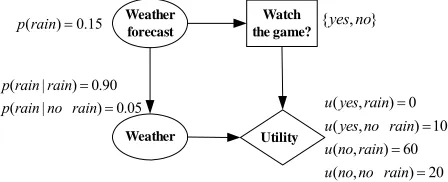
An example of an influence diagram is shown in Fig-ure 1. Bob is going to decide whether to go to watch a football game tomorrow. The only factor he considering is the weather. If there is no rain, he will go; otherwise he prefers to stay at home. He has a weather forecast sensor, from which he can know whether it will rain or not to-morrow. But the sensor has a small probability to make wrong forecast. As shown in Figure 1, there is an
infor-mation arc from the node “weather forecast” to the deci- sion node, and a relevance arc from the node “weather forecast” to the node “weather”. Bob’s utility varies with various instances of decisions and weather conditions.
The evaluation of an influence diagram is to find the best alternative by comparing the expected utility (EU) among every decision alternatives. Suppose Dj is a deci- sion node with a set of decision alternatives
d L d1, , n
.First we calculate the EU of each decision alternative di:
di
d ,i j
jEU
U c P c ej
(1)in which e represents the evidences.
Then we select the best alternative d* in
1, , n
d L d , which satisfies
* arg max
i
d EU d (2) The original evaluation approach is to unfold an in- fluence diagram into a decision tree. Obviously it is inef- ficient. Shachter presents a way to evaluate influence diagrams with two operations: node-removal and arc- reversal [20]. By recursively using the two operations, an influence diagram is transformed into a diagram with only a utility node. The utilities for individual decision alternatives are computed during the process. F. Jensen et al. describe a way to convert an influence diagram into a junction tree [21], and then the message passing algo-rithm is operated on the junction tree for calculating the expected utility. Zhang describes a method to reduce influence diagrams evaluation into Bayesian network inference problems [22], so that many Bayesian network inference algorithms can be used to evaluate influence diagrams.
3. Interval Probability
The theory of imprecise probability has received much attention [13-17,23-26]. Interval probability is a major expression of imprecise probability that has been used in uncertain reasoning [14,18], decision making [15,16], and some other applications. It is an extension of classi- cal probability so that can be adapted in more complex uncertain situations.
Definition 1. (Interval probability) [14,17,27]: Let Ω be
Weather Weather forecast
Watch the game?
Utility
( ) 0.15
p rain {yes no, }
( , ) 0
( , ) 100
( , ) 60
( , ) 20
u yes rain u yes no rain u no rain u no no rain
( | ) 0.90
( | ) 0.05
p rain rain p rain no rain
[image:2.595.311.535.632.723.2]
a sample space, A
a ii 1, 2,...,n
be a σ-field ofrandom events in Ω,a set of intervals L a U a
i , i is called interval probabilities if it satisfies the following conditions:
, 0 i i 1
i L a U a
(3)
, i i ,
i p a L a U a
i , such that
1
1;
n i i
p a
(4)
,inf
, ,sup
where | ,
i i
p P
i i
p P
i i i
i p a L a
i p a U a
P p L a p a U a i
(5)
The intervals satisfy conditions (3)-(5) are also called
reachable probability intervals [14] or F-probability [17]. Condition (4) can be modified as:
1 1
1
n n
i
i i
L a U a
i
(6)
Condition (6) and (4) are equivalence, while (6) is easier to understand. Condition (5) can be modified as [14,16]:
1 1
1, 1,
n n
i i i i
i i
i j i j
L a U a U a L a j
(7)Condition (7) is a more strict constraint than (6).
4. Probability Elicitation
[image:3.595.311.532.85.543.2]4.1. The Process of Probability Elicitation
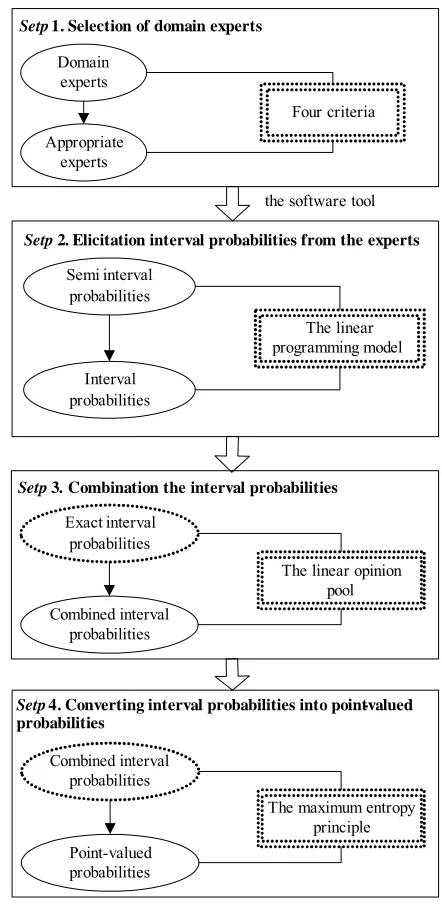
Figure 2 shows the entire process of probability elicita- tion from multiple experts. It consists of four main steps. In the first step we select a group of appropriate experts in related domains. Then in the second step we elicit in- terval probabilities from the selected experts. In step 3, we combine different interval probabilities to form a sin-gle interval probability distribution. The linear opinion pool approach is adapted to complete the combination. In the last step, the interval probabilities are converted into point-valued probabilities, because only point-valued probabilities are recognized by influence diagrams. We deal with the conversion by a maximum entropy princi- ple.
4.2. Selection of Experts
The elicitation work begins with selection of a group of appropriate experts. Each selected expert should meet the following four criteria: 1) Have to be specialists in the relevant fields; 2) Should be familiar with probability thinking and probability language; 3) Should have good communication skills so as to clearly express his opinion; 4) Should be quite patient to take time to engage in the
Four criteria Domain
experts
Setp 1. Selection of domain experts
Appropriate experts
Setp 2. Elicitation interval probabilities from the experts
The linear programming model Semi interval
probabilities
the software tool
Interval probabilities
The linear opinion pool
Setp 3. Combination the interval probabilities
Combined interval probabilities Exact interval
probabilities
The maximum entropy principle
Setp 4. Converting interval probabilities into point-valued
probabilities
Point-valued probabilities Combined interval
probabilities
Figure 2. The process of probability elicitation.
modeling task.
The number of experts depends on the complexity of the influence diagram model, however, at least 3 experts should be guaranteed.
4.3. Interval Probability Elicitation
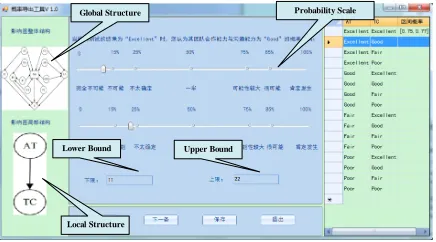
To help experts make judgments, we develop a software tool. The main window of the tool is shown in Figure 3. Two probability scales are arranged on the window. The above one is used to decide the lower bound of interval probability and the below one is used to decide the upper bound. The experts can drag the slider thumb on the scales to change the probability.
Local Structure
Probability Scale
[image:4.595.64.282.87.208.2]Lower Bound Upper Bound Global Structure
Figure 3. The software tool for eliciting interval probability.
probabilities. We denote them by and
call them semi interval probabilities. Then we need to
check if fully meet the definition of
interval probabilities. If not, we use the following linear programming model [16] to elicit interval probabilities
from
i , i L a U a
i , iL a U a
i U a i
L a
, L a
i ,U a i with least change.
1 1. . 1,
1, , , , n i j i i j n i j i i j i i i i i i
s t L a U a
U a L a j
U a L a i
U a U a i
L a L a i
j (8)The model ensures
i , i
i , i L a U a L a U a
and at the same time keeps the interval as big as possible. For example, the intervals on a random event are {[0.35, 0.40], [0.20, 0.30], [0.40, 0.45], [0.01, 0.05]}. The inter-val probabilities elicited from them are {[0.35, 0.39], [0.20, 0.24], [0.40, 0.44], [0.01, 0.05]}.
i , i L a U a 4.4. Interval Probability Combination
In order to improve the accuracy of the probabilities val- ues, we elicit probabilities from multiple experts. Each expert assigns interval probabilities to chance nodes in- dividually, and then their opinions are aggregated. By using multiple experts, we may get more precise results and eliminate the biasing effects.
A number of methods have been proposed for prob-ability combination. Here we take the linear opinion pool method [24,28]. The result is a linear combination of all the probability distributions given by different ex- perts. The linear opinion pool is a simple but very useful method to combine probabilities. It allows us to assign weights to the experts. The weight is a scale for reflect-
ing the difference of expertise. An expert with larger weight would have greater influence on the final results.
Let L A Uj
, j
A
j 1, 2, ,
m are interval probability distributions of a discrete random variable A
that assigned by expert j. Define ,U*
A L A* as weighted sum of all the distributions:
* *
1 1
, m j , m j
j j
j j
L A U A L A U A
(9)where j is the weight of expert j that satisfies 1 1 j j m
.Proposition 1. L A U A*
, *
is an interval prob- ability distribution.For combination, the important thing is to assign proper weight to each expert. Since the probabilities are subjective, some experts’ judgments may be more pre- cise than the others. They should have greater influence on the final result. So the weight of individual expert should reflect the degree of expertise and would be dif- ferent.
In most group decision-making situations, the weights are subjective. Here we propose a method to assign weights objectively. In detail, we give the weight to an expert by measuring the average distance (AL) between the probability distribution given by him and the distri- butions given by others. The value of AL shows the av- erage similarity between a certain probability distribution and the other distributions. We consider if an expert’s judgment is closer to the most experts’ judgments, we as- sign him a higher weight; otherwise we assign him a lower weight.
Definition 2. The distance between two interval prob- ability distributions
,
b b
L A U A
and L A Uc
, c
A is defined as
2
2 1, n b c ) ( b c
i i i i
i
D b c L a L a U a U a
(10) Definition 3. The average distance between an interval probability distribution L A Ub
, b
A and all the
other distributions j
,Uj
A j bL A
is defined as
2
21 1
1
( )
1
m n
b b j b
i i i i
j i j b
L L a L a U a U
m
j a
(11) Definition 4. The weight b of expert b is defined as
1 1 1 b b m j AL j AL 4.5. Convert Interval Probability into Point-Valued Probability
The evaluation algorithms of influence diagrams are all based on point-valued probabilities. After combination, oint-valued
prob ow that there always
For example, the interval probability distribu we need to convert interval probability into p
ability. By definition 1, we kn
exists point-valued probability distributions P(A) for each interval probability distribution [L(A), U(A)]. How- ever, P(A) is not unique. In case we have no additional information, the most reasonable converting method is to use maximum entropy principle [15,29]. As shown below, the point-valued probability distribution is the solution of the linear programming model.
1
* *
max log
0 1
. .
n
i i
i
i i i
n
H P p a p a
L a p a U a s t
(13)
1
1
i i
p a
tion is
0.35, 0.39 , 0.20, 0.24 , 0.40, 0.44 , 0.01, 0.05 .
Then the point-valued probability elicited from it is
5. Case Study
om several candidates who are all recent graduates. The company will make the decision after assessing individ-
andidates. On the basis of analysis on
0.35, 0.20, 0.40, 0.05 .
A China’s IT Company is going to hire employees fr
ual ability of the c
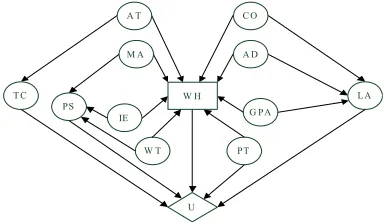
the relevant factors, we construct an influence diagram model, as shown in Figure 4. The nodes of the model are explained in Table 1.
After building the structure of the influence diagram, we consider the parameters of the nodes. We start with the conditional probability distribution of node “TC”. “TC” represents the teamwork spirit and communication skill of candidates. The company tests “TC” of candi- dates through a test and ranks it with four grades: “Ex- cellent”, “Good”, “Fair” and “Poor”. However, the result of the test does not always according with the real per- formance. The conditional probability p TC AT
re- presents the degree of the deviation.For p TC AT
, we need to obtain sixteen probabili- ties, as shown in Table 2.Here we illustrate the elicitation process of p(a1) to
p(a4). We select five experts. By using th ool, the semi interval
e software t probabilities given by each expert are shown in Table 3.
Using model (8), we transform them into real interval probabilities, which are shown in Table 4.
The weights of the experts obtained by formula (12)
A T
W H C O
U
LA T C
PT PS
W T IE
M A A D
[image:5.595.327.521.85.196.2]G PA
Figure 4. Influence diagram for employee recruitment.
Table 1. The description of the nodes.
Node Description
AT The result of aptitude test: {Excellent, Good, Fair, Poor}
TC G
Major: {A
tion, Not according with the position}
t
n test: {Excellent, Good, Fair, Poor}
CO raduated from:
AD
} }
hat , Somewhat introverted, Very in- Teamwork spirit and co munication skill: {Excellent, m
ood, Fair, Poor}
ccording with the position, Related to the
posi-MA
IE Internship experience: {Having been trained in the relevanfields, Having been trained in other fields, None}
The grade of writte
WT
PS Practical skill: {Excellent, Good, Fair, Poor} What kind of university the candidate g {Top, Superior, Fair}
Academic degree: {PhD, Master, Bachelor, None}
GPA Grade point average (GPA): {Excellent, Good, Fair, Poor
LA Learning ability: {Excellent, Good, Fair, Poor
PT
The result of personality test: {Very extroverted, Somew extroverted, In the middle
troverted}
WH Whether hiring: {Yes, No}
U Value node
2. Conditional probability table of node “TC”. Table
TC Fair Poor
AT
Excellent Good
Excellent p(a1) p(b1) p(c1) p(d1)
Good p(a2) p(b2) p(c2) p(d2)
Fair p(a3) p(b3) p(c3) p(d3) Poor p(a4) p(b4) p(c4) p(d4)
are listed as follows:
1 2
3 4
5
0.183214, 0.203496,
195304 0.20 ,
0.208627.
0. , 9359
The combined interval probabilities obtained by for-mula (9) are shown in Table 5.
[image:5.595.308.541.240.518.2] [image:5.595.306.539.518.601.2]terv
[image:6.595.57.538.102.183.2]E3 E4 E5
Table 3. Semi in al probabilities.
E1 E2
p(a1) [0.75 0.77] [0.77 0.80] [0.81 0.84] [0.75 0.78] [0.80 0.82]
p( ) a2 [0.20 0.22] [0.15 0.17] [0.12 0.13] [0.13 0.15] [0.14 0.20]
p(a3) [0.03 0.04] [0.04 0.07] [0.03 0.05] [0.04 0.05] [0.03 0.05]
p(a4) [0.00 0.02] [0.01 0.02] [0.02 0.04] [0.01 0.03] [0.02 0.04]
Interval probabiliti
E1 E2 E3 E4 E5
Table 4. es.
p(a1) [0.75 0.77] [0.77 0.80] [0.81 0.83] [0.77 0.78] [0.80 0.81]
p( )a2 [0.20 0.22] [0.15 0.17] [0.12 0.13] [0.14 0.15] [0.14 0.15]
p(a3) [0.03 0.04] [0.04 0.07] [0.03 0.05] [0.04 0.05] [0.03 0.04]
p(a4) [0.00 0.02] [0.01 0.02] [0.02 0.04] [0.02 0.03] [0.02 0.03]
Table 5. The combined interval probabilities.
p(a1) p(a2) p(a3) p(a4)
[0.78 0.80] [0.15 0.16] [0.03 0.05] [0.01 0.03]
p(a1) p(a2) p(a3) p(a4 Table 6. The point-valued probabilities.
)
0.78 0.15 0.04 0.03
6. Conclusion
Influence diagrams have be widely used for decision ertainty. The major obstacle of build-
is that it is difficult to get
ainly supported by the National of China (No. 70801024,
REFERENCES
[1] R. A. Howard and J. E. Matheson, “Influence diagrams”
a, M. G nd J. A. F. D. Pozo,
“Structural, E ional Issues Faced
en analysis under unc
ing an influence diagram
probabilities for chance nodes. Learning probabilities from data is a good approach but is useless in case of no available data set. In this paper, we propose a method to elicit probabilities from a group of domain experts. The theory of interval probability is adapted to handle the fuzziness of experts’ knowledge. Using a software tool, the experts assign interval probabilities to chance nodes, and then their judgments are combined. Finally, by using maximum entropy principle, the interval probabilities are converted into point-value probabilities. With this me- thod, experts feel more comfortable and confident to make judgments. We believe this method is useful in in- fluence diagrams modeling as well as in other probability elicitation situations.
7. Acknowledgements
This research was m Natural Science Foundation 71001032).
In:R. A. Howard and E. M. James, Ed., Readings on the Principles and Applications of Decision Analysis, Menlo Park, 1983, pp. 719-763.
[2] C. Bielz ómez, S. Ríos-INsua a licitation and Computat
When Solving Complex Decision Making Problems with Influence Diagrams,” Computers & Operations Research, Vol. 27, No. 7-8, 2000, pp. 725-740.
doi:10.1016/S0305-0548(99)00113-6
[3] C. Bielza, M. Gómez and P. P. Shenoy, “Modeling Chal- lenges with Influence Diagrams: Constructing Probability and Utility Models,” Decision Support Systems, Vol. 49, No. 4, 2010, pp. 354-364. doi:10.1016/j.dss.2010.04.003 [4] C. Bielza, M. Gómez and P. P. Sheno
Representation Issues and Modeling C
y, “A Review of hallenges with In- fluence Diagrams,” Omega, Vol. 39, No. 3, 2010, pp. 227-241. doi:10.1016/j.omega.2010.07.003
[5] G. F. Cooper and E. Herskovits, “A Bayesian Method for the Induction of Probabilistic Networks from Data,” Ma- chine Learning, Vol. 9, 1992, pp. 309-348.
doi:10.1007/BF00994110
[6] S. L. Lauritzen, “The EM Algorithm for Graphical Asso- ciation Models with Missing Data,” Computational Sta- tistics & Data Analysis, Vol. 19, No. 2, 1995, pp. 191- 201. doi:10.1016/0167-9473(93)E0056-A
[7] D. Heckerman, “Bayesian Networks for D
Data Mining and Knowle
ata Mining,”
dge Discovery, Vol. 1, No. 1, 1997, pp. 79-119. doi:10.1023/A:1009730122752
[8] S. Renooij and C. Witteman, “Talking Probabilities: Com- municating Probabilistic Information with Words and Numbers,” International Journal of Approximate Rea- soning, Vol. 22, 1999, pp. 169-194.
doi:10.1016/S0888-613X(99)00027-4
No. 3, 1975, pp. 340-358. doi:10.1287/mnsc.22.3.340 [10] H. Wang, D. Dash and M. J. Druzdzel, “A Method for
Evaluating Elicitation Schemes for Probabilistic Models,”
IEEE Transactions on Systems Man
Part B—Cybernetics, Vol. 32, No. 1, 2 and Cybernetics002, pp. 38-43. , doi:10.1109/3477.979958
[11] S. Monti and G. Carenini, “Dealing with the Expert In- consistency in Probability Elicitation,” IEEE Transac- tions on Knowledge and Data Engineering, Vol. 12, No. 3, 2000, pp. 499-508. doi:10.1109/69.868903
[12] D. A. Wiegmann, “Developing a Methodology for Elicit- ing subjective Probability Estimates during Expert Eva uations of Safety Interventions: Application for Bayesian l-Belief Networks,” Aviation Human Factors Division, University of Illinois at Urbana-Champaign, 2005. http://www.humanfactors.uiuc.edu/Reports&PapersPDFs/ TechReport/05-13.pdf
[13] A. Cano and S. Moral, “Using Probability Trees to Com-pute Marginals with Imprecise Probabilities,” Interna-tional Journal of Approximate Reasoning, Vol. 29, No. 1, 2002, pp. 1-46. doi:10.1016/S0888-613X(01)00046-9 [14] L. M. de Campos, J. F. Huete and S. Mora, “Probability
Intervals: A Tool for Uncertain Reasoning,” International Journal of Uncertainty Fuzziness and Knowledge-Based Systems, Vol. 2, No. 2, 1994, pp. 167-196.
doi:10.1142/S0218488594000146
[15] R. R. Yager and V. Kreinovich, “Decision Making under Interval Probabilities,” International Journal of Approxi- mate Reasoning, Vol. 22, 1999, pp. 195-215.
doi:10.1016/S0888-613X(99)00028-6
[16] P. Guo and H. Tanaka, “Decision Making with Interval Probabilities,” European Journal of Operatio
Vol. 203, 2010, pp. 444-454.
nal Research, doi:10.1016/j.ejor.2009.07.020
[17] K. Weichselberger, “The Theory of Interval-Probability as a Unifying Concept for Uncertainty,” Internat
nal of Approximate Reasoning, Vol. 24, 2000, pp. 149-ional Jour-170. doi:10.1016/S0888-613X(00)00032-3
[18] J. W. Hall, D. I. Blockley and J. P. Davis, “Uncertain Inference Using Interval Prob
tional Journal of Approximate Reasoning
ability Theory,” Interna-
, Vol. 19, 1998,
pp. 247-264. doi:10.1016/S0888-613X(98)10010-5 [19] U. B. Kjaerulff and A. L. Madsen, “Bayesian Networks
and Influence Diagrams: A Guide to Construction and Analysis,” Springer, Berlin, 2007.
[20] R. D. Shachter, “Evaluating Influence Diagrams,” Opera- tions Research, Vol. 34, No. 6, 1986, pp. 871-882. doi:10.1287/opre.34.6.871
[21] F. Jensen, F. V. Jensen and S. L. Dittmer, “From Influ- ence Diagrams to Junction Trees,” Proceeding o Tenth Conference on Uncert
f the ainty in Artificial Intelligence,
ence, Madison, Wisconsin,
/S0378-3758(01)00213-0 Seattle, 1994, pp. 367-373.
[22] N. L. Zhang, “Probabilistic Inference in Influence Dia- grams,” Proceedings of the 4th Conference on Uncer- tainty in Artificial Intellig
1998, pp. 514-522.
[23] R. F. Nau, “The Aggregation of Imprecise Probabilities,”
Journal Of Statistical Planning and Inference, Vol. 105, 2002, pp. 265-282. doi:10.1016
67-184.
[24] S. Mora and J. D. Sagrado, “Aggregation of Imprecise Probabilities,” In: B. Bouchon-Meunier, Ed., Aggregation and Fusion of Imperfect Information, Physica-Verlag, Heidelberg, 1997, pp. 162-168.
[25] F. G. Cozman, “Graphical Models for Imprecise Prob- abilities,” International Journal of Approximate Reason- ing, Vol. 39, No. 2-3, 2005, pp. 1
doi:10.1016/j.ijar.2004.10.003
[26] P. Walley, “Towards a Unified Theory of Imprecise Probability,” The 1st International Sympos
cise Probabilities and Their App
ium on Impre- lications, Ghent, 1999. [27] T. Augustin, “Generalized Basic Probability Assign-
ments,” International Journal of General Systems, Vol. 34, No. 4, 2005, pp.451-463.
doi:10.1080/03081070500190839
[28] R. T. Clemen and R. L. Winkler, “Combining Probability Distributions from Experts in Risk
sis, Vol. 19, No. 2, 1999, pp. 187-203. Analysis,” Risk Analy- doi:10.1111/j.1539-6924.1999.tb00399.x
[29] V. Kreinovich, “Maximum Entropy and Interval Compu- tations,” Reliable Computing, Vol. 2, N
63-79.