Nonlinear Dynamics in Directly Modulated Semiconductor
Lasers with Optical Loop Mirror Feedback
Hani J. Kbashi1,2
1Department of Physics, College of Science, University of Baghdad, Baghdad, Iraq 2School of Physics and Astronomy, University of Southampton, Southampton, UK
Email: [email protected]
Received August 7,2012; revised September 12, 2012; accepted September 27, 2012
ABSTRACT
The investigation of the nonlinear dynamics of a semiconductor laser based on nonlinear optical loop mirror (NOLM) feedback using Ge doped optical fiber was carried out experimentally. Animations of compilations of the output power as a function of time series and phase plane with effects of optical feedback level, carrier current and modulation signal strength are demonstrated as a tool to give insight into the laser dynamics. Different dynamic states, including 2×, 4× multiplication and quasi-periodic and periodic frequency-locked pulsing states extended to chaotic behaviour were ob-served by varying the parameters of modulated frequency and optical feedback strength. The frequency-locked pulsing states were observed to exhibit a harmonic frequency-locking phenomenon and the pulsing frequency is locked to a harmonic nonlinearity in loop instead of the modulated frequency.
Keywords: Nonlinear Dynamics; Nonlinear Loop Mirror; Pulse Multiplication; Optical Chaotic;
Pulse Mode Locking
1. Introduction
Nonlinear dynamics of semiconductor lasers have been widely studied due to the important roles semiconductor lasers play in conventional and chaotic optical commu-nication systems. Under external perturbations such as optical feedback [1], optical injection [2], and optoelec-tronic feedback [3,4], various nonlinear dynamics and routes to chaos have been observed and investigated in semiconductor laser [5]. Optical feedback is performed by re-injecting laser emission in external-cavity or by ring-cavity geometries. Hence, numerous theoretical and experimental studies on dynamical regimes in semicon-ductor lasers with optical feedback by re-injecting laser emission [6-9] and few numerical studies with ring cavity have been reported [10,11].
The intensity-dependent transmission characteristic of the NOLM is originally based on a nonlinear differential phase shift between the counter-propagating beams in the loop. This intensity is generally attributed to self-phase modulation (SPM) and a variation of the differential phase by π will cause a change of the NOLM from high transmission to a high reflection. However, such differ-ential phase shift may appear only if the NOLM power symmetry is broken in some ways. One way to obtain a differential phase is to use an asymmetrical coupler in the NOLM. In such case, the dynamic range and the critical
power are directly dependent on the coupling ratio with low insertion. A second possible way is to use a symmet-rical coupler in the NOLM and an attenuator in the loop which results in high dynamic range and low critical power, even when the insertion loss is high [12]. When applying feedback to semiconductor laser through NOLM, it behaves as an external optical resonator and can be used to generate bistable and chaotic output [13]. To date the reported nonlinear dynamics have been opto-electronics and optical re-injecting feedback. While, nonlinear dynamic with NOLM has been conventionally modelled using complex Ginzburg-Landau in fiber lasers, such as the figure of eight laser and the nonlinear polari-zation rotation technique laser [14]. In this paper, we report an experimental demonstration of nonlinear dy-namic system of semiconductor laser using a nonlinear optical loop mirror (NOLM) feedback. DC bias current, the modulation frequency, and feedback strength are taken in account as controllable parameters of this nonlinear loop mirror feedback.
2. Experimental Setup
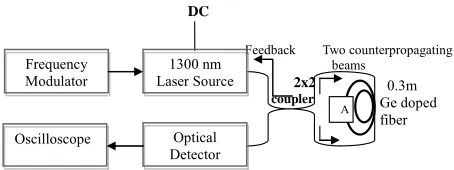
The schematic representation experimental setup of nonlinear dynamics based on NOLM feedback is shown in Figure 1. In this NOLM feedback system, an
Feedback Two counterpropagating beams 2x2 coupler 0.3m Ge doped fiber DC 1300 nm Laser Source Optical Detector Frequency Modulator Oscilloscope A
Figure 1. Experimental setup of a nonlinear dynamic based on NOLM.
wavelength at 1300 nm and threshold is 14 mA was used. The laser is DC biased with external modulation current source. The output power from the laser is connected to the first input part of 2 × 2 optical directional coupler. The two output parts of coupler are connected together through 1 m loop length and an optical attenuator (A). 30 cm from this loop is 20% Ge doped optical fiber with 10 µm core diameter. The Ge doped fiber is located in mid of loop as a nonlinear fiber to modified transmission properties of NOLM and generated high nonlinear dy-namic range with low critical power. The reflected light from coupler is split in two ways, one reflected as feed-back to the cavity of semiconductor laser and the other is detected and converted into an electrical signal with a fast amplified telecom photodiode. This electrical signal is observed in an oscilloscope. The controllable parame-ters of this optical feedback system are compose of the DC bias current, modulation current source whose modulated frequency changed, the feedback strength using Ge doped fiber and an attenuator, as shown in Fig-ure 2. The modulation current source provides periodic
timing slots to produce a regular pulse train, while nonlinear fiber shortens the pulse compared to that ex-pected from generator. By adjusting these parameters, the system could be operated in different dynamic states.
3. Results and Discussion
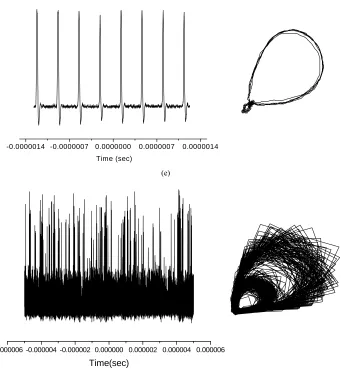
The characteristics of the states found in various dynamic NOLM feedback systems are plotted for time series on the left-hand side of Figures 2(a)-(e), and the phase
por-traits on the right-hand side of the figure. From these set of figures, the original periodic pulse, and its phase plane can be observed (Figure 2(a)). With high DC bias (100
mA) and large frequency modulation (50 MHz), 2× (100 MHz) and 4× (200 MHz) multiplications were observed (Figures 2(b) and (c)) respectively due to the
competi-tion between the effect of optical feedback and modula-tion frequency. The multiplicamodula-tion times as well as the loop frequency and loop harmonic are depends on the optical power propagate in loop and frequency modu-lated. As the loop frequencies are varied under strong modulation and high nonlinearity in loop, various fre-quency-locked pulsing states with 20 MHz repetition rate were observed (Figures 2(d) and (e)). Here, the pulsing
frequency of the laser locks to one of the harmonics of the delay loop frequency instead of the loop frequency itself. Chaotic behaviours as in Figure 2(f) were
ob-served in this setup between pulse multiplications and pulse mode locking. Weak chaotic signal was generated near laser threshold (14 mA) and strong chaotic signal was generated with strong feedback (–12 dBm) and high modulation frequency (100 MHz).
From the phase plane obtained, the original periodic pulse was stable node and the limit cycle around that vicinity was a stable limit cycle, whereas in 2×, 4× mul-tiplications and chaotic behavior, there is neither stable limit cycle nor stable node on the phase planes even with the ideal multiplication parameters. However, as the multiplication factor increases, the system trajectories moved away from the origin. Corresponding to the modu- lated frequency and fundamental cavity round-trip time, the laser operating in fundamental quasi-periodic as in (Figure 2(d)) and in a periodic as shown in (Figure 2(e))
mode-locking regime with only a single pulse circulating intracavity. The change from quasi-periodic to periodic mode-locking was due to more adjusting between modu-lated frequency and nonlinear phase shift generated in Ge fiber. The vicinity of quasi-periodic mode-locking was not stable cycle because the adjusting between modulated frequency and nonlinearity in Ge doped loop mirror was not high enough to generated uniform periodic mode- locking, other hand; higher stability in periodic mode- locking was result with more accuracy adjusting. In har-monic frequency locking pulse, the laser output was characterized using autocorrelator pulse duration meas-urements, as shown in Figure 3. The optimum output
characteristics in terms of both shortest pulse duration which is about 1 Psec and highest repetition rate were observed when the modulated frequency was higher [15]. These variations in the laser dynamics was due to the change of the modulated frequency and modulation cur-rent and their interplay with the nonlinear phase shift in Ge fiber. The intensity spikes correspond to ringing in the electronic system excited by the photodiode’s im-pulse response to a very short optical im-pulse.
4. Conclusion
In conclusion, the nonlinear dynamics of a semicon- ductor laser with nonlinear optical loop mirror feedback were investigated experimentally. The combined of mo- dulated frequency and managed effects of the nonlinear give rise to 2×, 4× multiplications, chaotic behaviours and sensitive to the repetition rate mode locking mecha-nism. This combined action of nonlinear effects inside Ge fiber acts similar to saturable absorber action and improving various features of the dynamic laser, such as increasing the side mode suppression and narrowing the
-1.80E-007-1.20E-007-6.00E-0080.00E+000 6.00E-008 1.20E-007 Time (sec)
(a)
-1.20E-007 -6.00E-008 0.00E+000 6.00E-008 1.20E-007 Time (sec)
(b)
-1.20E-007 -6.00E-008 0.00E+000 6.00E-008 1.20E-007
Time (sec)
(c)
-0.00000030 -0.00000015 0.00000000 0.00000015 0.00000030 Timme (sec)
-0.0000014 -0.0000007 0.0000000 0.0000007 0.0000014 Time (sec)
(e)
-0.000006 -0.000004 -0.000002 0.000000 0.000002 0.000004 0.000006
Time(sec)
(f)
Figure 2. (Left) Laser output power as a function of time, (Right) phase plane. (a) Original pulse; (b) 2× multiplication; (c) 4× multiplication; (d) Non periodic mode locking; (e) Periodic mode locking and (f) Chaotic behavior.
-6000 -4000 -2000 0 2000 4000 6000 0.0
0.5 1.0 1.5 2.0
Intensity
(Ac
count)
[image:4.595.132.476.79.450.2]Pulse duration (fsec)
Figure 3. Experimentally recorded autocorrelations laser pulses. The red line shows a fit to the expected hyperbolic secant quared. The full-width of this autocorrelation, obtained from the fit curves is 1 ps.
s
[image:4.595.161.437.500.707.2]5. Acknowledgements
This work was supported by both of Institute of Interna-tional Education/SRF and CARA.
REFERENCES
[1] J. Blakely, J. N. Illing and L. Gauthier, “High-Speed Chaos in an Optical Feedback System with Flexible Time- scales,” IEEE Quantum Electronics, Vol. 40, No. 3, 2004, pp. 299-305.
[2] S. Banerjee, P. Saha and A. R. Chowdhury, “Optically Injected Laser System: Characterization of Chaos, Bifur- cation, and Control,” American Institute of Physics Chaos,
Vol. 14, No. 2, 2004, pp. 347-357.
[3] L. Larger and J. M. Dudley, “Optoelectronic Chaos,”
Nature, Vol. 465, 2010, pp. 41-42.
[4] H. J. Kbashi, “RF Chaos Communication System Based on Optoelectronic Feedback,” Optoelectronics and Ad- vanced Materials—Rapid Communications Vol. 4, No. 8,
2010, pp. 1091-1094.
[5] F. Lin and J. Liu, “Nonlinear Dynamics of a Semicon- ductor Laser with Delayed Negative Optoelectronic Feed- back,” IEEE Journal of Quantum Electronics, Vol. 39,
No. 4, 2003, pp. 562-568.
[6] M. Lee, J. Paul, I. Pierce and K. A. Shore, “Fre- quency-Detuned Synchronization Switching in Chaotic DFB Laser Diodes,” IEEE Journal of Quantum Electron- ics, Vol. 41, No. 3, 2005, pp. 302-307.
[7] X. F. Li, W. Pan, B. Luo, D. Ma, N. H. Li and Y. Wang, “Suppressing Nonlinear Dynamics Induced by External Optical Feedback in Vertical-Cavity Surface-Emitting Lasers,” Optics and Laser Technology, Vol. 37, No. 6,
2005, pp. 438-443.
[8] J. P. Toomey, D. M. Kane, M. W. Lee and K. A. Shore, “Nonlinear Dynamics of Semiconductor Lasers with Feed-
back And Modulation,” Optics Express, Vol. 18, No. 16,
2010, pp. 16955-16972.doi:10.1364/OE.18.016955 [9] S. Bauer, O. Brox, J. Kreissl, B. Sartorius, M. Radziunas,
J. Sieber, H.-J. Wu¨nsche and F. Henneberger, “Nonlinear Dynamics of Semiconductor Lasers with Active Optical Feedback,” Physical Review E, Vol. 69, No. 1, 2004, Ar- ticle ID: 016206. doi:10.1103/PhysRevE.69.016206 [10] K. Spaulding, D. Yong, A. Kim and J. Kutz, “Nonlinear
Dynamics of Mode-Locking Optical Fiber Ring Lasers,”
Journal of the Optical Society of America B, Vol. 19, No.
5, 2002, pp. 1045-1054. doi:10.1364/JOSAB.19.001045 [11] Q. Xu and M. Yao, “Theoretical Analyses on Short-Term
Stability of Semiconductor Fiber Ring Lasers,” IEEE Jour- nal of Quantum Electronics, Vol. 39, No. 10, 2003, pp.
1260-1265.
[12] B. Ibarra-Escamilla, E. A. Kuzin, P. Zaca-Moran, R. Gra- jales-Couti, F. Mendez-Martinez, O. Pottiez, R. Rojas- Laguna and J. W. Haus, “Experimental Investigation of the Nonlinear Optical Loop Mirror with Twisted Fiber and Birefringence Bias,” Optics Express, Vol. 13, No. 26,
2005, pp. 10760-10767. doi:10.1364/OPEX.13.010760 [13] C. A. Merchant and A. L. Steele, “A Tunable Nonlinear
Optical Loop Mirror with Feedback Using Linear Highly Birefringent Fiber in the Loop,” Optics Communications,
Vol. 258, 2006, pp. 288-294. doi:10.1016/j.optcom.2005.08.004
[14] A. Karar, T. Smy and A. L. Steele, “Nonlinear Dynamics of a Passively Mode-Locked Fiber Laser Containing a Long-Period Fiber Grating,” IEEE Journal of Quantum Electronics, Vol. 44, No. 3, 2008, pp. 254-261, 288-294.
[15] H. J. Kbashi, “Additive Mode Locking Based on a Nonlinear Loop Mirror Ring Laser,” Quantum Electron- ics, Vol. 42, No. 3, 2012, pp. 216-219.