http://www.scirp.org/journal/jmmce ISSN Online: 2327-4085 ISSN Print: 2327-4077
DOI: 10.4236/jmmce.2017.56031 Nov. 22, 2017 374 J. Minerals and Materials Characterization and Engineering
Double SiC Oxidation Protective Coating on
C/C Composites Prepared by Spark
Plasma Sintering
Xianghong Zhang
1,2*, Changhu Yu
1, Lina Qiao
1, Beilong Zhao
1, Hao Huang
3, Hongxia Song
1,
Xiaochen Sheng
21Hebei Vocational & Technical College of Building Materials, Qinhuangdao, China
2Key Laboratory of Inorganic Coating Materials, Chinese Academy of Sciences, Shanghai, China
3State Key Laboratory of Metastable Materials Science & Technology, Yanshan University, Qinhuangdao, China
Abstract
Easy oxidation of carbon limits applications of carbon-carbon composites in an oxygen-containing environment. In this study, a two-layer SiC coating was prepared on carbon-carbon composites by a Spark plasma sintering technol-ogy at 1350˚C for 1 min. The coating was mainly composed of β-SiC and Si and well bonded with the substrate. The double SiC coating could effectively protect the C/C composites from oxidation at 1600˚C for 120 h, and the cor-responding weight loss was only 2.62%.
Keywords
Carbon-Carbon Composites, Spark Plasma Sintering, Anti-Oxidation, Coating
1. Introduction
Carbon/carbon (C/C) composites are promising materials used in aircraft and aerospace fields due to their excellent properties, such as high temperature strength, high thermal conductivity, low thermal expansion coefficient, good thermal shock and ablation resistance [1]. However, the oxidation of C/C com-posites above 723 K limits their applications in an oxygen-containing environ-ment [2] [3].
A silicon carbide (SiC) coating, which possesses an excellent oxidation resis-tance and good compatibility with C/C substrates, has attracted extensive atten-tion [4] [5] [6]. But, due to thermal expansion mismatch between SiC and C/C How to cite this paper: Zhang X.H., Yu,
C.H., Qiao, L.N., Zhao, B.L., Huang, H., Song, H.X. and Sheng, X.C. (2017) Double SiC Oxidation Protective Coating on C/C Composites Prepared by Spark Plasma Sintering. Journal of Minerals and Mate-rials Characterization and Engineering, 5, 374-384.
https://doi.org/10.4236/jmmce.2017.56031
Received: October 19, 2017 Accepted: November 19, 2017 Published: November 22, 2017
Copyright © 2017 by authors and Scientific Research Publishing Inc. This work is licensed under the Creative Commons Attribution International License (CC BY 4.0).
http://creativecommons.org/licenses/by/4.0/
DOI: 10.4236/jmmce.2017.56031 375 J. Minerals and Materials Characterization and Engineering composites, cracks are easily formed in the SiC coating, which could offer the path for oxygen to diffuse into the composites. Consequently, various multilayer coatings are explored, such as SiC/SiC [7] [8], mullite/SiC [9] [10], MoSi2/SiC [11], AlPO4/SiC [12], SiC-MoSi2-ZrB2/SiC [13]. Among them, double SiC coat-ing is considered as a good choice to protect C/C composites from oxidation be-cause of no thermal expansion mismatch between the outer layer and the inner layer.
Up to now, three methods, namely pack cementation, chemical vapor deposi-tion and slurry method, are mainly used to prepare coatings on C/C composites. Among them, pack cementation, which is usually used to offer a strong interface bonding between SiC coating and C/C composites, is needed to heat at 2173 - 2373 K for 2 - 4 h [13] [14] [15] [16]. Cracks will be formed inevitably in the coatings due to the mismatch of thermal expansion between the coatings and the composites. CVD can prepare the coatings at a lower preparation temperature but need to be provided a very long preparation time [17] [18] [19]. The draw-back of time-consumption also exists in slurry method [20] [21] [22]. In addi-tion, double coatings are needed to be prepared by two-step methods [7]-[22].
In this paper, we use a one-step technique, spark plasma sintering (SPS), to prepare rapidly a double SiC coating on C/C composites at 1350˚C for 1 min. To our knowledge, no literature has been published about using SPS technology to prepare muti-layer coatings on C/C composites. The microstructures and oxida-tion resistant of double SiC coating on C/C composites are investigated.
2. Experimental Procedure
C/C composites (Jiangnan Graphite Co., Ltd., Hunan, China) with a density of 1.70 g/cm3 were used as substrates, which were cut into small cylinder specimens (Φ 20 mm × 6 mm). The substrates were hand-grinded with 400, 600 and 1000 grit SiC paper, sequentially. Then they were cleaned ultrasonically in ethanol and dried at 100˚C for 1 h.
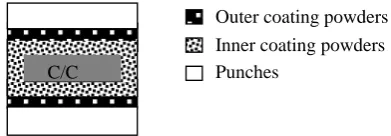
DOI: 10.4236/jmmce.2017.56031 376 J. Minerals and Materials Characterization and Engineering Figure 1. Schematic diagram of SPS for SiC/SiC coated C/C composites.
pared using Si and C powders. For comparison, C/C composites coated a single SiC layer with Si and graphic were prepared under the same conditions.
Surface and cross-section morphology of the coated composites were observed by scanning electron microscopy (SEM) using a KYKY2800 digital scanning electron microscope (Bejing, China). Crystalline structure of the coatings was measured by means of X-ray diffraction (XRD) using a D/Max-2500pc diffrac-tometer (Japan) equipped with a standard Cu-Ka radiation source employing a step size of 0.02˚ in 2θ.
Thermal behavior of double SiC coatings was analyzed using differential scanning calorimeter test and thermogravimetry (DSC-TG) complex thermal analysis with a NETZSCH differential scanning calorimeter (Model STA449C, Germany). The coatings were heated at 20˚C/min up to 1500˚C in flowing air.
To study the protection effects of double SiC coatings, the coated samples were placed in a furnace and oxidized at 1600˚C for different time with a heating rate of 10˚C/min. The weight of the coated samples was measured before and after the oxidation test, and the weight changes rate was determined according to Equation (1):
100 f i i m m M m −
∆ = × (1)
where mi is the initial weight (before the oxidation test) and mf is the final
weight (after the oxidation test). The morphologies and phase structures of the coated composites after the oxidation test were also examined by means of SEM and XRD, respectively.
3. Results and Discussions
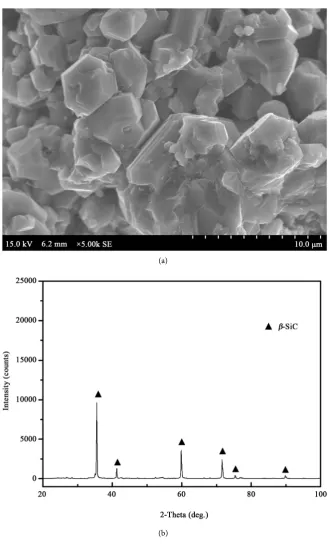
The surface SEM image and XRD pattern of SiC inner coating are shown in Figure 2(a) and Figure 2(b), respectively. As shown in Figure 2(a), SiC inner coating is dense with many good crystalline particles ranged from 3 to 6 μm. No visible holes and cracks are found in the coating. Moreover, as shown in Figure 2(b), only β-SiC could be detected in the inner coating, indicating that Si and C have reacted with each other at 1350˚C to form a SiC coating on the substrate. In addition, no Si and C are detected, meaning that they have been consumed com-pletely during SPS.
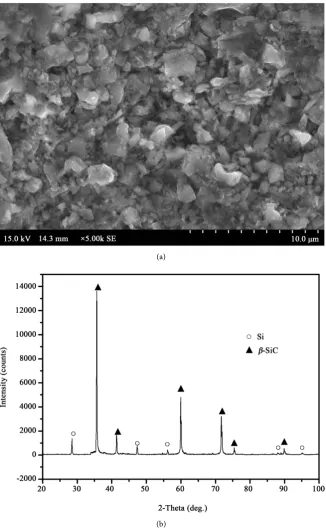
The surface SEM image and XRD pattern of SiC outer coating are shown in Figure 3(a) and Figure 3(b), respectively. The coating is dense and crack-free. From Figure 3(b), it can be found that the coating is composed of β-SiC and a
C/C
Inner coating powders Outer coating powders
DOI: 10.4236/jmmce.2017.56031 377 J. Minerals and Materials Characterization and Engineering (a)
[image:4.595.209.540.64.610.2](b)
Figure 2. SEM image (a) and XRD pattern (b) of SiC inner coating prepared at 1350˚C for 1 min.
DOI: 10.4236/jmmce.2017.56031 378 J. Minerals and Materials Characterization and Engineering (a)
[image:5.595.211.538.69.599.2](b)
Figure 3. SEM image (a) and XRD pattern (b) of SiC outer coating prepared at 1350˚C for 1 min.
DOI: 10.4236/jmmce.2017.56031 379 J. Minerals and Materials Characterization and Engineering (a)
[image:6.595.211.537.58.589.2](b)
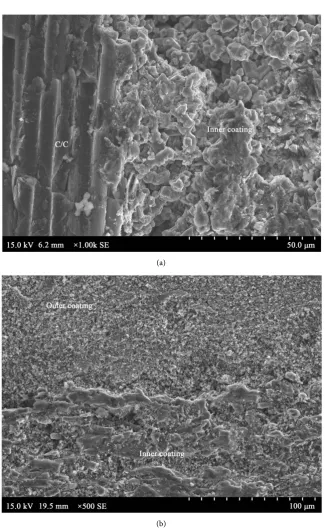
Figure 4. Cross-section SEM images of double SiC coating prepared at 1350˚C for 1 min: (a) between inner coating and substrate (b) between outer and inner coating.
DOI: 10.4236/jmmce.2017.56031 380 J. Minerals and Materials Characterization and Engineering Figure 5. TG-DSC curves of double SiC coating prepared by SPS at 1350˚C for 1 min: (a) TG; (b) DSC.
obtained due to the oxidation of SiC/Si. There is an endothermic reaction occur-ring at approximately 1418˚C in DSC curve. This endothermic effect is attri-buted to the melt of Si powder in SiC outer coating. Around 1500˚C, double SiC coating has a residual mass of 117.6 wt%.
Figure 6 shows oxidation curves of the coated C/C composite at 1600˚C in air. It can be seen that from Figure 6(a) that the weight of SiC coated C/C com-posites loses rapidly with oxidation time and reaches up to −8.0 wt% after oxida-tion only for 36 h, which indicates that SiC inner coating cannot protect C/C composites from oxidation effectively. As shown in Figure 6(b), SiC/SiC coating can effectively protect the substrate from oxidation and the oxidation process of SiC/SiC coated C/C composites can be divided into three stages. At the first 24 h, weight gains slowly due to the formation of SiO2 phase and the low oxygen per-meation constant. With the oxidation time increased, from 24 h to 72 h, weight change versus time stars to exhibit the trend of weight loss and the weight loss of 2.54% is detected after oxidation for 72 h, suggesting oxygen has passed through the double coating and eroded the substrate. Above 72 h, weight loses is almost constant, suggesting that oxidation enters a steady state, indicating the tunnel of oxygen diffusion has remedied by the vitreous SiO2 glass. When oxidation for 120 h, the weight loss of the double SiC coated composite is only 2.62%.
DOI: 10.4236/jmmce.2017.56031 381 J. Minerals and Materials Characterization and Engineering Figure 6. Oxidation curves of (a) SiC and (b) SiC/SiC coated C/C composite at 1600˚C in air.
(a) (b)
(c) (d)
[image:8.595.60.539.295.688.2]DOI: 10.4236/jmmce.2017.56031 382 J. Minerals and Materials Characterization and Engineering thermal expansion mismatch between SiC coating and the substrate, through which oxygen would diffuse into the substrate directly and cause severe oxida-tion. This is in good agreement with the result of Figure 6(a) and well explained why the protection of SiC coating was not desirable. For SiC/SiC coated C/C composite, when oxidation for 72 h, large amounts of fluid is formed because of the melted Si and the oxidation of SiC and Si, so the coating surface became much denser and smoother and the cracks are healed into narrow and shallow ones, which had little effect on the oxidation resistance of the coating, as shown in Figure 6(b). After oxidation at 1600˚C for 120 h, as shown in Figure 7(c) and Figure 7(d), the cracks are less and invisible resulting in a steady anti-oxidation ability of double SiC coating. It is worth mentioning that the coating surface be-come microscopically very rough due to volatilization of SiO2. The pores formed by the gas resultant remained in the coating, which greatly are disadvantageous to the oxidation resistance of the coating.
Figure 8 shows the XRD patterns of SiC/SiC coated composites after oxida-tion at 1600˚C in air for different time. After oxidaoxida-tion at 1600˚C for 24 h, the diffraction peaks are β-SiC, Si and SiO2. After oxidation at 1600˚C for 72 h, the diffraction peaks of Si disappeared and the intensity of SiO2 peaks become stronger due to the oxidation of Si. With the increase of oxidation time, the in-tensity of SiO2 peaks becomes stronger and stronger, while the intensity of SiC peaks gets weaker and weaker due to the oxidation of SiC. However, after oxida-tion at 1600˚C for 120 h, the intensity of SiC peaks is still strong, which indicates that the failures of the coating are mainly caused by cracks and oxygen diffusion.
DOI: 10.4236/jmmce.2017.56031 383 J. Minerals and Materials Characterization and Engineering
4. Conclusions
1) SPS is a promising method to prepare double SiC coatings on C/C compo-sites. The double SiC coating could be obtained by SPS at 1350˚C for 1 min.
2) The double coating is very dense and crack-free, composed of β-SiC and Si, and has a good bonding with the substrate.
3) The double SiC coating has good oxidation resistance and can protect C/C composites against oxidation at 1600˚C for 120 h with a weight loss of 2.62%. The failures of the coating are mainly caused by cracks and oxygen diffusion.
Acknowledgements
This work was supported by the Opening Project of Key Laboratory of Inorganic coating materials, Chinese Academy of Sciences, under grant No. KLICM-2014-06.
References
[1] Bacos, M.P. (1993) Carbon-Carbon Composites: Oxidation Behavior and Coatings Protection. Journal De Physique IV, 3, 1895-1899.
https://doi.org/10.1051/jp4:19937303
[2] Ren, J., Zhang, Y., Hu, H., Zhang, P., Fei, T. and Zhang, L. (2016) HfC Nanowires to Improve the Toughness and Oxidation Resistance of Si-Mo-Cr/SiC Coating for C/C Composites. Ceramics International, 42, 14518-14525.
https://doi.org/10.1016/j.ceramint.2016.06.064
[3] Zhang, Y.L., Huang, J.F., Zhu, K.J., Cao, L.Y., Li, C.Y., Zhou, L., Zhang, B.Y., Kong, W.H. and Zhang, B. (2015) Effects of Voltage on Microstructure and Oxidation Re-sistance of SiB6-MoSi2 Coating Deposited by Pulse Arc Discharge Deposition.
Ap-plied Surface Science, 304, 43-48. https://doi.org/10.1016/j.apsusc.2015.03.003 [4] Fu, Q.G., Xue, H., Wu, H., Li, H.J., Li, K.Z. and Tao, J. (2010) A Hot-Pressing
Reac-tion Technique for SiC Coating of Carbon/Carbon Composites. Ceramics Interna-tional, 36, 1463-1466. https://doi.org/10.1016/j.ceramint.2010.01.002
[5] Hao, W., Huang, J.F., Cao, L.Y., Yin, L.X., Wu, J.P., Fei, J., Huang, Y.C. and Yang, L.Q. (2013) An AlPO4-SiC-MoSi2/SiC Oxidation Protective Coating on
Car-bon/Carbon Composites by Pulse Arc Discharge Deposition. Ceramics Internation-al, 39, 9797-9801. https://doi.org/10.1016/j.ceramint.2013.05.052
[6] Chen, Z., Li, H., Li, K., Shen, Q. and Fu, Q. (2014) Influence of Grain Size on Wear Behavior of SiC Coating for Carbon/Carbon Composites at Elevated Temperatures. Materials & Design, 53, 412-418. https://doi.org/10.1016/j.matdes.2013.07.046 [7] Sun, C., Li, H., Fu, Q., Zhang, J. and Peng, H. (2013) Double SiC Coating on
Car-bon/Carbon Composites against Oxidation by a Two-Step Method. Transactions of Nonferrous Metals Society of China, 23, 2107-2112.
https://doi.org/10.1016/S1003-6326(13)62703-X
[8] Yang, X., Huang, Q., Su, Z., Chai, L., Wang, X. and Zhou, L. (2013) A Double Layer Nanostructure SiC Coating for Anti-Oxidation Protection of Carbon/Carbon Composites Prepared by Chemical Vapor Reaction and Chemical Vapor Deposi-tion. Ceramics International, 39, 3053-3062.
https://doi.org/10.1016/j.ceramint.2012.11.104
DOI: 10.4236/jmmce.2017.56031 384 J. Minerals and Materials Characterization and Engineering Technology, 29, 29-33. https://doi.org/10.1016/j.jmst.2012.11.001
[10] Wang, K.T., Cao, L.Y., Huang, J.F. and Fei, J. (2013) A Mullite/SiC Oxidation Pro-tective Coating for Carbon/Carbon Composites. Journal of the European Ceramic Society, 33, 191-198. https://doi.org/10.1016/j.jeurceramsoc.2012.08.009
[11] Shin, X.H., Ren, Y.C., Li, H.J., Li, T., Zhang, X., Huo, J.H. and Hu, X.J. (2014) LaB6
Modified MoSi2 Ceramic Coating of SiC Coated Carbon/Carbon Composites for
Oxidation Resistance at High Temperature. Ceramics International, 40, 6355-6358.
https://doi.org/10.1016/j.ceramint.2013.10.155
[12] Hao, W., Huang, J., Cao, L., Yin, L., Ouyang, H., Yang, L., Fei, J. and Zhang, Y. (2014) Oxidation Protective AlPO4 Coating for SiC Coated Carbon/Carbon
Com-posites for Application at 1773 K and 1873 K. Journal of Alloys and Compounds, 589, 153-156.
[13] Yao, X., Li, H., Zhang, Y. and Wang, Y. (2014) Oxidation and Mechanical Proper-ties of SiC/SiC-MoSi2-ZrB2 Coating for Carbon/Carbon Composites. Journal of
Materials Science and Technology, 30, 123-127.
https://doi.org/10.1016/j.ceramint.2013.10.155
[14] Ren, X., Lin, H., Chu, Y., Li, K. and Fun, Q. (2014) ZrB2-SiC Gradient Oxidation
Protective Coating for Carbon/Carbon Composites. Ceramics International, 40, 7171-7176.https://doi.org/10.1016/j.ceramint.2013.12.055
[15] Ren, X., Li, H., Fu, Q., Chu, Y. and Li, K. (2013) TaB2-SiC-Si Multiphase Oxidation
Protective Coating for SiC-Coated Carbon/Carbon Composites. Journal of the Eu-ropean Ceramic Society, 33, 2953-2959.
https://doi.org/10.1016/j.jeurceramsoc.2013.06.028
[16] Zou, X., Fu, Q., Liu, L., Li, H., Wang, Y., Yao, X. and He, Z. (2013) ZrB2-SiC
Coat-ing to Protect Carbon/Carbon Composites against Ablation. Surface and Coatings Technology, 226, 17-21.https://doi.org/10.1016/j.surfcoat.2013.03.027
[17] Long, Y., Javed, A., Shapiro, I., Chen, Z., Xiong, X. and Xiao, P. (2011) The Effect of Substrate Position on the Microstructure and Mechanical Properties of SiC Coatings on Carbon/Carbon Composites. Surface and Coatings Technology, 206, 568-574.
https://doi.org/10.1016/j.surfcoat.2011.07.087
[18] Zheng, G.B., Sano, H. and Uchiyama, Y. (2011) A Carbon Nanotube Enhanced SiC Coating for the Oxidation Protection of C/C Composite Materials. Composites Part B, 42, 2158-2162.https://doi.org/10.1016/j.compositesb.2011.05.012
[19] Wang, Y., Xiong, X., Li, G., Zhang, H., Chen, Z., Sun, W. and Zhao, X. (2012) Mi-crostructure and Ablation Behavior of Hafnium Carbide Coating for Carbon/Carbon Composites. Surface and Coatings Technology, 206, 2825-2832.
https://doi.org/10.1016/j.surfcoat.2011.12.001
[20] Zhang, Y.L., Li, H.J., Hu, Z.X., Ren, J.C. and Li, K.Z. (2013) Microstructure and Oxidation Resistance of Si-Mo-B Coating for C/SiC Coated Carbon/Carbon Com-posites. Corrosion Science, 72, 150-155.https://doi.org/10.1016/j.corsci.2013.03.015 [21] Zhang, Y., Li, H., Hu, Z., Li, K. and Zhang, L. (2013) C/SiC/MoSi2-SiC-Si Multilayer
Coating for Oxidation Protection of Carbon/Carbon Composites. Transactions of Nonferrous Metals Society of China, 23, 2118-2122.
https://doi.org/10.1016/S1003-6326(13)62705-3
[22] Zhang, Y.L., Li, H.J., Yao, X.Y., Li, K.Z. and Qiang, X.F. (2011) Oxidation Protec-tion of C/SiC Coated Carbon/Carbon Composites with Si-Mo Coating at High Temperature. Corrosion Science, 53, 2075-2079.