University of Warwick institutional repository:
http://go.warwick.ac.uk/wrap
A Thesis Submitted for the Degree of PhD at the University of Warwick
http://go.warwick.ac.uk/wrap/59167
This thesis is made available online and is protected by original copyright.
Please scroll down to view the document itself.
Cyclopalladated Metallomesogens
by
Donocadh Lydon.
A thesis submitted for the part requirement for the degree of
Doctor of Philosophy
Department of Chemistry
University
of
Warwick
Table of Contents.
List of Figures.
List of Tables.
Acknowledgements. Declaration. Summary. Abbreviations.
Chapter 1.
Section 1.1.1: Section 1.1.2: Section 1.1.3: Section 1.1.3.1: Section 1.1.3.2: Section 1.1.3.3: Section 1.1.3.4: Section 1.1.3.5: Section 1.1.3.6.1: Section 1.1.3.6.2: Section 1.1.4: Section 1.1.5.1: Section 1.1.5.2: Section 1.1.5.3: Section 1.1.5.4: Section 1.1.5.5:Table of Contents.
Introduction to Palladium and Platinum (II).
Co-ordination chemistry of divalent platinum group metals.
Bonding of ligand donors to M (II) metal centres.
Oxygen donors. Nitrogen donors. Sulfur donors. Phosphorus donors. Halide donors. Carbon donors.
Stability of carbon-palladium (II) and platinum (II) bonds.
Cisand trans influences and effects. Cyc1ometaliation.
Exo versus endo cyc1opalladation. Mechanism of cyc1opalladation.
Regiospecificity on cyc1opalladation.
Ligand exchange reactions.
page
Section
1.1.5.6:Aromaticity in cyclopalladated systems.
16Section
1.1.6:Summary.
18Section
1.2:References.
19Chapter2.
Section
2.1.1:Introduction to liquid crystals.
21Section
2.2.1:Calamitic mesophases.
22Section
2.2.1.1:The nematic phase.
22Section
2.2.1.2:The smectic A phase.
23Section
2.2.1.3:The smectic C phase.
23Section
2.2.1.4:The smectic B, F and I phases.
23Section
2.2.1.5:Crystal smectic phases.
24Section
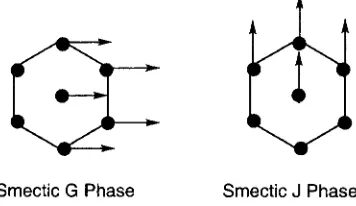
2.2.1.6:The smectic G and smectic
Jphases.
24Section
2.2.1.7:Chiral mesophases.
25Section
2.2.1.8:Molecular structure of calamitic mesophases.
26Section
2.2.2:Columnar meso gens.
27Section
2.2.2.1:Structure of columnar meso gens.
27Section
2.2.3:Future prospects for liquid crystal technology.
28Section
2.3.0:Introduction to metallomesogens.
28Section
2.3.1:Calami tic metallomesogens.
30Section
2.3.1.1:Group
6calamitic metallomesogens.
30Section
2.3.1.1.1:(1l6-arene)tricarbonyl chromium complexes.
30Section
2.3.1.2:Group
7calamitic metallomesogens.
31Section
2.3.1.2.1:Octahedral manganese (I) complexes.
31Section
2.3.1.2.2:Octahedral rhenium (I) complexes.
32Section
2.3.1.3:Group
8calamitic metallomesogens.
33Section
2.3.1.3.1:Iron tricarbonyl complexes.
34Section
2.3.1.3.2:Ferrocene based comp lexes.
34Section
2.3.1.4:Group
9calamitic metallomesogens.
38page
Section 2.3.1.4.1: Rhodium (III) complexes. 38
Section 2.3.1.4.2: Iridium (I) and rhodium (I) stilbazole complexes. 39
Section 2.3.1.5: Group 10 calamitic metallomesogens. 39
Section 2.3.1.5.1: Palladium (II) and platinum (II) co-ordination complexes. 39
Section 2.3.1.5.2.1: Group 10 metallocycle based complexes. 41
Section 2.3.1.5.2.2: Long chain carboxylato bridged metaUomesogens. 43
Section 2.3.1.5.2.3: Mixed bridged dimeric metallomesogens. 44
Section 2.3.1.5.2.4: Ortho-palladated azobenzene complexes. 45
Section 2.3.1.5.2.5: Perturbing symmetry of metallomesogens. 46
Section 2.3.1.5.2.6: Lateral-lateral fused meso gens. 47
Section 2.3.1.5.2.7: Cyclopalladated pyrimidine complexes. 48
Section 2.3.1.5.2.8: Palladium (II) cyclopentadienylide complexes. 50
Section 2.3.1.5.2.9: Chiral monomeric complexes. 51
Section 2.3.1.5.2.10: Chiral palladium (II) amino acid based complexes. 51
Section 2.3.1.5.2.11: Bridged dimeric chiral palladium (II) complexes. 52
Section 2.3.1.5.2.12: Bridged dimeric chiral platinum (II) complexes. 53
Section 2.3.1.5.2.13: Properties of metallomesogens with chiral terminal chains. 53
Section 2.3.1.6: Group 11 calamitic metallomesogens. 54
Section 2.3.1.6.1: Copper (II) complexes. 54
Section 2.3.1.6.2: Chiral paramagnetic complexes. 55
Section 2.3.1.6.3: Gold (I) acetylide complexes. 56
Section 2.3.1.6.4: Gold (I) carbene complexes. 57
Section 2.3.1.6.5: Gold (I) stilbazole complexes. 58
Section 2.3.1.7: Group 12 calamitic metallomesogens. 58
Section 2.3.1.7.1: Zinc (II) complexes. 59
Section 2.3.1.7.2: Mercury (II) complexes. 61
Section 2.3.2: Columnar metallomesogens. 61
Section 2.3.2.1: Group 4 columnar metallomesogens. 62
Section 2.3.2.1.1: Oxotitanium complexes. 62
page
Section 2.3.2.2: Group 6 columnar metallomesogens. 62
Section 2.3.2.2.1: Chromium (III) complexes. 62
Section 2.3.2.2.2: Molybdenum (IV) complexes. 63
Section 2.3.2.2.3: Tungsten-oxo (VI) complexes. 63
Section 2.3.2.3: Group 10 columnar metallomesogens. 64
Section 2.3.2.3.1: Palladium(lI) cyclometallated complexes. 64
Section 2.3.2.3.2: Chiral palladium (II) ~-diketonate complexes. 65
Section 2.3.2.4: Group 11 columnar metallomesogens. 66
Section 2.3.2.4.1: Copper (I) complexes. 67
Section 2.3.2.4.2: Copper (II) complexes. 67
Section 2.3.2.4.3: Gold (I) pyrazolate complexes. 68
Section 2.3.2.5: Group 12 columnar metallomesogens. 69
Section 2.3.2.5.1: Zinc (II) complexes. 69
Section 2.3.3: Polymeric metallomesogens. 71
Section 2.3.3.1: Main chain metallomesogenic polymers. 71
Section 2.3.3.2: Side chain metallomesogenic polymers. 72
Section 2.3.3.3: Spinal metallomesogenic polymers. 73
Section 2.3.3.4: Cross-linked metallomesogenic polymers. 74
Section 2.4: References. 75
Chapter 3.
Section 3.1:
Section 3.2:
Section 3.3:
Preparation of 4-alkoxy-N-( 4'-alkoxybiphenyl)benzylidenes. 79
Characterisation of 4-alkoxy- N-( 4'-alkoxybiphenyl)benzylidenes. 79
Preparation of palladium complexes of
4-alkoxy-N-(4'-Section 3.4:
alkoxybiphenyl)benzylidene ligands.
Characterisation of palladium complexes of
4-alkoxy-N-(4'-alkoxybiphenyl)benzylidene ligands.
Preparation of palladium cyclopentadienyl complexes of
4-alkyloxy- N-(4'-alkyloxybiphenyl)benzylidene.
80
81
Section 3.5:
83
Section 3.6: Section 3.7: Section 3.8: Chapter 4. Section 4.1.1: Section 4.1.2: Section 4.1.3: Section 4.1.4.0: Section 4.1.4.1: Section 4.1.4.1.1: Section 4.1.4.1.2: Section 4.1.4.1.3: Section 4.1.4.1.4:
. Section 4.1.5:
Section 4.1.5.1:
Section 4.1.5.2:
Section 4.2.1:
Section 4.2.2:
page
Characterisation of [palladium(cyclopentadienyl){
4-alkoxy- N-( 4'-alkoxybiphenyl)benzylidene }].
Conclusions.
References.
84
86
87
Discussion of terephthalylidene-bis-4-N-4' -alkyloxybenzylidenes. 88
Characterisation of
terephthalylidene-bis-4-N-4'-alkyloxybenzylidenes.
Cyclopalladation of
terephthalylidene-bis-4-N-4'-alkyloxybenzylidenes.
Discussion of monomeric trans palladium complexes of terephthalylidene-bis-4- N-4' -alkyloxybenzylidene (12-14).
88
92
94
Phase behaviour of dipalladated ~-diketonate complexes (12-14). 95
Group one. 96
98
100
102 Group two.
Group three.
Unsymmetrical ~-diketonate complexes.
Preparation ofcis dipalladated
terephthalylidene-bis-4-N-4'-alkyloxybenzylidenes acetylacetonate complexes (16). 103
Preparation of cis [dipalladium-bis(acetylacetonato) {terephthalylidene-bis-4- N-4' -alkyloxybenzylidene }] (16) via directed dicyclopalladation
method. 103
Acidolysis of trans [dipalladium-tu-chloro) {terephthalylidene-bis-4-N-4' -alkyloxybenzylidene }]: a potential pathway towards
cis [dipalladium-tu-chloro) {terephthalylidene-bis-4- N( 4'
-alkyloxybenzylidene }] via a ligand exchange mechanism.
Preparation of terephthalylidene-bis-N-( 4' -alkyloxybenzoate)
aniline.
Discussion of phase behaviour of
terephthalylidene-bis-N-(4'-104
104
Section 4.2.3:
Section 4.2.4:
Section 4.2.5:
Section 4.3.1:
Section 4.3.2:
Section 4.3.3:
Section 4.3.4:
page
104 alky1oxybenzoate )anilines.
Cyclopalladation of
terephtha1ylidene-bis-N-(4'-octy1oxybenzoate )anilines.
Preparation of [bis-palladium-bis(undecanedionato)
{terephthalylidene-bis- N-( 4' -decyloxybenzoate )aniline }]. 106 105
Phase behaviour of [bis-palladium-bisumdecanedionato)
{terephthalylidene-bis- N-( 4' -decyloxybenzoate )aniline }]. 106
Preparation of
bis(4-N-alkoxybenzylidene)-1,4-phenylenediamines.
Phase behaviour of bis( 4-
N-alkyloxybenzylidene)-l,4-phenylenediamines.
Preparation of
[bis-palladium-bis(acetylacetonato){bis(4-N-alkyloxybenzylidene )-1,4- phenylenediamine} ].
Characterisation of [bis- palladium-bis( acetylacetonato) {bis( 4-N-106
107
107
alkyloxybenzylidene )-1 ,4-p henylenediamine }]. 108
Section 4.4: Conclusions. 110
Section 4.5: References. 112
Chapter 5.
Section 5.1: Preparation of 3,6-bis(4' -alkyloxyphenyl)pyridazines. 113
Section 5.2: Characterisation of 3,6-bis( 4' -alkyloxyphenyl)pyridazines. 113
Section 5.3: Preparation of [palladiumtacetylacetonato)]
3,6-bis-(4' -alkyloxyphenyl)pyridazine}]. 114
Section 5.4: Characterisation of [palladium(acetylacetonato){
3,6-bis-(4' -alkyloxyphenyl)pyridazine}]. 115
Section 5.5: Preparation of [bis-palladium-bis(acetylacetonato){ 3,6-bis
(4'-alkoxyphenyl)pyridazine }]. 116
Section 5.6: Characterisation of [bis-palladium-bis(acetylacetonato){3,6-bis
(4'-alkoxyphenyl)pyridazine} ]. 117
Section 5.7: Section 5.8:
Chapter6.
Section 6.0: Section 6.1.1: Section 6.1.2: Section 6.1.3: Section 6.2.1: Section 6.2.2: Section 6.2.3: Section 6.3.1: Section 6.3.2: Section 6.4.1: Section 6.4.2: Section 6.5.1: page Conclusions. References. 117 119 General. 120Preparation and characterisation of
4-heptyloxy-N-(4'-heptyloxybiphenyl)benzylidene (3). 120
Preparation and characterisation of [palladium(acetylacetonato){
4-heptyloxy-N-(4' -heptyloxybiphenyl)benzylidene}] (5). 123
Preparation and characterisation of palladium(cyclopentadienyl){
4-heptyloxy-N-(4' -heptyloxybiphenyl)benzylidene}] (7). 125
Preparation and characterisation of
terephthalylidene-bis-4-N-4'-decyloxybenzylidene (10). 128
Preparation and characterisation of [bis-palladium-bis
(~-diketonato) {terephthalylidene-bis-4-decyloxybenzylidene }] (12),
(13), (14). 132
Preparation ofcis
[dipalladium-bis(acetylacetonato)-{terephthalylidene-bis-4-alkyloxybenzylidene}] (16). 138
Preparation and characterisation of
terephthalylidene-bis-4-n-(4'-alkyloxybenzoate)anilines (19). 139
Preparation of [bis-palladium-bis(acetylacetonato)
{terephthalylidene-bis-4-N-(4' -decyloxybenzoate)aniline}] (21). 142
Preparation and characterisation of
bis(4-N-alkyloxybenzylidene)-1,4-phenylenediamines (23). 145
Preparation of [bis-palladium-bis(acetylacetonato{ bis( 4-
N-decyloxybenzylidene) 1,4 phenylenediamine}] (25). 146
Preparation and characterisation of 3,6-bis(4' -alkoxyphenyl)
pyridazine (30). 148
page
Section 6.5.2: Preparation and characterisation of [palladium(acetylacetonato)
{3,6-bis(4' -alkoxyphenyl)pyridazine}] (30). 152
Preparation of and characterisation of
[bis-palladium-bis(acetylacetonato){ 3,6-bis( 4-decyloxyphenyl)pyridazine}] (34). 155
References. 157
Section 6.5.3:
Section 6.6:
Appendix 1: Liquid Crystal Phase Textures
158Appendix 2: Refereed Publications
162D.
P. Lydon
and J. P. Rourke, Di-cyclopalladated Schiff's base liquid crystals: Novelmetallomesogens. 1. Chem. Soc. Chem. Commun. (1997) 1741-1742.
D.
P. Lydon,
G. W. V. Cave and 1. P. Rourke, Cyclopalladated acac and cp liquid crystals: Acomparative study. 1. Mater. Chem., 7(1997) 403.
G W V Cave, D
P Lydon
andJ
P Rourke, Cyclopalladated Schiff's base liquid crystals: theeffect of the acac group on thermal behaviour. 1. Organomet. Chem., 1998,555,81.
Chapter 1.
Fig. 1.1: Fig. 1.2: Fig. 1.3: Fig. 1.4: Fig. 1.5: Fig. 1.6: Fig. 1.7: Fig. 1.8: Fig. 1.9: Fig. 1.10: Fig. 1.11: Fig. 1.12: Fig. 1.13: Fig. 1.14:List of Figures.
Stability of thio-bridged complexes to nucleophilic attack.
Exchange of bridging ligand due to class b properties of palladium.
18 electron Pt (II) 1t-cyclopentadienyl complex.
Energy level diagram of square planar Pd (II) or Pt (II) organometallic
complex.
Cyclometallation of azobenzene using palladium (II) and platinum (II).
Bonding modes for exo and endo palladocycles.
Cyclopalladation of bis(N-benzylidene )-1,4-phenyleneamines.
Highly ordered transition state for cyclopalladation of benzylidenes.
Step 1: Co-ordination of benzylidene to palladium acetate.
page
3
4
4 59
9
10 10 11Step 2: Activation of C-H bond leading to formation of metal carbon bond. 12
Co-ordination complex of palladium (II) with llLbenzylidenaniline.
Cyclopalladation of meta-fluorinated azobenzene.
Ligand exchange reaction from electron rich to electron deficient ring.
Intramolecular cyclopalladation exchange from an electron rich to an
electron deficient aromatic ring.
Fig. 1.15: Examples of enforced regioselectivity in cyclopalladation.
Fig. 1.16: Dicyclopalladated acetylacetonate complexes.
Fig. 1.17: Aromaticity in pallad acycles.
Chapter 2.
Fig. 2.1: Classification of liquid crystals.
Fig. 2.2: Schematic representation of nematic phase.
Fig.2.3: Variation in positional order gives rise to a variety of phases.
Fig. 2.4: Structure of smectic
I
and smecticF
phases.Fig.2.5: Structure of smectic G and smectic Jphases.
page
Fig. 2.6:
Phase behaviour of 4-(2' -methylbutyl)pheny14'
-n-octylbiphenyl-4-carboxylate.
25
Fig.2.7:
Fig.2.8:
Fig.2.9:
Helical twisting of director in cholesteric phase.
25
Schematic representation of molecular structure of calamitic liquid crystals.
26
Nematic discotic phase.
27
Fig.2.l0:
Molecular structure of a discotic mesogen.
Fig.2.ll:
Cis[MCl(COhL].
Fig.2.l2:
Mesogenic
(T\6-arene)tricarbonyl chromium complexes.
28
29
31
Fig.2.l3:
Liquid crystal complexes of octahedral manganese (I).
32
Fig.2.l4:
Octahedral liquid crystal complexes of 1,4-diazabutadienes with rhenium (I). 32
Fig. 2.15: Octahedral liquid crystal complexes of 2,2' -bipyridines with rhenium (I).
33
Fig.2.l6:
Tetrafluoro-substituted rhenium (I) complexes.
33
Fig. 2.17: Butadiene-irontricarbonyl metallomesogens.
34
Fig. 2.18: First example of ferrocene containing liquid crystals.
35
Fig.2.19:
Bis-(4-alkyloxy-4'-biphenyl)ferrocene 1, r-diesters.
35
Fig. 2.20:
1, 3 and 1, l' disubstituted ferrocenes.
36
Fig. 2.21:
1, l' disubstituted ferrocenes.
36
Fig.2.22:
1, l' -bis-(cholesteryloxycarbonyl)ferrocene derivative.
37
Fig. 2.23: Polysubstituted ferrocene derivatives.
38
Fig. 2.24: Polysubstituted ferrocene derivatives.
38
Fig.2.25:
Octahedral rhodium (ITI)metallomesogen.
39
Fig. 2.26: Iridium (I) and rhodium (I) metallomesogens.
39
Fig. 2.27: Palladium (II) cyanobiphenyl complexes.
40
Fig.2.28:
Platinum (IT)alkene mesogenic complexes.
40
Fig.2.29:
111 octa-alkyloxy substituted palladium (II) complexes.
41
Fig. 2.30: Dimeric
ortho-palladatedSchiff's base.
41
Fig. 2.31:
Cisand
transisomerism in dimeric acetato complexes.
42
Fig. 2.32: Favoured isomer in thiocyanato bridged complexes.
43
Fig.2.33:
Carboxylato bridged azine metal1omesogens.
43
page
Fig. 2.34: Dinuclear chloro-thiolato and acetato-thiolato bridged complexes.
44
Fig.2.35:
Chloro bridged cyclopalladated azobenzene dimer.
45
Fig. 2.36: Monomeric palladium (II) acetylacetonate metallomesogens.
47
Fig.2.37:
Transisomer of lateral-lateral fused complexes.
47
Fig.2.38:
Binuclear cyclopalladated cyclophanes.
48
Fig. 2.39: Cyclopalladated pyrimidine complexes.
49
Fig. 2.40: Cyclopalladated pyrimidine bipyridine complexes.
49
Fig. 2.41: Palladium bipyridine alkylsulfate metallomesogen.
49
Fig. 2.42: Phase behaviour of unsymmetrical ligand..
50
Fig. 2.43: Phase behaviour of half sandwich palladium (II) metallomesogen.
50
Fig. 2.44: Half sandwich metallomesogens.
51
Fig.2.45:
Phenyl alkyloxy substituted ~-diketonate with chiral terminal chain.
51
Fig. 2.46: Amino acid chelated cyclopalladated metallomesogens.
52
Fig. 2.47: Bridged dimeric chiral palladium (II) complexes.
53
Fig. 2.48: Chiral platinum metallomesogen exhibiting an optical storage effect.
53
Fig. 2.49: Copper (II) complexes of N-salicylideneaniline derivatives.
54
Fig. 2.50: Mesogenic copper (II) tropolone complexes.
55
Fig. 2.51: Paramagnetic chiral N-salicylicylideneaniline derivatives.
56
Fig. 2.52: (Isonitrile)gold (I) acetylide complexes.
57
Fig.2.53:
Gold (I) carbene metallomesogens.
57
Fig. 2.54: Isomers of gold (I) carbene complex.
58
Fig. 2.55: Gold (I) stilbazole complex.
58
Fig. 2.56: Calamitic Zn (II) complexes of 5,15-disubstituted porphyrins.
59
Fig.2.57:
Calamitic mesophases from Zn (II) complexes of
5,15-disubstituted porphyrins.
59
Fig.2.58:
Low melting calamitic mesophases from Zn (II) porphyrins.
60
Fig. 2.59: Low melting calamitic mesophases from polycatenar metalloporphyrins.
60
Fig. 2.60: The first organometallic liquid crystal: Mercury (II)
bis-4-(4'-alkyloxy)benzylidene.
61
page
Fig.2.61:
Ortho-cyc1ometal1atedmercury
(II)complex.
61
Fig. 2.62: Phthalocyaninatooxotitanium columnar liquid crystal.
62
Fig.2.63:
Chromium
(III)tris(1,3-diphenyl-l,3-propandionate) complexes.
63
Fig. 2 64: Molybdenum alkanoate liquid crystals.
63
Fig. 265:
Tungsten-oxocalix[4]arene liquid crystals.
64
Fig.2.66:
Tetranuc1earcyclopalladated columnar liquid crystals.
64
Fig. 2.67:
Transchiral ~-diketonate complexes exhibiting helical self-assembly.
65
Fig. 2.68: Copper
(I)metallohelicate columnar liquid crystal.
67
Fig. 2.69: d
9Copper
(II)discotic metallomesogen. '
68
Fig.2.70:
Columnar phases from bis(~,B-triketonato)copper(lI) complexes.
68
Fig.2.7l:
Trinuc1ear gold pyrazolate complexes.
69
Fig.2.72:
Columnar octaethanoporphyrin ether derivatives.
70
Fig.2.73:
Columnar octaethanoporphyrin ester derivatives.
71
Fig.2.74:
Meso genic cobalt
cyclopentadienyl cyclobutadieneacetylene co-polymer.
71
Fig. 2.75: Calamitic side chain liquid crystals on a poly(ferrocenylsilane)backbone.
72
Fig.2.76:
Cobalt phthalocyanine columnar liquid crystals.
73
Fig.2.77:
Oxystannyl polymeric phthalocyanine columnar liquid crystals.
73
Fig. 2.78: Polyazomethine cross-linked by co-ordination to copper
(II).74
Chapter
3.
Fig.3.l:
4-alkyloxy-N-(4'-alkyloxybiphenyl)benzylidenes.
79
80
80
Fig.3.2:
Fig.3.3:
Fig.3.4:
Phase diagram of 4-alkoxy-N-(4' -alkoxybiphenyl)benzylidene ligands.
[Palladium(ll-acetato){4-alkoxy-N-(4'-alkoxybiphenyl)benzylidene}].
[Palladium(acetylacetonato){4-heptyloxy-N-(4'-heptyloxybiphenyl)benzylidene }].
Fig.3.5:
Phase diagram of
[Palladium(acetylacetonato){4-Heptyloxy-N-(4'-81
heptyloxybiphenyl)benzylidene}].
Fig. 3.6:
Palladium(acetylacetonato){4-heptyloxy-N-(4'-heptyloxyphenyl)benzylidene }].
82
83
page
Fig. 3.7 [Palladium( cyclopentadienyl) {4-alkoxy- N-( 4'-alkoxybiphenyl)
benzylidene} ].
Fig. 3.8: Phase diagram of [Palladium(cyclopentadienyl){
4-alkoxy-N-(4'-alkoxybiphenyl)benzylidene} ].
Fig.3.9: Palladium cyclopentadienyl complexes prepared by Ghedini etal.
83
85
86
Chapter4.
Fig. 4.1: Terephthalylidene-bis-4-N-alkyloxybenzylidene.
Fig. 4.2: Phase diagram of terephthalylidene-bis-4-N-decyloxybenzylidene.
Fig.4.3: Monomeric dipalladated terephthalylidene-bis-4-N-alkyloxybenzylidene
88
90
acetylacetonate complexes . 93
Fig.4.4: Comparison of transition states for mono- and dipalladation. 94
Fig.4.5: Monomeric dipalladated acetylacetonate complexes. 95
Fig.4.6: Monomeric dipalladated ~-diketonate complexes. 95
Fig.4.7: Monomeric dipalladated ~-diketonate complexes. 96
Fig.4.8: Monomeric dipalladated ~-diketonate complexes. 96
Fig.4.9: Dipalladated acetylacetonate compelxes. 98
Fig.4.1O: ~-diketonate complexes with variable terminal chain length. 99
Fig.4.11: Variable ~-diketonate complexes. 101
Fig.4.12: Co-ordination of octane-2,4-dione yielding a mixture of isomers. 103
Fig.4.13: Cis
[dipalladium-bis(acetylacetonato){terephthalylidene-bis-4-N-alkyloxybenzylidene}] 103
Fig.4.14: Terephthalylidene-bis-N-( 4' -alkyloxybenzoate )anilines. 104
Fig.4.15: Phase diagram of terephthalylidene-bis-N-( 4' -octyloxybenzoate )anilines. 105
Fig.4.16: [Bis-palladium-bis(acetylacetonato) {terephthalylidenebis N( 4'
-decyloxybenzoate )aniline }]. 105
Fig.4.17:
[Bis-palladium-bis(undecanedionato){terephthalylidene-bis-N-(4'-decyloxybenzoate )aniline }]. 106
page
Fig.4.19:
Phase diagram of bis(4-N-alkyloxybenzylidene)1,4-phenylenediamines.
107
Fig. 4.20:
[Bis-palladium-bis(acetylacetonato){bis(4-N-alkyloxybenzylidene)
1,4-phenylenediamine}].
108
Fig.4.21:
Phase diagram of
[bis-palladium-bis(acetylacetonate){bis(4-N-alkyloxybenzylidene)-1,4-phenylenediamine }].
109
Chapter 5.
Fig. 5.1:
3,6-Bis(4' -alkyloxyphenyl)pyridazines.
113
Fig.5.2:
Phase diagram of 3,6-bis(4' -alkyloxyphenyl)pyridazine.
114
Fig. 5.3:
[Palladium(acetylacetonato){3,6-bis(4' -alkoxyphenyl)pyridazine}].
115
Fig. 5.4:
Phase diagram of [Palladium(acetylacetonato){3,6-bis
(4'-alkoxyphenyl)pyridazine }].
116
Fig.5.5:
[Bis-palladium-bis(f.l-acetato){3,6-bis(4'-decyloxyphenyl)pyridazine}].
116
Fig. 5.6:
[Bis-palladium-bis(acetylacetonato){ 3,6-bis(4' -alkoxyphenyl)pyridazine}].
117
List of Tables.
page
Chapterl.
Table 1.1:
Table 1.2:
Order of stability of final products for cyclopalladation in acetic acid.
Order of stability of final products for cyclopalladation in toluene.
10
11
Chapter 2.
Table 2.1: Thermal behaviour of acetylacetonate complexes. 46
Chapter
3.
Table 3.1: Phase behaviour of 4-alkoxy-N-(4' -alkoxybiphenyl)benzylidene. 79
Table 3.2: Phase behaviour of palladium acetylacetonate complexes. 81
Table 3.3: Phase behaviour of palladium cyclopentadienyl complexes. 84
Chapter4.
Table 4.1: Phase behaviour of terephthalylidene-bis-4-N-alkoxybenzylidene. 91
Table 4.2: Temperature, enthalpy and entropy transitions for group three
complexes. 101
Chapter S.
Table 5.1: Thermal analysis of 3,6-bis(4' -alkyloxyphenyl)pyridazine. 113
Chapter6.
Table 6.1: Microanalysis of 4-alkyloxy-N-( 4' -alkoxybiphenyl)benzylidene. 122
Table 6.2: Phase behaviour of 4-alkyloxy-N-(4' -alkoxybiphenyl)benzylidene. 123
Table 6.3: Microanalysis of series of palladium acetylacetonate complexes. 125
Table 6.4: Phase behaviour of palladium acetylacetonate complexes. 125
Table 6.5: Microanalysis of the series of palladium cyclopentadiene complexes. 127
Table 6.6: Phase behaviour of palladium cyclopentadiene complexes. 127
Table 6.7: Microanalysis of terephthalyli dene-bis-4- N-alkoxybenzylidene. 130
page
Table 6.9:
Microanalysis of [bis-palladium-bis(acetylacetonato)
{terephthalylidene-bis-4-N-(4' -alkyloxybenzylidene) }].
134
Table 6.10:
Phase behaviour of [bis-palladium-bis(acetylacetonato)
{terephthalylidene-bis-4-N-(4' -alkloxybenzylidene) }]
134
Table 6.11:
Microanalysis of B-diketone complexes.
137
Table 6.12:
Table 6.13:
Table 6.14:
Phase behaviour of B-diketone complexes.
Microanalysis of terephthalylidene-bis-d-N-(4' -alkoxybenzoate)aniline.
Phase behaviour of terephthalylidene-bis-4-N-(4'
-alkoxybenzoate)-aniline.
137
141
142
Table 6.15:
Phase behaviour of [bis-palladium-bis(undecanedionato){
terephthalylidene-bis-
4-N-(4'-decyloxybenzoate)aniline}].
145
Table 6.16:
Microanalysis of bis(4-N-alkoxybenzylidene)-1,4-phenylenediamine.
146
Table 6.17:
Phase behaviour of bis(4-N-alkoxybenzylidene)-1,4-phenylenediamine.
146
Table 6.18:
Microanalysis of
[bis-palladium-bis(acetylacetonato){bis(4-N-alkyloxybenzylidene)-1,4 phenylenediamine}].
148
Table 6.19:
Phase behaviour of
[bis-palladium-bis(acetylacetonato){bis(4-N-alkyloxybenzylidene)-1,4 phenylenediamine}].
148
Table 6.20:
Microanalysis of series of 3,6-bis(alkoxyphenyl)pyridazines.
152
Table 6.21:
Phase behaviour of 3,6-bis(alkoxyphenyl)pyridazines.
152
Table 6.22:
Microanalysis of series of
[palladium(acetylacetonato){3,6-bis(4-alkyloxyphenyl)pyridazine}].
154
Table 6.23:
Thermal analysis of series of
[palladium(acetylacetonato){3,6-bis(4-alkyloxyphenyl)pyridazine}].
154
Table 6.24:
Microanalysis of
[bis-palladium(acetylacetonato){3,6-bis(4-decyloxyphenyl)pyridazine }].
156
Table 6.25:
Phase behaviour of
[bis-palladium(acetylacetonato){3,6-bis(4-decyloxyphenyl)pyridazine }].
156
Acknowledgements.
I would like to acknowledge the assistance of the following, over the past three years:
Dr. Jonathan Rourke for his advice, help and the use of his research facilities; Mr. Gareth
Cave for preparation of the ~-diketone ligands his help
in
the laboratory; Warwick AnalyticalServices for elemental analysis and The University of Warwick for funding.
Declaration.
The work described in this thesis is my own work with the exception of the preparation of the
~-diketonate ligands undecane-5,7-dione, pentanedecane-7,9-dione and
nonadecane-9,10-dione, which were prepared by Mr. Gareth Cave.
Some of the material has been accepted for publication with the following references:
D. P. Lydon and 1. P. Rourke, Di-cyclopalladated Schiff's base liquid crystals: Novel
metallomesogens. J. Chem. Soc. Chem. Commun. (1997) 1741-1742.
D. P. Lydon, G. W. V. Cave and J. P. Rourke, Cyclopalladated acac and cp liquid crystals: A
comparative study. J. Mater. Chern., 7(1997) 403.
G W V Cave, D P Lydon andJP Rourke, Cyclopalladated Schiff's base liquid crystals: the
effect of the acac group on thermal behaviour. J. Organomet. Chem., 1998,555,81.
D. P. Lydon and J. P. Rourke, Homo- and hetero-bimetallic liquid crystals. Abstract papers
of the American Chemical Society, 1998, Vol. 215, No.Ptl, pp.470-INOR.
D. P. Lydon (BSc., MSc.).
Summary.
This thesis
describes
the synthesis
and characterisation
of novel cyclopalladated
metallomesogens from four principal N-functionalised mesogenic ligands:(i)
4-alkyloxy-N-(4' -alkyloxybiphenyl)benzylidene,
(H) terephthalylidene-bis-4-N-4' -alkyloxybenzylidene,
(iii)
bis( 4-alkoxybenzylidene-l
,4-phenylenediamine
and
(iv)
3,
6
bis-(alkyloxyphenyl)pyridazine).
The ligands have been studied to determine their liquid crystalline behaviour and the phase
behaviour is reported for the terephthalylidene-bis-4-N-4' -alkyloxybenzylidene series and for
the 3, 6 bis-(alkyloxyphenyl)pyridazine series since no comprehensive study of either system
has been reported in the literature.
The co-ordination chemistry of these ligands is reported.
The regiospecificity of the
cyc1opalladation reaction for the terephthalylidene-bis-4-N-4' -alkyloxybenzylidene and 3, 6
bis(alkyloxyphenyl)pyridazine series has been established and the influence of the primary
cyc1opalladation step on secondary cyc1opalladationhas been examined.
The co-ligands acetylacetonate, undecane-5,7 -dione, pentandecane-7,9-dione,
nonadecane-9,1O-dione, 2,2,6,6 tetra-methyl-heptane-3,5-dione
and cyclopentadienylide
have been
employed to enable elaboration of the geometry of the organopalladium complexes giving
A
br
Abbreviations.
angstrom (10-10 m)
broad
CD circular dichroism
d doublet
DSC differential scanning calorimetry
Et ethyl
m multiplet
Me
methylNMR nuclear magnetic resonance
p.p.m. parts per million
q quartet
s singlet
t triplet
8
chemical shiftChapter 1
Section 1.1.1: Introduction to palladium and platinum (II).
Platinum and palladium (II) species are favoured for a variety of reasons for the synthesis of
metallomesogenic materials. In the first part of this chapter the chemistry of these metal
species is discussed as a background to the physical and chemical properties of which arise in
palladium and platinum metallomesogens. In particular, the formation and structural
properties of palladium metallocycles are discussed in detail. The topics discussed are listed
below:
1 Co-ordination chemistry of divalent platinum group metals.
2 Trends in bonding of platinum and palladium (II) to donor ligands.
3 Cis and trans influences and effects. 4 Cyclopalladation.
5 Trends in cyclopalladation for benzylidene systems.
6 Mechanism of cyclopalladation for benzylidene systems.
7 Regiospecificity of cyclopalladation reaction.
8 Structure of palladocycles benzylidene systems versus benzylamine type systems.
9 Summary.
Section 1.1.2: Co-ordination chemistry of divalent platinum group metals.
The divalent (d8) oxidation state is common to the three platinum group metals and has
produced a vast number of complexes. Nickel (II) principally forms octahedral and square
planar complexes, though examples of trigonal bipyramidal and square pyramidal complexes
are also known. Trends for the formation of square planar, octahedral and tetrahedral
geometries are known to change going down the group.
Four co-ordinate complexes are the most popular species formed by the divalent Pd and Pt
ions. The vast majority of these complexes have square planar geometries or distortions of
this geometry. The complexation of palladium (II) and platinum (II) has a more dramatic
effect in splitting its d orbitals than for nickel (II), as complexes of these second and third row
metals in this oxidation state generally have a square planar geometry and they are less likely
to dissociate than other divalent metal ions.' Competition between square planar, octahedral
and tetrahedral geometries occurs for nickel (II) with the prevailing structure for a given
complex depending on the steric requirements and field strength of the donor ligands. The
major factor which determines which of the three geometries is observed is whether it is more
energetically favourable for the d orbitals to have all their electrons paired thus leading the
square planar geometry, or to have two electrons occupying two d orbitals singly (in two
degenerate orbitals), forming the octahedral or tetrahedral geometries.I The eighteen electron
rule is normally used to gauge the stability of organometallic compounds. However square
planar complexes of the platinum group have an electron count of sixteen and are quite stable.
Examples of eighteen electron palladium (II) systems do exist and they have a trigonal
bipyramidal geometry.
Section 1.1.3: Bonding of ligand donors to M(II) metal centres.
Section 1.1.3.1: Oxygen donors.
The lone pairs on oxygen donor ligands do not form strong bonds with platinum (II) or
palladium (II) and complexes formed from unidentate ligands of this type easily undergo
substitution reactions. Stabilisation of oxygen donor ligands can be brought about by using
bidentate ligands containing two oxygen donor ligands. This strategy is particularly effective
in the formation of five and six membered rings. The affinity of these ligands for the class b
platinum (II) and palladium (II) metal centres is augmented by a favourable entropy change
when the complex forms. The presence of another donor heteroatom such as sulfur or
nitrogen increases the affinity of the bidentate ligand further due to stronger binding. Ifthe
bidendate ligand contains two different donor atoms, geometrical isomerism is theoretically
possible but one of these complexes may be excluded by the preferential formation of the
other as a result of the trans effect.
Section 1.1.3.2: Nitrogen donors.
Nitrogen donor ligands form strong a-bonds with palladium (II) and also form complexes by
1t-back bondin~, as in the case of the CN- ligand.
Section 1.1.3.3: Sulfur donors.
Sulfur ligands such as RSH and R2S form strong co-ordinate bonds with platinum (II) and
palladium (11).3 This is a consequence of two factors: the ability of the sulfur atom to
generate a large induced dipole moment, in conjunction with its permanent dipole moment
will increase its co-ordinating ability; these platinum (II) and palladium (II) bonds to sulfur
are also strengthened by the rt-back-bonding from the metal to the vacant low lying d orbitals
on the sulfur atom. While halogen bridged complexes of platinum (II) and palladium (II) are
readily cleaved by monodenate ligands such as pyridine and triphenylphosphine, the
corresponding thio-bridged complexes are stable to attack from these nucleophiles. Note also
that the thio-bridged product is
cis
for palladium (II) andtrans
for the platinum (II) speciesdue to isomerisation of the palladium spccics.v"
Cl,
,Cl. ,
PPr3 Pd Pd,
,
',
Pr3P Cl Cl
Et8H
Et I Cl, /8, ,Cl
Pd Pd
,
,/ 'Pr3P 8 PPr3 I
Et
PPh3
No reaction
Cl,
,Cl. ~
PPr3 Pd Pd,
,
.
,
Pr3P Cl ClPPh3 Cl, ,Cl
Pd ~
,
Pr3P PPh3Fig. 1.1: Stability of thio-bridged complexes to nucleophilic attack.
Section 1.1.3.4: Phosphorus donors.
Platinum (II) and palladium (II) bonds to phosphorus are formed by a-donation of a lone pair
of electrons to a vacant orbital on the metal and rt-back-bonding from the metal to the
phosphorus atom. Lower members of this group also form co-ordination complexes with
palladium (II) and platinum (II), although there is some doubt over whether n-back-bonding
effects become more or less important on descending the group. This is because the size of
the d orbitals increase on going down the group, increasing overlap with the d orbitals of the
metal atom, while electronegativity also decreases, reducing the tendency for rt-back-bonding
to occur. It is likely that these two effects cancel each other out leading to similar bond order
throughout the series.7,8
Section 1.1.3.5: Halide donors.
As mentioned "above platinum (II) and palladium (II) are soft acids or class b metal centres,
since they have relatively full d orbitals and are less electropositive metal species, preferring
to form complexes with elements of high atomic number in a given group such as phosphorus
following order enabling heavy members of the group to displace lighter ones."
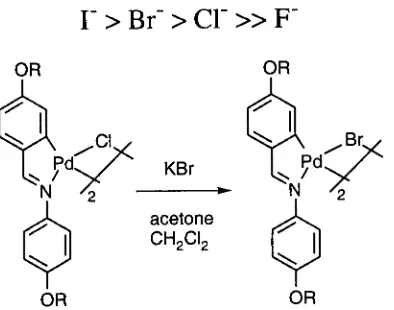
r
>
Br-
>
er
»
p-Fig. 1.2: Exchange of bridging ligand due to class b properties of palladium.
These metal centres form their most stable complexes with ligands which have vacant
rt-orbitals which can engage in n-back-bonding with the metal.
Section 1.1.3.6.1: Carbon donors.
Palladium forms both rt-bonds and a-bonds with carbon. rr-Cyclopentadienyl complexes can
be formed from sodium or thallium cyclopentadienides.l" These are eighteen electron
systems where the cyclopentadienyl group has a hapticity of five. Complexes of this kind
containing halogen ligands are the most stable, which is as a result of the electron
withdrawing effect of this electronegative group on the electron rich eighteen electron
complex. Their proton NMR spectra exhibit a single proton resonance in the range of
83.71-5.40 down field from TMS. The thermal stability of the complexes increases in the order of
Ni < Pd <Pt.
Pt
OC/ 'I
Fig. 1.3: 18 electron Pt (II) n-cyclopentadienyl complex.
Palladium (II) and platinum (II) are known to form a-bonds with both aryl and alkyl carbon
atoms. Indeed these metals form a large group of organometallic complexes more stable than
any other of the transition metals. II The orbitals involved in the metal-alkyl a-bonds arise from the interaction of the filled sp3 orbital on the alkyl carbon atom with the sPxPydx2_y2
orbitals on the metal; some back donation from the metal to alkyl carbon atom also takes
place. The metal-carbon a-bond for aryl complexes is formed by the sp2 orbital on the
[image:26.536.200.397.50.205.2]carbon atom with the empty spxPydx2-y2 orbitals on the metal atom. The formation of
1t-bonds also takes place due to the overlap of the filled Pn-orbitals of the aryl ligand with empty
orbitals on the metal and 1t-back-bonding from the filled orbitals of the metal to empty
Pn*-orbitals of the aryl ligand. The aryl complexes are generally more stable than the alkyl
complexes due to the stronger 1t-back-bonding effects.12,13
>-CD cc UJz
UJ e"u ,'=', ,.
I' '.
.
III '
a 19 ..
····
all19 '. ....--.-..
.
" ,.." " '. \,
__.2._ '::.-.... b'2g \ '.
~'.. ,,....--....'. '.
'. " e'u -; :- '.
\.
•
a,:::S,'\::::::::::' ::. }
Ligandn
,'. .. " "" acceptor orbitalss ' 1 " ...
~ " " '. '. ...b2g ", ' , "~,"
,
'. "
't,'..,..---:-- ..-...__ .._ ..\--, ---,' -t--
''. " \ ,f ... ".... b19"', '. '. ,,' Metal{d ,( .. -:
=<.,..."'" \/\
..', ' jE orbitals -. "~:-""._. /"," "\~, ,-,'
...
" ,' ,","" ...,... .. ~ ..----,,-, ..--
-'--",,~..~ '. -, e9 " \ ...\
',~.... .. ,' ,,,' '. ... \ ,..
".'::::,
1>;;'
\,\~~
}
\ \, 't... ,If'. '. eu
"-:.
",
,,- ..
,=
Ligand er'. .\ '\ ,f',\ donor orbitals
'. \\\, ... a'19 ;"f ,,' '. aig
'- \', ~ ,,' "f ,,~
'. '. "b ,,' "
'.
.
'..
\\~" " ",
. .
, , ' ,, ,, ,, '' ,,.
.
', 1 "
, '\ I "
· .
· .
· .
·
·
.
.
'. '. 9u ,t'
\l~'
,"
.
.
,'. a'9,'
Fig.1.4: Energy level diagram of square planar Pd (II) or Pt (II) organometallic
complex.
Section 1.1.3.6.2: Stability of carbon-palladium
(II) and platinum (II) bonds.
The stability of metal complexes is often discussed in terms of the tendency to undergo
reactions brought about by the influence of thermal, oxidative, hydrolytic or solvolytic
factors.14,15 Carbon bonds to palladium (II) are less stable to these factors than carbon bonds
an important factor in the stability of the complex. It is more meaningful to discuss the
stability of these complexes in terms of kinetics and thermodynamics. By heating these
complexes, the a-bonds undergo homolytic thermolysis, therefore the thermodynamic
stability of these complexes depends on the relative energies of the metal-carbon a-bond, the
carbon-carbon bond and the carbon-hydrogen bond. Since it is known that the
thermodynamic stability of the metal-carbon bond is 251 klmol+, that of the carbon-carbon
bond 347 klmol! and that of the carbon-hydrogen bond 364 klmol! the stability of the
metal-carbon a-bond is probably kinetic. This is exemplified by the thermal decomposition
of the complex [(PEt3hPd(CH3hl which yields ethane and ethene as the major products, with
only a small quantity of methane. This suggests that the complex decomposes by a
mechanism involving the breaking of carbon-phosphorus and carbon-hydrogen a-bonds
rather than palladium (Ilj-carbon o-bonds.V Metal-carbon a-bonds decompose to give
reactive products such as free radicals, or possibly a carbanion. This is an irreversible
process, therefore the formation of stable compounds suggests that the metal-carbon a-bond
must have a high activation energy towards decomposition. The homolytic dissociation of the
bond can come about by the promotion of an electron from the filled metal-carbon bonding
orbital to the lowest unfilled orbital or by the promotion of an electron from the highest filled
orbital to the metal carbon anti bonding orbital, depending on which transition requires less
energy. Therefore, to maximise the kinetic stability, these energy transitions should be as
large as possible. The distance between the HOMO and LUMO orbitals is always greater for
a square planar complex in which there is a-bonding and rt-back-bonding than in the case
where there is simply a-bonding. Complexes of the platinum group metals show the highest
stability with the order increasing from Nill < Pd II< PtII.16,17 This is due to the crystal field
stabilisation energy increasing in the same order,
i.e.
the energy gap between the HOMO'sand LUMO's gets larger as the metals get heavier. The stability of aryl groups over alkyl
groups forming metal carbon a-bonds is due to the ability of this class of ligand to engage in
n-back-bonding with the metal. This in turn increases the crystal field stabilisation energy of
the complex or increases the energy gap between the HOMO and LUMO of the complex.
Section 1.1.4: Cis and trans influences and effects.
The properties of platinum (II) and palladium (II) four co-ordinate square planar complexes
are known to be sensitive to the polarisability and geometrical distribution of the ligands
bonded to the metal centre. Selectivity in reactivity has been observed for certain ligands in
specific co-ordination environments.l'' Trends in the structure of the complexes have also
been observed by diffraction methods and vibrational and NMR spectroscopies.l These
trends arise because of the interaction of the donor electrons of a given ligand with the metal
centre through a-bonding and possibly n-back-bonding from the metal. Itis important to note
that this interaction occurs between every ligand in the complex and the metal centre.
Therefore the influence of the bonding characteristics of each ligand is felt by every other
ligand in the complex and this influence is mediated through the metal centre. These
interactions are generally referred to as the cis and trans effects and influences.
Cis and trans influences are terms applied when discussing the ground state properties of a complex and cis or trans effects are used to describe the kinetic and thermodynamic behaviour of a complex with respect to the interaction of the ligands concerned through the
metal centre. The reaction mechanism is the major influence on the kinetics of these
complexes and therefore factors relating to the structure of its transition state are important.
As a result the cis or trans influence which was present in the ground state may not correlate strongly with the cis or trans effect of the transition state. Itis recognised that no absolute series for the trans or cis effect has been obtained (as the order is always dependent on the technique used to gauge the magnitude of the effect), depending on the mode of bonding for
each of the ligands involved and whether the structure of the transition state resembles the
complex in the ground state.
However, there are some trends which generally re-occur. The origin of these effects is
fundamentally due to the bonding interactions which take place in the complex. A ligand
which is highly polarisable can lose electron density through the a-bonds to the ligand trans
to it, weakening this bond and hence influencing the ground state properties of the bond.
between the two states. This theory is consistent with the observation that the more
polarisable the metal, the stronger the trans effect, i.e.the trans effect at softer platinum (II) is greater than at the harder palladium (II).
A consequence of the trans effect is that soft ligands only bond cis to each other since the
trans conformation is unstable: dialkyls of Au (Ill), and platinum (II) are always cis and a ligand such as ethylene makes the trans position of [Pt(C2H4)CI3]- susceptible to attack by hard ligands. 19,20
The trans effect is very important in the preparation of specific isomeric forms of platinum (II) square planar complexes. However it is less useful for the preparation of palladium (II)
complexes, due to greater lability of these species.1,g,19,21
Section 1.1.5.1: Cyclometallation.
Transition metals have been used regularly in the preparation of molecular and
supramolecular materials because of the intermolecular interactions which can take place with
these materials giving rise to desirable physical properties. Modification of the structures can
be brought about by altering the transition metal or ligand used. Simple co-ordination
chemistry suffers from the disadvantage of not always being completely selective towards the
formation of the desired complex and secondly some complexes are quite labile leading to the
formation of other structures by further reaction. The kinetic stability of the metal-carbon
bond formed by cyc1ometallation reactions using platinum (II) and palladium (II) metal
centres is a means to overcome this difficulty, generating kinetically stable molecular and
supramolecular structures. This reaction allows the formation of species which will occupy
just two of the co-ordination sites of the metal, leaving remaining sites vacant for further
elaboration of the molecular structnre.F
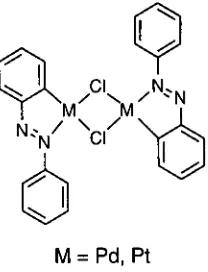
The first examples of cyclometallation using platinum (II) and palladium (II) were reported in
1965 by A. C. Cope.23 He described a complex containing a covalent bond between a
platinum (II) species and azobenzene. He also proved the metal was bonded at the
ortho-position in the phenyl group of the azobenzene. Sodium tetrachloropalladate (II) was also
found to react with azobenzene, but at a much faster rate forming the desired product in 95%
yield in 2 hours at room temperature.P
M
=
Pd, PtFig.1.5: Cyclometallation of azobenzene using palladium (II) and platinum (II).
This marked the beginning of intense research into trends in cyclometallation reactions of
platinum (II) and palladium (II) species due to potential applications in organic synthesis.I"
enantiomeric excess determination.P as carcinostatic agents-" and novel metallomesogens.F
Cyclopalladation reactions have successfully been carried out in solvents such as toluene,28
methanol-? or acetic acid30 using either palladium acetate or sodium (or potassium)
tetrachloropalladate (II) as a source of palladium (II).
Section 1.1.5.2:
Exo
versusendo
cyclopalladation.The cyclopalladation reaction has been widely applied to ligands such as azobenzenes,
benzylidenanilines and N,N-dimethyl benzylamine derivatives due to ability of these ligands
to donate a lone pair from nitrogen and subsequently bring about intramolecular C-H
[image:31.536.243.347.34.170.2]activation. The formation of a five membered endo metallocycle is the most favoured product in the cyclopalladation reaction. However, examples exist where exo metallocyc1es occur and where activation of aliphatic C-H bonds leads to more unusual metallocycles.
Fig. 1.6: Bonding modes for
exo
andendo
palladacycles.The table below ranks the order of stability of the final products of a given cyclometallation
Rank Rin SIze Nature of activated C-H bond Class of Palladoc cle
1 5 member Aromatic endo
2 6 member Aliphatic endo
3 5 member Aromatic exo
4 5 member Aliphatic exo
5 4 membered Aromatic/Aliphatic endo/exo
Table 1.1: Order of stability of final products for cyclopalladation in acetic acid.
An example of the selectivity of the cyclopalladation reaction towards five membered endo
palladocycles is with the ligand bis(N-benzylidene)-1,4-phenylenediamine and palladium
acetate in toluene, where five membered endo palladocycles have been produced. This leads to monopalladation of two different phenyl rings at either end of the molecule and shows the
endo form to be the most favoured class of metallocycle for benzylidenes when undergoing the cyclopalladation reaction.'! There is no dicylopalladation on the central ring observed as
this would have required the formation of stable four membered exo metallocyc1es which studies have shown to be less favourable than the observed five membered endo species.
x
R R CH3COO
X
* ~\
R - Pd R
/N-o-N~~
1 '\
RR Pd
I
-CH3COQ
Y
-1'
R RFig.1.7: Cyclopalladation of bis(N-benzylidene)-1.4-phenylenediamine.
Results of studies in acetic acid show that cyclopalladation is thought to proceed through a
highly ordered four centre transition state arising from the (Pd-acetato) and C-H bonds. The
reaction is thought to be enhanced by the presence of protons, as the leaving group CH3C02H
is thought to accept a proton forming CH3C02H2+.30
~N/
~----
P.d-o 0 "
o 0
H----·O
>-,0
H
Fig.l.8: Highly ordered transition state for cyclopalladation of benzylidenes.
The order of selectivity of the cyclopalladation reaction is slightly different when using
toluene as a solvent. This is thought to be because the reaction proceeds via the same highly
ordered four membered transition state, but in this case the reaction is influenced by sterically
bulky groups, thus making the formation of the transition state difficult. This can hinder the
activation of a given C-H bond forcing the formation of an alternative metallocycle*. No 5
membered aliphatic endo metallocycles are observed.i''
Rank Ring size Nature of activated C-H bond Class of Palladocycle
1 5 member Aromatic endo
2 5 member Aliphatic exo*
3 6 member Aliphatic exo
4 4 member Aromatic exo
Table 1.2: Order of stability of final products for cyclopalladation in toluene.
Section 1.1.5.3: Mechanism of cyclopalladation.
Two steps are involved in the formation of the metallocycle.
1) The co-ordination of the imine to palladium acetate. This step is considered to be the fast
step for the reaction and is not detectable.
9
N +
6
Fig. 1.9: Step 1: Co-ordination of benzylidene to palladium acetate.
2) The C-H activation leading to formation of the cyclopalladated product. This is the rate
limiting step of the reaction and kinetic studies have been carried out to probe the transition
state of the cyclopalladation reaction in acetic acid. It has been concluded on the basis of the
thermal activation parameter and activation volumes that the transition state is highly ordered.
These findings are supported by a crystal structure of the intermediates of the cyclopalladation
Fig. 1.10: Step 2: Activation of C-H bond leading to formation of metal carbon bond.
Itis interesting to compare the conditions for cyc1opalladation of benzylidenanilines with the
reaction conditions for simple co-ordination of a benzylidenaniline ligand with palladium
dichloride bis-benzonitrile. A simple ligand exchange reaction occurs when the
benzylidenaniline and the palladium dichloride bis-benzonitrile are stirred in hexane.V This
is because the non-polar nature of hexane does not facilitate the reaction.
RO
Ro"2
~I
~ N
A
ROY OR
OR
Ro~RO
~I~
OR71
Y
Pd(PhCNhCI2 ~
9
1/Nn-Hexane
X~'
&OR
ROY RO
OR
Fig. 1.11: Co-ordination complex of palladium (II) with YJ1.benzylidenaniline.
Section 1.1.5.4: Regiospecificity on cyclopalladation.
The cyclopalladation of ligands such as azobenzenes, benzylidenanilines and
N,N-dimethylbenzylamine derivatives is due to the ability of the lone pair from nitrogen to
co-ordinate to the metal centre and subsequently bring about intramolecular C-H activation.
Mechanistic studies on the cyclopalladation reaction have shown that the palladium acts an
electrophile when methanol is used as a solvent, undergoing electrophilic aromatic
substitution reactions.I" Palladium (II) dichloride reacts with unsymmetrical azobenzene
derivatives by attacking the aromatic ring with the greater electron density. In further studies
Cope compared the reactions ofpara-methoxy and 3,5 dimethoxy-N,N-dimethylbenzylamine with lithium tetrachloropalladate (II) in methanol. This was found to give the
di-u-chloro-bis-(amine)dipaUadium (II) ortho-palladated complexes in good yield. However, the
N,N-dimethylbenzylamine gave only a simple co-ordination complex and it was concluded
that palladium (II) was a weak electrophile since in did not interact with the
para-nitro-N,N-dimethylbenzylamine (a deactivated electron deficient aromatic system) due to the
withdrawing effect of the para-nitro group.I? A study of the electrophilic substitution of palladium (II) with meta-fluorinated azobenzene species shows selectivity towards the more negative positions on the aromatic ring when the cyclopalladation reaction is carried out in
methanol.
Yield% 80 20 <1
A B
c
Fig. 1.12: Cyclopalladation ofmeta-fluorinated azobenzene.
As expected the substantial product is the complex with ortho-palladation to the non-fluorinated ring. Ortho-palladation does occur on the fluorine substituted ring at the position
para to the fluorine atom, as this is the position most favoured towards electrophilic attack on the fluorinated ring. However, there is only a trace amount of the third possible product C,
since this is strongly deactivated towards electrophilic substitution due to the presence of the
fluorine atom in the meta position relative to the carbon-nitrogen bond.33
Section 1.1.5.5: Ligand exchange reactions.
Selective cyclopalladation of aromatic rings with electron withdrawing substituents is
possible by employing an alternative strategy: C-Pd activation.34-36 The activation of the
C-Pd bond occurs in the presence of acetic acid, facilitating a ligand exchange reaction whereby
new a cyclopalladated system is formed from another N-donor ligand present in the reaction
Me, "Me Et, ,Et Et, ,Et Me, "Me
&
Pd'N,
71
+QN
C6H6, AcOH~N'
Py
i"CY +6
N
2 1 -.;;::: 50°C 1 -.;;::: 2 ~ 1
h h ~
[image:36.536.157.412.305.607.2]N02 N02
Fig. 1.13: Ligand exchange reaction from electron rich to electron deficient ring.
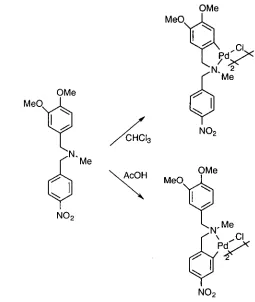
Itis interesting to note that altering reaction conditions (i.e. the presence or absence of acetic
acid) for the cyc1opalladation of a ligand can bring about cyc1opalladation at either an electron
rich or an electron deficient aromatic ring in the same ligand. Transfer of the Pd-C bond from
the electron rich aromatic ring to the electron deficient ring is also possible by heating the
electron rich metallocycle in acetic acid. This suggests that if a cyclopalladation reaction is
carried out in acetic acid, then the palladium (II) species is not behaving as an electrophile.
OMe
MeoiC(1-';;:::
h
6
N'Me
1 ~
~H
Fig. 1.14: Intramolecular cyclopalladation exchange from an electron rich to an electron deficient aromatic ring.
A mechanism for this ligand exchange reaction has been put forward-" suggesting that ligand
exchange occurs due to acidolysis of the initial cyclopalladated species in acetic acid. This
proceeds by cleavage of the Pd-N bond followed by protonolysis of the Pd-C bond. The
liberated palladium species proceeds to react with the electron deficient aromatic system. The
newly formed electron deficient palladocycle is less likely to undergo acidolysis and therefore
equilibration of the system favours the formation of the electron deficient metallocycle.
Selectivity in the cyclopalladation reaction has been demonstrated by the previous example
whereby the pathway of the cylcometallation reaction has been dictated by the reaction
conditions used in conjunction with the directing effect that various aromatic substituents
have on the route towards cyclopalladation. This has been defined as Regulated
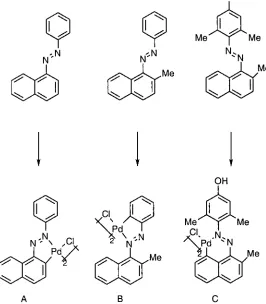
Cyclopalladation.F Selectivity can also be brought about to give the desired geometry by
employing an alternative strategy: Enforced Cyclopalladation.V .
Q
,Nc6
J
AJ
,("'pd,v
){2 \ ,N
~Me ~ B OH
A
MeYMe N,ro
Me'NI
::::-..J
OHA
MeYMe Cl, N,J\.
ro
'Pd· 'N ~MeI
::::-..
[image:37.536.161.427.243.547.2]C
Fig. 1.15: Examples of Enforced Regioselectivity in cyclopalladation.
The position of cyclopalladation of a ligand is determined by the reactivity of various C-H
bonds on the ligand which have the potential to be activated and subsequently undergo
cyclopalladation. Selectivity using this approach relies on having a bias where one of the
potential C-H bonds is strongly influenced by the presence of a strongly electron donating
Cis Trans
Fig. 1.16: Dicyclopalladated acetylacetonate complexes.
Trofimenko has prepared isomeric 1,3-diketonato complexes from the N,N,N' ,N'
-tetraethyl-p-xylene-a,a' -diamine by reaction with sodium tetrachloropalladate as a source of palladium
(II). The cis compound is of particular interest because the acetylacetonate rings are in a twisted conformation, giving rise to a chiral centre in the molecule. However, formation of
the kinetic trans isomer is favoured over the thermodyamically favoured cis isomer. A desirable synthetic goal would therefore be to create conditions where the cis geometry could be achieved more efficiently.P'
Section 1.1.5.6: Aromaticity in cyclopalladated systems.
Palladium (II) bonds with a square planar geometry when forming metallocycles. This tends
to produce planar structures, particularly when the metallocyc1e formed is a five membered
endo metallocyc1e. A sp2 hybridised nitrogen atom as the N donor site is thought to enhance the formation of a five membered endo metallocycle as this system may be aromatic in nature. This is because it is a planar 4n+2 n-electron system (four electrons form the two n-orbitals
from two conjugated double bonds in the ligand and a contribution of two n-electrons from a
Pd orbital via n back-bonding achieves the required number of electrons delocalised in a
planar ring).
B
Pd---A
Fig. 1.17: Aromaticity inpalladocycles.
The aromatic character of five membered palladocycles and how this is dependant on its
geometry has been studied Ghendini and Crispini.l? They have used aromaticity indices
developed for organic five and six membered heterocycles to estimate the bond order in
cyclopalladated rings. By comparing values of Pd-C and Pd-N for single and "double" bonds
(those involving a lot of n back-bonding) ideal values for single and double bonds were
found. Pd-C and Pd-N single bond distances were found to be 2.10
A
in both cases while Pd-C and Pd-N "double" bond distances were found to be 1.90A
each. They studied apopulation of structures examined in the Cambridge Structural Database which had its
statistical distribution centred around palladocycles that had essentially a planar geometry.
The study showed that a positive correlation exists between the deviation from planarity of a
palladocyc1e and reduction in aromatic character.
The planarity of five membered palladocycles is related to the hybridisation of the nitrogen
atom. Itis notable that all the imine based metallocycles have near planar configurations and
aromatic Pd-C bond distances. Itis also generally the case that endo metallocyc1es are almost always formed instead of exo palladocycles and the Pd-C bond length is comparable with aromatic bond lengths. The greatest deviation from planarity are seen for metallocycles with
a sp3 hybridised nitrogen atom, where the nitrogen forms three single covalent bonds to other
substituents and is also co-ordinated to the palladium bond.
The length of the Pd-N bond seems to dictate the degree of aromatic character in the
palladocycle. Longer Pd-N bonds have weaker Pd-N n bond interactions and consequently
reduced aromaticity and reduced planarity. A key factor influencing the length of the Pd-N
bond is the ligand trans to it. Most palladocycles with reduced aromatic character have trans
to the Pd-N bond, a Pd-P or Pd-S bond and generally the greater the n-acceptor ability of this
ligand, the weaker the Pd-N n-bond.l?
The aromatic character in 5 member palladocyc1es may account for the difference in reactivity
of various complexes of this type. When rt-back-bonding occurs to a large extent and the
cyclometallated system has a high degree of aromatic character, this system is likely to be
very stable and unlikely to undergo further reaction under mild conditions. A cyclopalladated
system where there is little rt-back-bonding, is more likely to undergo further reaction. This
high stability is desirable in a material which has applications in molecular electronics, while
a more reactive palladocycle is desirable as an intermediate towards a target molecule.
A cyclopalladated system designed to be used as a metallomesogen is likely to benefit from
enhanced intermolecular interactions. Therefore aromaticity and planarity in the molecular
structure are key factors to be addressed in the design of these molecules. It is highly
desirable to use a ligand which enhances the charge and shape anisotropy of the molecule,
hence it is not surprising that many of the metallomesogenic systems are based on
palladocyc1es with sp2 hybridised nitrogen donor ligands adjacent to a phenyl ring, capable of
forming five membered endo palladocyc1es which have a high degree of aromatic character.
Section 1.1.6: Summary.
Palladium and platinum (II) have been demonstrated to be suitable as platforms from which
new metallomesogens can be developed. This is due to their propensity to bond in square
planar based geometries - conferring planar structures on molecules - and forming extended
linear systems giving molecules with enhanced shape anisotropy. The attachment of
palladocyc1es to aromatic systems extends the planar surface and conjugation of a given
molecule while increasing the polarisability of the delocalised core.
The ability of these metals to form stable bonds with variety of donor ligands has given rise to
a wide variety of structural motifs from which many new materials can be developed. The
facility to attach a ligand which confers specific properties on the molecule increases the
scope for tailoring a molecule to the needs of a given application. Moreover, control of the
molecular structure of the material is possible by regiospecific bonding between the metal
centre and ligands achieved by the application of regulated cyc1opaUadation and enforced
cyclopalladation strategies and through use of cis and trans bonding patterns around the metal.
The above considerations have been applied to prepare novel mesomorphic materials which
are detailed in the following chapters.