159
Texar: A Modularized, Versatile, and Extensible Toolkit
for Text Generation
Zhiting Hu∗, Haoran Shi, Bowen Tan, Wentao Wang, Zichao Yang,
Tiancheng Zhao, Junxian He, Lianhui Qin, Di Wang, Xuezhe Ma, Zhengzhong Liu, Xiaodan Liang, Wangrong Zhu, Devendra Singh Sachan, Eric P. Xing
Carnegie Mellon University, Petuum Inc.
Abstract
We introduce Texar, an open-source toolkit
aiming to support the broad set oftext
genera-tiontasks that transform any inputs into natural
language, such as machine translation, sum-marization, dialog, content manipulation, and so forth. With the design goals of modularity, versatility, and extensibility in mind, Texar ex-tracts common patterns underlying the diverse tasks and methodologies, creates a library of highly reusable modules and functionalities, and allows arbitrary model architectures and algorithmic paradigms. In Texar, model archi-tecture, inference, and learning processes are properly decomposed. Modules at a high con-cept level can be freely assembled or plugged in/swapped out. Texar is thus particularly suit-able for researchers and practitioners to do
fast prototyping and experimentation. The
versatile toolkit also fosters technique sharing across different text generation tasks. Texar supports both TensorFlow and PyTorch, and is
released under Apache License 2.0 athttps:
//www.texar.io.1
1 Introduction
Text generation spans a broad set of natural lan-guage processing tasks that aim to generate nat-ural language from input data or machine repre-sentations. Such tasks include machine transla-tion (Brown et al., 1990;Bahdanau et al.,2014), dialog systems (Williams and Young, 2007; Ser-ban et al.,2016;Tang et al.,2019), text summa-rization (Hovy and Lin, 1998), text paraphrasing and manipulation (Madnani and Dorr, 2010;Hu et al., 2017;Lin et al.,2019), and more. Recent years have seen rapid progress of this active area, in part due to the integration of modern deep learn-ing approaches in many of the tasks. On the other hand, considerable research efforts are still needed
1An expanded version of the tech report can be found at
https://arxiv.org/abs/1809.00794
in order to improve techniques and enable real-world applications.
A few remarkable open-source toolkits have been developed (section2) which largely focus on one or a few specific tasks or algorithms. Emerg-ing new applications and approaches instead are often developed by individual teams in a more ad-hoc manner, which can easily result in hard-to-maintain custom code and duplicated efforts.
The variety of text generation tasks indeed have many common properties and share a set of key underlying techniques, such as neural encoder-decoders (Sutskever et al.,2014), attentions ( Bah-danau et al., 2014; Luong et al., 2015; Vaswani et al.,2017), memory networks (Sukhbaatar et al.,
2015), adversarial methods (Goodfellow et al.,
2014; Lamb et al., 2016), reinforcement learn-ing (Ranzato et al.,2015;Tan et al.,2018), struc-tured supervision (Hu et al., 2018; Yang et al.,
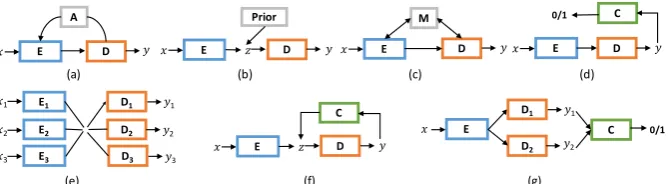
2018), as well as optimization techniques, data pre-processing and result post-processing, evalu-ations, etc. These techniques are often combined together in various ways to tackle different prob-lems. Figure 1 summarizes examples of various model architectures.
It is therefore highly desirable to have an open-source platform that unifies the development of the diverse yet closely-related applications, backed with clean and consistent implementations of the core algorithms. Such a platform would enable reuse of common components; standardize de-sign, implementation, and experimentation; foster reproducibility; and importantly, encourage tech-nique sharing among tasks so that an algorithmic advance developed for a specific task can quickly be evaluated and generalized to many others.
E D A
𝑥 𝑦 E D
Prior
𝑥 𝑧 𝑦 E D
M
𝑥 𝑦
C
E D
𝑥 𝑧 𝑦
E D
𝑥 𝑦
C
0/1
E1
E2
E3
D1
D2
D3
𝑦1
𝑦2
𝑦3
𝑥1
𝑥2
𝑥3
𝑥 E
D1
D2
C 𝑦1
𝑦2
0/1
(a) (b) (c) (d)
[image:2.595.132.467.64.156.2](e) (f) (g)
Figure 1: Examples of model architectures in recent text generation literatures (E: encoder,D: decoder,C:
clas-sifier). (a): The canonical encoder-decoder, sometimes with attentions A (Sutskever et al., 2014; Bahdanau
et al.,2014;Vaswani et al.,2017) or copy mechanisms (Gu et al.,2016;Vinyals et al.,2015). (b): Variational
encoder-decoder (Bowman et al.,2015). (c): Augmenting with external memory (Sukhbaatar et al.,2015). (d):
Adversarial model using a binary discriminatorC, w/ or w/o reinforcement learning (Zhang et al.,2017;Yu et al.,
2017). (e): Multi-task learning with multiple encoders/decoders (Luong et al.,2016). (f): Augmenting with
cyclic loss (Hu et al.,2017).(g): Adversarial alignment, either on samplesyor hidden states (Lamb et al.,2016).
flexible framework for building their models. Texar has two versions, building upon TensorFlow
(tensorflow.org) and PyTorch (pytorch.
org), respectively, with the same uniform design.
Underlying the core of Texar’s design is prin-cipled anatomy of extensive text generation mod-els and learning algorithms, which subsumes the diverse cases in Figures 1 and beyond, enabling a unified formulation and consistent implementa-tion. Texar emphasizes three key properties:
Versatility. Texar contains a wide range of
features and functionalities for 1) arbitrary model architectures as a combination of encoders, de-coders, embedders, discriminators, memories, and many other modules; and 2) different model-ing and learnmodel-ing paradigms such as sequence-to-sequence, probabilistic models, adversarial meth-ods, and reinforcement learning. Based on these, both workhorse and cutting-edge solutions to the broad spectrum of text generation tasks are either already included or can be easily constructed.
Modularity. Users can construct models at a
high conceptual level just like assembling build-ing blocks. It is convenient to plug in or swap out modules, configure rich module options, or even switch between distinct modeling paradigms. For example, switching from adversarial learning to reinforcement learning involves only minimal code changes (e.g., Figure 4). Modularity makes Texar particularly suitable for fast prototyping and experimentation.
Extensibility. The toolkit provides interfaces
ranging from simple configuration files to full li-brary APIs. Users of different needs and expertise are free to choose different interfaces for appro-priate programmability and internal accessibility. The library APIs are fully compatible with the
na-tive TensorFlow/PyTorch interfaces, which allows seamless integration of user-customized modules, and enables the toolkit to take advantage of the vi-brant open-source community by effortlessly im-porting any external components as needed.
Furthermore, Texar emphasizes on well-structured code, clean documentation, rich tutorial examples, and distributed GPU training.
2 Related Work
There exist several toolkits that focus on one or a few specific tasks. For neural machine transla-tion and alike, there are Tensor2Tensor (Vaswani
et al., 2018) on TensorFlow, OpenNMT (Klein
et al., 2017) on PyTorch, Nematus (Sennrich
et al., 2017) on Theano, MarianNMT ( Junczys-Dowmunt et al.,2018) on C++, etc. ParlAI (Miller et al.,2017) is a specialized platform for dialogue. Differing from the task-focusing tools, Texar aims to cover as many text generation tasks as possible. The goal of versatility poses unique design chal-lenges.
On the other end of the spectrum, there are libraries for more general NLP or ML applica-tions: AllenNLP (allennlp.org), GluonNLP
(gluon-nlp.mxnet.io) and others are
de-signed for the broad NLP tasks in general, while Keras (keras.io) is for high conceptual-level programming without specific task focuses. In comparison, Texar has a proper focus on the text generation sub-area, and provide a comprehensive set of modules and functionalities that are well-tailored and readily-usable for relevant tasks. For example, Texar provides rich text docoder
Applications
Model templates + Config files
Evaluation
Models Data
Decoder
Prediction Training
Library APIs
Architectures Losses
Embedder Classifier
Memory
. . .
(Seq) MaxLikelihood Adversarial
Rewards Regularize
MonoText PairedText
Dialog Numerical
Trainer
Optimizer
Seq/Episodic RL Agent
lr decay / grad clip / ... Encoder
Connector Policy QNet RL-related Multi-field/type Parallel
. . . . . .
Executor
. . .
stack
learning inferencedecoding architecturedecoder
Maximum likelihood Adversarial Reinforcement Reward-augmented
…
Teacher-forcing Sample Greedy Beam-search Gumbel-softmax
Top-k sample …
Basic RNN Attention RNN
Transformer …
[image:3.595.81.520.75.198.2]called as subroutines provide uniform interfaces
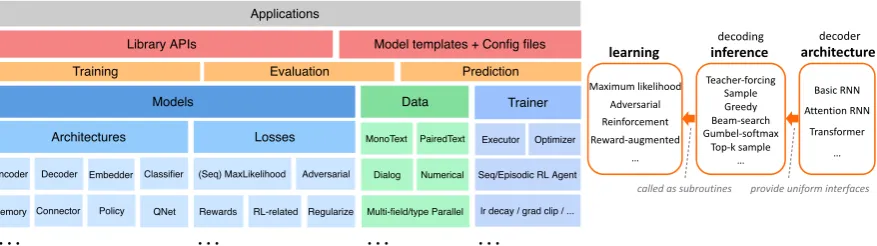
Figure 2:Left:The stack of main modules and functionalities in Texar.Right:The learning-inference-architecture
anatomy, taking decoder for example. A sequence decoder can have an arbitrary architecture; all architectures expose uniform interfaces for specifying one of the tens of inference (decoding) strategies to generate samples or infer probabilities; a learning procedure repeated calls specified inference procedure during training.
3 Structure and Design
Figure2, left panel, shows the stack of main mod-ules and functionalities in Texar. In the following, we first present the design principles (sec 3.1) of the toolkit, and then describe the detailed structure of Texar with running examples to demonstrate the key properties (sec3.2-3.4).
3.1 The Design of Texar
Designing a versatile toolkit is challenging due to the large variety of text generation tasks and fast-growing new models. We tackle the challenges by adopting principled anatomy of the modeling and experimentation pipeline. Specifically, we break down the complexity of rich tasks into three dimensions of variations, namely, varying data types/formats, arbitrary combinational model ar-chitectures and inference procedures, and diverse learning algorithms. Within the unified abstrac-tion, all learning paradigms are each specifying one or multiple loss functions (e.g., cross-entropy loss, policy gradient loss), along with an optimiza-tion procedure that improves the losses:
minθL(fθ, D) (1)
wherefθis the model that defines the model archi-tecture and the inference procedure;Dis the data; Lis the learning objectives (losses); andmin de-notes the optimization procedure. Note that the above can have multiple losses imposed on differ-ent model parts (e.g., adversarial learning).
Further, as illustrated in Figure 2 right panel, we decouple learning, inference, and model archi-tecture, forming abstraction layers oflearning –
inference – architecture. That is, different
ar-chitectures implement the same set of inference
procedures and provide the same interfaces, so that learning algorithms can call proper inference procedures as subroutines while staying agnos-tic to the underlying architecture and implemen-tation details. For example, maximum likelihood learning uses teacher-forcing decoding (Mikolov et al., 2010); a policy gradient algorithm can in-voke stochastic or greedy decoding (Ranzato et al.,
2015); and adversarial learning can use either stochastic decoding for policy gradient-based up-dates (Yu et al., 2017) or Gumbel-softmax repa-rameterized decoding (Jang et al.,2016) for direct gradient back-propagation. Users can switch be-tween different learning algorithms for the same model, by simply specifying the corresponding in-ference strategy and plugging into a new learning module, without adapting the model architecture (see section3.3for a running example).
3.2 Assemble Arbitrary Model Architectures
We develop an extensive set of frequently-used modules (e.g., various encoders, decoders,
embedders, classifiers, etc). Crucially,
Texar allows free concatenation between these modules in order to assemble arbitrary model ar-chitectures. Such concatenation can be done by directly interfacing two modules, or through an intermediate connector module that provides general functionalities of reshaping, reparameteri-zation, sampling, and others.
exam-1 # Read data
2 dataset =PairedTextData(data_hparams) 3 batch =DataIterator(dataset).get_next() 4
5 # Encode
6 embedder =WordEmbedder(dataset.vocab.size,hparams=embedder_hparams) 7 encoder = TransformerEncoder(hparams=encoder_hparams)
8 enc_outputs = encoder(embedder(batch['source_text_ids']),
9 batch['source_length']) 10
11 # Decode
12 decoder =AttentionRNNDecoder(memory=enc_outputs, 13 hparams=decoder_hparams) 14 outputs, length, _ = decoder(inputs=embedder(batch['target_text_ids']), 15 seq_length=batch['target_length']-1) 16
17 # Loss
18 loss =sequence_sparse_softmax_cross_entropy(
19 labels=batch['target_text_ids'][:,1:],logits=outputs.logits,seq_length=length) 20
1 source_embedder:WordEmbedder
2 source_embedder_hparams:
3 dim:300
4 encoder:UnidirectionalRNNEncoder
5 encoder_hparams:
6 rnn_cell:
7 type:BasicLSTMCell
8 kwargs:
9 num_units:300 10 num_layers:1 11 dropout:
12 output_dropout:0.5 13 variational_recurrent: True
14 embedder_share: True
15 decoder:AttentionRNNDecoder
16 decoder_hparams:
17 attention:
18 type:LuongAttention
[image:4.595.94.498.62.263.2]19 beam_search_width:5 20 optimization: …
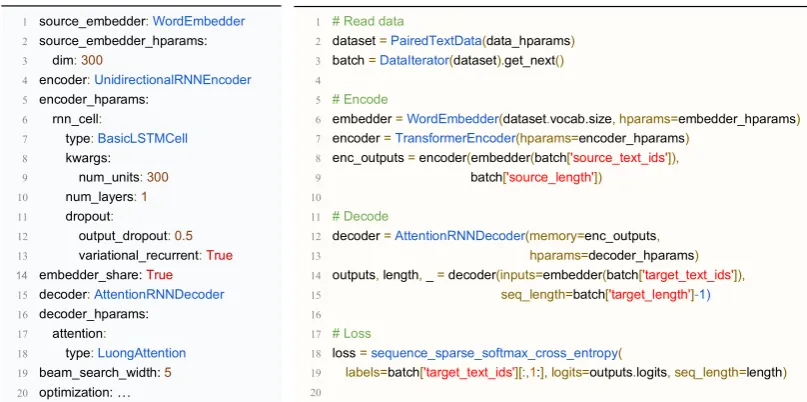
Figure 3: Two ways of specifying an attentional encoder-decoder model. Left:Part of an example YAML config
file of the model template. Hyperparameters taking default values can be omitted in the file. Right:Python code
assembling an encoder-decoder model using library APIs. Modules are created as Python objects, and called as functions to create computation operations and return output tensors. Other code such as optimization is omitted.
ple of specifying an attentional encoder-decoder model through the two interfaces, respectively.
Configuration file passes hyperparameters to
a predefined model template, which instantiates the model for training and evaluation. Text high-lighted in blue in the figure (left panel) specifies the names of modules to use. Most hyperparame-ters have sensible default values. Users only have to specify hyperparameter values that differ from the default. The interface is easily understandable for non-expert users, and has also been adopted in other tools (e.g.,Klein et al.,2017).
Library APIsoffer clean function calls. Users
can efficiently build any desired pipelines at a high conceptual level. Power users have the option to access the full internal states for low-level manip-ulations. Texar modules support convenient vari-able re-use. That is, each module instance creates its own sets of variables, and automatically re-uses them on subsequent calls. Hence TensorFlow vari-able scopeis transparent to users.
3.3 Plug-in and Swap-out Modules
It is convenient to change from one model-ing paradigm to another by simply pluggmodel-ing in/swapping out a single or few modules, or even merely changing a configuration parameter. For example, given the base code of an encoder-decoder model in Figure3(right panel), Figure4
illustrates how one can switch between different learning paradigms by changing only Lines.14–19 of the original code (maximum-likelihood
learn-ing). In particular, Figure 4 shows adversar-ial learning and reinforcement learning, which invokes Gumbel-softmax decoding and random-sample decoding, respectively.
3.4 Customize with Extensible Interfaces
Texar emphasizes on extensibility and allows easy addition of customized/external modules without editing the Texar codebase. Specifically, with the YAML configuration file, users can directly in-sert their own modules by providing the Python importing path to the module. For example, to use a customized RNN cell in the encoder, one can simply change Line.7 of Figure 3 (left panel) totype: path.to.MyCell, as long as
MyCellhas a compatible interface to other parts
of the model. Using customized modules with the library APIs is even more flexible, since the APIs are designed to be fully compatible with native TensorFlow/PyTorch programming interfaces.
4 Case Study: Transformer on Different Tasks
We present a case study to show that Texar can greatly reduce implementation efforts and enable technique sharing among different tasks. Trans-former, as first introduced in (Vaswani et al.,
2017), has greatly improved the machine transla-tion results and created other successful models such as BERT for text embedding (Devlin et al.,
Discriminator
Decoder
!" BLEU
Policy Gradient Agent "
Rewards <BOS>
Decoder …
<BOS>
" 0/1
!"1 !"2 … !"1 !"2
helper = GumbelSoftmaxTrainingHelper( # Gumbel-softmax decoding start_tokens=[BOS]*batch_size, end_token=EOS, embedding=embedder) outputs,_,_ =decoder(helper=helper)
discriminator =Conv1DClassifier(hparams=conv_hparams)
G_loss,D_loss=binary_adversarial_losses( embedder(batch[‘target_text_ids’][:, 1:]), embedder(soft_ids=softmax(outputs.logits)), discriminator)
outputs,length,_ =decoder( # Random sample decoding start_tokens=[BOS]*batch_size, end_token=EOS,
embedding=embedder, decoding_strategy=‘infer_sample')
agent =SeqPGAgent(
samples=outputs.sample_id, logits=outputs.logits, seq_length=length)
for_ in range(STEPS): samples =agent.get_samples()
rewards =BLEU(batch[‘target_text_ids’], samples) agent.observe(rewards) # Train the policy (decoder)
(a) Adversarial learning
[image:5.595.125.473.69.237.2](b) Reinforcement learning
Figure 4: Switching between different learning paradigms of a decoder involves only modification of Line.14-19 of
Figure3(maximum-likelihood learning). The same decoder is called with different decoding modes, and
discrim-inator or reinforcement learning agent is added as needed. (Left): Module structure of each paradigm; (Right):
The respective code snippets. For adversarial learning in (b), continuous Gumbel-softmax approximation (Jang
et al.,2016) to generated samples is used to enable gradient propagation from the discriminator to the decoder.
these models and fine-tuning pretrained weights. We can also deploy the Transformer components to various other tasks and get improved results.
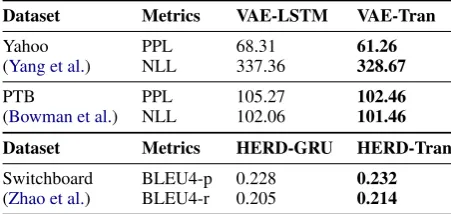
The first task we explored is the variational autoencoder (VAE) language modeling (Bowman et al., 2015). We test two models, one with an LSTM RNN decoder which is traditionally used in the task, and the other with a Transformer de-coder. All other model configurations including parameter size are the same across the two mod-els. Table 1, top panel, shows the Transformer VAE consistently improves over the LSTM VAE. With Texar, changing the decoder from an LSTM to a Transformer is easily achieved by modifying only 3 lines of code. It is also worth noting that, building the VAE language model (including data reading, model construction, and optimization) on Texar uses only 70 lines of code (with the length of each line<80chars). As a (rough) reference, a popular public TensorFlow code (Li,2017) of the same model has used around 400 lines of code for the same part (without line length limit).
The second task is conversation genera-tion. The dialog history is encoded with the
HierarchicalRNNEncodermodule which is
followed by a decoder to generate the response. We study the performance of a Transformer de-coder v.s. a conventional GRU RNN dede-coder. Ta-ble 1, bottom panel, shows the Transformer out-performs GRU. Regarding the implementation ef-fort, the Texar code has around 100 lines of code, while the reference TensorFlow code (Zhao et al.,
2017) involves over 600 lines.
Dataset Metrics VAE-LSTM VAE-Tran
Yahoo PPL 68.31 61.26
(Yang et al.) NLL 337.36 328.67
PTB PPL 105.27 102.46
(Bowman et al.) NLL 102.06 101.46
Dataset Metrics HERD-GRU HERD-Tran
Switchboard BLEU4-p 0.228 0.232
(Zhao et al.) BLEU4-r 0.205 0.214
Table 1: Top: Transformer vs LSTM for VAE LM.
Perplexity (PPL) and sentence negative log likelihood
(NLL) are evaluated (The lower the better). Bottom:
TransformervsGRU decoders in HERD (Serban et al.,
2016) for conversation response generation. BLEU4-p
and -r are precision and recall (Zhao et al.,2017).
References
Dzmitry Bahdanau, Kyunghyun Cho, and Yoshua
Ben-gio. 2014. Neural machine translation by jointly
learning to align and translate. arXiv:1409.0473.
Samuel R Bowman, Luke Vilnis, Oriol Vinyals, An-drew M Dai, Rafal Jozefowicz, and Samy Ben-gio. 2015. Generating sentences from a continuous
space. arXiv:1511.06349.
Peter F Brown, John Cocke, Stephen A Della Pietra, Vincent J Della Pietra, Fredrick Jelinek, John D Laf-ferty, Robert L Mercer, and Paul S Roossin. 1990. A
statistical approach to machine translation. CL.
Jacob Devlin, Ming-Wei Chang, Kenton Lee, and Kristina Toutanova. 2019. BERT: Pre-training of deep bidirectional transformers for language
under-standing. NAACL.
Ian Goodfellow, Jean Pouget-Abadie, Mehdi Mirza, Bing Xu, David Warde-Farley, Sherjil Ozair, Aaron Courville, and Yoshua Bengio. 2014. Generative
ad-versarial nets.NeurIPS.
[image:5.595.306.532.312.419.2]Li. 2016. Incorporating copying mechanism in
sequence-to-sequence learning.arXiv:1603.06393.
Eduard Hovy and Chin-Yew Lin. 1998. Automated text summarization and the SUMMARIST system. In
Advances in automatic text summarization.
Zhiting Hu, Zichao Yang, Xiaodan Liang, Ruslan Salakhutdinov, and Eric P Xing. 2017. Toward
con-trolled generation of text. InICML.
Zhiting Hu, Zichao Yang, Ruslan Salakhutdinov, Xi-aodan Liang, Lianhui Qin, Haoye Dong, and Eric Xing. 2018. Deep generative models with learnable
knowledge constraints. InNeurIPS.
Eric Jang, Shixiang Gu, and Ben Poole. 2016. Cat-egorical reparameterization with Gumbel-softmax.
arXiv:1611.01144.
Marcin Junczys-Dowmunt, Roman Grundkiewicz,
Tomasz Dwojak, Hieu Hoang, Kenneth Heafield, Tom Neckermann, Frank Seide, Ulrich Germann, Alham Fikri Aji, Nikolay Bogoychev, Andr F. T.
Martins, and Alexandra Birch. 2018.
Mar-ian: Fast neural machine translation in C++.
arXiv:1804.00344.
Guillaume Klein, Yoon Kim, Yuntian Deng, Jean Senellart, and Alexander M Rush. 2017. OpenNMT: Open-source toolkit for neural machine translation.
arXiv:1701.02810.
Alex M Lamb, Anirudh Goyal Alias Parth Goyal, Ying Zhang, Saizheng Zhang, Aaron C Courville, and Yoshua Bengio. 2016. Professor forcing: A new
al-gorithm for training recurrent networks. InNeurIPS.
Zhong-Yi Li. 2017.
https://github.com/Chung-I/Variational-Recurrent-Autoencoder-Tensorflow.
Shuai Lin, Wentao Wang, Zichao Yang, Haoran Shi, Frank Xu, Xiaodan Liang, Eric Xing, and Zhiting Hu. 2019. Towards unsupervised text content
ma-nipulation. arXiv preprint arXiv:1901.09501.
Minh-Thang Luong, Quoc V Le, Ilya Sutskever, Oriol Vinyals, and Lukasz Kaiser. 2016. Multi-task
se-quence to sese-quence learning. InICLR.
Minh-Thang Luong, Hieu Pham, and
Christo-pher D Manning. 2015. Effective approaches
to attention-based neural machine translation.
arXiv:1508.04025.
Nitin Madnani and Bonnie J Dorr. 2010. Generating phrasal and sentential paraphrases: A survey of
data-driven methods.CL.
Tom´aˇs Mikolov, Martin Karafi´at, Luk´aˇs Burget, Jan ˇ
Cernock`y, and Sanjeev Khudanpur. 2010.
Recur-rent neural network based language model. In
IN-TERSPEECH.
Alexander H Miller, Will Feng, Adam Fisch, Jiasen Lu, Dhruv Batra, Antoine Bordes, Devi Parikh, and Ja-son Weston. 2017. ParlAI: A dialog research
soft-ware platform. arXiv:1705.06476.
Alec Radford, Jeffrey Wu, Rewon Child, David Luan, Dario Amodei, and Ilya Sutskever. 2018. Language models are unsupervised multitask learners. Techni-cal report, TechniTechni-cal report, OpenAI.
Marc’Aurelio Ranzato, Sumit Chopra, Michael
Auli, and Wojciech Zaremba. 2015. Sequence
level training with recurrent neural networks.
arXiv:1511.06732.
Rico Sennrich, Orhan Firat, Kyunghyun Cho, Alexan-dra Birch, Barry Haddow, Julian Hitschler, Marcin Junczys-Dowmunt, Samuel L¨aubli, et al. 2017. Ne-matus: a toolkit for neural machine translation.
arXiv:1703.04357.
Iulian Vlad Serban, Alessandro Sordoni, Yoshua Ben-gio, Aaron C Courville, and Joelle Pineau. 2016. Building end-to-end dialogue systems using gener-ative hierarchical neural network models.
Sainbayar Sukhbaatar, Jason Weston, Rob Fergus, et al.
2015. End-to-end memory networks. InNeurIPS.
Ilya Sutskever, Oriol Vinyals, and Quoc Le. 2014. Se-quence to seSe-quence learning with neural networks.
NeurIPS.
Bowen Tan, Zhiting Hu, Zichao Yang, Ruslan
Salakhutdinov, and Eric Xing. 2018. Connecting the dots between MLE and RL for sequence generation.
arXiv:1811.09740.
Jianheng Tang, Tiancheng Zhao, Chengyan Xiong, Xi-aodan Liang, Eric P Xing, and Zhiting Hu. 2019.
Target-guided open-domain conversation. InACL.
Ashish Vaswani, Samy Bengio, Eugene Brevdo, Fran-cois Chollet, Aidan N Gomez, Stephan Gouws, Llion Jones, Łukasz Kaiser, Nal Kalchbrenner, Niki Parmar, et al. 2018. Tensor2Tensor for neural
ma-chine translation. arXiv:1803.07416.
Ashish Vaswani, Noam Shazeer, Niki Parmar, Jakob Uszkoreit, Llion Jones, Aidan N Gomez, Łukasz Kaiser, and Illia Polosukhin. 2017. Attention is all
you need. InNeurIPS.
Oriol Vinyals, Meire Fortunato, and Navdeep Jaitly.
2015. Pointer networks. InNeurIPS.
Jason D Williams and Steve Young. 2007. Partially ob-servable Markov decision processes for spoken
dia-log systems. CSL.
Zichao Yang, Zhiting Hu, Chris Dyer, Eric P Xing, and Taylor Berg-Kirkpatrick. 2018. Unsupervised text style transfer using language models as
discrimina-tors. arXiv:1805.11749.
Zichao Yang, Zhiting Hu, Ruslan Salakhutdinov, and
Taylor Berg-Kirkpatrick. 2017. Improved
varia-tional autoencoders for text modeling using dilated
convolutions. ICML.
Lantao Yu, Weinan Zhang, Jun Wang, and Yong Yu.
2017. SeqGAN: Sequence generative adversarial
nets with policy gradient. InAAAI.
Yizhe Zhang, Zhe Gan, Kai Fan, Zhi Chen, Ricardo Henao, Dinghan Shen, and Lawrence Carin. 2017. Adversarial feature matching for text generation.
arXiv:1706.03850.
Tiancheng Zhao, Ran Zhao, and Maxine Eskenazi. 2017. Learning discourse-level diversity for neural dialog models using conditional variational