147
Equalizing Gender Bias in Neural Machine Translation
with Word Embeddings Techniques
Joel Escud´e Font and Marta R. Costa-juss`a Universitat Polit`ecnica de Catalunya, 08034 Barcelona
[email protected],[email protected]
Abstract
Neural machine translation has significantly pushed forward the quality of the field. How-ever, there are remaining big issues with the output translations and one of them is fair-ness. Neural models are trained on large text corpora which contain biases and stereotypes. As a consequence, models inherit these so-cial biases. Recent methods have shown re-sults in reducing gender bias in other natu-ral language processing tools such as word embeddings. We take advantage of the fact that word embeddings are used in neural ma-chine translation to propose a method to equal-ize gender biases in neural machine transla-tion using these representatransla-tions. We evaluate our proposed system on the WMT English-Spanish benchmark task, showing gains up to one BLEU point. As for the gender bias eval-uation, we generate a test set of occupations and we show that our proposed system learns to equalize existing biases from the baseline system.
1 Introduction
Language is one of the most interesting and com-plex skills used in our daily life, and may even be taken for granted on our ability to communicate. However, the understanding of meanings between lines in natural languages is not straightforward for the logic rules of programming languages.
Natural language processing (NLP) is a sub-field of artificial intelligence that focuses on mak-ing natural languages understandable to comput-ers.
Similarly, the translation between different nat-ural languages is a task for Machine Transla-tion (MT). Neural MT has shown significant im-provements on performance using deep learning techniques, which are algorithms that learn ab-stractions from data. In recent years, these deep
learning techniques have shown promising re-sults in narrowing the gap between human-like performance with sequence-to-sequence learn-ing approaches in a variety of tasks (Sutskever et al.,2014), improvements in combination of ap-proaches such as attention (Bahdanau et al.,2014) and translation systems algorithms like the Trans-former (Vaswani et al.,2017).
One downside of models trained with human generated corpora is that social biases and stereo-types from the data are learned (Madaan et al.,
2018). A systematic way of showing this bias is by means of word embeddings, a vector rep-resentation of words. The presence of biases, such as gender bias, is studied for these repre-sentations and evaluated on crowd-sourced tests (Bolukbasi et al., 2016). The presence of biases in the data can directly impact downstream appli-cations (Zhao et al.,2018a) and are at risk of being amplified (Zhao et al.,2017).
The objective of this work is to study the pres-ence of gender bias in MT and give insight on the impact of debiasing in such systems. An ex-ample of this gender bias is the word “friend” in the English sentence “She works in a hospital, my friend is a nurse” would be correctly translated to “amiga” (girl friend in Spanish) in Spanish, while “She works in a hospital, my friend is a doctor” would be incorrectly translated to “amigo” (boy friend in Spanish) in Spanish. We consider that this translation contains gender bias since it ig-nores the fact that, for both cases, “friend” is a female and translates by focusing on the occupa-tional stereotypes, i.e. translating doctor as male and nurse as female.
frame-work to experiment, detect and evaluate gender bias in MT for a particular task; second, we pro-pose to use debiased word embeddings techniques in the MT system to reduce the detected bias. This is the first study in proposing debiasing techniques for MT.
The rest the paper is organized as follows. Sec-tion2reports material relevant to the background of the study. Section3presents previous work on the bias problem. Section 4 reports the method-ology used for experimentation and section5 de-tails the experimental framework. The results and discussion are included in section6and section7
presents the main conclusions and ideas for further work.
2 Background
This section presents the models used in this paper. First, we describe the Transformer model which is the state-of-the-art model in MT. Second, we re-port describe word embeddings and, then, the cor-responding techniques to debias them.
2.1 Transformer
The Transformer (Vaswani et al., 2017) is a deep learning architecture based on self-attention, which has shown better performance over previ-ous systems. It is more efficient in using compu-tational resources and has higher training speed than previous recurrent (Sutskever et al., 2014;
Bahdanau et al.,2014) and convolutional models (Gehring et al.,2017).
The Transformer architecture consists of two main parts: an encoder and a decoder. The en-coder reads an input sentence to generate a repre-sentation which is later used by a decoder to pro-duce a sentence output word by word.
The input words are represented as vectors, word embeddings (more on this in section2.2) and then, positional embeddings keep track of the se-quentiality of language. The Transformer archi-tecture computes a reduced constant number of steps using a self-attention mechanism on each one. The attention score is computed for all words in a sentence when comparing the contribution of each word to the next representation. New repre-sentations are generated in parallel for all words at each step .
Finally, the decoder uses self-attention in gener-ated words and also uses the representations from the last words in the encoder to produce a single
word each time.
2.2 Word embeddings
Word embeddings are vector representations of words. These representations are used in many NLP applications. Based on the hypothesis that words appearing in same contexts share semantic meaning, this continuous vector space representa-tion gathers semantically similar words, thus be-ing more expressive than other discrete represen-tations like one-hot vectors.
Arithmetic operations can be performed with these embeddings, in order to find analogies be-tween pairs of nouns with the pattern “A is to B what C is to D” (Mikolov et al.,2013). For nouns, such as countries and their respective capitals or for the conjugations of verbs.
While there are many techniques for extract-ing word embeddextract-ings, in this work we are us-ing Global Vectors, or GloVe (Pennington et al.,
2014). Glove is an unsupervised method for learn-ing word embeddlearn-ings. This count-based method, uses statistical information of word occurrences from a given corpus to train a vector space for which each vector is related to a word and their values describes their semantic relations.
2.3 Equalizing biases in word embeddings
The presence of biases in word embeddings is a topic of discussion about fairness in NLP. More specifically, Bolukbasi et al. (2016) proposes a post-process method for debiasing already trained word embeddings. (Zhao et al., 2018b) aims to restrict learning biases during the training of the embeddings to obtain a more neutral representa-tion. The main ideas behind these methods are de-scribed next.
Hard-debiased embeddings (Bolukbasi et al.,
2016) is a post-process method for debiasing word embeddings. First, the direction of the embed-dings where the bias is present is identified. Sec-ond, the gender neutral words in this direction are neutralized to zero and also equalizes the sets by making the neutral word equidistant to the remain-ing ones in the set. The disadvantage of the first part of the process is that it can remove valuable information in the embeddings for semantic rela-tions between words with several meanings that are not related to the bias being treated.
embed-dings models. It is based on the GloVe represen-tation (Pennington et al., 2014) and modified to learn such word representations while restricting specific attributes, such as gender information, to specific dimensions. A set of seed male and fe-male words are used to define metrics for com-puting the optimization and a set of gender neu-tral words is used for restricting neuneu-tral words in a gender direction.
3 Related work
While there are many studies on the presence of biases in many NLP applications, studies of this type in MT are quite limited.
Prates et al. (2018) performs a case study on gender bias in machine translation. They build a test set consisting of a list of jobs and gender-specific sentences. Using English as a target lan-guage and a variety of gender neutral lanlan-guages as a source, i.e. languages that do not explicitly give gender information about the subject, they test these sentences on the translating service Google Translate. They find that occupations related to science, engineering and mathematics present a strong stereotype toward male subjects.
Vanmassenhove et al. (2018) compile a large multilingual dataset on the politics domain that contains the speaker information. They specifi-cally use this information to incorporate it in a MT system. Adding this information improves the translation quality.
Our contribution is different from previous ap-proaches in the sense that we are explicitly propos-ing a gender-debiased approach for NMT as well as an specific analysis based on correference and stereotypes to evaluate the effectiveness of our technique.
4 Methodology
In this section, we describe the methodology used for this study. The prior layer of both the encoder and decoder in the Transformer (Vaswani et al.,
2017), where the word embeddings are trained, is adapted to use pre-trained word embeddings. We train the system with different pre-trained word embeddings (based on GloVe (Pennington et al.,
2014)) to have a set of models. The scenarios are the following:
• No pre-trained word embeddings, i.e. they are learned within the training of the model.
• Pre-trained word embeddings learned from the same corpus. Specifically, GloVe, Hard-Debiased GloVe and Gender Neutral Glove (GN-GloVe) embeddings.
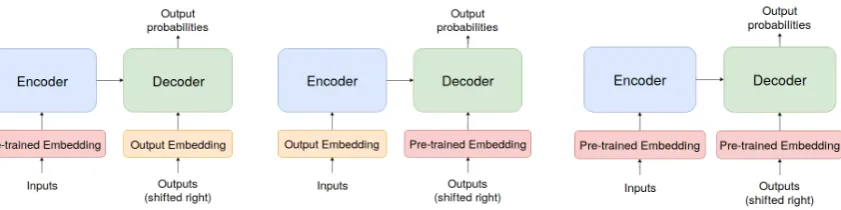
Also, the models with pre-trained embeddings given to the Transformer have three cases: using pre-trained embeddings only in the encoder side, see Figure1(left), only in the decoder side, Figure
1 (center), and both in the encoder and decoder sides, Figure1(right).
5 Experimental framework
In this section, we present the experimental frame-work. We report details on the training of the word embeddings and the translation system. We de-scribe the data related to the training corpus and test sets and the parameters. Also, we comment on the use of computational resources.
5.1 Corpora
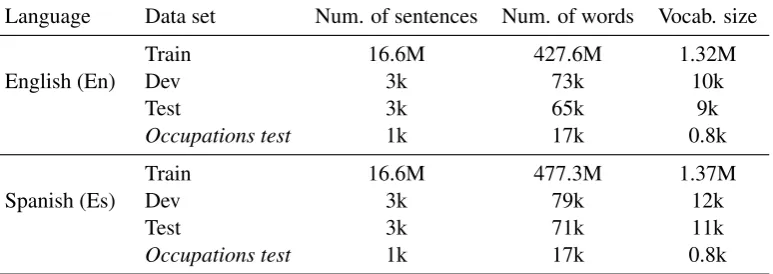
The language pair used for the experiments is English-Spanish. The training set consists of 16,554,790 sentences from a variety of sources in-cluding United Nations (Ziemski et al.,2016), Eu-roparl (Koehn, 2005), CommonCrawl and News available from the Workshop on Machine Trans-lation (WMT) 1. The validation and test sets used are the newstest2012(3,003 sentences) and newstest2013(3,000 sentences), respectively, also from the same WMT workshop. See Table 2for the corpus statistics.
To study gender bias, we have developed an ad-ditional test set with custom sentences to evaluate the quality of the translation in the models. We built this test set using a sentence pattern “I’ve known {her, him, <proper noun>} for a long time, my friend works as{a, an}<occupation>.” for a list of occupations from different profes-sional areas. We refer to this test asOccupations test, their related sizes are also listed in Table2and sample sentences from this set are in Table1. We use Spanish proper names to reduce ambiguity in this particular test. These sentences are properly tokenized before using them in the test.
With these test sentences we see how “friend” is translated into its Spanish equivalent “amiga” or “amigo” which has a gender relation for each word, female and male, respectively. Note that we are formulating sentences with an ambiguous
Figure 1: (Left) Pre-trained word embeddings in the encoder. (Center) Pre-trained word embeddings in the decoder. (Right) Pre-trained word embeddings in both the encoder and the decoder.
word “friend” that can be translated into any of the two words and we are adding context in the same sentence so that the system has enough informa-tion to translate them correctly. The list of occupa-tions is from the U.S. Bureau of Labor Statistics2, which also includes statistical data for gender and race for most professions. We use a pre-processed version of this list from (Prates et al.,2018).
5.2 Models
The architecture to train the models for the transla-tion task is the Transformer (Vaswani et al.,2017) and we used the implementation provided by the OpenNMT toolkit3. The parameter values used in the Transformer are the same as proposed in the OpenNMT baseline system. Our baseline system is the Transformer witout pre-trained word embed-dings.
Additionally, OpenNMT has built-in tools for training with pre-trained embeddings. In our case, these pre-trained embeddings have been imple-mented with the corresponding github repositories in GloVe4, Hard-Debiasing with Debiaswe5 and GN-GloVe6.
The GloVe and GN-GloVe embeddings are trained from the same corpus presented in the previous section. We refer to the method from
Bolukbasi et al.(2016) applied to the previously mentioned GloVe embeddings as Hard-Debiased GloVe. The dimension of the vectors is settled to 512 (as standard) and kept through all the ex-periments in this study. The parameter values for training the word embedding models are shown in Table3.
2
https://www.bls.gov/cps/tables.htm# empstat
3
http://opennmt.net/
4https://github.com/stanfordnlp/GloVe
5https://github.com/tolga-b/debiaswe
6
https://github.com/uclanlp/gn_glove
Bolukbasi et al. (2016) uses a set of words to define the gender direction and to neutralize and equalize the bias from the word vectors. Three set of words are used: One set of ten pairs of words such as woman-man, girl-boy, she-he are used to define the gender direction. Another set of 218 gender-specific words such asaunt, uncle, wife, husbandare used for learning a larger set of gender-specific words. Finally, a set of crowd-sourced male-female equalization pairs such as dad-mom, boy-girl, granpa-grandma that repre-sent gender direction are equalized in the algo-rithm. In fact, for the English side, the gendered pairs used are the same as identified in the crowd-sourcing test by Bolukbasi et al.(2016). For the Spanish side, the sets are translated manually and modified when necessary to avoid non-applicable pairs or unnecessary repetitions. The sets from
Zhao et al. (2018b) are similarly adapted to the Spanish language.
To evaluate the performance of the models we use the BLEU metric (Papineni et al.,2002). This metric gives a score for a predicted translation set compared to its expected output.
5.3 Hardware resources
The GPUs used for training are separate groups of four NVIDIA TITAN Xp and NVIDIA GeForce GTX TITAN. The duration time for training is ap-proximately 3 and 5 days, respectively. In the im-plementation, the model is set to accumulate the gradient two times before updating the parameters, which simulates 4 more GPUs during training giv-ing a total of 8 GPUs.
6 Results
[image:4.595.95.516.63.168.2](En) I’ve knownherfor a long time, myfriendworks as anaccounting clerk. (Es)Laconozco desde hace mucho tiempo, miamigatrabaja comocontable. (En) I’ve knownhimfor a long time, myfriendworks as anaccounting clerk. (Es)Loconozco desde hace mucho tiempo, miamigotrabaja comocontable. (En) I’ve knownMaryfor a long time, myfriendworks as anaccounting clerk. (Es) Conozco aMarydesde hace mucho tiempo, miamigatrabaja comocontable. (En) I’ve knownJohnfor a long time, myfriendworks as anaccounting clerk. (Es) Conozco aJohndesde hace mucho tiempo, miamigotrabaja comocontable.
Table 1: Sample sentences from theOccupations testset. English (En) and Spanish (Es).
Language Data set Num. of sentences Num. of words Vocab. size
English (En)
Train 16.6M 427.6M 1.32M
Dev 3k 73k 10k
Test 3k 65k 9k
Occupations test 1k 17k 0.8k
Spanish (Es)
Train 16.6M 477.3M 1.37M
Dev 3k 79k 12k
Test 3k 71k 11k
Occupations test 1k 17k 0.8k
Table 2: English-Spanish data set.
Parameter Value
Vector size 512
Memory 4.0
Vocab. min. count 5
Max. iter. 15
Window size 15 Num. threads 8
X max. 10
Binary 2
Verbose 2
Table 3: Word Embeddings Parameters.
6.1 Translation
For the test set newstest2013, BLUE scores are given in Table4. Pre-trained embeddings are used for training in three scenarios: in the encoder side (Enc.), in the decoder side (Dec.) and in both the encoder and decoder sides (Enc./Dec.). These pre-trained embeddings are updated during train-ing. We are comparing several pre-trained embed-dings against a baseline system (‘Baseline’ in Ta-ble4) which does not include pre-trained embed-dings (neither on the encoder nor the decoder).
For the studied cases, values do not differ much. Using pre-trained embeddings can improve the
Baseline 29.78
Pre-trained emb. Enc. Dec. Enc./Dec.
GloVe 30.21 30.24 30.62
GloVe Hard-Deb. 30.16 30.09 29.95 GN-GloVe 29.12 30.13 30.74
Table 4: BLEU scores for thenewstest2013 test set. English-Spanish. Pre-trained embeddings are updated during training. In bold best results.
translation, which is coherent with previous stud-ies (Qi et al.,2018). Furthermore, debiasing with GN-GloVe embeddings keeps this improvement and even increases it when used in both the en-coder and deen-coder sides. We want to underline that these models do not decrease the quality of trans-lation in terms of BLEU when tested in a standard MT task. Next, we show how each of the models performs on a gender debiasing task.
6.2 Gender Bias
or “amiga” in Spanish. The lower the bias in the system, the better the system will be able to translate the gender correctly. See Table5for the percentages of how “friend” is predicted for each model.
“Him” is predicted at almost 100% accuracy for all models. However not all occupations are well translated. On the other hand, the accuracy drops when predicting the word “her” on all mod-els. When using names, the accuracy is even lower for “Mary” opposite to “John”.
Note that gender debiasing is shown by aug-menting the percentage of “amiga” in the trans-lation in the presence of the female pronoun while keeping the quality of translation (coherently with generic results in Table 4). Based on accuracy values from Table 5, the most neutral system is achieved with GloVe and also with Hard-Debiased GloVe pre-trained embeddings. The accuracy im-proves by 30 percentage points compared to the baseline system and over 10 percentage points compared to the non-debiased pre-trained word embeddings.
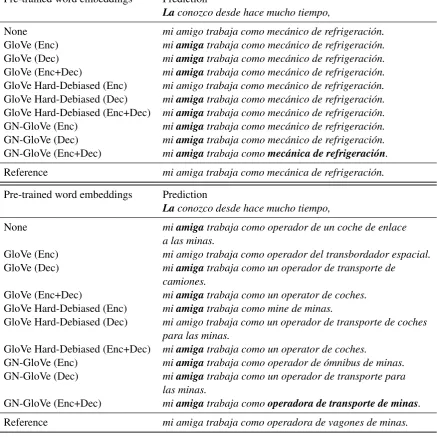
The quality of the translation also depends on the professions from theOccupations testand its predicted gender. Again, the system has no prob-lem predicting the gender of professions in the context of “him”, so we focus the analysis on the context of “her”. With GN-GloVe pre-trained em-beddings both in the encoder and decoder sides, the model shows a higher accuracy when predict-ing the gender of a profession in Spanish. Specifi-cally, for technical professions such as “criminal investigator”, “heating mechanic”, “refrigeration mechanic” and others such as “mine shuttle car operator”. See Table 6 for the prediction on this last profession.
7 Conclusions and further work
Biases learned from human generated corpora is a topic that has gained relevance over the years. Specifically, for MT, studies quantifying gender bias present in news corpora and proposing de-biasing approaches for word embedding models have shown improvements on this matter.
We studied the impact of gender debiasing on neural MT. We trained sets of word embeddings with the standard GloVe algorithm. Then, we debiased the embeddings using a post-process method (Bolukbasi et al., 2016) and also trained a gender neutral version (Zhao et al.,2018b). We
used all these different models on the Transformer (Vaswani et al.,2017). Experiments were reported on using these embeddings on both the encoder and decoder sides, or only the encoder or the de-coder sides.
The models were evaluated using the BLEU metric on the standard task of the WMT new-stest2013 test set. BLEU performance increase when using pre-trained word embeddings and it is slightly better for the debiased models.
In order to study the bias on the translations, we evaluate the systems on a custom test set com-posed of occupations. This set consists of sen-tences that include context of the gender of the ambiguous “friend” in the English-Spanish trans-lation. This word can be translated to feminine or masculine and the proper translation has to be derived from context. We verified our hypothesis that consisted on the fact that if the translation sys-tem is gender biased, the context is disregarded, while if the system is neutral, the translation is cor-rect (since it has the information of gender in the sentence). Results show that the male pronoun is always identified, despite not all occupations are well translated, while the female pronoun has dif-ferent ratio of appearance for difdif-ferent models. In fact, the accuracy when predicting the gender for this test set is improved for some settings, when using the debiased and gender neutral word em-beddings. Also, as mentioned, this system slightly improves the BLEU performance from the base-line translation system. Therefore, we are “equal-izing” the translation, while keeping its quality. Experimental material from this paper is available online7.
As far as we are concerned, this is one of the pi-oneer works on proposing gender debiased trans-lation systems with word embedding techniques.
We did our study in the domain of news articles and professions. However, human corpora has a broad spectrum of categories, as an instance: in-dustrial, medical, legal that may rise other biases particular to each area. Also, other language pairs with different degree in specifying gender infor-mation in their written or spoken communication could be studied for the evaluation of debiasing in MT. Furthermore, while we studied gender as a bias in MT, other social constructs and stereo-types may be present in corpora, whether individ-ually or combined, such as race, religious beliefs
7
Pre-trained embeddings her him Mary John amiga amigo amiga amigo
None 99.8 99.9 69.5 99.9
GloVe (Enc.) 2.6 100.0 0.0 100.0
GloVe (Dec.) 95.0 100.0 4.0 100.0
GloVe (Enc./Dec.) 100.0 100.0 90.0 100.0 GloVe Hard-Debiased (Enc.) 100.0 100.0 99.5 100.0 GloVe Hard-Debiased (Dec.) 12.0 100.0 0.0 100.0 GloVe Hard-Debiased (Enc./Dec.) 99.9 100.0 100.0 99.9
GN-GloVe (Enc.) 100.0 100.0 7.7 100.0
GN-GloVe (Dec.) 97.2 100.0 51.8 100.0
[image:7.595.143.458.65.237.2]GN-GloVe (Enc./Dec.) 99.6 100.0 56.4 100.0
Table 5: Percentage of “friend” being translated as “amiga” or “amigo” in test sentences with female-male pro-nouns and proper names for theOccupations test. Best results in bold.
or age; this being just a small subset of possible biases which will present new challenges for fair-ness both in machine learning and MT.
Acknowledgments
This work is supported in part by the Spanish Min-isterio de Econom´ıa y Competitividad, the Euro-pean Regional Development Fund and the Agen-cia Estatal de Investigaci´on, through the post-doctoral senior grant Ram´on y Cajal, the con-tract TEC2015-69266-P (MINECO/FEDER,EU) and the contract PCIN-2017-079 (AEI/MINECO).
References
Dzmitry Bahdanau, Kyunghyun Cho, and Yoshua Bengio. 2014. Neural machine translation by jointly learning to align and translate. CoRR, abs/1409.0473.
Tolga Bolukbasi, Kai-Wei Chang, James Y. Zou, Venkatesh Saligrama, and Adam Kalai. 2016. Man is to computer programmer as woman is to home-maker? debiasing word embeddings. CoRR, abs/1607.06520.
Jonas Gehring, Michael Auli, David Grangier, De-nis Yarats, and Yann N. Dauphin. 2017. Con-volutional sequence to sequence learning. CoRR, abs/1705.03122.
Philipp Koehn. 2005. Europarl: A Parallel Corpus for Statistical Machine Translation. InConference Pro-ceedings: the tenth Machine Translation Summit, pages 79–86, Phuket, Thailand. AAMT, AAMT.
Nishtha Madaan, Sameep Mehta, Shravika Mittal, and Ashima Suvarna. 2018. Judging a book by its description : Analyzing gender stereotypes in
the man bookers prize winning fiction. CoRR, abs/1807.10615.
Tomas Mikolov, Kai Chen, Greg Corrado, and Jeffrey Dean. 2013. Efficient estimation of word represen-tations in vector space.CoRR, abs/1301.3781.
Kishore Papineni, Salim Roukos, Todd Ward, and Wei jing Zhu. 2002. Bleu: a method for automatic eval-uation of machine translation. InProceedings of the 40th Annual Meeting of the Association for Compu-tational Linguistics, pages 311–318.
Jeffrey Pennington, Richard Socher, and Christo-pher D. Manning. 2014. Glove: Global vectors for word representation. InEmpirical Methods in Nat-ural Language Processing (EMNLP), pages 1532– 1543.
Marcelo O. R. Prates, Pedro H. C. Avelar, and Lu´ıs C. Lamb. 2018. Assessing gender bias in machine translation - A case study with google translate.
CoRR, abs/1809.02208.
Ye Qi, Devendra Sachan, Matthieu Felix, Sarguna Pad-manabhan, and Graham Neubig. 2018. When and why are pre-trained word embeddings useful for neural machine translation? In Proceedings of the 2018 Conference of the North American Chapter of the Association for Computational Linguistics: Hu-man Language Technologies, Volume 2 (Short Pa-pers), pages 529–535, New Orleans, Louisiana. As-sociation for Computational Linguistics.
Ilya Sutskever, Oriol Vinyals, and Quoc V. Le. 2014. Sequence to sequence learning with neural net-works. CoRR, abs/1409.3215.
Pre-trained word embeddings Prediction
Laconozco desde hace mucho tiempo,
None mi amigo trabaja como mec´anico de refrigeraci´on. GloVe (Enc) miamigatrabaja como mec´anico de refrigeraci´on. GloVe (Dec) miamigatrabaja como mec´anico de refrigeraci´on. GloVe (Enc+Dec) miamigatrabaja como mec´anico de refrigeraci´on. GloVe Hard-Debiased (Enc) mi amigo trabaja como mec´anico de refrigeraci´on. GloVe Hard-Debiased (Dec) miamigatrabaja como mec´anico de refrigeraci´on. GloVe Hard-Debiased (Enc+Dec) miamigatrabaja como mec´anico de refrigeraci´on. GN-GloVe (Enc) miamigatrabaja como mec´anico de refrigeraci´on. GN-GloVe (Dec) miamigatrabaja como mec´anico de refrigeraci´on. GN-GloVe (Enc+Dec) miamigatrabaja comomec´anica de refrigeraci´on.
Reference mi amiga trabaja como mec´anica de refrigeraci´on.
Pre-trained word embeddings Prediction
Laconozco desde hace mucho tiempo,
None miamigatrabaja como operador de un coche de enlace
a las minas.
GloVe (Enc) mi amigo trabaja como operador del transbordador espacial. GloVe (Dec) miamigatrabaja como un operador de transporte de
camiones.
GloVe (Enc+Dec) miamigatrabaja como un operator de coches. GloVe Hard-Debiased (Enc) miamigatrabaja como mine de minas.
GloVe Hard-Debiased (Dec) mi amigo trabaja como un operador de transporte de coches para las minas.
GloVe Hard-Debiased (Enc+Dec) miamigatrabaja como un operator de coches.
GN-GloVe (Enc) miamigatrabaja como operador de ´omnibus de minas. GN-GloVe (Dec) miamigatrabaja como un operador de transporte para
las minas.
GN-GloVe (Enc+Dec) miamigatrabaja comooperadora de transporte de minas.
[image:8.595.81.519.74.511.2]Reference mi amiga trabaja como operadora de vagones de minas.
Table 6: Spanish predictions for the test sentences “I’ve known her for a long time, my friend works as a refriger-ation mechanic.” “I’ve known her for a long time, my friend works as a mine shuttle car operator.”. Best results in bold.
Ashish Vaswani, Noam Shazeer, Niki Parmar, Jakob Uszkoreit, Llion Jones, Aidan N Gomez, Ł ukasz Kaiser, and Illia Polosukhin. 2017. Attention is all you need. In I. Guyon, U. V. Luxburg, S. Bengio, H. Wallach, R. Fergus, S. Vishwanathan, and R. Gar-nett, editors, Advances in Neural Information Pro-cessing Systems 30, pages 5998–6008. Curran As-sociates, Inc.
Jieyu Zhao, Tianlu Wang, Mark Yatskar, Vicente Or-donez, and Kai-Wei Chang. 2017. Men also like shopping: Reducing gender bias amplification using corpus-level constraints. InEMNLP, pages 2979– 2989. Association for Computational Linguistics.
Jieyu Zhao, Tianlu Wang, Mark Yatskar, Vicente Or-donez, and Kai-Wei Chang. 2018a. Gender bias
in coreference resolution: Evaluation and debiasing methods. InNAACL-HLT (2), pages 15–20. Associ-ation for ComputAssoci-ational Linguistics.
Jieyu Zhao, Yichao Zhou, Zeyu Li, Wei Wang, and Kai-Wei Chang. 2018b. Learning gender-neutral word embeddings. InProceedings of the 2018 Confer-ence on Empirical Methods in Natural Language Processing, Brussels, Belgium, October 31 - Novem-ber 4, 2018, pages 4847–4853.