Munich Personal RePEc Archive
A Bayesian approach for correcting bias
of data envelopment analysis estimators
Zervopoulos, Panagiotis and Emrouznejad, Ali and Sklavos,
Sokratis
Department of Management, University of Sharjah, Operations
Information Management Department, Aston Business School,
NeuroBioAnalysis Lab
January 2019
Online at
https://mpra.ub.uni-muenchen.de/91886/
A Bayesian approach for correcting bias of data envelopment analysis estimators
Panagiotis D. Zervopoulos*
Department of Management
University of Sharjah, Sharjah 27272, United Arab Emirates
Tel.: +971 567159809
Ali Emrouznejad
Operations & Information Management Department
Aston Business School, Aston University, Birmingham B4 7ET, UK
Sokratis Sklavos
NeuroBioAnalysis Lab, 2 Lefktron St & Michalakopoulou Av., Athens 11527, Greece
*Corresponding author
Abstract
The validity of data envelopment analysis (DEA) efficiency estimators depends on the
robustness of the production frontier to measurement errors, specification errors and
the dimension of the input-output space. It has been proven that DEA estimators, within
the interval (0, 1], are overestimated when finite samples are used while asymptotically
this bias reduces to zero. The non-parametric literature dealing with bias correction of
efficiencies solely refers to estimators that do not exceed one. We prove that efficiency
estimators, both lower and higher than one, are biased. A Bayesian DEA method is
developed to correct bias of efficiency estimators. This is a two-stage procedure of
super-efficiency DEA followed by a Bayesian approach relying on consistent efficiency
estimators. This method is applicable to ‘small’ and ‘medium’ samples. The new
Bayesian DEA method is applied to two data sets of 50 and 100 E.U. banks. The mean
square error, root mean square error and mean absolute error of the new method reduce
Keywords: Data envelopment analysis; Super-efficiency; Bayesian methods; Statistical
inference; Banking
1. Introduction
Data envelopment analysis (DEA) put forth by Charnes et al. (1978) and extended by
Banker et al. (1984) is a mathematical programming methodology to evaluate the
efficiency of a sample firm relative to a reference set of all sample firms. DEA is a
non-parametric approach to construct production frontiers based on observed input and
output data of the sample firms. Despite the non-parametric nature of DEA, Banker and
Maindiratta (1992), Banker (1993), Sarath and Maindiratta (1997), Banker and
Natarajan (2008) provided statistical justification for DEA. In particular, Banker (1993)
proved that DEA (with one output and multiple inputs), under the conditions of
monotonicity and concavity, yields consistent estimators of the production frontier. The
studies of Simar and Wilson (1998, 1999), Kneip et al. (2008, 2011), Kuosmanen and
Johnson (2010) and Tsionas and Papadakis (2010) also allowed for inference on DEA
efficiency estimators.
The validity of DEA efficiency estimators depends on the robustness of the production
frontier to measurement errors, specification errors and the dimension of the
input-output space. Banker (1993) was the first to highlight the overestimation of DEA
efficiencies when finite samples are used. Banker (1993) and Grosskopf (1996) showed
that this bias asymptotically reduces to zero. In line with these studies, Simar (2007)
identified an inverse relationship between the rate of convergence of DEA efficiency
estimators and the dimensionality of the production set. Simar and Wilson (2015) stated
that the true efficiency of a firm is unknown.
Emphasizing DEA, there are six major approaches dealing with the sensitivity of
efficiency estimators: (a) Chance Constrained DEA (CCDEA); (b) Two-stage
DEA-based methods; (c) Corrected Concave Non-Parametric Least Squares (C2NLS); (d)
Stochastic Non-Smooth Envelopment of Data (StoNED); (e) Bayesian DEA; and (f)
CCDEA (Charnes and Cooper, 1963; Land et al., 1993; Olesen and Petersen, 1995)
specifies stochastic production frontiers by replacing the observed input and output data
with their randomly distributed counterparts. CCDEA programs are appropriate for
dealing with the presence of noise in the data. However, they lack statistical theory. A
review of CCDEA is available in Olesen and Petersen (2016). Two-stage DEA-based
procedures presented by Banker and Natarajan (2008) for estimating non-parametric
stochastic frontiers. In the first stage, a conventional DEA model is applied (e.g. the
variable returns to scale (VRS) DEA put forth by Banker et al. (1984)) to estimate the
technical efficiency of sample firms. In the second stage, the DEA efficiency estimators
obtained from the previous stage are introduced in OLS and maximum likelihood
models to yield consistent estimators.
The C2NLS (Kuosmanen and Johnson, 2010) is a least-square interpretation of the VRS
DEA model, which, in contrast to conventional DEA models constructing production
frontiers based on dominant firms, uses all available information for estimating a
production frontier. Kuosmanen and Johnson (2010) concluded that the C2NLS
estimators outperform DEA estimators when the number of firms are significantly
higher than the number of input and output variables while the C2NLS estimators
perform at least as well as the DEA estimators when dimensionality is present. The
StoNED method (Kuosmanen and Kortelainen, 2007; Kuosmanen and Kortelainen,
2012) estimates semiparametric frontiers by combining the DEA-style frontier with the
Stochastic Frontier Analysis (SFA)-style treatment of inefficiency and noise. StoNED
facilitates statistical inference while relying on regularity properties (e.g. free
disposability, convexity) and without requiring the assumption of a particular
production function.
A Bayesian DEA approach for CCDEA was developed by Tsionas and Papadakis
(2010). This method provides statistical inference (e.g. estimation of CCDEA
efficiencies based on an estimated prior distribution, construction of confidence
intervals) to CCDEA relying on assumptions about the distribution (e.g. multivariate
normal) of the (posterior/observed) inputs and outputs. Relying on the distribution of
the posterior input and output data, it is possible to estimate the prior distribution of the
data and then estimate CCDEA efficiencies. This approach lacks formal statistical
Bootstrap DEA is a widely used method for correcting bias and constructing confidence
intervals of efficiency estimators (Kneip et al., 2008). Bootstrap DEA, or smoothed
bootstrap, originated from Simar and Wilson (1998), combines both the virtues and
limitations of bootstrap and DEA. Smoothed bootstrap relies on pseudo-data obtained
from an estimated data generating process (DGP) (Dyson and Shale, 2010). Kneip et
al. (2008, 2011) developed improved smoothed bootstrap algorithms providing
consistent bias-corrected estimators. Major limitations of the smoothed bootstrap are
the considerably large confidence intervals, which make difficult to obtain meaningful
comparisons between the sample firms, and unsatisfactory performance when
inadequate samples for the dimension of the input-output space are available.
All methods discussed above dealing with the sensitivity of DEA efficiencies refer to
estimators lying within the interval (0, 1]. Andersen and Petersen (1993), drawing on
the work of Banker and Gifford (1988), presented a super-efficiency DEA model,
which makes possible efficiency estimators to exceed unity, unlike the conventional
DEA models, as the firm under review is excluded from its own reference set.
Super-efficiency DEA procedure is used for ranking efficient units and identifying outliers
(Banker and Chang, 2006). However, Banker and Chang (2006) and Banker et al.
(2017) found that super-efficiency performs unsatisfactorily in ranking efficiency units.
It should be noted that this result has not been tested to cases of multiple inputs and
multiple outputs and input values considerably greater than 20. Another issue of the
traditional super-efficiency DEA model under VRS is the infeasibility.
The contribution of this work is to provide statistical inference in super-efficiency DEA
models. We develop a two-stage Bayesian DEA approach to correct bias of
super-efficiency estimators. In the first stage, we use a super-super-efficiency DEA model while in
the second stage we specify consistent super-efficiency estimators. These estimators
are introduced in the Bayesian framework to estimate bias-corrected (prior)
super-efficiencies. To the best of our knowledge, this is the first work on correction of bias of
super-efficiency estimators.
The rest of the paper unfolds as follows. In Section 2, we present the super-efficiency
conventional statistical inference; Step 2: Bayesian statistical inference; Step 3: bias
correction). In Section 3, we present the two data sets used in this study and analyze the
results. Section 4 concludes and discusses future research directions.
2. Methodology
2.1 Super-efficiency DEA
After the work of Andersen and Petersen (1993), many studies appear in the literature
(Lovell and Rouse, 2003; Chen, 2005; Li et al., 2007; Ray, 2008; Cook et al., 2009;
Chen et al., 2011; Lee et al., 2011; Chen and Liang, 2011) dealing with the
measurement of super-efficiency in DEA under the condition of VRS. The latter studies
tried to solve the problem of infeasibility of the VRS super-efficiency DEA model.
In this study, we use Chen and Liang (2011)’s model to obtain super-efficiency
estimators (j), which is as follows
1
min
s r r
M
1
. . (1 ) 1, 2,...,
n
j ij io j
j o
s t x x i m
1
(1 ) 1, 2,...,
n
j rj r ro j
j o
y y r s
1
1
n j j j o
j 0, jo, r 0 (1)
where M is a user-defined large positive number (e.g. 105).
The super-efficiency estimators are defined as 1 1 1 1 r R
r
R
, where R is the setFor the application of this Bayesian DEA method for the correction of bias of the
super-efficiency DEA estimators, other super-super-efficiency models (e.g. Chen, 2005; Li et al.,
2007; Ray, 2008; Cook et al., 2009; Chen et al., 2011; Lee et al., 2011) can be used
instead of model (1).
2.2 Conventional statistical inference
Let (j), where j 0 (j1, 2,..., )n , be a random variable of independently and identically distributed (iid) super-efficiency estimators obtained from model (1). is assumed uniformly distributed from L (0L1) to U ( U 1). The two parameters (i.e. L and U) are unknown.
Acknowledging the probability density function (PDF) of as 1
,
( , )
0 , otherwise
L j L
j L
f
U U
U (2)
the likelihood function is expressed as follows
iid
1
1
( , ) ( , ) , , 1, 2,...,
( )
n
L U j L U n L j U
j U L
L f j n
(3)By partially differentiating the likelihood function (3)
1
1
( , ) 0
( )
( , ) 0
( )
L n
L L
L n
U L
n L
n L
U
U
U
U
we find that it is monotone increasing for L and monotone decreasing for U. Hence,
the likelihood function (3) is maximized at ˆL min and ˆU max.
Taking into account the maximum likelihood estimators (MLE) ˆL and ˆU, we define the joint cumulative distribution function (CDF) as follows
ˆ ˆ
( L,U)( , ) Prob(ˆL , ˆU ) Prob(min , max )
F t s t s t s
iid
1 1
Prob(max s) Prob( s,...,n s) Prob( s) n
1 1
= ( , )d
L n s L U f
1 1d , 1
L
n n
s
L
U
U L U L
s s
(5)and
iid
1 1
Prob(min t, max s) Prob(t s,...,tn s) Prob(t s) n
1 1 1
1 ( , )d d
n n
s s
L U
U L
t t
f
, n L U U L s t t s (6)
Based on expressions (4)-(6), the joint CDF is written as follows
ˆ ˆ
( L,U)( , , ) ,
n n
L
L U L U
U L U L
s s t
F t s t s
(7)
with corresponding joint PDF
2
ˆ ˆ ˆ ˆ ˆ ˆ
( L,U)( , L, U) ( L,U)( , ) ( L,U)( , )
f t s F t s F t s
t s t s
1 1 ( ) ( ) ( ) ( ) n n L n n
U L U L
n s n s t
t 2
( 1)( ) , ( ) n L U n U L
n n s t
t s
(8)
The marginal PDF of ˆL is expressed as follows
2
ˆ (ˆ ˆ, )
( 1)( )
( , ) ( , , )d d
( )
U U
L L U
n
L U L U n
U L
t t
n n s t
f t f t s s s
1 ( ) , ( ) nU L U
n U L n t t
(9)
and the corresponding marginal PDF of ˆU reads as follows
2
ˆ (ˆ ˆ, )
( 1)( )
( , ) ( , , )d d
( )
U L U
L L
s s n
L U L U n
U L
n n s t
f s f t s t t
1
( ) ,
( )
n
L L U
n U L
n
s s
(10)
As we noticed in expressions (8)-(10)
ˆ ˆ ˆ ˆ
(L,U)( , L, U) L( L, U) U( L, U)
f t s f t f s (11)
Hence, the MLE ˆL and ˆU are not independent.
The expected value of ˆL is (see Appendix 1.1 for formal mathematical analysis)
ˆ1
ˆ ( , )d 1
1 1
U
L L
n L L U L U
n
E t f t t
n n
(12)Based on (12), we conclude that the MLE ˆL is asymptotically unbiased to the
parameter L as lim n
ˆL LnE (13)
The second moment of ˆL is defined as follows (see Appendix 1.2 for formal mathematical analysis)
2 2 2ˆ 2( ) ( 1)
ˆ ( , )d
1 2
U
L L
U L L U
n L L U L
n
E t f t t
n n
(14)In addition, the variance of ˆL is
ˆ ˆ2 2 ˆVarn L En L En L
2
2 2( ) ( 1) 1
1 2 1 1
U L L U
L L U
n n
n n n n
(15)
It is straightforward that lim Varn
ˆL 0n . (16)
The mean square error (MSE) of ˆL is
ˆ 2
ˆ
ˆMSEn L biasn L Varn L (17)
ˆ ˆbiasn L En L L (18)
The MLE ˆL is a consistent estimator of the parameter L.
Proof. Based on expression (13) and (16), we find that lim biasn
ˆL 0n and
ˆlim MSEn L 0
n .
Likewise, the expected value of ˆU is (the formal mathematical analysis is like that in Appendix 1.1)
ˆ1
ˆ ( , )d
1 1
U
U L
n U L U U L
n
E s f s s
n n
(19)where 1 1 L U
n
to ensure that the mean value of ˆU is always greater than unity.
Based on expression (19), we conclude that the MLE ˆU is asymptotically unbiased to
the parameter U as lim n
ˆU UnE . (20)
The second moment of ˆU is defined as follows (the formal mathematical analysis is like that in Appendix 1.2)
2 2 2ˆ 2( ) ( 1)
ˆ ( , )d
1 2
U
U L
U L U L
n U L U U
n
E s f s s
n n
(21)and its variance is
ˆ ˆ2 2 ˆVarn U En U En U
2
2 2( ) ( 1) 1
1 2 1 1
U L U L
U U L
n n
n n n n
(22)
It is straightforward that lim Varn
ˆU 0n . (23)
The MSE of ˆU is
ˆ 2
ˆ
ˆand the bias is defined as follows
ˆ ˆbiasn U En U U (25)
The MLE ˆU is consistent estimator of the parameter U .
Proof. Based on expressions (20) and (23), we find that lim biasn
ˆU 0n and
ˆlim MSEn U 0
n .
Using expressions (12) and (19), the unbiased estimators of parameters L and U are
ˆ ˆ ˆ
1 L U
L L
n n
(26) and,
ˆ ˆ ˆ
1 U L
U U
n n
(27) respectively, which satisfy
n L L
E (28) and En
U U (29), respectively.The covariance of ˆL and ˆU is defined as follows (see Appendix 2 for formal mathematical analysis)
ˆ ˆ ˆ ˆ ˆ ˆ
cov (n L, U)En L U En L En U
2 2 2 2
2
( ) ( 1) ( )
2 ( 1)
U L L U L U
L U
n n
n n
(30)
The covariance of ˆL and ˆU facilitates the definition of the variance of the unbiased
estimator L. Using property (26), the variance is
ˆVar Var
1
L U
n L n
n n
2
2
1 ˆ ˆ ˆ ˆ
Var Var 2 cov ( , )
(n 1) n n L n U n n L U
(31)
which is asymptotically zero, lim Varn
L 0n (32)
In addition, MSEn
L Varn
L (33)Proof. Based on expressions (28) and (32), we find that lim MSEn
L 0n .
Likewise, using property (27), the variance of the unbiased estimator U is
ˆVar Var
1
U L
n U n
n n
2
2
1 ˆ ˆ ˆ ˆ
Var Var 2 cov ,
(n 1) n n U n L n n L U
(34)
which is asymptotically zero lim Varn
U 0n (35)
and MSEn
U Varn
U (36)The unbiased estimator U is consistent to parameter U.
Proof. Expressions (29) and (35) lead to lim MSEn
U 0n .
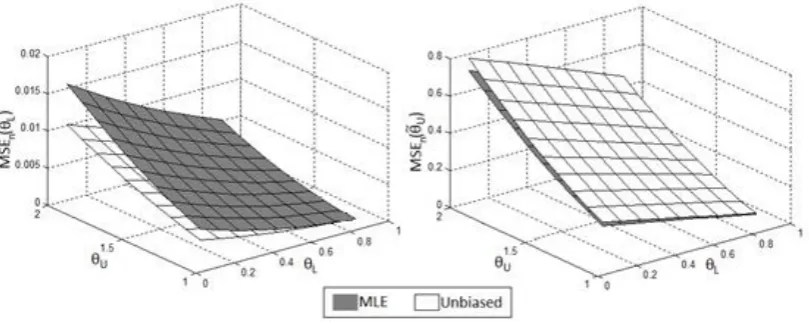
Figure 1 illustrates the performance of the MSE of the unbiased estimators against that
of the maximum likelihood estimators. This comparative analysis is obtained from
1,000 Monte Carlo simulations. In detail, we find that MSEn
L MSEn
ˆL while
ˆ
MSEn U MSEn U . Therefore, the unbiased estimator L is better than the
[image:12.595.95.500.563.724.2]corresponding MLE ˆL for the parameter L while the opposite applies for the parameter U.
The covariance of L and U is defined as follows (see Appendix 3 for formal mathematical analysis)
cov (n L, U)En L U En L En U
2 2 2
2
2 2
2 2
( ) 2( )
1
( 1) 2 ( 1) ( 1)
U L U L
L U L U L U
n n
n n n n
(37)
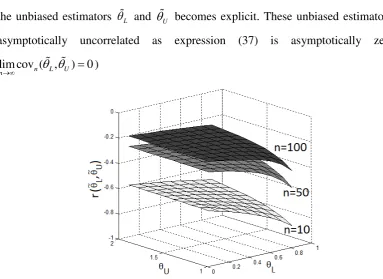
Based on expression (37) we develop Figure 2 where an inverse relationship between
the unbiased estimators L and U becomes explicit. These unbiased estimators are asymptotically uncorrelated as expression (37) is asymptotically zero (
[image:13.595.93.477.252.531.2]lim cov (n L, U) 0 n )
Figure 2. Covariance of the unbiased estimators L and U
2.3 Bayesian statistical inference
The prior
Let the vector ( O, I) of super-efficiency scores where O (1,...,k),
O 1
L
, and I (k1,...,n), 1 I U. In the absence of any information
about the distribution of the DEA super-efficiency scores, we assume OL and
I U
O
1
, 1, 1,..., 1
( )
0 , otherwise
L j L
j L
j k
f
(38)
I
1
, 1 , 1,...,
1
( )
0 , otherwise
j U U
j U
j k n
f
(39)
and joint PDF
O O iid O 1 1 ( ) ( ) (1 ) k
L j L k
j L
f f
(40)I I iid I 1 1 ( ) ( ) ( 1) n
U j U n k
j k U
f f
(41)The parameter L could be beta-distributed (see Appendix 4) with parameters 0 and 0.
Assuming the unbiased estimator of L is equivalent to the expected value of the prior
beta distribution of L (i.e.
), we find that δ is an expression of γ
(1 L)
L
(42)
and the prior beta distribution is reduced to the single parameter γ.
The vector O has a joint PDF
O O
1
O O
0
( , )
( ) ( ) ( )d
( , )
L
L L L L
k
f f f
(43)where k (beta function is defined in Appendix 4).
Then, the parameter γ is lower bounded
1 L L k
(44)
Assuming the unbiased estimator is identical to the expected value 1 of the prior shifted gamma-distribution of U, then the parameter is an expression of
1
U
(45)
Hence, the prior shifted gamma-distribution is reduced to the single parameter .
The vector I has a joint PDF
I I I I
1
( )
( ) ( ) ( )d
( )
U
U U U U
n k
f f f
(46)where n k.
Then, the parameter is upper bounded U 1
n k
(47)
The posterior
The Bayesian PDF of L O is Ο
Ο
Ο Ο Ο
Ο
( ) ( )
( )
( )
L L
L L
L
f f
f
f
(48)
According to the joint PDF (40), the Bayesian PDF (48) becomes
1 ( ) 1
1
(1 )
( , )
k
L L
k
(49)
which refers to a posterior beta distribution with parameters and k .
The posterior beta distribution shifts the corresponding prior beta distribution, with
parameters and , to the right, which is justified by the following expected values
O
k L k L
E E as
k
(50)
I I
I
1
I I
I
1
( 1) exp
( ) ( )
( )
( ) ( )
U U
n k U
U
U U
U n k
f f
f
f n k
(51)
which refers to a posterior shifted gamma distribution with parameters n k 0 and 0.
The posterior shifted gamma distribution shifts the corresponding prior distribution to
the left, which justifies the underestimation of the DEA efficiencies that are greater than
one. This underestimation is explained as follows
I
n k U n k U
E E as ( n k) 1 1 (52)
2.4 Bias correction
Let a correction parameter L L/ ˆL where L 1 (53)
Elaborating on expressions (42), (44) and (53), we estimate parameters and as follows
ˆ k L/ (1 L)
(54)
and ˆ (1 L)ˆ L
(55)
Two random data sets of size k are generated, where k expresses the number of DMUs
assigned efficiencies (e.g. obtained from DEA program (1)) lower than unity. The first
randomly generated data set is drawn from a prior beta distribution of L with
parameters ˆ and ˆ (see expressions (54) and (55)). The second randomly generated
data set is drawn from a posterior beta distribution L O with parameters ˆ and ˆk
. The prior to posterior distribution
O
L L
L
is fitted by a gamma distribution with
parameters zO 0 and eO 0. The maximum likelihood estimates of these two
parameters (i.e. zˆO and eˆO) are obtained from the MATLAB function gamfit. The
The corrected estimator is
O ˆO
ˆ
( , )
p pGamma z e
, p1,..., (k p j) (56)
with confidence interval p s( p)cv p p s( p)cv
w w
(57)
where w expresses the number of Monte Carlo iterations and cv denotes the critical
value of t-distribution with w1 degrees of freedom.
The Monte Carlo simulated mean and standard deviation are defined as follows
1 , 1
w
p p l
l
w
(58)and 1 2
, 1
( ) ( 1) ( )
w
p p l p
l
s w
(59)With respect to the DEA estimators that are greater than unity, we define a correction
parameter U U / ˆU that satisfies U 1 (60)
We already know that n k (46) and u 1
(45). To estimate the two
parameters of the shifted gamma distribution we introduce ( ˆ1) 1
( )
U U U
in (46), which
leads to ˆ ( )( ˆ 1)
( )
U U U
n k
(61) and
1
ˆ ˆ U
(62).
Similar to the correction process followed for the DEA estimators lying within the
interval (0,1), for the estimators exceeding one, we generate two random data sets for
both the prior shifted gamma distribution with parameters ˆ and ˆ, and the posterior shifted gamma distribution with parameters ˆ n k and ˆ. The prior to posterior
distribution
I
U U
U
is fitted by a gamma distribution with parameters zI 0 and
I 0
obtained from the MATLAB function gamfit. Like above, the goodness-of-fit is
calculated using the Wilcoxon rank sum test for equal medians.
The corrected estimator is
I ˆI
ˆ
( , ) q qGamma z e
, q1,...,n k (q j) (63)
with confidence interval q s( q)cv q q s( q)cv
w w
(64)
where 1 ,
1
w
q q l
l
w
and 1 , 21
( ) ( 1) ( )
w
q q l q
l
s w
.3. Application to E.U. banks
3.1 Data set and selection of variables
In this study, we used two data sets to test the performance of the Bayesian DEA method
in correcting bias of DEA estimators. The first data set consists of 50 banks while the
second one is expanded to 100 banks. In practice, the second data set includes 50 new
banks in addition to those of the first data set. Both data sets include three inputs (i.e.
(a) Deposits & Short-term funding; (b) Equity; (c) Overheads) and two outputs (i.e. (a)
Other operating income; (b) Total earning assets). The data come from Orbis Bank
Focus (the two data sets are available in the online version of this article; see Table E1).
The size of both samples is considered adequate for the dimension of the input-output
space. The sample size (e.g. 50 banks) satisfies the ‘rule of thumb’ put forth by Cooper
et al. (2007): nmax{xy, 3(xy)}, where n stands for the number of firms and x and
y are the number of inputs and output, respectively. However, the DEA efficiency
estimators assigned to the banks are expected to be biased as the samples of 50 and 100
firms are regarded as small and medium (Banker et al., 2010).
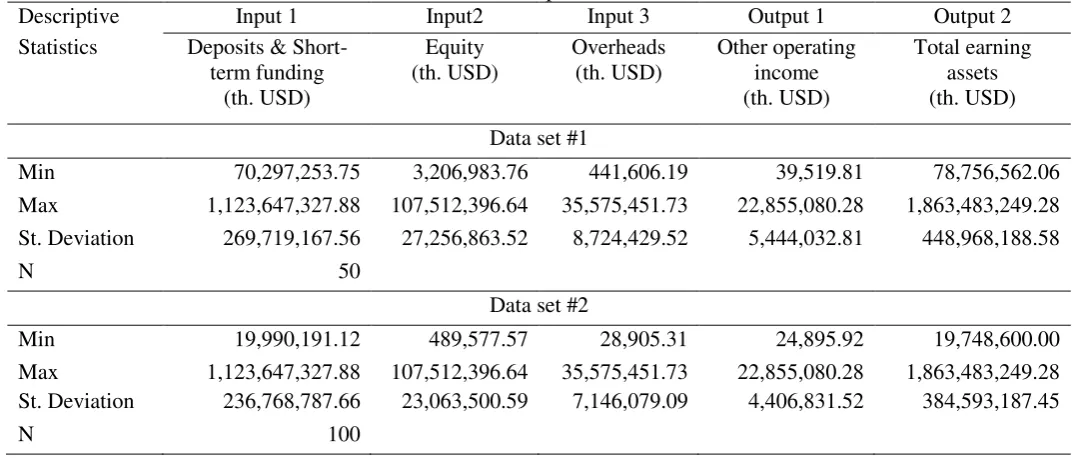
Descriptive statistics of the two-real-world data sets we used in this study are presented
Table 1. Descriptive statistics
Descriptive Input 1 Input2 Input 3 Output 1 Output 2 Statistics Deposits & Short-
term funding (th. USD)
Equity (th. USD)
Overheads (th. USD)
Other operating income (th. USD)
Total earning assets (th. USD) Data set #1
Min 70,297,253.75 3,206,983.76 441,606.19 39,519.81 78,756,562.06 Max 1,123,647,327.88 107,512,396.64 35,575,451.73 22,855,080.28 1,863,483,249.28 St. Deviation 269,719,167.56 27,256,863.52 8,724,429.52 5,444,032.81 448,968,188.58
N 50
Data set #2
Min 19,990,191.12 489,577.57 28,905.31 24,895.92 19,748,600.00 Max 1,123,647,327.88 107,512,396.64 35,575,451.73 22,855,080.28 1,863,483,249.28 St. Deviation 236,768,787.66 23,063,500.59 7,146,079.09 4,406,831.52 384,593,187.45
N 100
3.2 Empirical results
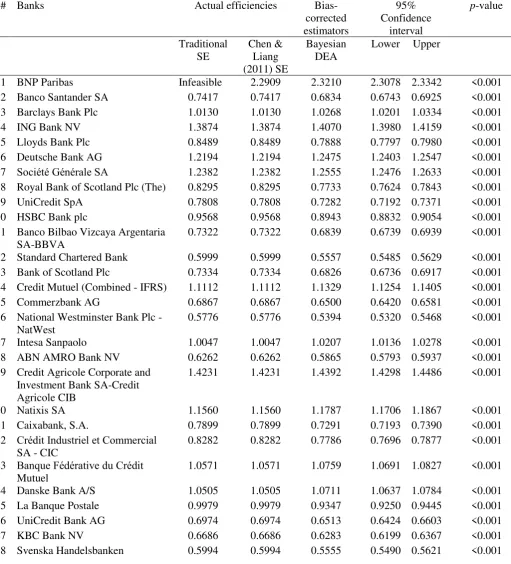
The empirical results of the first data set, consisting of 50 banks, are reported in Table
2. The actual efficiencies refer to the results obtained from the traditional
super-efficiency model of Andersen and Petersen (1993) and Chen and Liang (2011)’s super
-efficiency model (see model (1)). The bias-corrected super--efficiency estimators
yielded by our Bayesian DEA approach are presented on the right side column of the
actual efficiencies followed by the 95% Monte Carlo confidence intervals of the
bias-corrected estimators and the significance of the bias correction process (p-value).
According to Table 2, the Bayesian DEA approach presented in Section 2 yields
reduced estimators for actual efficiencies lower than one and increased estimators for
actual efficiencies exceeding one. The mean bias of efficiency estimators below one is
higher (i.e. mean bias: -0.0533; min bias: -0.0325 and max bias: -0.0723) than the bias
of the estimators above one (i.e. mean bias: 0.0209; min bias: 0.0137 and max bias:
0.0363). Moreover, in the case of estimators below one, the bias is higher for those
getting closer to unity while lower for the estimators with higher deviation from one.
The opposite applies to the super-efficiency estimators as the bias becomes lower when
the estimator approaches one and higher when it moves far from one. All bias-corrected
In the case of the sample of 50 banks, the mean square error (MSE), root mean square
error (RMSE) and mean absolute error (MAE) of the Bayesian DEA estimators are
[image:20.595.45.557.198.763.2]0.0021, 0.0453 and 0.0416, respectively.
Table 2. Empirical results
# Banks Actual efficiencies
Bias-corrected estimators
95% Confidence
interval
p-value
Traditional SE
Chen & Liang (2011) SE
Bayesian DEA
Lower Upper
1 BNP Paribas Infeasible 2.2909 2.3210 2.3078 2.3342 <0.001 2 Banco Santander SA 0.7417 0.7417 0.6834 0.6743 0.6925 <0.001 3 Barclays Bank Plc 1.0130 1.0130 1.0268 1.0201 1.0334 <0.001 4 ING Bank NV 1.3874 1.3874 1.4070 1.3980 1.4159 <0.001 5 Lloyds Bank Plc 0.8489 0.8489 0.7888 0.7797 0.7980 <0.001 6 Deutsche Bank AG 1.2194 1.2194 1.2475 1.2403 1.2547 <0.001 7 Société Générale SA 1.2382 1.2382 1.2555 1.2476 1.2633 <0.001 8 Royal Bank of Scotland Plc (The) 0.8295 0.8295 0.7733 0.7624 0.7843 <0.001 9 UniCredit SpA 0.7808 0.7808 0.7282 0.7192 0.7371 <0.001 10 HSBC Bank plc 0.9568 0.9568 0.8943 0.8832 0.9054 <0.001 11 Banco Bilbao Vizcaya Argentaria
SA-BBVA
0.7322 0.7322 0.6839 0.6739 0.6939 <0.001
12 Standard Chartered Bank 0.5999 0.5999 0.5557 0.5485 0.5629 <0.001 13 Bank of Scotland Plc 0.7334 0.7334 0.6826 0.6736 0.6917 <0.001 14 Credit Mutuel (Combined - IFRS) 1.1112 1.1112 1.1329 1.1254 1.1405 <0.001 15 Commerzbank AG 0.6867 0.6867 0.6500 0.6420 0.6581 <0.001 16 National Westminster Bank Plc -
NatWest
0.5776 0.5776 0.5394 0.5320 0.5468 <0.001
17 Intesa Sanpaolo 1.0047 1.0047 1.0207 1.0136 1.0278 <0.001 18 ABN AMRO Bank NV 0.6262 0.6262 0.5865 0.5793 0.5937 <0.001 19 Credit Agricole Corporate and
Investment Bank SA-Credit Agricole CIB
1.4231 1.4231 1.4392 1.4298 1.4486 <0.001
20 Natixis SA 1.1560 1.1560 1.1787 1.1706 1.1867 <0.001 21 Caixabank, S.A. 0.7899 0.7899 0.7291 0.7193 0.7390 <0.001 22 Crédit Industriel et Commercial
SA - CIC
0.8282 0.8282 0.7786 0.7696 0.7877 <0.001
23 Banque Fédérative du Crédit Mutuel
1.0571 1.0571 1.0759 1.0691 1.0827 <0.001
29 Banco de Sabadell SA 0.8004 0.8004 0.7395 0.7303 0.7487 <0.001 30 Bankia, SA 0.5714 0.5714 0.5388 0.5319 0.5458 <0.001 31 UniCredit Bank Austria AG-Bank
Austria
0.7621 0.7621 0.7053 0.6954 0.7151 <0.001
32 Deutsche Postbank AG 0.7525 0.7525 0.7003 0.6919 0.7088 <0.001 33 ING-DiBa AG 0.5462 0.5462 0.5057 0.4987 0.5128 <0.001 34 Skandinaviska Enskilda Banken
AB
1.0449 1.0449 1.0627 1.0556 1.0699 <0.001
35 Banco Popular Espanol SA 0.6505 0.6505 0.6097 0.6017 0.6178 <0.001 36 Le Crédit Lyonnais (LCL) SA 0.8824 0.8824 0.8131 0.8023 0.8239 <0.001 37 ING Belgium SA/NV-ING 0.7142 0.7142 0.6624 0.6545 0.6704 <0.001 38 Banca Monte dei Paschi di Siena
SpA-Gruppo Monte dei Paschi di Siena
1.1716 1.1716 1.1977 1.1896 1.2058 <0.001
39 Deutsche Bank Privat-und Geschaftskunden AG
1.5377 1.5377 1.5564 1.5454 1.5675 <0.001
40 Banco BPM SPA 0.9995 0.9995 0.9390 0.9267 0.9512 <0.001 41 Belfius Banque SA/NV-Belfius
Bank SA/NV
0.8518 0.8518 0.7938 0.7833 0.8043 <0.001
42 Raiffeisen Bank International AG 0.9183 0.9183 0.8549 0.8444 0.8655 <0.001 43 Bank Austria Creditanstalt AG 0.9260 0.9260 0.8624 0.8511 0.8737 <0.001 44 Dexia Crédit Local SA 2.4948 2.4948 2.5311 2.5143 2.5479 <0.001 45 Caixa Geral de Depositos 1.1182 1.1182 1.1368 1.1305 1.1432 <0.001 46 Allied Irish Banks plc 0.9073 0.9073 0.8350 0.8229 0.8471 <0.001 47 Piraeus Bank SA 0.9216 0.9216 0.8615 0.8509 0.8721 <0.001 48 Abbey National Treasury
Services Plc
1.1857 1.1857 1.2032 1.1955 1.2109 <0.001
49 National Bank of Greece SA 0.9647 0.9647 0.8942 0.8826 0.9059 <0.001 50 Deutsche Kreditbank AG (DKB) 1.2066 1.2066 1.2235 1.2147 1.2323 <0.001
MSE 0.0021
RMSE 0.0453
MAE 0.0416
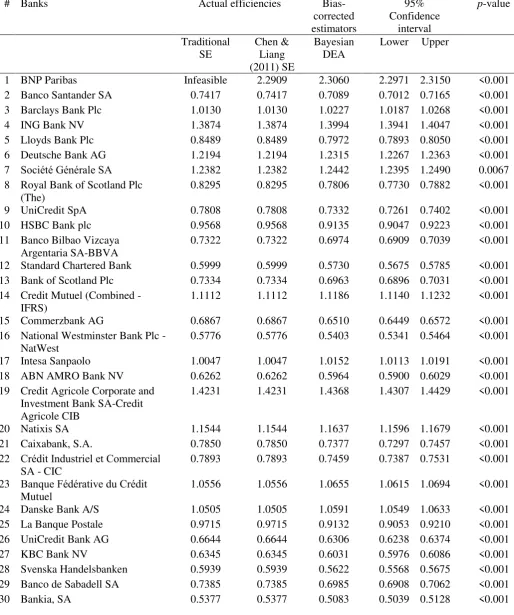
In the case of the extended sample of 100 banks (Table A1 in Appendix 6), the MSE,
RMSE and MAE of the Bayesian DEA estimators are 0.0013, 0.0355 and 0.0321,
respectively. All three measures are lower than the corresponding measures referring
to the sample of 50 banks (Table 2). It should be noted that this Bayesian DEA approach
is appropriate for small and medium samples where the estimators, lower and greater
than unity, are dependent. Based on expression (37) and Figure 2, it is straightforward
4. Concluding remarks and future research
The purpose of this study was to develop a Bayesian DEA approach for correcting bias
of super-efficiency estimators. The new method uses consistent estimators to the
unknown efficiency parameters to correct the bias of the actual efficiencies. The
assumptions made for the development of the Bayesian DEA method are regarded as
realistic.
The new method draws on Chen and Liang (2011)’s super-efficiency model. However,
other super-efficiency models that tackle the infeasibility problem could be used
instead. The new Bayesian DEA method is appropriate for small and medium data sets
where dependence among the estimators below and above one is present. The empirical
results showed a decrease in MSE, RMSE and MAE when the sample size increases.
In addition, the range of the 95% Monte Carlo confidence intervals of the estimators
decreases while the sample size becomes larger. The empirical analysis presented in
this study was based on two real-world data sets of 50 and 100 firms coming from the
E.U. banking sector. The two data sets included three inputs and two outputs.
Further research is needed to test the performance of the new Bayesian DEA
bias-corrected estimators when real-world data sets of different dimensions and scales than
those used in this study are employed. The Bayesian DEA method presented in this
work should be modified to become appropriate for large samples as well. Furthermore,
the application of outlier-detection methods in conjunction with the new Bayesian DEA
method would prevent distortion of the bias-corrected estimators - especially in cases
where observed efficiency estimators are significantly higher than one. Addressing
these limitations would improve the performance, applicability and generalizability of
Appendices
Appendix 1.1
The expected value of ˆL is as follows
1ˆ
1 d
ˆ ( , )d ( ) d ( ( ) )d
( ) ( ) d
U U U
L
L L L
n n
n L L U n U n U
U L U L
n
E t f t t t t t t t t
t
1( ( ) ) 1 1 d ( )
= ( ) d d
( ) ( ) ( ) d 1
U U U
L L L n n n U U U L
n n n
U L U L U L
t t t
t t t
t n
1 ( ) 1( ) 1 1
U
L
n
U U L
L n L
U L t n n 1 1 1 1 L U n n n Appendix 1.2
The second moment of ˆL is defined as follows
2 2 2ˆ 1
2( ) ( 1)( )
ˆ ( , )d d
1 ( )
U U
L
L L
n
U L U
n L L U L n
U L
n t
E t f t t t t
n
2 2 12( ) ˆ 2( ) ( 1)
1 1 2
U L U L L U
L n L L
n E
n n n
Appendix 2
The covariance of ˆL and ˆU is defined as follows
ˆ ˆ ˆ ˆ ˆ ˆ
cov (n L, U)En L U En L En U (A2.a)
where
2ˆ ˆ
( , )
( 1)( )
ˆ ˆ ( , , )d d d d
( )
U U
L U
L L L L
s s n
n L U L U n
U L
n n s t
E ts f t s t s ts t s
2( 1)( ) d d
( ) U L L s n n U L n
s t n s t t s
(A2.b)2 1 ( )
( 1)( ) d ( )
L
s n
n n L
L L
s
t n s t t s
n
(A2.c)2 2
1 ( ) ( ) ( ) ( )
( ) d
( 1) ( 1)( 2)
U
L
n n n
n
n L L U U L U L U L
L L
s
s s s
n n n n n n n
(A2.d)By replacing (A2.c) and (A2.d) in (A2.b), we obtain
2 2( ) ( ) ( )
ˆ ˆ
( ) ( 1) ( 1)( 2)
n n n
U L U L U L
n L U n L U
U L
n E
n n n n n n
2 ( ) 2 U L L U n
(A2.e)
Introducing expressions (A2.e),
ˆ 11 1
n L L U
n E
n n
(12), and
ˆ 11 1
n U U L
n E
n n
(19) in (A2.a) we find
2 2 2 22
( ) ( 1) ( )
ˆ ˆ
cov ,
2 ( 1)
U L L U L U
n L U L U
n n n n Appendix 3
The covariance of L and U is defined as follows
cov (n L, U)En L U En L En U
Based on expressions (26) and (27), we obtain
2 2 2
2
ˆ ˆ ˆ ˆ 1 ˆ ˆ ˆ ˆ ˆ ˆ
1 1 ( 1)
L U U L
n L U n n L U L U U L
n n
E E E n n n
n n n
2 2 2
2
1 ˆ ˆ ˆ ˆ
( 1) ( ) ( ) ( )
(n 1) n En L U nEn L nEn U
(A3.a)
given expressions (14), (21) and (A2.e), (A3.a) is rewritten as follows
2 2
2
2 2
( ) 2( ) ( 1)
1 =
( 1) 2 ( 1) 1 2
U L U L L U
L U L
n
n n
n n n n n
2 2
2( ) ( 1)
( 1) 1 2
U L U L
U
n n
n n n
2 2 2 ( ) 1 =
( 1) 2
U L L U n n n
2 2 2 2( )( 1) ( 1)
( 1) ( 1)( 2)
U L
L U L U U L
n
n n
n n n
where
2 22( )
( 1) ( 1) 2
( 1)( 2) 1
U L U L
L n U U n L
n n n
Since the estimators are unbiased we find
cov (n L, U)En L U En L En U
2 2 2
2
2 2
2 2
( ) 2( )
1
( 1) 2 ( 1) ( 1)
U L U L
L U L U L U
n n
n n n n
Appendix 4
The prior beta distribution of L with parameters 0 and 0 has a PDF
1 1
1
( ) (1 ) , 0 1
( , )
L L L L L
f
with the function
1
1 1
0
( , ) L (1 L)dL
Appendix 5
Let a random variable v be gamma-distributed with parameters a0 and 0. The PDF is
1
exp( / )
, 0
( , ) ( )
0 , otherwise
v v v Gamma v
where 1
0
( ) t exp( t)dt
The expected value of v is ( )E v
The shifted random variable vs v 1 is shifted gamma-distributed with PDF
1
( 1) exp ( 1) /
, 1
( , ) ( 1 , ) ( )
0 , otherwise
s
s s
s
v s s
v v
v
Gamma v Gamma v
Appendix 6
Table A1. Efficiency estimators
# Banks Actual efficiencies
Bias-corrected estimators
95% Confidence
interval
p-value
Traditional SE
Chen & Liang (2011) SE
Bayesian DEA
Lower Upper
1 BNP Paribas Infeasible 2.2909 2.3060 2.2971 2.3150 <0.001 2 Banco Santander SA 0.7417 0.7417 0.7089 0.7012 0.7165 <0.001 3 Barclays Bank Plc 1.0130 1.0130 1.0227 1.0187 1.0268 <0.001 4 ING Bank NV 1.3874 1.3874 1.3994 1.3941 1.4047 <0.001 5 Lloyds Bank Plc 0.8489 0.8489 0.7972 0.7893 0.8050 <0.001 6 Deutsche Bank AG 1.2194 1.2194 1.2315 1.2267 1.2363 <0.001 7 Société Générale SA 1.2382 1.2382 1.2442 1.2395 1.2490 0.0067 8 Royal Bank of Scotland Plc
(The)
0.8295 0.8295 0.7806 0.7730 0.7882 <0.001
9 UniCredit SpA 0.7808 0.7808 0.7332 0.7261 0.7402 <0.001 10 HSBC Bank plc 0.9568 0.9568 0.9135 0.9047 0.9223 <0.001 11 Banco Bilbao Vizcaya
Argentaria SA-BBVA
0.7322 0.7322 0.6974 0.6909 0.7039 <0.001
12 Standard Chartered Bank 0.5999 0.5999 0.5730 0.5675 0.5785 <0.001 13 Bank of Scotland Plc 0.7334 0.7334 0.6963 0.6896 0.7031 <0.001 14 Credit Mutuel (Combined -
IFRS)
1.1112 1.1112 1.1186 1.1140 1.1232 <0.001
15 Commerzbank AG 0.6867 0.6867 0.6510 0.6449 0.6572 <0.001 16 National Westminster Bank Plc -
NatWest
0.5776 0.5776 0.5403 0.5341 0.5464 <0.001
17 Intesa Sanpaolo 1.0047 1.0047 1.0152 1.0113 1.0191 <0.001 18 ABN AMRO Bank NV 0.6262 0.6262 0.5964 0.5900 0.6029 <0.001 19 Credit Agricole Corporate and
Investment Bank SA-Credit Agricole CIB
1.4231 1.4231 1.4368 1.4307 1.4429 <0.001
20 Natixis SA 1.1544 1.1544 1.1637 1.1596 1.1679 <0.001 21 Caixabank, S.A. 0.7850 0.7850 0.7377 0.7297 0.7457 <0.001 22 Crédit Industriel et Commercial
SA - CIC
0.7893 0.7893 0.7459 0.7387 0.7531 <0.001
23 Banque Fédérative du Crédit Mutuel
1.0556 1.0556 1.0655 1.0615 1.0694 <0.001
31 UniCredit Bank Austria AG-Bank Austria
0.7204 0.7204 0.6805 0.6733 0.6877 <0.001
32 Deutsche Postbank AG 0.6735 0.6735 0.6362 0.6297 0.6426 <0.001 33 ING-DiBa AG 0.4104 0.4104 0.3888 0.3848 0.3929 <0.001 34 Skandinaviska Enskilda Banken
AB
0.9987 0.9987 0.9464 0.9363 0.9565 <0.001
35 Banco Popular Espanol SA 0.5486 0.5486 0.5193 0.5140 0.5245 <0.001 36 Le Crédit Lyonnais (LCL) SA 0.7613 0.7613 0.7181 0.7117 0.7245 <0.001 37 ING Belgium SA/NV-ING 0.5325 0.5325 0.5046 0.4994 0.5099 <0.001 38 Banca Monte dei Paschi di Siena
SpA-Gruppo Monte dei Paschi di Siena
1.0716 1.0716 1.0872 1.0826 1.0917 <0.001
39 Deutsche Bank Privat-und Geschaftskunden AG
1.0945 1.0945 1.1038 1.0993 1.1083 <0.001
40 Banco BPM SPA 0.9447 0.9447 0.8974 0.8885 0.9063 <0.001 41 Belfius Banque SA/NV-Belfius
Bank SA/NV
0.6500 0.6500 0.6160 0.6099 0.6221 <0.001
42 Raiffeisen Bank International AG
0.6788 0.6788 0.6433 0.6365 0.6502 <0.001
43 Bank Austria Creditanstalt AG 0.6849 0.6849 0.6486 0.6422 0.6549 <0.001 44 Dexia Crédit Local SA 2.4948 2.4948 2.5147 2.5060 2.5234 <0.001 45 Caixa Geral de Depositos 0.8878 0.8878 0.8435 0.8355 0.8516 <0.001 46 Allied Irish Banks plc 0.4556 0.4556 0.4308 0.4266 0.4350 <0.001 47 Piraeus Bank SA 0.3890 0.3890 0.3709 0.3671 0.3747 <0.001 48 Abbey National Treasury
Services Plc
0.8700 0.8700 0.8252 0.8179 0.8324 <0.001
49 National Bank of Greece SA 0.4045 0.4045 0.3860 0.3821 0.3898 <0.001 50 Deutsche Kreditbank AG (DKB) 0.5329 0.5329 0.5078 0.5028 0.5129 <0.001 51 Eurobank Ergasias SA 0.4360 0.4360 0.4141 0.4100 0.4181 <0.001 52 Banca Nazionale del Lavoro
SpA-BNL
0.5846 0.5846 0.5556 0.5499 0.5612 <0.001
53 HSBC France SA 1.0171 1.0171 1.0253 1.0213 1.0294 <0.001 54 Banco Comercial Português, SA
-Millennium bcp
0.9004 0.9004 0.8517 0.8435 0.8598 <0.001
55 Alpha Bank AE 0.4538 0.4538 0.4322 0.4278 0.4367 <0.001 56 SNS Bank N.V. 0.5847 0.5847 0.5487 0.5430 0.5544 <0.001 57 Nykredit Realkredit A/S 1.3530 1.3530 1.3625 1.3570 1.3679 <0.001 58 CACEIS Bank Luxembourg 0.9121 0.9121 0.8682 0.8590 0.8773 <0.001 59 Crédit du Nord SA 0.7184 0.7184 0.6752 0.6685 0.6819 <0.001 60 Ibercaja Banco SAU 1.4488 1.4488 1.4594 1.4534 1.4653 <0.001 61 Kutxabank SA 0.5622 0.5622 0.5332 0.5278 0.5386 <0.001 62 Novo Banco 0.6055 0.6055 0.5708 0.5654 0.5762 <0.001 63 Abanca Corporacion Bancaria
SA
0.8723 0.8723 0.8213 0.8133 0.8294 <0.001
69 Bank of New York Mellon SA/NV
0.7982 0.7982 0.7551 0.7468 0.7634 <0.001
70 Co-operative Bank Plc (The) 0.6823 0.6823 0.6405 0.6337 0.6474 <0.001 71 BGL BNP Paribas 0.6587 0.6587 0.6214 0.6152 0.6276 <0.001 72 Mediobanca
SpA-MEDIOBANCA - Banca di
Credito Finanziario Società per
Azioni
0.9987 0.9987 0.9464 0.9363 0.9565 <0.001
73 Bank Polska Kasa Opieki SA-Bank Pekao SA
0.6734 0.6734 0.6409 0.6350 0.6469 <0.001
74 Lyonnaise de Banque SA 0.9797 0.9797 0.9293 0.9204 0.9381 <0.001 75 OP Corporate Bank plc 1.3976 1.3976 1.4046 1.4001 1.4092 0.0015 76 Jyske Bank A/S (Group) 0.9055 0.9055 0.8552 0.8472 0.8632 <0.001 77 Ceska Sporitelna a.s. 0.6957 0.6957 0.6592 0.6522 0.6662 <0.001 78 OTP Bank Plc 1.1127 1.1127 1.1203 1.1158 1.1248 <0.001 79 Bank für Arbeit und Wirtschaft
und Österreichische
Postsparkasse
Aktiengesellschaft-BAWAG P.S.K. AG
0.7754 0.7754 0.7301 0.7229 0.7372 <0.001
80 Komercni Banka 0.7662 0.7662 0.7286 0.7217 0.7354 <0.001 81 Banque CIC Est SA 1.0218 1.0218 1.0314 1.0270 1.0358 <0.001 82 SEB AG 0.8577 0.8577 0.8094 0.8014 0.8174 <0.001 83 Banco di Napoli SpA 0.8153 0.8153 0.7719 0.7642 0.7795 <0.001 84 Bank Zachodni WBK S.A. 0.8070 0.8070 0.7577 0.7496 0.7658 <0.001 85 Permanent TSB Plc 0.8130 0.8130 0.7669 0.7598 0.7740 <0.001 86 Sumitomo Mitsui Banking
Corporation Europe Limited-SMBCE
0.8248 0.8248 0.7847 0.7768 0.7926 <0.001
87 Ceskoslovenska Obchodni Banka A.S.- CSOB
0.8442 0.8442 0.7966 0.7879 0.8053 <0.001
88 Credito Emiliano SpA-CREDEM
0.8893 0.8893 0.8369 0.8287 0.8450 <0.001
89 KfW Ipex-Bank Gmbh 0.9140 0.9140 0.8631 0.8553 0.8709 <0.001 90 Banca Mediolanum SpA 1.2666 1.2666 1.2777 1.2729 1.2825 <0.001 91 mBank SA 0.8761 0.8761 0.8313 0.8224 0.8401 <0.001 92 Danske Bank Plc 0.9320 0.9320 0.8864 0.8774 0.8953 <0.001 93 Citibank International Limited 0.9092 0.9092 0.8498 0.8419 0.8577 <0.001 94 Banco Cooperativo Espanol 2.4548 2.4548 2.4821 2.4733 2.4910 <0.001 95 CIC Ouest SA 1.1469 1.1469 1.1559 1.1507 1.1611 <0.001 96 Erste Bank der Oesterreichischen
Sparkassen AG
0.9982 0.9982 0.9509 0.9425 0.9592 <0.001
97 Montepio Investimento SA 1.0670 1.0670 1.0732 1.0686 1.0777 0.0041 98 Bank of Cyprus Public Company
Limited-Bank of Cyprus Group
0.9973 0.9973 0.9410 0.9314 0.9507 <0.001
99 ABH Financial Limited 1.2521 1.2521 1.2654 1.2607 1.2701 <0.001 100 Banca Carige SpA 1.0916 1.0916 1.1000 1.0959 1.1041 <0.001
MSE 0.0013
RMSE 0.0355
References
Andersen, P. & Petersen, N. C. (1993). A procedure for ranking efficient units in data
envelopment analysis. Management Science, 39, 1261-1264.
Banker, R. D. (1993). Maximum likelihood, consistency and data envelopment
analysis: A statistical foundation. Management Science, 39, 1265-1273.
Banker, R. D., & Chang, H. (2006). The super-efficiency procedure for outlier
identification, not for ranking efficient units. European Journal of Operational
Research, 175, 1311-1320.
Banker, R. D., & Gifford, J. L. (1988). A relative efficiency model for the evaluation
public health nurse productivity. Pittsburgh: Mimeo, Carnegie Mellon University.
Banker, R. D., & Maindiratta, A. (1992). Maximum likelihood estimation of monotone
and concave production frontiers. Journal of Productivity Analysis, 3, 401-415.
Banker, R. D., & Natarajan, R. (2008). Evaluating contextual variables affecting
productivity using data envelopment analysis. Operations Research, 56,