Sequence-to-Sequence Generation for Spoken Dialogue via Deep Syntax
Trees and Strings
Ondˇrej Duˇsek and Filip Jurˇc´ıˇcek
Charles University in Prague, Faculty of Mathematics and Physics Institute of Formal and Applied Linguistics
Malostransk´e n´amˇest´ı 25, CZ-11800 Prague, Czech Republic
{odusek,jurcicek}@ufal.mff.cuni.cz
Abstract
We present a natural language genera-tor based on the sequence-to-sequence ap-proach that can be trained to produce natu-ral language strings as well as deep syntax dependency trees from input dialogue acts, and we use it to directly compare two-step generation with separate sentence plan-ning and surface realization stages to a joint, one-step approach.
We were able to train both setups success-fully using very little training data. The joint setup offers better performance, sur-passing state-of-the-art with regards to n-gram-based scores while providing more relevant outputs.
1 Introduction
In spoken dialogue systems (SDS), the task of nat-ural language generation (NLG) is to convert a meaning representation (MR) produced by the di-alogue manager into one or more sentences in a natural language. It is traditionally divided into two subtasks: sentence planning, which decides on the overall sentence structure, andsurface re-alization, determining the exact word forms and linearizing the structure into a string (Reiter and Dale, 2000). While some generators keep this di-vision and use a two-step pipeline (Walker et al., 2001; Rieser et al., 2010; Dethlefs et al., 2013), others apply a joint model for both tasks (Wong and Mooney, 2007; Konstas and Lapata, 2013).
We present a new, conceptually simple NLG system for SDS that is able to operate in both modes: it either produces natural language strings or generates deep syntax dependency trees, which are subsequently processed by an external surface realizer (Duˇsek et al., 2015). This allows us to show a direct comparison of two-step generation,
where sentence planning and surface realization are separated, with a joint, one-step approach.
Our generator is based on the sequence-to-sequence (seq2seq) generation technique (Cho et al., 2014; Sutskever et al., 2014), combined with beam search and ann-best list reranker to suppress irrelevant information in the outputs. Unlike most previous NLG systems for SDS (e.g., (Stent et al., 2004; Raux et al., 2005; Mairesse et al., 2010)), it is trainable from unaligned pairs of MR and sen-tences alone. We experiment with using much less training data than recent systems based on recur-rent neural networks (RNN) (Wen et al., 2015b; Mei et al., 2015), and we find that our genera-tor learns successfully to produce both strings and deep syntax trees on the BAGEL restaurant infor-mation dataset (Mairesse et al., 2010). It is able to surpassn-gram-based scores achieved previously by Duˇsek and Jurˇc´ıˇcek (2015), offering a simpler setup and more relevant outputs.
We introduce the generation setting in Section 2 and describe our generator architecture in Sec-tion 3. SecSec-tion 4 details our experiments, SecSec-tion 5 analyzes the results. We summarize related work in Section 6 and offer conclusions in Section 7.
2 Generator Setting
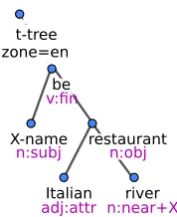
The input to our generator aredialogue acts(DA) (Young et al., 2010) representing an action, such asinformor request, along with one or more at-tributes (slots) and their values. Our generator op-erates in two modes, producing either deep syn-tax trees (Duˇsek et al., 2012) or natural language strings (see Fig. 1). The first mode corresponds to the sentence planning NLG stage as it decides the syntactic shape of the output sentence; the result-ing deep syntax tree involves content words (lem-mas) and their syntactic form (formemes, purple in Fig. 1). The trees are linearized to strings using a
t-tree zone=en
X-name
n:subj
be
v:fin
Italian
adj:attr
restaurant
n:obj
river
n:near+X
inform(name=X-name,type=placetoeat,eattype=restaurant, area=riverside,food=Italian)
[image:2.595.125.214.79.188.2]X is an Italian restaurant near the river.
Figure 1: Example DA (top) with the correspond-ing deep syntax tree (middle) and natural language string (bottom)
surface realizer from the TectoMT translation sys-tem (Duˇsek et al., 2015). The second generator mode joins sentence planning and surface realiza-tion into one step, producing natural language sen-tences directly.
Both modes offer their advantages: The two-step mode simplifies generation by abstracting away from complex surface syntax and morphol-ogy, which can be handled by a handcrafted, domain-independent module to ensure grammat-ical correctness at all times (Duˇsek and Jurˇc´ıˇcek, 2015), and the joint mode does not need to model structure explicitly and avoids accumulating errors along the pipeline (Konstas and Lapata, 2013).
3 The Seq2seq Generation Model
Our generator is based on the seq2seq approach (Cho et al., 2014; Sutskever et al., 2014), a type of an encoder-decoder RNN architecture operat-ing on variable-length sequences of tokens. We address the necessary conversion of input DA and output trees/sentences into sequences in Sec-tion 3.1 and then describe the main seq2seq com-ponent in Section 3.2. It is supplemented by a reranker, as explained in Section 3.3.
3.1 Sequence Representation of DA, Trees, and Sentences
We represent DA, deep syntax trees, and sentences as sequences of tokens to enable their usage in the sequence-based RNN components of our genera-tor (see Sections 3.2 and 3.3). Each token is rep-resented by its embedding – a vector of floating-point numbers (Bengio et al., 2003).
To form a sequence representation of a DA, we create a triple of the structure “DA type, slot, value” for each slot in the DA and concatenate
the triples (see Fig. 3). The deep syntax tree out-put from the seq2seq generator is represented in a bracketed notation similar to the one used by Vinyals et al. (2015, see Fig. 2). The inputs to the reranker are always a sequence of tokens; struc-ture is disregarded in trees, resulting in a list of lemma-formeme pairs (see Fig. 2).
3.2 Seq2seq Generator
Our seq2seq generator with attention (Bahdanau et al., 2015, see Fig. 3)1starts with the encoder stage,
which uses an RNN to encode an input sequence
x={x1, . . . , xn}into a sequence of encoder
out-puts and hidden statesh = {h1, . . . , hn}, where
ht = lstm(xt, ht−1), a non-linear function
rep-resented by the long-short-term memory (LSTM) cell (Graves, 2013).
The decoder stage then uses the hidden states to generate a sequencey={y1, . . . , ym}with a
sec-ond LSTM-based RNN. The probability of each output token is defined as:
p(yt|y1, . . . , yt−1,x) =softmax((st◦ct)WY)
Here, st is the decoder state where s0 = hn
andst = lstm((yt−1 ◦ct)WS, st−1), i.e., the
de-coder is initialized by the last hidden state and uses the previous output token at each step. WY
andWSare learned linear projection matrices and
“◦” denotes concatenation. ct is the context
vec-tor– a weighted sum of the encoder hidden states ct = Pni=1αtihi, where αti corresponds to an
alignment model, represented by a feed-forward network with a singletanhhidden layer.
On top of this basic seq2seq model, we im-plemented a simple beam search for decoding (Sutskever et al., 2014; Bahdanau et al., 2015). It proceeds left-to-right and keeps track of log prob-abilities of top n possible output sequences, ex-panding them one token at a time.
3.3 Reranker
( <root> <root> ( ( X-name n:subj ) be v:fin ( ( Italian adj:attr ) restaurant n:obj ( river n:near+X ) ) ) ) X-name n:subj be v:fin Italian adj:attr restaurant n:obj river n:near+X
Figure 2: Trees encoded as sequences for the seq2seq generator (top) and the reranker (bottom)
inform name X-name inform eattype restaurant <GO> X is a restaurant . X is a restaurant . <STOP>
lstm lstm lstm lstm lstm lstm
lstm lstm lstm lstm lstm lstm
att
+
att att att att att
Figure 3: Seq2seq generator with attention
X is a restaurant .
lstm lstm lstm lstm lstm 110 10
infor
m
name=X
-name
eattype=bar
eattype=r
estaur
ant
ar
ea=citycen
tr
e
inform(name=X-name,eattype=bar, area=citycentre)
σ 101 11
✓✗✗✓✗ penalty=3
ar
ea=riverside
0
[image:3.595.74.288.215.340.2]0 ✓
Figure 4: The reranker
The input DA is converted to a similar 1-hot vec-tor and the reranking penalty of the sentence is the Hamming distance between the two vectors (see Fig. 4). Weighted penalties for all sentences are subtracted from theirn-best list log probabilities.
We employ a similar architecture for the classi-fier as in our seq2seq generator encoder (see Sec-tion 3.2), with an RNN encoder operating on the output trees/strings and a single logistic layer for classification over the last encoder hidden state. Given an output sequence representing a string or a treey ={y1, . . . , yn}(cf. Section 3.1), the
en-coder again produces a sequence of hidden states
h = {h1, . . . , hn} where ht = lstm(yt, ht−1).
The output binary vectorois computed as: oi =sigmoid((hn·WR+b)i)
Here,WRis a learned projection matrix andbis a
corresponding bias term. 4 Experiments
We perform our experiments on the BAGEL data set of Mairesse et al. (2010), which contains 202 DA from the restaurant information domain with two natural language paraphrases each, de-scribing restaurant locations, price ranges, food types etc. Some properties such as restaurant names or phone numbers are delexicalized (re-placed with “X” symbols) to avoid data spar-sity.2Unlike Mairesse et al. (2010), we do not use
2We adopt the delexicalization scenario used by Mairesse et al. (2010) and Duˇsek and Jurˇc´ıˇcek (2015).
manually annotated alignment of slots and values in the input DA to target words and phrases and let the generator learn it from data, which simpli-fies training data preparation but makes our task harder. We lowercase the data and treat plural -s as separate tokens for generating into strings, and we apply automatic analysis from the Treex NLP toolkit (Popel and ˇZabokrtsk´y, 2010) to ob-tain deep syntax trees for training tree-based gen-erator setups.3 Same as Mairesse et al. (2010), we
apply 10-fold cross-validation, with 181 training DA and 21 testing DA. In addition, we reserve 10 DA from the training set for validation.4
To train our seq2seq generator, we use the Adam optimizer (Kingma and Ba, 2015) to min-imize unweighted sequence cross-entropy.5 We
perform 10 runs with different random initializa-tion of the network and up to 1,000 passes over the training data,6 validating after each pass and
se-lecting the parameters that yield the highest BLEU score on the validation set. Neither beam search nor the reranker are used for validation.
We use the Adam optimizer minimizing cross-entropy to train the reranker as well.7 We perform
a single run of up to 100 passes over the data, and we also validate after each pass and select the parameters giving minimal Hamming distance on both validation and training set.8
3The input vocabulary size is around 45 (DA types, slots, and values added up) and output vocabulary sizes are around 170 for string generation and 180 for tree generation (45 formemes and 135 lemmas).
4We treat the two paraphrases for the same DA as sepa-rate instances in the training set but use them together as two references to measure BLEU and NIST scores (Papineni et al., 2002; Doddington, 2002) on the validation and test sets.
5Based on a few preliminary experiments, the learning rate is set to 0.001, embedding size 50, LSTM cell size 128, and batch size 20. Reranking penalty for decoding is 100.
6Training is terminated early if the top 10 so far achieved validation BLEU scores do not change for 100 passes.
Setup BLEU NIST ERR
Mairesse et al. (2010)∗ ∼67 - 0
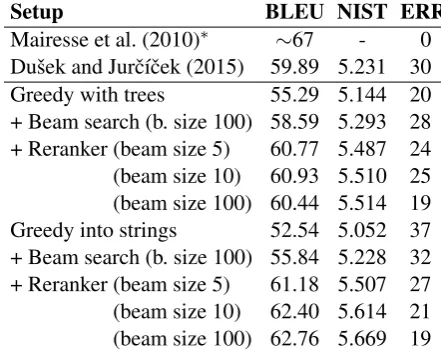
[image:4.595.70.291.63.239.2]Duˇsek and Jurˇc´ıˇcek (2015) 59.89 5.231 30 Greedy with trees 55.29 5.144 20 + Beam search (b. size 100) 58.59 5.293 28 + Reranker (beam size 5) 60.77 5.487 24 (beam size 10) 60.93 5.510 25 (beam size 100) 60.44 5.514 19 Greedy into strings 52.54 5.052 37 + Beam search (b. size 100) 55.84 5.228 32 + Reranker (beam size 5) 61.18 5.507 27 (beam size 10) 62.40 5.614 21 (beam size 100) 62.76 5.669 19 Table 1: Results on the BAGEL data set NIST, BLEU, and semantic errors in a sample of the output. ∗Mairesse et al. (2010) use manual alignments in their work, so their result is not directly comparable to ours. The zero semantic error is implied by the manual alignments and the architecture of their system.
5 Results
The results of our experiments and a comparison to previous works on this dataset are shown in Ta-ble 1. We include BLEU and NIST scores and the number of semantic errors (incorrect, missing, and repeated information), which we assessed manu-ally on a sample of 42 output sentences (outputs of two randomly selected cross-validation runs).
The outputs of direct string generation show that the models learn to produce fluent sentences in the domain style;9incoherent sentences are rare,
but semantic errors are very frequent in the greedy search. Most errors involve confusion of semanti-cally close items, e.g., Italian instead of French or riverside area instead of city centre (see Ta-ble 2); items occurring more frequently are pre-ferred regardless of their relevance. The beam search brings a BLEU improvement but keeps most semantic errors in place. The reranker is able to reduce the number of semantic errors while in-creasing automatic scores considerably. Using a larger beam increases the effect of the reranker as expected, resulting in slightly improved outputs.
Models generating deep syntax trees are also able to learn the domain style, and they have virtu-ally no problems producing valid trees.10 The
sur-face realizer works almost flawlessly on this
lim-9The average sentence length is around 13 tokens. 10The generated sequences are longer, but have a very rigid structure, i.e., less uncertainty per generation step. The av-erage output length is around 36 tokens in the generated se-quence or 9 tree nodes; surface realizer outputs have a similar length as the sentences produced in direct string generation.
ited domain (Duˇsek and Jurˇc´ıˇcek, 2015), leaving the seq2seq generator as the major error source. The syntax-generating models tend to make dif-ferent kinds of errors than the string-based mod-els: Some outputs are valid trees but not entirely syntactically fluent; missing, incorrect, or repeated information is more frequent than a confusion of semantically similar items (see Table 2). Seman-tic error rates of greedy and beam-search decod-ing are lower than for strdecod-ing-based models, partly because confusion of two similar items counts as two errors. The beam search brings an increase in BLEU but also in the number of semantic errors. The reranker is able to reduce the number of errors and improve automatic scores slightly. A larger beam leads to a small BLEU decrease even though the sentences contain less errors; here, NIST re-flects the situation more accurately.
A comparison of the two approaches goes in fa-vor of the joint setup: Without the reranker, mod-els generating trees produce less semantic errors and gain higher BLEU/NIST scores. However, with the reranker, the string-based model is able to reduce the number of semantic errors while producing outputs significantly better in terms of BLEU/NIST.11 In addition, the joint setup does
not need an external surface realizer. The best re-sults of both setups surpass the best rere-sults on this dataset using training data without manual align-ments (Duˇsek and Jurˇc´ıˇcek, 2015) in both auto-matic metrics12and the number of semantic errors.
6 Related Work
While most recent NLG systems attempt to learn generation from data, the choice of a particular approach – pipeline or joint – is often arbitrary and depends on system architecture or particular generation domain. Works using the pipeline ap-proach in SDS tend to focus on sentence planning, improving a handcrafted generator (Walker et al., 2001; Stent et al., 2004; Paiva and Evans, 2005) or using perceptron-guided A* search (Duˇsek and Jurˇc´ıˇcek, 2015). Generators taking the joint ap-proach employ various methods, e.g., factored lan-guage models (Mairesse et al., 2010), inverted parsing (Wong and Mooney, 2007; Konstas and Lapata, 2013), or a pipeline of discriminative clas-sifiers (Angeli et al., 2010). Unlike most previous
Input DA inform(name=X-name, type=placetoeat, eattype=restaurant, area=citycentre, near=X-near, food=”Chinese takeaway”, food=Japanese)
Reference X is a Chinese takeaway and Japanese restaurant in the city centre near X. Greedy with trees X is a restaurant offering chinese takeaway in the centre of town near X. [Japanese] + Beam search X is a restaurantandjapanese foodandchinese takeaway.
+ Reranker X is a restaurant serving japanese food in the centre of the city that offers chinese takeaway.
Greedy into strings X is a restaurant offeringitalianandindiantakeaway in the city centre area near X. [Japanese,Chinese] + Beam search X is a restaurant that servesfusionchinese takeaway in theriversidearea near X. [Japanese,citycentre] + Reranker X is a japanese restaurant in the city centre near X providing chinese food. [takeaway]
Input DA inform(name=X-name, type=placetoeat, eattype=restaurant, area=riverside, food=French) Reference X is a French restaurant on the riverside.
Greedy with trees X is a restaurant providing french andcontinentalandby the river. + Beam search X is a restaurant that serves frenchtakeaway. [riverside]
+ Reranker X is a french restaurant in the riverside area.
Greedy into strings X is a restaurant in the riverside that servesitalianfood. [French] + Beam search X is a restaurant in the riverside that servesitalianfood. [French] + Reranker X is a restaurant in the riverside area that serves french food.
Input DA inform(name=X-name, type=placetoeat, eattype=restaurant, near=X-near, food=Continental, food=French) Reference X is a French and Continental restaurant near X.
Greedy with trees X is a french restaurant that servesfrenchfoodandnear X. [Continental] + Beam search X is a french restaurant that servesfrenchfoodandnear X. [Continental] + Reranker X is a restaurant serving french and continental food near X.
Greedy into strings X is a french and continental style restaurant near X. + Beam search X is a french and continental style restaurant near X.
+ Reranker X is a restaurant providing french and continental food, near X.
Table 2: Example outputs of different generator setups (beam size 100 is used). Errors are marked in color (missing,superfluous,repeatedinformation,disfluency).
NLG systems, our generator is trainable from un-aligned pairs of MR and sentences alone.
Recent RNN-based generators are most simi-lar to our work. Wen et al. (2015a) combined two RNN with a convolutional network reranker; Wen et al. (2015b) later replaced basic sigmoid cells with an LSTM. Mei et al. (2015) present the only seq2seq-based NLG system known to us. We extend the previous works by generating deep syntax trees as well as strings and directly comparing pipeline and joint generation. In ad-dition, we experiment with an order-of-magnitude smaller dataset than other RNN-based systems.
7 Conclusions and Future Work
We have presented a direct comparison of two-step generation via deep syntax trees with a direct gen-eration into strings, both using the same NLG sys-tem based on the seq2seq approach. While both approaches offer decent performance, their out-puts are quite different. The results show the di-rect approach as more favorable, with significantly highern-gram based scores and a similar number of semantic errors in the output.
We also showed that our generator can learn to produce meaningful utterances using a much smaller amount of training data than what is typi-cally used for RNN-based approaches. The result-ing models had virtually no problems with
produc-ing fluent, coherent sentences or with generatproduc-ing valid structure of bracketed deep syntax trees. Our generator was able to surpass the best BLEU/NIST scores on the same dataset previously achieved by a perceptron-based generator of Duˇsek and Jurˇc´ıˇcek (2015) while reducing the amount of ir-relevant information on the output.
Our generator is released on GitHub at the fol-lowing URL:
https://github.com/UFAL-DSG/tgen We intend to apply it to other datasets for a broader comparison, and we plan further improvements, such as enhancing the reranker or including a bidi-rectional encoder (Bahdanau et al., 2015; Mei et al., 2015; Jean et al., 2015) and sequence level training (Ranzato et al., 2015).
Acknowledgments
References
M. Abadi, A. Agarwal, P. Barham, E. Brevdo, Z. Chen, C. Citro, G. S. Corrado, A. Davis, J. Dean, M. Devin, S. Ghemawat, I. Goodfellow, A. Harp, G. Irving, M. Isard, Y. Jia, R. Jozefow-icz, L. Kaiser, M. Kudlur, J. Levenberg, D. Man´e, R. Monga, S. Moore, D. Murray, C. Olah, M. Schus-ter, J. Shlens, B. Steiner, I. Sutskever, K. Talwar, P. Tucker, V. Vanhoucke, V. Vasudevan, F. Vi´egas, O. Vinyals, P. Warden, M. Wattenberg, M. Wicke, Y. Yu, and X. Zheng. 2015. TensorFlow: Large-scale machine learning on heterogeneous systems. Software available from tensorflow.org.
G. Angeli, P. Liang, and D. Klein. 2010. A simple domain-independent probabilistic approach to gen-eration. InProceedings of the 2010 Conference on Empirical Methods in Natural Language Process-ing, pages 502–512.
D. Bahdanau, K. Cho, and Y. Bengio. 2015. Neural Machine Translation by Jointly Learning to Align and Translate. arXiv:1409.0473.
Y. Bengio, R. Ducharme, P. Vincent, and C. Jauvin. 2003. A Neural Probabilistic Language Model. Journal of Machine Learning Research, 3:1137– 1155.
K. Cho, B. van Merrienboer, C. Gulcehre, D. Bah-danau, F. Bougares, H. Schwenk, and Y. Ben-gio. 2014. Learning Phrase Representations us-ing RNN Encoder-Decoder for Statistical Machine Translation. InProceedings of the 2014 Conference on Empirical Methods in Natural Language Pro-cessing (EMNLP), pages 1724–1734, Doha, Qatar. arXiv:1406.1078.
N. Dethlefs, H. Hastie, H. Cuay´ahuitl, and O. Lemon. 2013. Conditional Random Fields for Responsive Surface Realisation using Global Features. In Pro-ceedings of ACL, Sofia.
G. Doddington. 2002. Automatic Evaluation of Machine Translation Quality Using N-gram Co-occurrence Statistics. In Proceedings of the Sec-ond International Conference on Human Language Technology Research, pages 138–145, San Fran-cisco, CA, USA. Morgan Kaufmann Publishers Inc. O. Duˇsek and F. Jurˇc´ıˇcek. 2015. Training a Natural Language Generator From Unaligned Data. In Pro-ceedings of the 53rd Annual Meeting of the Associ-ation for ComputAssoci-ational Linguistics and the 7th In-ternational Joint Conference on Natural Language Processing, pages 451–461, Beijing, China. Associ-ation for ComputAssoci-ational Linguistics.
Ondˇrej Duˇsek, Zdenˇek ˇZabokrtsk´y, Martin Popel, Mar-tin Majliˇs, Michal Nov´ak, and David Mareˇcek. 2012. Formemes in English-Czech Deep Syntac-tic MT. In Proceedings of the Seventh Workshop on Statistical Machine Translation, pages 267–274, Montr´eal, Canada. Association for Computational Linguistics.
O. Duˇsek, L. Gomes, M. Nov´ak, M. Popel, and R. Rosa. 2015. New Language Pairs in TectoMT. In Proceedings of the 10th Workshop on Machine Translation, pages 98–104, Lisbon, Portugal. Asso-ciation for Computational Linguistics.
A. Graves. 2013. Generating Sequences With Recur-rent Neural Networks. arXiv:1308.0850 [cs], Au-gust.
S. Jean, K. Cho, R. Memisevic, and Y. Bengio. 2015. On Using Very Large Target Vocabulary for Neural Machine Translation. In Proceedings of the 53rd Annual Meeting of the Association for Computa-tional Linguistics and the 7th InternaComputa-tional Joint Conference on Natural Language Processing (Vol-ume 1: Long Papers), pages 1–10, Beijing, China. Association for Computational Linguistics.
D. Kingma and J. Ba. 2015. Adam: A Method for Stochastic Optimization. In Inter-national Conference on Learning Representations. arXiv:1412.6980.
P. Koehn. 2004. Statistical significance tests for machine translation evaluation. In Proceedings of EMNLP, pages 388–395.
I. Konstas and M. Lapata. 2013. A Global Model for Concept-to-Text Generation. Journal of Artifi-cial Intelligence Research, 48:305–346.
F. Mairesse, M. Gaˇsi´c, F. Jurˇc´ıˇcek, S. Keizer, B. Thom-son, K. Yu, and S. Young. 2010. Phrase-based sta-tistical language generation using graphical models and active learning. InProceedings of the 48th An-nual Meeting of the Association for Computational Linguistics, pages 1552–1561.
H. Mei, M. Bansal, and M. R. Walter. 2015. What to talk about and how? Selective Genera-tion using LSTMs with Coarse-to-Fine Alignment. arXiv:1509.00838 [cs], September.
D. S. Paiva and R. Evans. 2005. Empirically-based control of natural language generation. In Proceed-ings of the 43rd Annual Meeting on Association for Computational Linguistics, ACL ’05, pages 58–65, Stroudsburg, PA, USA. Association for Computa-tional Linguistics.
K. Papineni, S. Roukos, T. Ward, and W.-J. Zhu. 2002. BLEU: a method for automatic evaluation of ma-chine translation. InProceedings of the 40th annual meeting of the Association for Computational Lin-guistics, pages 311–318.
M. Popel and Z. ˇZabokrtsk´y. 2010. TectoMT: modu-lar NLP framework. InProceedings of IceTAL, 7th International Conference on Natural Language Pro-cessing,, pages 293–304, Reykjav´ık.
A. Raux, B. Langner, D. Bohus, A. W. Black, and M. Eskenazi. 2005. Let’s go public! taking a spo-ken dialog system to the real world. Inin Proc. of Interspeech 2005. Citeseer.
E. Reiter and R. Dale. 2000. Building Natural Lan-guage Generation Systems. Cambridge University Press, studies in natural language processing edition. V. Rieser, O. Lemon, and X. Liu. 2010. Optimising information presentation for spoken dialogue sys-tems. In Proceedings of the 48th Annual Meeting of the Association for Computational Linguistics, pages 1009–1018.
A. Stent, R. Prasad, and M. Walker. 2004. Trainable sentence planning for complex information presen-tation in spoken dialog systems. InProceedings of the 42nd Annual Meeting on Association for Com-putational Linguistics, pages 79–86.
I. Sutskever, O. Vinyals, and Q. VV Le. 2014. Se-quence to seSe-quence learning with neural networks. InAdvances in Neural Information Processing Sys-tems, pages 3104–3112. arXiv:1409.3215.
O. Vinyals, Ł. Kaiser, T. Koo, S. Petrov, I. Sutskever, and G. Hinton. 2015. Grammar as a Foreign Lan-guage. In C. Cortes, N. D. Lawrence, D. D. Lee, M. Sugiyama, R. Garnett, and R. Garnett, editors, Advances in Neural Information Processing Systems 28, pages 2755–2763.
M. A. Walker, O. Rambow, and M. Rogati. 2001. SPoT: a trainable sentence planner. InProceedings of the second meeting of the North American Chap-ter of the Association for Computational Linguistics on Language technologies, pages 1–8, Stroudsburg, PA, USA. Association for Computational Linguis-tics.
T.-H. Wen, M. Gasic, D. Kim, N. Mrksic, P.-H. Su, D. Vandyke, and S. Young. 2015a. Stochastic Lan-guage Generation in Dialogue using Recurrent Neu-ral Networks with Convolutional Sentence Rerank-ing. In Proceedings of the 16th Annual Meeting of the Special Interest Group on Discourse and Di-alogue, pages 275–284, Prague, Czech Republic, September. Association for Computational Linguis-tics.
T.-H. Wen, M. Gasic, N. Mrkˇsi´c, P.-H. Su, D. Vandyke, and S. Young. 2015b. Semantically Conditioned LSTM-based Natural Language Generation for Spo-ken Dialogue Systems. InProceedings of the 2015 Conference on Empirical Methods in Natural Lan-guage Processing, pages 1711–1721, Lisbon, Portu-gal. Association for Computational Linguistics. Y. W. Wong and R. J. Mooney. 2007. Generation by
inverting a semantic parser that uses statistical ma-chine translation. In Proceedings of Human Lan-guage Technologies: The Conference of the North American Chapter of the Association for Compu-tational Linguistics (NAACL-HLT-07), pages 172– 179.