4157
Keeping Notes: Conditional Natural Language Generation
with a Scratchpad Mechanism
Ryan Y. Benmalek†∗, Madian Khabsa‡∗, Suma Desu¶∗, Claire Cardie†, Michele Banko§∗
†Cornell University,‡Facebook,¶Independent ,§Sentropy Technologies
[email protected], [email protected],
[email protected], [email protected], [email protected]
Abstract
We introduce the Scratchpad Mechanism, a novel addition to the sequence-to-sequence (seq2seq) neural network architecture and demonstrate its effectiveness in improving the overall fluency of seq2seq models for natural language generation tasks. By enabling the decoder at each time step to write to all of the encoder output layers,Scratchpadcan em-ploy the encoder as a “scratchpad” memory to keep track of what has been generated so far and thereby guide future generation. We evaluate Scratchpad in the context of three well-studied natural language generation tasks — Machine Translation, Question Generation, and Text Summarization — and obtain state-of-the-art or comparable performance on stan-dard datasets for each task. Qualitative as-sessments in the form of human judgements (question generation), attention visualization (MT), and sample output (summarization) pro-vide further epro-vidence of the ability of Scratch-padto generate fluent and expressive output.
1 Introduction
The sequence-to-sequence neural network frame-work (seq2seq) (Sutskever et al.,2014) has been successful in a wide range of tasks in natural lan-guage processing, from machine translation ( Bah-danau et al., 2014) and semantic parsing (Dong and Lapata, 2016) to summarization (Nallapati et al.,2016b;See et al., 2017). Despite this suc-cess, seq2seq models are known to often exhibit an overall lack of fluency in the natural language output produced: problems include lexical rep-etition, under-generation in the form of partial phrases and lack of specificity (often caused by the gap between the input and output vocabular-ies) (Xie, 2017). Recently, a number of task-specific attention variants have been proposed to deal with these issues: See et al. (2017) intro-duced a coverage mechanism (Tu et al., 2016)
∗
Work performed while at Apple.
to deal with repetition and over-copying in sum-marization, Hua and Wang (2018) introduced a method of attending over keyphrases to improve argument generation, and Kiddon et al. (2016) introduced a method that attends to an agenda of items to improve recipe generation. Perhaps not surprisingly, general-purpose attention mech-anisms targeting individual problems from the list above have also begun to be developed. Copy-net (Gu et al., 2016) and pointer-generator net-works (Vinyals et al., 2015), for example, aim to reduce input-output vocabulary mismatch and, thereby, improve specificity, while the coverage-based techniques of Tu et al. (2016) tackle rep-etition and under-generation. These techniques, however, often require significant hyperparameter tuning and are purposely limited to fixing a spe-cific problem in the generated text.
We present here a general-purpose addition to the standard seq2seq framework that aims to si-multaneously tackle all of the above issues. In particular, we propose Scratchpad, a novel write mechanism that allows the decoder to keep notes on its past actions (i.e., generation, attention, copying) by directly modifying encoder states. TheScratchpadmechanism essentially lets the de-coder more easily keep track of what the model has focused on and copied from the input in the recent past, as well as what it has produced thus far as output. Thus, Scratchpadcan alternatively be viewed as an external memory initialized by the input, or as an input re-encoding step that takes into account past attention and generation.
language) and typically have required a variety of computational strategies to perform well (at-tention, pointing, copying). We find, for each task, that Scratchpad attains improvements over several strong baselines: Sequence-to-Sequence with attention (Sutskever et al., 2014; Bahdanau et al., 2014), copy-enhanced approaches (Gu et al.,2016; Vinyals et al.,2015), and coverage-enhanced approaches (Tu et al., 2016;See et al., 2017). Scratchpad furthermore obtains state-of-the-art performance for each task. Qualitative as-sessments in the form of human judgements (ques-tion genera(ques-tion), atten(ques-tion visualiza(ques-tion (MT) and sample output (summarization) provide further ev-idence of the ability ofScratchpadto generate flu-ent and expressive output.
2 Background
Scratchpadbuilds upon a standard attention-based seq2seq neural architecture (Bahdanau et al., 2014) comprised of (a) anencoder that operates token-by-token over theinput, (b) adecoder that produces theoutput, and (c) an attention mecha-nism that allows the decoder to focus on differ-ent parts of the input. In the subsections below, we first briefly review this architecture (we assume the reader is familiar with the framework). In Sec-tion3, we introduce theScratchpadmechanism.
Encoder Let X = [x1, ..., xn]denote an input sequence of length N wherexi is the i-th token. The encoder is a recurrent neural network (RNN) that produces in its final layer a sequence of hidden states [h1, ...,hn] = RNN({x1, ...,xn}). These
can be viewed as a sequence of token-level feature vectors learned from the input.
Decoder Let the decoding sequence be indexed by the superscript i. The decoder is an RNN whose initial hidden state s0 is set to the final state(s) of the of the encoder.
Attention At every decoding stepi, an attention mechanism, i.e., an attentive read (often termed at-tentional context) (ci), is derived from the encoder output states ([h1, ...,hn]). Concretely, attention is applied by first computing ascorefor each en-coder output,ht:
scoreit=W1(W2[si,ht]T) (1)
where weight matricesW1 andW2 are learned
parameters. These scores, scorei1..T, are then
nor-malized into a probability distribution:
ai =softmax(scorei1..T) (2)
Theattentive readoperation is then the weighted average of encoder outputs according to this distri-bution, which allows the decoder to focus on dif-ferent parts of the input at difdif-ferent timestepsi:
ci =
T X
t=1
(ait∗ht) (3)
3 Scratchpad Mechanism
The above attention mechanism has been widely successful in many generation tasks but the qual-ity of generated text still suffers from caveats and requires significant tuning. We augment attention with aScratchpadmechanism to introduce higher quality generated text with less effort. Intuitively,
Scratchpad adds one simple step to the decoder: treating the encoder output states,[h1, ...,hn], as ascratchpad, thus it writes to them as if the set of states were an external memory. Exactly how this is done is described next.
WithoutScratchpad, the decoder’s workflow at every output timestep stepiis as follows:
1. Readattentively (ci) from the encoder outputs ([h1, ...,hn]) using the current state,si.
2. Update si using the most recently generated output token,yi−1, and the results of the attentive read (ci).
3. Output a distribution over the output vocabu-laryyˆi.
Scratchpadsimply adds a fourth step:
4. Write an update (ui) to the encoder outputs ([h1, ...,hn]) in an attentive fashion (αi1..T), treat-ing the encoder outputs as if they were cells in an external memory.
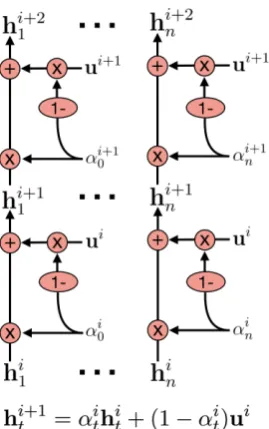
More specifically, to calculate both the write-attention and the update,Scratchpaduses the con-catenation of the decoder state after steps 1-3 (si+1) and the attentive read (ci):
hit+1=αithti+ (1−αit)ui (4)
αit=σ(fα([si+1,ci,hit])) (5)
ui =tanh(fu([si+1;ci])) (6)
Figure 1: The Scratchpad Mechanismfirst computes the update probability (αi
t) for each encoder state
ac-cording to Eq.5, then computes a global updateui
ac-cording to Eq.6, and finally updates the encoder states according to Eq.4.
(ui). The second is similar to the ’forget’ gate in an LSTM, where the network decides how much to overwrite a cell (1−αi
t) versus how much to keep past information (αit) for that cell. These two components are used in concert (see Fig.1) to pro-vide new encoder states (hit+1) to the decoder at each decoding timestep (i). Tanh is used to en-sure thathit+1 remains in the range[−1,1], since hi
t∈[−1,1]as[h1, ...,hn]0is the hidden states of a GRU or LSTM. We parametrizefαandfuas an MLP. Figure1shows the outline of the scratchpad mechanism update at multiple timesteps.
4 Experiments
In this section we describe experimental setup and results for Machine Translation, Question Gen-eration, and Summarization tasks which exhibit a variety of input modalities and strategies re-quired to perform well. We work with struc-tured and unstrucstruc-tured language and several se-quence to sese-quences architectures i.e. attention, pointing, and copying. Machine translation is a canonical sequence-to-sequence task where pair-wise word-level or phrase-level generation is ex-pected. Question Generation from logical forms requires reasoning about the syntax, parse tree, and vocabulary of the input sequence to infer the meaning of the logical form program and utilize copy-mechanism to copy entities. Lastly,
sum-marization requires understanding both the global and the local context of a sentence within a docu-ment, identifying spans that are informative and diverse, and generating coherent representative summaries. Demonstrating a single mechanism that reaches state of the art on such a diverse set of natural language tasks underscores the gener-alizability of our technique, particularly given the large range in number of training examples (3k, 56k, 153k, 287k) across datasets.
4.1 Translation
We evaluate on the IWLST 14 English to German and Spanish to English translation datasets ( Cet-tolo et al., 2015) as well as the IWSLT 15 ( Cet-tolo et al., 2015) English to Vietnamese transla-tion dataset. For IWSLT14 (Cettolo et al.,2015), we compare to the models evaluated byHe et al. (2018), which includes a transformer (Vaswani et al., 2017) and RNN-based models (Bahdanau et al., 2014). For IWSLT15, we primarily com-pare to GNMT (Wu et al.,2016), which incorpo-rates Coverage (Tu et al., 2016). Table 1 shows BLEU scores of our approach on 3 IWSLT trans-lation tasks along with reported results from previ-ous work. Our approach achieves state-of-the-art or comparable results on all datasets.
Model IWSLT14 IWSLT15
De→En Es→En En→Vi
MIXER 21.83 7 7
AC + LL 28.53 7 7
NPMT 29.96 7 28.07
Stanford NMT 7 7 26.1
[image:3.595.114.249.60.275.2]Transformer (6 layer) 32.86 38.57 7 Layer-Coord (14 layer) 35.07 40.50 7 Scratchpad (3 layer) 35.08 40.92 29.59∗
Table 1: Performance for non-scratchpad models are taken fromHe et al.(2018) except Stanford NMT ( Lu-ong and Manning,2015).∗: model is 2 layers.
Model
Per-Sentence Corpus-Level
Bleu Meteor Rouge-L Bleu Meteor Rouge-L
W
ebQSP
Baseline 7.51 23.9 47.1 17.96 22.9 47.13
Copynet 6.89 27.1 52.5 17.42 26.03 52.56
Copy + Coverage 14.55 33.7 58.9 26.78 30.86 58.91 Copy + Scratchpad 15.29 34.7 59.5 27.64 31.49 59.44
W
ikiSQL
Baseline 9.94 26.71 47.96 17.34 25.34 47.96
Copynet 8.04 24.66 46.82 15.11 23.53 46.82
[image:4.595.111.488.62.228.2]Copy + Coverage 15.76 34.04 54.94 25.01 32.38 54.94 Copy + Scratchpad 16.89 34.47 55.69 26.10 32.76 55.69
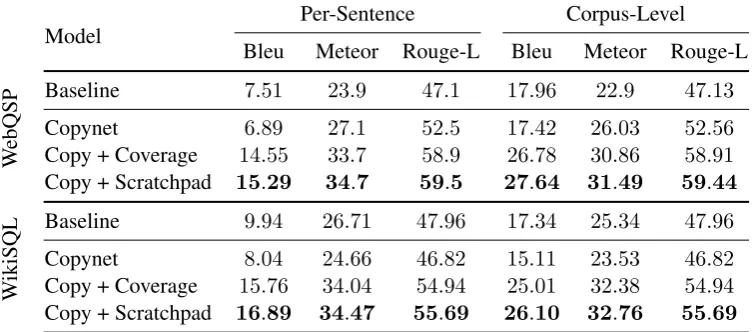
Table 2: Methods allowing the model to keep track of past attention (Coverage,Scratchpad) significantly improve performance when combined with a copy mechanism. TheScratchpad Encoderachieves the best performance.
hidden size of512(for the LSTM and any MLP’s). The internal layers of the decoder are residual, adding their output to their input and putting it through Layer Normalization (Ba et al., 2016). Sentences were encoded using byte-pair encoding (Sennrich et al.,2016), with a shared source-target vocabulary of10,000for De→En and Es→En (En →Vi uses words as tokens to be comparable to Wu et al.(2016)). Source and target word embed-dings are dimension 128. We use dropout ( Sri-vastava et al., 2014) in the encoder and decoder with a probability of 0.1. We use the Adam op-timizer (Kingma and Ba, 2014), with an initial learning rate of0.002.We train for 30/20 epochs for IWSLT14/15, decaying the learning rate by a factor of0.7whenever the validation loss does not improve from the last epoch. Each training batch contained at most 2000 source or target tokens. We use label smoothing withls = 0.1(Szegedy
et al.,2016). We average the last 5 epochs to ob-tain the final model and run with a beam of size 4.
4.2 Question Generation
We use the task of question generation: Given a structured representation of a query against a knowledge base or a database (e.g. alogical form), produce the corresponding natural language ques-tion. We use two datasets consisting of (ques-tion, logical form) pairs: WebQuestionsSP (Yih et al.,2016) (a standard dataset for semantic pars-ing, where the logical form is in SPARQL), and WikiSQL (Zhong et al., 2017) (where the logical form is SQL). Both datasets are small, with the former having 3098 training and 1639 testing
ex-amples, and the latter being an order of magnitude larger with 56346 training and 15873 testing ex-amples.
We evaluate metrics at both a corpuslevel (to indicate hownaturaloutput questions are) and at aper-sentencelevel (to demonstrate how well out-put questions exactly match the gold question). BLEU (Papineni et al.,2002), ROUGE (Lin,2004) are chosen for precision and recall-based metrics. METEOR (Banerjee and Lavie,2005) is chosen to deal with stemming and synonyms.
We noticed that many tokens that appear in the logical form are also present in the natural lan-guage form for each example. In fact, nearly half of the tokens in the question appear in the corre-sponding SPARQL of the WebQuestionSP dataset (Yih et al., 2016), implying that a network with the ability to copy from the input could see signif-icant gains on the task. Accordingly, we compare our Scratchpad Mechanism against three base-lines: (1) Seq2Seq, (2) Copynet and (3) Cover-age, a method introduced by Tu et al.(2016) that aims to solve attention-related problems. Seq2Seq is the standard approach introduced in Sutskever et al.(2014). TheCopynet(He et al.,2017) base-line additionally gives the Seq2Seq model the abil-ity to copy vocabulary from the source to the tar-get.
From Table 2 it is clear that our approach,
Scratchpad outperforms all baselines on all the metrics.
Model
Rouge Meteor
1 2 L exact match +stem/syn/para
Pointer-generator 36.44 15.66 33.42 15.35 16.65
See et al.(2017) 39.53 17.28 36.38 17.32 18.72
Scratchpad 39.65 17.61 36.62 17.26 18.63
CopyTransformer + Coverage Penalty 39.25 17.54 36.45 7 7
Pointer-Generator + Mask Only 37.70 15.63 35.49 7 7
[image:5.595.80.520.66.200.2]Bottom-up (Gehrmann et al.,2018) 41.22 18.68 38.34 7 7
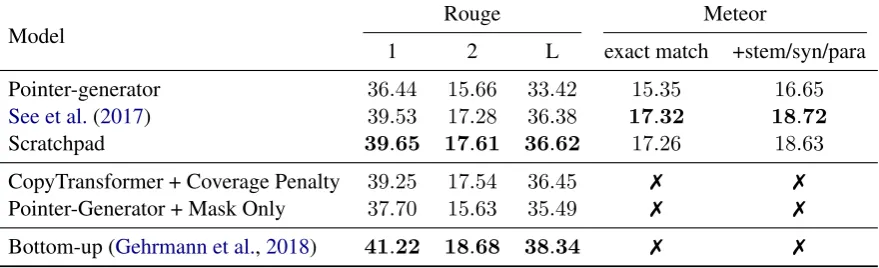
Table 3: The middle third of the table contains the end-to-end models performing the best from (Gehrmann et al.,
2018), while the bottom section contains the current state-of-the-art which involves a 2-step training process and is not end-to-end. Scratchpad establishes a state of the art for end-to-end models on summarization without Rein-forcement Learning on ROUGE, while remaining competitive withSee et al.(2017) on METEOR. Additionally, Scratchpad does not use an auxiliary loss as inSee et al.(2017) or the middle third of the table. Gehrmann et al.
(2018) do not evaluate on METEOR.
GRU. We use the attention mechanism from 4.1. We train all models for75epochs with a batch size of32, a hidden size of512(for the GRU and any MLP’s), and a word vector size of 300. Dropout is used on every layer except the output layer, with a drop probability of0.5. Where Glove vec-tors (Pennington et al., 2014) are used to initial-ize word vectors, we use 300-dimensional vectors trained on Wikipedia and Gigaword (6B.300D). We use the Adam optimizer with a learning rate of1e−4 and we do teacher forcing (Williams and Zipser,1989) with probability 0.5. These hyper-parameters were tuned for our Seq2Seq baselines and held constant for the rest of the models. The vocabulary consists of all tokens appearing at least once in the training set.
4.3 Summarization
We use the CNN/Daily Mail dataset (Hermann et al.,2015;Nallapati et al.,2016b) as inSee et al. (2017). The dataset consists of 287,226 training, 13,368 validation, and 11,490 test examples. Each example is an online news article (781 tokens on average) along with a multi-sentence summary (56 tokens, 3.75 sentences on average). As inSee et al. (2017) we operate on the original non-anonymized version of the data.
We follow See et al.(2017) in evaluating with ROUGE (Lin,2004) and METEOR (Banerjee and Lavie,2005). We reportF1scores for ROUGE-1,
ROUGE-2, and ROUGE-LCS (measuring word, bigram, and longest-common-subsequence over-lap, respectively) and we report METEOR in ex-act and full mode. We compare to the
pointer-generator baseline and the coverage variant in-troduced by See et al.(2017). See et al. (2017) use a multi-step training procedure for the cover-age component to improve performance where a pointer-generator model is first trained without the coverage component for a large number of itera-tions, then trained with the component and a tuned auxiliary coverage loss, finding that the auxiliary loss and pre-training the network without coverage are required to improve performance. As demon-strated in Tab. 3, with Scratchpad, we are able to improve performance overSee et al.(2017) in all the Rouge metrics, statistically significant for Rouge-2 and Rouge-L, while remaining compara-ble in METEOR. We reach this performance with half of the training iterations, no pretraining, and without the additional memory outlay and model complexity of including an auxiliary loss.
Experimental Details We use the same setup as inSee et al.(2017): The encoder is a single-layer bi-directional LSTM where outputs are combined by concatenation, and the decoder consists of a single-layer LSTM. The encoder states modified by the scratchpad mechanism are the outputs of the LSTM at every timestep, i.e. the ’hidden’ state. We use the same attention mechanism as in See et al.(2017) to calculate the attentive read and the attentive write probabilitiesαi
tfor thescratchpad
trained for 3k iterations with the combined cross-entropy coverage loss. See et al.(2017) use Ada-grad (Duchi et al., 2010) with learning rate 0.15 and an initial accumulator value of 0.1. Early stop-ping on validation is used to select the final model. We adopt a simpler procedure, training our full model with thescratchpad mechanismfor 100k it-erations with Adam and a learning rate of1e−4as compared to the two-step procedure in See et al. (2017) taking 230k iterations. We followSee et al. (2017) in using a batch size of16and clipping gra-dient norms to 2.
5 Analysis
To gain insight into the behaviour and perfor-mance of ourScratchpad Mechanism, we analyze the output for Question Generation and Transla-tion. We start by conducting a human evaluation study on the Question Generation task, since this task is relatively new and it is well known that quantitative metrics like BLEU do not always cor-relate with human assessed quality of generated text1. Later we use the attention heatmaps to visu-alize how thescratchpad mechanismdrives the at-tention weights to be more focused on the relevant source token(s). Additionally, we analize the en-tropiesof the attention weights to understand how thescratchpad mechanismbetter allows models to attend to the input. We hypothesize that this is one of the reasons that lead to good performance of the
scratchpad mechanismas the decoder ends up be-ing more focused than with the standard seq2seq models.
5.1 Human Evaluations
For our human evaluation we use two standard metrics from the machine translation community:
Adequacy and Fluency (Bojar et al., 2017). To compute Adequacy, human judges are presented with a reference output and the system proposed output, and are asked to rate the adequacy of the proposed output in conveying the meaning of the reference output on a scale from 0-10. To com-pute Fluency, the judges are asked to rate, on a scale from 0-10, whether the proposed output is a fluent English sentence. We used crowd-sourced judges. Each output is rated by 3 judges.
1The relation between BLEU scores and more canonical
tasks such as machine translation and summarization have al-ready been studied in the literature.(Bojar et al.,2017; Gra-ham,2015)
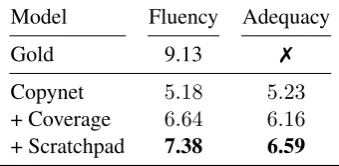
Table 4 summarizes the human evaluation re-sults for ourScratchpad Mechanismand two more baselines. As the table shows, the judges assigned higher fluency and adequacy scores to our ap-proach than both the coverage-based and copynet baseline. In the table we also report the fluency score of the gold questions as a way to measure the gap between the generated questions and the expected ones. Our approach is only 2 points be-hind the gold when it comes to generation fluency.
Model Fluency Adequacy
Gold 9.13 7
Copynet 5.18 5.23
+ Coverage 6.64 6.16
[image:6.595.331.501.213.296.2]+ Scratchpad 7.38 6.59
Table 4: Human evaluations show that theScratchpad delivers a large improvement in both fluencyand ad-equacy overCopynetandCoverage, accentuating the improvement in quantitative metrics (Bleu, Rouge, Me-teor).
Scratchpad vs. Copynet Scratchpad vs. Coverage
Both Good 9.26% Both Good 15.11%
Scratchpad 37.78% Scratchpad 23.80%
Copynet 6.46% Coverage 14.99%
Both Bad 46.5% Both Bad 43.07%
Win Rate 89.44% Win Rate 61.36%
Table 5: The percentage of times judges preferred one result over the other. In a Head-to-Head evaluation the output ofScratchpad Encoder is9and2 times as likely to be chosen vs.CopynetandCoverage, respec-tively. Win rate is the percentage of times Scratchpad was picked when the judges chose a single winner (not a tie).
[image:6.595.309.518.392.480.2]ofscratchpadgenerated questions.
5.2 Attention Visualization and Analysis
In the standard attention setup, the weights as-signed to each encoder output is determined by the decoder internal state and the encoder output (si andht) in Equation 1. Throughout the decoding steps, onlysivaries from timestep to the next. Our
scratchpad mechanismallows the encoder outputs to change in order to keep track of generated out-put, so that bothsiandhtwill vary from timestep to the next, hence more focused attention can be generated.
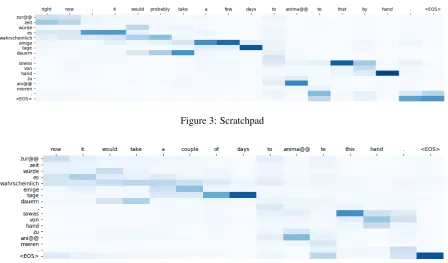
We demonstrate this behavior in Fig 5 where two sentences in a German to English machine translation system are shown. In the top figure, attention weights are shown when thescratchpad mechanismis utilized, while in the bottom Figure standard attention is used. As can be seen from the figures, attention weights are more focused espe-cially in the first few steps of decoding that better aligns with word-level translations (e.g. ’hand’ is properly attended to with scratchpad, but not with non-scratchpad). Additionally, some words that are never properly translated (e.g. wahrscheinlich - ’probably’) by the non-scratchpad model are not heavily attended to, whereas with the scratchpad mechanism, they are.
We also demonstrate this effect quantitatively. Recall the attention distributionait over the input [x1, ..., xn] generated at each decoding timestep
i. By calculating the entropy enti = −P tait∗
log(ait) and taking the mean of this value across a set of output sentences we can measure how well the model “focuses” on input sequences (e.g. [x1, ..., xn]) as it decodes. Thelowerthe entropy, thesharperthe attention distribution. We evaluate this metric on the IWSLT14 De→En test set for the scratchpad and non-scratchpad models. By adding the scratchpad mechanism, the mean en-tropy decreases substantially from 1.33 to 0.887 - indicating that it makes the model more selec-tive (focusing on fewer input tokens with higher
weights during generation). Additionally, we plot in Fig. 2 the cumulative frequency of the word-level entropies entifor all output timestepsi. Note from the graph that for every valuex, the scratch-pad model produces more attention distributions with an entropy ≤ x. Finally, the shape of the curve changes to be less sigmoidal, with the pro-portion of particularlypeaky orfocused
[image:7.595.309.523.117.278.2]distribu-tions (very low entropy, e.g. ≤ 0.5) increasing significantly, over4×that for the non-scratchpad model.
Figure 2: We plot the cumulative frequency of attention distribution entropies. On theY-axis is the proportion of attention distribution entropies lower than or equal tox.
Previous work based on coverage based ap-proaches (Tu et al.,2016;See et al., 2017) either imposed an extra term to the loss function or used an extra vector to keep track of which parts of the input sequences had been attended to, thereby fo-cusing the attention weights in subsequent steps on tokens that received little attention before. In other words, focusing the attention on the relevant parts of the input. Our proposed approach natu-rally learns to focus the attention on the important tokens, without a need for modifying the loss func-tion or introducing coverage vectors.
6 Related work
Figure 3: Scratchpad
Figure 4: No Scratchpad
Figure 5: Attention over the source sequence visualized at each decoder timestep with and without the scratchpad mechanism. Darker cells mean higher values. ”@@” at the end of a bpe token denotes it should be concatenated with the following token(s) to make a word. With Scratchpad, we see sharper attention earlier in the sentence that better aligns with word-level translations (e.g. ’hand’ is properly attended to with scratchpad, but not with non-scratchpad). Additionally, some words that are never properly translated (e.g. wahrscheinlich - ’probably’) by the non-scratchpad model are not heavily attended to, whereas with the scratchpad mechanism, they are.
be used with any choice of encoder/decoder as long as attention is used.
Summarization Since Rush et al. (2015) first applied neural networks to abstractive text sum-marization, work has focused on augmenting mod-els (Chopra et al., 2016; Nallapati et al., 2016b; Gu et al., 2016), incorporating syntactic and se-mantic information (Takase et al., 2016), or di-rect optimization of the metric at hand (Ranzato et al.,2016). Nallapati et al.(2016b) adapted the DeepMind question-answering dataset (Hermann et al., 2015) for summarization and provided the first abstractive and extractive (Nallapati et al., 2016a) models. See et al. (2017) demonstrated that pointer-generator networks can significantly improve the quality of generated summaries. Ad-ditionally, work has explored using Reinforcement Learning, often with additional losses or objec-tive functions to improve performance (Hsu et al., 2018;Paulus et al.,2018;Li et al.,2018; elikyil-maz et al.,2018;Pasunuru and Bansal,2018). Fi-nally,Gehrmann et al.(2018) demonstrated that a
two-stage procedure, where a model first identi-fies spans in the article that could be copied into the summary which are used to restrict a second pointer-generator model can reap significant gains.
there has been a recent surge in research on gener-ating questions for a given paragraph of text (Song et al., 2017; Du et al., 2017; Tang et al., 2017; Duan et al., 2017;Wang et al., 2018;Yao et al., 2018), with most of the work being a variant of the seq2seq approach. InSong et al.(2017), a seq2seq model with copynet and a coverage mechanism (Tu et al.,2016) is used to achieve state-of-the-art results. We have demonstrated that ourScratchpad
outperforms this approach in both quantitative and qualitative evaluations.
Attention Closest to our work, in the general paradigm of seq2seq learning, is the coverage mechanism introduced inTu et al.(2016) and later adapted for summarization in See et al. (2017). Both works try to minimize erroneous repetitions generated by a copy mechanism by introducing a new vector to keep track of what has been used from the encoder thus far. Tu et al. (2016), for example, use an extra GRU to keep track of this information, whereasSee et al.(2017) keep track of the sum of attention weights and add a penalty to the loss function based on it to discourage rep-etition. Our approach is much simpler than either solution since it does not require any extra vectors or an additional loss term; rather, the encoder vec-tor itself is being used as scratch memory. Our experiments also show that for the question gen-eration task, the Scratchpad performs better than coverage based approaches.
Our idea was influenced by the dialogue gener-ation work ofEric and Manning (2017) in which the entire sequence of interactions is re-encoded every time a response is generated by the decoder.
7 Conclusion
In this paper, we introduce the Mechanism, a novel write operator, to the sequence to sequence frame-work aimed at addressing many of the common is-sues encountered by sequence to sequence models and evaluate it on a variety of standard conditional natural language generation tasks. By letting the decoder ’keep notes’ on the encoder, or said an-other way, re-encode the input at every decod-ing step, the Scratchpad Mechanism effectively guides future generation. The Scratchpad Mech-anism attains state of the art in Machine Trans-lation, Question Generation, and Summarization on standard metrics and human evaluation across multiple datasets. In addition, our approach de-creases training time and model complexity
com-pared to other leading approaches. Our success on such a diverse set of tasks, input data, and volumes of training data underscores the generalizability of our approach and its conceptual simplicity make it easy to add to any sequence to sequence model with attention.
Acknowledgments
The work was begun while the first author was in-terning at Apple Siri. We thank Christopher R´e for his helpful comments and feedback on the paper. We thank the reviewers for insightful comments and suggesting mean entropy to measure the dis-tribution of attention weights.
References
Jimmy Ba, Ryan Kiros, and Geoffrey E. Hinton. 2016. Layer normalization. CoRR, abs/1607.06450.
Dzmitry Bahdanau, Kyunghyun Cho, and Yoshua Bengio. 2014. Neural machine translation by jointly learning to align and translate. CoRR, abs/1409.0473.
Satanjeev Banerjee and Alon Lavie. 2005. Meteor: An automatic metric for mt evaluation with improved correlation with human judgments. In IEEvalua-tion@ACL.
Ondˇrej Bojar, Rajen Chatterjee, Christian Federmann, Yvette Graham, Barry Haddow, Shujian Huang, Matthias Huck, Philipp Koehn, Qun Liu, Varvara Logacheva, et al. 2017. Findings of the 2017 confer-ence on machine translation (wmt17). In Proceed-ings of the Second Conference on Machine Transla-tion, pages 169–214.
Antoine Bordes, Jason Weston, Ronan Collobert, Yoshua Bengio, et al. 2011. Learning structured em-beddings of knowledge bases. In AAAI, volume 6, page 6.
Mauro Cettolo, Jan Niehues, Sebastian St¨uker, Luisa Bentivogli, and Marcello Federico. 2015. Report on the 11 th iwslt evaluation campaign , iwslt 2014.
Sumit Chopra, Michael Auli, and Alexander M. Rush. 2016. Abstractive sentence summarization with at-tentive recurrent neural networks. InHLT-NAACL.
Li Dong and Mirella Lapata. 2016. Language to logical form with neural attention. arXiv preprint arXiv:1601.01280.
Nan Duan, Duyu Tang, Peng Chen, and Ming Zhou. 2017. Question generation for question answering. In Proceedings of the 2017 Conference on Empiri-cal Methods in Natural Language Processing, pages 866–874.
John C. Duchi, Elad Hazan, and Yoram Singer. 2010. Adaptive subgradient methods for online learning and stochastic optimization. Journal of Machine Learning Research, 12:2121–2159.
Hady Elsahar, Christophe Gravier, and Frederique Laforest. 2018. Zero-shot question generation from knowledge graphs for unseen predicates and entity types. In Proceedings of the 2018 Conference of the North American Chapter of the Association for Computational Linguistics: Human Language Tech-nologies, Volume 1 (Long Papers), volume 1, pages 218–228.
Mihail Eric and Christopher Manning. 2017. A copy-augmented sequence-to-sequence architecture gives good performance on task-oriented dialogue. In Proceedings of the 15th Conference of the European Chapter of the Association for Computational Lin-guistics: Volume 2, Short Papers, volume 2, pages 468–473.
Sebastian Gehrmann, Yuntian Deng, and Alexander M. Rush. 2018. Bottom-up abstractive summarization. InEMNLP.
Yvette Graham. 2015. Re-evaluating automatic sum-marization with bleu and 192 shades of rouge. In Proceedings of the 2015 conference on empirical methods in natural language processing, pages 128– 137.
Jiatao Gu, Zhengdong Lu, Hang Li, and Victor O. K. Li. 2016. Incorporating copying mech-anism in sequence-to-sequence learning. CoRR, abs/1603.06393.
Shizhu He, Cao Liu, Kang Liu, and Jun Zhao. 2017. Generating natural answers by incorporating copying and retrieving mechanisms in sequence-to-sequence learning. InACL.
Tianyu He, Xu Tan, Tao Qin, and Zhibo Chen. 2018. Layer-wise coordination between encoder and de-coder for neural machine translation. InNeurIPS.
Karl Moritz Hermann, Tom´as Kocisk´y, Edward Grefenstette, Lasse Espeholt, Will Kay, Mustafa Su-leyman, and Phil Blunsom. 2015. Teaching ma-chines to read and comprehend. InNIPS.
Sepp Hochreiter and J¨urgen Schmidhuber. 1997. Long short-term memory. Neural Computation, 9:1735– 1780.
Wan Ting Hsu, Chieh-Kai Lin, Ming-Ying Lee, Kerui Min, Jing Tang, and Min Sun. 2018. A unified model for extractive and abstractive summarization using inconsistency loss. InACL.
Xinyu Hua and Lu Wang. 2018. Neural argument generation augmented with externally retrieved ev-idence. InACL.
Chlo´e Kiddon, Luke S. Zettlemoyer, and Yejin Choi. 2016. Globally coherent text generation with neural checklist models. InEMNLP.
Diederik P. Kingma and Jimmy Ba. 2014. Adam: A method for stochastic optimization. CoRR, abs/1412.6980.
Piji Li, Lidong Bing, and Wai Lam. 2018. Actor-critic based training framework for abstractive sum-marization.CoRR, abs/1803.11070.
Chin-Yew Lin. 2004. Rouge: A package for automatic evaluation of summaries.
Minh-Thang Luong and Christopher D. Manning. 2015. Neural machine translation systems for spo-ken language domains.
Thang Luong, Hieu Pham, and Christopher D. Man-ning. 2015. Effective approaches to attention-based neural machine translation. InEMNLP.
Ramesh Nallapati, Feifei Zhai, and Bowen Zhou. 2016a. Summarunner: A recurrent neural network based sequence model for extractive summarization of documents. InAAAI.
Ramesh Nallapati, Bowen Zhou, C´ıcero Nogueira dos Santos, aglar G¨ulehre, and Bing Xiang. 2016b. Abstractive text summarization using sequence-to-sequence rnns and beyond. InCoNLL.
Axel-Cyrille Ngonga Ngomo, Lorenz B¨uhmann, Christina Unger, Jens Lehmann, and Daniel Gerber. 2013a. Sorry, i don’t speak sparql: translating sparql queries into natural language. InProceedings of the 22nd international conference on World Wide Web, pages 977–988. ACM.
Axel-Cyrille Ngonga Ngomo, Lorenz B¨uhmann, Christina Unger, Jens Lehmann, and Daniel Gerber. 2013b. Sparql2nl: verbalizing sparql queries. In Proceedings of the 22nd International Conference on World Wide Web, pages 329–332. ACM.
Kishore Papineni, Salim Roukos, Todd Ward, and Wei-Jing Zhu. 2002. Bleu: a method for automatic eval-uation of machine translation. InACL.
Ramakanth Pasunuru and Mohit Bansal. 2018. Multi-reward reinforced summarization with saliency and entailment. InNAACL-HLT.
Romain Paulus, Caiming Xiong, and Richard Socher. 2018. A deep reinforced model for abstractive sum-marization.CoRR, abs/1705.04304.
Marc’Aurelio Ranzato, Sumit Chopra, Michael Auli, and Wojciech Zaremba. 2016. Sequence level training with recurrent neural networks. CoRR, abs/1511.06732.
Alexander M. Rush, Sumit Chopra, and Jason Weston. 2015. A neural attention model for abstractive sen-tence summarization. InEMNLP.
Abigail See, Peter J Liu, and Christopher D Manning. 2017. Get to the point: Summarization with pointer-generator networks. InProceedings of the 55th An-nual Meeting of the Association for Computational Linguistics (Volume 1: Long Papers), volume 1, pages 1073–1083.
Rico Sennrich, Barry Haddow, and Alexandra Birch. 2016. Neural machine translation of rare words with subword units. CoRR, abs/1508.07909.
Iulian Vlad Serban, Alberto Garc´ıa-Dur´an, Caglar Gulcehre, Sungjin Ahn, Sarath Chandar, Aaron Courville, and Yoshua Bengio. 2016. Generating factoid questions with recurrent neural networks: The 30m factoid question-answer corpus. In Pro-ceedings of the 54th Annual Meeting of the Associa-tion for ComputaAssocia-tional Linguistics (Volume 1: Long Papers), volume 1, pages 588–598.
Dominic Seyler, Mohamed Yahya, and Klaus Berberich. 2017. Knowledge questions from knowl-edge graphs. In Proceedings of the ACM SIGIR International Conference on Theory of Information Retrieval, pages 11–18. ACM.
Linfeng Song, Zhiguo Wang, and Wael Hamza. 2017. A unified query-based generative model for question generation and question answering. arXiv preprint arXiv:1709.01058.
Nitish Srivastava, Geoffrey E. Hinton, Alex Krizhevsky, Ilya Sutskever, and Ruslan R. Salakhut-dinov. 2014. Dropout: a simple way to prevent neural networks from overfitting. Journal of Machine Learning Research, 15:1929–1958.
Ilya Sutskever, Oriol Vinyals, and Quoc V. Le. 2014. Sequence to sequence learning with neural net-works. InNIPS.
Christian Szegedy, Vincent Vanhoucke, Sergey Ioffe, Jonathon Shlens, and Zbigniew Wojna. 2016. Re-thinking the inception architecture for computer vi-sion. 2016 IEEE Conference on Computer Vision and Pattern Recognition (CVPR), pages 2818–2826.
Sho Takase, Jun Suzuki, Naoaki Okazaki, Tsutomu Hi-rao, and Masaaki Nagata. 2016. Neural headline generation on abstract meaning representation. In EMNLP.
Duyu Tang, Nan Duan, Tao Qin, Zhao Yan, and Ming Zhou. 2017. Question answering and ques-tion generaques-tion as dual tasks. arXiv preprint arXiv:1706.02027.
Priyansh Trivedi, Gaurav Maheshwari, Mohnish Dubey, and Jens Lehmann. 2017. Lc-quad: A cor-pus for complex question answering over knowledge graphs. InInternational Semantic Web Conference, pages 210–218. Springer.
Zhaopeng Tu, Zhengdong Lu, Yang Liu, Xiaohua Liu, and Hang Li. 2016. Modeling coverage for neural machine translation. InACL.
Ashish Vaswani, Noam Shazeer, Niki Parmar, Jakob Uszkoreit, Llion Jones, Aidan N. Gomez, Lukasz Kaiser, and Illia Polosukhin. 2017. Attention is all you need. InNIPS.
Oriol Vinyals, Meire Fortunato, and Navdeep Jaitly. 2015. Pointer networks. InNIPS.
Yansen Wang, Chenyi Liu, Minlie Huang, and Liqiang Nie. 2018. Learning to ask questions in open-domain conversational systems with typed decoders. InACL.
Ronald J. Williams and David Zipser. 1989. A learn-ing algorithm for continually runnlearn-ing fully recurrent neural networks. Neural Computation, 1:270–280.
Yonghui Wu, Mike Schuster, Zhifeng Chen, Quoc V. Le, Mohammad Norouzi, Wolfgang Macherey, Maxim Krikun, Yuan Cao, Qin Gao, Klaus Macherey, Jeff Klingner, Apurva Shah, Melvin Johnson, Xiaobing Liu, Lukasz Kaiser, Stephan Gouws, Yoshikiyo Kato, Taku Kudo, Hideto Kazawa, Keith Stevens, George Kurian, Nishant Patil, Wei Wang, Cliff Young, Jason Smith, Jason Riesa, Alex Rudnick, Oriol Vinyals, Gregory S. Corrado, Macduff Hughes, and Jeffrey Dean. 2016. Google’s neural machine translation system: Bridg-ing the gap between human and machine translation. CoRR, abs/1609.08144.
Ziang Xie. 2017. Neural text generation: A practical guide. arXiv preprint arXiv:1711.09534.
Kaichun Yao, Libo Zhang, Tiejian Luo, Lili Tao, and Yanjun Wu. 2018. Teaching machines to ask ques-tions. InIJCAI, pages 4546–4552.
Scott Yih, Matthew Richardson, Christopher Meek, Ming-Wei Chang, and Jina Suh. 2016. The value of semantic parse labeling for knowledge base ques-tion answering. InACL.
Victor Zhong, Caiming Xiong, and Richard Socher. 2017. Seq2sql: Generating structured queries from natural language using reinforcement learning. arXiv preprint arXiv:1709.00103.