331
Adaptive Attention Span in Transformers
Sainbayar Sukhbaatar Edouard Grave Piotr Bojanowski Armand Joulin Facebook AI Research
{sainbar,egrave,bojanowski,ajoulin}@fb.com
Abstract
We propose a novel self-attention mechanism that can learn its optimal attention span. This allows us to extend significantly the maximum context size used in Transformer, while main-taining control over their memory footprint and computational time. We show the effec-tiveness of our approach on the task of charac-ter level language modeling, where we achieve state-of-the-art performances ontext8 and enwiki8by using a maximum context of8k characters.
1 Introduction
Language models are at the core of many NLP applications, like machine translation or dialogue. Recently, much progress has been made by a new neural network called Transformer (Vaswani et al., 2017). Part of its success is due to its ability to capture long term dependencies. This is achieved by taking long sequences as inputs and explicitly compute the relations between every token via a mechanism called the “self-attention” layer ( Al-Rfou et al.,2019).
While this layer allows for information to prop-agate across long distances, it has a computa-tional and memory cost that scales quadratically with the size of the input sequence. As a con-sequence, Transformers hardly scale to sequences of more than a thousand tokens. This is partic-ularly problematic in the case of character level language modeling where dependencies are often spread over a few thousands time steps.
In this work, we propose an alternative to the self-attention layer to reduce the computational burden of a Transformer. Our layer learns its op-timal context size, resulting in a network where each attention layer gathers information on their own context. In practice, we observe that this leads to Transformer with small context in the
low-level layers and very large ones for the last lay-ers. With this modification, we are able to scale input sequences to more than 8k tokens with no loss of performance, nor additional computational or memory cost. We validate our approach on the task of character level language modeling where we reach state-of-the-art performances while re-ducing the number of FLOPS. The code to repro-duce our results is publicly available1.
2 Approach
2.1 Sequential transformer network
Language modeling is the problem of assigning a probability to a sequence of tokens(w1, . . . , wT):
P(w1, . . . , wT) = T Y
t=1
P(wt|wt−1, . . . , w1).
Recent progress was made with a new auto-regressive model called Sequential Trans-former (Vaswani et al., 2017). A Transformer is made of a sequence of layers that are composed of a block of parallel self-attention layers followed by a feedforward network. We refer to Vaswani et al.(2017) for the details on the structure. In this paper, we make a couple of modifications to the Transformer model: we use the relative position embeddings ofShaw et al.(2018) and the caching mechanism of Dai et al. (2019) to speed up the train and test time.
Self-attention layer. A core mechanism of a transformer network is the self-attention layer, which consists of multiple attention heads work-ing in parallel. Each attention head applies the at-tention mechanism ofBahdanau et al.(2015) to its own input. Given a tokentin a sequence, the head
−100 −80 −60 −40 −20 Context
0.000 0.002 0.004
A
tten
tion
[image:2.595.78.288.64.137.2]Head A Head B
Figure 1: Attention patterns of two different heads of a standard Transformer. The two patterns are quali-tatively different: Head A utilizes recent steps, while Head B has uniform attention over the context.
first computes similarities with its past, i.e., any tokenrin the span[t−S, t):
str =x>tW>q (Wkxr+pt−r), (1)
whereWkandWqare the “key” and “query”
ma-trices, andpt−ris the relative position embedding.
The attention weights are then obtained by apply-ing a softmax function on these similarities:
atr =
exp (str)
Pt−1
q=t−Sexp (stq)
, (2)
Finally, the head outputs a vectorytby taking the
average of the past representations weighted by their attention weights:
yt = t−1 X
r=t−S
atrWvxr, (3)
where Wv is called the “value” matrix.
Out-puts from different heads are then concatenated together and multiplied by an output matrix Wo
before feeding to the next layer.
Similar to the memory access mechanisms of Sukhbaatar et al. (2015), it pulls information from the past to update the current token repre-sentation. Repeating this mechanism in consecu-tive layers allows for information to flow over long distances. However, for each input token, each at-tention head scales linearly in memory and time in the context size, or attention span. There are typ-ically 12 layers with8heads each that processes
512tokens simultaneously. This drastically limits the maximum attention span used in Transformers.
2.2 Adaptive attention span
Each attention head of a Transformer shares the same attention span S. This assumes that every head requires the same span to form its represen-tation. As shown in Figure1, this assumption does not hold in the context of character level language
x mz(x)
1
[image:2.595.326.508.65.132.2]z z+R
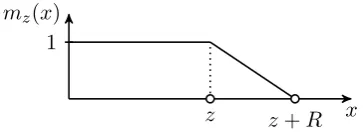
Figure 2: The soft mask as a function of the distance.
modeling: some heads (e.g., Head A) focus on the recent history, while others take information from the whole available context (e.g., Head B). In this section, we propose to learn the attention span of each head independently to reduce their computa-tional and memory cost.
For each head, we add a masking function to control for the span of the attention. A masking function is a non-increasing function that maps a distance to a value in[0,1]. We take the following soft masking function mz parametrized by a real
valuezin[0, S]:
mz(x) = min
max
1
R(R+z−x),0
,1
,
whereRis a hyper-parameter that controls its soft-ness. This soft masking function is inspired by Jer-nite et al.(2017). In Figure2, we show the shape of this piecewise function as a function of the dis-tance. The attention weights from Eq. 2are then computed on the masked span, i.e.,
atr =
mz(t−r) exp (str) t−1
P
q=t−S
mz(t−q) exp (stq) .
We add a`1penalization on the parameterszifor
each attention headiof the model to the loss func-tion:
L=−logP(w1, . . . , wT) + λ M
X
i zi,
where λ > 0 is the regularization hyper-parameter, andM is the number of heads in each layer. Our formulation is differentiable in the pa-rametersziand we learn them jointly with the rest
of the model.
an attention head is then a function of the input parametrized by a vector v and a scalar b, i.e.,
zt = Sσ(vTxt+b). We penalizeztin the same
way as before and learn the parametersv,bjointly with the rest of the parameters.
3 Experiments
In this section, we evaluate the impact of our adap-tive attention mechanism in the experimental set-ting of Al-Rfou et al. (2019) for character level language modeling.
Dataset. We use the text8 and enwik8 datasets of Mahoney (2011). The both dataset have 100M tokens. We report bit per character (bpc) on dev and test set.
Implementation details. We experiment with two sizes of models. Our small models have
12 layers and a hidden size of dh = 512,
ex-cept for the feedforward ReLU layers, which have
2048units. The large models have24layers with a hidden size of dh = 768, and a ReLU size
of 4096. All models have 8 attention heads in each layer. Token and position embedding pa-rameters are initialized fromN(0,1), and the pro-jection matrices W{q,k,v,o} are initialized from
U(−1/√dh,1/√dh). A single set of position
em-beddingsptis shared across all the heads.
In adaptive-span models, we reprameterized the span parameterz by z = Sz0, where z0 ∈ [0,1]
is initialized to 0. In dynamic-span models, the bias termbis initialized−4to make initial spans small. We set the hyperparametersλ= 2×10⁻⁶ andR= 32for the both type of models, exceptλ
is reduced to0.5×10−6whenS= 8192because
zwas not growing longer than 4000.
We use Adagrad with a batch size of 64 and fixed learning rate of0.07and32k warm-up steps. Our warm-up strategy differs fromVaswani et al. (2017): we linearly increase learning rate from zero to the final learning rate. Gradients of each module are clipped at0.03for better stability. At train time, we use a block of512consecutive char-acters and compute the loss and gradient for each of those512characters.
In small models, we apply dropout with a rate of0.3to the attention and the feedforward ReLU activations. We train small models for600Ksteps (900K steps whenS = 8192), which takes about
2∼3days on8V100 GPUs depending on the at-tention span limit. Large models are trained with
a dropout rate of 0.4 until the validation perfor-mance stopped improving (250Ksteps fortext8 and 150K steps for enwik8), and then further trained for20Ksteps with a learning rate divided by10.
Results. In Table1, we compare our sequential Transformer with the adaptive spans (“Adaptive-Span”) of Sec. 2.2 to models of Al-Rfou et al. (2019) and Dai et al. (2019). For small models, our model outperforms the other Transformers by
0.07 bcp while significantly reducing the mem-ory usage for large attention span. Interestingly, even with a limit on span sets to 8192, the av-erage span is only 314. Similar results are ob-tained onenwik8as shown in Table2, where the adaptive-span model outperformed similar sized models with a significantly smaller average span. Our large models achieved state-of-the-art perfor-mances on both datasets with fewer parameters and FLOPS.
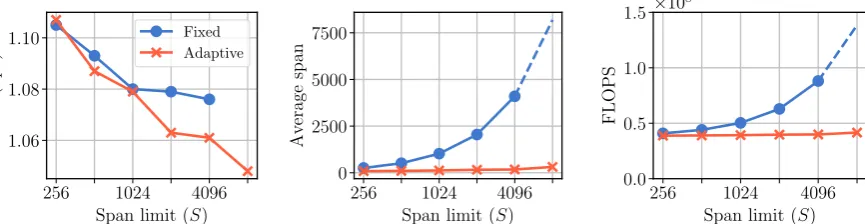
In Figure3, we compare the fixed and adaptive span small Transformers as we increase the atten-tion span limitS. The performance of both models improve as the limit increase (see Figure3(left)), but the adaptive-span model benefits more from longer span. As shown on the Figure 3(center), a Transformer with adaptive spans controls its av-erage spans, leading to reduction of up to70%in the number of FLOPS for the inference with large spans (see Figure3(right)).
Impact on the attention span. In Figure4, we show the final attention spans of every attention heads of our small adaptive-span model withS = 4096. Even though all the span sizes are initial-ized to the same value, we see large varieties in their final values. We can see that the lowest 5 layers have the smallest possible attention span, which isR = 32 of the masking function. This indicates that lower layers in a Transformer model do not really require a long attention span in this particular task. In contrast, few attention heads in the higher layers have very long spans, exceed-ing several thousand. Although there is a general tendency of higher layers having longer attention spans, it is not a simple monotonic function of the layer height.
Model #layers Avg. span #Params #FLOPS dev test
Small models
T12 (Al-Rfou et al.,2019) 12 512 44M 22G - 1.18
Adaptive-Span (S = 8192) 12 314 38M 42M 1.05 1.11
Large models
T64 (Al-Rfou et al.,2019) 64 512 235M 120G 1.06 1.13
T-XL (Dai et al.,2019) 24 3800 277M 438M - 1.08
[image:4.595.87.520.251.363.2]Adaptive-Span (S = 8192) 24 245 209M 179M 1.01 1.07
Table 1: Character level language modeling ontext8. We report bpc for the dev and test sets, as well as, the number of parameters, the average attention spans and total number of FLOPS (an estimate of the number of FLOPS necessary for computing one step prediction).
256 1024 4096 Span limit (S) 1.06
1.08 1.10
Dev.
(bp
c)
Fixed Adaptive
256 1024 4096 Span limit (S) 0
2500 5000 7500
Av
erage
span
256 1024 4096 Span limit (S) 0.0
0.5 1.0 1.5
FLOPS
[image:4.595.308.524.449.529.2]×108
Figure 3: Left:validation performances improve as the attention span limitSincrease (we did not train a fixed-span model withS= 8192due to memory limitation).Center:average attention span of trained models. Learning attention spans significantly reduces the average attention span. Right: the number of FLOPS during inference time grows almost linearly withSfor the fixed span models. The adaptive-span models do not have this growth in #FLOPS because they have a very small attention span on average.
Model #layers #Params #FLOPS dev / test
Small models
T12 12 44M 22G - / 1.11
T-XL 12 41M 64M - / 1.06
Adaptive 12 39M 41M 1.04 /1.02
Large models
T64 64 235M 120G - / 1.06
T-XL 18 88M 329M - / 1.03
T-XL 24 277M 438M - / 0.99
Adaptive 24 209M 181M 1.00 /0.98
Table 2: Results onenwik8. The span limit isS = 8192for the adaptive-span models.
model, the total number of FLOPS is mostly con-trolled by the feed-forward layer (accounting for 62% of FLOPS whenS = 256). However, as the span increase, the attention layer dominates the computation (82% of FLOPS when S = 8192), making it hard to scale to longer sequences. In contrast, the learning of an attention span keeps computation at a relatively constant level even as
1 2 3 4 5 6 7 8 9 10 11 12 Layers
101
102
103
A
tten
tion
span
Figure 4: Adaptive spans (in log-scale) of every atten-tion heads in a 12-layer model with span limit S = 4096. Few attention heads require long attention spans.
Sincrease as shown in Figure3(right).
The memory usage is also dominated by the at-tention layer as the atat-tention span increase. Thus, reducing the average span will also reduce the memory usage. However, because all heads in a single layer attend to common state vectors, the maximum span within each layer will determine the memory usage. The same is true for the num-ber of FLOPS if all heads of a layer are computed together, as often done for better efficiency.
In practice, the largest fixed-span model that can fit in memory for training had a span ofS= 2048
o v e r l o o k s t h e p a r k a nd i t s nume r o u s 100
200
Av
erage
[image:5.595.76.288.67.134.2]span
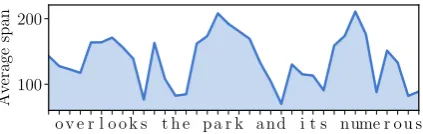
Figure 5: Example of average dynamic attention span as a function of the input sequence. The span is aver-aged over the layers and heads.
Model Avg. span dev
Adaptive (S = 1024) 123 1.08
Dynamic (S= 1024) 149 1.08
Table 3: Comparison between adaptive and dynamic attention span ontext8.
it took about 550ms per batch. In contrast, an adaptive-span model with a 4 times longer span ofS= 8192fit in memory and took about similar time per batch.
Dynamic span. In Table 3, we show the adap-tive and dynamic spans achieved the same perfor-mance with comparable average spans ontext8. Figure 5 shows how the average dynamic span adapts to the input sequence. The span increases at the beginning of words and in the middle of com-posed words, e.g., to predict the “l” in “overlook”.
4 Conclusion
In this work, we present a novel self-attention layer with an adaptive span. This mechanism al-lows for models with longer context, and thus with the capability to catch longer dependencies. We have shown the importantce of this feature in the context of character level modeling where infor-mation is spread over great distances.
References
Rami Al-Rfou, Dokook Choe, Noah Constant, Mandy Guo, and Llion Jones. 2019. Character-level lan-guage modeling with deeper self-attention. In Pro-ceedings of the 33rd AAAI Conference on Artificial Intelligence.
Dzmitry Bahdanau, Kyunghyun Cho, and Yoshua Ben-gio. 2015. Neural machine translation by jointly learning to align and translate. In3rd International Conference on Learning Representations, ICLR.
Zihang Dai, Zhilin Yang, Yiming Yang, Jaime G. Carbonell, Quoc V. Le, and Ruslan Salakhutdi-nov. 2019. Transformer-xl: Attentive language
models beyond a fixed-length context. CoRR, abs/1901.02860.
Alex Graves. 2016. Adaptive computation time for re-current neural networks.CoRR, abs/1603.08983.
Yacine Jernite, Edouard Grave, Armand Joulin, and Tomas Mikolov. 2017. Variable computation in re-current neural networks. In5th International Con-ference on Learning Representations, ICLR.
Thang Luong, Hieu Pham, and Christopher D. Man-ning. 2015. Effective approaches to attention-based neural machine translation. In Proceedings of the 2015 Conference on Empirical Methods in Natural Language Processing, EMNLP.
Matt Mahoney. 2011. Large text compression bench-mark. URL: http://www. mattmahoney. net/text/text. html.
Peter Shaw, Jakob Uszkoreit, and Ashish Vaswani. 2018. Self-attention with relative position represen-tations. In Proceedings of the 2018 Conference of the North American Chapter of the Association for Computational Linguistics: Human Language Tech-nologies, NAACL-HLT.
Raphael Shu and Hideki Nakayama. 2017. An empiri-cal study of adequate vision span for attention-based neural machine translation. In Proceedings of the First Workshop on Neural Machine Translation.
Sainbayar Sukhbaatar, Arthur Szlam, Jason Weston, and Rob Fergus. 2015. End-to-end memory net-works. InAdvances in Neural Information Process-ing Systems 28.