Proceedings of the 57th Annual Meeting of the Association for Computational Linguistics, pages 3472–3484 3472
Scalable Syntax-Aware Language Models Using Knowledge Distillation
Adhiguna Kuncoro♠♦ Chris Dyer♠ Laura Rimell♠
Stephen Clark♠Phil Blunsom♠♦
♠DeepMind, London, UK
♦Department of Computer Science, University of Oxford, UK
{akuncoro,cdyer,laurarimell,clarkstephen,pblunsom}@google.com
Abstract
Prior work has shown that, on small amounts of training data, syntactic neural language models learn structurally sensitive generalisa-tions more successfully than sequential lan-guage models. However, their computational complexity renders scaling difficult, and it re-mains an open question whether structural bi-ases are still necessary when sequential mod-els have access to ever larger amounts of train-ing data. To answer this question, we intro-duce an efficient knowledge distillation (KD) technique that transfers knowledge from a syn-tactic language model trained on a small cor-pus to an LSTM language model, hence en-abling the LSTM to develop a more struc-turally sensitive representation of the larger training data it learns from. On targeted syn-tactic evaluations, we find that, while sequen-tial LSTMs perform much better than previ-ously reported, our proposed technique sub-stantially improves on this baseline, yielding a new state of the art. Our findings and anal-ysis affirm the importance of structural biases, even in models that learn from large amounts of data.
1 Introduction
Language models (LMs) based on sequential LSTMs (Hochreiter and Schmidhuber,1997) have numerous practical applications, but it has also been shown that they do not always develop accu-rate syntactic generalisations (Marvin and Linzen, 2018). Thus, one strategy for improving LSTMs is to change their biases to facilitate more linguis-tically valid generalisations.
This paper introduces a scalable method for in-troducing syntactic biases to LSTMs (and indeed, to any left-to-right language model trained with a cross-entropy objective) by distilling knowl-edge (Bucilˇa et al.,2006;Hinton et al.,2015) from recurrent neural network grammars (Dyer et al.,
2016, RNNGs). RNNGs have been shown to suc-cessfully capture non-local syntactic dependencies (Kuncoro et al., 2018), achieve excellent parsing performance (Kuncoro et al., 2017; Fried et al., 2017), and correlate well with encephalography signals (Hale et al., 2018). Unfortunately, these benefits come at the expense ofscalability, since the hierarchical constituent composition process (§3) within RNNGs means that the structure of the computation graph for a sentence varies according to its tree structure. Even with the help of auto-matic dynamic batching (Neubig et al., 2017a,b), RNNGs can be ten times slower to train than a comparable LSTM as they benefit less from spe-cialised hardware like GPUs. As such, RNNGs are an impractical alternative to computationally convenient architectures that are used to build lan-guage models from massive corpora (Peters et al., 2018; Howard and Ruder, 2018; Devlin et al., 2019;Radford et al.,2019).
As RNNGs are hard to scale, we instead use the predictions of an RNNGteacher modeltrained on a small training set, to guide the learning of syntactic structure in a sequential LSTM student model, which is trained on the training set in its entirety. We denote the resulting lanugage model (i.e., the student LSTM) as a distilled syntax-aware LSTM LM (DSA-LSTM). Intuitively, the RNNG teacher is an expert on syntactic general-isation, although it lacks the opportunity to learn the relevant semantic and common-sense knowl-edge from a large training corpus. By learning from both, the DSA-LSTM therefore learns from a signal that is informative for syntactic generalisa-tion, but without sacrificing the semantic richness contained in a large corpus.
faster to train. On targeted syntactic evaluations, it achieves better accuracy than: (i) a strong LSTM LM which, through careful hyperparameter tun-ing, performs much better than previously thought (§2); (ii) the teacher RNNG that exploits a hierar-chical inductive bias but lacks scalability (§3); and (iii) a born-again network (Furlanello et al.,2018) that similarly learns from KD, albeit without a hi-erarchical bias from the teacher. We analyse the DSA-LSTM’s internal representation through the syntactic probe (Shi et al.,2016;Adi et al.,2017) ofBlevins et al.(2018), and find that the learned representations encode hierarchical information to a large extent, despite the DSA-LSTM lacking di-rect access to syntactic annotation.
While not directly comparable, on subject-verb agreement both the teacher RNNG and student
DSA-LSTM outperform BERT (Devlin et al.,
2019;Goldberg,2019), which benefits from bidi-rectional information and is trained on 30 times as much data. Altogether, these findings suggest that structural biases continue to play an important role, even at massive data scales, in improving the linguistic competence of LMs.
2 Replication of Targeted Syntactic
Evaluations of LSTM LMs
In this section, we replicate the targeted syntac-tic evaluations reported by Marvin and Linzen (2018), which assess LMs’ ability to assign higher probability in grammatical/ungrammatical mini-mal pairs within a variety of complex syntactic structures. This will serve as our primary evalu-ation instrument in this paper.
The following example illustrates the subject-verb agreement across an object relative clause (no complementiser)construction:
• The farmer the parents love swims/∗swim.
An LM succeeds on each example iff it assigns a higher probability to the grammatical sentence. Marvin and Linzen (2018) report that LSTMs, even with multi-task syntactic supervision, on ag-gregate still lag far behind human performance.
Experimental settings. Following Marvin and Linzen (2018), we use LSTMs with 650 hidden units trained on the Wikipedia corpus of Gulor-dava et al.(2018). Hyperparameters are optimised based on a grid search and can be found in the Ap-pendix. As the targeted syntactic evaluations are based on individual sentences, our LSTM models
each sentence separately.1
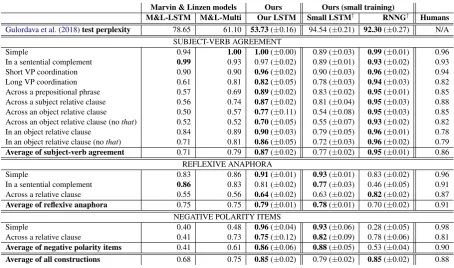
Discussion. We present our findings in Table1 (“Ours”); for all our models we report mean and standard deviation of 10 identical models from dif-ferent random seeds. Our LSTM LM achieves much better perplexity than the LSTM LM (32% ppl. reduction) and even the multi-task LSTM (12% reduction) ofMarvin and Linzen(2018). As our LSTM has the same number of hidden units, we attribute this gap to differences in optimisation and codebases. On aggregate, our LSTM LM out-performs the LSTM multi-task model from Mar-vin and Linzen(2018) that exploits explicit CCG annotations, and is able to match or exceed hu-man perforhu-mance on 7 out of all 15 constructions, thus confirming earlier findings that neural lan-guage models are able to acquire complex syntac-tic generalisation without explicit syntacsyntac-tic super-vision (Gulordava et al.,2018;Goldberg,2019).
Despite the small variance in perplexity (stdev 0.16 ppl.), the trained LMs exhibit large variance in accuracy for some constructions (up to stdev 0.12 for NPI across a relative clause). This ob-servation is consistent with earlier findings that models with similar perplexity may exhibit differ-ent patterns of syntactic generalisation (Kuncoro et al.,2018;Tran et al.,2018), and serves as a cau-tion against reporting results based on single runs.
3 Syntactic Evaluation with RNNG
To what extent can a model that leverages tic bias and annotation do well on targeted syntac-tic evaluations, even when trained on less data?
Here we briefly describe and assess the perfor-mance of the stack-only RNNG (Kuncoro et al., 2017) that we use as the teacher. Our choice of RNNG is motivated by its excellent number agreement performance on theLinzen et al.(2016) dataset,2 achieving 92.9% for four attractors un-der purely incremental decoding (Kuncoro et al., 2018).
1By modelling each sentence separately, our setup is
con-sistent with that ofMarvin and Linzen(2018) but differs from those with cross-sentential context (Mikolov et al.,2010).
2
Marvin & Linzen models Ours Ours (small training)
M&L-LSTM M&L-Multi Our LSTM Small LSTM† RNNG† Humans
Gulordava et al.(2018)test perplexity 78.65 61.10 53.73(±0.16) 94.54 (±0.21) 92.30(±0.27) N/A SUBJECT-VERB AGREEMENT
Simple 0.94 1.00 1.00(±0.00) 0.89 (±0.03) 0.99(±0.01) 0.96 In a sentential complement 0.99 0.93 0.97 (±0.02) 0.89 (±0.01) 0.93(±0.02) 0.93 Short VP coordination 0.90 0.90 0.96(±0.02) 0.90 (±0.03) 0.96(±0.02) 0.94 Long VP coordination 0.61 0.81 0.82(±0.05) 0.78 (±0.03) 0.94(±0.03) 0.82 Across a prepositional phrase 0.57 0.69 0.89(±0.02) 0.83 (±0.02) 0.95(±0.01) 0.85 Across a subject relative clause 0.56 0.74 0.87(±0.02) 0.81 (±0.04) 0.95(±0.03) 0.88 Across an object relative clause 0.50 0.57 0.77(±0.11) 0.54 (±0.08) 0.95(±0.03) 0.85 Across an object relative clause (nothat) 0.52 0.52 0.70(±0.05) 0.55 (±0.07) 0.93(±0.02) 0.82 In an object relative clause 0.84 0.89 0.90(±0.03) 0.79 (±0.05) 0.96(±0.01) 0.78 In an object relative clause (nothat) 0.71 0.81 0.86(±0.05) 0.72 (±0.03) 0.96(±0.02) 0.79
Average of subject-verb agreement 0.71 0.79 0.87(±0.02) 0.77 (±0.02) 0.95(±0.01) 0.86 REFLEXIVE ANAPHORA
Simple 0.83 0.86 0.91(±0.01) 0.93(±0.01) 0.83 (±0.02) 0.96 In a sentential complement 0.86 0.83 0.81 (±0.02) 0.77(±0.03) 0.46 (±0.05) 0.91 Across a relative clause 0.55 0.56 0.64(±0.02) 0.63 (±0.02) 0.82(±0.02) 0.87
Average of reflexive anaphora 0.75 0.75 0.79(±0.01) 0.78(±0.01) 0.70 (±0.02) 0.91 NEGATIVE POLARITY ITEMS
Simple 0.40 0.48 0.96(±0.04) 0.93(±0.06) 0.28 (±0.05) 0.98 Across a relative clause 0.41 0.73 0.75(±0.12) 0.82(±0.09) 0.78 (±0.06) 0.81
Average of negative polarity items 0.41 0.61 0.86(±0.06) 0.88(±0.05) 0.53 (±0.04) 0.90
[image:3.595.71.526.60.328.2]Average of all constructions 0.68 0.75 0.85(±0.02) 0.79 (±0.02) 0.85(±0.02) 0.88
Table 1: Replication ofMarvin and Linzen(2018) results. M&L-Multi is theMarvin and Linzen(2018) LSTM trained on LM and CCG supertagging (Bangalore and Joshi,1999;Clark and Curran,2007) losses with an interpolation factor of 0.5. We report our LSTM LM, small LSTM†, and RNNG†performance (†smaller training data; §3) in the format of mean (±standard deviation) of 10 identical models from different seeds. Results in bold denote the best among models trained on similar amounts of training data.
3.1 Recurrent Neural Network Grammars
An RNNG defines the joint probability of sur-face stringxand phrase-structure treey, denoted ast(x,y). The model generates phrase-structure trees in a top-down, left-to-right manner through a series of action sequences in a process reminis-cent of shift-reduce parsing. At any given state, the decision over which action to take is param-eterised by a stack LSTM (Dyer et al.,2015) en-coding partially-completed constituents. Lethtbe the stack LSTM hidden state at timet. The next action at ∈ {GEN,NT,REDUCE} is sampled ac-cording to a categorical distribution defined by an affine transformation and a softmax:
at∼softmax(Waht+ba).
• Ifat ∈ {GEN,NT}, the model samples a termi-nalxor a non-terminalnfrom each respective categorical distribution as the next input:
x∼softmax(Wxht+bx),
n∼softmax(Wnht+bn).
• If at = REDUCE, the topmost stack elements
going back to the last incomplete non-terminal are popped, and a composition function (here
a bidirectional LSTM) is executed to represent the completed phrase on the stack. This recur-sive composition function constitutes a primary difference with the syntactic LM ofChoe and Charniak(2016) that operates sequentially, and has been found to be crucial for achieving good number agreement (Kuncoro et al., 2018) and correlation with brain signals (Hale et al.,2018).
The stack LSTM, composition function, lookup embeddings, and pairs of affine transformation weights and biases{W,b}are model parameters.
3.2 Experiments
Here we outline the experimental settings and present our RNNG findings.
as the LSTM would take more than a month,3 we train the RNNG on∼ 20%of the training set (600,000 sentences), and use a smaller hidden state size of 256 (vs. 650 for the full LSTM). As the dataset is pre-processed, we select this subset such that all word types occur at least once in this smaller training set.
Incremental decoding and marginal probabil-ity. To preserve incrementality constraints, at test time we use a word-synchronised beam search (Fried et al.,2017) with fast-tracking (Stern et al., 2017), using word and action beam sizes ofk = 50andk×10 = 500, respectively. As exact in-ference oft(x) is intractable, we evaluate with a lower bound of the marginal probability by sum-ming over the top k hypotheses yb1(x), . . . ,ybk(x) on the beamb(x)once parsing finishes:
t(x) = X
y0∈T(x)
t(x,y0)≥
k X
i=1
t(x,ybi(x)),
whereT(x)denotes the set of all possible phrase-structure trees for a sentence x. On targeted syntactic evaluations, the model succeeds iff
logt(xcorrect)>logt(xincorrect).
Discussion. We present the results in Table 1
(sixth column: “RNNG”), and compare with
LSTMs trained on: (i) the full dataset (fourth col-umn: “Our LSTM”), and (ii) the same (smaller) training set as the RNNG (fifth column: “Small LSTM”). Our findings clearly reaffirm the ben-efits of both hierarchical bias and data scale. In terms of hierarchical bias, an RNNG that leverages syntactic annotations and explicit composition op-erators outperforms a comparable small LSTM on 11 out of 15 constructions, and on aggregate im-proves accuracy on targeted syntactic evaluations from 79% to 85% (29% error reduction), thus matching the aggregate performance of the full LSTM trained on 5 times as much data, although we remark that their success and failure modes ap-pear to be different.
In terms of data scale, the LSTM LM trained on the full training set substantially outperforms the LSTM trained on the smaller training set. In particular, the performance difference between the small and full LSTMs sheds light on which con-structions are sensitive to variations in the amount
3We tested the speed of RNNGs and LSTMs with
simi-lar capacity (40 million parameters) on DyNet. Both models ran on a single Quadro P4000 GPU with automatic batching turned on and a batch size of 20 sentences.
of data. For instance, agreement across an ob-ject relative clause exhibits large variations across the two training regimes (77% to 54%), suggest-ing that LSTMs require a large amount of data to learn these constructions well. Our finding on the importance of data scale for LM training is consistent with the success of recent LM pre-training approaches (Peters et al., 2018; Devlin et al.,2019,inter alia) and earlier work on noisy channel models for tasks such as machine transla-tion and speech recognitransla-tion (Jelinek,1997; Rosen-feld,2000;Koehn,2010,inter alia).
Despite its smaller training set, the RNNG per-forms extremely well on subject-verb agreement, substantially outperforming both the full LSTM and a pre-trained BERT (Devlin et al.,2019, Ta-ble2) trained on 150 times as much data, although it still lags behind the full LSTM on reflexive anaphora and NPI.
4 Syntax-Aware Language Model
Given the trade-off between hierarchical opera-tions and scalability, how can we design LMs that can better capture complex syntactic dependencies andbe easily scalable at the same time?
4.1 Knowledge Distillation (KD)
The goal of KD is to find a set of student model parameters θˆKD that would minimise the Kullback–Leibler (KL) divergence between the teacher RNNG’s marginal probability t(x) =
P
y0∈T(x)t(x,y
0) and the LSTM studentq θ(x). Expanding the KL term and removing terms that do not depend onθyields:
ˆ
θKD= arg min
θ
DKL(t(x) || qθ(x)), (1)
= arg min
θ
− X
x∈Σ∗
t(x) logqθ(x), (2)
= arg min
θ
−Ex∼t(x)logqθ(x), (3)
where Σdenotes the set of all word types in the vocabulary, and Σ∗ the set of all possible sen-tences. As Eq. 2 involves an intractable sum-mation over the set of all possible sentences, one alternative is to approximate this expectation with Monte Carlo sampling to obtainKsentences
D0 = {x0(1), . . . ,x0(K)} fromt(x),4 and train a student LSTM LM on these sampled sentences as opposed to ground-truth LM data:
4
Ex∼t(x)logqθ(x)≈
1
K X
x0∈D0 |x0| X
j=1
logqθ(x0j|x
0
<j),
although our preliminary experiments suggest that this procedure performs poorly due to high vari-ance.5 We instead approximate Eq.3by minimis-ing the KL at thelocal word-level:
Ex∼t(x)logqθ(x)≈
Ex∗∼p∗(x) |x∗|
X
j=1
DKL(t(w|x∗<j)|| qθ(w|x∗<j)),
wherex∗ is sampled from the empirical distribu-tion p∗(x), rather than from the teacher RNNG. Heret(w | x∗<j)andqθ(w |x∗<j)respectively parameterise the (marginal) probability of gener-ating the next-word continuationw∈Σ, given the “ground-truth” conditioning context x∗<j, under the teacher and student models.
For a dataset of sentences D =
{x∗(1), . . . ,x∗(|D|)} characterising the em-pirical distribution p∗(x∗) = |D1| whenx∗ ∈ D
(i.i.d. assumption), the word-level objective is:
ˆ
θKD≈arg min
θ
− 1 |D|
X
x∗∈D
`KD(x∗;θ),
`KD(x∗;θ) =
|x∗|
X
j=1
X
w∈Σ
t(w|x∗<j) logqθ(w|x∗<j).
In earlier work, this local word-level approxima-tion to the KD objective for sequence models has been shown to work surprisingly well in the case of neural machine translation6 (Kim and Rush, 2016) and language modelling (Furlanello et al., 2018, Born-Again Networks).
Interpolation. As the teacher RNNG is trained on a smaller training set, the DSA-LSTM should not only aim to emulate the RNNG’s predictions and risk being upbounded by the teacher’s per-formance, but also learn from the correct next wordx∗jto fully exploit scalability.7 We thus inter-polate the distillation (left) and LM (right) losses:
5This procedure of training a student LSTM LM on string
samples from the RNNG withK≈3,000,000yields a high validation perplexity of above 1,000, due to the enormity of the sample space and the use of discrete samples.
6WhileKim and Rush(2016) proposed a technique for
sequence-level KD for machine translation through beam search, the same technique is not directly applicable to LM, which is an unconditional language generation problem.
7Recall that`
KD(x;θ)does not depend on the true next
wordx∗j.
ˆ
θα-int= arg min
θ
− 1 |D|
X
x∗∈D
α`KD(x∗;θ) + (1−α)
|x∗| X
j=1
logqθ(x∗j |x ∗
<j)
,
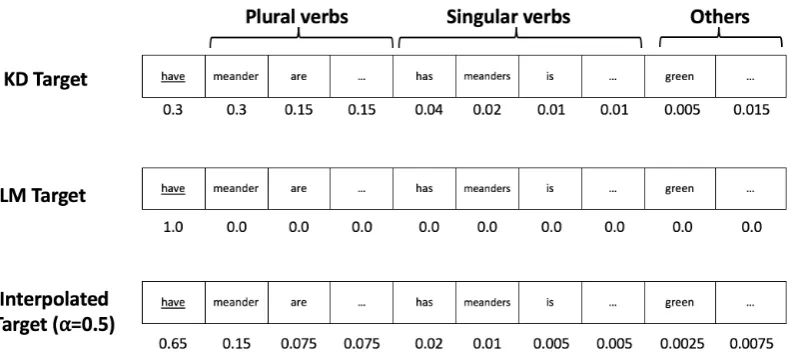
whereαis the interpolation coefficient. We illus-trate the effect of this interpolation in Fig.1.
Furthermore, computing `KD(x∗;θ) requires the RNNG’s estimate oft(w | x∗<j), which ne-cessitates an expensive marginalisation over all tree prefixes that generatewconditional onx∗<j. For efficiency, we approximate this using the one-best predicted tree from a pre-trained Berkeley parser,8denoted asyˆberk(x∗), as follows:
t(w|x∗<j)≈t(w|x∗<j, yˆberk<j (x∗)),
where yˆberk<j (x∗) are all the non-terminals in
ˆ
yberk(x∗) that occur before x∗j. In other words, we first parse the sentence with a Berkeley parser, and use the resulting tree prefix as conditioning context to compute the probability of generating
w∈Σunder the RNNG. While this means that the teacher’s predictions are not derived from a purely incremental process,9the student DSA-LSTM still
operates strictly incrementally. This interpolated objective is similar to label smoothing (Szegedy et al.,2016;Pereyra et al.,2017), with the softmax distribution of the RNNG as the smoothing factor as opposed to the uniform distribution.
Intuition. In Fig. 1, we provide an intuition about why the interpolation of the distillation and LM losses could inject hierarchical bias into a se-quential model. We consider the interpolated tar-get with α = 0.5 for a prefix (suppressing non-terminals)Parts of the river valley, where the cor-rect continuation ishavesince the agreement con-troller parts is plural. The standard LM loss is zero only when all word types other than the cor-rect one are assigned zero probability mass, and it is only in expectation (across training contexts) that syntactic regularities are inferred. In contrast, the interpolated target assigns a minimum proba-bility of 0.5 to the correct label, but crucially con-tains additional information about theplausibility
of every alternative based on the teacher RNNG’s predictions. Under this objective, the plural verbs
8We use the same pre-trained Berkeley parser to obtain
training and validation trees in §3.
9
The resulting syntactic prefixyˆberk
Figure 1: Example of the KD target (top), the standard LM target (middle), and the interpolated target used to train the DSA-LSTM (bottom) withα = 0.5, for a prefix (showing only the terminals)Parts of the river valley, where the correct continuation ishavedue to the plural subjectparts.
areandmeanderare assigned relatively high prob-ability mass since they fit both the syntactic and semantic constraints (e.g. Parts of the river val-ley often meander), while the set of singular verbs
has, meanders, and is are assigned much lower probability mass since they are syntactically il-licit. Thus, as long as the RNNG makes the accu-rate structural generalisations (and we have shown that it largely does in §3), every training instance provides the student LSTM with a wealth of in-formation about all the possible legitimate contin-uations according to the predictions of the hier-archical teacher, thereby making it easier for the student to learn the appropriate hierarchical con-straints and generalisations.
Differences with other KD work. Our ap-proach departs from the predominant view of distillation primarily as a means of compressing
knowledge from a bigger teacher or an ensemble to a compact student (Ba and Caruana,2014;Kim and Rush,2016;Liu et al.,2018,inter alia) in two important ways. First, here the teacher and stu-dent models are different in character, and not just in size: we transfer knowledge from a teacher that models the joint probability of strings and phrase-structure trees through hierarchical operations, to a student that only models surface strings through sequential operations. This setup presents an in-teresting dynamic since the DSA-LSTM has to mimic the predictions of the RNNG, which condi-tions on syntactic annotation to guide hierarchical operations, even though the DSA-LSTM itself has no direct access to any syntactic annotations at all. Second, distillation thus far has mostly been
applied in settings where the teacher and student models are trained on the same data. For scal-ability reasons, we train the RNNG on a subset of the data, and obtain its soft predictions on the rest. We hypothesise that the predictions of the hierarchical teacher—although they come from a model trained on a smaller dataset—can neverthe-less encourage the LSTM to develop structurally sensitive representations of the larger dataset it ob-serves.
Born-Again Networks (BA). In practice, the in-terpolated distillation objective above can be ap-plied to any teacher and student models. Recently, Furlanello et al.(2018) surprisingly finds perplex-ity improvement in aborn-againsetup that trains an LSTM LM on the gold data, and then uses the resulting model as a teacher to a student LSTM that shares the same architecture as the teacher. To better understand the importance of learning from a hierarchical teacher (which is not the case in a BA-LSTM since the teacher model is also sequen-tial), we present experiments comparing the DSA-LSTM with a BA-DSA-LSTM.
4.2 Experiments
Here we describe our experimental settings and present our findings.
pro-hibitive memory footprint.10 To save space, we instead pre-compute the teacher RNNG’s hidden stateht ∈ RM for every tokenx
t in the training set (M |Σ|), and compute the teacher’s soft-max on-the-fly with an affine transformation and a softmax, which presents minimal computational overhead.
Experimental settings. The DSA-LSTM has an identical architecture to the LSTM LM (§2), al-though the learning rate is optimised indepen-dently (Appendix). We select the final model based on validation LM perplexity, with targeted syntactic evaluations only applied at test time.
Training speed. Since the DSA-LSTM operates sequentially, it is amenable to batching operations and is five times faster to train than a comparable RNNG. Despite this significant speed-up, train-ing the DSA-LSTM in our basic implementation is still half as fast as the standard LM objective. We attribute this difference to the additional com-putational overhead associated with the distillation objective, such as I/O operations and computing the cross-entropy between the teacher and student models for the entire vocabulary. These opera-tions, however, only apply at training time; at test time there is no overhead of inferringqθˆα-int(x) un-der the DSA-LSTM.
Baselines. The DSA-LSTM benefits from three main components: (i) a KD objective, which in itself has been shown to be a good regulariser (Furlanello et al., 2018), (ii) the scalability of the sequential architecture, and (iii) a hierarchical bias, which here comes from the teacher RNNG. To understand the benefit of each component, we compare DSA-LSTM with these baselines:
• a strong LSTM LM (§2) that is scalable but lacks a hierarchical bias (“Full LSTM”);
• the teacher RNNG trained on a 20% subset of the training set (§3), which benefits from a hier-archical bias but lacks scalability (“RNNG”);
• a DSA-LSTM trained on the same smaller sub-set as the teacher RNNG (“S-DSA-LSTM”). This baseline isolates the importance of scala-bility, since it still benefits from a KD objective and a hierarchical bias from the teacher RNNG;
10Pre-computing the RNNG’s predictions necessitates
storingN× |Σ|numbers, whereNis the number of tokens. For theGulordava et al.(2018) training set (∼80M tokens), this requires storing 4 trillion floating points, or 25 terabytes.
• a born-again LSTM that benefits from KD and scalability, though it lacks a hierarchical bias due to the sequential teacher (“BA-LSTM”).
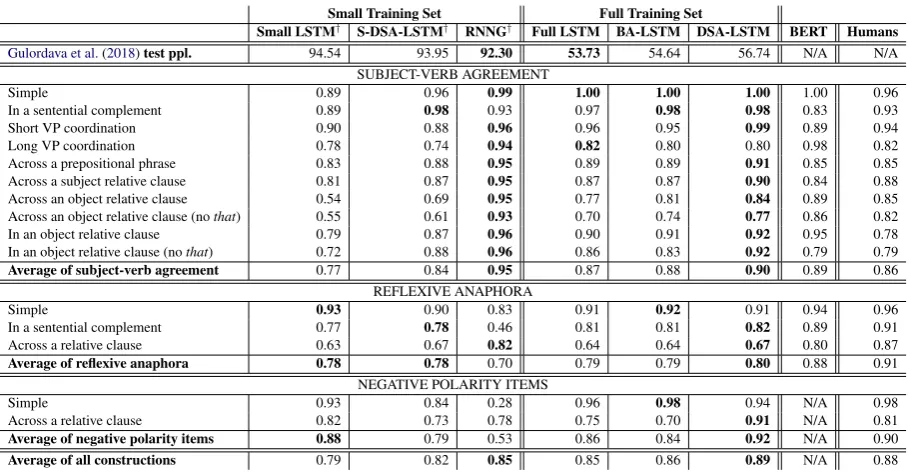
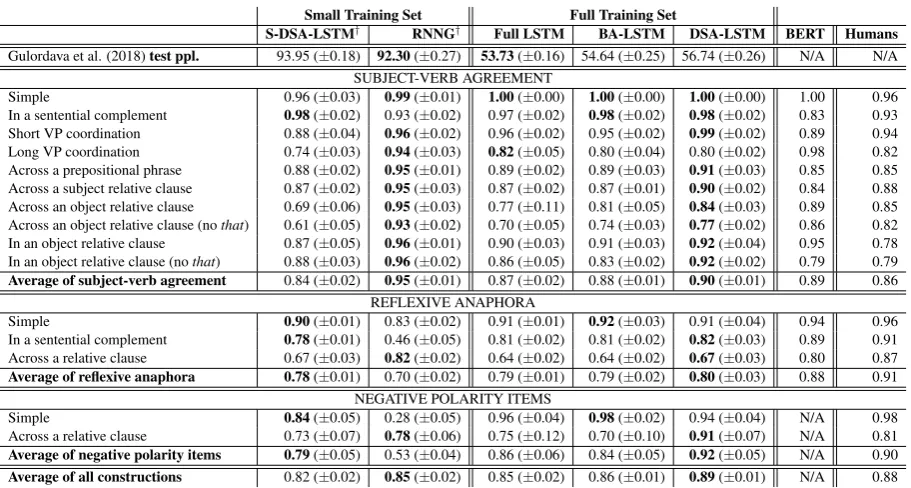
Discussion. To avoid clutter, for each model variant we present only the mean performance of 10 identical models from different random seeds; results with standard deviations are in the Ap-pendix. We present our findings in Table2, based on which we derive several observations.
• Of the three models trained on the small subset, the S-DSA-LSTM outperforms the small LSTM trained on standard LM objective, improving overall acccuracy from 0.79 to 0.82 (14% error reduction), even though both models share the same architecture and training set size (i.e. only the training objective is different). On subject-verb agreement, the S-DSA-LSTM successfully narrows the gap with the slower teacher RNNG, which benefits from syntactic bias and annota-tion. These findings confirm our hypothesis that the KD approach constitutes an efficient way to inject hierarchical bias into sequential models.
• The born-again model (BA-LSTM) outperforms the LSTM LM, albeit by a small margin. This finding suggests that KD helps improve the syn-tactic competence of LSTMs, even when the teacher model lacks explicit hierarchical bias and shares the same architecture as the student.
• In terms of perplexity, both BA-LSTM and DSA-LSTM perform slightly worse than the full LSTM LM trained without KD loss. We attribute this gap to the smoother target distri-bution when using KD, which effectively pe-nalises high probabilities on the correct next wordx∗j unless the teacher model is extremely confident. This observation is consistent with earlier findings on label smoothing in machine translation (Pereyra et al.,2017;Vaswani et al., 2017), which often results in better BLEU at the expense of slightly worse likelihood.
Small Training Set Full Training Set
Small LSTM† S-DSA-LSTM† RNNG† Full LSTM BA-LSTM DSA-LSTM BERT Humans
Gulordava et al.(2018)test ppl. 94.54 93.95 92.30 53.73 54.64 56.74 N/A N/A
SUBJECT-VERB AGREEMENT
Simple 0.89 0.96 0.99 1.00 1.00 1.00 1.00 0.96
In a sentential complement 0.89 0.98 0.93 0.97 0.98 0.98 0.83 0.93
Short VP coordination 0.90 0.88 0.96 0.96 0.95 0.99 0.89 0.94
Long VP coordination 0.78 0.74 0.94 0.82 0.80 0.80 0.98 0.82
Across a prepositional phrase 0.83 0.88 0.95 0.89 0.89 0.91 0.85 0.85
Across a subject relative clause 0.81 0.87 0.95 0.87 0.87 0.90 0.84 0.88
Across an object relative clause 0.54 0.69 0.95 0.77 0.81 0.84 0.89 0.85
Across an object relative clause (nothat) 0.55 0.61 0.93 0.70 0.74 0.77 0.86 0.82
In an object relative clause 0.79 0.87 0.96 0.90 0.91 0.92 0.95 0.78
In an object relative clause (nothat) 0.72 0.88 0.96 0.86 0.83 0.92 0.79 0.79
Average of subject-verb agreement 0.77 0.84 0.95 0.87 0.88 0.90 0.89 0.86 REFLEXIVE ANAPHORA
Simple 0.93 0.90 0.83 0.91 0.92 0.91 0.94 0.96
In a sentential complement 0.77 0.78 0.46 0.81 0.81 0.82 0.89 0.91
Across a relative clause 0.63 0.67 0.82 0.64 0.64 0.67 0.80 0.87
Average of reflexive anaphora 0.78 0.78 0.70 0.79 0.79 0.80 0.88 0.91
NEGATIVE POLARITY ITEMS
Simple 0.93 0.84 0.28 0.96 0.98 0.94 N/A 0.98
Across a relative clause 0.82 0.73 0.78 0.75 0.70 0.91 N/A 0.81
Average of negative polarity items 0.88 0.79 0.53 0.86 0.84 0.92 N/A 0.90
[image:8.595.72.528.60.296.2]Average of all constructions 0.79 0.82 0.85 0.85 0.86 0.89 N/A 0.88
Table 2: Experimental findings of the“DSA-LSTM”. For each column, we report the mean of 10 iden-tical models trained from different random seeds; standard deviation values are reported in the Ap-pendix. “S-DSA-LSTM” indicates the DSA-LSTM trained on the smaller RNNG training set, while
“BA-LSTM”is the born-again model where the teacher is the full LSTM LM. We also compare with the syntactic generalisation of“BERT”Base (Devlin et al.,2019;Goldberg,2019), which is not strictly comparable since it is trained on 30 times as much data. †indicates models trained on the smaller 20% training set (§3). Results in bold denote the best among those trained with the same amounts of data.
NPI, on which the teacher RNNG (but not the full LSTM) fails to achieve a good performance. • While not directly comparable, the DSA-LSTM outperforms a pre-trained BERT (Devlin et al., 2019;Goldberg,2019)11on subject-verb agree-ment. Since BERT benefits from bidirectional-ity and was trained on 30 times as much data as the DSA-LSTM, this finding suggests that, at least in terms of syntactic competence, struc-tural biases continue to be relevant even as the current generation of sequential LMs is able to exploit increasingly large amounts of data.
4.3 Probing for Hierarchical Information
Having established the advantages of the DSA-LSTM on targeted syntactic evaluations, we turn to the question of analysing how its internal rep-resentation differs from that of a standard LSTM LM. To this end, we adopt the method ofBlevins et al.(2018) and use a probe (Shi et al.,2016;Adi et al.,2017;Belinkov et al.,2017;Conneau et al., 2018;Hewitt and Manning, 2019, inter alia) that
11Goldberg (2019) applies an additional pre-processing
step, removing sentences in which the focus verb does not appear as a single word in the word piece-based vocabulary; hence, the evaluation sentences are slightly different.
predicts thegrandparent constituentof a word to-ken xt, based on its encoding ht under the pre-trained LSTM. Under this framework, the accu-racy of the probe on a held-out set can be un-derstood as an indication of how well the hidden states encode the relevant syntactic information re-quired to succeed in this task.
We use a linear classifier for the probe and ob-tain the predicted grandparent constituent label us-ing the same pre-trained Berkeley parser (§3) that we used to obtain predicted phrase-structure trees to train the RNNG. For the probing experiment, we randomly select sentences from each respec-tive training, validation, and test set of the Gulor-dava et al.(2018) dataset to yield∼300,000 words for training and∼10,000 words for each of vali-dation and test sets. For the probe features, we use a concatenation of the LSTM hidden state at the current and next words,12 i.e. [ht;ht+1], where; denotes the concatenation operation.
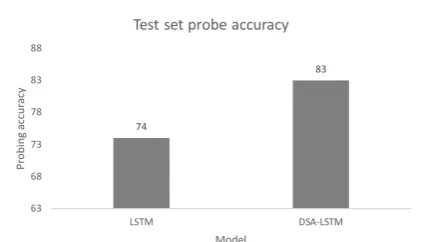
Recall that the DSA-LSTM operates only on word sequences and has no access to the Berkeley parse during training. We summarise the probing
12Our probing feature set thus slightly differs from that of
Figure 2: Probing accuracy on the test set. We analyse the hidden states of the LSTM and DSA-LSTM to analyse the structural information en-coded in each respective model’s hidden state.
result in Fig.2. Overall, the syntactic probing ac-curacy for the DSA-LSTM is much higher than for the LSTM LM (83% to 74%; a 34% error rate re-duction), suggesting that the means by which the DSA-LSTM achieves better syntactic competence is by tracking more hierarchical information dur-ing sequential processdur-ing.
5 Related Work
Augmenting language models with syntactic in-formation and structural inductive bias has been a long-standing area of research. To this end, syn-tactic language models estimate the joint proba-bility of surface strings and some form of syn-tactic structure (Jurafsky et al.,1995;Chelba and Jelinek, 2000; Roark, 2001; Henderson, 2004; Emami and Jelinek, 2005; Buys and Blunsom, 2015; Mirowski and Vlachos, 2015;Dyer et al., 2016;Kim et al., 2019). In contrast to these ap-proaches, the DSA-LSTM only models the prob-ability of surface strings, albeit with an auxiliary loss that distills the next-word predictive distribu-tion of a syntactic language model.
Earlier work has also explored multi-task learn-ing with syntactic objectives as an auxiliary loss in language modelling and machine translation ( Lu-ong et al., 2016; Eriguchi et al., 2016; Nadejde et al.,2017;Enguehard et al., 2017;Aharoni and Goldberg, 2017; Eriguchi et al., 2017). Our ap-proach of injecting syntactic bias through a KD objective is orthogonal to this approach, with the primary difference that here the student DSA-LSTM has no direct access to syntactic annota-tions; it does, however, have access to the teacher RNNG’s softmax distribution over the next word.
Our approach is also closely related to recent work that introduces structurally-motivated
induc-tive biases into language models. Chung et al. (2017) segmented the hidden state update of an RNN through a multi-scale hierarchical recur-rence, thereby providing a shortcut to the gradient propagation of long-range, hierarchical dependen-cies. Yogatama et al.(2018) introduced a stack-structured memory to encourage hierarchical mod-elling in language models, where the resulting model successfully outperforms standard LSTM variants in number agreement (Linzen et al.,2016) evaluation.Shen et al.(2019) imposed a hierarchi-cal bias on the LSTM cell-updating mechanism, based on the intuition that larger constituents con-tain information that changes more slowly across the sequence. Our proposed method is orthogo-nal and can be applied on top of these recent ap-proaches.
6 Conclusion
In this paper, we introduce a distilled syntax-aware LSTM (DSA-LSTM), which combines scalability with structural biases. We achieve this by dis-tilling the predictions about upcoming words in a large training corpus made by a (computationally complex) hierarchical language model trained on a small subset of the data. While we find that LSTM language models achieve better syntactic general-isation than previously thought, on targeted syn-tactic evaluations our approach improves over this strong baseline, yields a new state of the art, com-pares favourably to a language model trained on much more data, and results in a language model that encodes hierarchical information to a large ex-tent despite its sequential architecture. Our ap-proach is a general one that can be applied to other student model architectures, such as Transformers (Vaswani et al.,2017). These findings suggest that the question of structural biases continues to be relevant for improving syntactic competence, even in scalable architectures that can benefit from ever-growing amounts of training data.
Acknowledgments
References
Yossi Adi, Einat Kermany, Yonatan Belinkov, Ofer Lavi, and Yoav Goldberg. 2017. Fine-grained anal-ysis of sentence embeddings using auxiliary predic-tion tasks. InProc. of ICLR.
Roee Aharoni and Yoav Goldberg. 2017. Towards string-to-tree neural machine translation. In Proc. of ACL.
Jimmy Ba and Rich Caruana. 2014. Do deep nets really need to be deep? InNIPS.
Srinivas Bangalore and Aravind K. Joshi. 1999. Su-pertagging: An approach to almost parsing. Com-putational Linguistics, 25.
Yonatan Belinkov, Nadir Durrani, Fahim Dalvi, Hassan Sajjad, and James Glass. 2017. What do neural ma-chine translation models learn about morphology? InProc. of ACL.
Terra Blevins, Omer Levy, and Luke Zettlemoyer and. 2018. Deep rnns encode soft hierarchical syntax. In
Proc. of ACL.
Cristian Bucilˇa, Rich Caruana, and Alexandru Niculescu-Mizil. 2006. Model compression. In
Proc. of KDD.
Jan Buys and Phil Blunsom. 2015. A Bayesian model for generative transition-based dependency parsing.
CoRR, abs/1506.04334.
Ciprian Chelba and Frederick Jelinek. 2000. Struc-tured language modeling. Computer Speech and Language, 14(4).
Do Kook Choe and Eugene Charniak. 2016. Parsing as language modeling. InProc. of EMNLP.
Junyoung Chung, Sungjin Ahn, and Yoshua Bengio. 2017. Hierarchical multiscale recurrent neural net-works. InProc. of ICLR.
Stephen Clark and James R. Curran. 2007. Wide-coverage efficient statistical parsing with CCG and log-linear models.Computational Linguistics.
Alexis Conneau, Germ´an Kruszewski, Guillaume Lample, Lo¨ıc Barrault, and Marco Baroni. 2018. What you can cram into a single vector: Probing sentence embeddings for linguistic properties.
Mostafa Dehghani, Stephan Gouws, Oriol Vinyals, Jakob Uszkoreit, and Lukasz Kaiser. 2019. Univer-sal transformers. InProc. of ICLR.
Jacob Devlin, Ming-Wei Chang, Kenton Lee, and Kristina Toutanova. 2019. BERT: pre-training of deep bidirectional transformers for language under-standing. InProc. of NAACL.
Chris Dyer, Miguel Ballesteros, Wang Ling, Austin Matthews, and Noah A. Smith. 2015. Transition-based dependency parsing with stack long short-term memory. InProc. of ACL.
Chris Dyer, Adhiguna Kuncoro, Miguel Ballesteros, and Noah A. Smith. 2016. Recurrent neural network grammars. InProc. of NAACL.
Ahmad Emami and Frederick Jelinek. 2005. A neu-ral syntactic language model. Machine Learning, 60:195–227.
´
Emile Enguehard, Yoav Goldberg, and Tal Linzen. 2017. Exploring the syntactic abilities of rnns with multi-task learning. InProc. of CoNLL.
Akiko Eriguchi, Kazuma Hashimoto, and Yoshimasa Tsuruoka. 2016. Tree-to-sequence attentional neu-ral machine translation. InProc. of ACL.
Akiko Eriguchi, Yoshimasa Tsuruoka, and Kyunghyun Cho. 2017. Learning to parse and translate improves neural machine translation. InProc. of ACL.
Daniel Fried, Mitchell Stern, and Dan Klein. 2017. Im-proving neural parsing by disentangling model com-bination and reranking effects. InProc. of ACL.
Tommaso Furlanello, Zachary Chase Lipton, Michael Tschannen, Laurent Itti, and Anima Anandkumar. 2018. Born-again neural networks. In Proc. of
ICML.
Yoav Goldberg. 2019. Assessing BERT’s syntactic abilities. CoRR, abs/1901.05287.
Kristina Gulordava, Piotr Bojanowski, Edouard Grave, Tal Linzen, and Marco Baroni. 2018. Colorless green recurrent networks dream hierarchically. In
Proc. of NAACL.
John Hale, Chris Dyer, Adhiguna Kuncoro, and Jonathan R. Brennan. 2018. Finding syntax in hu-man encephalography with beam search. InProc. of ACL.
James Henderson. 2004. Discriminative training of a neural network statistical parser. InProc. of ACL.
John Hewitt and Christopher D. Manning. 2019. A structural probe for finding syntax in word represen-tations. InProc. of NAACL.
Geoffrey E. Hinton, Oriol Vinyals, and Jeffrey Dean. 2015. Distilling the knowledge in a neural network.
CoRR, abs/1503.02531.
Sepp Hochreiter and J¨urgen Schmidhuber. 1997. Long short-term memory.Neural Computation.
Jeremy Howard and Sebastian Ruder. 2018. Universal language model fine-tuning for text classification. In
Proc. of ACL.
Frederick Jelinek. 1997. Statistical Methods for
Speech Recognition. MIT Press.
Yoon Kim and Alexander M. Rush. 2016. Sequence-level knowledge distillation. InProc. of EMNLP.
Yoon Kim, Alexander M. Rush, Lei Yu, Adhiguna Kuncoro, Chris Dyer, and Gabor Melis. 2019. Un-supervised recurrent neural network grammars. In
Proc. of NAACL.
Philipp Koehn. 2010. Statistical Machine Translation. Cambridge University Press.
Adhiguna Kuncoro, Miguel Ballesteros, Lingpeng Kong, Chris Dyer, Graham Neubig, and Noah A. Smith. 2017. What do recurrent neural network grammars learn about syntax? InProc. of EACL.
Adhiguna Kuncoro, Chris Dyer, John Hale, Dani Yo-gatama, Stephen Clark, and Phil Blunsom. 2018. Lstms can learn syntax-sensitive dependencies well, but modeling structure makes them better. InProc. of ACL.
Tal Linzen, Emmanuel Dupoux, and Yoav Goldberg. 2016. Assessing the ability of LSTMs to learn syntax-sensitive dependencies. Transactions of the Association for Computational Linguistics.
Yijia Liu, Wanxiang Che, Huaipeng Zhao, Bing Qin, and Ting Liu. 2018. Distilling knowledge for search-based structured prediction. InProc. of ACL.
Thang Luong, Quoc V. Le, Ilya Sutskever, Oriol Vinyals, and Lukasz Kaiser. 2016. Multi-task se-quence to sese-quence learning. InProc. of ICLR.
Rebecca Marvin and Tal Linzen. 2018. Targeted syn-tactic evaluation of language models. In Proc. of
EMNLP.
Tom´aˇs Mikolov, Martin Karafi´at, Luk´aˇs Burget, Jan ˇ
Cernock´y, and Sanjeev Khudanpur. 2010. Recur-rent neural network based language model. InProc. of Interspeech.
Piotr Mirowski and Andreas Vlachos. 2015. Depen-dency recurrent neural language models for sentence completion. InProc. of ACL-IJCNLP.
Maria Nadejde, Siva Reddy, Rico Sennrich, Tomasz Dwojak, Marcin Junczys-Dowmunt, Philipp Koehn, and Alexandra Birch. 2017. Predicting target lan-guage ccg supertags improves neural machine trans-lation. InProc. of WMT.
Graham Neubig, Chris Dyer, Yoav Goldberg, Austin Matthews, Waleed Ammar, Antonios Anastasopou-los, Miguel Ballesteros, David Chiang, Daniel Clothiaux, Trevor Cohn, Kevin Duh, Manaal Faruqui, Cynthia Gan, Dan Garrette, Yangfeng Ji, Lingpeng Kong, Adhiguna Kuncoro, Gaurav Ku-mar, Chaitanya Malaviya, Paul Michel, Yusuke Oda, Matthew Richardson, Naomi Saphra, Swabha Swayamdipta, and Pengcheng Yin. 2017a. DyNet: The Dynamic Neural Network Toolkit. arXiv preprint arXiv:1701.03980.
Graham Neubig, Yoav Goldberg, and Chris Dyer. 2017b. On-the-fly operation batching in dynamic computation graphs. InProc. of NIPS.
Gabriel Pereyra, George Tucker, Jan Chorowski, Lukasz Kaiser, and Geoffrey Hinton. 2017. Regular-izing neural networks by penalRegular-izing confident output distributions. InProc. of ICLR.
Matthew E. Peters, Mark Neumann, Mohit Iyyer, Matt Gardner, Christopher Clark, Kenton Lee, and Luke Zettlemoyer. 2018. Deep contextualized word rep-resentations. InProc. of NAACL.
Slav Petrov and Dan Klein. 2007. Improved inference for unlexicalized parsing. InProc. of NAACL.
Alec Radford, Jeffrey Wu, Rewon Child, David Luan, Dario Amodei, and Ilya Sutskever. 2019. Language models are unsupervised multitask learners.
Brian Roark. 2001. Probabilistic top-down parsing and language modeling. Computational Linguistics, 27(2).
Ronald Rosenfeld. 2000. Two decades of statistical language modeling: Where do we go from here. In
Proc. of IEEE.
Yikang Shen, Shawn Tan, Alessandro Sordoni, and Aaron C. Courville. 2019. Ordered neurons: In-tegrating tree structures into recurrent neural net-works. InProc. of ICLR.
Xing Shi, Inkit Padhi, and Kevin Knight. 2016. Does string-based neural MT learn source syntax? In
Proc. of EMNLP.
Mitchell Stern, Daniel Fried, and Dan Klein. 2017. Ef-fective inference for generative neural parsing. In
Proc. of EMNLP.
Christian Szegedy, Vincent Vanhoucke, Sergey Ioffe, Jonathon Shlens, and Zbigniew Wojna. 2016. Re-thinking the inception architecture for computer vi-sion. InProc. of CVPR.
Ke M. Tran, Arianna Bisazza, and Christof Monz. 2018. The importance of being recurrent for mod-eling hierarchical structure. InProc. of EMNLP.
Ashish Vaswani, Noam Shazeer, Niki Parmar, Jakob Uszkoreit, Llion Jones, Aidan N. Gomez, Lukasz Kaiser, and Illia Polosukhin. 2017. Attention is all you need. InProc. of NIPS.
Appendix
Here we outline the hyperparameters and the ex-perimental results with standard deviation values.
A Hyperparameters
The hyperparameters for each model is sum-marised as follows.
LSTM LMs. For the LSTM LMs trained on the full and small training sets, we use the follow-ing hyperparameters that achieve the best valida-tion perplexity following a grid search: 2-layer LSTM with 650 hidden units per layer for the full LSTM and 300 hidden units per layer for the small LSTM (similar model capacity as the RNNG trained on the same smaller training set), opti-mised by stochastic gradient descent (SGD) with a learning rate of 0.45 (decayed exponentially at every epoch with a factor of 0.9 after the tenth epoch), a dropout rate of 0.2 applied on both in-put and recurrent connections, and a batch size of 20 sentences.
RNNG. For the RNNG, we use the following hyperparameters that achieve the best validation perplexity following a similar grid search: 2-layer stack LSTM with 256 hidden units per layer, opti-mised by SGD with a learning rate of 0.3 (decayed exponentially at every epoch with a factor of 0.92 after the tenth epoch), a dropout rate of 0.3 ap-plied on both input and recurrent connections, and a batch size of 10 sentences.
DSA-LSTMs and Born-Again LSTMs. We use the same hyperparameters for the DSA-LSTMs trained on both the full and small (S-DSA-LSTM) training sets and the born-again LSTM (BA-LSTM) trained on the full training set. Since the model architectures are identical with the re-spective LSTM LMs (i.e. only the training objec-tive is different), we only optimise for the learning rates and keep all other hyperparameters the same. We find that a learning rate of 0.4 and an expo-nential decay factor of 0.9 applied after the tenth epoch works well across all three models trained with the KD objective.
B Experimental Results with Standard
Deviation
Small Training Set Full Training Set
S-DSA-LSTM† RNNG† Full LSTM BA-LSTM DSA-LSTM BERT Humans
Gulordava et al. (2018)test ppl. 93.95 (±0.18) 92.30(±0.27) 53.73(±0.16) 54.64 (±0.25) 56.74 (±0.26) N/A N/A
SUBJECT-VERB AGREEMENT
Simple 0.96 (±0.03) 0.99(±0.01) 1.00(±0.00) 1.00(±0.00) 1.00(±0.00) 1.00 0.96
In a sentential complement 0.98(±0.02) 0.93 (±0.02) 0.97 (±0.02) 0.98(±0.02) 0.98(±0.02) 0.83 0.93
Short VP coordination 0.88 (±0.04) 0.96(±0.02) 0.96 (±0.02) 0.95 (±0.02) 0.99(±0.02) 0.89 0.94
Long VP coordination 0.74 (±0.03) 0.94(±0.03) 0.82(±0.05) 0.80 (±0.04) 0.80 (±0.02) 0.98 0.82
Across a prepositional phrase 0.88 (±0.02) 0.95(±0.01) 0.89 (±0.02) 0.89 (±0.03) 0.91(±0.03) 0.85 0.85
Across a subject relative clause 0.87 (±0.02) 0.95(±0.03) 0.87 (±0.02) 0.87 (±0.01) 0.90(±0.02) 0.84 0.88
Across an object relative clause 0.69 (±0.06) 0.95(±0.03) 0.77 (±0.11) 0.81 (±0.05) 0.84(±0.03) 0.89 0.85
Across an object relative clause (nothat) 0.61 (±0.05) 0.93(±0.02) 0.70 (±0.05) 0.74 (±0.03) 0.77(±0.02) 0.86 0.82
In an object relative clause 0.87 (±0.05) 0.96(±0.01) 0.90 (±0.03) 0.91 (±0.03) 0.92(±0.04) 0.95 0.78
In an object relative clause (nothat) 0.88 (±0.03) 0.96(±0.02) 0.86 (±0.05) 0.83 (±0.02) 0.92(±0.02) 0.79 0.79
Average of subject-verb agreement 0.84 (±0.02) 0.95(±0.01) 0.87 (±0.02) 0.88 (±0.01) 0.90(±0.01) 0.89 0.86 REFLEXIVE ANAPHORA
Simple 0.90(±0.01) 0.83 (±0.02) 0.91 (±0.01) 0.92(±0.03) 0.91 (±0.04) 0.94 0.96
In a sentential complement 0.78(±0.01) 0.46 (±0.05) 0.81 (±0.02) 0.81 (±0.02) 0.82(±0.03) 0.89 0.91
Across a relative clause 0.67 (±0.03) 0.82(±0.02) 0.64 (±0.02) 0.64 (±0.02) 0.67(±0.03) 0.80 0.87
Average of reflexive anaphora 0.78(±0.01) 0.70 (±0.02) 0.79 (±0.01) 0.79 (±0.02) 0.80(±0.03) 0.88 0.91 NEGATIVE POLARITY ITEMS
Simple 0.84(±0.05) 0.28 (±0.05) 0.96 (±0.04) 0.98(±0.02) 0.94 (±0.04) N/A 0.98
Across a relative clause 0.73 (±0.07) 0.78(±0.06) 0.75 (±0.12) 0.70 (±0.10) 0.91(±0.07) N/A 0.81
Average of negative polarity items 0.79(±0.05) 0.53 (±0.04) 0.86 (±0.06) 0.84 (±0.05) 0.92(±0.05) N/A 0.90
[image:13.595.72.528.237.481.2]Average of all constructions 0.82 (±0.02) 0.85(±0.02) 0.85 (±0.02) 0.86 (±0.01) 0.89(±0.01) N/A 0.88
Table 3: Experimental findings of the“DSA-LSTM”. For each column, we report the mean and standard deviation values of 10 identical models trained from different random seeds.“S-DSA-LSTM”indicates the DSA-LSTM trained on the smaller RNNG training set, while“BA-LSTM”is the born-again model where the teacher is the full LSTM LM. We also compare with the syntactic generalisation of“BERT”