1884
Training Classifiers with Natural Language Explanations
Braden Hancock
Computer Science Dept. Stanford University
Paroma Varma
Electrical Engineering Dept. Stanford University
Stephanie Wang
Computer Science Dept. Stanford University
Martin Bringmann
OccamzRazor San Francisco, CA
Percy Liang
Computer Science Dept. Stanford University
Christopher R´e
Computer Science Dept. Stanford University
Abstract
Training accurate classifiers requires many
labels, but each label provides only
limited information (one bit for binary classification). In this work, we propose
BabbleLabble, a framework for training classifiers in which an annotator provides a natural language explanation for each
labeling decision. A semantic parser
converts these explanations into program-matic labeling functions that generate noisy labels for an arbitrary amount of unlabeled data, which is used to train a
classifier. On three relation extraction
tasks, we find that users are able to train classifiers with comparable F1 scores from 5–100 faster by providing explana-tions instead of just labels. Furthermore, given the inherent imperfection of labeling functions, we find that a simple rule-based semantic parser suffices.
1 Introduction
The standard protocol for obtaining a labeled dataset is to have a human annotator view each example, assess its relevance, and provide a label (e.g., positive or negative for binary classification). However, this only provides one bit of information per example. This invites the question: how can we get more information per example, given that the annotator has already spent the effort reading and understanding an example?
Previous works have relied on identifying rel-evant parts of the input such as labeling features (Druck et al.,2009;Raghavan et al.,2005;Liang et al., 2009), highlighting rationale phrases in
Both cohorts showed signs of optic nerve toxicitydue to ethambutol.
Example
Label
Explanation
Because the words “due to” occur between the chemical and the disease.
Does this chemicalcause this disease?
Why do you think so?
Labeling Function
def lf(x):
return (1if“due to” inbetween(x.chemical, x.disease)
[image:1.595.309.523.247.447.2]else 0)
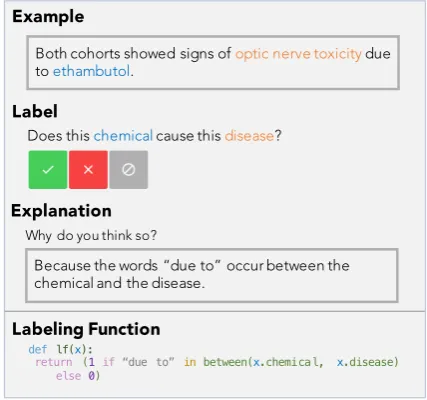
Figure 1: In BabbleLabble, the user provides
a natural language explanation for each label-ing decision. These explanations are parsed into labeling functions that convert unlabeled data into a large labeled dataset for training a classifier.
text (Zaidan and Eisner,2008;Arora and Nyberg,
2009), or marking relevant regions in images (Ahn
et al.,2006). But there are certain types of infor-mation which cannot be easily reduced to annotat-ing a portion of the input, such as the absence of a certain word, or the presence of at least two words. In this work, we tap into the power of natural lan-guage and allow annotators to provide supervision to a classifier vianatural language explanations.
Specifically, we propose a framework in which annotators provide a natural language explanation for each label they assign to an example (see
Fig-ure 1). These explanations are parsed into
Tom Bradyand his wife Gisele Bündchenwere spotted in New York City on Monday amid rumors of Brady’s alleged role in Deflategate.
True, because the words “his wife” are right before person 2.
defLF_1a(x):
return(1if“his wife”in
left(x.person2, dist==1)else0)
defLF_1b(x):
return(1if“his wife”in
right(x.person2)else0
Correct
Semantic Filter
(inconsistent) Unlabeled Examples + Explanations
Label whether person 1 is married to person 2
Labeling Functions Filters Label Matrix
None of us knows what happened at Kane‘s home Aug. 2, but it is telling that the NHL has not suspended Kane.
False, because person 1and person 2 in the sentence are identical.
Dr. Michael Richardsand real estate and insurance businessman Gary Kirke did not attend the event.
False, because the last word of person 1is different than the last word of person 2.
x1
x2
x3
defLF_3a(x): return (-1if
x.person1.tokens[-1] != x.person2.tokens[-1] else0)
Correct
Pragmatic Filter
(duplicate of LF_3a)
defLF_2b(x):
return (-1if x.person1 ==
x.person2)else0) Correct
defLF_3b(x): return (-1ifnot (
x.person1.tokens[-1] == x.person2.tokens[-1])else0)
defLF_2a(x):
return(-1if x.person1in
x.sentenceandx.person2 in
x.sentenceelse0)
Pragmatic Filter
(always true)
x1 x2 x3
LF1a LF2b LF3a 1 -1 -1 -1 ỹ
x4 …
LF…4c 1 1
… + 1 -+ -Noisy Labels
(x1,ỹ1) (x2,ỹ2)
(x3,ỹ3) (x4,ỹ4)
Classifier
[image:2.595.83.512.65.257.2]x ỹ
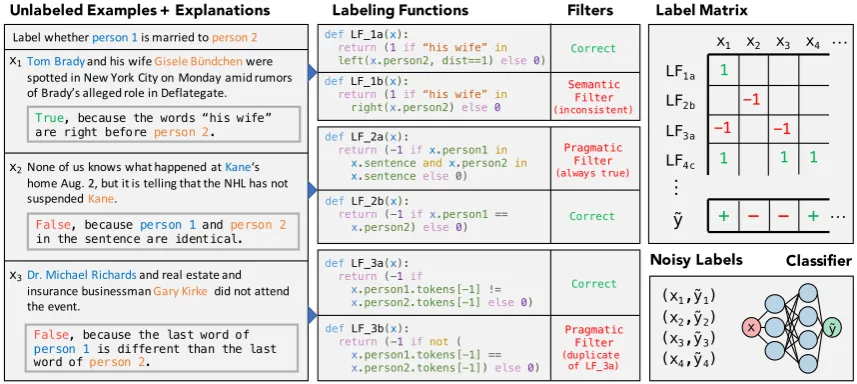
Figure 2: Natural language explanations are parsed into candidate labeling functions (LFs). Many incorrect LFs are filtered out automatically by the filter bank. The remaining functions provide heuristic labels over the unlabeled dataset, which are aggregated into one noisy label per example, yielding a large, noisily-labeled training set for a classifier.
then executed on many unlabeled examples, re-sulting in a large, weakly-supervised training set that is then used to train a classifier.
Semantic parsing of natural language into log-ical forms is recognized as a challenging
prob-lem and has been studied extensively (Zelle and
Mooney, 1996; Zettlemoyer and Collins, 2005;
Liang et al.,2011;Liang,2016). One of our ma-jor findings is that in our setting, even a simple rule-based semantic parser suffices for three rea-sons: First, we find that the majority of incorrect LFs can be automatically filtered out either seman-tically (e.g., is it consistent with the associated ex-ample?) or pragmatically (e.g., does it avoid as-signing the same label to the entire training set?). Second, LFs near the gold LF in the space of logi-cal forms are often just as accurate (and sometimes even more accurate). Third, techniques for com-bining weak supervision sources are built to toler-ate some noise (Alfonseca et al.,2012;Takamatsu et al.,2012;Ratner et al.,2018). The significance of this is that we can deploy the same semantic parser across tasks without task-specific training. We show how we can tackle a real-world biomedi-cal application with the same semantic parser used to extract instances of spouses.
Our work is most similar to that of Srivastava
et al.(2017), who also use natural language expla-nations to train a classifier, but with two important differences. First, they jointly train a task-specific semantic parser and classifier, whereas we use a
simple rule-based parser. In Section4, we find that in our weak supervision framework, the rule-based semantic parser and the perfect parser yield nearly identical downstream performance. Second, while they use the logical forms of explanations to pro-ducefeaturesthat are fed directly to a classifier, we
use them asfunctions for labeling a much larger
training set. In Section4, we show that using func-tions yields a 9.5 F1 improvement (26% relative improvement) over features, and that the F1 score scales with the amount of available unlabeled data. We validate our approach on two existing datasets from the literature (extracting spouses from news articles and disease-causing chemi-cals from biomedical abstracts) and one real-world use case with our biomedical collaborators at Oc-camzRazor to extract protein-kinase interactions related to Parkinson’s disease from text. We find empirically that users are able to train classifiers with comparable F1 scores up to two orders of magnitude faster when they provide natural lan-guage explanations instead of individual labels.
Our code and data can be found at https://
github.com/HazyResearch/babble.
2 TheBabbleLabbleFramework
The BabbleLabble framework converts natural language explanations and unlabeled data into a
noisily-labeled training set (see Figure2). There
<START> label false because X and Y are the same person <STOP>
START LABEL FALSE BECAUSE ARG AND ARG IS EQUAL STOP BOOL ARGLIST ISEQUAL
CONDITION
LF
Lexical Rules Unary Rules Compositional Rules
→<START> →label →false
START
LABEL
FALSE
→ FALSE
→ TRUE
→ INT
BOOL
BOOL
NUM
LF
CONDITION
ARGLIST
→ START LABEL BOOL BECAUSE CONDITION STOP
→ ARGLIST ISEQUAL
→ ARG AND ARG
[image:3.595.122.479.66.204.2]Ignored token
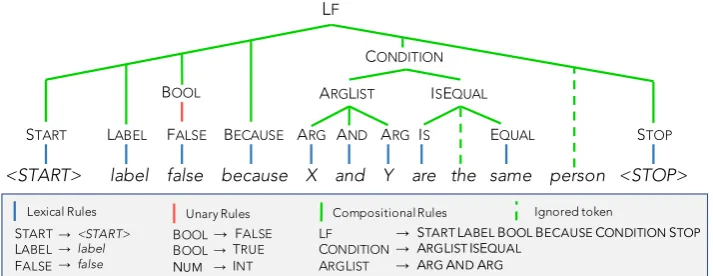
Figure 3: Valid parses are found by iterating over increasingly large subspans of the input looking for matches among the right hand sides of the rules in the grammar. Rules are either lexical (converting tokens into symbols), unary (converting one symbol into another symbol), or compositional (combining many symbols into a single higher-order symbol). A rule may optionally ignore unrecognized tokens in a span (denoted here with a dashed line).
parser converts natural language explanations into a set of logical forms representing labeling func-tions (LFs). The filter bank removes as many in-correct LFs as possible without requiring ground truth labels. The remaining LFs are applied to un-labeled examples to produce a matrix of labels. This label matrix is passed into the label aggre-gator, which combines these potentially conflict-ing and overlappconflict-ing labels into one label for each example. The resulting labeled examples are then used to train an arbitrary discriminative model.
2.1 Explanations
To create the input explanations, the user views a
subsetS of an unlabeled datasetD(where|S|
|D|) and provides for each inputxi ∈ S a label
yi and a natural language explanation ei, a
sen-tence explaining why the example should receive
that label. The explanationei generally refers to
specific aspects of the example (e.g., in Figure2, the location of a specific string “his wife”).
2.2 Semantic Parser
The semantic parser takes a natural language ex-planationeiand returns a set of LFs (logical forms or labeling functions) {f1, . . . , fk} of the form fi : X → {−1,0,1} in a binary classification setting, with 0 representing abstention. We em-phasize that the goal of this semantic parser isnot to generate the single correct parse, but rather to
have coverage over many potentially useful LFs.1
1Indeed, we find empirically that an incorrect LF nearby
the correct one in the space of logical forms actually has higher end-task accuracy 57% of the time (see Section4.2).
We choose a simple rule-based semantic parser that can be used without any training. Formally,
the parser uses a set of rules of the formα → β,
whereαcan be replaced by the token(s) inβ (see
Figure3for example rules). To identify candidate
LFs, we recursively construct a set of valid parses for each span of the explanation, based on the sub-stitutions defined by the grammar rules. At the end, the parser returns all valid parses (LFs in our case) corresponding to the entire explanation.
We also allow an arbitrary number of tokens in a given span to be ignored when looking for a matching rule. This improves the ability of the parser to handle unexpected input, such as un-known words or typos, since the portions of the input thatare parseable can still result in a valid
parse. For example, in Figure 3, the word
“per-son” is ignored.
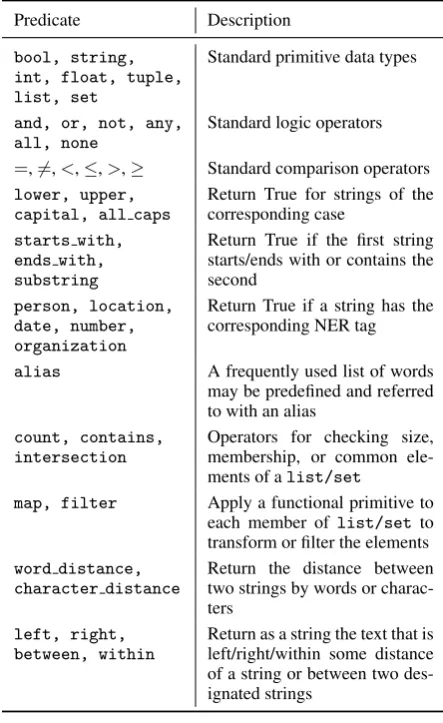
All predicates included in our grammar
(sum-marized in Table 1) are provided to
annota-tors, with minimal examples of each in use
(AppendixA). Importantly, all rules are
do-main independent (e.g., all three relation extrac-tion tasks that we tested used the same grammar), making the semantic parser easily transferrable to new domains. Additionally, while this paper fo-cuses on the task of relation extraction, in
princi-ple theBabbleLabbleframework can be applied
to other tasks or settings by extending the grammar with the necessary primitives (e.g., adding primi-tives for rows and columns to enable explanations about the alignments of words in tables). To guide the construction of the grammar, we collected 500
Predicate Description
bool, string, int, float, tuple, list, set
Standard primitive data types
and, or, not, any, all, none
Standard logic operators
=,6=,<,≤,>,≥ Standard comparison operators lower, upper,
capital, all caps
Return True for strings of the corresponding case
starts with, ends with, substring
Return True if the first string starts/ends with or contains the second
person, location, date, number, organization
Return True if a string has the corresponding NER tag
alias A frequently used list of words
may be predefined and referred to with an alias
count, contains, intersection
Operators for checking size, membership, or common ele-ments of alist/set
map, filter Apply a functional primitive to each member of list/set to transform or filter the elements word distance,
character distance
Return the distance between two strings by words or charac-ters
left, right, between, within
[image:4.595.71.293.63.425.2]Return as a string the text that is left/right/within some distance of a string or between two des-ignated strings
Table 1: Predicates in the grammar supported by
BabbleLabble’s rule-based semantic parser.
on Amazon Mechanical Turk and added support for the most commonly used predicates. These were added before the experiments described in
Section 4. Altogether the grammar contains 200
rule templates.
2.3 Filter Bank
The input to the filter bank is a set of candidate LFs produced by the semantic parser. The pur-pose of the filter bank is to discard as many incor-rect LFs as possible without requiring additional labels. It consists of two classes of filters: seman-tic and pragmaseman-tic.
Recall that each explanation ei is collected in
the context of a specific labeled example(xi, yi). The semantic filter checks for LFs that are in-consistent with their corresponding example; for-mally, any LFffor whichf(xi)6=yiis discarded.
For example, in the first explanation in Figure2,
the word “right” can be interpreted as either “im-mediately” (as in “right before”) or simply “to the
right.” The latter interpretation results in a func-tion that is inconsistent with the associated exam-ple (since “his wife” is actually to the left of person 2), so it can be safely removed.
Thepragmatic filtersremoves LFs that are con-stant, redundant, or correlated. For example, in Figure2,LF 2ais constant, as it labels every ex-ample positively (since all exex-amples contain two
people from the same sentence). LF 3bis
redun-dant, since even though it has a different syntax tree from LF 3a, it labels the training set identi-cally and therefore provides no new signal.
Finally, out of all LFs from the same explana-tion that pass all the other filters, we keep only the most specific (lowest coverage) LF. This pre-vents multiple correlated LFs from a single exam-ple from dominating.
As we show in Section 4, over three tasks, the
filter bank removes 86% of incorrect parses, and the incorrect ones that remain have average end-task accuracy within 2.5% of the corresponding correct parses.
2.4 Label Aggregator
The label aggregator combines multiple (poten-tially conflicting) suggested labels from the LFs and combines them into a single probabilistic
la-bel per example. Concretely, if m LFs pass
the filter bank and are applied to n examples,
the label aggregator implements a function f :
{−1,0,1}m×n→[0,1]n.
A naive solution would be to use a simple ma-jority vote, but this fails to account for the fact that LFs can vary widely in accuracy and
cover-age. Instead, we use data programming (Ratner
et al., 2016), which models the relationship be-tween the true labels and the output of the label-ing functions as a factor graph. More specifically, given the true labelsY ∈ {−1,1}n(latent) and la-bel matrixΛ ∈ {−1,0,1}m×n(observed) where
Λi,j = LFi(xj), we define two types of factors
representing labeling propensity and accuracy:
φLabi,j (Λ, Y) =1{Λi,j 6= 0} (1)
φAcci,j (Λ, Y) =1{Λi,j =yj}. (2)
Denoting the vector of factors pertaining to a given data pointxjasφj(Λ, Y)∈Rm, define the model:
pw(Λ, Y) =Zw−1exp Xn
j=1
w·φj(Λ, Y)
They include Joan Ridsdale, a 62-year-old payroll administrator from County Durham who was hit with a €16,000 tax bill when her husband Gordondied.
Spouse
Disease
Protein Example
Explanation True, because the phrase “her husband” is within three words of person 2. Example
Explanation
Young women on replacement estrogens for ovarian failure after cancer therapy may also have increased risk of endometrial carcinomaand should be examined periodically.
(person 1, person 2)
(chemical, disease)
(protein, kinase)
True, because “risk of” comes before the disease.
Here we show that c-Jun N-terminal kinases JNK1, JNK2 and JNK3 phosphorylate tauat many serine/threonine-prolines, as assessed by the generation of the epitopes of phosphorylation-dependent anti-tau antibodies.
Example
Explanation True, because at least one of the words 'phosphorylation', 'phosphorylate', 'phosphorylated', 'phosphorylates' is found in the sentence and the number of words between the protein and kinase is smaller than 8."
Figure 4: An example and explanation for each of the three datasets.
where w ∈ R2m is the weight vector and Z
w is the normalization constant. To learn this model
without knowing the true labels Y, we minimize
the negative log marginal likelihood given the ob-served labelsΛ:
ˆ
w= arg min
w
−logX
Y
pw(Λ, Y) (4)
using SGD and Gibbs sampling for inference, and then use the marginalspwˆ(Y |Λ)as probabilistic training labels.
Intuitively, we infer accuracies of the LFs based on the way they overlap and conflict with one an-other. Since noisier LFs are more likely to have high conflict rates with others, their
correspond-ing accuracy weights inwwill be smaller,
reduc-ing their influence on the aggregated labels.
2.5 Discriminative Model
The noisily-labeled training set that the label ag-gregator outputs is used to train an arbitrary dis-criminative model. One advantage of training a discriminative model on the task instead of us-ing the label aggregator as a classifier directly is that the label aggregator only takes into account those signals included in the LFs. A discrimina-tive model, on the other hand, can incorporate fea-tures that were not identified by the user but are
nevertheless informative.2 Consequently, even
ex-amples for which all LFs abstained can still be classified correctly. On the three tasks we eval-uate, using the discriminative model averages 4.3 F1 points higher than using the label aggregator directly.
For the results reported in this paper, our dis-criminative model is a simple logistic regression classifier with generic features defined over
depen-dency paths.3 These features include unigrams,
2
We give an example of two such features in Section4.3. 3https://github.com/HazyResearch/treedlib
Task Train Dev Test % Pos.
Spouse 22195 2796 2697 8%
Disease 6667 773 4101 20%
Protein 5546 1011 1058 22%
Table 2: The total number of unlabeled train-ing examples (a pair of annotated entities in a sentence), labeled development examples (for hy-perparameter tuning), labeled test examples (for assessment), and the fraction of positive labels in the test split.
bigrams, and trigrams of lemmas, dependency la-bels, and part of speech tags found in the siblings, parents, and nodes between the entities in the de-pendency parse of the sentence. We found this to perform better on average than a biLSTM, particu-larly for the traditional supervision baselines with small training set sizes; it also provided easily in-terpretable features for analysis.
3 Experimental Setup
We evaluate the accuracy of BabbleLabble on
three relation extraction tasks, which we refer to as Spouse, Disease, and Protein. The goal of each task is to train a classifier for predicting whether the two entities in an example are partic-ipating in the relationship of interest, as described below.
3.1 Datasets
Statistics for each dataset are reported in
Ta-ble2, with one example and one explanation for
each given in Figure4and additional explanations
shown in AppendixB.
In the Spouse task, annotators were shown a
sentence with two highlighted names and asked to label whether the sentence suggests that the two people are spouses. Sentences were pulled from
BL TS
# Inputs 30 30 60 150 300 1,000 3,000 10,000
Spouse 50.1 15.5 15.9 16.4 17.2 22.8 41.8 55.0
Disease 42.3 32.1 32.6 34.4 37.5 41.9 44.5
-Protein 47.3 39.3 42.1 46.8 51.0 57.6 -
-Average 46.6 28.9 30.2 32.5 35.2 40.8 43.2 55.0
Table 3: F1 scores obtained by a classifier trained with BabbleLabble (BL) using 30 explanations
or with traditional supervision (TS) using the specified number of individually labeled examples.
BabbleLabble achieves the same F1 score as traditional supervision while using fewer user inputs by a factor of over 5 (Protein) to over 100 (Spouse).
et al.,2016). Ground truth data was collected from Amazon Mechanical Turk workers, accepting the majority label over three annotations. The 30 ex-planations we report on were sampled randomly from a pool of 200 that were generated by 10
grad-uate students unfamiliar withBabbleLabble.
In the Diseasetask, annotators were shown a
sentence with highlighted names of a chemical and a disease and asked to label whether the sentence suggests that the chemical causes the disease. Sen-tences and ground truth labels came from a por-tion of the 2015 BioCreative chemical-disease re-lation dataset (Wei et al., 2015), which contains
abstracts from PubMed. Because this task
re-quires specialized domain expertise, we obtained explanations by having someone unfamiliar with
BabbleLabble translate from Python to natural language labeling functions from an existing pub-lication that explored applying weak supervision to this task (Ratner et al.,2018).
The Protein task was completed in conjunc-tion with OccamzRazor, a neuroscience company targeting biological pathways of Parkinson’s dis-ease. For this task, annotators were shown a sen-tence from the relevant biomedical literature with highlighted names of a protein and a kinase and asked to label whether or not the kinase influ-ences the protein in terms of a physical interac-tion or phosphorylainterac-tion. The annotators had do-main expertise but minimal programming
experi-ence, makingBabbleLabblea natural fit for their
use case.
3.2 Experimental Settings
Text documents are tokenized with spaCy.4 The
semantic parser is built on top of the Python-based
4https://github.com/explosion/spaCy
implementation SippyCup.5 On a single core,
parsing 360 explanations takes approximately two seconds. We use existing implementations of the label aggregator, feature library, and discrimina-tive classifier described in Sections 2.4–2.5
pro-vided by the open-source project Snorkel (Ratner
et al.,2018).
Hyperparameters for all methods we report were selected via random search over thirty con-figurations on the same held-out development set. We searched over learning rate, batch size, L2 reg-ularization, and the subsampling rate (for
improv-ing balance between classes).6 All reported F1
scores are the average value of 40 runs with ran-dom seeds and otherwise identical settings.
4 Experimental Results
We evaluate the performance of BabbleLabble
with respect to its rate of improvement by number of user inputs, its dependence on correctly parsed logical forms, and the mechanism by which it uti-lizes logical forms.
4.1 High Bandwidth Supervision
In Table 3 we report the average F1 score of a
classifier trained withBabbleLabbleusing 30
ex-planations or traditional supervision with the indi-cated number of labels. On average, it took the same amount of time to collect 30 explanations
as 60 labels.7 We observe that in all three tasks,
BabbleLabbleachieves a given F1 score with far fewer user inputs than traditional supervision, by
5
https://github.com/wcmac/sippycup
6Hyperparameter ranges: learning rate (1e-2 to 1e-4),
batch size (32 to 128), L2regularization (0 to 100), subsam-pling rate (0 to 0.5)
7Zaidan and Eisner(2008) also found that collecting
Pre-filters Discarded Post-filters
LFs Correct Sem. Prag. LFs Correct
Spouse 153 10% 19 115 19 84%
Disease 104 23% 41 36 27 89%
Protein 122 14% 44 58 20 85%
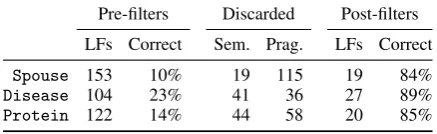
Table 4: The number of LFs generated from 30 explanations (pre-filters), discarded by the filter bank, and remaining (post-filters), along with the percentage of LFs that were correctly parsed from their corresponding explanations.
as much as 100 times in the case of the Spouse
task. Because explanations are applied to many unlabeled examples, each individual input from the user can implicitly contribute many (noisy) la-bels to the learning algorithm.
We also observe, however, that once the num-ber of labeled examples is sufficiently large, tra-ditional supervision once again dominates, since ground truth labels are preferable to noisy ones generated by labeling functions. However, in do-mains where there is much more unlabeled data available than labeled data (which in our experi-ence is most domains), we can gain in supervision
efficiency from usingBabbleLabble.
Of those explanations that did not produce a correct LF, 4% were caused by the explanation re-ferring to unsupported concepts (e.g., one expla-nation referred to “the subject of the sentence,” which our simple parser doesn’t support). An-other 2% were caused by human errors (the cor-rect LF for the explanation was inconsistent with the example). The remainder were due to unrecog-nized paraphrases (e.g., the explanation said “the order of appearance is X, Y” instead of a sup-ported phrasing like “X comes before Y”).
4.2 Utility of Incorrect Parses
In Table 4, we report LF summary statistics
be-fore and after filtering. LF correctness is based on exact match with a manually generated parse
for each explanation. Surprisingly, the simple
heuristic-based filter bank successfully removes over 95% of incorrect LFs in all three tasks, re-sulting in final LF sets that are 86% correct on av-erage. Furthermore, among those LFs that pass through the filter bank, we found that the aver-age difference in end-task accuracy between cor-rect and incorcor-rect parses is less than 2.5%. Intu-itively, the filters are effective because it is quite difficult for an LF to be parsed from the
explana-BL-FB BL BL+PP
Spouse 15.7 50.1 49.8
Disease 39.8 42.3 43.2
Protein 38.2 47.3 47.4
[image:7.595.72.291.64.131.2]Average 31.2 46.6 46.8
Table 5: F1 scores obtained usingBabbleLabble
with no filter bank (BL-FB), as normal (BL), and with a perfect parser (BL+PP) simulated by hand.
tion, label its own example correctly (passing the semantic filter), and not label all examples in the training set with the same label or identically to another LF (passing the pragmatic filter).
We went one step further: using the LFs that would be produced by a perfect semantic parser as starting points, we searched for “nearby” LFs (LFs differing by only one predicate) with higher end-task accuracy on the test set and succeeded 57%
of the time (see Figure5for an example). In other
words, when users provide explanations, the sig-nals they describe provide good starting points, but they are actually unlikely to be optimal. This
ob-servation is further supported by Table 5, which
shows that the filter bank is necessary to remove clearly irrelevant LFs, but with that in place, the simple rule-based semantic parser and a perfect parser have nearly identical average F1 scores.
4.3 Using LFs as Functions or Features
Once we have relevant logical forms from user-provided explanations, we have multiple options for how to use them. Srivastava et al.(2017) pro-pose using these logical forms as features in a lin-ear classifier. We choose instead to use them as functions for weakly supervising the creation of
a larger training set via data programming (
Rat-ner et al.,2016). In Table6, we compare the two approaches directly, finding that the the data pro-gramming approach outperforms a feature-based one by 9.5 F1 points with the rule-based parser, and by 4.5 points with a perfect parser.
We attribute this difference primarily to the abil-ity of data programming to utilize unlabeled data.
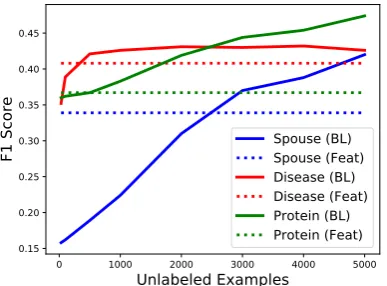
In Figure6, we show how the data programming
approach improves with the number of unlabeled examples, even as the number of LFs remains constant. We also observe qualitatively that data programming exposes the classifier to additional patterns that are correlated with our explanations but not mentioned directly. For example, in the
def LF_1a(x):
return(-1if any(w.startswith(“improv”)forw inleft(x.person2))else 0) Correct False, because a word
starting with “improve” appears before the
chemical. Incorrect
Explanation Labeling Function Correctness Accuracy
defLF_1b(x):
return(-1if“improv” inleft(x.person2)) else0)
84.6%
84.6%
defLF_2a(x):
return(1if“husband” inleft(x.person1, dist==1) else0) Correct
True, because “husband” occurs right before the
person1. Incorrect
13.6%
66.2%
defLF_2b(x):
[image:8.595.66.528.65.149.2]return(1if“husband” inleft(x.person2, dist==1)else0)
Figure 5: Incorrect LFs often still provide useful signal. On top is an incorrect LF produced for the
Diseasetask that had the same accuracy as the correct LF. On bottom is a correct LF from theSpouse
task and a more accurate incorrect LF discovered by randomly perturbing one predicate at a time as
described in Section4.2. (Person 2 is always the second person in the sentence).
0 1000 2000 3000 4000 5000
Unlabeled Examples
0.15 0.20 0.25 0.30 0.35 0.40 0.45
F1 Score
Spouse (BL)Spouse (Feat) Disease (BL) Disease (Feat) Protein (BL) Protein (Feat)Figure 6: When logical forms of natural language explanations are used as functions for data
pro-gramming (as they are inBabbleLabble),
perfor-mance can improve with the addition ofunlabeled
data, whereas using them as features does not ben-efit from unlabeled data.
highly by the discriminative model were the pres-ence of the trigrams “could produce a” or “support diagnosis of” between the chemical and disease, despite none of these words occurring in the
ex-planations for that task. In Table 6 we see a 4.3
F1 point improvement (10%) when we use the dis-criminative model that can take advantage of these features rather than applying the LFs directly to the test set and making predictions based on the output of the label aggregator.
5 Related Work and Discussion
Our work has two themes: modeling natural lan-guage explanations/instructions and learning from weak supervision. The closest body of work is
on “learning from natural language.” As
men-tioned earlier,Srivastava et al.(2017) convert nat-ural language explanations into classifier features (whereas we convert them into labeling functions).
Goldwasser and Roth (2011) convert natural
lan-BL-DM BL BL+PP Feat Feat+PP
Spouse 46.5 50.1 49.8 33.9 39.2
Disease 39.7 42.3 43.2 40.8 43.8
Protein 40.6 47.3 47.4 36.7 44.0
[image:8.595.76.270.228.371.2]Average 42.3 46.6 46.8 37.1 42.3
Table 6: F1 scores obtained using explanations as functions for data programming (BL) or features (Feat), optionally with no discriminative model (-DM) or using a perfect parser (+PP).
guage into concepts (e.g., the rules of a card
game). Ling and Fidler (2017) use natural
lan-guage explanations to assist in supervising an
im-age captioning model. Weston (2016); Li et al.
(2016) learn from natural language feedback in a
dialogue. Wang et al.(2017) convert natural
lan-guage definitions to rules in a semantic parser to build up progressively higher-level concepts.
We lean on the formalism of semantic
pars-ing (Zelle and Mooney, 1996; Zettlemoyer and
Collins,2005;Liang,2016). One notable trend is to learn semantic parsers from weak supervision (Clarke et al., 2010;Liang et al., 2011), whereas our goal is to obtain weak supervision signal from semantic parsers.
The broader topic of weak supervision has re-ceived much attention; we mention some works most related to relation extraction. In distant su-pervision (Craven et al.,1999;Mintz et al.,2009) and multi-instance learning (Riedel et al., 2010;
Hoffmann et al., 2011), an existing knowledge base is used to (probabilistically) impute a train-ing set. Various extensions have focused on aggre-gating a variety of supervision sources by
learn-ing generative models from noisy labels (
Alfon-seca et al.,2012;Takamatsu et al.,2012;Roth and Klakow, 2013;Ratner et al., 2016; Varma et al.,
Finally, while we have used natural language explanations asinputto train models, they can also beoutputto interpret models (Krening et al.,2017;
Lei et al.,2016). More generally, from a machine learning perspective, labels are the primary asset, but they are a low bandwidth signal between an-notators and the learning algorithm. Natural lan-guage opens up a much higher-bandwidth commu-nication channel. We have shown promising re-sults in relation extraction (where one explanation can be “worth” 100 labels), and it would be inter-esting to extend our framework to other tasks and more interactive settings.
Reproducibility
The code, data, and experiments for this paper
are available on the CodaLab platform athttps:
//worksheets.codalab.org/worksheets/
0x900e7e41deaa4ec5b2fe41dc50594548/.
Acknowledgments
We gratefully acknowledge the support of the following or-ganizations: DARPA under No. N66001-15-C-4043 (SIM-PLEX), No. FA8750-17-2-0095 (D3M), No. FA8750-12-2-0335 (XDATA), and No. FA8750-13-2-0039 (DEFT), DOE under No. 108845, NIH under No. U54EB020405 (Mobilize), ONR under No. N000141712266 and No. N000141310129, AFOSR under No. 580K753, the In-tel/NSF CPS Security grant No. 1505728, the Michael J. Fox Foundation for Parkinsons Research under Grant No. 14672, the Secure Internet of Things Project, Qualcomm, Ericsson, Analog Devices, the Moore Foundation, the Okawa Research Grant, American Family Insurance, Accenture, Toshiba, the National Science Foundation Graduate Research Fellowship under Grant No. DGE-114747, the Stanford Finch Family Fellowship, the Joseph W. and Hon Mai Goodman Stanford Graduate Fellowship, an NSF CAREER Award IIS-1552635, and the members of the Stanford DAWN project: Facebook, Google, Intel, Microsoft, NEC, Teradata, and VMware.
We thank Alex Ratner and the developers of Snorkel for their assistance with data programming, as well as the many members of the Hazy Research group and Stanford NLP group who provided feedback and tested early prototyptes. Thanks as well to the OccamzRazor team: Tarik Koc, Ben-jamin Angulo, Katharina S. Volz, and Charlotte Brzozowski. The U.S. Government is authorized to reproduce and dis-tribute reprints for Governmental purposes notwithstanding any copyright notation thereon. Any opinions, findings, and conclusions or recommendations expressed in this material are those of the authors and do not necessarily reflect the views, policies, or endorsements, either expressed or implied, of DARPA, DOE, NIH, ONR, AFOSR, NSF, or the U.S. Gov-ernment.
References
L. V. Ahn, R. Liu, and M. Blum. 2006. Peekaboom: a game for locating objects in images. InConference on Human Factors in Computing Systems (CHI). pages 55–64.
E. Alfonseca, K. Filippova, J. Delort, and G. Garrido. 2012. Pattern learning for relation extraction with a hierarchical
topic model. InAssociation for Computational Linguis-tics (ACL). pages 54–59.
S. Arora and E. Nyberg. 2009. Interactive annotation learn-ing with indirect feature votlearn-ing. InAssociation for Com-putational Linguistics (ACL). pages 55–60.
J. Clarke, D. Goldwasser, M. Chang, and D. Roth. 2010. Driving semantic parsing from the world’s response. InComputational Natural Language Learning (CoNLL). pages 18–27.
D. Corney, D. Albakour, M. Martinez-Alvarez, and S. Moussa. 2016. What do a million news articles look like? InNewsIR@ ECIR. pages 42–47.
M. Craven, J. Kumlien, et al. 1999. Constructing biologi-cal knowledge bases by extracting information from text sources. InISMB. pages 77–86.
G. Druck, B. Settles, and A. McCallum. 2009. Active learn-ing by labellearn-ing features. InEmpirical Methods in Natural Language Processing (EMNLP). pages 81–90.
D. Goldwasser and D. Roth. 2011. Learning from natural in-structions. InInternational Joint Conference on Artificial Intelligence (IJCAI). pages 1794–1800.
R. Hoffmann, C. Zhang, X. Ling, L. S. Zettlemoyer, and D. S. Weld. 2011. Knowledge-based weak supervision for in-formation extraction of overlapping relations. In Associa-tion for ComputaAssocia-tional Linguistics (ACL). pages 541–550.
S. Krening, B. Harrison, K. M. Feigh, C. L. Isbell, M. Riedl, and A. Thomaz. 2017. Learning from explanations using sentiment and advice in RL. IEEE Transactions on Cog-nitive and Developmental Systems9(1):44–55.
T. Lei, R. Barzilay, and T. Jaakkola. 2016. Rationalizing neural predictions. InEmpirical Methods in Natural Lan-guage Processing (EMNLP).
J. Li, A. H. Miller, S. Chopra, M. Ranzato, and J. Weston. 2016. Learning through dialogue interactions. arXiv preprint arXiv:1612.04936.
P. Liang. 2016. Learning executable semantic parsers for natural language understanding. Communications of the ACM59.
P. Liang, M. I. Jordan, and D. Klein. 2009. Learning from measurements in exponential families. InInternational Conference on Machine Learning (ICML).
P. Liang, M. I. Jordan, and D. Klein. 2011. Learning dependency-based compositional semantics. In Associa-tion for ComputaAssocia-tional Linguistics (ACL). pages 590–599.
H. Ling and S. Fidler. 2017. Teaching machines to describe images via natural language feedback. In Advances in Neural Information Processing Systems (NIPS).
M. Mintz, S. Bills, R. Snow, and D. Jurafsky. 2009. Distant supervision for relation extraction without labeled data. In
Association for Computational Linguistics (ACL). pages 1003–1011.
A. J. Ratner, S. H. Bach, H. Ehrenberg, J. Fries, S. Wu, and C. R’e. 2018. Snorkel: Rapid training data creation with weak supervision. InVery Large Data Bases (VLDB).
A. J. Ratner, C. M. D. Sa, S. Wu, D. Selsam, and C. R’e. 2016. Data programming: Creating large training sets, quickly. InAdvances in Neural Information Processing Systems (NIPS). pages 3567–3575.
S. Riedel, L. Yao, and A. McCallum. 2010. Modeling rela-tions and their menrela-tions without labeled text. InMachine Learning and Knowledge Discovery in Databases (ECML PKDD). pages 148–163.
B. Roth and D. Klakow. 2013. Combining generative and discriminative model scores for distant supervision. In Empirical Methods in Natural Language Processing (EMNLP). pages 24–29.
S. Srivastava, I. Labutov, and T. Mitchell. 2017. Joint con-cept learning and semantic parsing from natural language explanations. InEmpirical Methods in Natural Language Processing (EMNLP). pages 1528–1537.
S. Takamatsu, I. Sato, and H. Nakagawa. 2012. Reducing wrong labels in distant supervision for relation extrac-tion. InAssociation for Computational Linguistics (ACL). pages 721–729.
P. Varma, B. He, D. Iter, P. Xu, R. Yu, C. D. Sa, and C. R’e. 2017. Socratic learning: Augmenting generative mod-els to incorporate latent subsets in training data. arXiv preprint arXiv:1610.08123.
S. I. Wang, S. Ginn, P. Liang, and C. D. Manning. 2017. Nat-uralizing a programming language via interactive learning. InAssociation for Computational Linguistics (ACL).
C. Wei, Y. Peng, R. Leaman, A. P. Davis, C. J. Mattingly, J. Li, T. C. Wiegers, and Z. Lu. 2015. Overview of the biocreative V chemical disease relation (cdr) task. In
Proceedings of the fifth BioCreative challenge evaluation workshop. pages 154–166.
J. E. Weston. 2016. Dialog-based language learning. In Ad-vances in Neural Information Processing Systems (NIPS). pages 829–837.
O. F. Zaidan and J. Eisner. 2008. Modeling annotators: A generative approach to learning from annotator rationales. In Empirical Methods in Natural Language Processing (EMNLP).
M. Zelle and R. J. Mooney. 1996. Learning to parse database queries using inductive logic programming. In Associa-tion for the Advancement of Artificial Intelligence (AAAI). pages 1050–1055.
A Predicate Examples
Below are the predicates in the rule-based semantic parser grammar, each of which may have many supported paraphrases, only one of which is listed here in a minimal example.
Logic
and: X is true and Y is true or: X is true or Y is true not: X is not true
any: Any of X or Y or Z is true all: All of X and Y and Z are true none: None of X or Y or Z is true
Comparison
=: X is equal to Y
6
=: X is not Y
<: X is smaller than Y
≤: X is no more than Y
>: X is larger than Y
≥: X is at least Y
Syntax
lower: X is lowercase upper: X is upper case capital: X is capitalized all caps: X is in all caps
starts with: X starts with "cardio" ends with: X ends with "itis"
substring: X contains "-induced"
Named-entity Tags
person: A person is between X and Y
location: A place is within two words of X date: A date is between X and Y
number: There are three numbers in the sentence organization: An organization is right after X
Lists
list: (X, Y) is in Z set: X, Y, and Z are true
count: There is one word between X and Y contains: X is in Y
intersection: At least two of X are in Y map: X is at the start of a word in Y
filter: There are three capitalized words to the left of X
alias: A spouse word is in the sentence (“spouse” is a predefined list from the user)
Position
word distance: X is two words before Y
char distance: X is twenty characters after Y left: X is before Y
right: X is after Y
between: X is between Y and Z
B Sample Explanations
The following are a sample of the explanations provided by users for each task.
Spouse
Users referred to the first person in the sentence as “X” and the second as “Y”.
Label true because "and" occurs between X and Y and "marriage" occurs one word after person1.
Label true because person Y is preceded by ‘beau’.
Label false because the words "married", "spouse", "husband", and "wife" do not occur in the sentence.
Label false because there are more than 2 people in the sentence and "actor" or "actress" is left of person1 or person2.
Disease
Label true because the disease is immediately after the chemical and ’induc’ or ’assoc’ is in the chemical name.
Label true because a word containing ’develop’ appears somewhere before the chemical, and the word ’following’ is between the disease and the chemical.
Label true because "induced by", "caused by", or "due to" appears between the chemical and the disease."
Label false because "none", "not", or "no" is within 30 characters to the left of the disease.
Protein
Label true because "Ser" or "Tyr" are within 10 characters of the protein.
Label true because the words "by" or "with" are between the protein and kinase and the words "no", "not" or "none" are not in between the protein and kinase and the total number of words between them is smaller than 10.
Label false because the sentence contains "mRNA", "DNA", or "RNA".