306
Zero-shot Learning of Classifiers from Natural Language Quantification
Shashank Srivastava Igor Labutov Tom Mitchell School of Computer Science
Carnegie Mellon University Pittsburgh, PA 15213, USA
[email protected] [email protected] [email protected]
Abstract
Humans can efficiently learn new concepts using language. We present a framework through which a set of explanations of a concept can be used to learn a classifier without access to any labeled examples. We use semantic parsing to map explana-tions to probabilistic asserexplana-tions grounded in latent class labels and observed attributes of unlabeled data, and leverage the differen-tial semantics of linguistic quantifiers (e.g., ‘usually’ vs ‘always’) to drive model train-ing. Experiments on three domains show that the learned classifiers outperform pre-vious approaches for learning with limited data, and are comparable with fully super-vised classifiers trained from a small num-ber of labeled examples.
1 Introduction
As computer systems that interact with us in nat-ural language become pervasive (e.g., Siri, Alexa, Google Home), they suggest the possibility of let-ting users teach machines in language. The abil-ity to learn from language can enable a paradigm of ubiquitous machine learning, allowing users to teach personalized concepts (e.g., identifying ‘im-portant emails’ or ‘project-related emails’) when limited or no training data is available.
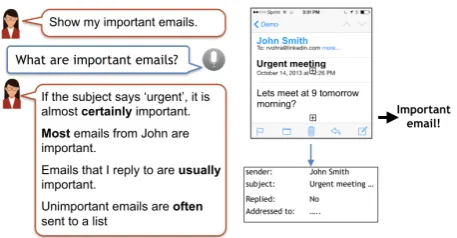
[image:1.595.307.536.220.339.2]In this paper, we take a step towards solving this problem by exploring the use of quantifiers to train classifiers from declarative language. For il-lustration, consider the hypothetical example of a user explaining the concept of an “important email” through natural language statements (Fig-ure1). Our framework takes a set of such natural language explanations describing a concept (e.g., “emails that I reply to are usually important”) and a set of unlabeled instances as input, and produces
Figure 1: Supervision from language can enable concept learning from limited or even no labeled examples. Our approach assumes the learner has sensors that can extract attributes from data, such as those listed in the table, and language that can refer to these sensors and their values.
a binary classifier (for important emails) as output. Our hypothesis is that language describing con-cepts encodes key properties that can aid statistical learning. These include specification of relevant attributes (e.g., whether an email was replied to), relationships between such attributes and concept labels (e.g., if a reply implies the class label of that email is ‘important’), as well as the strength of these relationships (e.g., via quantifiers like ‘often’, ‘sometimes’, ‘rarely’). We infer these properties automatically, and use the semantics of linguis-tic quantifiers to drive the training of classifiers without labeled examples for any concept. This is a novel scenario, where previous approaches in semi-supervised and constraint-based learning are not directly applicable. Those approaches require manual pre-specification of expert knowledge for model training. In our approach, this knowledge is automatically inferred from noisy natural language explanations from a user.
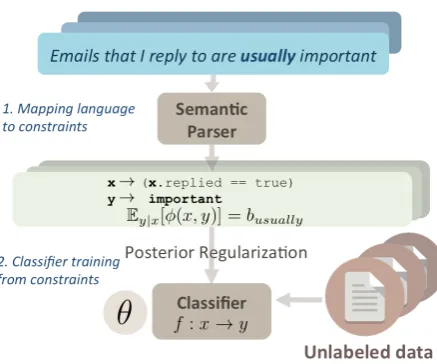
Figure 2: Our approach to Zero-shot learning from Language. Natural language explanations on how to classify concept examples are parsed into for-mal constraints relating features to concept labels. The constraints are combined with unlabeled data, using posterior regularization to yield a classifier.
that identify the attributes mentioned in the explana-tion, and describe the information conveyed about the attribute and the concept label as a quantitative constraint. This mapping is done through semantic parsing. The logical forms denote quantitative con-straints, which are probabilistic assertions about observable attributes of the data and unobserved concept labels. Here the strength of a constraint is assumed to be specified by a linguistic quanti-fier (such as ‘all’, ‘some’, ‘few’, etc., which reflect degrees of generality of propositions). Next, we train a classification model that can assimilate these constraints by adapting the posterior regularization framework (Ganchev et al.,2010).
Intuitively, this can be seen as defining an op-timization problem, where the objective is to find parameter estimates for the classifier that do not simply fit the data, but also agree with the human provided natural language advice to the greatest ex-tent possible. Since logical forms can be grounded in a variety of sensors and external resources, an explicit model of semantic interpretation concep-tually allows the framework to subsume a flexible range of grounding behaviors. The main contribu-tions of this work are:
1. We introduce the problem of zero-shot learn-ing of classifiers from language, and present an approach towards this.
2. We develop datasets for zero-shot classifi-cation from natural descriptions, exhibiting
tasks with various levels of difficulty.
3. We empirically show that coarse probability estimates to model linguistic quantifiers can effectively supervise model training across three domains of classification tasks.
2 Related Work
Many notable approaches have explored incorpo-ration of background knowledge into the training of learning algorithms. However, none of them ad-dresses the issue of learning from natural language. Prominent among these are the Constraint-driven learning (Chang et al.,2007a), Generalized Expec-tation (Mann and McCallum,2010) and Posterior Regularization (Ganchev et al.,2010) and Bayesian Measurements (Liang et al.,2009) frameworks. All of these require domain knowledge to be manually programmed in before learning. Similarly, Prob-abilistic Soft Logic (Kimmig et al.,2012) allows users to specify rules in a logical language that can be used for reasoning over graphical models. More recently, multiple approaches have explored few-shot learning from perspective of term or attribute-based transfer (Lampert et al.,2014), or learning representations of instances as probabilistic pro-grams (Lake et al.,2015).
Other work (Lei Ba et al.,2015;Elhoseiny et al., 2013) considers language terms such as colors and textures that can be directly grounded in visual meaning in images. Some previous work ( Srivas-tava et al.,2017) has explored using language ex-planations for feature space construction in concept learning tasks, where the problem of learning to in-terpret language, and learning classifiers is treated jointly. However, this approach assumes availabil-ity of labeled data for learning classifiers. Also notable is recent work by Andreas et al. (2017), who propose using language descriptions as param-eters to model structure in learning tasks in multiple settings. More generally, learning from language has also been previously explored in tasks such as playing games (Branavan et al., 2012), robot navigation (Karamcheti et al.,2017), etc.
Natural language quantification has been studied from multiple perspectives in formal logic (Barwise and Cooper,1981), linguistics (Löbner,1987;Bach et al.,2013) and cognitive psychology (Kurtzman and MacDonald,1993). While quantification has traditionally been defined in set-theoretic terms in linguistic theories1, our approach joins alternative
perspectives that represent quantifiers probabilis-tically (Moxey and Sanford,1993;Yildirim et al., 2013). To the best of our knowledge, this is the first work to leverage the semantics of quantifiers to guide statistical learning models.
3 Learning Classifiers from Language
Our approach relies on first mapping natural lan-guage descriptions to quantitative constraints that specify statistical relationships between observable attributes of instances and their latent concept la-bels (Step 1 in Figure2). These quantitative con-straints are then imbued into the training of a classi-fier by guiding predictions from the learned models to concur with them (Step 2). We use semantic parsing to interpret sentences as quantitative con-straints, and adapt the posterior regularization prin-ciple for our setting to estimate the classifier param-eters. Next, we describe these steps in detail. Since learning in this work is largely driven by the seman-tics of linguistic quantifiers, we call our approach Learning from Natural Quantification, orLNQ.
3.1 Mapping language to constraints
A key challenge in learning from language is con-verting free-form language to representations that can be reasoned over, and grounded in data. For example, a description such as ‘emails that I re-ply to are usually important’ may be converted to a mathematical assertion such asP(important |
replied:true) = 0.7’, which statistical methods can reason with. Here, we argue that this process can be automated for a large number of real-world descriptions. In interpreting statements describing concepts, we infer the following key elements:
1. Feature x, which is grounded in observed at-tributes of the data. For our example, ‘emails replied to’ can refer to a predicate such as replied:true, which can be evaluated in con-text of emails to indicate the whether an email was replied to. Incorporating compositional rep-resentations enables more complex reasoning. e.g., ‘the subject of course-related emails usu-ally mentions CS100’ can map to a composite predicate like ‘isStringMatch(field:subject, stringVal(‘CS100’))’, which can be evaluated for different emails to reflect whether their sub-ject mentions ‘CS100’. Mapping language to ex-ecutable feature functions has been shown to be effective (Srivastava et al.,2017). For sake of sim-plicity, here we assume that a statement refers to a
single feature, but the method can be extended to handle more complex descriptions.
2. Concept label y, specifying the class of in-stances a statement refers to. For binary classes, this reduces to examples or non-examples of a con-cept. For our running example,ycorresponds to the positive class of important emails.
3. Constraint-typeasserted by the statement. We argue that most concept descriptions belong to one of three categories shown in Table2, and these con-stitute our vocabulary of constraint types for this work. For our running example (‘emails that I reply to are usually important’), the type corresponds to
P(y | x), since the syntax of the statement cates an assertion conditioned on the feature indi-cating whether an email was replied to. On the other hand, an assertion such as ‘I usually reply to important emails’ indicates an assertion condi-tioned on the set important emails, and therefore corresponds to the typeP(x|y).
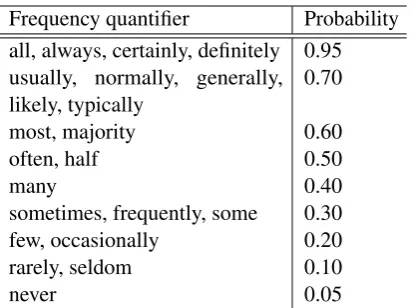
4. Strengthof the constraint. We assume this to be specified by a quantifier. For our running ex-ample, this corresponds to the adverb ‘usually’. In this work, by quantifier we specifically refer to frequency adverbs (‘usually’,‘rarely’, etc.) and fre-quency determiners (‘few’, ‘all’, etc.).2 Our thesis is that the semantics of quantifiers can be leveraged to make statistical assertions about relationships involving attributes and concept labels. One way to do this might be to simply associate point esti-mates of probability values, suggesting the fraction of truth values for assertions described with these quantifiers. Table1 shows probability values we assign to some common frequency quantifiers for English. These values were set simply based on the authors’ intuition about their semantics, and do not reflect any empirical distributions. See Fig-ure8for empirical distributions corresponding to some linguistic quantifiers in our data. While these probability values maybe inaccurate, and the se-mantics of these quantifiers may also change based on context and the speaker, they can still serve as a strong signal for learning classifiers since they are not used as hard constraints, but serve to bias classifiers towards better generalization.
We use a semantic parsing model to map state-ments to formal semantic representations that spec-ify these aspects. For example, the statement ‘Emails that I reply to are usually important’ is
Frequency quantifier Probability all, always, certainly, definitely 0.95 usually, normally, generally, likely, typically
0.70
most, majority 0.60
often, half 0.50
many 0.40
sometimes, frequently, some 0.30 few, occasionally 0.20
rarely, seldom 0.10
[image:4.595.80.287.60.214.2]never 0.05
Table 1: Probability values we assign to com-mon linguistic quantifiers (hyper-parameters for method)
mapped to a logical form like(x→replied:true y→positive type:y|x quant:usually).
3.1.1 Semantic Parser components
Given a descriptive statements, the parsing prob-lem consists of predicting a logical formlthat best represents its meaning. In turn, we formulate the probability of the logical formlas decomposing into three component factors: (i) probability of observing a feature and concept labelslxy based on the text of the sentence, (ii) probability of the type of the assertionltypebased on the identified feature, concept label and syntactic properties of the sentences, and (iii) identifying the linguistic quantifier,lquant, in the sentence.
P(l|s) =P(lxy |s)P(ltype|lxy, s)P(lquant |s)
We model each of the three components as fol-lows: by using a traditional semantic parser for the first component, training a Max-Ent classifier for the constraint-type for the second component, and looking for an explicit string match to identify the quantifier for the third component.
Identifying features and concept labels,lxy: For identifying the feature and concept label men-tioned in a sentence, we presume a linear score
S(s, lxy) = wTψ(s, lxy)indicating the goodness of assigning a partial logical form, lxy, to a sen-tences. Here,ψ(s, lxy)∈Rnare features that can depend on both the sentence and the partial logical form, andw∈Rnis a parameter weight-vector for this component. Following recent work in semantic parsing (Liang et al.,2011), we assume a loglinear distribution over interpretations of a sentence.
P(lxy |s)∝wTψ(s, lxy)
Provided data consisting of statements labeled with logical forms, the model can be trained via maximum likelihood estimation, and be used to predict interpretations for new statements. For training this component, we use a CCG semantic parsing formalism, and follow the feature-set fromZettlemoyer and Collins(2007), consisting of simple indicator features for occurrences of keywords and lexicon entries. This is also compatible with the semantic parsing formalism in Srivastava et al.(2017), whose data (and accom-panying lexicon) are also used in our evaluation. For other datasets with predefined features, this component is learned easily from simple lexicons consisting of trigger words for features and labels.3 This component is the only part of the parser that is domain-specific. We note that while this component assumes a domain-specific lexicon (and possibly statement annotated with logical forms), this effort is one-time-only, and will find re-use across the possibly large number of concepts in the domain (e.g., email categories).
Identifying assertion type, ltype: The principal novelty in our semantic parsing model is in iden-tifying the type of constraint asserted by a state-ment. For this, we train a MaxEnt classifier, which uses positional and syntactic features based on the text-spans corresponding to feature and concept mentions to predict the constraint type. We extract the following features from a statement:
1. Boolean value indicating whether the text-span corresponding to the feature x precedes the text span for the concept labely.
2. Boolean value indicating if sentence is in pas-sive (rather than active) voice, as identified by the occurrence ofnsubjpassdependency relation. 3. Boolean value indicating whether head of the text-span forxis a noun, or a verb.
4. Features indicating the occurrence of condi-tional tokens (‘if’, ‘then’ and ‘that’) preceding or following text-spans forxandy.
5. Features indicating presence of a linguistic quantifier in a det or an advmodrelation with syntactic head ofxory.
Since the constraint type is determined by syntactic and dependency parse features, this
Type Example description Conversion to Expectation Constraint
P(y|x) Emails that I reply to are usually important E[Iy=important,reply(x):true]−pusually×E[Ireply(x):true] = 0 P(x|y) I often reply to important emails E[Iy=important,reply(x):true]−pof ten×E[Iy=important] = 0 P(y) I rarely get important emails Same asP(y|x0), wherex0is a constant feature
Table 2: Common constraint-types, and their representation as expectations over feature values
component does not need to be retrained for new domains. In this work, we trained this classifier based on a manually annotated set of 80 sentences describing classes in the small UCI Zoo dataset (Lichman,2013), and used this model for all experiments.
Identifying quantifiers,lquant: Multiple linguis-tic quantifiers in a sentence are rare, and we simply look for the first occurrence of a linguistic quanti-fier in a sentence, i.e.P(lquant|s)is a deterministic function. We note that many real world descrip-tions of concepts lack an explicit quantifier. e.g., ‘Emails from my boss are important’. In this work, we ignore such statements for the purpose of train-ing. Another treatment might be to models these statements as reflecting a default quantifier, but we do not explore this direction here. Finally, the decoupling of quantification from logical represen-tation is a key decision. At the cost of linguistic coarseness, this allows modeling quantification ir-respective of the logical representation (lambda calculus, predicate-argument structures, etc.).
3.2 Classifier training from constraints
In the previous section, we described how indi-vidual explanations can be mapped to probabilis-tic assertions about observable attributes (e.g., the statement ‘Emails that I reply to are usually impor-tant’ may map toP(y =important|replied=
true) = pusually). Here, we describe how a set of such assertions can be used in conjunction with unlabeled data to train classification models.
Our approach relies on having predictions from the classifier on a set of unlabeled examples (X =
{x1. . . xn}) agree with human-provided advice (in form of constraints). The unobserved concept la-bels (Y ={y1. . . yn}) for the unlabeled data con-stitutelatent variablesfor our method. The train-ing procedure can be seen as iteratively inferrtrain-ing the latent concept labels for unlabeled examples so as to agree with the human advice, and updat-ing the classification models by takupdat-ing these labels as given. While there are multiple approaches for training statistical models with constraints on latent
variables, here we use the Posterior Regularization (PR) framework. The PR objective can be used to optimize a latent variable model subject to a set of constraints, which specify preferences for values of the posterior distributionspθ(Y |X).
JQ(θ) =L(θ)−minq∈QKL(q|pθ(Y|X))
Here, the setQrepresents a set ofpreferred pos-terior distributions over latent variablesY, and is defined as Q := {qX(Y) : Eq[φ(X, Y)] ≤ b}. The overall objective consists of two components, representing how well does a modelθexplain the data (likelihood termL(θ)), and how far it is from the setQ(KL-divergence term).
In our case, each parsed statement defines a probabilistic constraint. The conjunction of all such constraints defines Q(representing models that exactly agree with human-provided advice). Thus, optimizing the objective reflects a tension between choosing models that increase data likelihood, and emulating language advice.
Converting to PR constraints: The set of con-straints that PR can handle can be characterized as bounds on expected values of functions (φ) of
XandY (or equivalently, from linearity of expec-tation, as linear inequalities over expected values of functions ofXandY). To use the framework, we need to ensure that each constraint type in our vocabulary can be expressed in such a form.
Following the plan in Table2, each constraint type can be converted in an equivalent form Eq[φ(X, Y)] =b, compatible with PR. In partic-ular, each of these constraint types in our vocab-ulary can be expressed as equations about expec-tation values of joint indicator functions of label assignments to instances and their attributes. To ex-plain, consider the assertionP(y =important |
replied : true) = pusually. The probability on the LHS can be expressed as the empirical fraction
P
iE[Iyi=important,replied:true] P
iE[Ireplied:true] , which leads to the
adaptation of the PR scheme.
Learning and Inference: We choose a loglinear parameterization for the concept classifier.
pθ(yi |xi)∝exp(yθTx)
The training of the classifier follows the modified EM procedure described inGanchev et al.(2010). As proposed in the original work, we solve a re-laxed version of the optimization that allows slack variables, and modifies the PR objective with aL2
regularizer. This allows solutions even when the problem is over-constrained, and the setQis empty (e.g. due to contradictory advice).
J0(θ, q) =L(θ)−KL(q|pθ(Y|X))
−λ||Eq[φ(X, Y)]−b||2
The key step in the training is the computation of the posterior regularizer in the E-step.
argmin q
KL(q |pθ) +λ||Eq[φ(X, Y)]−b||2
This objective is strictly convex, and all constraints are linear inq. We follow the optimization proce-dure fromBellare et al.(2009), whereby the min-imization problem in the E-step can be efficiently solved through gradient steps in the dual space. In the M-step, we update the model parameters for the classifier based on label distributionsqestimated in the E-step. This simply reduces to estimating the parametersθfor the logistic regression classifier, when class label probabilities are known. In all experiments, we run EM for 20 iterations and use a regularization coefficient ofλ= 0.1.
4 Datasets
For evaluating our approach, we created datasets of classification tasks paired with descriptions of the classes, as well as used some existing resources. In this section, we summarize these steps.
Shapes data: To experiment with our approach in a wider range of controlled settings, part of our evaluation focuses on synthetic concepts. For this, we created a set of 50 shape classification tasks that exhibit a range of difficulty, and elicited language descriptions spanning a variety of quantifier ex-pressions. The tasks require classifying geometric shapes with a set of predefined attributes (fill color, border, color, shape, size) into two concept-labels (abstractly named ‘selected shape’, and ‘other’). The datasets were created through a generative pro-cess, where featuresxiare conditionally indepen-dent given the concept-label. Each feature’s con-ditional distribution is sampled from a symmetric
(a) Statement generation task
[image:6.595.314.517.64.352.2](b) Concept Quiz
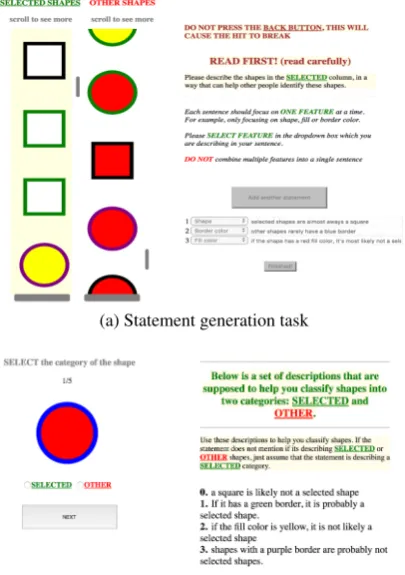
Figure 3: Shapes data: Mechanical Turk tasks for (a) collecting concept descriptions, and (b) human evaluation from concept descriptions
Dirichlet distribution, and varying the concentra-tion parameterαallows tuning the noise level of the generated datasets (quantified via their Bayes Optimal accuracy4). A dataset is then generated by sampling from these conditional distributions. We sample a total of 50 such datasets, consisting of 100 training and 100 test examples each, where each example is a shape and its assigned label.
For each dataset, we then collected statements from Mechanical Turk workers that describe the concept. The task required turkers to study a sam-ple of shapes presented on the screen for each of the two concept-labels (see Figure3(a)). They were then asked to write a set of statements that would help others classify these shapes without seeing the data. In total, 30 workers participated in this task, generating a mean of 4.3 statements per dataset. Email data: Srivastava et al. (2017) provide a dataset of language explanations from human users describing 7 categories of emails, as well as 1030 examples of emails belonging to those categories. While this work uses labeled examples, and focuses
Shapes:
If a shape doesn’t have a blue border, it is prob-ably not a selected shape.
Selected shapes occasionally have a yellow fill. Emails:
Emails that mention the word ’meet’ in the sub-ject are usually meeting requests
Personal reminders almost always have the same recipient and sender
Birds:
A specimen that has a striped crown is likely to be a selected bird.
[image:7.595.307.533.62.206.2]Birds in the other category rarely ever have dagger-shaped beaks
[image:7.595.82.284.288.519.2]Table 3: Examples of explanations for each domain
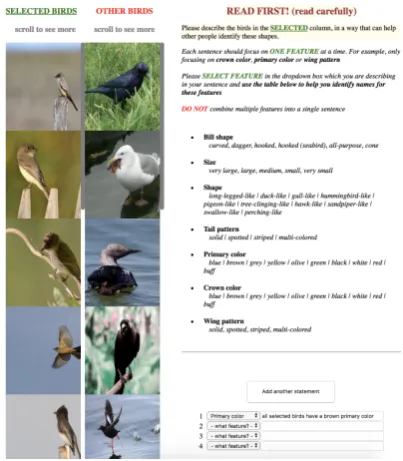
Figure 4: Statement generation task for Birds data
on mapping natural language explanations (∼30 explanations per email category) to compositional feature functions, we can also use statements in their data for evaluating our approach. While lan-guage quantifiers were not studied in the original work, we found about a third of the statements in this data to mention a quantifier.
Birds data: The CUB-200 dataset (Wah et al., 2011) contains images of birds annotated with observable attributes such as size, primary color, wing-patterns, etc. We selected a subset of the data consisting of 10 species of birds and 53 attributes (60 examples per species). Turkers were shown examples of birds from a species, and negative examples consisting of a mix of birds from other
Approach Avg Accuracy Labels Descriptions
LNQ 0.751 no yes
Bayes Optimal 0.831 – –
FLGE+ 0.659 no yes
FLGE 0.598 no yes
LR 0.737 yes no
Random 0.524 – –
Ablation:
LNQ (coarse quant) 0.679 no yes
LNQ (no quant) 0.545 no yes
Human:
Human teacher 0.802 yes writes
Human learner 0.734 no yes
Table 4: Classification performance on Shapes datasets (averaged over 50 classification tasks).
species, and were asked to describe the classes (similar to the Shapes data, see Figure4). During the task, users also had access to a table enumerat-ing groundable attributes they could refer to. In all, 60 workers participated, generating 6.1 statements on average.
5 Experiments
Incorporating constraints from language has not been addressed before, and hence previous ap-proaches for learning from limited data such as Mann and McCallum(2010);Chang et al.(2007b) would not directly work for this setting. Our base-lines hence consist of extended versions of previous approaches that incorporate output from the parser, as well as fully supervised classifiers trained from a small number of labeled examples.
Classification performance: The top section in Table4summarizes performance of various clas-sifiers on the Shape datasets, averaged over all 50 classification tasks. FLGE+ refers to a baseline
[image:7.595.309.524.576.712.2]that uses the Feature Labeling through General-ized Expectation criterion, following the approach inDruck et al.(2008);Mann and McCallum(2010). The approach is based on labeling features are in-dicating specific class-labels, which corresponds to specifiying constraints of typeP(y|x)5. While the original approach (Druck et al.,2008) sets this value to0.9, we provide the method the quantita-tive probabilities used by LNQ. Since the original method cannot handle language descriptions, we also provide the approach the concept labelyand feature x as identified by the parser. FLGE rep-resents the version that is not provided quantifier probabilities. LR refers to a supervised logistic re-gression model trained onn= 8randomly chosen labeled instances.6 We note that LNQ performs substantially better than both FLGE+ and LR on average. This validates our modeling principle for learning classifiers from explanations alone, and also suggests value in our PR-based formulation, which can handle multiple constraint types. We further note that not using quantifier probabilities significantly deteriorates FLGE’s performance.
Figure5provides a more detailed characteriza-tion of LNQ’s performance. Each blue dot repre-sents performance on a shape classification task. The horizontal axis represents the accuracy of the Bayes Optimal classifier, and the vertical repre-sents accuracy of the LNQ approach. The blue line represents the trajectory forx=y, representing a perfect statistical classifier in the asymptotic case of infinite samples. We note that LNQ is effective in learning competent classifiers for all levels of hardness. Secondly, except for a small number of outliers, the approach works especially well for learning easy concepts (towards the right). From an error-analysis, we found that a majority of these errors are due to problems in parsing (e.g., missed negation, incorrect constraint type) or due to poor explanations from the teacher (bad grammar, or simply incorrect information).
Figure6shows results for email classification tasks. In the figure, LN* refers to the approach inSrivastava et al.(2017), which uses natural lan-guage descriptions to define compositional features for email classification, but does not incorporate
5In general, Generalized Expectation can also handle broader constraint types, similar to Posterior Regularization
[image:8.595.325.508.59.163.2]6LNQ models are indistinct from LR w.r.t. parametriza-tion, but trained to maximize a different objective. The choice ofn here is arbitrary, but is roughly twice the number of explanations for each task in this domain
Figure 6: Classification performance (F1) on Email data. (LN* Results fromSrivastava et al.(2017))
supervision from quantification. For this task, we found very few of the natural language descriptions to contain quantifiers for some of the individual email categories, making a direct comparison im-practical. Thus in this case, we evaluate methods by combining supervision from descriptions in ad-dition to 10 labeled examples (also in line with evaluation in the original paper). We note that addi-tionally incorporating quantification (LNQ) consis-tently improves classification performance across email categories. On this task, LNQ improves upon FLGE+ and LN* for 6 of the 7 email categories.
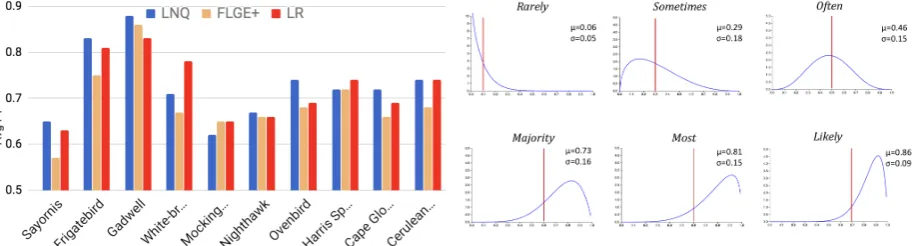
Figure7shows classification results on the Birds data. Here, LR refers to a logistic regression model trained onn=10 examples. The trends in this case are similar, where LNQ consistently outperforms FLGE+, and is competitive with LR.
Figure 7: Classification performance on Birds data
them on a quiz based on predicting labels for exam-ples from the test set (see Figure3(b)). Second, we solicit additional workers that were not exposed to examples from the dataset, and present them only with the statements describing that data (created by a teacher), which is comparable supervision to what LNQ receives. We then evaluate their perfor-mance at the same task. From Table4, we note that a human teacher’s average performance is signifi-cantly worse (p <0.05, Wilcoxon signed-rank test) than the Bayes Optimal classifier indicating that the teacher’s own synthesis of concepts is noisy. The human learner performance is expectedly lower, but interestingly is also significantly worse than LNQ. While this might be potentially be caused by factors such as user fatigue, this might also suggest that automated methods can be better at reasoning with constraints than humans in certain scenarios. These results need to be validated through compre-hensive experiments in more domains.
Empirical semantics of quantifiers: We can es-timate the distributions of probability values for different quantifiers from our labeled data. For this, we aggregate sentences mentioning a quantifier, and calculate the empirical value of the (condi-tional) probability associated with the statement, leading to a set of probability values for each quan-tifier. Figure8 shows empirical distributions of probability values for six quantifiers. We note that while a few estimates (e.g., ‘rarely’ and ‘often’) roughly align with pre-registered beliefs, others are somewhat off (e.g., ‘likely’ shows a much higher value), and yet others (e.g., ‘sometimes’) show a large spread of values to be meaningfully modeled as point values. LNQ’s performance, inspite of this, shows strong stability in the approach. We don’t use these empirical probabilities in experi-ments, (instead of pre-registered values), so as not to tune the hyperparameters to a specific dataset.
Figure 8: Empirical probability distributions for six quantifiers (Shapes data). Plots show Beta dis-tributions with Method-of-Moment estimates. Red bars correspond to values from Table1
Such estimates would not be available for a new task without labeled data. Further, using labeled data for estimating these probabilities, and then us-ing the learned model for predictus-ing labels would constitute overfitting, biasing evaluation.
6 Discussion and Future Work
Our approach is surprisingly effective in learning from free-form language. However, it does not ad-dress linguistic issues such as modifiers (e.g.,very likely), nested quantification, etc. On the other hand, we found no instances of nested quantifi-cation in the data, suggesting that people might be primed to use simpler language when teaching. While we approximate quantifier semantics as abso-lute probability values, they may vary significantly based on the context, as shown by cognitive studies such asNewstead and Collis(1987). Future work can model how these parameters can be adapted in a task specific way (e.g., cases such as cancer prediction where base rates are small), and pro-vide better models of quantifier semantics. e.g., as distributions, rather than point values.
Our approach is a step towards the idea of using language to guide learning of statistical models. This is an exciting direction, which contrasts with the predominant theme of using statistical learning methods to advance the field of NLP. We believe that language may have as much to help learning, as statistical learning has helped NLP.
Acknowledgments
References
Jacob Andreas, Dan Klein, and Sergey Levine. 2017. Learning with latent language. CoRR
abs/1711.00482. http://arxiv.org/abs/1711.00482.
Elke Bach, Eloise Jelinek, Angelika Kratzer, and Bar-bara BH Partee. 2013.Quantification in natural lan-guages, volume 54. Springer Science & Business Media.
Jon Barwise and Robin Cooper. 1981. Generalized quantifiers and natural language. Linguistics and philosophy4(2):159–219.
Kedar Bellare, Gregory Druck, and Andrew McCallum. 2009. Alternating projections for learning with ex-pectation constraints. InProceedings of the Twenty-Fifth Conference on Uncertainty in Artificial Intelli-gence. AUAI Press, pages 43–50.
SRK Branavan, David Silver, and Regina Barzilay. 2012. Learning to win by reading manuals in a monte-carlo framework. Journal of Artificial Intel-ligence Research43:661–704.
Ming-Wei Chang, Lev Ratinov, and Dan Roth. 2007a.
Guiding semi-supervision with constraint-driven learning. In Proceedings of the 45th Annual Meeting of the Association of Computational Lin-guistics. Association for Computational Linguis-tics, Prague, Czech Republic, pages 280–287.
http://www.aclweb.org/anthology/P07-1036.
Ming-Wei Chang, Lev Ratinov, and Dan Roth. 2007b. Guiding semi-supervision with constraint-driven learning. InACL. pages 280–287.
Gregory Druck, Gideon Mann, and Andrew McCallum. 2008. Learning from labeled features using gener-alized expectation criteria. In Proceedings of the 31st annual international ACM SIGIR conference on Research and development in information retrieval. ACM, pages 595–602.
Mohamed Elhoseiny, Babak Saleh, and Ahmed Elgam-mal. 2013. Write a classifier: Zero-shot learning us-ing purely textual descriptions. InThe IEEE Inter-national Conference on Computer Vision (ICCV).
Kuzman Ganchev, Jennifer Gillenwater, Ben Taskar, et al. 2010. Posterior regularization for structured latent variable models. Journal of Machine Learn-ing Research11(Jul):2001–2049.
Siddharth Karamcheti, Edward C Williams, Dilip Aru-mugam, Mina Rhee, Nakul Gopalan, Lawson LS Wong, and Stefanie Tellex. 2017. A tale of two draggns: A hybrid approach for interpreting action-oriented and goal-action-oriented instructions. arXiv preprint arXiv:1707.08668.
Angelika Kimmig, Stephen H. Bach, Matthias Broecheler, Bert Huang, and Lise Getoor. 2012. A short introduction to probabilistic soft logic. In NIPS Workshop on Probabilistic Programming: Foundations and Applications.
Howard S Kurtzman and Maryellen C MacDonald. 1993. Resolution of quantifier scope ambiguities.
Cognition48(3):243–279.
Brenden M Lake, Ruslan Salakhutdinov, and Joshua B Tenenbaum. 2015. Human-level concept learning through probabilistic program induction. Science
350(6266):1332–1338.
Christoph H Lampert, Hannes Nickisch, and Stefan Harmeling. 2014. Attribute-based classification for zero-shot visual object categorization. IEEE Trans-actions on Pattern Analysis and Machine Intelli-gence36(3):453–465.
Jimmy Lei Ba, Kevin Swersky, Sanja Fidler, and Rus-lan Salakhutdinov. 2015. Predicting deep zero-shot convolutional neural networks using textual descrip-tions. In The IEEE International Conference on Computer Vision (ICCV).
Percy Liang, Michael I Jordan, and Dan Klein. 2009. Learning from measurements in exponential fami-lies. InProceedings of the 26th annual international conference on machine learning. ACM, pages 641– 648.
Percy Liang, Michael I Jordan, and Dan Klein. 2011. Learning dependency-based compositional seman-tics. InProceedings of the 49th Annual Meeting of the Association for Computational Linguistics: Hu-man Language Technologies-Volume 1. Association for Computational Linguistics, pages 590–599.
M. Lichman. 2013. UCI machine learning repository.
http://archive.ics.uci.edu/ml.
Sebastian Löbner. 1987. Quantification as a major module of natural language semantics. Studies in discourse representation theory and the theory of generalized quantifiers8:53.
Gideon S Mann and Andrew McCallum. 2010. Gener-alized expectation criteria for semi-supervised learn-ing with weakly labeled data. Journal of machine learning research11(Feb):955–984.
Linda M Moxey and Anthony J Sanford. 1993. Prior expectation and the interpretation of natural lan-guage quantifiers. European Journal of Cognitive Psychology5(1):73–91.
Stephen E Newstead and Janet M Collis. 1987. Con-text and the interpretation of quantifiers of frequency.
Ergonomics30(10):1447–1462.
Shashank Srivastava, Igor Labutov, and Tom Mitchell. 2017. Joint concept learning and semantic parsing from natural language explanations. In Proceed-ings of the 2017 Conference on Empirical Meth-ods in Natural Language Processing. Association for Computational Linguistics, pages 1528–1537.
http://aclweb.org/anthology/D17-1161.
Ilker Yildirim, Judith Degen, Michael K Tanenhaus, and T Florian Jaeger. 2013. Linguistic variability and adaptation in quantifier meanings. InCogSci.