Proceedings of the 55th Annual Meeting of the Association for Computational Linguistics, pages 996–1005 Vancouver, Canada, July 30 - August 4, 2017. c2017 Association for Computational Linguistics Proceedings of the 55th Annual Meeting of the Association for Computational Linguistics, pages 996–1005
Vancouver, Canada, July 30 - August 4, 2017. c2017 Association for Computational Linguistics
Neural Discourse Structure for Text Categorization
Yangfeng JiandNoah A. Smith
Paul G. Allen School of Computer Science & Engineering University of Washington
Seattle, WA 98195, USA
{yangfeng,nasmith}@cs.washington.edu
Abstract
We show that discourse structure, as de-fined by Rhetorical Structure Theory and provided by an existing discourse parser, benefits text categorization. Our approach uses a recursive neural network and a newly proposed attention mechanism to compute a representation of the text that focuses on salient content, from the per-spective of both RST and the task. Exper-iments consider variants of the approach and illustrate its strengths and weaknesses.
1 Introduction
Advances in text categorization have the poten-tial to improve systems for analyzing sentiment, inferring authorship or author attributes, making predictions, and many more. Several past re-searchers have noticed that methods that reason about the relative salience or importance of pas-sages within a text can lead to improvements (Ko et al.,2004). Latent variables (Yessenalina et al.,
2010), structured-sparse regularizers (Yogatama and Smith, 2014), and neural attention models (Yang et al.,2016) have all been explored.
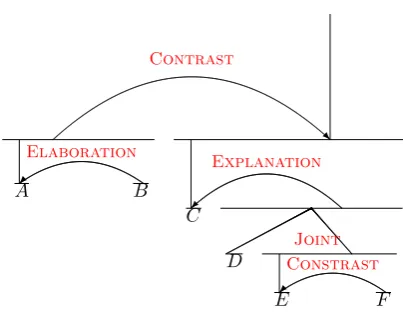
[image:1.595.312.514.216.373.2]Discourse structure, which represents the or-ganization of a text as a tree (for an example, see
Figure 1), might provide cues for the importance of different parts of a text. Some promising re-sults on sentiment classification tasks support this idea: Bhatia et al. (2015) and Hogenboom et al.
(2015) applied hand-crafted weighting schemes to the sentences in a document, based on its discourse structure, and showed benefit to sentiment polarity classification.
In this paper, we investigate the value of discourse structure for text categorization more broadly, considering five tasks, through the use of a recursive neural network built on an
R Contrast
Elaboration
A B
Explanation C
Joint D Constrast
E F
[Although the food was amazing]A[and I was in love with the spicy pork burrito,]B [the service was really awful.]C [We watched our waiter serve himself many drinks.]D [He kept running into the bathroom]E [in-stead of grabbing our bill.]F
Figure 1: A manually constructed example of the RST (Mann and Thompson,1988) discourse struc-ture on a text.
automatically-derived document parse from a top-performing, open-source discourse parser, DPLP (Ji and Eisenstein, 2014). Our models learn to weight the importance of a document’s sentences, based on their positions and relations in the dis-course tree. We introduce a new, unnormalized attention mechanism to this end.
Experimental results show that variants of our model outperform prior work on four out of five tasks considered. Our method unsurprisingly un-derperforms on the fifth task, making predictions about legislative bills—a genre in which discourse conventions are quite different from those in the discourse parser’s training data. Further experi-ments show the effect of discourse parse quality on text categorization performance, suggesting that future improvements to discourse parsing will pay off for text categorization, and validate our new attention mechanism.
Our implementation is available athttps://
github.com/jiyfeng/disco4textcat.
2 Background: Rhetorical Structure Theory
Rhetorical Structure Theory (RST; Mann and Thompson, 1988) is a theory of discourse that has enjoyed popularity in NLP. RST posits that a document can be represented by a tree whose leaves are elementary discourse units (EDUs, typ-ically clauses or sentences). Internal nodes in the tree correspond to spans of sentences that are con-nected via discourse relations such as CONTRAST
and ELABORATION. In most cases, a discourse
re-lation links adjacent spans denoted “nucleus” and “satellite,” with the former more essential to the writer’s purpose than the latter.1
An example of a manually constructed RST parse for a restaurant review is shown inFigure 1. The six EDUs are indexed fromA toF; the
dis-course tree organizes them hierarchically into in-creasingly larger spans, with the last CONTRAST
relation resulting in a span that covers the whole review. Within each relation, the RST tree in-dicates the nucleus pointed by an arrow from its satellite (e.g., in the ELABORATIONrelation,Ais the nucleus andBis the satellite).
The information embedded in RST trees has motivated many applications in NLP research, in-cluding document summarization (Marcu,1999), argumentation mining (Azar,1999), and sentiment analysis (Bhatia et al., 2015). In most applica-tions, RST trees are built by automatic discourse parsing, due to the expensive cost of manual an-notation. In this work, we use a state-of-the-art open-source RST-style discourse parser, DPLP (Ji and Eisenstein,2014).2
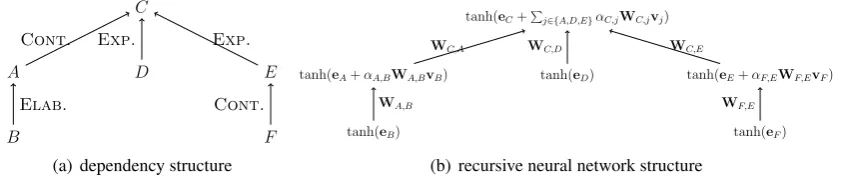
We follow recent work that suggests trans-forming the RST tree into a dependency struc-ture (Yoshida et al.,2014).3 Figure2(a)shows the corresponding dependency structure of the RST tree in Figure 1. It is clear thatC is the root of
the tree, and in fact this clause summarizes the re-view and suffices to categorize it as negative. This dependency representation of the RST tree offers a
1There are also a few exceptions in which a relation can
be realized with multiple nuclei.
2https://github.com/jiyfeng/DPLP
3The transformation is trivial and deterministic given the
nucleus-satellite mapping for each relation. The procedure is analogous to the transformation of a headed phrase-structure parse in syntax into a dependency tree (e.g.,Yamada and Mat-sumoto,2003).
form of inductive bias for our neural model, help-ing it to discern the most salient parts of a text in order to assign it a label.
3 Model
Our model is a recursive neural network built on a discourse dependency tree. It includes a dis-tributed representation computed for each EDU, and a composition function that combines EDUs and partial trees into larger trees. At the top of the tree, the representation of the complete document is used to make a categorization decision. Our ap-proach is analogous to (and inspired by) the use of recursive neural networks on syntactic depen-dency trees, with word embeddings at the leaves (Socher et al.,2014).
3.1 Representation of Sentences
Letebe the distributed representation of an EDU. We use a bidirectional LSTM on the words’ beddings within each EDU (details of word em-beddings are given insection 4), concatenating the last hidden state vector from the forward LSTM (−→e) with that of the backward LSTM (←−e) to gete. There is extensive recent work on architectures for embedding representations of sentences and other short pieces of text, including, for example, (bi)recursive neural networks (Paulus et al.,2014) and convolutional neural networks (Kalchbrenner et al.,2014). Future work might consider alterna-tives; we chose the bidirectional LSTM due to its effectiveness in many settings.
3.2 Full Recursive Model
Given the discourse dependency tree for an input text, our recursive model builds a vector represen-tation through composition at each arc in the tree. Letvi denote the vector representation of EDUi
and its descendants. For the base case where EDU
iis a leaf in the tree, we letvi= tanh(ei), which is the elementwise hyperbolic tangent function.
For an internal nodei, the composition function
considers a parent and all of its children, whose in-dices are denoted bychildren(i). In defining this
C
D
A E
B F
Elab.
Cont. Exp. Exp.
Cont. (a) dependency structure
tanh(eC+Pj∈{A,D,E}αC,jWC,jvj)
tanh(eD)
tanh(eA+αA,BWA,BvB) tanh(eE+αF,EWF,EvF)
tanh(eB) tanh(eF)
WA,B
WC,A WC,D WC,E
WF,E
[image:3.595.86.508.65.154.2](b) recursive neural network structure
Figure 2: The dependency discourse tree derived from the example RST tree in Figure 1(a) and the corresponding recursive neural network model on the tree (b).
vi = tanh
ei+ X
j∈children(i)
αi,jWri,jvj ,
(1) where Wri,j is a relation-specific composition
matrix indexed by the relation between i and j, ri,j.
αi,jis an “attention” weight, defined as
αi,j =σ
e>i Wαvj
, (2)
where σ is the elementwise sigmoid and Wα contains attention parameters (these are relation-independent). Our attention mechanism differs from prior work (Bahdanau et al.,2015), in which attention weights are normalized to sum to one across competing candidates for attention. Here,
αi,j does not depend on node i’s other children. This is motivated by RST, in which the presence of a node does not signify lesser importance to its siblings. Consider, for example, EDUDand text
span E-F inFigure 1, which in parallel provide
EXPLANATION for EDU C. This scenario
dif-fers from machine translation, where attention is-used to implicitly and softly align output-language words to relatively few input-language words. It also differs from attention in composition func-tions used in syntactic parsing (Kuncoro et al.,
2017), where attention can mimic head rules that follow from an endocentricity hypothesis of syn-tactic phrase representation.
Our recursive composition function, through the attention mechanism and the relation-specific weight matrices, is designed to learn how to dif-ferently weight EDUs for the categorization task. This idea of using a weighting scheme along with discourse structure is explored in prior works (Bhatia et al.,2015;Hogenboom et al.,2015), al-though they are manually designed, rather than learned from training data.
Once we have vroot of a text, the prediction of
its category is given by softmax(Wovroot+b).
We refer to this model as the FULLmodel, since
it makes use of the entire discourse dependency tree.
3.3 Unlabeled Model
The FULLmodel based onEquation 1 uses a
de-pendency discourse tree with relations. Because alternate discourse relation labels have been pro-posed (e.g.,Prasad et al.,2008), we seek to mea-sure the effect of these labels. We therefore con-sider an UNLABELED model based only on the
tree structure, without the relations:
vi = tanh
ei+
X
j∈children(i)
αi,jvj
. (3)
Here, only attention weights are used to compose the children nodes’ representations, significantly reducing the number of model parameters.
This UNLABELEDmodel is similar to the depth
weighting scheme introduced by Bhatia et al.
(2015), which also uses an unlabeled discourse de-pendency tree, but our attention weights are com-puted by a function whose parameters are learned. This approach sits squarely between Bhatia et al.
(2015) and the flat document structure used by
Yang et al. (2016); the UNLABELED model still
uses discourse to bias the model toward some con-tent (that which is closer to the tree’s root).
3.4 Simpler Variants
We consider two additional baselines that are even simpler. The first, ROOT, uses the discourse
de-pendency structure only to select the root EDU, which is used to represent the entire text: vroot =
eroot. No composition function is needed. This
most central EDU is used to represent the whole text.
The second variant, ADDITIVE, uses all the
EDUs with a simple composition function, and does not depend on discourse structure at all: vroot = N1 PNi=1ei,whereN is the total number of EDUs. This serves as a baseline to test the bene-fits of discourse, controlling for other design deci-sions and implementation choices. Although sen-tence representationseiare built in a different way from the work ofYang et al.(2016), this model is quite similar to their HN-AVE model on building document representations.
4 Implementation Details
The parameters of all components of our model (top-level classification, composition, and EDU representation) are learned end-to-end using stan-dard methods. We implement our learning pro-cedure with the DyNet package (Neubig et al.,
2017).
Preprocessing. For all datasets, we use the same preprocessing steps, mostly following recent work on language modeling (e.g.,Mikolov et al.,2010). We lowercased all the tokens and removed tokens that contain only punctuation symbols. We re-placed numbers in the documents with a special number token. Low-frequency word types were replaced by UNK; we reduce the vocabulary for
each dataset until approximately 5% of tokens are mapped to UNK. The vocabulary sizes after
pre-processing are also shown inTable 1.
Discourse parsing. Our model requires the dis-course structure for each document. We used DPLP, the RST parser from Ji and Eisenstein
(2014), which is one of the best discourse parsers on the RST discourse treebank benchmark ( Carl-son et al., 2001). It employs a greedy decoding algorithm for parsing, producing 2,000 parses per minute on average on a single CPU. DPLP pro-vides discourse segmentation, breaking a text into EDUs, typically clauses or sentences, based on syntactic parses provided by Stanford CoreNLP. RST trees are converted to dependencies follow-ing the method of Yoshida et al. (2014). DPLP as distributed is trained on 347Wall Street Jour-nalarticles from the Penn Treebank (Marcus et al.,
1993).
Word embeddings. In cases where there are 10,000 or fewer training examples, we used
pretrained GloVe word embeddings (Pennington et al., 2014), following previous work on neu-ral discourse processing (Ji and Eisenstein,2015). For larger datasets, we randomly initialized word embeddings and trained them alongside other model parameters.
Learning and hyperparameters. Online learn-ing was performed with the optimization method and initial learning rate as hyperparameters. To avoid the exploding gradient problem, we used the norm clipping trick with a threshold of τ = 5.0. In addition, dropout rate 0.3 was used on both input and hidden layers to avoid overfitting. We performed grid search over the word vector repre-sentation dimensionality, the LSTM hidden state dimensionality (both {32,48,64,128,256}), the
initial learning rate ({0.1,0.01,0.001}), and the update method (SGD and Adam,Kingma and Ba,
2015). For each corpus, the highest-accuracy com-bination of these hyperparameters is selected us-ing development data or ten-fold cross validation, which will be specified insection 5.
5 Datasets
We selected five datasets of different sizes and cor-responding to varying categorization tasks. Some information about these datasets is summarized inTable 1.
Sentiment analysis on Yelp reviews. Originally from the Yelp Dataset Challenge in 2015, this dataset contains 1.5 million examples. We used the preprocessed dataset fromZhang et al.(2015), which has 650,000 training and 50,000 test exam-ples. The task is to predict an ordinal rating (1–5) from the text of the review. To select the best com-bination of hyperparameters, we randomly sam-pled 10% training examples as the development data. We compared with hierarchical attention net-works (Yang et al.,2016), which use the normal-ized attention mechanism on both word and sen-tence layers with a flat document structure, and provide the state-of-the-art result on this corpus. Framing dimensions in news articles. The Me-dia Frames Corpus (MFC; Card et al., 2015) in-cludes around 4,200 news articles about immi-gration from 13 U.S. newspapers over the years 1980–2012. The annotations of these articles are in terms of a set of 15 general-purpose labels, such as ECONOMICS and MORALITY, designed
Number of docs.
Dataset Task Classes Total Training Development Test Vocab. size
Yelp Sentiment 5 700K 650K – 50K 10K
MFC Frames 15 4.2K – – – 7.5K
Debates Vote 2 1.6K 1,135 105 403 5K
Movies Sentiment 2 2.0K – – – 5K
Bills Survival 2 52K 46K – 6K 10K
Table 1: Information about the five datasets used in our experiments. To compare with prior work, we use different experimental settings. For Yelp and Bill corpora, we use 10% of the training examples as development data. For MFC and Movies corpora, we use 10-fold cross validation and report averages across all folds.
immigration issue within the articles. We fo-cused on predicting the single primary frame of each article. The state-of-the-art result on this corpus is from Card et al. (2016), where they used logistic regression together with unigrams, bigrams and Bamman-style personas (Bamman et al., 2014) as features. The best feature com-bination in their model alongside other hyperpa-rameters was identified by a Bayesian optimiza-tion method (Bergstra et al.,2015). To select hy-perparameters, we used a small set of examples from the corpus as a development set. Then, we report average accuracy across 10-fold cross vali-dation as in (Card et al.,2016).
Congressional floor debates. The corpus was originally collected by Thomas et al.(2006), and the data split we used was constructed by Yesse-nalina et al.(2010). The goal is to predict the vote (“yea” or “nay”) for the speaker of each speech segment. The most recent work on this corpus is fromYogatama and Smith (2014), which pro-posed structured regularization methods based on linguistic components, e.g., sentences, topics, and syntactic parses. Each regularization method in-duces a linguistic bias to improve text classifica-tion accuracy, where the best result we repeated here is from the model with sentence regularizers.
Movie reviews. This classic movie review cor-pus was constructed byPang and Lee(2004) and includes 1,000 positive and 1,000 negative re-views. On this corpus, we used the standard ten-fold data split for cross validation and reported the average accuracy across folds. We compared with the work from bothBhatia et al.(2015) and
Hogenboom et al. (2015), which are two recent works on discourse for sentiment analysis.
Bha-tia et al. (2015) used a hand-crafted weighting scheme to bias the bag-of-word representations on sentences. Hogenboom et al.(2015) also consid-ered manually-designed weighting schemes and a lexicon-based model as classifier, achieving per-formance inferior to fully-supervised methods like
Bhatia et al.(2015) and ours.
Congressional bill corpus. This corpus, col-lected byYano et al.(2012), includes 51,762 leg-islative bills from the 103rd to 111th U.S. Con-gresses. The task is to predict whether a bill will survive based on its content. We randomly sam-pled 10% training examples as development data to search for the best hyperparameters. To our knowledge, the best published results are due to
Yogatama and Smith (2014), which is the same baseline as for the congressional floor debates cor-pus.
6 Experiments
We evaluated all variants of our model on the five datasets presented insection 5, comparing in each case to the published state of the art as well as the most relevant works.
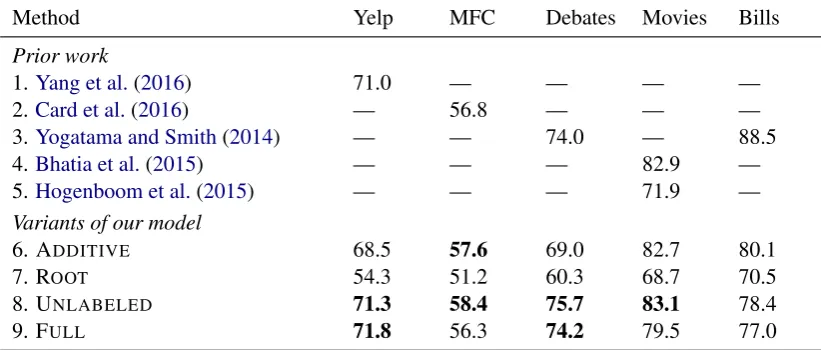
Results. See Table 2. On four out of five datasets, our UNLABELEDmodel (line 8)
outper-forms past methods. In the case of the very large Yelp dataset, our FULLmodel (line 9) gives even
stronger performance, but not elsewhere, suggest-ing that it is overparameterized for the smaller datasets. Indeed, on the MFC and Movies tasks, the discourse-ignorant ADDITIVEoutperforms the
FULLmodel. On these datasets, the selected FULL
model had nearly 20 times as many parameters as the UNLABELEDmodel, which in turn had twice
Method Yelp MFC Debates Movies Bills
Prior work
1.Yang et al.(2016) 71.0 — — — —
2.Card et al.(2016) — 56.8 — — —
3.Yogatama and Smith(2014) — — 74.0 — 88.5
4.Bhatia et al.(2015) — — — 82.9 —
5.Hogenboom et al.(2015) — — — 71.9 —
Variants of our model
6. ADDITIVE 68.5 57.6 69.0 82.7 80.1
7. ROOT 54.3 51.2 60.3 68.7 70.5
8. UNLABELED 71.3 58.4 75.7 83.1 78.4
[image:6.595.90.501.64.239.2]9. FULL 71.8 56.3 74.2 79.5 77.0
Table 2: Test-set accuracy across five datasets. Results from prior work are reprinted from the corre-sponding publications. Boldface marks performance stronger than the previous state of the art.
This finding demonstrates the benefit of ex-plicit discourse structure—even the output from an imperfect parser—for text categorization in some genres. This benefit is supported by both UN -LABELED and FULL, since both of them use
dis-course structures of texts. The advantage of us-ing discourse information varies on different gen-res and different corpus sizes. Even though the discourse parser is trained on news text, it still of-fers benefit to restaurant and movie reviews and to the genre of congressional debates. Even for news text, if the training dataset is small (e.g., MFC), a lighter-weight variant of discourse (UNLABELED)
is preferred.
Legislative bills, which have technical legal content and highly specialized conventions (see the supplementary material for an example), are arguably the most distant genre from news among those we considered. On that task, we see dis-course working against accuracy. Note that the corpus of bills is more than ten times larger than three cases where our UNLABELEDmodel
outper-formed past methods, suggesting that the drop in performance is not due to lack of data.
It is also important to notice that the ROOT
model performs quite poorly in all cases. This im-plies that discourse structure is not simply helping by finding a single EDU upon which to make the categorization decision.
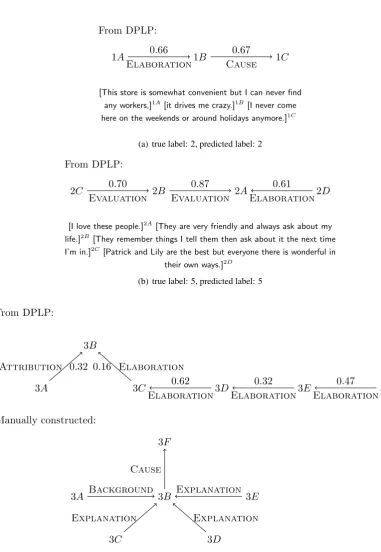
Qualitative analysis. Figure 3 shows some ex-ample texts from the Yelp Review corpus with their discourse structures produced by DPLP, where the weights were generated with the FULL
model. Figures 3(a) and3(b) are two successful
examples of the FULL model. Figure3(a) shows
a simple case with respect to the discourse struc-ture. Figure3(b) is slightly different—the text in this example may have more than one reasonable discourse structure, e.g., 2D could be a child of
2C instead of2A. In both cases, discourse
struc-tures help the FULL model bias to the important
sentences.
Figure3(c), on the other hand, presents a neg-ative example, where DPLP failed to identify the most salient sentence 3F. In addition, the
weights produced by the FULL model do not
make much sense, which we suspect the model was confused by the structure. Figure 3(c) also presents a manually-constructed discourse struc-ture on the same text for reference. A more accu-rate prediction is expected if we use this manually-constructed discourse structure, because it has the appropriate dependency between sentences. In ad-dition, the annotated discourse relations are able to select the right relation-specific composition ma-trices in FULL model, which are consistent with
the training examples.
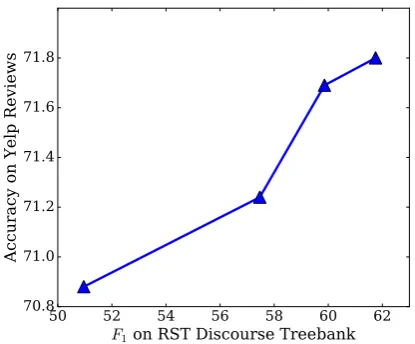
Effect of parsing performance. A natural ques-tion is whether further improvements to RST dis-course parsing would lead to even greater gains in text categorization. While advances in discourse parsing are beyond the scope of this paper, we can gain some insight by exploring degradation to the DPLP parser. An easy way to do this is to train it on subsets of the RST discourse tree-bank. We repeated the conditions described above for our FULLmodel, training DPLP on 25%, 50%,
From DPLP:
1A 0.66 1B 1C
Elaboration
0.67 Cause
[This store is somewhat convenient but I can never find any workers,]1A[it drives me crazy.]1B[I never come
here on the weekends or around holidays anymore.]1C
(a) true label: 2, predicted label: 2
From DPLP:
2A
2B
2C 0.87 2D
Evaluation
0.61
Elaboration
0.70
Evaluation
[I love these people.]2A[They are very friendly and always ask about my
life.]2B [They remember things I tell them then ask about it the next time
I’m in.]2C[Patrick and Lily are the best but everyone there is wonderful in
their own ways.]2D
(b) true label: 5, predicted label: 5
From DPLP:
3B
3A 3C 3D 3E 0.47 3F
Elaboration 0.32
Elaboration 0.62
Elaboration 0.16 Elaboration 0.32
Attribution
Manually constructed:
3F
3B
3A
3C 3D
3E
Cause
Background
Explanation Explanation Explanation
[We use to visit this pub 10 years ago because they had a nice english waitress and excellent fish and chips for the price.]3A[However we went back a few weeks ago and were disappointed.]3B [The price of the fish and chip
dinner went up and they cut the portion in half.]3C[No one assisted us in putting two tables together we had to
do it ourselves.]3D [Two guests wanted a good English hot tea and they didn’t brew it in advance.]3E[So we’ve
decided there are newer and better places to eat fish and chips especially up in north phoenix.]3F
[image:7.595.98.480.52.605.2](c) true label: 1, predicted label: 3
50 52 54 56 58 60 62
F1
on RST Discourse Treebank
70.8 71.0 71.2 71.4 71.6 71.8
[image:8.595.76.284.59.231.2]Accuracy on Yelp Reviews
Figure 4: Varying the amount of training data for the discourse parser, we can see how parsing F1
performance affects accuracy on the Yelp review task.
each case) before re-parsing the data for the sen-timent analysis task. We did not repeat the hy-perparameter search. In Figure 4, we plot accu-racy of the classifier (y-axis) against theF1
perfor-mance of the discourse parser (x-axis).
Unsurpris-ingly, lower parsing performance implies lower classification accuracy. Notably, if the RST dis-course treebank were reduced to 25% of its size, our method would underperform the discourse-ignorant model ofYang et al. (2016). While we cannot extrapolate with certainty, these findings suggest that further improvements to discourse parsing, through larger annotated datasets or im-proved models, could lead to greater gains. Attention mechanism. In section 3, we con-trasted our new attention mechanism (Equation 2), which is inspired by RST’s lack of “competi-tion” for salience among satellites, with the atten-tion mechanism used in machine translaatten-tion ( Bah-danau et al.,2015). We consider here a variant of our model with normalized attention:
α0i=softmax
... v>j
...
j∈children(i)
Wα·ei
.
(4) The result here is a vectorα0i, with one element for
each child nodej ∈children(i), and which sums to one.
On Yelp dateset, this variant of the FULLmodel
achieves 70.3% accuracy (1.5% absolute behind our FULLmodel), giving empirical support to our
theoretically-motivated design decision not to nor-malize attention. Of course, further architecture improvements may yet be possible.
Discussion. Our findings in this work show the benefit of using discourse structure for text cate-gorization. Although discourse structure strongly improves the performance on most of corpora in our experiments, its benefit is limited particularly by two factors: (1) the state-of-the-art perfor-mance on RST discourse parsing; and (2) domain mismatch between the training corpus for a dis-course parser and the domain where the disdis-course parser is used. For the first factor, discourse pars-ing is still an active research topic in NLP, and may yet improve. The second factor suggests explor-ing domain adaptation methods or even direct dis-course annotation for genres of interest.
7 Related Work
Early work on text categorization often treated text as a bag of words (e.g.,Joachims,1998;Yang and Pedersen,1997). Representation learning, for ex-ample through matrix decomposition (Deerwester et al., 1990) or latent topic variables (Ramage et al., 2009), has been considered to avoid over-fitting in the face of sparse data.
The assumption that all parts of a text should influence categorization equally persists even as more powerful representation learners are consid-ered.Zhang et al.(2015) treat a text as a sequence of characters, proposing to a deep convolutional neural network to build text representation. Xiao and Cho (2016) extended that architecture by in-serting a recurrent neural network layer between the convolutional layer and the classification layer. In contrast, our contributions follow Ko et al.
(2004), who sought to weight the influence of dif-ferent parts of an input text on the task. Two works that sought to learn the importance of sentences in a document areYessenalina et al.(2010) andYang et al. (2016). The former used a latent variable for the informativeness of each sentence, and the latter used a neural network to learn an attention function. Neither used any linguistic bias, relying only on task supervision to discover the latent vari-able distribution or attention function. Our work builds the neural network directly on a discourse dependency tree, favoring the most central EDUs over the others but giving the model the ability to overcome this bias.
presented by Yogatama and Smith (2014), who used a bag-of-words model. The novelty in their approach was a data-driven regularization method that encouraged the model to collectively ignore groups of features found to coocur. Most related to our work is their “sentence regularizer,” which encouraged the model to try to ignore training-set sentences that were not informative for the task. Discourse structure was not considered.
Discourse for sentiment analysis. Recently, discourse structure has been considered for sen-timent analysis, which can be cast as a text cate-gorization problem. Bhatia et al.(2015) proposed two discourse-motivated models for sentiment po-larity prediction. One of the models is also based on discourse dependency trees, but using a hand-crafted weighting scheme. Our method’s attention mechanism automates the weighting.
8 Conclusion
We conclude that automatically-derived discourse structure can be helpful to text categorization, and the benefit increases with the accuracy of dis-course parsing. We did not see a benefit for categorizing legislative bills, a text genre whose discourse structure diverges from that of news. These findings motivate further improvements to discourse parsing, especially for new genres.
Acknowledgments
We thank anonymous reviewers and members of Noah’s ARK for helpful feedback on this work. We thank Dallas Card and Jesse Dodge for helping prepare the Media Frames Corpus and the Con-gressional bill corpus. This work was made pos-sible by a University of Washington Innovation Award.
References
Moshe Azar. 1999. Argumentative text as rhetorical structure: An application of rhetorical structure the-ory.Argumentation13(1):97–114.
Dzmitry Bahdanau, Kyunghyun Cho, and Yoshua Ben-gio. 2015. Neural machine translation by jointly learning to align and translate. InICLR.
David Bamman, Brendan O’Connor, and Noah A Smith. 2014. Learning latent personas of film char-acters. InACL.
James Bergstra, Brent Komer, Chris Eliasmith, Dan Yamins, and David D. Cox. 2015. Hyperopt: a
Python library for model selection and hyperparam-eter optimization. Computational Science & Dis-covery8(1).
Parminder Bhatia, Yangfeng Ji, and Jacob Eisenstein. 2015. Better document-level sentiment analysis from RST discourse parsing. InEMNLP.
Dallas Card, Amber E. Boydstun, Justin H. Gross, Philip Resnik, and Noah A. Smith. 2015. The Me-dia Frames Corpus: Annotations of frames across issues. InACL.
Dallas Card, Justin Gross, Amber E. Boydstun, and Noah A. Smith. 2016. Analyzing framing through the casts of characters in the news. InEMNLP.
Lynn Carlson, Daniel Marcu, and Mary Ellen Okurowski. 2001. Building a discourse-tagged cor-pus in the framework of Rhetorical Structure The-ory. InProceedings of Second SIGdial Workshop on Discourse and Dialogue.
Scott Deerwester, Susan T. Dumais, George W. Fur-nas, Thomas K. Landauer, and Richard Harshman. 1990. Indexing by latent semantic analysis. Jour-nal of the American Society for Information Science
41(6):391.
Alexander Hogenboom, Flavius Frasincar, Franciska de Jong, and Uzay Kaymak. 2015. Using rhetorical structure in sentiment analysis. Communications of the ACM58(7):69–77.
Yangfeng Ji and Jacob Eisenstein. 2014. Representa-tion learning for document-level discourse parsing. InACL.
Yangfeng Ji and Jacob Eisenstein. 2015. One vector is not enough: Entity-augmented distributed semantics for discourse relations. Transactions of the Associa-tion of ComputaAssocia-tional Linguistics3:329–344. Thorsten Joachims. 1998. Text categorization with
support vector machines: Learning with many rel-evant features. InECML.
Nal Kalchbrenner, Edward Grefenstette, and Phil Blun-som. 2014. A convolutional neural network for modelling sentences. ArXiv:1404.2188.
Diederik Kingma and Jimmy Ba. 2015. Adam: A method for stochastic optimization. InICLR.
Youngjoong Ko, Jinwoo Park, and Jungyun Seo. 2004. Improving text categorization using the importance of sentences. Information Processing & Manage-ment40(1):65–79.
Adhiguna Kuncoro, Miguel Ballesteros, Lingpeng Kong, Chris Dyer, Graham Neubig, and Noah A. Smith. 2017. What do recurrent neural network grammars learn about syntax? InEACL.
Daniel Marcu. 1999. Discourse trees are good indi-cators of importance in text. In Inderjeet Mani and Mark T. Maybury, editors, Advances in Automatic Text Summarization, pages 123–136.
Mitchell P. Marcus, Mary Ann Marcinkiewicz, and Beatrice Santorini. 1993. Building a large annotated corpus of English: The Penn Treebank. Computa-tional Linguistics19(2):313–330.
Tomas Mikolov, Martin Karafi´at, Lukas Burget, Jan Cernock`y, and Sanjeev Khudanpur. 2010. Recur-rent neural network based language model. In
IN-TERSPEECH.
Graham Neubig, Chris Dyer, Yoav Goldberg, Austin Matthews, Waleed Ammar, Antonios Anastasopou-los, Miguel Ballesteros, David Chiang, Daniel Clothiaux, Trevor Cohn, et al. 2017. Dynet: The dy-namic neural network toolkit. ArXiv:1701.03980.
Bo Pang and Lillian Lee. 2004. A sentimental educa-tion: Sentiment analysis using subjectivity summa-rization based on minimum cuts. InProceedings of the 42nd annual meeting on Association for Compu-tational Linguistics. Association for Computational Linguistics, page 271.
Romain Paulus, Richard Socher, and Christopher D Manning. 2014. Global belief recursive neural net-works. InNIPS.
Jeffrey Pennington, Richard Socher, and Christopher D Manning. 2014. GloVe: Global vectors for word representation. InEMNLP.
Rashmi Prasad, Nikhil Dinesh, Alan Lee, Eleni Milt-sakaki, Livio Robaldo, Aravind Joshi, and Bonnie Webber. 2008. The Penn Discourse Treebank 2.0. InLREC.
Daniel Ramage, David Hall, Ramesh Nallapati, and Christopher D. Manning. 2009. Labeled lda: A su-pervised topic model for credit attribution in multi-labeled corpora. InEMNLP.
Richard Socher, Andrej Karpathy, Quoc V Le, Christo-pher D. Manning, and Andrew Y. Ng. 2014. Grounded compositional semantics for finding and describing images with sentences. Transactions of the Association for Computational Linguistics
2:207–218.
Matt Thomas, Bo Pang, and Lillian Lee. 2006. Get out the vote: Determining support or opposition from Congressional floor-debate transcripts. InEMNLP.
Yijun Xiao and Kyunghyun Cho. 2016. Effi-cient character-level document classification by combining convolution and recurrent layers. ArXiv:1602.00367.
H. Yamada and Y. Matsumoto. 2003. Statistical de-pendency analysis with support vector machines. In
IWPT.
Yiming Yang and Jan O. Pedersen. 1997. A compara-tive study on feature selection in text categorization. InICML.
Zichao Yang, Diyi Yang, Chris Dyer, Xiaodong He, Alex Smola, and Eduard Hovy. 2016. Hierarchical attention networks for document classification. In
NAACL.
Tae Yano, Noah A. Smith, and John D. Wilkerson. 2012. Textual predictors of bill survival in congres-sional committees. InNAACL.
Ainur Yessenalina, Yisong Yue, and Claire Cardie. 2010. Multi-level structured models for document sentiment classification. InEMNLP.
Dani Yogatama and Noah A. Smith. 2014. Linguistic structured sparsity in text categorization. InACL.
Yasuhisa Yoshida, Jun Suzuki, Tsutomu Hirao, and Masaaki Nagata. 2014. Dependency-based dis-course parser for single-document summarization. InEMNLP.