Joint part-of-speech and dependency projection from multiple sources
Anders Johannsen ˇZeljko Agi´c Anders Søgaard
Center for Language Technology, University of Copenhagen, Denmark
Abstract
Most previous work on annotation projec-tion has been limited to a subset of Indo-European languages, using only a single source language, and projecting annota-tion for one task at a time. In contrast, we present an Integer Linear Program-ming (ILP) algorithm that simultaneously projects annotation for multiple tasks from multiple source languages, relying on par-allel corpora available for hundreds of lan-guages. When training POS taggers and dependency parsers on jointly projected POS tags and syntactic dependencies us-ing our algorithm, we obtain better perfor-mance than a standard approach on 20/23 languages using one parallel corpus; and 18/27 languages using another.
1 Introduction
Cross-language annotation projection for unsuper-vised POS tagging and syntactic parsing was in-troduced fifteen years ago (Yarowsky et al., 2001; Hwa et al., 2005), and the best unsupervised de-pendency parsers today rely on annotation projec-tion (Rasooli and Collins, 2015).
Despite the maturity of the field, there is an in-herent language bias in previous work on cross-language annotation projection. Cross-cross-language annotation projection experiments require training data in m source languages, a parallel corpus of translations from themsource languages into the target language of interest, as well as evaluation data for the target language.1 Since the canonical resource for parallel text is the Europarl Corpus (Koehn, 2005), which covers languages spoken in the European parliament, annotation projection is
1All previous work that we are aware of—with the possi-ble exception of McDonald et al. (2011); but see Sections 2 and 5—uses only a single source (m= 1), but in our experi-ments, we use multiple source languages.
typically limited to the subset of Indo-European languages that have treebanks.
Previous work is also limited in another respect. While treebanks typically contain multiple layers of annotation, previous work has focused on pro-jecting data for a single task.
We go significantly beyond previous work in two ways: 1) by considering multi-source pro-jection across languages in parallel corpora that are available for hundreds of languages, includ-ing many non-Indo-European languages; and 2) by jointlyprojecting annotation for two mutually dependent tasks, namely POS tagging and depen-dency parsing. Using multiple source languages makes our projections denser. In single source projection, the source language may not contain all syntactic phenomena of the target language; we combat this by transferring syntactic information from multiple source languages. Our work also differs from previous work on annotation projec-tion in projecting soft rather than hard constraints, i.e., scores rather than labels and edges.
Contributions We present a novel ILP-based al-gorithm for jointly projecting POS labels and de-pendency annotations across word-aligned parallel corpora. The performance of our algorithm com-pares favorably to that of a state-of-the-art projec-tion algorithm, as well as to multi-source delex-icalized transfer. Our experiments include be-tween 23 and 27 languages using two parallel cor-pora that are available for hundreds of languages, namely a collection of Bibles and Watchtower pe-riodicals. Finally, we make both the parallel cor-pora and the code publicly available.2
2 Projection algorithm
The projection algorithm is divided into two dis-tinct steps. First, we project potential syntactic
2https://bitbucket.org/lowlands/
release
edges and POS tags from all source languages into an intermediate target graph, which is left deliber-ately ambiguous. In the second step, we decode the target graph by solving a constrained optimi-sation problem, which simultaneously resolves all ambiguities and produces a single dependency tree with a fixed set of POS tags. Below we describe both steps in more detail.
2.1 Cross-language sentence
The input to our projection algorithm is a cross-language sentence, a data structure that ties to-gether a collection of aligned sentences from a par-allel corpus, i.e., sentences in many different lan-guages that are determined to be translation equiv-alents. One sentence of the set is designated as the target while the rest are sources. We project syn-tactic information from the sources to the target.
All source sentences are automatically parsed with a graph-based dependency parser and labeled with parts of speech. Instead of using the sin-gle best dependency tree output by the parser, we extract its scoring matrix, an ambiguous structure that assigns a numeric score to each potential de-pendency edge. The target sentence is not parsed or POS-tagged. In fact, our approach is explicitly designed to work for target languages where no such resources are available. Only unsupervised word alignments couple the target sentence with each source sentence.
More formally, a cross-language sentence may be represented as a graph G = (V, E), where each vertex is a POS-tagged token of a sentence in some language. With one target andn source languages, the total set of tagged word verticesV
can be written as the union of sentence vertices:
V =V0∪. . .∪Vn. The target sentence isVt=V0, while source sentences areVs=V1∪. . .∪Vn.
Two kinds of weighted edges connect the graph. Edges that go between tagged tokens of a sentence
Vi represent potential dependency edges. Thus,
for the sentencei, the induced subgraph G[Vi]is
the (ambiguous) dependency graph. Edges con-necting a source vertex to target vertex represent word alignments. The set of alignment edges is
A⊆Vs×Vt.
To account for POS we introduce a vertex label-ing functionl : V 7→ Σ, whereΣis the POS vo-cabulary. The source sentences are automatically tagged, and for any source vertex the label func-tion simply returns this tag. For the target sentence
the POS labels are unknown, which is to say that every target token is ambiguous between|Σ|POS tags. We represent this ambiguity in the graph by creating a vertex for each possible combination of target word and POS. Concretely, if a source sen-tenceihasntokens, and the target sentence hasm
tokens, then|Vi|=n, and|Vs|=m|Σ|.
Alignments are constrained such that an align-ment(u, v)∈Vs×Vtonly exists if the source and
target token were linked by the automatic aligner andl(u) =l(v), i.e., the POS tags match. This fil-ters out potential source relations with dissimilar syntax, a luxury that we are allowed in a multiple source language setup.
2.2 Projecting to ambiguous target graph The target graphG[Vt]starts out empty and is
pop-ulated with edges in the following way. We go through the source sentences, looking for poten-tial dependency edges where both endpoints are aligned to the target sentence, and transferring the edge whenever we find one. Technically, for every source sentenceiand for each edge in the source graph(us, vs)∈G[Vi], we create an edge(ut, vt)
in the target iff both (us, ut) and (vs, vt) ∈ A.
The edge weight is the source edge score (as de-termined by an automatic parser) weighted by the joint alignment probability of(us, ut)and(vs, vt):
d(ut, vt) = maxu
s,vs a(us, vs) a(us, ut) d(vs, vt).
For clarity, d refers to weights of dependency edges, and ato alignment edge weights. Multi-ple source sentences may project the same edge to the target graph. When this happens we update the target edge weight only if the new weight is larger than the existing. The weight then reflects the strongest evidence found for a given syntactic relation across all source languages.
2.3 Decoding the target graph
We are now ready to decode the target graph. The result of decoding is a dependency tree as well as a labeling of the target sentences with POS tags. Labeling with POS corresponds to selecting a sub-set of the verticesV˜ ⊂ Vt, such that exactly one
the decoded tree. We solve this constrained opti-mization problem by casting it as an integer linear programming (ILP) problem.
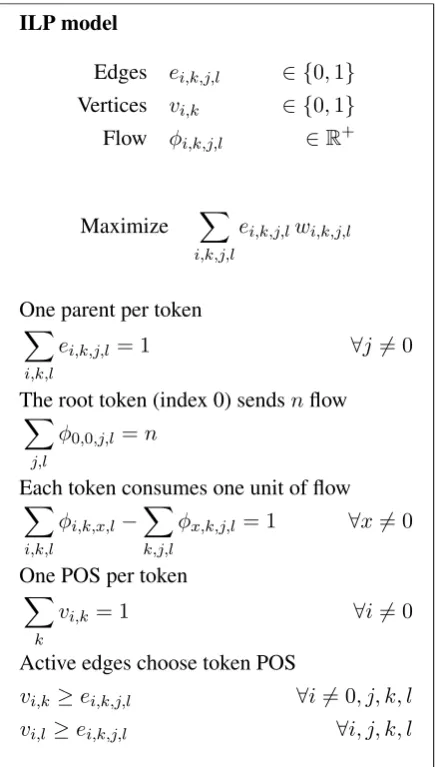
The full specification of the ILP model is dis-played as Figure 1. The model is optimized over two types of binary decision variables mapping di-rectly to the target graph representation discussed in the previous section, plus additionalflow ables that enforce tree structure. An edge vari-able ei,k,j,l represents a target edge (i, j) where
the POS ofi isk and the POS ofj isl. For in-stance, the variable e2,V,1,Nrepresents a directed edge from the second token (a verb) to the first (a noun). An active vertex variablevi,kindicates that
the POS of tokeniis chosen ask.
Following Martins (2012), we constrain the search space to spanning trees by using a single-flow construction. In the commodity-flow analogy, we imagine the root as a factory that producesncommodities (for anntoken sentence) which are distributed along the edges of the tree. Each token is a consumer that must receive and pass on all except one commodity to its depen-dents, i.e., the difference between incoming and outgoing flow should be 1. Since all commodities must be consumed, the outgoing flow for a leaf node will be zero. Together with the requirement that each token must have exactly one head, this ensures all tokens are connected to the root in the tree structure.
The last two constraint groups enforce edge and POS consistency, and the selection of single POS per token. Both are new to this work.
3 Data sources
Our projection requires parallel text, ideally span-ning a large number of languages, and dependency treebanks for the sources.
Treebanks To train the source-side taggers and dependency parsers, and to evaluate the cross-lingual taggers and parsers, we use the Universal Dependencies (UD) version 1.2 treebanks with the corresponding test sets.3
Parallel texts We exploit two sources of par-allel text: the Edinburgh Multilingual Bible cor-pus (EBC) (Christodouloupoulos and Steedman, 2014), and our own collection of online texts pub-lished by the Wathctower Society (WTC).4While
3http://hdl.handle.net/11234/1-1548
4https://www.jw.org/
ILP model
Edges ei,k,j,l ∈ {0,1}
Vertices vi,k ∈ {0,1}
Flow φi,k,j,l ∈R+
Maximize X
i,k,j,l
ei,k,j,lwi,k,j,l
One parent per tokenX
i,k,l
ei,k,j,l= 1 ∀j6= 0
The root token (index 0) sendsX nflow
j,l
φ0,0,j,l=n
Each token consumes one unit of flowX
i,k,l
φi,k,x,l−
X
k,j,l
φx,k,j,l= 1 ∀x6= 0
One POS per tokenX
k
vi,k = 1 ∀i6= 0
Active edges choose token POS
vi,k ≥ei,k,j,l ∀i6= 0, j, k, l vi,l≥ei,k,j,l ∀i, j, k, l
[image:3.595.308.526.61.445.2]Above,i,j, andxare token indices, whilekandlrefer to POS. Quantification over these symbols in the equa-tions are always with respect to a given target graph.
Figure 1: Specification of the ILP model. We list, in order, the decision variables, the objective, and the five groups of constraint templates.
the two collections span more than 100 languages, we focus on the subsets that overlap with the UD languages to facilitate evaluation. For EBC, that amounts to 27 languages, and 23 for WTC. Preprocessing We use simple sentence splitting and tokenization models to segment the parallel corpora.5 To sentence- and word-align the indi-vidual language pairs, we use a Gibbs sampling-based IBM1 alignment model called efmaral
( ¨Ostling, 2015). IBM1 has been shown to lead to more robust alignments across typologically dis-tant language pairs ( ¨Ostling, 2015). We modify
5https://github.com/bplank/
the aligner to output alignment probabilities. All the source-side texts are POS-tagged and depen-dency parsed using TnT (Brants, 2000) and Tur-boParser (Martins et al., 2013). We use our own fork of the arc-factored TurboParser to output the edge weight matrices.6
4 Experiments 4.1 Setup
In our experiments, as in the preprocessing, we use the TnT tagger and the arc-factored TurboParser, which we train on the EBC and WTC texts with projected and decoded annotations. We randomly sample up to 20k sentences per training file in both tagging and parsing. This 20k sampling limit ap-plies to all systems.
We compare two cross-lingual projection-based parsing systems, and one baseline system.
ILP The ILP-based joint projection algorithm we presented in Section 2.
DCA Our implementation of thede facto stan-dard annotation projection algorithm of Hwa et al. (2005), as refined by Tiedemann (2014). In contrast to our ILP approach, it uses heuristics to ensure dependency tree constraints on a source-target sentence pair basis. We gather all the pair-wise projections into a target sentence graph and then perform maximum spanning tree decoding following Sagae and Lavie (2006).
DELEX The multi-source direct delexicalized transfer baseline of McDonald et al. (2011). Each source is represented by an approximately equal number of sentences.
4.2 Results
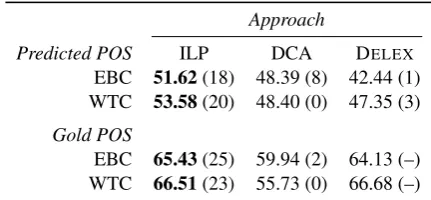
Table 1 provides a summary of dependency pars-ing scores. We report UAS scores over predicted and gold POS. The predicted tags come from our cross-lingual taggers. Our ILP approach consis-tently outperforms DCA on both by a large margin of 3-5 points UAS using predicted POS, and 5-10 points on gold POS. Note that DELEX is trained on gold POS and therefore has an advantage in this
6https://github.com/andersjo/
TurboParser
8We do not include DELEXin the comparisonfor the gold
POS scenario only. In this particular scenario, DELEXis also trained on gold POS, and thus biased: the cross-lingual tag-gers do not have gold POS available for training, and the same holds for DELEXand projected POS.
Approach
Predicted POS ILP DCA DELEX
EBC 51.62(18) 48.39 (8) 42.44 (1) WTC 53.58(20) 48.40 (0) 47.35 (3) Gold POS
[image:4.595.307.523.62.162.2]EBC 65.43(25) 59.94 (2) 64.13 (–) WTC 66.51(23) 55.73 (0) 66.68 (–)
Table 1: Macro-averaged UAS scores summariz-ing our evaluation. EBC: Edinburgh Bible corpus, WTC: Watchtower corpus. Numbers of languages with top performance per system are reported in brackets. All parsers use their respective EBC or WTC taggers.8
setting. Relying on predicted POS and WTC data, our ILP approach beats DCA for allthe test lan-guages. With EBC, we outperform DCA on 19 out of 27 languages.
In Table 2, we split the scores across the test languages and parallel data sources, and we also report the POS tagging accuracies. Our WTC gers are on average 3.5 points better than EBC tag-gers, yielding the top score for 16/23 languages from the overlap. Notably, on several non-Indo-European languages, we observe significant im-provements. For example, on Indonesian, DCA improves over DELEX by 12 points UAS, while ILP adds 6 more points on top. We observe a sim-ilar pattern for Arabic and Estonian. We note that DELEXtops ILP and DCA on only 1 EBC and 3 WTC languages, and by a narrow margin.
Analysis A projected parse is allowed to be a composite of edges from many source languages. To find out to what degree this actually happens, we analyze all projections into English and Ger-man on the WTC corpus.
For German the top four source languages are Czech, Norwegian, French, and English, con-tributing between 16% and 7% of all edges. For English the top languages are Norwegian, Ital-ian, IndonesItal-ian, and Swedish. Here, the top lan-guage Norwegian is responsible for 42% of the edges, while Swedish accounts for 13%. Only the language projecting the highest scoring edge is counted. On average, a German sentence has edges from 4.1 source languages. The same num-ber for English is slightly higher, at 4.5.
Dependency parsing
POS tagging EBC WTC
Language EBC WTC ILP DCA DELEX ILP DCA DELEX
Arabic 39.54 53.91 36.59 37.70 13.17 37.41 32.14 21.15 Basque 43.43 – 22.77 17.38 27.85 – – – Bulgarian 76.45 68.27 50.6 60.03 57.83 49.68 37.18 48.37
Croatian 72.83 76.18 54.19 45.08 42.34 55.16 50.56 45.49 Czech 70.81 78.49 52.67 41.44 40.99 53.09 44.36 47.99 Danish 76.43 86.36 61.14 53.22 49.65 61.78 58.64 55.96 English 71.90 79.2 55.76 50.64 48.04 58.70 57.12 53.87 * Estonian 75.55 73.98 62.9 56.95 49.32 63.85 58.41 48.48 Farsi 64.94 25.67 23.53 42.37 28.93 20.34 12.26 19.48 Finnish 70.41 67.44 43.66 44.51 41.18 42.59 35.6 41.52 French 74.25 79.23 53.52 53.11 48.97 55.69 51.47 51.53 German 74.36 68.36 45.02 50.21 49.36 43.99 36.7 45.79 * Greek 56.52 75.75 62.59 37.73 37.11 62.43 52.95 54.90 Hebrew 43.65 – 30.25 39.76 19.06 – – –
Hindi 59.99 48.86 18.26 35.59 21.03 15.95 10.77 21.04 * Hungarian 71.57 71.42 49.74 44.97 43.07 44.17 42.33 46.66 Indonesian 63.30 75.61 51.99 23.53 31.18 58.01 52.29 39.67 Italian 79.28 83.82 63.13 58.66 53.94 64.88 63.57 58.06 * Latin 83.41 – 68.65 68.45 41.42 – – – Norwegian 77.00 85.31 65.04 58.32 53.46 66.54 64.37 60.11
Polish 73.36 73.68 62.94 59.27 53.33 63.74 55.4 54.87 Portuguese 78.41 83.67 63.75 60.45 52.91 64.62 63.16 56.99 * Romanian 71.56 76.34 57.74 56.73 45.73 58.76 54.78 51.23 * Serbian 74.07 – 49.15 49.38 47.06 – – –
Slovene 75.68 78.11 59.17 53.66 50.55 59.79 54.8 52.53 Spanish 76.72 85.69 63.63 52.20 47.6 64.93 61.90 55.87 Swedish 78.26 84.80 65.24 55.21 50.85 66.15 62.45 57.48
Average 69.40 73.05 51.62 48.39 42.44 53.58 48.40 47.35
[image:5.595.76.289.61.326.2]Best for 7 16 18 8 1 20 0 3
Table 2: Tagging and parsing (UAS) accuracy. Scores are macro-averaged, and all parsers use predicted POS from respective EBC or WTC tag-gers. *: True target languages, not used as sources.
WTC, which gives us a way to directly evaluate the projections without training parsers. On this small test set of2×50sentences, we obtain UAS scores of 68% (WTC) and 62% (EBC). The POS accuracies are 79% and 80%. All figures are com-parable to the results from the indirect projection evaluation.
5 Related work
In recent years, we note an increased interest for work in cross-lingual processing, and particularly in POS tagging and dependency parsing of low-resource languages.
Yarowsky et al. (2001) proposed the idea of in-ducing NLP tools via parallel corpora. Their con-tribution started a line of work in annotation pro-jection. Das and Petrov (2011) used graph-based label propagation to yield competitive POS tag-gers, while Hwa et al. (2005) introduced the pro-jection of dependency trees. Tiedemann (2014) further improved this approach to single-source projection in the context of synthesizing depen-dency treebanks (Tiedemann and Agi´c, 2016). The current state of the art in cross-lingual de-pendency parsing also involves exploiting large parallel corpora (Ma and Xia, 2014; Rasooli and
Collins, 2015).
Transferring models by training parsers with-out lexical features was first introduced by Zeman and Resnik (2008). McDonald et al. (2011) and Søgaard (2011) coupled delexicalization with con-tributions from multiple sources, while McDonald et al. (2013) were the first to leverage uniform rep-resentations of POS and syntactic dependencies in cross-lingual parsing.
Even more recently, Agi´c et al. (2015) exposed a bias towards closely related Indo-European lan-guages shared by most previous work on anno-tation projection, while introducing a bias-free projection algorithm for learning 100 POS tag-gers from multiple sources. Their line of work is non-trivially extended to multilingual dependency parsing by Agi´c et al. (2016).
The work in annotation projection for cross-lingual NLP invariably treats mutually dependent layers of annotation separately. Our contribution is distinct from these works by implementing the first approach to joint projection of POS and de-pendencies, while maintaining the outlook on pro-cessing truly low-resource languages.
6 Conclusion
In our contribution, we addressed tagging and parsing for low-resource languages through joint cross-lingual projection of POS tags and syntac-tic dependencies from multiple source languages. Our novel approach to transferring the annotations via word alignments is based on integer linear programming, more specifically on a commodity-flow formalization for spanning trees.
In our experiments with 27 treebanks from the Universal Dependencies (UD) project, our ap-proach compared very favorably to two competi-tive cross-lingual systems: we provided the best cross-lingual taggers and parsers for 18/27 and 20/23 languages, depending on the parallel cor-pora used. We made no unrealistic assumptions as to the availability of parallel texts and prepro-cessing tools for the target languages. Our code and data is freely available.9
Acknowledgements This research is partially funded by the ERC Starting Grant LOWLANDS (#313695).
9https://bitbucket.org/lowlands/
References
ˇZeljko Agi´c, Dirk Hovy, and Anders Søgaard. 2015. If All You Have is a Bit of the Bible: Learning POS Taggers for Truly Low-Resource Languages. InACL.
ˇZeljko Agi´c, Anders Johannsen, Barbara Plank, H´ector Mart´ınez Alonso, Natalie Schluter, and Anders Søgaard. 2016. Multilingual Projection for Parsing Truly Low-Resource Languages. TACL, 4.
Thorsten Brants. 2000. TnT – A Statistical Part-of-Speech Tagger. InANLP.
Christos Christodouloupoulos and Mark Steedman. 2014. A Massively Parallel Corpus: The Bible in 100 Languages. Language Resources and Evalua-tion, 49(2).
Dipanjan Das and Slav Petrov. 2011. Unsupervised Part-of-Speech Tagging with Bilingual Graph-Based Projections. InACL.
Rebecca Hwa, Philip Resnik, Amy Weinberg, Clara Cabezas, and Okan Kolak. 2005. Bootstrap-ping Parsers via Syntactic Projection Across Parallel Texts.Natural Language Engineering, 11(3).
Philipp Koehn. 2005. Europarl: A Parallel Corpus for Statistical Machine Translation. InMT Summit.
Xuezhe Ma and Fei Xia. 2014. Unsupervised De-pendency Parsing with Transferring Distribution via Parallel Guidance and Entropy Regularization. In ACL.
Andr´e F. T. Martins, Miguel Almeida, and Noah A. Smith. 2013. Turning on the Turbo: Fast Third-Order Non-Projective Turbo Parsers. InACL.
Andr´e F. T. Martins. 2012. The Geometry of Con-strained Structured Prediction: Applications to In-ference and Learning of Natural Language Syntax. Ph.D. thesis, Carnegie Mellon University and Insti-tuto Superior Tecnico.
Ryan McDonald, Slav Petrov, and Keith Hall. 2011. Multi-Source Transfer of Delexicalized Dependency Parsers. InEMNLP.
Ryan McDonald, Joakim Nivre, Yvonne Quirmbach-Brundage, Yoav Goldberg, Dipanjan Das, Kuz-man Ganchev, Keith Hall, Slav Petrov, Hao Zhang, Oscar T¨ackstr¨om, Claudia Bedini, N´uria Bertomeu Castell´o, and Jungmee Lee. 2013. Universal Dependency Annotation for Multilingual Parsing. InACL.
Robert ¨Ostling. 2015. Word Order Typology through Multilingual Word Alignment. InACL.
Mohammad Sadegh Rasooli and Michael Collins. 2015. Density-Driven Cross-Lingual Transfer of Dependency Parsers. InEMNLP.
Kenji Sagae and Alon Lavie. 2006. Parser Combina-tion by Reparsing. InNAACL.
Anders Søgaard. 2011. Data Point Selection for Cross-Language Adaptation of Dependency Parsers. In ACL.
J¨org Tiedemann and ˇZeljko Agi´c. 2016. Synthetic Treebanking for Cross-Lingual Dependency Pars-ing.Journal of Artificial Intelligence Research, 55. J¨org Tiedemann. 2014. Rediscovering Annotation
Projection for Cross-Lingual Parser Induction. In COLING.
David Yarowsky, Grace Ngai, and Richard Wicen-towski. 2001. Inducing Multilingual Text Analy-sis Tools via Robust Projection Across Aligned Cor-pora. InNAACL.