Using prosodic annotations to improve coreference resolution
of spoken text
Ina R¨osiger and Arndt Riester
Institute for Natural Language Processing University of Stuttgart, Germany Pfaffenwaldring 5b, 70569 Stuttgart
roesigia|[email protected]
Abstract
This paper is the first to examine the effect of prosodic features on coreference resolu-tion in spoken discourse. We test features from different prosodic levels and investi-gate which strategies can be applied. Our results on the basis of manual prosodic la-belling show that the presence of an accent is a helpful feature in a machine-learning setting. Including prosodic boundaries and determining whether the accent is the nu-clear accent further increases results.
1 Introduction
Noun phrase coreference resolution is the task of determining which noun phrases (NPs) in a text or dialogue refer to the same discourse entities (Ng, 2010). Coreference resolution has been ex-tensively addressed in NLP research, e.g. in the CoNLL shared task 2012 (Pradhan et al., 2012) or in the SemEval shared task 2010 (Recasens et al., 2010). Amoia et al. (2012) have shown that there are differences between written and spoken text wrt coreference resolution and that the per-formance typically drops when systems that have been developed for written text are applied on spo-ken text. There has been considerable work on coreference resolution in written text, but com-paratively little work on spoken text, with a few exceptions of systems for pronoun resolution in transcripts of spoken text e.g. Strube and M¨uller (2003), Tetreault and Allen (2004). However, so far, prosodic information has not been taken into account. The interaction between prosodic prominence and coreference has been investigated in several experimental and theoretical analyses (Terken and Hirschberg, 1994; Schwarzschild, 1999; Cruttenden, 2006); for German (Baumann and Riester, 2013; Baumann and Roth, 2014; Bau-mann et al., 2015).
There is a tendency for coreferent items, i.e. en-tities that have already been introduced into the discourse, to be deaccented, as the speaker as-sumes the entity to be salient in the listener’s dis-course model. We can exploit this by including prominence features in the coreference resolver.
Our prosodic features mainly aim at definite descriptions, where it is difficult for the resolver to decide whether the potential anaphor is actu-ally anaphoric or not. In these cases, accentua-tion is an important means to distinguish between given entities (often deaccented) and other cate-gories (i.e. bridging anaphors, see below) that are typically accented, particularly for entities whose heads have a different lexeme than their potential antecedent. Pronouns are not the case of inter-est here, as they are (almost) always anaphoric. To make the intuitions clearer, Example (1), taken from Umbach (2002), shows the difference promi-nence can make:
(1) John has an old cottage.1
a. Last year he reconstructed the SHED. b. Last year he reconSTRUCtedthe shed.
Due to the pitch accent onshedin (1a), it is quite obvious thatthe shedandthe cottagerefer to dif-ferent entities; they exemplify a bridging relation, where the shed is a part of the cottage. In (1b), however,the shedis deaccented, which has the ef-fect thatthe shedandthe cottagecorefer.
We present a pilot study on German spoken text that uses manual prominence marking to show the principled usefulness of prosodic features for coreference resolution. In the long run and for application-based settings, of course, we do not want to rely on manual annotations. This work is investigating the potential of prominence informa-tion and is meant to motivate the use of automatic
1Anaphors are typed in boldface, their antecedents are un-derlined. Accented syllables are capitalised.
prosodic features. Our study deals with German data, but the prosodic properties are comparable to other West Germanic languages, like English or Dutch. To the best of our knowledge, this is the first work on coreference resolution in spoken text that tests the theoretical claims regarding the inter-action between coreference and prominence in a general, state-of-the-art coreference resolver, and shows that prosodic features improve coreference resolution.
2 Prosodic features for coreference resolution
The prosodic information used for the purpose of our research results from manual annotations that follow the GToBI(S) guidelines by Mayer (1995), which stand in the tradition of autosegmental-metrical phonology, cf. Pierrehumbert (1980), Gussenhoven (1984), F´ery (1993), Ladd (2008), Beckman et al. (2005). We mainly make use of
pitch accents and prosodic phrasing. The an-notations distinguish intonation phrases, termi-nated by a major boundary (%), andintermediate phrases, closed by a minor boundary (-), as shown in Examples (2) and (3).
The available pitch accent and boundary an-notations allow us to automatically derive a sec-ondary layer of prosodic information which rep-resents a mapping of the pitch accents onto a prominence scale in which the nuclear (i.e. final) accents of an intonation phrase (n2) rank as the most prominent, followed by the nuclear accents of intermediate phrases (n1) and prenuclear (i.e. non-final) accents which are perceptually the least prominent. To put it simply, the nuclear accent is the most prominent accent in a prosodic phrase while prenuclear accents are less prominent.
While we expect the difference between the presence or absence of pitch accents to influence the classification of short NPs like in Example (1), we do not expect complex NPs to be fully deaccented. For complex NPs, we nevertheless hope that the prosodic structure of coreferential NPs will turn out to significantly differ from the structure of discourse-new NPs such as to yield a measurable effect. Examples (2) and (3) show the prosodic realisation of two expressions with different information status. In Example (2), the complex NP the text about the aims and future of the EU refers back to the Berlin Declaration, whereas in Example (3), the complex NPassault
with lethal consequences and reckless homicideis not anaphoric. The share of prenuclear accents is higher in the anaphoric case, which indicates lower overall prominence. The features described in Section 2.1 only take into account the absence or type of the pitch accent; those in Section 2.2 additionally employ prosodic phrasing. To get a better picture of the effect of these features, we im-plement, for each feature, one version for all noun phrases and a second version only for short noun phrases (<=4 words).
2.1 Prosodic features ignorant of phrase boundaries
Pitch accent type corresponds to the following pitch accent types that are present in the GToBI(S) based annotations.
Fall H*L
Rise L*H
Downstep fall !H*L High target H* Low target L* Early peak HH*L Late peak L*HL
For complex NPs, the crucial label is the last la-bel in the mention. For short NPs, this usually matches the label on the syntactic head.
Pitch accent presence focuses on the presence of a pitch accent, disregarding its type. If one ac-cent is present in the markable, the boolean feature gets assigned the valuetrue, andfalseotherwise.
2.2 Prosodic features including phrase boundary information
The following set of features takes into account the degree of prominence of pitch accents as presented at the beginning of Section 2, which at the same time encodes information about prosodic phras-ing.
Nuclear accent type looks at the different de-grees of accent prominence. The markable gets assigned the type n2, n1, pn if the last accent in the phrase matches one of the types (andnoneif it is deaccented).
(2) Anaphoric complex NP (DIRNDL sentences 9/10):
9: Im Mittelpunkt steht eine von der Ratspr¨asidentin, Bundeskanzlerin Merkel, vorbereitete “Berliner Erkl¨arung”.
10: Die Pr¨asidenten [. . . ] wollen [den TEXT ¨uber die ZIEle und ZUkunft der EU] unterzeichnen. the presidents [. . . ] want [the text about the aims and future the EU] sign
(( L*H L*H-) ( H*L H*L H*L -)%)
pn n1 pn pn
Central is the ’Berlin Declaration’ that was prepared by the president of the Council of the EU, Chancellor Merkel. The presidents want to sign [the text about the aims and future of the EU.]
(3) Non-anaphoric complex NP (DIRNDL sentences 2527/2528):
2527: Der Prozess um den Tod eines Asylbewerbers aus Sierra Leone in Polizeigewahrsam ist [. . . ] er¨offnet worden. 2528: [Wegen K ¨ORperverletzung mit TOdesfolge und fahrl¨assiger T ¨Otung] M ¨USsen . . .
[Due assault with lethal consequence, and reckless homicide] must
(( H*L L*H -) ( H*L -)%)
pn n1 n2
The trial about the death of an asylum seeker from Sierra Leone during police custody has started. Charges include [assault with lethal consequence, and reckless homicide], . . .
1. Onlyn2accents get assignedtrue
2. n2andn1accents get assignedtrue
Note that a version where all accents get assigned
true, i.e.pnandn1andn2, is not included as this equals the featurePitch accent presence.
Nuclear bag of accents treats accents like a bag-of-words approach treats words: if one accent type is present once (or multiple times), the accent type is considered present. This means we get a number of different combinations (23= 8in total)
of accent types that are present in the markable, e.g.pnandn1but non2for Example (2), andpn, n1andn2for Example (3).
Nuclear: first and last includes linear informa-tion while avoiding an explosion of combinainforma-tions. It only looks at the (degree of the) first pitch ac-cent present in the markable and combines it with the last accent.
3 Experimental setup
We perform our experiments using the IMS Hot-Coref system (Bj¨orkelund and Kuhn, 2014), a state-of-the-art coreference resolution system for English. As German is not a language that is fea-tured in the standard resolver, we first had to adapt it. These adaptations include gender and number agreement, lemma-based (sub)string match and a feature that addresses German compounds, to name only a few.2
2To download the German coreference system, visit: www.ims.uni-stuttgart.de/forschung/ ressourcen/werkzeuge/HOTCorefDe.html
For our experiments on prosodic features, we use the DIRNDL corpus3(ca. 50.000 tokens, 3221 sentences), a radio news corpus annotated with both manual coreference and manual prosody la-bels (Eckart et al., 2012; Bj¨orkelund et al., 2014)4. We adopt the official train, test and development split. We decided to remove abstract anaphors (e.g. anaphors that refer to events or facts), which are not resolved by the system. In all experi-ments, we only use predicted annotations and no gold mention boundary (GB) information as we aim at real end-to-end coreference resolution. On DIRNDL, our system achieves a CoNLL score of 47.93, which will serve as a baseline in our ex-periments. To put the baseline in context, we also report performance on the German reference cor-pus T¨uBa-D/Z5(Naumann, 2006), which consists
3http://www.ims.uni-stuttgart.de/ forschung/ressourcen/korpora/dirndl.html
4In this work, we have focused on improvements within the clearly defined field of coreference resolution, using prosodic features. As one of the reviewers pointed out, the DIRNDL corpus additionally features manual two-level in-formation status annotations according to theRefLexscheme (Baumann and Riester, 2012), which additionally distin-guishes bridging anaphors, deictic expressions, and more. Recent work on smaller datasets of read text has shown that there is a meaningful correspondence between information status classes and degrees of prosodic prominence, with re-gard to both pitch accent type and position (Baumann and Riester, 2013; Baumann et al., 2015). Moreover, informa-tion status classificainforma-tion has been identified as a task closely related to coreference resolution (Cahill and Riester, 2012; Rahman and Ng, 2012). Integrating these approaches is a promising, though rather complex task, which we reserve for future work. It might, furthermore, require more detailed prosodic analyses than are currently available in DIRNDL.
System CoNLL CoNLL (+singl.) (-singl.) IMS HotCoref DE (open) 60.35 48.61
CorZu (open) 60.27 45.82
BART (open) 57.72 39.07
[image:4.595.87.276.62.138.2]SUCRE (closed) 51.23 36,32 TANL-1 (closed) 38.48 14.17
Table 1: SemEval Shared Task 2010 post-task evaluation for trackregular (on T¨uBa 8), includ-ing and excludinclud-ing sinclud-ingletons
System CoNLL
[image:4.595.316.513.66.264.2]IMS HOTCoref DE (no GB matching) 51.61 CorZu (no GB matching) 53.07
Table 2: IMS HotCoref performance on T¨uBa 9 (no singletons), using regular preprocessing
of newspaper text. In a post-task SemEval 2010 evaluation6 our system achieves a CoNLL score of 60.35 in theopen, regulartrack7 (cf. Table 1). On the newest dataset available (T¨uBa-D/Z v9), our resolver currently achieves a CoNLL score of 51.61.8 Table 2 compares the performance of our system against CorZu (Klenner and Tuggener, 2011; Tuggener and Klenner, 2014), a rule-based state-of-the-art system for German9(on the newest T¨uBa dataset).
4 Experiments using prosodic features
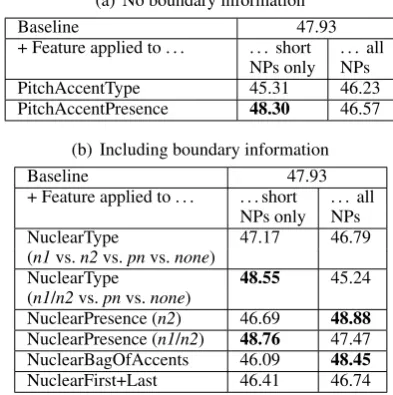
Table 3 shows the effect of the respective features which are not informed about intonation bound-aries (Table 3a) and those that are (Table 3b). Fea-tures that achieved a significant improvement over the baseline are marked in boldface.10
The best-performing feature in Table 3a is the presence of a pitch accent in short NPs. It can be seen that this feature has a negative effect when be-ing applied on all NPs. Presumably, this is because the system is misled to classify a higher number of complex anaphoric expressions as non-anaphoric, due to the presence of pitch accents. This confirms our conjecture that long NPs will always contain
somekind of accent and we cannot distinguish
nu-6http://stel.ub.edu/semeval2010-coref/ 7Using the official CoNLL scorer v8.01, including single-tons as they are part of T¨uBa 8
8Using the official CoNLL scorer v8.01, not including singletons as T¨uBa 9 does not contain them.
9CorZu performance: Don Tuggener,
personal communication. We did not use CorZu for our ex-periments as the integration of prosodic information in a rule-based system is non-trivial.
10We compute significance using the Wilcoxon signed rank test (Siegel and Castellan, 1988) at the 0.01 level.
(a) No boundary information
Baseline 47.93
+ Feature applied to . . . short . . . all NPs only NPs
PitchAccentType 45.31 46.23
PitchAccentPresence 48.30 46.57 (b) Including boundary information
Baseline 47.93
+ Feature applied to . . . short . . . all NPs only NPs
NuclearType 47.17 46.79
(n1vs.n2vs.pnvs.none)
NuclearType 48.55 45.24
(n1/n2vs.pnvs.none)
NuclearPresence (n2) 46.69 48.88
NuclearPresence (n1/n2) 48.76 47.47 NuclearBagOfAccents 46.09 48.45
NuclearFirst+Last 46.41 46.74
Table 3: CoNLL metric scores on DIRNDL for different prosodic features (no singletons, signifi-cant results in boldface)
clear from prenuclear accents. Features based on GToBI(S) accent type did not result in any im-provements.
Table 3b presents the performance of the fea-tures that are phonologically more informed. Dis-tinguishing between prenuclear and nuclear ac-cents (NuclearType) is a feature that works best for short NPs where there is only one accent, while having a negative effect on all NPs. Nuclear pres-ence, however, works well for both versions (not distinguishing between n1 orn2 works for short NPs whilen2accents only works best for all NPs). This feature achieves the overall best performance for both short NPs (48.76) and all NPs (48.88).
The NuclearBagOfAccents feature works quite well, too: this is a feature designed for NPs that have more than one accent and so it works best for complex NPs. Combining the features did not lead to any improvements.
sug-gest that simpler features (like the presence or ab-sence of a certain type of pitch accent) work best for simple (i.e. short) phrases. For longer mark-ables this effect turns into the negative. This prob-ably means that simple features cannot do justice to the complex prosody of longer NPs, which gets blurred. The obvious solution is to define more complex features that approximate the rhythmic pattern (or even the prosodic contour) found on longer phrases, which however will require more data and, ideally, automatic prosodic annotation.
5 Conclusion
We have tested a set of features that include dif-ferent levels of prosodic information and investi-gated which strategies can be successfully applied for coreference resolution. Our results on the basis of manual prosodic labelling show that including prosody improves performance. While informa-tion on pitch accent types does not seem benefi-cial, the presence of an accent is a helpful feature in a machine-learning setting. Including prosodic boundaries and determining whether the accent is the nuclear accent further increases results. We in-terpret this as a promising result, which motivates further research on the integration of coreference resolution and spoken language.
Acknowledgements
We would like to thank Anders Bj¨orkelund for his valuable comments on an earlier version of this paper, as well as Kerstin Eckart for her help with the preparation of DIRNDL data. This work was funded by the German Science Foundation (DFG), Sonderforschungsbereich 732Incremental Speci-fication in Context, Project A6, at the University of Stuttgart.
References
Marilisa Amoia, Kerstin Kunz, and Ekaterina Lapshinova-Koltunski. 2012. Coreference in spoken vs. written texts: a corpus-based analysis. In
Proceedings of LREC, Istanbul.
Stefan Baumann and Arndt Riester. 2012. Referen-tial and Lexical Givenness: semantic, prosodic and cognitive aspects. In Gorka Elordieta and Pilar Pri-eto, editors,Prosody and Meaning, pages 119–162. Mouton de Gruyter, Berlin.
Stefan Baumann and Arndt Riester. 2013. Corefer-ence, Lexical Givenness and Prosody in German.
Lingua, 136:16–37.
Stefan Baumann and Anna Roth. 2014. Prominence and coreference – On the perceptual relevance of F0 movement, duration and intensity. InProceedings of Speech Prosody, pages 227–231, Dublin. Stefan Baumann, Christine R¨ohr, and Martine Grice.
2015. Prosodische (De-)Kodierung des Informa-tionsstatus im Deutschen. Zeitschrift f¨ur Sprachwis-senschaft, 34(1):1–42.
Mary Beckman, Julia Hirschberg, and Stefanie Shattuck-Hufnagel. 2005. The original ToBI system and the evolution of the ToBI framework. In Sun-Ah Jun, editor, Prosodic Typology – The Phonology of Intonation and Phrasing, pages 9–54. Oxford University Press.
Anders Bj¨orkelund and Jonas Kuhn. 2014. Learn-ing structured perceptrons for coreference resolution with latent antecedents and non-local features. In
Proceedings of the 52nd Annual Meeting of the As-sociation for Computational Linguistics (Volume 1: Long Papers), pages 47–57, Baltimore.
Anders Bj¨orkelund, Kerstin Eckart, Arndt Riester, Nadja Schauffler, and Katrin Schweitzer. 2014. The extended DIRNDL corpus as a resource for auto-matic coreference and bridging resolution. In Pro-ceedings of LREC, pages 3222–3228, Reykjav´ık. Aoife Cahill and Arndt Riester. 2012. Automatically
Acquiring Fine-Grained Information Status Distinc-tions. In Proceedings of the 13th Annual SIGdial Meeting on Discourse and Dialog, pages 232–236, Seoul.
Alan Cruttenden. 2006. The de-accenting of given information: a cognitive universal? In Giuliano Bernini and Marcia Schwartz, editors, Pragmatic Organization of Discourse in the Languages of Eu-rope, pages 311–355. De Gruyter, Berlin.
Kerstin Eckart, Arndt Riester, and Katrin Schweitzer. 2012. A Discourse Information Radio News Database for Linguistic Analysis. In Sebas-tian Nordhoff ChrisSebas-tian Chiarcos and SebasSebas-tian Hellmann, editors,Linked Data in Linguistics: Rep-resenting and Connecting Language Data and Lan-guage Metadata, pages 65–76. Springer.
Caroline F´ery. 1993. German Intonational Patterns. Niemeyer, T¨ubingen.
Carlos Gussenhoven. 1984. On the Grammar and Se-mantics of Sentence Accents. Foris, Dordrecht. Manfred Klenner and Don Tuggener. 2011. An
in-cremental entity-mention model for coreference res-olution with restrictive antecedent accessibility. In
Proceedings of RANLP, pages 178–185, Hissar, Bul-garia.
D. Robert Ladd. 2008. Intonational Phonology (2nd
ed.). Cambridge University Press.
Karin Naumann. 2006. Manual for the annotation of in-document referential relations. University of T¨ubingen.
Vincent Ng. 2010. Supervised noun phrase corefer-ence research: The first fifteen years. In Proceed-ings of the 48th Annual Meeting of the Association for Computational Linguistics, pages 1396–1411. Janet Pierrehumbert. 1980. The Phonology and
Pho-netics of English Intonation. Ph.D. thesis, Mas-sachusetts Institute of Technology.
Sameer Pradhan, Alessandro Moschitti, Nianwen Xue, Olga Uryupina, and Yuchen Zhang. 2012. Conll-2012 shared task: Modeling multilingual unre-stricted coreference in ontonotes. In Joint Confer-ence on EMNLP and CoNLL-Shared Task, pages 1– 40. Association for Computational Linguistics. Altaf Rahman and Vincent Ng. 2012. Learning the
fine-grained information status of discourse entities. InProceedings of the 13th Conference of the Euro-pean Chapter of the Association for Computational Linguistics, pages 798–807. Association for Com-putational Linguistics.
Marta Recasens, Llu´ıs M`arquez, Emili Sapena, M. Ant`onia Mart´ı, Mariona Taul´e, V´eronique Hoste, Massimo Poesio, and Yannick Versley. 2010. Semeval-2010 task 1: Coreference resolution in multiple languages. In Proceedings of the 5th In-ternational Workshop on Semantic Evaluation, Se-mEval ’10, pages 1–8, Stroudsburg, PA, USA. Roger Schwarzschild. 1999. GIVENness, AvoidF, and
Other Constraints on the Placement of Accent. Nat-ural Language Semantics, 7(2):141–177.
Michael Strube and Christoph M¨uller. 2003. A ma-chine learning approach to pronoun resolution in spoken dialogue. InProceedings of the 41st Annual Meeting on Association for Computational Linguis-tics, pages 168–175.
Jacques Terken and Julia Hirschberg. 1994. Deaccen-tuation of words representing ’given’ information: Effects of persistence of grammatical function and surface position. Language and Speech, 37(2):125– 145.
Joel Tetreault and James Allen. 2004. Dialogue struc-ture and pronoun resolution. InProceedings of the 5th Discourse Anaphora and Anaphor Resolution Colloquium, S. Miguel, Portugal.
Don Tuggener and Manfred Klenner. 2014. A hybrid entity-mention pronoun resolution model for ger-man using markov logic networks. InProceedings of KONVENS 2014, pages 21–29.