Using Discourse Structure Improves Machine Translation Evaluation
Francisco Guzm´an Shafiq Joty Llu´ıs M`arquez and Preslav Nakov
ALT Research Group
Qatar Computing Research Institute — Qatar Foundation {fguzman,sjoty,lmarquez,pnakov}@qf.org.qa
Abstract
We present experiments in using dis-course structure for improving machine translation evaluation. We first design two discourse-aware similarity measures, which use all-subtree kernels to compare discourse parse trees in accordance with the Rhetorical Structure Theory. Then, we show that these measures can help improve a number of existing machine translation evaluation metrics both at the segment- and at the system-level. Rather than proposing a single new metric, we show that discourse information is com-plementary to the state-of-the-art evalu-ation metrics, and thus should be taken into account in the development of future richer evaluation metrics.
1 Introduction
From its foundations, Statistical Machine Transla-tion (SMT) had two defining characteristics: first, translation was modeled as a generative processat the sentence-level. Second, it was purely statisti-cal over words or word sequences and made lit-tle to no use of linguistic information. Although modern SMT systems have switched to a discrim-inative log-linear framework, which allows for ad-ditional sources as features, it is generally hard to incorporate dependencies beyond a small window of adjacent words, thus making it difficult to use linguistically-rich models.
Recently, there have been two promising re-search directions for improving SMT and its eval-uation: (a) by using more structured linguistic information, such as syntax (Galley et al., 2004; Quirk et al., 2005), hierarchical structures (Chi-ang, 2005), and semantic roles (Wu and Fung, 2009; Lo et al., 2012), and (b) by going beyond the sentence-level, e.g., translating at the docu-ment level (Hardmeier et al., 2012).
Going beyond the sentence-level is important since sentences rarely stand on their own in a well-written text. Rather, each sentence follows smoothly from the ones before it, and leads into the ones that come afterwards. The logical rela-tionship between sentences carries important in-formation that allows the text to express a meaning as a whole beyond the sum of its separate parts.
Note that sentences can be made of several clauses, which in turn can be interrelated through the same logical relations. Thus, in a coherent text, discourse units (sentences or clauses) are logically connected: the meaning of a unit relates to that of the previous and the following units.
Discourse analysis seeks to uncover this coher-ence structure underneath the text. Several formal theories of discourse have been proposed to de-scribe the coherence structure (Mann and Thomp-son, 1988; Asher and Lascarides, 2003; Webber, 2004). For example, the Rhetorical Structure The-ory (Mann and Thompson, 1988), or RST, repre-sents text by labeled hierarchical structures called Discourse Trees (DTs), which can incorporate sev-eral layers of other linguistic information, e.g., syntax, predicate-argument structure, etc.
Modeling discourse brings together the above research directions (a) and (b), which makes it an attractive goal for MT. This is demonstrated by the establishment of a recent workshop dedicated to Discourse in Machine Translation (Webber et al., 2013), collocated with the 2013 annual meeting of the Association of Computational Linguistics.
The area of discourse analysis for SMT is still nascent and, to the best of our knowledge, no previous research has attempted to use rhetorical structure for SMT or machine translation evalua-tion. One possible reason could be the unavailabil-ity of accurate discourse parsers. However, this situation is likely to change given the most recent advances in automatic discourse analysis (Joty et al., 2012; Joty et al., 2013).
We believe that the semantic and pragmatic in-formation captured in the form of DTs (i) can help develop discourse-aware SMT systems that pro-duce coherent translations, and (ii) can yield bet-ter MT evaluation metrics. While in this work we focus on the latter, we think that the former is also within reach, and that SMT systems would bene-fit from preserving the coherence relations in the source language when generating target-language translations.
In this paper, rather than proposing yet another MT evaluation metric, we show that discourse information is complementary to many existing evaluation metrics, and thus should not be ignored. We first design two discourse-aware similarity measures, which use DTs generated by a publicly-available discourse parser (Joty et al., 2012); then, we show that they can help improve a number of MT evaluation metrics at the segment- and at the system-level in the context of the WMT11 and the WMT12 metrics shared tasks (Callison-Burch et al., 2011; Callison-Burch et al., 2012).
These metrics tasks are based on sentence-level evaluation, which arguably can limit the benefits of using global discourse properties. Fortunately, several sentences are long and complex enough to present rich discourse structures connecting their basic clauses. Thus, although limited, this setting is able to demonstrate the potential of discourse-level information for MT evaluation. Furthermore, sentence-level scoring (i) is compatible with most translation systems, which work on a sentence-by-sentence basis, (ii) could be beneficial to mod-ern MT tuning mechanisms such as PRO (Hop-kins and May, 2011) and MIRA (Watanabe et al., 2007; Chiang et al., 2008), which also work at the sentence-level, and (iii) could be used for re-rankingn-best lists of translation hypotheses.
2 Related Work
Addressing discourse-level phenomena in ma-chine translation is relatively new as a research di-rection. Some recent work has looked at anaphora resolution (Hardmeier and Federico, 2010) and discourse connectives (Cartoni et al., 2011; Meyer, 2011), to mention two examples.1 However, so
far the attempts to incorporate discourse-related knowledge in MT have been only moderately suc-cessful, at best.
1We refer the reader to (Hardmeier, 2012) for an in-depth overview of discourse-related research for MT.
A common argument, is that current automatic evaluation metrics such as BLEU are inadequate to capture discourse-related aspects of translation quality (Hardmeier and Federico, 2010; Meyer et al., 2012). Thus, there is consensus that discourse-informed MT evaluation metrics are needed in or-der to advance research in this direction. Here we suggest some simple ways to create such metrics, and we also show that they yield better correlation with human judgments.
The field of automatic evaluation metrics for MT is very active, and new metrics are contin-uously being proposed, especially in the context of the evaluation campaigns that run as part of the Workshops on Statistical Machine Transla-tion (WMT 2008-2012), and NIST Metrics for Machine Translation Challenge (MetricsMATR), among others. For example, at WMT12, 12 met-rics were compared (Callison-Burch et al., 2012), most of them new.
There have been several attempts to incorpo-rate syntactic and semantic linguistic knowledge into MT evaluation. For instance, at the syn-tactic level, we find metrics that measure the structural similarity between shallow syntactic se-quences (Gim´enez and M`arquez, 2007; Popovic and Ney, 2007) or between constituency trees (Liu and Gildea, 2005). In the semantic case, there are metrics that exploit the similarity over named en-tities and predicate-argument structures (Gim´enez and M`arquez, 2007; Lo et al., 2012).
In this work, instead of proposing a new metric, we focus on enriching current MT evaluation met-rics with discourse information. Our experiments show that many existing metrics can benefit from additional knowledge about discourse structure.
Compared to the previous work, (i) we use a different discourse representation (RST), (ii) we compare discourse parses using all-subtree ker-nels (Collins and Duffy, 2001), (iii) we evaluate on much larger datasets, for several language pairs and for multiple metrics, and (iv) we do demon-strate better correlation with human judgments.
Wong and Kit (2012) recently proposed an extension of MT metrics with a measure of document-level lexical cohesion (Halliday and Hasan, 1976). Lexical cohesion is achieved using word repetitions and semantically similar words such as synonyms, hypernyms, and hyponyms. For BLEU and TER, they observed improved correlation with human judgments on the MTC4 dataset when linearly interpolating these metrics with their lexical cohesion score. Unlike their work, which measures lexical cohesion at the document-level, here we are concerned with co-herence (rhetorical) structure, primarily at the sentence-level.
3 Our Discourse-Based Measures
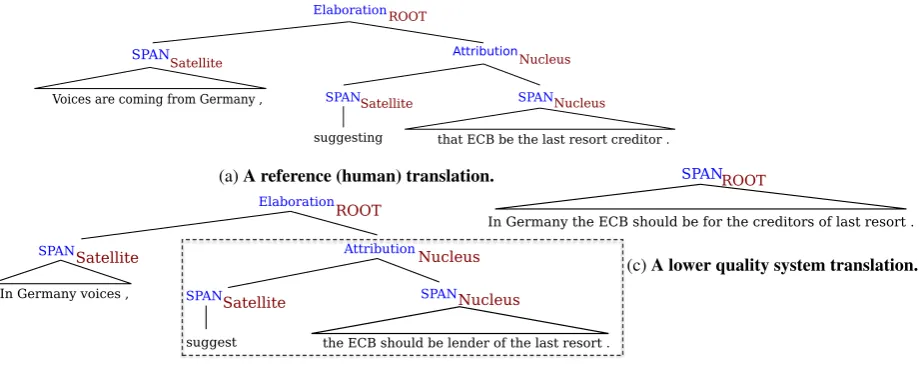
Our working hypothesis is that the similarity be-tween the discourse structures of an automatic and of a reference translation provides additional in-formation that can be valuable for evaluating MT systems. In particular, we believe that good trans-lations should tend to preserve discourse retrans-lations. As an example, consider the three discourse trees (DTs) shown in Figure 1: (a) for a reference (human) translation, and (b) and (c) for transla-tions of two different systems on the WMT12 test dataset. The leaves of a DT correspond to con-tiguous atomic text spans, calledElementary Dis-course Units or EDUs (three in Figure 1a). Ad-jacent spans are connected by certain coherence relations (e.g.,Elaboration,Attribution), forming larger discourse units, which in turn are also sub-ject to this relation linking. Discourse units linked by a relation are further distinguished based on their relative importance in the text: nuclei are the core parts of the relation while satellites are supportive ones. Note that the nuclearity and re-lation labels in the reference transre-lation are also realized in the system translation in (b), but not in (c), which makes (b) a better translation com-pared to (c), according to our hypothesis. We ar-gue that existing metrics that only use lexical and syntactic information cannot distinguish well be-tween (b) and (c).
In order to develop a discourse-aware evalua-tion metric, we first generate discourse trees for the reference and the system-translated sentences using a discourse parser, and then we measure the similarity between the two discourse trees. We de-scribe these two steps below.
3.1 Generating Discourse Trees
In Rhetorical Structure Theory, discourse analysis involves two subtasks: (i)discourse segmentation, or breaking the text into a sequence of EDUs, and (ii) discourse parsing, or the task of linking the units (EDUs and larger discourse units) into la-beled discourse trees. Recently, Joty et al. (2012) proposed discriminative models for both discourse segmentation and discourse parsing at the stence level. The segmenter uses a maximum en-tropy model that achieves state-of-the-art accuracy on this task, having anF1-score of 90.5%, while
human agreement is98.3%.
The discourse parser uses a dynamic Condi-tional Random Field (Sutton et al., 2007) as a pars-ing model in order to infer the probability of all possible discourse tree constituents. The inferred (posterior) probabilities are then used in a proba-bilistic CKY-like bottom-up parsing algorithm to find the most likely DT. Using the standard set of 18 coarse-grained relations defined in (Carlson and Marcu, 2001), the parser achieved anF1-score
of 79.8%, which is very close to the human agree-ment of 83%. These high scores allowed us to de-velop successful discourse similarity metrics.2
3.2 Measuring Similarity
A number of metrics have been proposed to mea-sure the similarity between two labeled trees, e.g., Tree Edit Distance (Tai, 1979) and Tree Kernels (Collins and Duffy, 2001; Moschitti and Basili, 2006). Tree kernels (TKs) provide an effective way to integrate arbitrary tree structures in kernel-based machine learning algorithms like SVMs.
In the present work, we use the convolution TK defined in (Collins and Duffy, 2001), which effi-ciently calculates the number of common subtrees in two trees. Note that this kernel was originally designed for syntactic parsing, where the subtrees are subject to the constraint that their nodes are taken with either all or none of the children. This constraint of the TK imposes some limitations on the type of substructures that can be compared.
ElaborationROOT
SPANSatellite AttributionNucleus
Voices are coming from Germany , SPANSatellite SPANNucleus
suggesting that ECB be the last resort creditor .
(a)A reference (human) translation.
(b)A higher quality system translation.
SPANROOT
In Germany the ECB should be for the creditors of last resort .
[image:4.595.75.535.65.251.2](c)A lower quality system translation.
Figure 1: Example of three different discourse trees for the translations of a source sentence. (a) The reference, (b) A higher quality translation, (c) A lower quality translation.
One way to cope with the limitations of the TK is to change the representation of the trees to a form that is suitable to capture the relevant infor-mation for our task. We experiment with TKs ap-plied to two different representations of the dis-course tree: non-lexicalized (DR), and lexicalized (DR-LEX). In Figure 2 we show the two represen-tations for the subtree that spans the text: “sug-gest the ECB should be the lender of last resort”, which is highlighted in Figure 1b.
As shown in Figure 2a, DR does not include any lexical item, and therefore measures the similar-ity between two translations in terms of their dis-course structures only. On the contrary, DR-LEX includes the lexical items to account for lexical matching; moreover, it separates the structure (the skeleton) of the tree from its labels, i.e. the nucle-arity and the relations, in order to allow the tree kernel to give partial credit to subtrees that differ in labels but match in their skeletons. More specif-ically, it uses the tags SPAN and EDU to build the skeleton of the tree, and considers the nuclearity and/or the relation labels as properties, added as children, of these tags.
For example, a SPAN has two properties (its nuclearity and its relation), and an EDU has one property (its nuclearity). The words of an EDU are placed under the predefined children NGRAM. In order to allow the tree kernel to find subtree matches at the word level, we include an additional layer ofdummyleaves as was done in (Moschitti et al., 2007); not shown in Figure 2, for simplicity.
4 Experimental Setup
In our experiments, we used the data available for the WMT12 and the WMT11 metrics shared tasks for translations into English.3 This included the
output from the systems that participated in the WMT12 and the WMT11 MT evaluation cam-paigns, both consisting of 3,003 sentences, for four different language pairs: Czech-English (CS -EN), French-English (FR-EN), German-English (DE-EN), and Spanish-English (ES-EN); as well as a dataset with the English references.
We measured the correlation of the metrics with the human judgments provided by the organizers. The judgments represent rankings of the output of five systems chosen at random, for a particu-lar sentence, also chosen at random. Note that each judgment effectively constitutes 10 pairwise system rankings. The overall coverage, i.e. the number of unique sentences that were evaluated, was only a fraction of the total; the total number of judgments, along with other information of the datasets are shown in Table 1.
4.1 MT Evaluation Metrics
In this study, we evaluate to what extent existing evaluation metrics can benefit from additional dis-course information. To do so, we contrast different MT evaluation metrics with and without discourse information. The evaluation metrics we used are described below.
Attribution
SPANSatellite SPAN Nucleus
Nucleus
(a) DT for DR
SPAN
EDU EDU
NUC NGRAM NUC NGRAM
Satellite suggest Nucleus the ECB should be lender of the last resort . NUC
Nucleus
REL
Attribution
[image:5.595.77.520.65.173.2](b) DT for DR-LEX
Figure 2: Two different DT representations for the highlighted subtree shown in Figure 1b.
WMT12 WMT11
systs ranks sents judges systs ranks sents judges
CS-EN 6 1,294 951 45 8 498 171 20 DE-EN 16 1,427 975 47 20 924 303 31
ES-EN 12 1,141 923 45 15 570 207 18
FR-EN 15 1,395 949 44 18 708 249 32 Table 1: Number of systems (systs), judgments (ranks), unique sentences (sents), and different judges (judges) for the different language pairs, for the human evaluation of the WMT12 and WMT11 shared tasks.
Metrics from WMT12. We used the publicly available scores for all metrics that participated in the WMT12 metrics task (Callison-Burch et al., 2012): SPEDE07PP, AMBER, METEOR, TERRORCAT, SIMPBLEU, XENERRCATS, WORDBLOCKEC, BLOCKERRCATS, andPOSF.
Metrics fromASIYA. We used the freely avail-able version of the ASIYA toolkit4in order to ex-tend the set of evaluation measures contrasted in this study beyond those from the WMT12 metrics task. ASIYA (Gim´enez and M`arquez, 2010a) is a suite for MT evaluation that provides a large set of metrics that use different levels of linguistic infor-mation. For reproducibility, below we explain the individual metrics with the exact names required by the toolkit to calculate them.
First, we used ASIYA’s ULC (Gim´enez and M`arquez, 2010b), which was the best performing metric at the system and the segment levels at the WMT08 and WMT09 metrics tasks. This is a uni-form linear combination of 12 individual metrics. From the original ULC, we only replaced TER and Meteor individual metrics by newer versions tak-ing into account synonymy lookup and paraphras-ing: TERp-A and METEOR-pa in ASIYA’s termi-nology. We will call this combined metric Asiya-0809 in our experiments.
4http://nlp.lsi.upc.edu/asiya/
To complement the set of individual metrics that participated at the WMT12 metrics task, we also computed the scores of other commonly-used evaluation metrics: BLEU (Papineni et al., 2002), NIST (Doddington, 2002), TER (Snover et al., 2006), ROUGE-W (Lin, 2004), and three METEOR variants (Denkowski and Lavie, 2011): METEOR-ex (exact match), METEOR-st (+stem-ming) and METEOR-sy (+synonyms). The uni-form linear combination of the previous 7 indi-vidual metrics plus the 12 from Asiya-0809 is re-ported as Asiya-ALLin the experimental section.
The individual metrics combined in Asiya-ALL can be naturally categorized according to the type of linguistic information they use to compute the quality scores. We grouped them in the follow-ing four families and calculated the uniform linear combination of the metrics in each group:5
1. Asiya-LEX. Combination of five metrics based on lexical similarity: BLEU, NIST, METEOR-ex, ROUGE-W, and TERp-A. 2. Asiya-SYN. Combination of four
met-rics ba-sed on syntactic information from constituency and dependency parse trees:
‘CP-STM-4’, ‘DP-HWCM c-4’,
‘DP-HWCM r-4’, and ‘DP-Or(*)’.
3. Asiya-SRL. Combination of three metric variants based on predicate argument struc-tures (semantic role labeling): ‘SR-Mr(*)’, ‘SR-Or(*)’, and ‘SR-Or’.
4. Asiya-SEM. Combination of two metrics variants based on semantic parsing:6
‘DR-Or(*)’ and ‘DR-Orp(*)’.
[image:5.595.75.288.209.276.2]All uniform linear combinations are calculated outside ASIYA. In order to make the scores of the different metrics comparable, we performed a
min–max normalization, for each metric, and for each language pair combination.
4.2 Human Judgements and Learning
The human-annotated data from the WMT cam-paigns encompasses series of rankings on the out-put of different MT systems for every source sen-tence. Annotators rank the output of five systems according to perceived translation quality. The or-ganizers relied on a random selection of systems, and a large number of comparisons between pairs of them, to make comparisons across systems fea-sible (Callison-Burch et al., 2012). As a result, for each source sentence, only relative rankings were available. As in the WMT12 experimen-tal setup, we use these rankings to calculate cor-relation with human judgments at the sentence-level, i.e. Kendall’s Tau; see (Callison-Burch et al., 2012) for details.
For the experiments reported in Section 5.4, we used pairwise rankings to discriminatively learn the weights of the linear combinations of indi-vidual metrics. In order to use the WMT12 data for training a learning-to-rank model, we trans-formed the five-way relative rankings into ten pairwise comparisons. For instance, if a judge ranked the output of systems A, B, C, D, E
as A > B > C > D > E, this would entail that
A > B,A > C,A > DandA > E, etc.
To determine the relative weights for the tuned combinations, we followed a similar approach to the one used by PRO to tune the relative weights of the components of a log-linear SMT model (Hop-kins and May, 2011), also using Maximum En-tropy as the base learning algorithm. Unlike PRO, (i) we usehuman judgments, not automatic scores, and (ii) we train onall pairs, not on a sub-sample.
5 Experimental Results
In this section, we explore how discourse informa-tion can be used to improve machine translainforma-tion evaluation metrics. Below we present the evalua-tion results at the system- and segment-level, using our two basic metrics on discourse trees (Section 3.1), which are referred to as DR and DR-LEX.
5.1 Evaluation
In our experiments, we only consider translation into English, and use the data described in Table 1. For evaluation, we follow the setup of the metrics task of WMT12 (Callison-Burch et al., 2012): at the system-level, we use the official script from WMT12 to calculate the Spearman’s correlation, where higherabsolutevalues indicate better met-rics performance; at the segment-level, we use Kendall’s Tau for measuring correlation, where negative values are worse than positive ones.7
In our experiments, we combine DR and DR-LEX to other metrics in two different ways: using uniform linear interpolation (at system- and segment-level), and using a tuned linear interpo-lation for the segment-level. We only present the average results over all four language pairs. For simplicity, in our tables we show results divided into evaluation groups:
1. Group I: contains our evaluation metrics, DR and DR-LEX.
2. Group II: includes the metrics that partici-pated in the WMT12 metrics task, excluding metrics which did not have results for all lan-guage pairs.
3. Group III: contains other important evalu-ation metrics, which were not considered in the WMT12 metrics task: NIST and ROUGE for both system- and segment-level, and BLEU and TER at segment-level.
4. Group IV: includes the metric combinations calculated with ASIYAand described in Sec-tion 4.
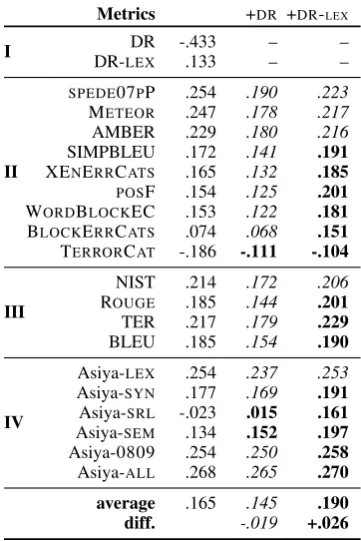
For each metric in groups II, III and IV, we present the results for the original metric as well for the linear interpolation of that metric with DR and with DR-LEX. The combinations with DR and DR-LEX that improve over the original met-rics are shown inbold, and those that degrade are initalic. Furthermore, we also present overall re-sults for: (i) the average score over all metrics, ex-cluding DR and DR-LEX, and (ii) the differences in the correlations for the DR/DR-LEX-combined and the original metrics.
Metrics +DR +DR-LEX
I DR-LEXDR .807.876 –– ––
II
SEMPOS .902 .853 .903
AMBER .857 .829 .869
METEOR .834 .861 .888
TERRORCAT .831 .854 .889
SIMPBLEU .823 .826 .859
TER .812 .836 .848
BLEU .810 .830 .846
POSF .754 .841 .857
BLOCKERRCATS .751 .859 .855
WORDBLOCKEC .738 .822 .843
XENERRCATS .735 .819 .843 III ROUGENIST .817.884 .842.899 .875.869
IV
Asiya-LEX .879 .881 .882
Asiya-SYN .891 .913 .883
Asiya-SRL .917 .911 .909
Asiya-SEM .891 .889 .886
Asiya-0809 .905 .914 .905 Asiya-ALL .899 .907 .896
average .839 .862 .874
[image:7.595.325.506.60.331.2]diff. +.024 +.035
Table 2: Results on WMT12 at the system-level. Spearman’s correlation with human judgments.
[image:7.595.91.272.61.332.2]5.2 System-level Results
Table 2 shows the system-level experimental re-sults for WMT12. We can see that DR is already competitive by itself: on average, it has a cor-relation of .807, very close to BLEU and TER scores (.810 and .812, respectively). Moreover, DR yields improvements when combined with 15 of the 19 metrics; worsening only four of the met-rics. Overall, we observe an average improvement of +.024, in the correlation with the human judg-ments. This suggests that DR contains information that is complementary to that used by the other metrics. Note that this is true both for the indi-vidual metrics from groups II and III, as well as for the metric combinations in group IV. Combi-nations in the last group involve several metrics that already use linguistic information at different levels and are hard to improve over; yet, adding DR does improve, which shows that it has some complementary information to offer.
As expected, DR-LEXperforms better than DR since it is lexicalized (at the unigram level), and also gives partial credit to correct structures. Indi-vidually, DR-LEXoutperforms most of the metrics from group II, and ranks as the second best metric in that group. Furthermore, when combined with individual metrics in group II, DR-LEXis able to improve consistently over each one of them.
Metrics +DR +DR-LEX
I DR-LEXDR -.433.133 –– ––
II
SPEDE07PP .254 .190 .223
METEOR .247 .178 .217
AMBER .229 .180 .216 SIMPBLEU .172 .141 .191
XENERRCATS .165 .132 .185
POSF .154 .125 .201
WORDBLOCKEC .153 .122 .181
BLOCKERRCATS .074 .068 .151
TERRORCAT -.186 -.111 -.104
III
NIST .214 .172 .206 ROUGE .185 .144 .201
TER .217 .179 .229
BLEU .185 .154 .190
IV
Asiya-LEX .254 .237 .253 Asiya-SYN .177 .169 .191
Asiya-SRL -.023 .015 .161
Asiya-SEM .134 .152 .197
Asiya-0809 .254 .250 .258
Asiya-ALL .268 .265 .270
average .165 .145 .190
diff. -.019 +.026
Table 3: Results on WMT12 at the segment-level. Kendall’s Tau with human judgments.
Note that, even though DR-LEXhas better indi-vidual performance than DR, it does not yield im-provements when combined with most of the met-rics in group IV.8However, over all metrics and all
language pairs, DR-LEXis able to obtain an aver-age improvement in correlation of +.035, which is remarkably higher than that of DR. Thus, we can conclude that at the system-level, adding discourse information to a metric, even using the simplest of the combination schemes, is a good idea for most of the metrics, and can help to significantly im-prove the correlation with human judgments.
5.3 Segment-level Results: Non-tuned
Table 3 shows the results for WMT12 at the segment-level. We can see that DR performs badly, with a high negative Kendall’s Tau of -.433. This should not be surprising: (a) the discourse tree structure alone does not contain enough infor-mation for a good evaluation at the segment-level, and (b) this metric is more sensitive to the quality of the DT, which can be wrong or void.
8In this work, we have not investigated the reasons behind this phenomenon. We speculate that this might be caused by the fact that the lexical information in DR-LEX is
[image:7.595.92.269.65.332.2]Tuned
Metrics Orig. +DR +DR-LEX
I DR-LEXDR -.433.133 –– –– ––
II
SPEDE07PP .254 – .253 .254
METEOR .247 – .250 .251
AMBER .229 – .230 .232
SIMPBLEU .172 – .181 .199
TERRORCAT -.186 – .181 .196
XENERRCATS .165 – .175 .194
POSF .154 – .160 .201
WORDBLOCKEC .153 – .161 .189
BLOCKERRCATS .074 – .087 .150
III
NIST .214 – .222 .224
ROUGE .185 – .196 .218
TER .217 – .229 .246
BLEU .185 – .189 .194
IV
Asiya-LEX .254 .266 .269 .270
Asiya-SYN .177 .229 .228 .232
Asiya-SRL -.023 -.004 .039 .181
Asiya-SEM .134 .146 .179 .202
Asiya-0809 .254 .295 .295 .295 Asiya-ALL .268 .296 .295 .295
average .165 .201 .222
diff. +.036 +.057
Table 4: Results on WMT12 at the segment-level: tuning with cross-validation on WMT12. Kendall’s Tau with human judgments.
Additionally, DR is more likely to produce a high number of ties, which is harshly penalized by WMT12’s definition of Kendall’s Tau. Con-versely, ties and incomplete discourse analysis were not a problem at the system-level, where ev-idence from all 3,003 test sentences is aggregated, and allows to rank systems more precisely. Due to the low score of DR as an individual metric, it fails to yield improvements when uniformly combined with other metrics.
Again, DR-LEXis better than DR; with a pos-itive Tau of +.133, yet as an individual metric, it ranks poorly compared to other metrics in group II. However, when linearly combined with other metrics, DR-LEX outperforms 14 of the 19 met-rics in Table 3. Across all metmet-rics, DR-LEXyields an average Tau improvement of +.026, i.e. from .165 to .190. This is a large improvement, taking into account that the combinations are just uniform linear combinations. In subsection 5.4, we present the results of tuning the linear combination in a discriminative way.
5.4 Segment-level Results: Tuned
We experimented with tuning the weights of the individual metrics in the metric combinations, us-ing the learnus-ing method described in Section 4.2.
First, we did this using cross-validation to tune and test on WMT12. Later we tuned on WMT12 and evaluated on WMT11. For cross-validation in WMT12, we used ten folds of approximately equal sizes, each containing about 300 sentences: we constructed the folds by putting together en-tire documents, thus not allowing sentences from a document to be split over two different folds. During each cross-validation run, we trained our pairwise ranker using the human judgments cor-responding to nine of the ten folds. We aggre-gated the data for different language pairs, and produced a single set of tuning weights for all lan-guage pairs.9 We then used the remaining fold for
evaluation
The results are shown in Table 4. As in previ-ous sections we present the average results over all four language pairs. We can see that the tuned combinations with DR-LEXimprove over most of the individual metrics in groups II and III. Inter-estingly, the tuned combinations that include the much weaker metric DR now improve over 12 out of 13 of the individual metrics in groups II and III, and only slightly degrades the score of the 13th one (SPEDE07PP).
Note that the ASIYA metrics are combinations of several metrics, and these combinations (which exclude DR and DR-LEX) can be also tuned; this yields sizable improvements over the untuned ver-sions as column three in the table shows. Com-pared to this baseline, DR improves for three of the six ASIYA metrics, while DR-LEX improves for four of them. Note that improving over the last two ASIYA metrics is very hard: they have very high scores of .296 and .295; for compar-ison, the best segment-level system at WMT12 (SPEDE07PP) achieved a Tau of .254.
On average, DR improves Tau from .165 to .201, which is +.036, while DR-LEX improves to .222, or +.057. These much larger improvements highlight the importance of tuning the linear com-bination when working at the segment-level.
5.4.1 Testing on WMT11
In order to rule out the possibility that the im-provement of the tuned metrics on WMT12 comes from over-fitting, and to verify that the tuned met-rics do generalize when applied to other sentences, we also tested on a new test set: WMT11.
[image:8.595.75.288.64.330.2]Therefore, we tuned the weights onallWMT12 pairwise judgments (no cross-validation), and we evaluated on WMT11. Since the metrics that par-ticipated in WMT11 and WMT12 are different (and even when they have the same name, there is no guarantee that they have not changed from 2011 to 2012), we only report results for the ver-sions of NIST, ROUGE, TER, and BLEU available in ASIYA, as well as for the ASIYAmetrics, thus ensuring that the metrics in the experiments are consistent for 2011 and 2012.
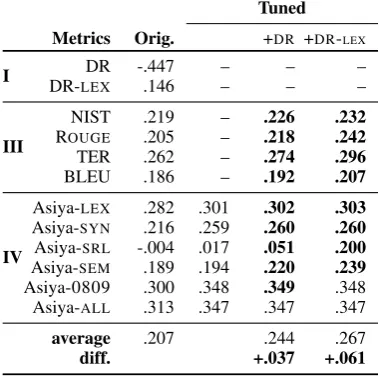
The results are shown in Table 5. Once again, tuning yields sizable improvements over the sim-ple combination for the ASIYAmetrics (third col-umn in Table 5). Adding DR and DR-LEX to the combinations manages to improve over five and four of the six tuned ASIYAmetrics, respectively. However, some of the differences are very small. On the contrary, DR and DR-LEXsignificantly im-prove over NIST, ROUGE, TER, and BLEU. Over-all, DR improves the average Tau from .207 to .244, which is +.037, while DR-LEXimproves to .267 or +.061. These improvements are very close to those for the WMT12 cross-validation. This shows that the weights learned on WMT12 gen-eralize well, as they are also good for WMT11.
What is also interesting to note is that when tun-ing is used, DR helps achieve sizeable improve-ments, even if not as strong as for DR-LEX. This is remarkable given that DR has a strong negative Tau as an individual metric at the sentence-level. This suggests that both DR and DR-LEX contain information that is complementary to that of the individual metrics that we experimented with.
Overall, from the experimental results in this section, we can conclude that discourse structure is an important information source to be taken into account in the automatic evaluation of machine translation output.
6 Conclusions and Future Work
In this paper we have shown that discourse struc-ture can be used to improve automatic MT evalua-tion. First, we defined two simple discourse-aware similarity metrics (lexicalized and un-lexicalized), which use the all-subtree kernel to compute sim-ilarity between discourse parse trees in accor-dance with the Rhetorical Structure Theory. Then, after extensive experimentation on WMT12 and WMT11 data, we showed that a variety of ex-isting evaluation metrics can benefit from our
Tuned
Metrics Orig. +DR +DR-LEX
I DR-LEXDR -.447.146 –– –– ––
III
NIST .219 – .226 .232
ROUGE .205 – .218 .242
TER .262 – .274 .296
BLEU .186 – .192 .207
IV
Asiya-LEX .282 .301 .302 .303
Asiya-SYN .216 .259 .260 .260
Asiya-SRL -.004 .017 .051 .200
Asiya-SEM .189 .194 .220 .239
Asiya-0809 .300 .348 .349 .348 Asiya-ALL .313 .347 .347 .347
average .207 .244 .267
[image:9.595.321.511.63.251.2]diff. +.037 +.061
Table 5: Results on WMT11 at the segment-level: tuning on the entire WMT12. Kendall’s Tau with human judgments.
discourse-based metrics, both at the segment- and the system-level, especially when the discourse in-formation is incorporated in an informed way (i.e. using supervised tuning). Our results show that discourse-based metrics can improve the state-of-the-art MT metrics, by increasing correlation with human judgments, even when only sentence-level discourse information is used.
Addressing discourse-level phenomena in MT is a relatively new research direction. Yet, many of the ongoing efforts have been moderately suc-cessful according to traditional evaluation met-rics. There is a consensus in the MT community that more discourse-aware metrics need to be pro-posed for this area to move forward. We believe this work is a valuable contribution towards this longer-term goal.
References
Nicholas Asher and Alex Lascarides, 2003. Logics of Conversation. Cambridge University Press.
Chris Callison-Burch, Philipp Koehn, Christof Monz, and Omar Zaidan. 2011. Findings of the 2011 workshop on statistical machine translation. In Pro-ceedings of the Sixth Workshop on Statistical Ma-chine Translation, pages 22–64, Edinburgh, Scot-land, July. ACL.
Chris Callison-Burch, Philipp Koehn, Christof Monz, Matt Post, Radu Soricut, and Lucia Specia. 2012. Findings of the 2012 workshop on statistical ma-chine translation. In Proceedings of the Seventh Workshop on Statistical Machine Translation, pages 10–51, Montr´eal, Canada, June. ACL.
Lynn Carlson and Daniel Marcu. 2001. Discourse Tag-ging Reference Manual. Technical Report ISI-TR-545, University of Southern California Information Sciences Institute.
Bruno Cartoni, Sandrine Zufferey, Thomas Meyer, and Andrei Popescu-Belis. 2011. How comparable are parallel corpora? measuring the distribution of gen-eral vocabulary and connectives. InProceedings of the 4th Workshop on Building and Using Compa-rable Corpora: CompaCompa-rable Corpora and the Web, pages 78–86, Portland, Oregon, June. ACL.
David Chiang, Yuval Marton, and Philip Resnik. 2008. Online large-margin training of syntactic and struc-tural translation features. InProceedings of the 2008 Conference on Empirical Methods in Natural Lan-guage Processing (EMNLP’08), Honolulu, Hawaii, USA.
David Chiang. 2005. A hierarchical phrase-based model for statistical machine translation. In Pro-ceedings of the 43rd Annual Meeting on Association for Computational Linguistics, ACL ’05, pages 263– 270, Ann Arbor, Michigan.
Michael Collins and Nigel Duffy. 2001. Convolution Kernels for Natural Language. InNeural Informa-tion Processing Systems, NIPS’01, pages 625–632, Vancouver, Canada.
Elisabet Comelles, Jes´us Gim´enez, Llu´ıs M`arquez, Irene Castell´on, and Victoria Arranz. 2010. Document-level automatic mt evaluation based on discourse representations. In Proceedings of the Joint Fifth Workshop on Statistical Machine Trans-lation and MetricsMATR, pages 333–338, Uppsala, Sweden, July. ACL.
Michael Denkowski and Alon Lavie. 2011. Meteor 1.3: Automatic metric for reliable optimization and evaluation of machine translation systems. In Pro-ceedings of the Sixth Workshop on Statistical Ma-chine Translation, pages 85–91, Edinburgh, Scot-land, July. ACL.
George Doddington. 2002. Automatic evaluation of machine translation quality using n-gram co-occurrence statistics. In Proceedings of the Sec-ond International Conference on Human Language Technology Research, HLT ’02, pages 138–145, San Francisco, CA, USA. Morgan Kaufmann Publishers Inc.
Michel Galley, Mark Hopkins, Kevin Knight, and Daniel Marcu. 2004. What’s in a translation rule? InProceedings of the 2004 Conference of the North American Chapter of the Association for Compu-tational Linguistics: Human Language Technology, HLT-NAACL, pages 273–280.
Jes´us Gim´enez and Llu´ıs M`arquez. 2007. Linguis-tic features for automaLinguis-tic evaluation of heterogenous MT systems. InProceedings of the Second Work-shop on Statistical Machine Translation, pages 256– 264, Prague, Czech Republic, June. ACL.
Jes´us Gim´enez and Llu´ıs M`arquez. 2009. On the ro-bustness of syntactic and semantic features for auto-matic MT evaluation. InProceedings of the Fourth Workshop on Statistical Machine Translation, pages 250–258, Athens, Greece, March. ACL.
Jes´us Gim´enez and Llu´ıs M`arquez. 2010a. Asiya: an Open Toolkit for Automatic Machine Translation (Meta-)Evaluation. The Prague Bulletin of Mathe-matical Linguistics, 94:77–86.
Jes´us Gim´enez and Llu´ıs M`arquez. 2010b. Linguistic Measures for Automatic Machine Translation Eval-uation. Machine Translation, 24(3–4):77–86.
Michael Halliday and Ruqaiya Hasan, 1976. Cohesion in English. Longman, London.
Christian Hardmeier and Marcello Federico. 2010. Modelling pronominal anaphora in statistical ma-chine translation. In Proceedings of the Interna-tional Workshop on Spoken Language Translation, pages 283–289.
Christian Hardmeier, Joakim Nivre, and J¨org Tiede-mann. 2012. Document-wide decoding for phrase-based statistical machine translation. In Proceed-ings of the 2012 Joint Conference on Empirical Methods in Natural Language Processing and Com-putational Natural Language Learning, EMNLP-CoNLL ’12, pages 1179–1190, Jeju Island, Korea. ACL.
Christian Hardmeier. 2012. Discourse in statistical machine translation. a survey and a case study. Dis-cours. Revue de linguistique, psycholinguistique et informatique, 11(8726).
Shafiq Joty, Giuseppe Carenini, and Raymond T. Ng. 2012. A Novel Discriminative Framework for Sentence-Level Discourse Analysis. InProceedings of the 2012 Joint Conference on Empirical Methods in Natural Language Processing and Computational Natural Language Learning, EMNLP-CoNLL ’12, pages 904–915, Jeju Island, Korea. ACL.
Shafiq Joty, Giuseppe Carenini, Raymond T. Ng, and Yashar Mehdad. 2013. Combining Intra- and Multi-sentential Rhetorical Parsing for Document-level Discourse Analysis. In Proceedings of the 51st Annual Meeting of the Association for Compu-tational Linguistics, ACL ’13, pages 486–496, Sofia, Bulgaria. ACL.
Hans Kamp and Uwe Reyle. 1993. From Discourse to Logic: Introduction to Model theoretic Semantics of Natural Language, Formal Logic and Discourse Representation Theory. Number 42 in Studies in Linguistics and Philosophy. Kluwer Academic Pub-lishers.
Chin-Yew Lin. 2004. ROUGE: A Package for Au-tomatic Evaluation of Summaries. InProceedings of Workshop on Text Summarization Branches Out, pages 74–81, Barcelona.
Ding Liu and Daniel Gildea. 2005. Syntactic fea-tures for evaluation of machine translation. In Pro-ceedings of the ACL Workshop on Intrinsic and Ex-trinsic Evaluation Measures for Machine Transla-tion and/or SummarizaTransla-tion, pages 25–32, Ann Ar-bor, Michigan, June. ACL.
Chi-kiu Lo, Anand Karthik Tumuluru, and Dekai Wu. 2012. Fully automatic semantic mt evaluation. In Proceedings of the Seventh Workshop on Statisti-cal Machine Translation, pages 243–252, Montr´eal, Canada, June. ACL.
William Mann and Sandra Thompson. 1988. Rhetor-ical Structure Theory: Toward a Functional Theory of Text Organization. Text, 8(3):243–281.
Thomas Meyer, Andrei Popescu-Belis, Najeh Hajlaoui, and Andrea Gesmundo. 2012. Machine translation of labeled discourse connectives. InProceedings of the Tenth Biennial Conference of the Association for Machine Translation in the Americas (AMTA). Thomas Meyer. 2011. Disambiguating
temporal-contrastive connectives for machine translation. In Proceedings of the ACL 2011 Student Session, pages 46–51, Portland, OR, USA, June. ACL.
Alessandro Moschitti and Roberto Basili. 2006. A Tree Kernel approach to Question and Answer Clas-sification in Question Answering Systems. In Pro-ceedings of the 5th international conference on Lan-guage Resources and Evaluation, Genoa, Italy. Alessandro Moschitti, Silvia Quarteroni, Roberto
Basili, and Suresh Manandhar. 2007. Exploiting Syntactic and Shallow Semantic Kernels for Ques-tion/Answer Classification. In Proceedings of the
ACL-2007, pages 776–783, Prague, Czech Repub-lic.
Kishore Papineni, Salim Roukos, Todd Ward, and Wei-Jing Zhu. 2002. BLEU: a method for automatic evaluation of machine translation. In Proceedings of the Association for Computational Linguistics (ACL’02), Philadelphia, PA, USA.
Maja Popovic and Hermann Ney. 2007. Word error rates: Decomposition over POS classes and applica-tions for error analysis. InProceedings of the Sec-ond Workshop on Statistical Machine Translation, pages 48–55, Prague, Czech Republic, June. ACL.
Chris Quirk, Arul Menezes, and Colin Cherry. 2005. Dependency treelet translation: Syntactically in-formed phrasal smt. In Proceedings of the 43rd Annual Meeting on Association for Computational Linguistics, ACL ’05, pages 271–279, Ann Arbor, Michigan.
Matthew Snover, Bonnie Dorr, Richard Schwartz, Lin-nea Micciulla, and John Makhoul. 2006. A study of translation edit rate with targeted human annotation. InProceedings of the 7th Biennial Conference of the Association for Machine Translation in the Ameri-cas, AMTA ’06, Cambridge, MA, USA.
Charles Sutton, Andrew McCallum, and Khashayar Rohanimanesh. 2007. Dynamic Conditional Ran-dom Fields: Factorized Probabilistic Models for La-beling and Segmenting Sequence Data. Journal of Machine Learning Research (JMLR), 8:693–723.
Kuo-Chung Tai. 1979. The tree-to-tree correction problem.Journal of the ACM, 26(3):422–433, July.
Taro Watanabe, Jun Suzuki, Hajime Tsukada, and Hideki Isozaki. 2007. Online large-margin training for statistical machine translation. In Proceedings of the 2007 Joint Conference on Empirical Methods in Natural Language Processing and Computational Natural Language Learning, EMNLP-CoNLL ’07, Prague, Czech Republic.
Bonnie Webber, Andrei Popescu-Belis, Katja Markert, and J¨org Tiedemann, editors. 2013. Proceedings of the Workshop on Discourse in Machine Translation. ACL, Sofia, Bulgaria, August.
Bonnie Webber. 2004. D-LTAG: Extending Lex-icalized TAG to Discourse. Cognitive Science, 28(5):751–779.