Engineering, 2010, 2, 1019-1025
doi:10.4236/eng.2010.212128 Published Online December 2010 (http://www.scirp.org/journal/eng)
Tool Wear Optimization for General CNC Turning
Using Fuzzy Deduction
Tian-Syung Lan
Department of Information Management, Yu Da University, Miaoli County, Taiwan, China E-mail: tslan@ydu.edu.tw
Received October 12,2010; revised November 9,2010; accepted November 6,2010
Abstract
Tool wear is frequently considered in the modern CNC (computer numerical control) turning industry. Most existing optimization researches for CNC finish turning were either accomplished within certain manufac-turing circumstances, or achieved through numerous equipment operations. Therefore, a general deduction optimization scheme proposed is deemed to be necessary for the industry. In this paper, four parameters (cut-ting depth, feed rate, speed, tool nose runoff) with three levels (low, medium, high) are considered to optim-ize the tool wear for finish turning based on 4
9
L (3 ) orthogonal array. Additionally, nine fuzzy control rules using triangle membership function with respective to five linguistic grades for tool wear are constructed. Considering four input and twenty output intervals, the defuzzification using center of gravity is then com-pleted and introduced as the S/N (signal-to-noise) ratio. Thus, the optimum general deduction parameters can then be received. The confirmation experiment for optimum general deduction parameters is furthermore performed on an ECOCA-3807 CNC lathe. It is shown that the tool wear ratio from the fuzzy deduction op-timization parameters is significantly advanced comparing to those from benchmark. This paper not only proposes a general deduction optimization scheme using orthogonal array, but also contributes the satisfac-tory fuzzy linguistic approach to tool wear in CNC turning with profound insight.
Keywords:CNC, General Optimization, Fuzzy Deduction, Tool Wear Ratio
1. Introduction
Machining operations have been the core of the manu-facturing industry since the industrial revolution [1]. The existing optimization researches for CNC (computer numerical controlled) turning were either simulated within particular manufacturing circumstances [2-5], or achieved through numerous frequent equipment opera-tions [6,7]. Nevertheless, these are regarded as compu-ting simulations, and the applicability to real world in-dustry is still uncertain. Therefore, a general deduction optimization scheme without equipment operations is deemed to be necessarily developed.
The machining process on a CNC lathe is programmed by speed, feed rate, and cutting depth, which are fre-quently determined based on the job shop experiences. However, the machine performance and the product characteristics are not guaranteed to be acceptable. Therefore, the optimum turning conditions have to be accomplished. It is mentioned that the tool nose run-off will affect the performance of the machining process [8].
Therefore, the tool nose run-off is also selected as one of the control factors in this study.
sys-Copyright © 2010 SciRes. ENG
tems that may influence the decision maker’s decision, fuzzy set theory is the most suitable solution [13-18]. Fuzzy linguistic models permit the translation of verbal expressions into numerical ones [19]. Therefore, the in-put outin-put relationship of the process can be described by the collection of fuzzy control rules involving linguistic variables rather than a complicated dynamic mathemati-cal model.
With all the viewpoints above, this paper considers four parameters (cutting depth, feed rate, speed, tool nose runoff) with three levels (low, medium, high) to optimize the tool wear in CNC finish turning. The fuzzy control rules using triangle membership function with respective to five linguistic grades for tool wear are additionally constructed. The defuzzification is then quantified using center of gravity and moreover introduced to Taguchi experiment as the S/N (signal-to-noise) ratio; therefore, the optimum general deduction parameters can then be received. This paper definitely proposes a fuzzy deduc-tion general optimizadeduc-tion approach and satisfactory fuzzy linguistic technique for improving tool wear in CNC turning with profound insight.
2. Methodology
In this paper, the linguistic variable quantification and parameter optimization for general deduction CNC turn-ing operations are proposed usturn-ing fuzzy set theory, and Taguchi method respectively. They are described as be-low.
2.1. Fuzzy Set Theory
Let X be an universe of discourse, A is a fuzzy sub-set of X if for all xX , there is a number
A( )x [0,1]
assigned to represent the membership of
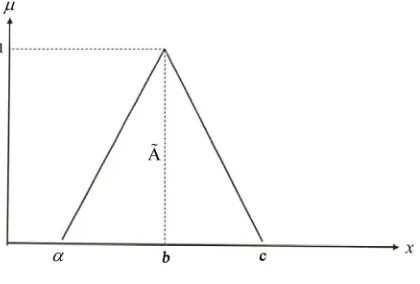
x to A , and A( )x is called the membership func-tion of A . A triangular fuzzy number A can be de-fined by a trip-let (a, b, c) (Figure 1) [20]. The member-ship function is defined as
A
: , ,
0 otherwise x a
a x b b a
x b
x a b c b x c
c b
(1) [image:2.595.321.531.79.221.2]
In this paper, the two most important parameters for tool wear are primarily concluded through literature re-view. Additionally, nine fuzzy control rules for tool wear using triangle membership function with respective to five linguistic grades will be constructed following IF-THEN rules.
Figure 1. Triangle fuzzy numbers.
To eliminate the computation, four input (parameter) and twenty output (tool wear) intervals are considered to prepare the defuzzification. Through Cartesian product, the degree of membership for both input and output can thus be attained as
RInput Output (2)
Here, “ Input ” describes the parameter, “ Output ” represents the quality, and R denotes the fuzzy relation between the parameter and quality.
The “OR” rules are then utilized for combining rules for maximum degree of membership as
R1 R2 max R1 , R2
(3) where, R1 and R2 symbolize for the two rules.
In this study, the average value using center of gravity is determined to represent the fuzzy set as
A A
( )
i i
i i
i i
x x
F x
x
(4)
where F x
i is the final rating of activity,A
xi describes the membership function of fuzzy set A .2.2. Taguchi Method
T. S. LAN 1021
S/
N=
2 1 10 log n i i y n
(dB) (5)
where n is the number of experiments for each expe-rimental set, and yi expresses the quality characteristic
at the ith experiment. On the contrary, the larger quality characteristic will have better result t when con-sidering the larger-the-best quality, therefore, by taking the inverse of quality characteristic into Equation (5), the related S/N ratio can also be deduced and shown in Equ-ation (6). S/N= 2 1 1 / 10 log n i i y n
(dB) (6)In this study, the defuzification result for tool wear in CNC machining is introduced to the Taguchi experiment as the S/N ratio. Therefore, it is judged as the quality of smaller-the-best. In addition to the S/N ratio, a statistical analysis of variance (ANOVA) [26] can be employed to indicate the impact of process parameters. In this way, the optimal levels of process parameters can be esti-mated.
3. Research Design
The tool wear is considered as the quality in this paper. Four parameters with three levels are selected to optim-ize the finish turning based on the
49
L 3 orthogonal array. Additionally, nine fuzzy control rules with respec-tive to five linguistic grades for tool wear are constructed. Considering four input and twenty output intervals, the defuzzification using center of gravity is thus completed. Thus, the optimum general deduction parameters can then be received.
3.1. Construction of Orthogonal Array
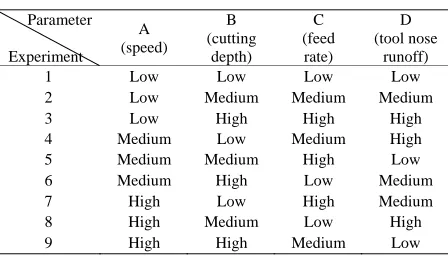
In this study, the four turning parameters (A-speed, B-cutting depth, C-feed rate and D-tool nose runoff D) [27] with three different levels (low, medium, and high) (see Table 1) are constructed for the deduction optimiza-tion of machining operaoptimiza-tion. In Table 1, the three levels of speed, cutting depth, and feed rate are considered ac-cording to the machining handbook suggested by the tool manufacturer. The tool nose runoff is positioned by using different shims located under the tool holder. The ortho-gonal array is then selected to perform the nine sets of deduction experiments.
3.2. Fuzzy Control Rules
[image:3.595.312.536.92.220.2]Since less tool wear results better tool life, the tool life is used to describe the tool wear in this study. The modified
Table 1. Orthogonal array.
Parameter Experiment A (speed) B (cutting depth) C (feed rate) D (tool nose runoff)
1 Low Low Low Low
2 Low Medium Medium Medium
3 Low High High High
4 Medium Low Medium High
5 Medium Medium High Low
6 Medium High Low Medium
7 High Low High Medium
8 High Medium Low High
9 High High Medium Low
Taylor equation TV1/nf1/md1/l C' [4] is often utilized to express the tool life, where only the machining speed (V ) and feed rate (f ) can be identified and found as the two major parameters to the tool wear. Additionally, for less computation, five linguistic grades for tool wear are determined as excellent (least), good (light), fair, poor (large), and worst (heavy). The nine fuzzy control rules with respective to five linguistic grades for tool wear in this paper are constructed under the following considera-tions. The fuzzy rules can be described as
RULE 1: If low machining speed and low feed rate, then the tool wear is excellent.
RULE 2: If low machining speed and medium feed rate, then the tool wear is poor.
RULE 3: If low machining speed and high feed rate, then the tool wear is fair.
RULE 4: If medium machining speed and medium feed rate, then the tool wear is good.
RULE 5: If medium machining speed and high feed rate, then the tool wear is fair.
RULE 6: If medium machining speed and low feed rate, then the tool wear is poor.
RULE 7: If high machining speed and high feed rate, then the tool wear is fair.
RULE 8: If high machining speed and low feed rate, then the tool wear is poor.
RULE 9: If high machining speed and medium feed rate, then the tool wear is worst.
3.3. Defuzzification
In this paper, the three parameter levels are selected based on the Taguchi experimental method, therefore, each triangle membership function is related to the peak point of its fuzzy area. Considering four input and twenty output intervals, the defuzzification of five linguistic grades using center of gravity can then be completed.
Copyright © 2010 SciRes. ENG
Figure 2. Fuzzy Relationship of two major parameters to the tool wear.
ship for input (parameter) and output (tool wear) can be described as shown in Table 2 and Table 3 respectively. Utilizing the average value of the fuzzy set to represent the entire set,
Average value =
Maching Value s s
(7)We then have the quantified result for the fuzzy item of five linguistic grades as shown in Table 4.
4. Results and Discussion
By considering the parameter combinations of the nine sets of experiment based on the L9
34 orthogonalarray, the quantified results from fuzzy deduction for the tool wear are determined and shown as Table 5.
Introducing the quantified result as the signal to noise ratio (S/N) for tool wear of smaller-the-best expectation, the results of factor responses are calculated and listed in
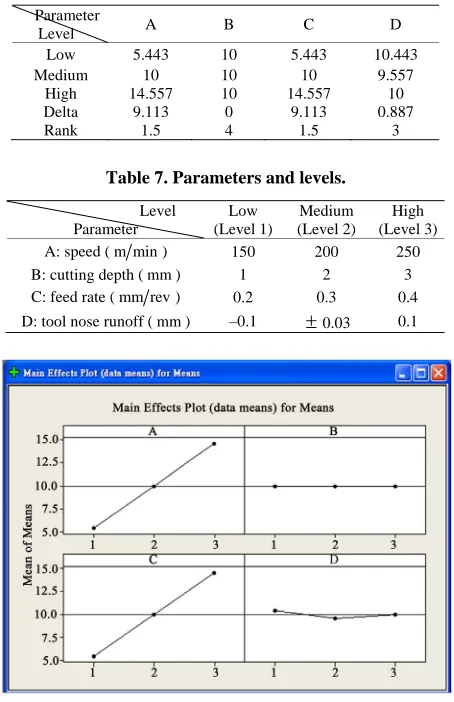
Table 6. The mean effects for S/N ratios are then drawn by MINITAB 14 and shown as Figure 3. Therefore, the optimum fuzzy deduction turning parameters for toll wear are found to be A(High), B(High, Medium, Low), C(High), and D(Low).
5. Confirmation Experiment
The finishing diameter turning operation of S45C (45mm 250mm ) work piece on an ECOCA-3807 CNC lathe is arranged for the experiment. The TOSHI-BA WTJNR2020K16 tool holder with MITSUBISHI NX2525 insert is utilized as the cutting tool. The four
turning parameters (speed, cutting depth, feed rate, and tool nose runoff) with three different levels (low, me-dium, and high) (Table 7) are experimentally distin-guished for the machining operation on the basis of
49
L 3 orthogonal array. In Table 8, the three levels of speed, cutting depth, and feed rate are identified from the machining handbook suggested by the tool manufacturer. The tool nose runoff is positioned by using different shims located under the tool holder and determined by measuring the tip after face turned the work piece. When the tool nose is set approximately 0.1 mm higher (lower) than the center of the work piece, it is regard as “High (Low)”. When the tool nose is set within 0.03 mm, it is considered as “Medium”.
The tool wearing length VB2(mm) in Figure 4 is
se-lected and scaled on the 3D SONY COLOR VIDEO electronic camera. To reduce the costly and timecon- suming experiments, this study employs the tool wear ratio (tool wear length per unit material removal vo-lume) instead of the tool life to demonstrate the tool wear status of turning under specific parameter combi-nation. The tool wearing length is then divided by the volume of material removed as the tool wear ration (mm-2), which is utilized as the indicator of tool wear in this study.
Table 2. Degree of membership for parameter.
Interval
Fuzzy item 0 1 2 3 4
Low 1 0.5 0 0 0
Medium 0 0.5 1 0.5 0
High 0 0 0 0.5 1
Table 3. Degree of membership for tool wear.
Interval
Fuzzy item 0 1 2 3 4 5 6 7 8 109 11 12 13 14 15 16 17 18 19 20
Excellent 1 0.8 0.6 0.4 0.2 0 0 0 0 0 0 0 0 0 0 0 0 0 0 0 0
Good 0 0.2 0.4 0.8 0.61 0.4 0.2 0 0 0 0 0 0 0 0 0 0 0 0 0
Fair 0 0 0 0 0 0.20 0.4 0.6 0.8 1 0.8 0.6 0.4 0.2 0 0 0 0 0 0
Poor 0 0 0 0 0 0 0 0 0 00 0.2 0.4 0.6 0.8 1 0.8 0.6 0.4 0.2 0
T. S. LAN 1023
Table 4. Quantified results for linguistic results.
Scale Excellent Good Fair Poor Worse
Defuzzification 1.33 5 10 15 18.67
Table 5. Fuzzy Deduction Results.
Experiment Tool Wear
1 1.33 2 5 3 10 4 10 5 15 6 5 7 18.67 8 10 9 15
Table 6. Result of factor responses.
Parameter
Level A B C D
Low
5.443 10 5.443 10.443
Medium
10 10 10 9.557
High
14.557 10 14.557 10
Delta
9.113 9.1130 0.887
Rank
[image:5.595.307.538.71.239.2]1.5 1.54 3
Table 7. Parameters and levels.
Level Parameter
Low (Level 1)
Medium (Level 2)
High (Level 3)
A: speed (m min) 150 200 250
B: cutting depth ( mm ) 1 2 3
C: feed rate (mm rev) 0.2 0.3 0.4
D: tool nose runoff ( mm ) –0.1 0.03 0.1
Figure 3. Plot of main effects.
To verify the applicability of the optimum result achieved by our proposed general optimization technique, the machining operations under both fuzzy Taguchi de-duction optimization parameters and benchmark parame-ters; A (Medium), B (Medium), C (Medium), D (Me-
Figure 4. Tool wear length.
Table 8. Confirmation resultse.
Tool Wear Ratio Fuzzy Deduction Optimization
Parameters (A3B3C3D1) 3.67 E-07 mm-2 Fuzzy Deduction Optimization
Parameters (A3B2C3D1) 3.03 E-07 mm-2 Fuzzy Deduction Optimization
Parameters (A3B1C3D1) 3.99 E-07 mm-2 Benchmark Parameters
(A2B2C2D2) 4.38 E-07 mm-2
dium), which are often introduced into the confirmation experiment in many of the studies [7,28] for comparison to the optimum parameters, are performed on the CNC lathe. The machined results are concluded and listed in
Table 8. From Table 8, it is observed that the tool wear ratio under fuzzy deduction parameters are significantly improved by 16.21%, 30.02% and 8.9% respectively, and the average result is also improved by 18.38% from the benchmark parameters. It is shown that our proposed general deduction optimization technique can really ad-vance the tool wear without compromise.
6. Concluding Remarks
In this paper, the fuzzy Taguchi deduction was proposed and applied to achieve the optimum CNC finish turning parameters under the considerations of tool wear. A con-firmation experiment of the optimum general deduction parameters was conducted to indicate the effectiveness of the proposed fuzzy Taguchi deduction optimization me-thod. Through the confirmation test for the proposed method, the experimental results validate the potency that tool wear ratios can be greatly advanced from our fuzzy Taguchi deduction optimization technique. The considered qualities in the general deduction optimiza-tion are found valuable to be possibly extended for the real-world machining industry.
[image:5.595.59.286.282.633.2]Copyright © 2010 SciRes. ENG
approach using orthogonal array, but also contributes the satisfactory fuzzy linguistic technique for improving tool wear performance in CNC turning with profound insight. The competition of manufacturing industry will then be economically excited through the proposed development in this study.
7. Acknowledgements
Financial support for this work was provided by the Na-tional Science Council Taiwan, under the contract of NSC98-2221-E-412-002. The author would like to thank the anonymous referees who kindly provided the sugges-tions and comments to improve this work.
8. References
[1] R. R. Venkata, “Machinability Evaluation of Work Mate-rials Using a Combined Multiple Attribute Decision- mak-ing Method,” International Journal of Advanced. Manu-facturing Technology, Vol. 28, No. 3-4, 2006, pp. 221-227.
[2] J. P. Davim and A. Conceicao, “Optimization of Cutting Conditions in Machining of Aluminium Matrix Composites Using a Numerical and Experimental Model,” Journal Materials Processing Technology, Vol. 112, No. 1, 2001, pp. 78-82.
[3] W. S. Lin, B. Y. Lee and C. L. Wu, “Modeling the Surface Roughness and Cutting Force for Turning,” Journal Mate-rials Processing Technology, Vol. 108, No. 3, 2001, pp. 286-293.
[4] W. S. Lin, “The Study of Machining Accuracy and Tool Wear Reliability,” Ph.D. Thesis, National Central Univer-sity, Taoyuan, 1998.
[5] Q., Meng, J. A. Arsecularatne and P. Mathew,(2000) “Calculation of Optimum Cutting Conditions for Turning Operations Using a Machining Theory,” International Journal of Advanced. Manufacturing Technology, Vol. 40, No. 4, 2000, pp. 1709-1733.
[6] J. Kopac, “Optimal Machining for Achieving the Desired Surface Roughness in Fine Turning of Cold Preformed Steel Work Piece,” International Journal of Machine Tools and Manufacture, Vol. 42, No. 10, 2002, pp. 707-716.
[7] N. Tosun and L. Ozler, “Optimisation for Hot Turning Operations with Multiple Performance Characteristics,” International Journal of Advanced Manufacturing Tech-nology, Vol. 23, No. 11-12, 2004, pp. 777-782.
[8] L. J. Yeh, “A Study on the Monitoring and Suppression System for Turning Slender Workpieces,” Ph. D. Thesis, Tatung University, Taibei, 1994.
[9] H. Huh, J. H. Heo and H. W. Lee, “Optimization of a Roller Leveling Process for Al7001T9 Pipes with Finite Element Analysis and Taguchi Method,” International Journal of Machine Tools and Manufacture, Vol. 43, No. 4, 2003, pp. 345-350.
[10] K. S. Anastasiou, “Optimization of the Aluminium Die Casting Process Based on the Taguchi Method,” Pro-ceedings of the Institution of Mechanical Engineers, Part
B: Journal of Engineering Manufacture, Vol. 216, No. 7, 2002, pp. 969-977.
[11] M. N. Dhavlikar, M. S. Kulkarni and V. Mariappan, “Combined Taguchi and Dual Response Method for Op-timization of a Centerless Grinding Operation,” Journal Materials Processing Technology, Vol. 132, No. 1-3, 2003, pp. 90-94.
[12] S. J. Kim, K. S. Kim and H. Jang, “Optimization of Man-ufacturing Parameters for a Brake Lining Using Taguchi Method,” Journal Materials Processing Technology, Vol. 136, No. 1-3, 2003, pp. 202-208.
[13] L. A. Zadeh, “Fuzzy sets,” Information and Control, Vol. 8, No. 3, 1965, pp. 338-353.
[14] H. J. Zimmerman, “Fuzzy Sets THeory and Its Applica-tions,” Kluwer Academic Publisher, Boston, 1992.
[15] J. Wanga, C. Yao and Z. Zhang, “A Fuzzy-AHP Compre-hensive Evaluation Method for Optimization Design of Machine Tool,” Mechanic Automation and Control Engi-neering, Wuhan, 26-28 June 2010, pp. 2652-2656.
[16] G. Chai, C. Lu and D. Wen, “Study on the Multiple Objec-tive Parameter Optimization Method for NC Turning,” Ad-vanced Materials Research, Vol. 102-104, 2010, pp. 705-709.
[17] J. Mao, Y. Cao, H. Ching and R. Du, “Fuzzy Tolerancing Based on Available Manufacturing Resources,” Comput-er-Aided Design and Applications, Vol. 6, No. 2, 2009, pp. 253-261.
[18] H. Gao, M. Xu, Y. Su, P. Fu and Q. Liu, “Experimental Study of Tool Wear Monitoring Based on Neural Net-works,” Intelligent Control and Automation, Chongqing, 25-27 June, pp. 6906-6910.
[19] Z. Güngör and F. Arıkan, “Using Fuzzy Decision Making System to Improve Quality-based Investment,” Journal of Intelligent Manufacturing, Vol. 18, No. 2, 2007, pp. 197-207.
[20] A. Kaufmann and M. M. Gupta, “Introduction to Fuzzy Arithmetic Theory and Applications,” Van Nostrand Rein-hold, New York, 1991.
[21] K. Palanikumar, “Application of Taguchi and Response Surface Methodologies for Surface Roughness in Ma-chining Glass Fiber Reinforced Plastics by PCD Tool-ing,” International Journal of Advanced. Manufacturing Technology, Vol. 36, No. 1-2, 2008, pp. 19-27.
[22] P. J. Ross, “Taguchi Techniques for Quality Engineer-ing,” McGraw-Hill Publication, New York, 1998.
[23] J. C. Chang, “The Application of Taguchi Method in the Finite Element Analysis for the Optimal Structural De-sign of Compressed Sheet in Huge Extended Plate,” Master’s Thesis, National Chung Hsing University, Tai-chung, 2000.
[24] H. S. Wei, S. C. Hwang and S. J. Liu, “Analysis for the Optimum Conditions in Derrick Hook by Using Taguchi Method,” Master’s Thesis, Nation Pingtung University of Science and Technology, Pingtung, 2002.
T. S. LAN 1025
Vol. 26, No. 5-6, 2005, pp. 631-637.
[26] F. C. Wu and C. C. Chyu, “A Comparative Study on Ta-guchi’s SN Ratio, Minimising MSD and Variance for Nominal-the-best Characteristic Experiment,” Interna-tional Journal of Advanced Manufacturing Technology, Vol. 20, No. 9, 2002, pp. 655-659.
[27] T. S. Lan and M. Y. Wang, “Competitive parameter opti-mization of multi-quality CNC turning,” International Journal of Advanced Manufacturing Technology, Vol. 41,
No. 7-8, 2009, pp. 820-826.