Accepted Manuscript
Title: Transition Metal Bifluorides
Author: Fady Nahra Marcel Brill Alberto G´omez-Herrera Catherine S.J. Cazin Steven P. Nolan
PII: S0010-8545(15)00281-7
DOI: http://dx.doi.org/doi:10.1016/j.ccr.2015.08.011
Reference: CCR 112133
To appear in: Coordination Chemistry Reviews
Received date: 13-5-2015
Revised date: 21-7-2015
Accepted date: 31-8-2015
Please cite this article as: F. Nahra, M. Brill, A. G´omez-Herrera, C.S.J. Cazin, S.P. Nolan, Transition Metal Bifluorides, Coordination Chemistry Reviews (2015), http://dx.doi.org/10.1016/j.ccr.2015.08.011
Accepted Manuscript
HighlightsAccepted Manuscript
Transition Metal Bifluorides
Fady Nahra
a, Marcel Brill
a, Alberto Gómez-Herrera
a, Catherine S. J. Cazin
a* and
Steven P. Nolan
b*
a
EaStCHEM, School of Chemistry, University of St Andrews, North Haugh, St Andrews, Fife,
KY16 9ST. E-mail: [email protected]; [email protected]
b
Chemistry Department, College of Science, King Saud University, P.O. Box 2455, Riyadh
11451, (Saudi Arabia)
Keywords: Phosphine; NHC; Transition metal; Bifluoride
Table of Contents
1. Introduction... 3
2. Phosphine-Based Transition Metal Bifluorides ... 4
2.1. Molybdenum and Tungsten ... 4
2.2. Ruthenium... 7
2.3. Rhodium... 10
2.4. Nickel... 13
2.5. Palladium ... 14
2.6. Platinum ... 19
3. NHC-based Transition Metal Bifluorides ... 21
3.1. 5-membered NHCs ... 21
3.1.1 Copper... 21
3.1.2 Gold... 23
3.1.3 Iridium and Rhodium... 25
3.2. 6-membered NHCs ... 26
4. Other Transition Metal Bifluorides... 28
Accepted Manuscript
Acknowledgments... 38 References... 38
Abbreviations:FHF- or HF
2-, hydrogen(difluoride) anion or bifluoride; M, metal; F, fluoride; TM, transition metal;
dmpe, 1,2-bis(dimethylphosphino)ethane; dcpe, bis(dicyclohexylphosphino)ethane; PMe3, trimethylphosphine; t
Bu-bpy, 4,4′-di-tert-butyl-2,2′-dipyridyl; NFSI, N-Fluorodibenzenesulfonimide; NBS, N-bromosuccinimide; NHC, N -heterocyclic carbene; IPr, [1,3-bis(2,6-diisopropylphenyl)imidazol-2-ylidene]; IMes, [1,3-bis(2,4,6-trimethyl)phenyl)imidazol-2-ylidene]; DMPU, [1,3-dimethyl-3,4,5,6-tetrahydro-2(1H)-pyrimidinone]; SIPr, [1,3-bis(2,6-diisopropylphenyl)-4,5-dihydroimidazol-2-ylidene]; cod, 1,5-cyclooctadiene; 6-iPr, [1,3-bis(iso-
propyl)-3,4,5,6-tetrahydropyrimidin-2-ylidene]; pipz, piperazine; OAc, acetate; NMR, nuclear magnetic resonance.
ABSTRACT: Since its initial discovery, four decades ago, transition metal bifluoride chemistry has
exhibited a slow growth, mainly due to problems associated with synthesis and characterization. Until recently, reports on this chemistry almost always presented these complexes as a fluke discovery. However, with the recent increase in reports and applications involving such species, a renewed interest in these complexes has been observed. Most of the work done in this area, so far, has been directed toward the synthesis and quite challenging characterization of these complexes, yet mostly neglecting the behavior of such species and their influence on catalytic processes. The aim of this work is to present a summary of the various preparation methods, characterization techniques and applications of reported transition metal bifluoride complexes. It is our hope that by centralizing all information available on such species, future efforts aimed at exploiting the full potential of transition metal bifluoride species can be facilitated.
1. Introduction
The hydrogen(difluoride) anion, commonly known as the bifluoride anion, is a unique moiety as it features the strongest known hydrogen bond [1]. Hydrogen bond interactions are one of the most important intra- and intermolecular interactions in chemistry [1-7]. Understanding these interactions has been the driving force behind numerous studies, mostly revolving around non-metal systems. In recent years, in-depth studies of transition metal-based structures and reactions have shown that hydrogen bonding could also be found in these systems. As a result, interest has risen in understanding the characteristics of these interactions and the properties they confer upon the metal system. Leading reports by Crabtree [8] and Morris [9] on the unconventional hydrogen-hydrogen interaction between a metal hydride and common organic hydrogen bond donors, such as amines or alcohols, catalyzed the rapid development of this area of research [10-15].
[16-Accepted Manuscript
26]. Furthermore, it is now known that the reactivity of these compounds can be further influenced by interactions of the M-F bond with hydrogen bond donors, such as -OH, -NH or -CH groups [27,28]. Other donor molecules, such as hydrogen chloride (M-F---H-Cl) have also been reported [29 ]. Considering that the M-F---H-F interaction should exhibit the strongest hydrogen bond, this would be the most interesting unit to explore. Consequently, new reports aimed at investigating the nature of hydrogen bonding between metal fluoride species and HF by studying transition metal bifluorides, are nowadays increasing.
Reports have shown that TM bifluorides can express the bifluoride moiety in various forms (coordinated, non-coordinated, symmetrical, unsymmetrical) with different dissociation patterns. Typically, these bifluorides are classified into two main categories; bifluoride complexes (where the bifluoride unit is coordinated to the metal) and bifluoride salts (where the bifluoride unit does not interact with the metal and is located outside the metal’s coordination sphere). These manifestations could be especially important for catalytic fluorination processes, where catalysts, particularly metal fluorides, are exposed to an excess of a HF source [30-33]. However, the influence of the metal and/or the ligand on this moiety is still unclear.
To date, there are no comprehensive reviews combining all the valuable, scattered information on the synthesis, characterization and structural behavior of these species. Recent reports have started to present these species as possible reaction intermediates and/or feedstocks for fluoride release. In hopes of shedding more light on the properties of transition metal bifluorides, a summary of the various preparation methods, characterization techniques and applications of bifluoride complexes/salts is presented. A description and classification of the reported systems will most certainly ensure a better understanding and possibly will help guide future efforts towards fully exploiting their potential in e.g.
TM-catalyzed reactions.
2. Phosphine-Based Transition Metal Bifluorides
Since the initial report of a phosphine-based platinum bifluoride complex by Coulson [34], the use of phosphine ligands has been the main approach for the synthesis of these bifluoride complexes. The wide availability of these ligands with their wide range of tunable steric and electronic demands has enabled the isolation and characterization of several transition metal bifluorides.
2.1. Molybdenum and Tungsten
Bifluoride complexes based on group 6 transition metals (particularly, Mo and W) are the focus of the oldest reports in this field, and have contributed immensely to the advancement of this chemistry.
Accepted Manuscript
[Mo(H)2(PMe3)5] (1) with aqueous hydrogen fluoride (HF) (Scheme 1). The use of substoichiometric
amounts of aqueous HF afforded the conversion of 1 to the octacoordinate difluoride complex
[Mo(F)2(H)2(PMe3)4] (2) with concomitant loss of one equivalent of phosphine ligand. Unexpectedly, in
the presence of further excess of HF, 1 afforded a mixture of the bis(bifluoride) [Mo(H)2(HF2)2(PMe3)4]
(3, major compound) and the mono(bifluoride) complex [MoF(H)2(HF2)(PMe3)4] (4). The procedure was
further optimized in order to obtain full conversion to the bis(bifluoride) complex 3. Selective formation
of 4 was achieved by the subsequent reaction of 3 with 0.33 equivalents of [Mo(N2)(PMe3)5)]. Following
this strategy, the complex was isolated and fully characterized. Consequently, it was revealed that the HF was involved in a hydrogen-bonding interaction with one of the Mo-F ligands (Figure 1).
aq. HF (excess)
[Mo(N2)(PMe3)5] (0.33 equiv.)
1
Mo PMe3
PMe3
PMe3
Me3P H
H Me3P
aq. HF
2
Mo PMe3
PMe3
Me3P F
F
Me3P
H H 3 Mo PMe3 PMe3
Me3P F
F
Me3P
H H H H F F 4 Mo PMe3 PMe3
Me3P F
F
Me3P
H
H
H F KH, NEt3
Scheme 1. Synthesis of bis- and mono(bifluoride) molybdenum complexes 3 and 4 [35]
The X-ray structure of 4 highlights some fundamental features of the bifluoride complex. The complex
presents an irregular dodecahedron structure, with the phosphine ligands occupying positions of the elongated tetrahedral subunit of the dodecahedron, while the anionic ligands form the flattened tetrahedral subunit. As shown in Figure 1, the F---H-F moiety is clearly not bound linearly to the molybdenum center, but depicts a Mo-F---F angle of 134º [36]. The Mo-FHF distance is longer than that of the Mo-F bond (2.124(3) Å vs 2.077(4) Å, respectively), and the distance between both fluorine atoms of the bifluoride unit (2.351(8) Å) permits the classification of the interaction as a “strong” hydrogen bond, although weaker than that present in bifluoride salts, such as KHF2 (2.277 Å) [37]. Compared to that of a
Accepted Manuscript
in the IR spectrum of complex 4 strongly contrasts with typical values observed for bifluoride salts
(1284–1372 cm-1) [38], thus reflecting their distinct character.
Mo PMe3
PMe3
Me3P
F
Me3P
H H
F
F H
Figure 1. Solid-state structure of [MoF(H)2(HF2)(PMe3)4)] (4) [35]
At the time, the reported NMR analyses were less informative about the spectroscopic properties of the bifluoride behavior in solution. 1H NMR spectra of complex
4 exhibited a doublet at 12.5 ppm (C6D6, 1J H-F = 410 Hz), whereas the bifluoride anion in salts typically displayed a triplet (1JH-F = 120 Hz) [39-40].
Based on these observations, it was suggested that the Mo-F---HF interaction was significantly weakened in solution with respect to that found in the solid state. A similar conclusion was drawn from the 19F NMR
analysis; complex 4 exhibited, in addition to the Mo-bound fluoride (proximal) signal at −230 ppm, a
doublet at −182 ppm which was assigned to the distal fluoride of the FHF unit. The latter signal showed a
coupling constant similar to that of a free HF molecule [41]. Later reports on similar complexes have helped to validate these notions.
The study of the aforementioned molybdenum complex was not only groundbreaking, but also initiated a re-evaluation of previously reported structures, now suspected to be bifluorides. For example, in 1984 Parkin and co-workers reported the reaction of the hydride complex [WH(η2-CH
2PMe2)(PMe3)4] with
aqueous HF, yielding a product which was initially assigned as the aqua complex [WF(H)2(OH2)(PMe3)4][F] [42-44]. Driven by the isomorphism between molybdenum and tungsten, and
Accepted Manuscript
2.2. Ruthenium
The discovery of ruthenium bifluoride complexes resulted from observations made from the application of ruthenium complexes in the activation of C-F bonds [46-49].
Perutz and co-workers, who were initially focused on the study of the C-F activation of fluoro-compounds [48] using ruthenium hydride complexes, pioneered the field of ruthenium bifluorides. In 1997, they reported the synthesis and structural study of the bifluoride species with formula trans -[RuH(HF2)(dmpe)2] (5a) [49]. This complex was obtained as a side-product in the reaction between cis
-[Ru(H)2(dmpe)2] and hexafluorobenzene at −78 ºC, which mainly yielded trans-[RuH(C6F5)(dmpe)2] via
C-F bond activation (Scheme 2). The aromatic C-F activation promoted by metal complexes was a very active area of research at the time, and a precedent of this unexpected side-product was observed by the same group the previous year, although then, it had remained unidentified [48].
cis-[Ru(H)2(dmpe)2] trans-[RuH(HF2)(dmpe)2] (5a)
a) obtained as byproduct b) obtained as main product a) C6FnH6-n
or b) NEt3·3HF
Scheme 2. Synthesis and solid-state structure of trans-[RuH(HF2)(dmpe)2] [49]
These studies showed that two equivalents of fluoroaryl compounds (C6FnH6-n, n = 3,4,5,6) reacted with
the dihydride ruthenium complex to afford an unknown compound in a 1:2 ratio with respect to the C-F activation product. 1H NMR spectroscopy (d
8-THF, 293 K) of the former displayed two broad singlets at
13.8 and −25.8 ppm. 31P{1H} NMR experiments displayed a broad singlet, and 19F NMR analysis showed
no resonances. However, low-temperature 19F NMR studies showed a pattern consistent with a bifluoride
complex. Moreover, the presence of an excess of triethylamine completely suppressed the formation of this compound, whereas the addition of NEt3·3HF (less than one equivalent in THF at room temperature),
Accepted Manuscript
revealing a broad band at 1690 cm-1, which is within the range of reported HF
2 salts. The structure of the
bifluoride species was unambiguously determined by X-ray diffraction analysis and showed a Ru-bound bifluoride unit (FHF, with a Ru-F---F angle of 129.9(3)º) in a trans disposition relative to the hydride. Interestingly, the F---F distance of 2.276(8) Å found in complex 5ais closer in range to that found in
bifluoride salts [50,51] or pyridine·nHF [52], and considerably shorter than the F---F distance observed in the Parkin complex [MoF(H2)(HF2)(PMe3)4] (3) (2.351(8) Å). The Ru-F bond length of 2.284(5) Å is
significantly longer than that of Ru-F complexes (2.01-2.04 Å) known at the time [53-54]. The bifluoride complex was also highlighted as a very rare example of an octahedral complex containing a hydride and a fluoride ligand in a trans disposition [55]. The formation of the bifluoride species was suggested to proceed via the formation of a dihydrogen intermediate, followed by trapping of the excess HF to yield the desired compound 5a (Scheme 3).
cis-[Ru(H)2(dmpe)2] HF [{RuH(2-H2)(dmpe)2+}(F-)]
[{RuH(2-H2)(dmpe)2+}(F-)] HF trans-[RuH(HF2)(dmpe)2] + H2 (5a)
Scheme 3. Suggested reaction pathway for the synthesis of the ruthenium bifluoride complex 5a [49]
Furthermore, a second pattern of signals (belonging to a new species) was observed when NMR spectroscopy experiments were conducted at low temperatures. 1H NMR and 19F NMR analyses showed a
triplet at 14.8 ppm (J = 145 Hz) and a broad doublet at −150.9 ppm, respectively. However, due to a lack
of further data, an unambiguous identification of this species was not possible. Based on similarities with previously reported ruthenium complexes [56-59], it was tentatively assigned as [{RuH(dmpe)2+}(HF2-)].
In light of these results, the competition/equilibrium between free and coordinated bifluoride anions became the major interest of further studies.
In 2001, Whittlesey and co-workers showed that not only fluoroarenes, but also fluoroalkenes could be C-F activated with concomitant HF release and formation of new metal bifluoride species [60a]. In this example, perfluoroisohexene, (CF3)2C=C(F)CF2CF3, was used for the successful C-F cleavage/bifluoride
synthesis, under similar conditions as before. However, the use of stoichiometric amounts of the cis -[Ru(H)2(dmpe)2] and the fluoroalkene afforded a mixture of trans-[RuH(HF2)(dmpe)2] (5a) and cis
-[RuF(HF2)(dmpe)2] (6a), in a 1:4 ratio. Addition of excess NEt3 (10 equivalents) afforded full conversion
towards the new cis complex (6a), which was isolated and characterized (Scheme 4). 1H NMR
spectroscopy showed a doublet at 14.2 ppm (1J
H-F = 328 Hz) indicating, once again, a weakening of the
Accepted Manuscript
distal fluoride, RuF-H-F) and two broad multiplets at −343 and −362 ppm (attributed to the two Ru -bound fluorides).
cis-[Ru(H)2(dmpe)2]
(CF3)2C=C(F)CF2CF3 excess NEt3
cis-[RuF(HF2)(dmpe)2] (6a)
Scheme 4. Synthesis and solid-state structure of cis-[RuF(HF2)(dmpe)2] (6a) [60a]
X-ray analysis of 6ashows a Ru-FHF bond length of 2.168(3) Å, which is longer than the other Ru-F
bond (2.101(3) Å). The present bifluoride complex displays a longer F---F distance when compared to that of complex 5a (2.292(8) Å vs 2.276(8) Å). The Ru-F---F angle of 142º is within the range observed
for other transition metal bifluorides. Furthermore, IR measurements showed two bands at 2452 and 1915 cm-1 characteristic of two unsymmetrical H-F bonds.
Interestingly, the above methodology could not be extended to other ruthenium hydrides bearing different phosphine ligands. For example, the reaction of cis-[Ru(H)2(dcpe)2] with perfluoroisohexene
afforded a 16-e- ruthenium complex, which was identified as a [{RuH(dcpe)
2}+] bearing a
perfluoro-enolate [(CF3)2C=C(O)CF2CF3] as counter-anion, in 31% yield. The origin of the enolate moiety
presumably is promoted via hydrolysis by traces of water; the use of excess water afforded a quantitative yield of the cationic species, thus further supporting this hypothesis.
Perutz and co-workers were able to overcome the above limitation and extend the method, using NEt3·3HF as a fluorinating reagent, to access new ruthenium bifluoride complexes bearing different
phosphine ligands (Scheme 5) [60b]. Three new diphosphine-based ruthenium bifluorides (5b-d) were
synthesized, of the formula trans-[Ru(H)(HF2)(L)2], in which the bifluoride ligand adopted a trans
disposition to the hydride. A ruthenium bis-bifluoride complex (6b) was also successfully accessed,
bearing trimethylphosphine as ligand. In contrast to the diphosphine analogs, the bifluoride moieties in
cis-[Ru(HF2)2(PMe3)2] (6b) adopted a cis position relative to each other and each was located trans to a
Accepted Manuscript
cis-[Ru(H)2(L)2] NEt3·3HF trans-[RuH(HF2)(L)2]
L= depe (5b) dppe (5c) dppp (5d)
cis-[Ru(H)2(PMe3)4] cis-[Ru(HF2)2(PMe3)4] (6b)
NEt3·3HF
Scheme 5. Synthesis of new ruthenium bifluorides with different phosphine ligands [60b]
Exchange reactions and dynamic behavior studies, which were conducted in that report, showed that dissociation was more likely occurring at the Ru-F bond and as a consequence liberating free HF2- in
solution and not HF.
2.3. Rhodium
Rhodium fluoride complexes have attracted much attention in recent years, mostly due to the rapid growth of fluorination chemistry. These species were typically prepared by Cl/F exchange using AgF [17], or by C-F activation/hydrogenolysis of fluorinated alkenes [61]. Nowadays, the use of NEt3·3HF is
considered a more practical approach for metal fluoride synthesis [26,62]. However, since this reagent is also an excellent bifluoride promoter, various reports of Rh-FHF complexes have started to appear in the literature.
Braun and co-workers prepared [RhF(PEt3)3] (8) by reacting [RhH(PEt3)3] (7) with NEt3·3HF. Upon
treatment of 8 with HCl in ether, the chloro analog [RhCl(PEt3)3] was obtained (Scheme 6) [63]. However,
it was found that the use of substoichiometric amounts of HCl affords the bifluoride complex, [Rh(HF2)(PEt3)3] (9), as the major compound. Tuning the amount of added HCl proved crucial for the
selective formation of the bifluoride species. 31P NMR analysis (223 K) shows a very similar pattern to
that of the initial complex. However, the 1H NMR spectrum (room temperature) displays a broad signal at
13.2 ppm, clearly indicating the presence of a bifluoride species. This signal can be further resolved at 223 K into a doublet of doublets (1J
H-F = 42 Hz with the Rh-bound proximal F, and 1JH-F = 382 Hz with
the distal F). Furthermore, 19F NMR spectroscopy clearly shows the two characteristic peaks at −176.4
ppm (distal F) and −278.3 ppm (proximal F). The proximal fluorine couples with a vicinal phosphorus nucleus (2J
F-P = 175 Hz, no H-Fproximal coupling is observed), while the distal fluorine reveals a coupling
with the proximal fluorine (2J
F-F = 116 Hz) and the H atom (1JF-H = 386 Hz). The proposed reaction
Accepted Manuscript
RhF Et3P PEt3
PEt3
Rh FHF Et3P PEt3
PEt3
Rh Cl Et3P PEt3
PEt3
+ Rh
H Et3P PEt3
PEt3
NEt3·3HF
Rh F Et3P PEt3
PEt3
NEt3
Cs2CO3
HCl
9 8
7 8
Scheme 6. Synthesis of [Rh(HF2)(PEt3)3] (9) [63]
During the same year, Vicente and co-workers reported the isolation and characterization of several rhodium bifluoride complexes. In a similar manner, fluoride complexes of the type [RhF(cod)(PR3)] (10)
were reacted with NEt3·3HF to afford 3 new bifluorides, [Rh(HF2)(cod)(PR3)] (R = Ph, iPr or Cy) [64].
[RhF(cod)(PR3)] complexes were accessed by reacting the trinuclear bifluoride species [{Rh3(µ3
-OH)2(cod)3}(HF2)] with the corresponding phosphine. Under these conditions, the bifluoride complexes
were obtained in 67-92% isolated yields (Scheme 7).
PR3 (cod)Rh Rh(cod) O (cod)Rh O H H HF2 Rh F PR3
1/3 NEt3·3HF
Rh F
PR3 H F
10 R = Ph, 11a
R = iPr, 11b
R = Cy, 11c
Scheme 7. Synthesis of [Rh(HF2)(cod)(PR3)3] from the trinuclear [{Rh3(µ3-OH)2(cod)3}(HF2)] [64]
X-ray analysis of [Rh(HF2)(cod)(PPh3)] (11a) confirmed the presence of the HF2 ligand. The metal
Accepted Manuscript
1842 (11a), 2580 and 1866 (11b), and 2634 and 1842 cm-1 (11c), assigned to the stretching and bending
(HF2) modes. Since hydrogen bond interactions become stronger in bifluoride complexes, a decrease in
the (FHF) relative to free HF (3960 cm-1) is expected. However, all observed wavenumbers were much
higher than those found in most common HF2 salts (1284–1372 cm-1). Furthermore, the bands at higher
wavenumbers were closer to those observed in mixed XHF- anions (X = Cl, 2491 cm-1, or Br, 2803 cm-1),
thus indicating that these bifluoride ligands are highly unsymmetrical in nature. 19F NMR spectroscopy
(193 K) shows a characteristic doublet of doublets in the range of −176.2 to −190 ppm for all bifluoride
complexes and an unresolved multiplet around ~ −260 ppm. 1H NMR spectroscopy shows a broad signal
at around 12 ppm, resolving into a doublet of doublets at low temperature. Once again, it is shown that the coupling constant for the distal fluoride is significantly higher than that of the rhodium-bound fluoride (360–375 Hz vs 32–41 Hz), both differing considerably from free HF2- anions (120 Hz) and free HF (476
Hz in CH3CN). Again, the higher values are actually closer to those found in mixed anionic species, such
as [ClHF-] (404 Hz) [40].
In a later study, the fluoride analog of Wilkinson’s catalyst, [RhF(PPh3)3], was synthesized and fully
characterized. During this synthesis, a side-product was observed when reaction mixtures were filtered over cotton. The product was identified as the bifluoride complex, [Rh(HF2)(FPPh2)(PPh3)2] (Figure 2)
[image:13.612.88.527.323.652.2][65a]. The latter displayed similar properties as previous bifluorides. The Rh-F bond length of 2.082(1) Å is again slightly longer than the value of the fluoride analog. Within a similar value range to other reported bifluoride species, the F---F distance has been measured as 2.329 Å, with a Rh-F---F angle of 135.6º.
Figure 2. ORTEP representation of the solid-state structure of [Rh(HF2)(FPPh2)(PPh3)2] [65a]
Accepted Manuscript
[65b]. The rhodium bifluoride was postulated as an intermediate in the reaction of fluoro(vinylidene)rhodium(I) complexes with acetic acid.
2.4. Nickel
Perutz and co-workers successfully isolated and characterized a nickel complex with the formula
trans-[Ni(HF2)(2-C4HF2N2)(PEt3)2] (12) [66]. The reported synthesis involved the stepwise reaction of
[Ni(cod)2] with PEt3, followed by oxidative addition of 2,4,6-trifluoropyrimidine, resulting in a
tetra-coordinated nickel complex (Scheme 8). The subsequent reaction with NEt3·3HF afforded the Ni-FHF
complex. The structure was confirmed by the presence of two signals in the 19F NMR spectrum at 233 K;
a doublet at −180.35 ppm with a 1J
H-F ~ 390 Hz for distal fluorine, and a broad singlet at −332.61 ppm for
proximal fluorine. 1H NMR spectroscopy showed a characteristic broad doublet at 11.36 ppm (1JH-F ~ 430
Hz). The 31P NMR spectrum reinforced the presence of the Ni-F unit, due to the observed F-P coupling
(doublet at 13.2 ppm, 2J
P-F = 43.2 Hz). Compared to the fluoride analog, the Ni-C bond length in the
bifluoride complex is shorter (1.844 Å vs 1.856 Å), while the Ni-F bond is significantly longer (1.908 Å
vs 1.869 Å) (Figure 3). These data are in agreement with previously described bifluorides.
[Ni(cod)2]
Ni F
PEt3
Et3P Ni
FHF PEt3
Et3P
[Ni(cod)(PEt3)2]
Ni F
PEt3
Et3P Ni
FHF PEt3
Et3P
NEt3·3HF
NEt3·3HF
N N F F N N F F N F F F F N F F F F 1) PEt3, hexane
2) N N F F N F F F F F 12 13 F
Scheme 8. Synthesis of nickel bifluoride complexes [66,67]
In a later report by the same group, pentafluoropyridine was used instead of 2,4,6-trifluoropyrimidine for the oxidative addition reaction at the Ni(0) center. In a similar fashion as before, trans -[NiF(2-C5NF4)(PEt3)2] reacted with NEt3·3HF to afford the desired bifluoride 13 (Scheme 8) [67]. 19F NMR
analysis at 190 K, showed a doublet of doublets at −179.37 ppm (distal fluorine H-F, 1J
F-H = 422 Hz, 2JF-F
= 85 Hz) and a broad singlet at −339.06 ppm (proximal fluorine, Ni-F). 1H NMR analysis exhibited a
broad doublet of doublets at 11.58 ppm (1J
Accepted Manuscript
also confirmed by 31P NMR spectroscopy, which showed a signal at 14.4 ppm with a P-F coupling (2J P-F =
[image:15.612.217.515.124.287.2]37.9 Hz). This is again in accordance with previous bifluoride reports.
Figure 3. ORTEP representation of the solid-state structure of trans-[Ni(HF2)(2-C4HF2N2)(PEt3)2]
(12) (A co-crystallized nickel complex is not shown) [66]
2.5. Palladium
In recent years, the use of palladium complexes as catalysts in fluorination chemistry has grown exponentially. For this reason, studies probing the behavior of the corresponding fluoro-derived intermediates have been the focus of investigation. This need propelled the investigation of Pd-fluoride complexes as well as their synthesis and characterization, which in turn led to the discovery and study of palladium bifluoride species.
The initial work of Grushin and co-workers on palladium fluoride complexes brought the bifluoride analogs into the spotlight [68-74]. They successfully prepared the bifluoride complexes trans -[Pd(HF2)(Ph)(PPh3)2] (14a) and trans-[Pd(HF2)(Me)(PPh3)2] (14b) (98% and 86% isolated yields,
respectively) by treating the respective hydroxide precursor with excess NEt3·3HF [75,76]. Coordination
parameters of bifluoride 14a were closer to those observed for the weakly π-donating monobromide or
monoiodide analogs, and distinct from that of their monofluoride or monochloride counterparts (much
stronger π-donors). This can be clearly seen in the X-ray structure of the bifluoride 14a (Figure 4), since a
twisted orientation of the phosphine is observed (typically found in the bromo and iodo analogs) and not an eclipsed conformation (found in the fluoro and chloro complexes). The Pd-F bond length (2.098(2) and 2.103(2) Å) is longer than that observed for the fluoride analogue (2.085(3) Å), and similar Pd-C bond lengths are observed in both cases (1.989(2) for C-Pd-FHF vs 1.994(2) Å for C-Pd-F). Infrared bands at 2578 and 1822 cm-1 for (HF) highlight the presence of strong hydrogen bonding within the complex.
Accepted Manuscript
Pd-F---F angle was measured as 153.6º and 153.4º in the two independent molecules found in the unit cell. The large value presumably arises from the existence of a push-pull system along the Ph-Pd-F axis. A similarly large angle (156.7o) is observed in trans-[Ni(HF
2)(2-C4HF2N2)(PEt3)2] (12), for which push-pull
considerations regarding the interaction between the fluoride and the pyrimidyl moiety are also conceivable [66].
1H NMR and 31P NMR spectroscopy of a sample of
14a [CD2Cl2/toluene-d8 (2/1, v/v), room
temperature] displayed a broad singlet at 12.5 ppm (F-H-F) and at 22.9 ppm (PPh3), respectively. At this
temperature, no clearly resolved resonances were observed in the 19F NMR spectrum. However, at 213 K,
the 19F NMR spectrum displayed a doublet of doublets at −174 ppm (distal F, 1J
H-F = 368 Hz, 2JF-F = 119
Hz) and a signal of ddt multiplicity at −254 ppm (proximal F, 1J
F-H = 33 Hz, 2JF-F = 119 Hz, 2JF-P = 8 Hz).
The proton resonance was also resolved as a doublet of doublets showing strongly differing coupling constant to the distal F atom (1J
H-F = 368 Hz) and the proximal F atom (1JH-F = 33 Hz), thus reflecting the
[image:16.612.73.541.171.513.2]profound unsymmetrical nature of this bifluoride species.
Figure 4. Solid-state structure of trans-[Pd(HF2)(Ph)(PPh3)2] (14a) (Only one of the molecules of the
unit cell is shown) [76]
The same group went on to conduct a study on the behavior of complex 14a in solution [76], which, at
Accepted Manuscript
Pd P P Ph F H F Pd P P Ph H F F Pd P P Ph F H FI II III
Scheme 9. Proposed mechanism for the intramolecular exchange of the palladium bifluoride species in solution [76]
Evidence of HF dissociation and transfer were obtained if glass tubes were used for NMR spectroscopy experiments. Glass etching was detected and new signals were found in the 19F NMR spectrum (assigned
to Si-F species), whereas the use of Teflon liners completely inhibited this phenomenon. Magnetization transfer studies demonstrated that HF dissociation is a minor contributor to exchange processes in low polarity solvents. The exchange process depicted in Scheme 9 between I and III is fast and concentration
independent, which points out to an intramolecular version of the known associative mechanism for ligand exchange in square-planar complexes of Pd(II) (via intermediate II) [77]. These observations ruled
out mechanisms involving HF elimination or full ionization and dissociation of [FHF-].
Decomposition studies were also performed and it was found that trans-[Pd(HF2)(Ph)(PPh3)2] (14a) is
significantly less thermally stable than its monofluoride analog. The bifluoride complex decomposed after 4 hours at 75 oC in toluene, whereas the fluoride species only decomposed after 16 hours at 110 oC [78]. A
more detailed study of these reactions revealed different decomposition pathways for both complexes (Scheme 10).
[PdII(HF2)(Ph)(PPh3)2] [PdIV(H)(F)2(Ph)(PPh3)2] [PdII(F)2(PPh3)2]
Ph-H
[Pd(PPh3)2] 1/
3[Pd(PPh3)3] + 2/3[Pd]
Ph3PF2
[PdII(F)(Ph)(PPh3)2] [PdII(F)(PPh2)(PPh3)]
Ph-Ph
1/
2[Pd(PPh3)2]
1/3[Pd(PPh3)3] + 2/3[Pd]
1/
2Ph3PF2 + 1/2Pd + 1/2Ph2P-PPh2 1
/2[PdII(F)2(PPh3)]
+
1/
2[PdII(PPh2)2(PPh3)]
Decomposition mechanism for [Pd(HF2)(Ph)(PPh3)2]:
Decomposition mechanism for [Pd(F)(Ph)(PPh3)2]:
Accepted Manuscript
In an attempt to synthesize a [F-PdIV-Ar] species, Sanford and co-workers observed the formation of a
PdIV bifluoride complex (Scheme 11) [79a]. This study was prompted by several reports suggesting that
the Pd-catalyzed Ar-F bond formation, using electrophilic fluorinating reagents, involved a transient PdIV
species. Moreover, evidence obtained by Ritter and co-workers gave prominence to this theory and spurred additional efforts to isolate such complexes [80]. For these reasons, [PdF(Ar)(tBu-bpy)] was
prepared by reacting [PdI(Ar)(tBu-bpy)] with silver(I) fluoride (83% isolated yield). Upon addition of three equivalents of XeF2 at 90 oC, the aryl-F reductive elimination product was observed. In an attempt
to detect the palladium intermediate, the same reaction was repeated at a lower temperature (70 oC). After
2.5 minutes, a new complex was observed and isolated in 38% yield. X-ray diffraction analysis revealed a PdIV bifluoride complex, [Pd(F)
2(HF2)(Ar)(tBu-bpy)] (15). 19F NMR (298 K) spectroscopy showed three
broad resonances at −117.2 ppm (Ar-F), −206.3 ppm (Pd-F) and −257.4 ppm (Pd-F), in a 1:1:2 ratio. At 203 K, the Pd-F signals appeared as a multiplet (−204.5 ppm) and a doublet (−256.9 ppm). Furthermore,
a fourth signal appeared as a doublet of doublets at −177.6 ppm (distal fluoride, Pd-F-H-F). The corresponding group appeared in the low-temperature 1H NMR spectrum as a doublet of doublets at 12.7
ppm (1J
H-F = 31 Hz with proximal F, 1JH-F= 370 Hz with distal F). All spectroscopic data are in accord
with the formulation of the product as a bifluoride complex. The source of the HF present in the final complex was suggested to originate from traces of H2O present in the system, as noted in other reactive
systems involving XeF2[81]. This complex is one of the first isolable monoaryl PdIV complexes with no
stabilizing ortho substituent.
N N
tBu
Pd F
F
N N
tBu tBu
Pd F F F F
H F XeF2(3 equiv.)
70 ºC, 2.5 min t
Bu
Accepted Manuscript
Scheme 11. Synthesis and solid-state structure of [Pd(F)2(HF2)(Ar)(t
Bu-bpy)] (15) [79a]
The reactivity of the palladium bifluoride species was also briefly analyzed in the same study (Table 1). While warming the complex did not afford a substantial amount of the aryl-F reductive elimination product (16), it did, however, yield significant quantities of the biaryl coupling product (17, 35%). This
observation was discouraging, since Ritter and co-workers had previously shown that a PdIV complex
bearing fluorides and aryl ligands could undergo reductive elimination upon thermolysis, to form the desired Ar-F bond [80]. However, it was discovered that the presence of additional XeF2, greatly increased
conversion, while changing the selectivity towards the fluorination product. The same reactivity was observed with two other electrophilic fluorination reagents, although in lower conversions.
Table 1. Synthesis and X-ray structure of [Pd(F)2(HF2)(Ar)(
t
Bu-bpy)] (15) [79a]
F F + F F
16 17
N N
tBu tBu
Pd F F F F
H F
"F+" (3 equiv.)
PhNO2, 90 ºC, 1 h
Entry “F+” 16a 17a
1 - traces 35%
2 XeF2 92% 4%
3 NFSI 83% <1%
4
N+ F BF4
-50% 2%
5 NBS >95%
-[a] Yields are determined by NMR spectroscopy, with hexafluorobenzene as internal standard.
These observations have confirmed the need for additional “F+” in the reaction media to promote the
formation of the fluorinated product. Interestingly, the reaction of N-bromosuccinimide with the bifluoride complex also afforded 16, thus suggesting that the additional oxidant does not serve as a
fluorine source. The authors reasoned that the oxidant could react with the bifluoride unit, thus allowing the reductive elimination, and consequently the Ar-F bond formation, to take place [82a].
Braun and co-workers reported two examples of palladium bifluoride salts by reacting [Pd(Me)2(R2PCH2PR2)] (R = Cy, Ph) with NEt3·3HF in THF [79b]. The resulting A-frame palladium
Accepted Manuscript
compounds (R = Ph) confirmed the salt aspect by showing that the symmetrical HF2 moiety was outside
the coordination sphere of the metal, and having no interaction with the palladium metal center.
Pd Cy2 P P Cy2 Me Me Pd Me2 N N Me2 Me Me NEt3·3HF
THF
1)Ph2P PPh2
2) NEt3·3HF Pd
PR2 R2P
Pd F
PR2
R2P
Me Me
R = Cy, Ph
HF2
Scheme 12. Synthesis of nickel bifluoride complexes [79b]
The remarkable results obtained in these reports showed the sensitive and complex nature of the Pd-catalyzed fluorination process towards oxidative and non-anhydrous conditions. Furthermore, the stability of the bifluoride complex, under mild conditions, suggested that the reductive elimination is probably the rate-limiting step in PdII/PdIV-catalyzed fluorination reactions.
2.6. Platinum
The first transition metal bifluoride complex to be observed was a Pt-based compound, formulated as
trans-[Pt(HF2)(C6H5)(PEt3)2], and was reported by Coulson in 1976. It was obtained as a by-product
during attempts to prepare its fluoride analog, trans-[PtF(C6H5)(PEt3)2], from the reaction between trans
-[Pt(C6H5)2(PEt3)2] and gaseous HF [34]. However, as the above reports have come to show, metal
fluorides will most certainly react with excess HF to generate the bifluoride species. Elemental analysis, as well as 1H and 13C NMR data indicated the formation of the suggested bifluoride complex. However, as the 13C NMR spectroscopy cannot unambiguously distinguish between the fluoride and the bifluoride
species, the only conclusive evidence for the bifluoride formation was the observation of a clear broad resonance at 10.7 ppm in the1H NMR spectrum, suggesting a strongly coupled and acidic hydrogen atom.
The proton was assigned to the acidic proton in the HF2 moiety, and the strong hydrogen bond interaction
between free HF and the F ligand was put forth as a possible explanation for this observation. Unfortunately, no X-ray analysis was included in this report. Therefore the nature of this bifluoride complex remains uncertain.
In 1992, Hintermann and co-workers observed the formation of trans-[PtH(HF2)(PCy3)2] in an
electron-transfer reaction between trans-[Pt(H)2(PCy3)2] and fluorinated benzonitrile [83]. However, attempts to
isolate the complex were unsuccessful. Inspired by these findings, Perutz and co-workers succeeded in the isolation of this complex, by reacting the dihydride complex with NEt3·3HF [82]. In this manner, two
bifluoride complexes bearing different phosphine ligands were isolated and characterized;
Accepted Manuscript
As expected, 19F NMR analysis (room temperature) for each of the platinum bifluoride complexes
shows two resonances: a doublet at −280 ppm (Pt-F) and a broad resonance at −180 ppm (distal F). The latter was resolved into a doublet of doublets at 193 K (1J
H-F = 400 Hz and 2JF-F = 103 Hz). The coupling
constant 1JPt-F between platinum and the proximal F (572 and 588 Hz, see Table 3), determined at 193 K,
clearly highlights the bifluoride interaction with the metal center. 1H NMR spectra (room temperature)
showed that the acidic proton of each complex appears as a broad resonance at 11.5 ppm. At low temperature (193 K), this signal resolves into a doublet of doublets at 11.9 ppm (R = Cy, 1J
H-F = 412 Hz
with the distal F, and 1J
H-F = 48 Hz with the proximal F) and at 11.3 ppm (R = iPr, 1JH-F = 393 Hz and 1JH-F
= 43 Hz). Dynamic NMR studies showed that two intermolecular exchange mechanisms were at play; distal fluoride exchange and/or HF exchange between two platinum centers (Scheme 13).
Distal Fluoride exchange
Pt F H
F F Pt
H F
HF exchange
Pt
F H F Pt
F H F
Pt
Pt F
Pt
F F H F
Pt F H
F
H F
H F
Scheme 13. Transition states for the intermolecular exchange of the distal fluoride and HF [82]
It was further demonstrated that the bifluoride ligand can easily be replaced by various anionic (e.g.
OTf-) and neutral ligands (e.g. PPh
3), or converted back to the monofluoride complex by reaction with
CsOH in the presence of tetra-methylammonium fluoride.
Another example by Vigalok and co-workers proposed the formation of a PtIV bifluoride species while
studying the migration of aryl ligands in aryl α-naphthyl PtIV difluorides (Scheme 14) [84]. This species
Accepted Manuscript
Pt P tBu Py
FHF Pt P(tBu)2
Py
Pt P(tBu)2
R
F
F
R L
L = CH3CN, Py
R
Bifluoride intermediate (detected by NMR)
- 2HF
Scheme 14. Aryl migration process and proposed bifluoride intermediate [84]
3. NHC-based Transition Metal Bifluorides
The most recent family of bifluorides consists of complexes bearing NHCs as ligands. Since the discovery of these stable carbenes, it has been of great interest to use their strong donating capabilities to coordinate and stabilize metal species which, otherwise, would have been difficult or impossible to obtain with other ligand classes [85]. For this reason, NHCs have appeared ideally suited to overcome difficulties related to the stabilization of metal fluoride complexes. The knowledge acquired during the synthesis of phosphine-based fluorides and bifluorides has been applied to related NHC-metal complexes. Despite the scarce number of reports compared to phosphine-based systems, a significantly greater number of complexes per report have been obtained. In this manner, a substantial amount of information on new metal bifluoride species has been gathered and discussed.
3.1. 5-membered NHCs
3.1.1 Copper
The first copper bifluorides to be synthesized were NHC-based species, and were reported by Riant and Leyssens [86]. In their report, four neutral and two cationic (salts) NHC copper bifluorides were synthesized (Scheme 15). The copper bifluorides were accessed using a modified synthesis of the monofluoride analogs [87-89]. In this fashion, the corresponding [CuCl(NHC)] was reacted with KOtBu,
followed by addition of NEt3·3HF in THF. The same species were also obtained by treating the copper
chloride complexes with AgHF2. X-ray diffraction data were obtained for the neutral complex
Accepted Manuscript
N N
R R
Cu Cl
1) KOtBu, THF 2) 2/3Et3N·3HF
Method A :
AgHF2 THF or DMPU
Method B :
N N
R R
Cu F
H F or
N N
R R
Cu+
N N
R R
HF2
-Scheme 15. Synthesis of neutral and cationic NHC copper bifluoride complexes [86]
The preference for obtaining a mono- or a bis-(NHC) copper species was dependent on the nature of the
[image:23.612.118.516.73.171.2]N-substituents of the corresponding NHC. Steric rather than electronic factors were presumed as the major contributor to this phenomenon. The reaction outcome of the silver route proved highly solvent dependent, giving either the mono- or the bis-(NHC) copper in THF or DMPU, respectively. Two of the six reported bifluorides were based on a family of chiral NHC ligands developed by Tomioka and co-workers [90]. The latter constitute the first examples of metal bifluorides bearing a chiral ligand.
Figure 5. ORTEP representation of the solid-state structure of the neutral bifluoride complex [Cu(HF2)(IPr)] (18) [86]
As expected, X-ray diffraction analysis of [Cu(HF2)(IPr)] (18) revealed a longer Cu-F bond length
(1.872 Å) compared to that of the monofluoride analog [CuF(IPr)] (1.820 Å) (Figure 5) [87]. The F---F distance, measured as 2.243 Å, was considerably smaller than the one observed for other bifluoride complexes (except in the case of ruthenium bifluorides). Surprisingly, the M-F---F angle of 108.87º was significantly more acute than in previously reported bifluorides (128º-156º). 19F NMR spectroscopy in
CD3CN (room temperature) exhibited two broad signals at −138 ppm (distal F) and −220 ppm (Cu-F).
The 1H NMR spectrum (measured at room temperature) showed a broad singlet at 14.1 ppm, whereas at
193 K, a resolved triplet with J = 120 Hz was observed. Based on these data, the authors suggested that the HF2 ligand ionization occurred at the Cu-F bond (Cu---F-H-F), instead of the usual F-H bond
Accepted Manuscript
Figure 6. ORTEP representation of the solid-state structure of the bifluoride salt[{Cu(IMes)2}(HF2)] (19) [86]
The crystal structure of [{Cu(IMes)2}(HF2)] (19) showed a Cu-C bond length of 2.182 Å, with a
C-Cu-C angle of 180º and a torsion angle of 60.04º between the two NHC-Cu-C planes (in agreement with other bis-(NHC) salts, Figure 6). The HF2 ligand was suggested to interact with the C-H bonds of the imidazole
ring, since the shortest distance observed between both entities was 2.461 Å (smaller than the sum of the van der Waals radii (2.55 Å)). The 1H NMR spectrum showed a resonance at 13.6 ppm in CD
2Cl2, which
was assigned to the acidic proton (F-H-F). Meanwhile, 19F NMR data displayed a single signal at −170
ppm, thus highlighting the symmetrical nature of the HF2 moiety.
The reactivity of the copper bifluorides was also investigated in the same report. It was shown that these complexes were highly active in a variety of reactions; mainly, reactions involving boron- or silicon-activation processes (e.g., reduction of ketones, 1,4-borylation and 1,4-silylation of enones, allylation of aldehydes and aldimines). In contrast to similar copper-catalyzed procedures, bifluoride catalysts did not require in situ activation. In later reports by the same group, detailed studies on the generation of [CuH(IPr)] from [Cu(HF2)(IPr)], using NMR and DFT analyses, greatly helped to elucidate the
mechanism of the hydrosilylation of ketones [91-92].
3.1.2 Gold
Following the above reports by Riant and Leyssens on the high stability and reactivity of bifluorides, of the type [Cu(HF2)(NHC)n] (n = 1, 2), the Nolan group applied the same strategy for the synthesis of NHC
AuI bifluorides. In this manner, nine gold bifluoride salts were obtained from the reaction of the corresponding [Au(OH)(NHC)] and NEt3·3HF (Scheme 16) [93]. The high stability of gold hydroxides
[94], compared to their tert-butoxide analogs, presented a more practical alternative. Under these conditions, only cationic gold bifluorides, formulated as [{Au(NHC)(NEt3)}(HF2)], were obtained.
Accepted Manuscript
In the presence of additional stronger donating ligands than NEt3 (such as pyridine (Py) or Se(SIPr)
[95]), the same reaction afforded exclusively the desired [{Au(NHC)(L)}(HF2)] (L = Py, Se(SIPr))
bifluoride salts. All gold bifluorides were air and moisture stable in the solid state, and in solution [96]. The 19F NMR spectra displayed a broad singlet approximately −170 ppm, which is characteristic of a symmetric [FHF-] anion. The acidic proton of the HF
2 moiety was observed in CD2Cl2 or CD3CN
(between 13.2 and 13.7 ppm). X-ray data for complexes 20 and 21 were obtained confirming the
proposed structures.
[{Au(IPr)(Py)}(HF2)] (20)
N N
Au+ N
N N
Au+
N N
Se HF2
-HF2
-[{Au(IPr)(Se(SIPr))}(HF2)] (21)
Method A:
Py·2HF (1.3 equiv.) or NEt3·3HF (1.3 equiv.)
Method B:
NEt3·3HF (0.7 equiv.)
L(1 equiv.)
[{Au(NHC)(L)}(HF2)]
[Au(NHC)OH]
9 examples L= NEt3, Py, Se(SIPr)
Scheme 16. Synthesis of [{Au(NHC)(L)}(HF2)] salts [93]
The relationship between the monofluoride and bifluoride congeners was also investigated. It was found that the former will react with NEt3·3HF or traces of water to afford the gold bifluoride, whereas the latter
delivers the gold fluoride under basic conditions. Furthermore, the gold bifluorides proved highly efficient and selective catalysts in the hydrofluorination of alkynes (Scheme 17).
R1 R2
[{Au(NHC)(NEt3)}(HF2)] (2-5 mol%) NEt3·3HF (3 equiv.)
NH4BF4(1.5 equiv.)
CH2Cl2 R1
R2 F
H
19 examples Up tp 99% yield
1 isomer
Accepted Manuscript
3.1.3 Iridium and Rhodium
Recently, Nolan and co-workers also reported the synthesis of several NHC-based IrI and RhIfluoride
and bifluoride complexes (Scheme 18) [97]. Using the same strategy described above, a metal hydroxide of the type [M(OH)(cod)(NHC)] (M = Rh, Ir) afforded the corresponding bifluorides 22–24 in good
yields (93%, 90% and 82%, respectively).
NMR analyses of these new bifluoride complexes showed subtle differences compared to their fluoride counterparts. The 1H NMR spectra (room temperature) showed a broad doublet (11.4 ppm, (22); 12.3
ppm, (23)) or a broad singlet (11.7 ppm (24)), assigned to the acidic proton. As in previous studies, at
lower temperature (200 K), these signals resolved into doublets of doublets (for more details, see Table 3).
19F NMR signals (at 200 K) for each compound appeared as distinct doublets of doublets (δ (ppm): −178
(22); −173 (23); −184.3 (24), distal F; and −253.6 (22); −239 (23); −246.5 (24), proximal F).
NEt3.3HF (0.66 equiv.)
THF, r.t.
M = Ir/Rh N N
M
R R
OH
N N
M
R R
F H
[Ir(HF2)(cod)(IPr)] (22) (93%)
[Rh(HF2)(cod)(IPr)] (23) (90%)
[Ir(HF2)(cod)(IiPr)] (24) (82%)
F
X-ray of 22
Scheme 18. Synthesis of NHC iridium and rhodium bifluoride complexes and ORTEP representation of the solid-state structure of 22 [97]
X-ray diffraction analysis of 22-24 revealed the expected square planar geometries (Scheme 18) and
Accepted Manuscript
separation in 22 (2.35-2.39 Å) and 23 (2.32-2.33 Å) are indicative of strong hydrogen bonding, and are in
agreement with previous reports. However, the solid-state structure of 24 showed an unusually large F---F
separation (2.457(6), 2.587(6) Å). A higher stability was experienced for complexes 22 and 23 compared
to 24, which was attributed to interactions between the iso-propyl protons of the IPr ligand and the
proximal fluoride (these interactions are not possible in complex 24).
FT-IR analyses showed two broad bands for each compound ranging from 2530 to 2623 cm-1, and from
1807 to 1869 cm-1, corresponding to the two different types of H-F bonds. The spectroscopic data, together with the X-ray analysis, confirmed the unsymmetrical nature of the bifluoride unit in each complex (i.e. [M]-F---H-F rather than [M]---F-H-F).
3.2. 6-membered NHCs
In a recent report, Whittlesey and co-workers found that treatment of a cis/trans mixture of
[RhH(6-iPr)(PPh
3)2] with NEt3·3HF afforded only one isomer of the corresponding bifluoride complex, cis
-[Rh(HF2)(6-iPr)(PPh3)2] (25) [98]. Later on, they extended the 6-NHC scope to include the methyl
(6-NHC = 6-Me, 26) and ethyl (6-NHC = 6-Et, 27) derivatives (Scheme 19) [99].
While the trans bifluoride 26 was the only product obtained for 6-Me, a mixture of both isomers (27a
and 27b) was observed for 6-Et which isomerized into a 1:1 ratio after several hours in solution.
Spectroscopic analyses helped differentiate between the two species: e.g., cis-[Rh(HF2)(6-Et)(PPh3)2]
(27a) displayed a 31P{1H} NMR spectrum with two different doublet of doublet of doublets (indicating a
dissimilar environment for each phosphines), whereas the trans-[Rh(HF2)(6-Et)(PPh3)2] (27b) exhibited a
Accepted Manuscript
N N
iPr iPr
Rh PPh3
FHF Ph3P
Et3N·3HF
N N
Me Me
Rh
FHF PPh3 Ph3P
cis/trans-[Rh(H)(6-NHC)(PPh3)2]
6-NHC = 6-iPr
Et3N·3HF
6-NHC = 6-Me
25
26
cis/trans-[Rh(H)(6-Et)(PPh3)2] Et3N·3HF
N N
Et Et
Rh
PPh3
FHF Ph3P
27a
N N
Et Et
Rh
FHF PPh3 Ph3P
27b
+
Scheme 19. Synthesis of [Rh(HF2)(6-NHC)(PPh3)2] [98,99]
Solid-state structures for both trans isomers (26 and 27b) were obtained (Figure 7). Interestingly,
Rh-F---F angles (122.96(6)o (26) and 121.41(9)º (27b)) were significantly smaller than that found for the
[image:28.612.137.513.69.319.2]isopropyl derivative (127.44º), and were considered among the smallest M-F---F angles observed for bifluoride complexes.
Figure 7. ORTEP representation of the solid-state structure of trans-[Rh(HF2)(6-Me)(PPh3)2] (26)
[99]
The solution behavior of trans-[Rh(HF2)(6-Me)(PPh3)2] (26) was also investigated. A line broadening of
the doublet at 13.2 ppm in the 1H NMR spectrum (room temperature, C
6D6, 1JH-F≈ 390 Hz with the distal
Accepted Manuscript
[MoF(H)2(HF2)(PMe3)4] [35] or HF in solution [41], suggesting a Rh-F---H-F rather than a Rh---F-H-F
interaction. IR measurements showed two broad bands at 2506 and 1896 cm-1 for 26; the lower frequency
band is similar to that of 25 (1923 cm-1) and 27b (1883 cm-1), but the high frequency band differed
significantly. 19F NMR analysis of the complex at room temperature displayed a broadened doublet at
−177 ppm (1J
H-F = 390 Hz, distal F) and a broad unresolved singlet at −312 ppm (proximal F). At low
temperature (245 K), signals resolved into a doublet of doublets at −174 ppm (1JH-F ≈ 386 Hz, 2JF-F = 117
Hz) and a broad doublet at −311 ppm (2J
F-F ≈ 114 Hz). At this temperature, only partial resolution
occurred in the 1H NMR spectrum affording an additional coupling constant with the proximal F (1J F-H≈
38 Hz).
Changing the NMR solvent to THF-d8 severely lowered the resolution of all aforementioned signals.
Interestingly, the removal of THF-d8 under high vacuum and the reuse of C6D6 restored the previously
observed resolution. These observations were attributed to the donor capability of the NMR solvent, based on similar reports [14]. Surprisingly, no evidence for the monofluoride species [RhF(6-Me)(PPh3)2]
was ever detected, even in the presence of excess base (NEt3). Consequently, the remarkable stability of
the bifluoride species is once again asserted. In line with this observation, no glassware etching was observed in any of the NMR experiments. In a similar fashion to other bifluoride species, magnetization transfer studies by 19F NMR analysis revealed an intramolecular exchange process of the HF
2 moiety.
4. Other Transition Metal Bifluorides
Recently, Weng and co-workers have reported the synthesis of a cationic CuI bifluoride salt (
28), ligated
by a phenantroline-derived ligand [100]. This compound was prepared in 92% yield by reacting Cu(OtBu)
with the appropriate ligand and NEt3·3HF in THF (Scheme 20). The bifluoride species was only obtained
when small substituents (i.e. methyl) were used on the phenanthroline moiety (otherwise, a neutral monofluoride species was obtained). This is in correlation with previous observations reported by Riant and co-workers on NHC-copper bifluorides.
The structure, determined by single crystal X-ray diffraction analysis, shows a cationic CuI center with a tetrahedral arrangement of the phenanthroline ligands, and an outer-sphere HF2- anion. The 1H NMR
spectrum analysis displayed the typical F-H-F resonance at 13.6 ppm. 19F NMR analysis revealed a
singlet at −158.4 ppm, characteristic of a symmetrical bifluoride anion. The latter signal is significantly shifted compared to other cationic bifluorides, such as [{Cu(NHC)2}(HF2)] and [{Au(NHC)(L)}(HF2)] (~
−170 ppm). Bifluoride 28 also proved highly efficient in the selective fluorination of primary and
Accepted Manuscript
N N
H3C CH3
CuOtBu +
N N
CH3 CH3
Cu+ N N H3C
H3C
HF2
-Et3N·3HF
THF
28
Scheme 20. Synthesis and X-ray structure of bifluoride complex 28 [100]
A manganese-based bifluoride was also prepared by Massa and co-workers in 2000 [101a]. The compound, with a reported formula [(pipzH2){Mn(F)4(HF2)}], was obtained by reacting Mn(OAc)3·2H2O
with a solution of piperaziniumfluoride in 20% aqueous HF (Scheme 21). The molecular structure was identified by single-crystal X-ray diffraction analysis. The structure contained anionic chains of MnF4
bridged by HF2 units. Piperazinium(+2) cations are located between the chain network. Alternatively, the
chains can be viewed as distorted octahedral MnF6 units with bridging H atoms. The manganese
bifluoride features a narrow Mn-F---F angle of 111.7°.The bifluoride anions have a symmetry close to that of simple bifluoride salts, such as KHF2, with H-F bond lengths of 1.14 Å.
N+ N+
Mn(OAc)3 + aq. HF
H H H
H 2F
-[(pipzH2){Mn(F)4(HF2)}]
Scheme 21. Synthesis of [(pipzH2){Mn(F)4(HF2)}] [101a]
The work of Manson and co-workers has recently advanced this chemistry even further [101b-d]. The development of robust metal-organic frameworks containing a bifluoride bridge (M-F-H-F-M, with M = Cu, Ni) has introduced new properties to these compounds and highlighted the crucial role that the strong bonding in bifluorides could play.
Accepted Manuscript
and Br2 at 380 ºC, followed by the reaction with excess KHF2 at 250-270 ºC. The desired compound was
obtained in a 37% isolated yield. IR, X-ray and elemental analyses were also provided. A distance of 2.140 Å was determined for the Mo---FHF bond, with an Fproximal-H bond length of 1.3 Å, H-Fdistal bond
length of 1.1 Å and F---H-F angle of 170º. As expected, these data suggest a slightly unsymmetrical bifluoride unit. In recent ye
In 2004, Grushin and co-workers reported the synthesis and full characterization of a trinuclear rhodium bifluoride complex, [{Rh3(µ3-OH)2(cod)3}(HF2)] [103]. Later that year, Vicente and Gil-Rubio published
a similar report, synthesizing the same compound from [Rh2(µ-OH)2(cod)2] and stoichiometric amounts of
HF [64]. X-ray diffraction analysis of the bifluoride species revealed a trigonal bipyramidal geometry, with the rhodium atoms forming the trigonal base and the OH units at the apical positions. O-H---F interactions between O-H bonds and F-H-F units of adjacent trimetallic cores were clearly observed in the crystal packing. It was shown that these hydrogen bond interactions persist in solution.
One of the earliest reports on modern bifluoride complexes was made by Roesky and co-workers describing the synthesis of a niobium-based complex, with the formula [{Nb(F)3(HF2)(η5
-C5Me5)}(AsF3)]2, containing bridging F---H-F units [104].
5. Analysis and Outlook
As shown in all previously described reports, bifluorides can be quite elusive and difficult to identify. Typically, low temperature NMR analysis is required to characterize such species. In some cases, acetonitrile-d3 is used in order to observe the acidic proton (F-H-F) in the 1H NMR spectroscopy [86,93].
Nevertheless, X-ray crystallography usually is the best way to unambiguously determine the true nature of metal bifluoride complexes. In order to centralize the bifluoride database, characteristic structural and NMR data of the HF2 moiety for all reported compounds are assembled in Table 2 and 3. Furthermore, IR
analyses of unsymmetrical bifluoride complexes typically show two bands; one ranging from 1690 to 1923 cm-1 and another ranging from 2422 to 2682 cm-1. Since hydrogen bond interactions become
stronger in bifluoride complexes, a decrease in the (FHF) relative to free HF (3960 cm-1) is observed, as
one might expect. However, all observed wavenumbers were much higher than those found in most common HF2 salts (1284–1372 cm-1); this is due to the unsymmetrical nature of the bifluoride moiety. It
should be noted that all bifluoride salts reported here, which display a linear HF2 geometry, exhibit one
distinctive IR band in the same range of common HF2 salts (1284–1372 cm-1). These characteristics
Accepted Manuscript
1H NMR data reveal a broad signal in the range of 11 to 14 ppm for both neutral (HF2 is bound to the
metal) and cationic (HF2 in this case takes on the role of a weakly-coordinating anion) bifluorides, hence
confirming the presence of the acidic proton. In the case of neutral complexes, one or both of the coupling constants (large JH-F with the distal F and a small JH-F with the proximal F) are observed for this proton
due to the unsymmetrical nature of the HF2 unit. A clear difference is observed in the 19F NMR spectra
when comparing neutral and cationic bifluoride complexes. Since the latter displayed a symmetrical HF2
moiety, they are easily identified by a broad singlet at ~ −170 ppm. The only exception is the cationic
CuI(phenanthroline)
2 salt 28 which shows a broad singlet at −158.4 ppm. This signal is significantly
shifted downfield compared to other cationic bifluorides, and is closer to ammonium bifluorides (~ −150
ppm). This is probably due to the highly dissociative nature of this complex, indicating little or no interaction with the metal-ligand fragment.
The most interesting bifluorides are the neutral complexes. These species exhibit an unsymmetrical HF2
unit, while the extent of dissymmetry is highly influenced by the metal-ligand fragment. For this reason, different dissociation and exchange patterns between metal bifluoride fragments can exist in solution. As stated earlier, understanding these processes would be especially important in catalytic fluorination reactions. For neutral bifluoride complexes, two fluorine signals are usually observed in the 19F NMR
spectra. The first signal, found in the range of −173 to −184 ppm (except for the copper complex 18
(−138 ppm)), belongs to the distal fluorine (M-FHF) and usually manifests as a doublet of doublets at low temperature. The second signal, typically found above −220 ppm, corresponds to the proximal fluorine (M-FHF) and has a chemical shift highly dependent on the metal center.
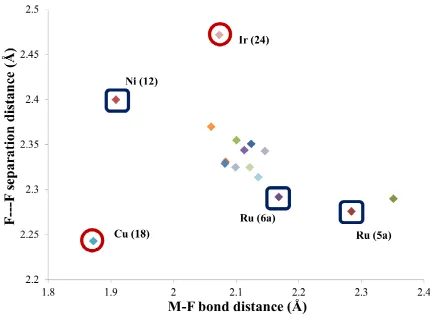
If the F---F separation of the solid-state is plotted as a function of the M-F distance, a rough pattern emerges (Figure 8). Most of the complexes behave as expected and exhibit an inverse relationship of the two distances. As the M-F bond increases in length, the F---F distance becomes shorter, hence indicating a shift towards the formation of a tight ion pair [(L-M+)(HF
2-)] bearing a symmetrical HF2 unit. This is
further demonstrated by the ruthenium bifluoride complex 5a which is situated at the ionic limit of the
correlation. After recrystallization of this complex, NMR analysis indicated the presence of another species (19F NMR signal at −150 ppm) which was assigned to the cationic salt [{RuH(dmpe)
2+}(HF2-)].
Furthermore, this complex exhibits the highest recorded F---F coupling constant (152 Hz) suggesting that the short F---F distance is similarly reflected in solution. These data indicate that this particular complex could be situated at the tipping point towards a complete dissociation of the HF2 unit from the metal
center. However, it should be kept in mind that the nature of the other ligands on the metal could drastically influence the HF2 behavior, as demonstrated by the similar ruthenium complex 6a(only the
Accepted Manuscript
Figure 8. Plot of the F---F separation distance (Å) as a function of the M-F distance (Å) of all thebifluoride complexes reported in Table 2
A closer look at Figure 8 shows two distinct anomalies that are outside the correlation trend; NHC iridium complex 24 and NHC copper complex 18. The former has an unusually long F---F separation
which is apparent both in the solid state (2.457(6); 2.587(6)) and in solution (1J
F-F = 99 Hz). In their
report, the authors attribute this phenomenon to a significant dissociation of the HF bond (M-F---HF), due to a lack of stabilization by the NHC ligand (IiPr) compared to the IPr-based analog (
22). The
[Cu(HF2)(IPr)] complex (18) is unique as it features; 1) the shortest M-F bond (1.872 Å), 2) the shortest
F---F separation distance (2.243 Å), 3) and the smallest M-F---F angle (108o) of all reported bifluorides.
However, when comparing the M-F bond of [Cu(HF2)(IPr)] (18) to that of its monofluoride analog
[CuF(IPr)] (1.820 Å), we realize that this bond is longer in the former. This indicates that the M-F bond contraction in this particular complex is most likely due to the nature of the Cu-F bond rather than an influence of the HF2 moiety. If we disregard the M-F bond distance in this case and focus only on the
F---F distance, we notice that the latter is in the same range as complex 5a. Similarly to 5a, 18 is also placed
![Figure 2. ORTEP representation of the solid-state structure of [Rh(HF2)(FPPh2)(PPh3)2] [65a]](https://thumb-us.123doks.com/thumbv2/123dok_us/8981916.393576/13.612.88.527.323.652/figure-ortep-representation-solid-state-structure-fpph-pph.webp)
![Figure 3. ORTEP representation of the solid-state structure of trans-[Ni(HFAccepted Manuscript2)(2-C4HF2N2)(PEt3)2] (12) (A co-crystallized nickel complex is not shown) [66]](https://thumb-us.123doks.com/thumbv2/123dok_us/8981916.393576/15.612.217.515.124.287/figure-representation-structure-hfaccepted-manuscript-crystallized-nickel-complex.webp)
![Figure 4. Solid-state structure of Accepted Manuscripttrans-[Pd(HF2)(Ph)(PPh3)2] (14a) (Only one of the molecules of the unit cell is shown) [76]](https://thumb-us.123doks.com/thumbv2/123dok_us/8981916.393576/16.612.73.541.171.513/figure-solid-state-structure-accepted-manuscripttrans-molecules-shown.webp)
![Figure 5. ORTEP representation of the solid-state structure of the neutral bifluoride complex Accepted Manuscript[Cu(HF2)(IPr)] (18) [86]](https://thumb-us.123doks.com/thumbv2/123dok_us/8981916.393576/23.612.118.516.73.171/figure-representation-structure-neutral-bifluoride-complex-accepted-manuscript.webp)
![Figure 7. ORTEP representation of the solid-state structure of Accepted Manuscripttrans-[Rh(HF2)(6-Me)(PPh3)2] (26) [99]](https://thumb-us.123doks.com/thumbv2/123dok_us/8981916.393576/28.612.137.513.69.319/figure-ortep-representation-solid-state-structure-accepted-manuscripttrans.webp)