ISSN Online: 1940-9907 ISSN Print: 1940-9893
DOI: 10.4236/jssm.2019.126050 Oct. 9, 2019 742 Journal of Service Science and Management
Product Conceptual Design Method Based on
Intuitionistic Fuzzy Binary Semantics Group
Decision Making
Xiaoguang Zhou
*, Yongpeng Wu, Vendula Polochova
Donlinks School of Economics and Management, University of Science and Technology Beijing, Beijing, China
Abstract
Faced with a fiercely competitive market environment, enterprises are in-vesting huge resources, such as human resource, capital and material re-sources to research and develop new products. The product conceptual de-sign determines the quality, cost and reliability of the final product and is considered to be the most important stage in the product life cycle. Consi-dering the ambiguity of information in the product conceptual design process and the interactivity of experts in selecting conceptual products, a product conceptual design method based on intuitionistic fuzzy binary semantics group decision making is proposed, and a case is used to illustrate the pro-posed method.
Keywords
Product Conceptual Design, Group Decision Making, Binary Semantics, Conceptual Product, Intuitionistic Fuzzy Set
1. Introduction
New product development is a crucial process in maintaining a company’s competitive position and succeeding in dynamic markets. Conceptual design plays an important role in development of new products and redesign of existing products. Brunetti and Golob [1] proposed an approach incorporates a fea-ture-based representation scheme for capturing product semantics in the con-ceptual design phase and links early design with part and assembly modelling. Tay and Gu [2] presented a function-based model for conceptual design. To close the loop for supporting designers in generating design concepts flexibly, fast, and easily, an ontology-based approach for knowledge management that
How to cite this paper: Zhou, X.G., Wu, Y.P. and Polochova, V. (2019) Product Conceptual Design Method Based on Intui-tionistic Fuzzy Binary Semantics Group Decision Making. Journal of Service Science and Management, 12, 742-754.
https://doi.org/10.4236/jssm.2019.126050
Received: September 6, 2019 Accepted: October 6, 2019 Published: October 9, 2019
Copyright © 2019 by author(s) and Scientific Research Publishing Inc. This work is licensed under the Creative Commons Attribution International License (CC BY 4.0).
http://creativecommons.org/licenses/by/4.0/
DOI: 10.4236/jssm.2019.126050 743 Journal of Service Science and Management works along with the graphical modeling tool is explored [3]. Focusing on the solution search phase, Liikkanen and Perttula [4] analysed explicit and implicit problem decomposition techniques and integrated them into a descriptive cog-nitive model. Gehin etal.[5] introduced a method to support designers in the definition of the product lifecycle scenario when designing the elements of the structure of the product, and the proposed method was illustrated via a fridge case study. Li etal. [6] proposed a conceptual design process model to aid mul-ti-stage innovation of product design based on the integration of the essential rules of the axiomatic design model, function-behaviour-structure model, and the guideline of functional creative thinking logics. To draw up a framework proposal for integrated materials and process selection in product design, Al-biñana and Vila [7] defined a workflow based on the relations among the para-meters of the whole life cycle. There are many open source applications in Computer Aided Design; however there is no on-line environment; hence Suaza
etal.[8] presented Web 2.0 online technology for conceptual design. With the development of internet technology, it becomes possible to combine designers from different fields into one team to support product design. A distributed col-laborative product design environment is investigated to support top-down process-oriented product design [9]. The use of digital sculpting software is proposed as a way of producing 3D sketches in the process of conceptual prod-uct design [10]. To enhance the designers’ awareness during the conceptual de-sign of a product service system, Bertoni [11] presented the testing activity of a color-coded 3D visualization approach. Case-based reasoning is a promising methodology for assisting conceptual product design. Li and Xie [12] proposed a modularized generic product model for managing one-of-a-kind production product families. Weiss and Hari [13] improved the systematic method for con-ceptual design of a new product introduced by Pahl and Beitz in 1977. Gani and Ng [14] provided an overview of product design, including four product types: molecular products, formulated products, devices and functional products.
DOI: 10.4236/jssm.2019.126050 744 Journal of Service Science and Management to estimate the cost of new product development in one-of-a-kind production companies. Zhang etal.[21] developed a conceptual model for manufacturers to redesign product and identified additive manufacturing process adoption op-portunities. He et al.[22] devoted to conceptual design evaluation for product environmental footprint using unascertained measure model. Jiang et al. [23] proposed the concept of the performance value of the principle solution, and a scheme is improved.
Multi-objective optimization is used for the conceptual design of a new in-dustrial process for the production of poly dimethyl ethers [24]. Ilgin etal.[25] presented over 190 multi-criteria decision making studies in environmentally conscious manufacturing and product recovery. Bracke et al.[26]introduced a concept, how to make eco- and sustainability-related decisions within the con-ceptual design phase of a subsequently product generation, and the decision concept is explained by an automotive engineering example.
The uncertainties due to the subjective evaluations from engineers and cus-tomers are not considered in most existing conceptual design approaches. For conceptual design of mechatronics system, various tools like fuzzy delphi me-thod, fuzzy interpretive structural modeling, fuzzy analytical network process and fuzzy quality function deployment can be used [27] [28]. Büyüközkan and Güleryüz [29] proposed a combined intuitionistic fuzzy group decision making model that consists of the intuitionistic fuzzy analytic hierarchy process and in-tuitionistic fuzzy technique for order preference by similarity to ideal solution methods for effectively evaluating product development partners. A systematic decision making approach is developed for product conceptual design based on fuzzy morphological matrix to quantitatively evaluate function solution prin-ciples using knowledge and preferences of engineers and customers with subjec-tive uncertainties [30].
The concept of intuitionistic fuzzy set (IFS) was presented by Atanassov [31], which is the generalization of fuzzy set. As an IFS assigns to each element a membership degree, a non-membership degree and a hesitation degree, there-fore, the IFS is more expressive in dealing with uncertain and vague information than fuzzy set. This paper proposed a conceptual design method based on intui-tionistic fuzzy binary semantics group decision making, which is supposed to make the conceptual design process more scientific and reliable.
2. Basic Definitions and Operation Rules
Combining the advantages of intuitionistic fuzzy set and binary semantics, intui-tionistic fuzzy binary semantics can express the uncertainty and fuzziness in the decision-making process well. The definitions and operation rules of intuitionis-tic fuzzy binary semanintuitionis-tics are given as follows.
Definition 1Let S=
{
s ii| =1, 2,,g}
be a language term set, S is the in-tuitionistic fuzzy binary semantic set generated by S, and(
)
[ ]
{
i, i1 , , 0,1 , 1, 1, 2, , 1}
in-DOI: 10.4236/jssm.2019.126050 745 Journal of Service Science and Management dicates that the membership degree of a scheme belongs to si is μ, and the
mem-bership degree belongs to si+1 is v.
Definition 2 Let S=
{
(
µs vsi, i+1)
, ,µ v∈[ ]
0,1 ,µ+ ≤v 1,i=1, 2,,g−1}
be anintuitionistic fuzzy binary semantic set. We can define a mapping f, and which can convert S into corresponding interval values.
(
i, i 1) (
1)
,f µs vs+ = − +b i a i+ (1)
where, a= −1
µ
, b= −1 v. The subscript 1, 2,,g represents thecorres-ponding language variables. Then formula (1)can be further rewritten as:
(
, 1)
[
,1]
,L R
i i
f µs vs+ = +v i − + = µ i µ µ (2)
where, L
u = +v i, R 1
u = − +µ i.
During the process of group decision making, it is necessary to aggregate the evaluation information on the basis of the weight of each indicator, and also need to summarize the opinions of experts. Therefore, the intuitionistic fuzzy binary semantics should be integrated.
Definition 3 Let S=
(
(
µ1 1s v s, 1 2) (
, µ2 2s v s, 2 3)
,,(
µn ns v s, n n+1)
)
be anintui-tionistic fuzzy binary semantic set, and W =
{
ω ω1, 2,,ωn}
is the correspond-ing weight vector, where ω ∈i[ ]
0,1 , and 1 1n i i=ω =
∑
. The weighted average set of intuitionistic fuzzy binary semantics is:( )
1(
(
, 1)
)
1 ,n n L R
i i i i i
i i
TWA s =
∑
=ω
fµ
s vs+ =∑
= ω µ ω µ
(3)The membership degrees of the intuitionistic fuzzy binary semantics can be converted into interval values by formula (1). Hence the operation rules of in-terval values can be adopted. Inspired by the reference [32], the distance between two intuitionistic fuzzy binary semantic intervals can be defined.
Definition 4 If the intuitionistic fuzzy binary semantic sets
(
1, ,2 ,)
k
n
R = r r r
generated from the language terms set S=
{
s ii| =1, 2,,g}
, where k = 1, 2, then the distance between the two sets 1R and R2 is:
(
)
(
( )
( )
)
(
( )
( )
)
1
1 2
1, 1
1 1 1
,
2 2
n
L L R R
i j i j
i j
d R R r r r r
n
θ θ θ
µ µ µ µ
= =
= − + −
∑
(4)
The reverse distance between 1
R and R2 can be defined as:
(
1, 2)
(
1, 2)
T R R = −g d R R (5)
For formula (5), the larger the reverse distance T, the closer the set 1
R and
2
R are, and the more similar the two sets are. For 1
R and 2
R , the following
properties hold.
1)
(
1 2)
0≤T R R , ≤g; 2)
(
1 2) (
2 1)
, ,
T R R =T R R ;
3) T R R
(
1, 2)
=g, if and only if 1R and R2 are completely similar;
4)
(
1 2)
, 0
T R R = , if and only if R1 and R2 are completely different.
Since the proof is simple, hence it is ignored here.
DOI: 10.4236/jssm.2019.126050 746 Journal of Service Science and Management process? The technique for order preference by similarity to ideal solution (TOPSIS) method is adopted in this paper. The basic principle is to calculate the distances between different opinions according to formulas (4) and (5). If the decision maker’s opinion differs greatly from the ideal optimal opinion, then a smaller weight is assigned to the decision maker. Otherwise, a larger weight is assigned.
Definition 5 The weight of the kth decision maker can be determined as,
(
) (
)
(
) (
)
1
, ,
, 1, 2, , .
, ,
k k
k l k k
k
T R R d R R
k l
T R R d R R
λ
+ −
+ −
=
+
= =
+
∑
(6)
where, l indicates the number of decision makers; λk represents the weight of the kth decision maker; T R R
(
k, +)
denotes the inverse distance between the opinion of the kth decision maker and the ideal optimal opinion; d R(
k,R−)
indicates the distance between the opinion of the kth decision maker and the ideal worst opinion; R+ is the ideal optimal opinion and R− is the ideal worst
opinion. The distance and the reverse distance are simultaneously considered because for a cell in a large interval, the cell closest to the left border is not nec-essarily the farthest from the right border.
In practice, the selection of a conceptual product is generally based on the comprehensive optimal principle, that is, the combination of all aspects of indi-cators to choose the best comprehensive performance. In this paper, the idea of TOPSIS method is adopted, that is, the conceptual product is selected according to the reverse distance between each alternative and the ideal optimal scheme and also the distance from the ideal worst one. The alternative closest to the ideal optimal solution and the farthest from the ideal worst solution is the best solution.
Definition 6 There are two scheme X1 and X2, if
(
1,) (
1,) (
2,) (
2,)
T X R+ +d X R− >T X R+ +d X R− (7)
Then, the scheme X1 is superior to the scheme X2.
3. Group Decision Making Process Based on Intuitionistic
Fuzzy Binary Semantics
Let X =
{
X X1, 2,,Xm}
be the set of alternative conceptual products,{
1, 2, , n}
C= C C C indicates the evaluation indicators, Cj denotes the jth
indi-cator, j=1, 2,,n. Suppose l decision makers are invited to evaluate
concep-tual products, and Ek indicates the evaluation opinion of the kth decision maker,
marked as E=
{
E E1, 2,,El}
. λk represents the weight of the kth decisionmaker, where 1 1
l k k= λ =
∑
, k=1, 2,,l, and λk is a normalized weight vector.DOI: 10.4236/jssm.2019.126050 747 Journal of Service Science and Management
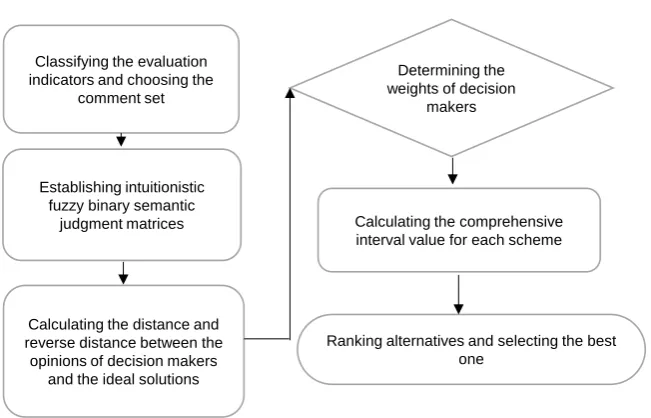
Figure 1. Intuitionistic fuzzy binary semantic group decision process.
The optimal conceptual product selection process is as follows.
Step 1: According to the attribute types of evaluation indices, the corres-ponding comment sets are selected. The linguistic variables in the comment sets represent the evaluation opinions of decision makers. For instance, a five-level comment set is defined as below:
For benefit-based indicators: the comment set is {s1 (very low), s2 (low), s3
(medium), s4 (high), s5 (very high)}. For cost-based indicators: the comment set
is {s1 (very high), s2 (high), s3 (medium), s4 (low), s5 (very low)}.
It should be pointed out that different levels of comment sets, such as sev-en-level or nine-level, can be used according to actual conditions.
Step 2: The decision makers evaluate alternative conceptual products and thus the corresponding judgment matrices are formed. Assume that there are
(
1, 2, ,)
jC j= n indicators of X ii
(
=1, 2,,m)
conceptual product need to be evaluated by Ek(
k=1, 2,,l)
decision makers, and the evaluation opinionk ij
r is denoted by intuitionistic fuzzy binary semantics, that is,
( )
( )
(
, 1)
k
ij i ij i ij
r = µs x vs+ x , xij represents the Cj attribute of the product Xi. The
decision opinion of each decision maker constitutes an intuitionistic fuzzy bi-nary semantic decision matrix k
( )
kij m n
R r
× =
.
11 12 1
21 22 2
1 2
k k k
m
k k k
k m
k k k
n n nm
r r r
r r r
R
r r r
=
The intuitionistic fuzzy binary semantic decision matrix can be rewritten ac-cording to formulas (1) and (2), and the corresponding interval evaluation val-ues are obtained. The opinions of decision makers are assembled according to formula (3).
Step 3: According to formulas (4) and (5), the distances and reverse distances Classifying the evaluation
indicators and choosing the comment set
Establishing intuitionistic fuzzy binary semantic
judgment matrices
Calculating the distance and reverse distance between the
opinions of decision makers and the ideal solutions
Calculating the comprehensive interval value for each scheme
Determining the weights of decision
makers
DOI: 10.4236/jssm.2019.126050 748 Journal of Service Science and Management between the opinions of decision makers and the virtual optimal/worst scheme are calculated.
Step 4: According to formula (6), the weights of decision makers can be achieved. The formula (3) is used to aggregate the opinions of the various deci-sion makers, and the evaluation interval values of alternative conceptual prod-ucts are acquired.
Step 5: Select the best conceptual product on the basis of formula (7).
4. Product Conceptual Design Based on Intuitionistic Fuzzy
Binary Semantics Group Decision Making Method
Assume that there are four types of conceptual products have been selected through the process of product conceptual design, as shown in Table 1.
A total of four decision makers further evaluated the four kinds of alternative conceptual products: product function C1, product structure C2, operation
beha-vior C3, and product cost C4. The weights of indicators can be acquired by
me-thods such as analytic network process, entropy method, and principal compo-nent analysis. This paper does not focus on the weights of indicators. Suppose these four indicators have the same weights:
(
) (
T)
TT
1, 2, 3, 4 0.25, 0.25, 0.25, 0.25
W = ω ω ω ω =
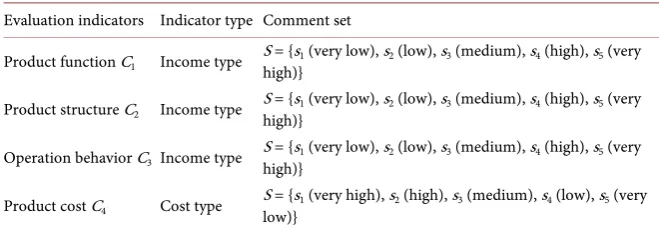
1) Determining the comment sets, as shown in Table 2.
2) Assume that the evaluation information given by the four decision makers are as follows.
4 5 3 4 2 3 2 3
3 4 4 5 3 4 2 3
1
2 3 2 3 2 3 4 5
3 4 3 4 3 4 3 4
0.8 , 0.1 0.3 , 0.4 0.6 , 0.2 0.2 , 0.5 0.6 , 0.2 0.7 , 0.2 0.5 , 0.3 0.2 , 0.6 0.8 , 0.2 0.8 , 0.2 0.7 , 0.2 0.2 , 0.6 0.3 , 0.4 0.3 , 0.6 0.5 , 0.3 0.2 , 0.7
s s s s s s s s
s s s s s s s s
R
s s s s s s s s
s s s s s s s s
=
4 5 3 4 2 3 2 3
2 3 4 5 3 4 2 3
2
2 3 2 3 2 3 4 5
3 4 3 4 3 4 3 4
0.2 , 0.5 0.2 , 0.7 0.6 , 0.2 0.6 , 0.3 0.3 , 0.6 0.3 , 0.7 0.5 , 0.2 0.5 , 0.2 0.3 , 0.6 0.7 , 0.2 0.6 , 0.3 0.8 , 0.2 0.3 , 0.5 0.4 , 0.5 0.4 , 0.5 0.2 , 0.5
s s s s s s s s
s s s s s s s s
R
s s s s s s s s
s s s s s s s s
=
4 5 3 4 2 3 3 4
2 3 4 5 3 4 2 3
3
2 3 2 3 2 3 4 5
3 4 3 4 3 4 3 4
0.2 , 0.5 0.2 , 0.8 0.5 , 0.2 0.7 , 0.2 0.5 , 0.3 0.5 , 0.3 0.8 , 0.2 0.3 , 0.5 0.3 , 0.6 0.8 , 0.2 0.6 , 0.4 0.6 , 0.2 0.3 , 0.5 0.4 , 0.5 0.4 , 0.5 0.3 , 0.5
s s s s s s s s
s s s s s s s s
R
s s s s s s s s
s s s s s s s s
=
4 5 3 4 2 3 2 3
3 4 4 5 2 3 2 3
4
2 3 2 3 2 3 4 5
3 4 3 4 3 4 3 4
0.3 , 0.5 0.7 , 0.1 0.2 , 0.6 0.7 , 0.1 0.4 , 0.4 0.5 , 0.4 0.4 , 0.5 0.2 , 0.6 0.6 , 0.1 0.5 , 0.4 0.4 , 0.4 0.8 , 0.2 0.3 , 0.5 0.6 , 0.2 0.8 , 0.1 0.4 , 0.4
s s s s s s s s
s s s s s s s s
R
s s s s s s s s
s s s s s s s s
=
DOI: 10.4236/jssm.2019.126050 749 Journal of Service Science and Management
Table 1. Alternative conceptual products.
Product Category Product Characteristics
Class A Class B Class C Class D
Focus on functional design and improving functional innovation Focus on improving product structure performance
Focus on cost savings
[image:8.595.208.538.183.298.2]Not specializing, but considering many aspects
Table 2. Evaluation indicators and comment sets.
Evaluation indicators Indicator type Comment set
Product function C1 Income type S = {shigh)} 1 (very low), s2 (low), s3 (medium), s4 (high), s5 (very
Product structure C2 Income type S = {shigh)} 1 (very low), s2 (low), s3 (medium), s4 (high), s5 (very
Operation behavior C3 Income type S = {shigh)} 1 (very low), s2 (low), s3 (medium), s4 (high), s5 (very
Product cost C4 Cost type S = {slow)} 1 (very high), s2 (high), s3 (medium), s4 (low), s5 (very
According to formulas (1) and (2), the above intuitionistic fuzzy binary se-mantic sets can be converted into:
( )
[
] [
] [
] [
]
[
] [
] [
] [
]
[
] [
] [
] [
]
[
] [
] [
] [
]
14.1, 4.2 3.4, 3.7 2.2, 2.4 2.5, 2.8 3.2, 3.4 4.2, 4.3 3.3, 3.5 2.6, 2.8 2.2, 2.2 2.2, 2.2 2.2, 2.3 4.6, 4.8 3.4, 3.7 3.6, 3.7 3.3, 3.5 3.7, 3.8 f R =
( )
[
] [
] [
] [
]
[
] [
] [
] [
]
[
] [
] [
] [
]
[
] [
] [
] [
]
24.5, 4.8 3.7, 3.8 2.2, 2.4 2.3, 2.4 2.6, 2.7 4.7, 4.7 3.2, 3.5 2.2, 2.5 2.6, 2.7 2.2, 2.3 2.3, 2.4 4.2, 4.2 3.5, 3.7 3.5, 3.6 3.5, 3.6 3.5, 3.8 f R =
( )
[
] [
] [
] [
]
[
] [
] [
] [
]
[
] [
] [
] [
]
[
] [
] [
] [
]
34.5, 4.8 3.8, 3.8 2.2, 2.5 3.2, 3.3 2.3, 2.5 4.3, 4.5 3.2, 3.2 2.5, 2.7 2.6, 2.7 2.2, 2.2 2.4, 2.4 4.2, 4.4 3.5, 3.7 3.5, 3.6 3.5, 3.6 3.5, 3.7 f R =
( )
[
] [
] [
] [
]
[
] [
] [
] [
]
[
] [
] [
] [
]
[
] [
] [
] [
]
44.5, 4.7 3.1, 3.3 2.6, 2.8 2.1, 2.3 3.4, 3.6 4.4, 4.5 2.5, 2.6 2.6, 2.8 2.1, 2.4 2.4, 2.5 2.4, 2.6 4.2, 4.2 3.5, 3.7 3.2, 3.4 3.1, 3.2 3.4, 3.6 f R =
According to formula (3), the information of evaluation indices are assembled, and the comprehensive evaluation intervals of the four types of conceptual products are obtained:
DOI: 10.4236/jssm.2019.126050 750 Journal of Service Science and Management
( )
[
]
[
]
[
]
[
]
2 3.18, 3.35 3.18, 3.35 2.83, 2.90 3.50, 3.68 f R = ,( )
[
]
[
]
[
]
[
]
3 3.43, 3.60 3.08, 3.23 2.85, 2.93 3.50, 3.65 f R = ,( )
[
]
[
]
[
]
[
]
4 3.08, 3.28 3.23, 3.38 2.78, 2.93 3.30, 3.48 f R = ,The virtual optimal and worst comprehensive evaluation interval values of the four types of conceptual products are:
( )
[
]
[
]
[
]
[
]
5.00, 5.00 5.00, 5.00 5.00, 5.00 5.00, 5.00 f R+ = ,
( )
[
]
[
]
[
]
[
]
1.00,1.00 1.00,1.00 1.00,1.00 1.00,1.00 f R− = .
1) According to formulas (4) and (5), the distances between each alternative conceptual product and the virtual worst scheme and their reverse distances from the virtual optimal scheme were calculated, where θ = 2.
(
)
[
]
[
]
[
]
[
]
1 1.84, 2.17 1.59, 2.41 , 2.16,1.84 1.42, 2.59 d R R = ,
(
)
[
]
[
]
[
]
[
]
2 1.74, 2.26 1.74, 2.26 , 2.14,1.86 1.42, 2.59 d R R = ,
(
)
[
]
[
]
[
]
[
]
3 1.49, 2.51 1.85, 2.15 , 2.11,1.89 1.43, 2.58 d R R = ,
(
)
[
]
[
]
[
]
[
]
4 1.83, 2.18 1.70, 2.30 , 2.15, 2.85 1.61, 2.39 d R R = ,
DOI: 10.4236/jssm.2019.126050 751 Journal of Service Science and Management the semantic set elements is s5− =s1 4 in this paper, the distance and reverse
distance should be ranged between 0 and 4. That is, for formula (5), it could be modified as:
(
1, 2)
4(
1, 2)
T R R = −d R R .
2) Calculating the weights of each decision maker on the basis of formula (6): 0.24 0.25 0.27 0.24
0.27 0.25 0.23 0.25 0.25 0.25 0.25 0.25 0.26 0.26 0.25 0.23
λ
=
.
In the above matrix, each row denotes the weights of a conceptual product, and each column indicates the weights of a decision maker. That is to say, each alternative conceptual product has its own weight, and each decision maker has different weights for different alternative conceptual products. The reason is that each decision maker has a preference for each candidate conceptual product. This preference is reflected by the evaluation weight for different schemes. The distances between the comprehensive evaluation interval values and the ideal optimal/worst scheme are different. For each type of alternative conceptual product, the process of determining the weight of each decision maker in line with formula (6) is actually the process of gathering opinions of decision makers. According to formula (3), the final comprehensive evaluation interval values of the four types of alternative conceptual products are obtained:
( )
[
]
[
]
[
]
[
]
3.19, 3.38 3.20, 3.37 2.81, 2.91 3.45, 3.62 f X
=
3) According to formulas (4) and (5), the distances between each candidate conceptual product and the virtual optimal/worst scheme are calculated respec-tively. The results are as follows:
(
)
[
]
[
]
[
]
[
]
1.71, 2.29 1.72, 2.29 ,
2.14,1.86 1.47, 2.54 d X R
=
where, the first column denotes the distance from the optimal scheme, and the second column represents the distance from the worst scheme. The sum of dis-tance between each alternative conceptual product and the ideal optimal/worst conceptual product can be calculated:
(
) (
)
4.58 4.57
, ,
3.72 5.07
T X R+ d X R−
+ =
DOI: 10.4236/jssm.2019.126050 752 Journal of Service Science and Management According to formula (7), the ranking of the four alternative conceptual products is: D > A > B > C, then the kind of conceptual product D is the optimal one. This is in line with the actual situation. Product D is not specialized, how-ever, various factors are comprehensive considered.
5. Conclusion
The conceptual product is the prototype of the final product, which is expected to improve people’s consumption experience. The conceptual product design is based on the evaluation of the current product and on the assumption of future demand. Therefore, it is important to choose the best conceptual product. This paper proposes a conceptual product selection method based on intuitionistic fuzzy binary semantics group decision making, which can better deal with the fuzziness and uncertainty in the decision making process, and can integrate the opinions of various decision makers to select the optimal conceptual product as well. The case study shows that the proposed method can solve this kind of problem well.
Acknowledgements
This work was supported by “the National Natural Science Foundation of China (No. 71771023)”.
Conflicts of Interest
The authors declare no conflicts of interest.
References
[1] Brunetti, G. and Golob, B. (2000) A Feature-Based Approach towards an Integrated Product Model Including Conceptual Design Information. Computer-Aided De-sign, 32, 877-887.https://doi.org/10.1016/S0010-4485(00)00076-2
[2] Tay, F.E.H. and Gu, J.X. (2002) Product Modeling for Conceptual Design Support. Computer in Industry, 48, 143-155.https://doi.org/10.1016/S0166-3615(02)00014-3 [3] Chang, X., Sahin, A. and Terpenny, J. (2008) An Ontology-Based Support for
Product Conceptual Design. Robotics and Computer-Integrated Manufacturing, 24, 755-762.https://doi.org/10.1016/j.rcim.2008.03.004
[4] Liikkanen, L.A. and Perttula, M. (2009) Exploring Problem Decomposition in Con-ceptual Design among Novice Designers. Design Studies, 30, 38-59.
https://doi.org/10.1016/j.destud.2008.07.003
[5] Gehin, A., Zwolinski, P. and Brissaud, D. (2009) Integrated Design of Product Life-cycles—The Fridge Case Study. CIRP Journal of Manufacturing Science and Tech-nology, 1, 214-220.https://doi.org/10.1016/j.cirpj.2009.05.002
[6] Li, W., Li, Y., Wang, J. and Liu, X. (2010) The Process Model to Aid Innovation of Products Conceptual Design. Expert Systems with Applications, 37, 3574-3587. https://doi.org/10.1016/j.eswa.2009.10.034
DOI: 10.4236/jssm.2019.126050 753 Journal of Service Science and Management [8] Suaza, R.L., Magal-Royo, T. and Albiñana, B.J. (2012) New Online Services Oriented
to the Conceptual Design of Industrial Products through the Application of Web 2.0. Procedia—Social and Behavioral Sciences, 51, 682-686.
https://doi.org/10.1016/j.sbspro.2012.08.224
[9] Wu, T., Pei, X., Lu, Y., Chen, C. and Gao, L. (2013) A Distributed Collaborative Product Design Environment Based on Semantic Norm Model and Role-Based Access Control. Journal of Network and Computer Applications, 36, 1431-1440. https://doi.org/10.1016/j.jnca.2013.02.018
[10] Alcaide-Marzal, J., Diego-Más, J.A., Asensio-Cuesta, S. and Piqueras-Fiszman, B. (2013) An Exploratory Study on the Use of Digital Sculpting in Conceptual Product Design. Design Studies, 34, 264-284.https://doi.org/10.1016/j.destud.2012.09.001 [11] Bertoni, A. (2013) Analyzing Product-Service Systems Conceptual Design: The
Ef-fect of Color-Coded 3D Representation. Design Studies, 34, 763-793. https://doi.org/10.1016/j.destud.2013.02.003
[12] Li, B.M. and Xie, S.Q. (2013) Product Similarity Assessment for Conceptual One-of-a-Kind Product Design: A Weight Distribution Approach. Computers in Industry, 64, 720-731.https://doi.org/10.1016/j.compind.2013.04.001
[13] Weiss, M.P. and Hari, A. (2015) Extension of the Pahl & Beitz Systematic Method for Conceptual Design of a New Product. Procedia CIRP, 36, 254-260.
https://doi.org/10.1016/j.procir.2015.03.010
[14] Gani, R. and Ng, K.M. (2015) Product Design—Molecules, Devices, Functional Products, and Formulated Products. Computers & Chemical Engineering, 81, 70-79. https://doi.org/10.1016/j.compchemeng.2015.04.013
[15] Lager, T. (2017) A Conceptual Framework for Platform-Based Design of Non-As- sembled Products. Technovation, 68, 20-34.
https://doi.org/10.1016/j.technovation.2017.09.002
[16] Szejka, A.L., Junior, O.C., Panetto, H., Aubry, A. and Loures, E.F.R. (2017) A Se-mantic Reconciliation View to Support the Interoperable Information Relationships in Product Design and Manufacturing. IFAC-PapersOnLine, 50, 15896-15903. https://doi.org/10.1016/j.ifacol.2017.08.2357
[17] Bourgeois-Bougrine, S., Buisine, S., Vandendriessche, C., Glaveanu, V. and Lubart, T. (2017) Engineering Students’ Use of Creativity and Development Tools in Con-ceptual Product Design: What, When and How? Thinking Skills and Creativity, 24, 104-117.https://doi.org/10.1016/j.tsc.2017.02.016
[18] Ko, Y. (2017) Modeling a Hybrid-Compact Design Matrix for New Product Innova-tion. Computers & Industrial Engineering, 107, 345-359.
https://doi.org/10.1016/j.cie.2016.04.016
[19] Filho, M.F., Liao, Y., Loures, E.R. and Canciglieri, O. (2017) Self-Aware Smart Products: Systematic Literature Review, Conceptual Design and Prototype Imple-mentation. Procedia Manufacturing, 11, 1471-1480.
https://doi.org/10.1016/j.promfg.2017.07.278
[20] Relich, M. and Pawlewski, P. (2018) A Case-Based Reasoning Approach to Cost Es-timation of New Product Development. Neurocomputing, 272, 40-45.
https://doi.org/10.1016/j.neucom.2017.05.092
Envi-DOI: 10.4236/jssm.2019.126050 754 Journal of Service Science and Management ronmental Footprint. Journal of Cleaner Production, 172, 3066-3080.
https://doi.org/10.1016/j.jclepro.2017.11.104
[23] Jiang, S., Jing, L., Sun, T., Xu, Q., Peng, X. and Li, J. (2019) A Conceptual Scheme Improvement Approach Based on the Performance Value of the Principle Solution Taking a Coal Mining Machine as a Case Study. Computers in Industry, 105, 17-34. https://doi.org/10.1016/j.compind.2018.10.009
[24] Burger, J. and Hasse, H. (2013) Multi-Objective Optimization Using Reduced Mod-els in Conceptual Design of a Fuel Additive Production Process. Chemical Engi-neering Science, 99, 118-126.https://doi.org/10.1016/j.ces.2013.05.049
[25] Ilgin, M.A., Gupta, S.M. and Battaïa, O. (2015) Use of MCDM Techniques in Envi-ronmentally Conscious Manufacturing and Product Recovery: State of the Art. Journal of Manufacturing Systems, 37, 746-758.
https://doi.org/10.1016/j.jmsy.2015.04.010
[26] Bracke, S., Yamada, S., Kinoshita, Y., Inoue, M. and Yamada, T. (2017) Decision Making within the Conceptual Design Phase of Eco-Friendly Products. Procedia Manufacturing, 8, 463-470.https://doi.org/10.1016/j.promfg.2017.02.059
[27] Parameshwaran, R., Baskar, C. and Karthik, T. (2015) An Integrated Framework for Mechatronics Based Product Development in a Fuzzy Environment. Applied Soft Computing, 27, 376-390.https://doi.org/10.1016/j.asoc.2014.11.013
[28] Zhou, X.G., Wang, J.N. and Sun, F. (2018) Product Conceptual Design Based on Intuitionistic Fuzzy Analytic Network Process. Academic Journal of Manufacturing Engineering, 16, 118-127.
[29] Büyüközkan, G. and Güleryüz, S. (2016) A New Integrated Intuitionistic Fuzzy Group Decision Making Approach for Product Development Partner Selection. Computers & Industrial Engineering, 102, 383-395.
https://doi.org/10.1016/j.cie.2016.05.038
[30] Ma, H., Chu, X., Xue, D. and Chen, D. (2017) A Systematic Decision Making Ap-proach for Product Conceptual Design Based on Fuzzy Morphological Matrix. Ex-pert Systems with Applications, 81, 444-456.
https://doi.org/10.1016/j.eswa.2017.03.074
[31] Atanassov, K.T. (1986) Intuitionistic Fuzzy Sets. Fuzzy Sets & Systems, 20, 87-96. https://doi.org/10.1016/S0165-0114(86)80034-3
[32] Zhang, H. and Yu, L. (2013) New Distance Measures between Intuitionistic Fuzzy Sets and Interval-Valued Fuzzy Sets. Information Sciences, 245, 181-196.