The stability and nonlinear evolution of
quasi-geostrophic toroidal vortices
Jean N. Reinaud
†
and David G. Dritschel
Mathematical Institute, University of St Andrews, North Haugh, St Andrews, KY16 9SS, UK (Received xx; revised xx; accepted xx)
We investigate the linear stability and nonlinear evolution of a three-dimensional toroidal vortex of uniform potential vorticity under the quasi-geostrophic approximation. The torus can undergo a primary instability leading to the formation of a circular array of vortices, whose radius is about the same as the major radius of the torus. This occurs for azimuthal instability mode numbersm>3, on sufficiently thin tori. The number of vortices corresponds to the azimuthal mode number of the most unstable mode growing on the torus. This value of m depends on the ratio of the torus’ major radius to its minor radius, with thin tori favouring high modemvalues. The resulting array is stable when m= 4 andm= 5 and unstable whenm= 3 andm>6. Whenm= 3 the array has barely formed before it collapses toward its centre with the ejection of filamentary debris. When m= 6 the vortices exhibit oscillatory staggering, and when m >7 they exhibit irregular staggering followed by substantial vortex migration, e.g. of one vortex to the centre whenm= 7. We also investigate the effect of an additional vortex located at the centre of the torus. This vortex alters the stability properties of the torus as well as the stability properties of the circular vortex array formed from the primary toroidal instability. We show that a like-signed central vortex may stabilise a circular m-vortex array withm>6.
1. Introduction
Motivated by large scale fluid flows in the Earth’s ocean and atmosphere and in the atmospheres of the gas-giant planets, all of which are strongly influenced by the planetary rotation and stable density stratification, we use QG theory (quasi-geostrophic theory, see §2) to study a set of vortex interaction problems of fundamental interest. They are particularly relevant to the recent discovery, by the Juno spacecraft, of circular arrays of vortices surrounding the poles of Jupiter (Adriani et al. 2018). As is well known, QG theory is the simplest mathematical model that self-consistently captures the essential dynamics of such flows, in which the potential vorticity (PV) distribution evolves nonlinearly by advection and from which the advecting velocity field is obtainable, together with the pressure and temperature fields, by PV inversion (Hoskins, McIntyre & Robertson, 1985), solving an elliptic problem for given PV at each time step.
In flows of this kind, the PV field tends to self-organise into elongated structures such as jetstreams and shear lines, or into compact structures such as vortices (e.g. Williams 1978, Dritschel & McIntyre 2008). In this paper, we investigate the linear stability and nonlinear evolution of an idealized shear line in the form of a torus of uniform PV, embedded in an otherwise uniformly-rotating and linearly-stratified three-dimensional fluid. We also investigate cases in which, at the outset, a compact vortex is introduced at the centre of the torus. Such cases turn out to be of special interest for Jupiter.
The torus is found to be generally unstable, depending on the ratioR0/r0of its major
(centerline) radiusR0to its minor (cross-sectional) radiusr0, and on the strength and size
of the central vortex if any. ForR0/r0&5, the instability causes the torus to self-organise
into an array of similar-sized vortices lying approximately on a circle. The numbermof vortices is typically equal to the azimuthal mode number of the most unstable mode of the torus. The value ofmincreases with the radius ratioR0/r0. The circular vortex array
may itself be unstable and is sometimes dubbed “Thomson’s vortices” after the seminal work of Thomson (1883), who considered the stability properties of a circular array of identical, equally spaced point vortices, with no central vortex, governed by the two-dimensional Euler equations. (Henceforth, though, we use self-explanatory terms such as “circular vortex array”, or “circularm-vortex array” as appropriate.)
Thomson showed that his circular m-vortex array is a steadily-rotating equilibrium state, stable to small disturbances form67 (marginally so form= 7) and unstable for m >7. Dritschel (1985) extended Thomson’s study to finite-sized, uniform-vorticity two-dimensional vortices governed by Euler’s equations, still with no central vortex, showing that m = 7 vortices are then unstable and thatm < 7 vortices become unstable at a critical vortex size that increases with decreasingm. Prior to that, Morikawa & Svenson (1971) had extended Thomson’s point-vortex study by including a central point vortex and by generalising to the QG shallow-water model, which contains Euler’s equations as a special case. More recently, a corresponding set of problems including finite-volume as well as point vortices were addressed by Reinaud (2018) within the same three-dimensional, linearly-stratified QG framework as in the present paper. Reinaud found that, in the absence of a central vortex, only m 6 5 point vortices are stable while m > 6 are unstable, in contrast with Thomson’s results. Reinaud also found unstable finite-volume vortex configurations for any given m when the vortices are larger than a critical size, which again increases with decreasing m.
Precursors to the present torus problem include the work of Dritschel (1988) and Kossin & Schubert (2001) on its two-dimensional counterpart, an annulus of uniform PV, studying its early-time nonlinear evolution, and the work of Morel & Carton (1994) on the stability of an annulus plus a finite-sized central vortex.
In this paper we show that form>3 the three-dimensional QG torus self-organises into an approximately circularm-vortex array, of approximately equal-sized vortices, which itself appears to be stable for just two valuesm= 4 orm= 5 on the evidence from long-time numerical integrations. The addition of a like-signed central vortex may stabilise arrays for whichm >5, in agreement with Reinaud (2018). In cases where them-vortex array is unstable we find a rich variety of strongly nonlinear behaviours, including a case withm= 8 where the central vortex undergoes chaotic outward migration and becomes the outermost vortex.
The paper is laid out as follows. First we recall the standard QG equations in §2. This is followed by a treatment of the linear stability properties of the torus in §3, with and without a central vortex. In cases of instability the long-time nonlinear evolution is studied in§4. Finally, some conclusions and perspectives for future research are offered in
§5, including a brief discussion of the casesm= 5 andm= 8 observed on Jupiter, near its south and north poles respectively, in which stabilizing central vortices are present.
2. Mathematical set-up
of the background rotation. The flow is inviscid and adiabatic. We define the Rossby number Ro = U/(f L) and the Froude number F r = U/(N H), where U is a typical horizontal velocity scale, f is the Coriolis frequency, assumed constant, L is a typical horizontal length scale,N is the buoyancy or Brunt-V¨ais¨al¨a frequency andH is a typical vertical length scale. The Rossby number may also be seen as the ratio of a typical relative vertical vorticity U/Lto the planetary vorticity f, while the Froude number may also be seen as the ratio of a typical horizontal vorticityU/H to the buoyancy frequencyN. The QG model results from an asymptotic expansion inRoassumingF r∼Ro1.
For simplicity we assume both f and N are constant. By using new coordinates in which the vertical coordinate is stretched by the ratio N/f, the equations of motion become independent of bothf andN. Hence the results presented in this paper are valid for all constantN andf.
The QG equations of motion consist of an inversion problem giving the streamfunction ψin terms of the QG PV,
∂2ψ
∂x2 +
∂2ψ
∂y2 +
∂2ψ
∂z2 =q , (2.1)
which is Poisson’s equation in Cartesian coordinates, together an equation expressing material conservation of QG PV,
∂q ∂t +u
∂q ∂x +v
∂q
∂y = 0, (2.2)
where
u=−∂ψ
∂y and v= ∂ψ ∂x
is the advecting geostrophic horizontal velocity, see Vallis (2006) for details, also Hoskins et al,(1985,§5b). The vertical velocity (appearing at second order inRo) is not involved in the advection of q.
3. Linear stability
3.1. The basic state
We consider a torus centred at the origin and spanned bynl1 horizontal layers of
equal thicknessδz. Within thekth horizontal layer the torus boundary is represented by two contours, one at the inner boundary Ck− and the other at the outer boundaryCk+. There are thereforenc = 2nl contours altogether bounding the torus. The contoursCk∓
lying at heightzkwith|zk|< r0are initially circular with radiire∓(zk) =R0∓ p
r2 0−zk2.
We denoter∓e,k(θ) as the position vector of a point on the unperturbed circular contour
C∓
k at azimuthal angleθ.
3.2. The disturbance equation We next consider infinitesimal radial perturbations of the form
rk∓(θ, t) =re∓(zk) +
ηk∓(θ, t) r∓e(zk)
, (3.1)
whereηk has units of area (Dritschel 1995). Due to symmetry, we may expressη∓k as
For an axisymmetric flow, in the linearised equations, the evolution of the disturbance areaη∓k is governed by
∂η∓k ∂t +Ω
∓
k
∂η∓k ∂θ =
∂Fk∓ ∂θ
Fk∓(θ) =−
nc X
l=1
∆ql
Z 2π
0
η+l (θ0)Gk,l(|r∓e,k(θ)−r
+
e,l(θ
0) |) dθ0−
Z 2π
0
ηl−(θ0)Gk,l(|re,k∓ (θ)−r−e,l(θ0)|) dθ0
, (3.3)
where Ωk∓ is the constant basic-state angular velocity around contour Ck∓, ∆ql is the
PV jump across contour Cl∓ (for a uniform-PV torus, all of the ∆ql are equal). Gk,l(r)
is the Green’s function giving the influence of a point in layer l on a point in layer k separated by a distancer(see Appendix A in Dritschel (2002) as well as Dritschel (1995) and Reinaud & Dritschel (2002) for the derivation of (3.3)).
3.3. The eigenvalue problem
Substituting ηk and ηl by their expressions in equation (3.2) leads to an eigenvalue
problem involving a real matrix of size 2×ncsquared — for each azimuthal mode number
m. The eigenvaluesσ are generally complex. The real part σr is the growth rate while
the imaginary partσi is the frequency. Since the original system is Hamiltonian, if σis
an eigenvalue, then so are−σ, σ∗and −σ∗ where∗ denotes complex conjugation. Without loss of generality, we take the uniform PV in the torus to beq0= 2π(all PV
jumps∆ql are then equal to q0). This defines a PV-based timescaleTP V = 6π/q0 = 3,
which physically corresponds to the rotation period of a spherical vortex of PV q0. The
volume of the torus is exactlyV0= 2π2R0r0. Without loss of generality we setr0= 0.5
so that the total vertical extent of the torus is h0 = 1. The layer thickness is then
δz=h0/nl= 1/nl.
3.4. Results
The results presented are obtained using the highest vertical resolution, nl = 51.
Smaller values of nl were used for testing and give closely similar results. Each contour
C∓
k is discretised by an equal number of nodes,np= 400.
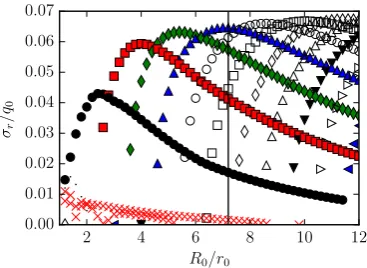
The growth ratesσrof the unstable modes are summarised in figure 1 for 1.26R0/r06
12. An increment in relative radiusR0/r0of∆(R0/r0) = 0.2 is used between cases. The
frequencies of the modes are generally non-zero, and so the disturbances propagate while amplifying. We find that, for eachm, at most only one eigenvalue is found withσr>0.
This allows us to refer tomas the ‘mode’ of instability.
Notably, the vertical eigenstructures of the modes are, with few exceptions, upright or quasi-barotropic in the sense of being nearly independent of z, hence nearly free of vertical shear. The mid-levels near z = 0 are generally most amplified, but the vertical variation is weak apart from near the top and bottom of the torus, where the amplitudes diminish.
The growth rates and frequencies of the modes for R0/r0 = 7.2 are summarised in
table 1. The unstable modes, sorted in order of decreasing σr, arem= 5,6,4, 7,3 and
2.
Overall, we find that unstable modes with increasing azimuthal mode numbermappear sequentially asR0/r0increases. Thus thick tori with smallR0/r0are most unstable to low
2 4 6 8 10 12
R0/r0
0.00 0.01 0.02 0.03 0.04 0.05 0.06 0.07
σr
/q
[image:5.493.159.343.65.199.2]0
Figure 1. Growth rates σr of the unstable modes vs the torus normalised radius R0/r0 for
1 6 R0/r0 6 12, with ∆(R0/r0) = 0.2. Symbols indicate the azimuthal mode number of the
mode:m= 1×, 2•, 3, 4, 5N, 6◦, 7, 8♦, 9,4, 10,H, 11 B, 12J. The vertical line marks the caseR0/r0= 7.2 which is further detailed in table 1.
m σr/q0 σi/q0
5 6.46×10⁻² ±4.58×10⁻² 6 6.14×10⁻² ±5.53×10⁻² 4 5.73×10⁻² ±3.82×10⁻² 7 4.45×10⁻² ±6.86×10⁻² 3 4.13×10⁻² ±3.13×10⁻² 2 1.71×10⁻² ±2.42×10⁻²
Table 1.Mode numbersm, growth ratesσr and frequenciesσiof the 6 most unstable modes (arising as complex conjugate pairs) forR0/r0= 7.2.
the torus increases allowing more room to fit disturbances of a characteristic wavelength λ. Qualitatively,m∝R0/r0. WhenR0/r01, figure 1 indicates that a number of modes
have closely comparable growth rates. This is important for the nonlinear dynamics discussed in §4.
The growth rate curvesσrvsR0/r0have a similar shape for each modem >1. Indeed,
for eachmexceptm= 1,2, there is a region of neutral stabilityσr= 0 forR0/r0less than
a threshold which depends onm. This means that most modes are neutrally stable for thick tori. The value of this threshold inR0/r0increases withm, nearly proportionally.
For m = 2, our results indicate that σr → 0 as R0/r0 → 1, the limit where the
innermost edge of the torus shrinks to a point. As R0/r0 increases, σr first reaches a
maximum then slowly decreases to 0 asR0/r0→ ∞.
Finally, the relatively weakm= 1 instability is associated, exceptionally, with a vertical shearing of the torus, in which the mid-section atz= 0 is displaced relative to the edges at z = ±r0 (as deduced from the vertical eigenstructure). The m = 1 instability also
3.5. The influence of a central vortex
We next consider the influence of a spherical vortex of uniform PV qc and of radius
rc =r0 located at the centre of torus. The sphere then has the same vertical extent as
the torus. The linear stability method is readily extended to include an extra contour in each layer bounding the central vortex (see Reinaud & Dritschel (2002) for the general framework).
Four cases are considered withqc/q0= 1,−1,3 and−3. We consider tori with radius
ratios 2.26R0/r0 612. The limiting caseR0/r0= 2 corresponds to when the central
vortex touches the innermost edge of the torus.
The growth rates of the unstable modes are presented in figures 2 and 3, the latter showing a zoom of the smallR0/r0region where growth rates are significantly larger. First
of all, the results converge asR0/r0increases since (i) the influence of the central vortex
weakens as R0/r0 increases, and (ii) a spherical vortex alone is stable and is expected
to be stable for a distant toroidal PV distribution (R0/rc 1). Results however differ
for small to moderate values ofR0/r0. The modes most affected by the presence of the
central vortex have m 6 3. The curves σr vs R0/r0 are almost identical for m > 4,
with a slight increase in σr for decreasing qc/q0. An opposite-signed central vortex is
destabilising, while a like-signed one is stabilising, except for smallR0/r0.
For a like-signed central vortex, the peak growth rates are shifted to largerR0/r0but a
second instability emerges at smallR0/r0as shown in figure 3 which focuses on the range
2.026R0/r063. In this range ofR0/r0, in particular near the limiting caseR0/r0= 2,
several unstable modes with large growth rates appear. Recall that when R0/r0 = 2,
the central vortex touches the innermost edge of the torus. These unstable modes are therefore associated with the strong shear created in the gap between the sphere and the torus. This shear enables waves propagating on the two vortices to phase lock and therefore grow. The shear is opposite and therefore stabilising for an opposite-signed central vortex. Finally, figure 3 shows that thick tori surrounding a central vortex can be unstable to modem= 1. This mode predominantly displaces the central vortex toward a portion of the inner edge of the torus, the whole disturbance having relatively little vertical shear.
4. Nonlinear evolution
We next investigate the nonlinear evolution of the torus for various values of R0/r0.
We first consider the torus alone, then include a central vortex.
4.1. Numerical method
Numerical simulations are conducted using the purely Lagrangian Contour Surgery algorithm (Dritschel 1988; Dritschel & Saravanan 1994) developed for unbounded QG flow in Dritschel (2002). Time integration is performed using a 4th-order Runge-Kutta algorithm with a PV-controlled time step ∆t = 2π/(20 max(|q0|,|qc|)) which is the
standard setting. Node redistribution and contour surgery are periodically carried out (about every 8 time steps) to maintain resolution and to limit the complexity of the contours. We use a dimensionless node-spacing parameter ofµ= 0.15 and a large-scale length`=d0 = 2r0= 1, the diameter of the torus section. From these, for consistency
the surgical cut-off length δ = µ2`/4 = 5.625
2 4 6 8 10 12
R0/r0
0.00 0.01 0.02 0.03 0.04 0.05 0.06 0.07
σr
/q
0
(a)
2 4 6 8 10 12
R0/r0
0.00 0.01 0.02 0.03 0.04 0.05 0.06 0.07
σr
/q
0
(b)
2 4 6 8 10 12
R0/r0
0.00 0.01 0.02 0.03 0.04 0.05 0.06 0.07
σr /q0
(c)
2 4 6 8 10 12
R0/r0
0.00 0.01 0.02 0.03 0.04 0.05 0.06 0.07
σr /qt
[image:7.493.80.418.63.311.2](d)
Figure 2. Growth rates σr of the unstable modes vs the torus normalised radius R0/r0 for
2.26R0/r0 6 12, with∆(R0/r0) = 0.2, and for a central spherical vortex of radius rc =r0.
The PV ratio between the central vortex and the torus is (a) qc/q0 = 1, (b) qc/q0 =−1, (c)
qc/q0 = 3 and (d) qc/q0 = −3. Symbols indicate the azimuthal wave number of the mode:
m= 1×, 2•, 3, 4, 5N, 6◦, 7, 8♦, 94, 10H, 11 B, 12J.
2.0 2.2 2.4 2.6 2.8 3.0
R0/r0
0.00 0.05 0.10 0.15 0.20 0.25 0.30 0.35
σr /q0
(a)
2.0 2.2 2.4 2.6 2.8 3.0
R0/r0
0.00 0.05 0.10 0.15 0.20 0.25 0.30 0.35 0.40 0.45
σr /q0
(b)
Figure 3. Growth rates σr of the unstable modes vs the torus normalised radius R0/r0 for
(a)qc/q0 = 1 and (b) qc/q0 = 3 covering the range 2.026R0/r0 6 3, with∆(R0/r0) = 0.02.
Symbols are the same as used in figure 2.
4.2. Torus evolution
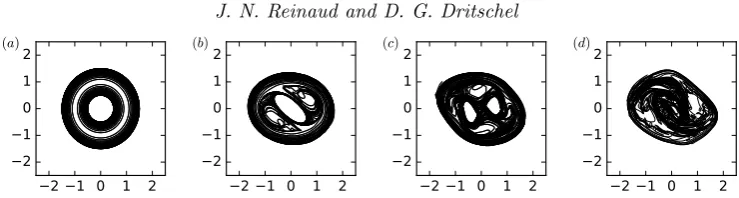
We first consider a thick torus withR0/r0 = 2. The most unstable mode hasm = 2
and its normalised growth rate isσr/q0 = 3.86×10⁻². The nonlinear evolution of the
[image:7.493.80.418.393.509.2]−2 −1 0 1 2 −2 −1 0 1 2 (a)
−2 −1 0 1 2 −2 −1 0 1 2 (b)
−2 −1 0 1 2 −2 −1 0 1 2 (c)
[image:8.493.68.438.43.142.2]−2 −1 0 1 2 −2 −1 0 1 2 (d)
Figure 4.Evolution of a uniform-PV torus withR0/r0= 2. The view is from the top showing
all of the bounding contours (at all heightsz) att= 0,40,49 and 61. The same view is used in subsequent figures of the flow evolution, unless otherwise stated. In figure (d) only contours in every fifth layer are shown. If all contours were included then the figure would be almost black with contours.
−4 −2 0 2 4 −4 −2 0 2 4 (a)
−4 −2 0 2 4 −4 −2 0 2 4 (b)
−4 −2 0 2 4 −4 −2 0 2 4 (c)
−4 −2 0 2 4 −4 −2 0 2 4 (d)
−4 −2 0 2 4 −4 −2 0 2 4 (e)
−4 −2 0 2 4 −4 −2 0 2 4 (f)
−4 −2 0 2 4 −4 −2 0 2 4 (g)
−4 −2 0 2 4 −4 −2 0 2 4 (g)
Figure 5.Evolution of a uniform-PV torus withR0/r0= 4. Top view of the bounding contours
at t = 0,23,29, 35, 40, 50, 60, 85. In figures (e)−(h) only contours in every fifth layer are shown. If all contours were included then the figure would be almost black with contours.
the three-dimensional structure of the vortex becomes highly convoluted. The inner region initially devoid of PV at the centre of the torus cannot disappear since, at each height, the area of this region is conserved. Instead, it becomes split and further fragmented in time from t= 50 onwards. At late times, due to contour surgery, this area may escape to the exterior (not shown).
Next consider a thinner torus withR0/r0= 4. The most unstable mode is nowm= 3
with σr/q0 = 5.94×10⁻². However, there are two competing instabilities:m = 4 with
σr/q0= 4.70×10⁻² andm= 2 withσr/q0= 3.44×10⁻². Figure 5 shows the evolution
in this case, perturbed only by numerical noise. The m = 3 mode emerges first and dominates the evolution. The torus nearly breaks into three vortices but not before the main parts of the torus collapse and merge near the origin, leaving a small triangular hole there. The concentration of PV around the origin is compensated by the ejection of tongues of PV further away, primarily to conserve angular impulse J =RRR
V q(x
2+
y2)dV. The tips of these tongues of PV begin to roll up at late times since the shear
[image:8.493.71.439.213.388.2]−6 −2 0 2 4 64 −6
4
−2 0 2 4 6 (a)
−6 −2 0 2 4 64
−6 4
−2 0 2 4 6 (b)
−6 −2 0 2 4 64
−6 4
−2 0 2 4 6 (c)
−6 −2 0 2 4 64
−6 4
[image:9.493.71.440.44.145.2]−2 0 2 4 6 (d)
Figure 6.Evolution of a uniform-PV torus withR0/r0= 6. Top view of the bounding
contours att= 0,20,50 and 140.
For larger R0/r0 >6, the general topology of the late-time PV distribution changes
significantly. Figure 6 shows the evolution of an unstable torus having R0/r0 = 6. The
three most unstable modes arem = 4 with σr/q0 = 6.20×10⁻², m= 5 with σr/q0 =
6.11×10⁻², and m = 3 with σr/q0 = 4.85×10⁻². For illustration purposes and due
to the close proximity of the growth rates of modes m = 4 and 5, a small amplitude disturbance is initially introduced to excite the most unstable modem = 4. The torus self-organises into a 4-vortex circular array within a sea of low energy filaments and very small vortices. Unlike in the previous cases, the vortices remain far away from each other and do not merge together. The four vortices instead rotate around the centre of the domain in a quasi-stable manner until at leastt = 1000, the end of the simulation. There is no indication that the quasi-periodic rotation of the four main vortices would cease or change significantly for longer integration times. The stability of the circular 4-vortex array could have been anticipated from the linearly stable QG 4-point-vortex case studied in Reinaud (2018).
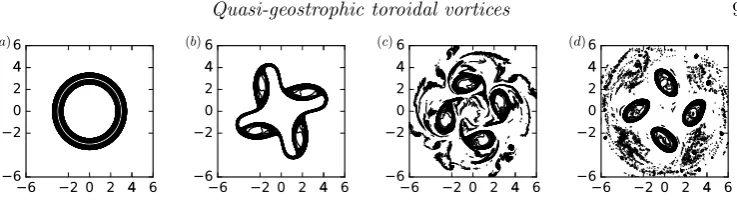
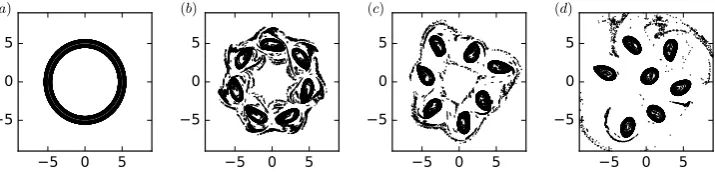
The situation is similar forR0/r0= 7.2, withm= 5 the most unstable mode (figure 7),
again paralleling the linearly stable 5-point-vortex case of Reinaud (2018). The growth rates of the six most unstable modes on a torus withR0/r0= 7.2 were listed in table 1.
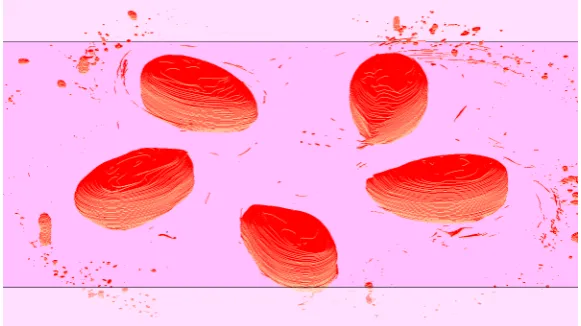
In this case them= 5 mode is significantly more unstable than the closest competitors m= 6 andm= 4, and dominates the nonlinear evolution even without the introduction of a small initial disturbance favouring it. Figures 7 and 8 show that a circular 5-vortex array rapidly forms, then persists at least until the end of the simulation t = 1000' 333TP V, with no indication of significant change at later times.
Since m= 5 is not the only unstable mode, other unstable modes play a role in the deformation of the torus. As a result, the five vortices which emerge differ in volume by up to 9%. The evolution of the volumes of the five largest vortices identified in the simulation after the destabilisation of the torus is shown in figure 9. The structures are identified as contiguous regions of PV (horizontally and vertically). The fluctuations in volume are associated with the erosion or absorption of filaments and debris from and into the vortices. Figure 9 also shows the near circular trajectories of the five vortex centroids, confirming the stable nature of the quasi-periodic rotation. The stability of the 5-vortex array is striking considering that the volume fluctuations may be regarded as a significant perturbation to a configuration of five otherwise identical vortices.
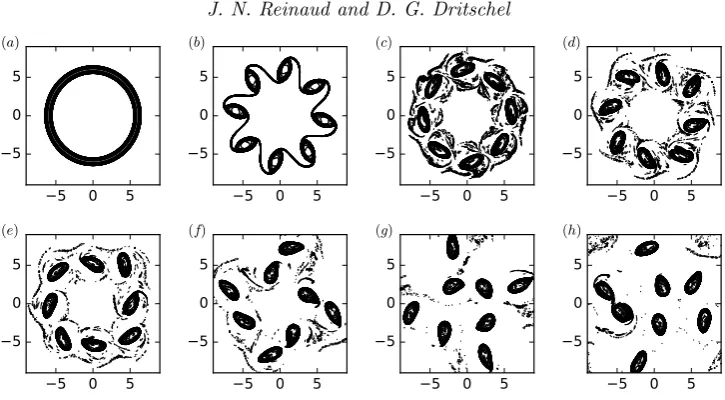
Reinaud (2018) showed that a circular array of six identical point vortices is weakly unstable. The instability expresses itself as a small amplitude oscillation in the radial coordinate of the point vortices, with neighbouring vortices in antiphase. For a torus, the most unstable mode is m = 6 when R0/r0 = 8, and the normalised growth rate
is σr/q0 = 6.53×10⁻². But there are many competing modes, and the second most
unstable mode is m= 5 withσr/q0 = 6.32×10⁻². In order to favour the formation of
−6−4−2 0 2 4 6 −6
−4 −2 0 2 4 6 (a)
−6−4−2 0 2 4 6 −6
−4 −2 0 2 4 6 (b)
−6−4−2 0 2 4 6 −6
−4 −2 0 2 4 6 (c)
−6−4−2 0 2 4 6 −6
[image:10.493.70.437.44.144.2]−4 −2 0 2 4 6 (d)
Figure 7.Evolution of a uniform-PV torus withR0/r0= 7.2. Top view of the bounding
[image:10.493.106.397.185.348.2]contours att= 0,26,129 and 408.
Figure 8.Orthographic view of the PV field at an angle of 60◦from the vertical for the torus withR0/r0= 7.2 att= 100. The horizontal lines indicate the vertical extent of the domain of
view, here|z|60.5. Flow structures seen through the lower front face are slightly faded.
50 250 450 650 850
t
0.160 0.165 0.170 0.175 0.180 0.185 0.190
V
/V
t
−4−3−2−1 0 1 2 3 4
x
−4
−3
−2
−1 0 1 2 3 4
y
Figure 9.(a) Volume fractionV /V0of the five largest vortices formed by the instability of a
torus withR0/r0= 7.2. (b) Near circular trajectories of the vortex centroids for 406t6900.
[image:10.493.96.404.404.548.2]−6−4−2 0 2 4 6 −6
−4 −2 0 2 4 6 (a)
−6−4−2 0 2 4 6 −6
−4 −2 0 2 4 6 (b)
−6−4−2 0 2 4 6 −6
−4 −2 0 2 4 6 (c)
−6−4−2 0 2 4 6 −6
[image:11.493.72.439.45.145.2]−4 −2 0 2 4 6 (d)
Figure 10.Evolution of a uniform-PV torus withR0/r0= 8. Top view of the bounding
contours att= 0,40,90 and 161.
−5 0 5
−5 0 5 (a)
−5 0 5
−5 0 5 (b)
−5 0 5
−5 0 5 (c)
−5 0 5
−5 0 5 (d)
Figure 11.Evolution of a uniform-PV torus withR0/r0= 10. Top view of the bounding
contours att= 0,60,105 and 200.
being displaced inward and outward alternately. In the second state (figure 10(c)), the six vortices are close to forming a triangle.
For R0/r0 = 10, the most unstable mode has m = 7, with σr/q0 = 6.67×10⁻².
The second most unstable mode has m = 8, withσr/q0 = 6.41×10⁻² For illustrative
purposes, the m = 7 mode is initially excited by a small amplitude disturbance. The evolution of the flow is presented in figure 11. Growth of the m= 7 mode leads to the formation of a circular 7-vortex array with vortices of roughly equal size. The array is unstable, however, again as anticipated from the point-vortex results of Reinaud (2018). The array undergoes a kind of irregular staggering (figure 11(c)) followed by migration of one of the vortices toward the centre of the domain (figure 11(d)). From then on, the configuration appears robust and persistent in time, with the same vortex staying near the centre.
Such persistence is consonant with the fact that a circular array of six identical point vortices together with an identical central vortex is linearly stable (Reinaud 2018), even though, due to asymmetries, the arrangement of peripheral vortices is far from regular in figure 11(d). We note further that conservation of angular impulse J implies that the motion of one of the vortices towards the centre must be accompanied by an overall outward motion of the others, or at least some of them. The peripheral vortices take turns at being the outermost vortex.
Finally consider a torus with R0/r0 = 12, the largest value examined. The six most
[image:11.493.76.434.190.279.2]−5 0 5 −5
0 5 (a)
−5 0 5
−5 0 5 (b)
−5 0 5
−5 0 5 (c)
−5 0 5
−5 0 5 (d)
−5 0 5
−5 0 5 (e)
−5 0 5
−5 0 5 (f)
−5 0 5
−5 0 5 (g)
−5 0 5
[image:12.493.72.435.44.244.2]−5 0 5 (h)
Figure 12.Evolution of a uniform-PV torus withR0/r0= 12. Top view of the bounding
contours att= 0,20,60,82,92,112,132 and 200.
Figure 13.Orthographic view of the PV field at an angle of 60◦from the vertical for the torus withR0/r0= 12 att= 92.
regular, as shown in figures 12(f)−(h). The inward motion of four of the vortices is associated with the shedding of filaments.
The subsequent loss of volume within these vortices can be seen in figure 14(a). Figure 14(b) confirms the inward motion of these vortices. This motion is however irregular due to the accumulation of asymmetries. This causes some vortices to get close enough to each other to merge briefly before breaking apart. These interactions are known as ‘weak exchange’ or ‘partial merger’ depending on the volume of material exchanged by the two vortices, see Reinaud & Dritschel (2002). At least seven instances of such interactions occur by t = 1000, the end of the simulation. The important point is that the eight vortices generated early on do not remain in a stable configuration, but nor do they readily merge with one another. Figure 14(a) shows that their volumes settle down to being roughly constant, and indeed that they stay within about 10% of V0/8 at least
untilt= 170.
[image:12.493.107.395.284.438.2]m σr/q0 σi/q0
8 6.70×10⁻² ±3.32×10⁻²
9 6.66×10⁻² ±3.73×10⁻²
7 6.35×10⁻² ±2.96×10⁻²
10 6.18×10⁻² ±4.19×10⁻²
6 5.69×10⁻² ±2.62×10⁻²
11 5.15×10⁻² ±4.75×10⁻²
Table 2.Mode numbersm, growth ratesσr and frequenciesσi for the six most unstable modes (arising as complex conjugate pairs) whenR0/r0= 12.
40 60 80 100 120 140 160 180
t
0.109 0.110 0.111 0.112 0.113
V
/V
0
(a)
−8−6−4−2 0 2 4 6 8
x
−8
−6
−4
−2 0 2 4 6 8
y
[image:13.493.91.409.196.353.2](b)
Figure 14.(a) Volume fractionV /V0of the eight largest vortices formed by the instability of
a torus withR0/r0= 12. (a) Trajectories of the vortex centroids for 60< t <170.
R0/r0 = 12 is more complex, see figure 15. Recall from table 2 that in this case several
modes with similar growth rates are unstable. The evolution shown in figure 15 is asymmetric due to a strong competition between modes. Here, disturbances grow from numerical noise, which depends on resolution, and hence the outcome of the instability also depends on resolution. The outcome can also depend on external forcing not included in the current work. We conclude that the evolution of thin tori is sensitive to disturbances within the surrounding flow. On the other hand, thicker tori, for which fewer modes are unstable and for which one mode has a growth rate significantly larger than the others, tend to evolve more symmetrically. As an example, the torus withR0/r0= 7.2 in figure 7
self-organises into a persistent 5-vortex array even in the absence of an initial eigen-mode disturbance.
4.3. Torus plus central vortex evolution
Reinaud (2018) found that a like-signed central vortex may stabilise a circular 8-vortex array. We next examine if this is also possible for finite vortices emerging from the instability of a torus when a central vortex is also present. We also explore other cases when the central vortex is not strong enough to stabilise the configuration but is still able to ensure quasi-regular behaviour to late times.
We first consider the same torusR0/r0= 12 as in figure 12, but now with a spherical
vortex of the same uniform PV qc = q0 = 2π, and of radius rc = r0. Hence the
−5 0 5 −5
0 5 (a)
−5 0 5
−5 0 5 (b)
−5 0 5
−5 0 5 (c)
−5 0 5
[image:14.493.73.435.45.149.2]−5 0 5 (d)
Figure 15.Evolution of the unstable uniform PV torus withR0/ro= 12 perturbed by pseudo-random numerical noise only: top view on the vortex bounding contours at
t= 20,30,40,55.
−5 0 5
−5 0 5 (a)
−5 0 5
−5 0 5 (b)
−5 0 5
−5 0 5 (c)
−5 0 5
−5 0 5 (d)
−5 0 5
−5 0 5 (e)
−5 0 5
−5 0 5 (f)
−5 0 5
−5 0 5 (g)
−5 0 5
[image:14.493.73.436.201.382.2]−5 0 5 (h)
Figure 16.Evolution of a uniform-PV torus withR0/r0= 12 and a spherical central vortex with
rc/r0= 1 andqc/q0= 1. Top view of the bounding contours att= 0,50,100,149,237,239,243
and 249.
0 50 100 150 200 250
t
0.00 0.02 0.04 0.06 0.08 0.10 0.12 0.14
V
/V
0
(a)
−8−6−4−2 0 2 4 6 8
x
−8
−6
−4
−2 0 2 4 6 8
y
(b)
Figure 17.(a) Volume fractionV /V0 of the nine largest vortices formed from the torus in
[image:14.493.97.407.436.580.2]−5 0 5 −5
0 5 (a)
−5 0 5
−5 0 5 (b)
−5 0 5
−5 0 5 (c)
−5 0 5
−5 0 5 (d)
−5 0 5
−5 0 5 (f)
−5 0 5
−5 0 5 (g)
−5 0 5
−5 0 5 (h)
−5 0 5
[image:15.493.74.438.46.244.2]−5 0 5 (h)
Figure 18. Evolution of a uniform-PV torus with R0/r0 = 12 and a spheroidal central
vortex with V0/Vc = 16, hc/r0 = 1 and rc/r0 = 1.88. Top view of the bounding contours
att= 0,90,130,500,700,800,900 and 1000.
is therefore not only small in comparison with the strength of the whole torus but also in comparison with one-eighth thereof, the order of magnitude for an individual vortex in the expected circular 8-vortex array The evolution of the flow is shown in figure 16. Since the central vortex is weak, the overall evolution of the flow is closely similar to the previous case without a central vortex. The torus first forms a circular 8-vortex array, as expected (figure 16(b)), followed by staggering (figure 16(c)). Significant differences appear when the inward moving four vortices get close to the central vortex. For a while, the central vortex remains almost equidistant from these four peripheral vortices limiting their further inward motion. Due to the build-up of asymmetries, two vortices eventually move further inward while two back outward. At a later stage of the evolution, the small central vortex becomes close enough to one of the large peripheral vortices and the two vortices partially merge, generating a slightly larger structure and a small secondary one. Nonetheless, the vortex volumes remain approximately constant, as shown in figure 17(a). The merged vortex moves towards the centre of the domain, while the other vortices organise into an irregular array around it (see figure 17(b)). Similar behaviour has been observed in simulations using fewer layers, both fornl= 21 andnl= 15.
Next consider the effect of a larger, initially spheroidal central vortex with the same PV qc = q0 and half-height hc = r0 = 0.5 as before, but with a larger horizontal
radius rc > r0 corresponding to an oblate spheroid such that Vc = V0/16, half the
expected strength of a peripheral vortex. This results in a spheroid of horizontal radius rc=
p
(3π/32)(R0/r0)r0'1.88r0. To favour the formation of eight peripheral vortices,
the torus and central vortex are initially perturbed by them= 8 eigenmode.
0 100 200 300 400
t
0.05 0.06 0.07 0.08 0.09 0.10 0.11 0.12 0.13
V
/V
0
(a)
−8−6−4−2 0 2 4 6 8
x
−8
−6
−4
−2 0 2 4 6 8
y
[image:16.493.96.405.53.208.2](b)
Figure 19.(a) Volume fractionV /V0 of the nine largest vortices formed from the torus in
figure 18. (b) Trajectories of the vortex centroids for 25< t <388.
−5 0 5
−5 0 5 (a)
−5 0 5
−5 0 5 (b)
−5 0 5
−5 0 5 (c)
−5 0 5
−5 0 5 (d)
Figure 20. Evolution of a uniform-PV torus with R0/r0 = 11.8 and a spheroidal central
vortex with V0/Vc = 8, hc/r0 = 1 and rc/r0 = 2.64. Top view of the bounding contours at
t= 0,110,230 and 1000.
of the peripheral vortices interacts strongly with the central vortex, and the two vortices start to rotate around each other. This is clearly visible in the vortex centroid trajectories shown in figure 19. Eventually, one the peripheral vortices moves close to the centre of the domain, taking the place of the initially central vortex, and the remaining vortices move in an irregular way without merging. The initially central vortex, which is smallest in size, moves furthest out and slowly migrates around the group of vortices as a whole. We next consider a larger central vortex with the same PV, qc = q0, but with
volume Vc = V0/8 comparable to the volume of a peripheral vortex. This requires
rc=
p
(3π/16)(R0/r0)r0'2.64r0. In this case we use R0/r0= 11.8 to ensure that the
most unstable mode ism= 8. A circular 8-point-vortex array with an equal-strength, like-signed central vortex is linearly stable (Reinaud 2018), so we expect to see the analogue of this here after the destabilisation of the torus. As in the previous case, we take the half height of the central vortex to be the same as that of the torus,hc=r0, and again
give it the same PV, qc =q0. We only increase the horizontal radiusrc torc '2.64r0.
The initial configuration is weakly perturbed by them= 8 eigenmode.
The flow evolution is shown in figure 20. As previously, an 8-vortex array forms, but it now appears to remain stable for the entire period of integration up to t= 1000. The same is observed using a lower vertical resolution ofnl= 15 layers. There is no evidence
that the configuration formed will ever change significantly.
[image:16.493.75.433.254.343.2]−1.8−0.9 0.0 0.9 1.8 −1.8
−0.9 0.0 0.9 1.8 (a)
−1.8−0.9 0.0 0.9 1.8 −1.8
−0.9 0.0 0.9 1.8 (b)
−1.8−0.9 0.0 0.9 1.8 −1.8
−0.9 0.0 0.9 1.8 (c)
−1.8−0.9 0.0 0.9 1.8 −1.8
−0.9 0.0 0.9 1.8 (d)
−1.8−0.9 0.0 0.9 1.8 −1.8
−0.9 0.0 0.9 1.8 (e)
−1.8−0.9 0.0 0.9 1.8 −1.8
−0.9 0.0 0.9 1.8 (f)
−1.8−0.9 0.0 0.9 1.8 −1.8
−0.9 0.0 0.9 1.8 (g)
−1.8−0.9 0.0 0.9 1.8 −1.8
[image:17.493.67.439.44.219.2]−0.9 0.0 0.9 1.8 (h)
Figure 21.Evolution of a uniform-PV torus withR0/r0= 2.4, and a spherical central vortex
withrc/r0 = 1 andqc/q0 = 1. Top view of the bounding contours at t= 0,11,14,22,26,30
and 35. In figures (f)−(h) only contours in every fifth layer are shown. If all contours were included then the figure would be almost black with contours.
and 4 respectively). Consider then a torus withR0/r0 = 2.4 and a central vortex with
hc=rc =r0 andqc =q0. This equilibrium state lies in a region of the parameter space
containing a large number of competing unstable modes arising from the strong shear between the central vortex and the inner side of the torus, see figure 3(a). The flow evolution at early times is shown in figure 21. The central vortex and the inner part of the torus deform mostly through a combination of modesm= 3 and 2. Eventually the central vortex and torus merge, creating three bridges of PV at the edges of the deformed central vortex. The complexity of the flow then grows rapidly. The central vortex and the torus later merge into a large compound structure, most visible in figures 21(d)−(h). Notably, the early evolution in figures 21(a)−(c) is quasi-barotropic, as the contours at opposite heights nearly coincide. This is consistent with the vertical eigenstructures of the linearly unstable modes discussed in§3.4. At later times however, vertical asymmetries develop and accelerate the growth in complexity of the flow.
5. Conclusion and discussion
We have investigated the formation of circular vortex arrays arising from the instability of a torus of uniform potential vorticity in an unbounded quasi-geostrophic flow under the Boussinesq approximation, with and without a central vortex. We have also investigated the subsequent nonlinear evolution.
We have first shown that a torus of uniform potential vorticity is unstable to az-imuthally wavy disturbance modes, over a large range of torus radius ratios R0/r0.
The azimuthal mode number m of the most unstable such disturbance increases with R0/r0, roughly in proportion to it. The most unstable mode has azimuthal length scale
comparable to 2r0, the diameter of the cross section of the torus.
In the nonlinear dynamics, an unstable mode with azimuthal wavenumberm >3 leads to the formation of a circular array ofmvortices initially lying along the mean radius of the torus. The configuration is stable form= 4 and 5 but unstable otherwise. Form>6 the growth of a subharmonic instability staggers the vortices.
a strength comparable to or larger than a vortex in the circular array, the array is kept stable apparently indefinitely. Weaker central vortices can still lead to quasi-regular vortex evolution without any merging, over long times, such as oscillatory staggering.
A question currently under investigation, and to be reported on in future work, is the effect of a vertical offset of the central vortex above or below the torus. In the Boussinesq model, which provides a good approximation for the ocean over modest height scales, the sign of the offset is immaterial. However, the Boussinesq model does not accurately account for the exponential density stratification typical of planetary atmospheres, including the Earth’s and Jupiter’s. The quasi-geostrophic model can account for this stratification by the introduction of a new length scale, the density scale height H, while retaining the simplicity of an unbounded geometry (Scott & Dritschel 2005). The sign of the offset then matters, as interactions decay more rapidly upwards but more slowly downwards (Hoskinset al. 1985, eqs. (33); Scott & Dritschel, 2005). The formation and stability of circular vortex arrays are likely to depend on H, especially when this height is comparable to the minor radius r0 of the torus. This is an ongoing
research which will bring us a step closer to understanding, for instance, the formation and longevity of circular vortex arrays such as those recently observed near Jupiter’s poles (Adrianiet al.2018).
Acknowledgements
The authors would like to thank Michael E. McIntyre especially for his helpful com-ments on an early draft of this paper that greatly improved the final version.
REFERENCES
Adriani, A., Mura, A., Orton, G., Hansen, C., Altieri, F., Moriconi, M. L., Rogers, J., Eichstdt, G., Momary, T., Ingersoll, A. P., Filacchione, G., Sindoni, G., Tabataba-Vakili, F., Dinelli, B. M., Fabiano, F., Bolton, S. J., Connerney, J. E. P., Atreya, S. K., Lunine, J. I., Tosi, F., Migliorini, A., Grassi, D., Piccioni, G., Noschese, R., Cicchetti, A., Plainaki, C., Olivieri, A., ONeill, M. E., Turrini, D., Stefani, S., Sordini, R. & Amoroso, M.2018 Cluster of cyclones encircling jupiter’s poles.Nature555, 216–219.
Dritschel, D. G.1986 The nonlinear evolution of rotating configurations of uniform vorticity. J. Fluid Mech.172, 157–182.
Dritschel, D. G. 1988 Contour surgery: A topological reconnection scheme for extended integrations using contour dynamics.J. Comput. Phys.77, 240–266.
Dritschel, D. G.1995 A general theory for two dimensional vortex interactions.J. Fluid Mech. 293, 269–303.
Dritschel, D. G.2002 Vortex merger in rotating stratified flows.J. Fluid Mech.455, 83–101. Dritschel, D. G. & McIntyre, M. E.2008 Multiple jets as PV staircases: the Phillips effect
and the resilience of eddy-transport barriers.J. Atmos. Sci.65(3), 855–874.
Dritschel, D. G. & Saravanan, R. 1994 Three-dimensional quasi-geostrophic contour dynamics, with an application to stratospheric vortex dynamics.Quart. J. Roy. Meteorol. Soc.120, 1267–1297.
Hoskins, B. J., McIntyre, M. E. & Robertson, A. W.1985 On the use and significance of isentropic potential-vorticity maps.Quart. J. Roy. Meteor. Soc.111, 877–946.
Kossin, J. P. & Schubert, W. H.2001 Mesovortices, polygonal patterns and rapid pressure falls in hurricane-like vortices. J. Atmos. Sci.58, 2196–2209.
Morel, Y. G. & Carton, X. J. 1994 Multipolar vortices in two-dimensional incompressible flows. J. Fluid Mech.276, 23–51.
Reinaud, J. N. 2018 Three-dimensional quasi-geostrophic vortex equilibria with m−fold symmetry.J. Fluid Mech.in press.
Reinaud, J. N. & Dritschel, D. G. 2002 The merger of vertically offset quasi-geostrophic vortices.J. Fluid. Mech.469, 287–315.
Scott, R. K. & Dritschel, D. G. 2005 Quasi-geostrophic vortices in compressible atmospheres.J. Fluid. Mech.530, 305–325.
Thomson, J. J.1883A treatise of vortex rings. London: MacMillan and Co.
Vallis, G. K. 2006 Atmospheric and oceanic fluid dynamics: fundamentals and large-scale circulation. Cambridge: Cambridge University Press.