DOI: 10.4236/abcr.2019.83007 Jun. 28, 2019 87 Advances in Breast Cancer Research
The Keys to Optimising Breast Wounds:
A Meta-Analysis
Stephanie Mary Anne Vincent
1,2, Mary Gallagher
1,2, Alison Johnston
1, Risal Djohan
3,
Manvydas Varzgalis
1, Michael Sugrue
1*1Department of Breast Surgery, Letterkenny University Hospital, Donegal Clinical Research Academy, Donegal, Ireland 2National University of Ireland, Galway, Ireland
3Department of Plastic Surgery, Cleveland Clinic, Cleveland, OH, USA
Abstract
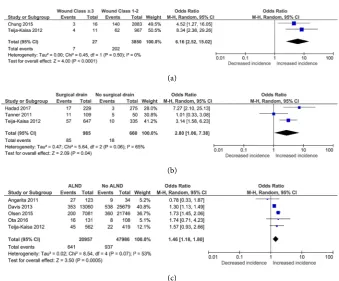
Background: Breast disease and breast cancer management form a major part of healthcare delivery. Surgical site occurrence (SSO) poses septic and oncolog-ical risks to patients. This study undertook a meta-analysis to identify key risk factors and interventions that may alter the incidence of SSO in patients un-dergoing breast surgery. Methods: An ethically approved, PROSPERO-regis- tered meta-analysis following PRISMA guidelines and Cochrane Handbook for Systematic Reviews was undertaken of all published English articles using electronic databases from 2010 to 2017 incorporating MeSH terms “risk fac-tors”, “surgical site infections”, “breast surgery”, and “interventions”. Articles scoring > 10 for non-comparative studies and >15 for comparative studies, using MINORS criteria were included. The OR or RR using random-effects, Mantel-Haenszel method were computed for each risk factor and interven-tion respectively with RevMan 5. Results: The pre-operative factors affecting breast surgery SSO were diabetes mellitus (OR = 2.52, CI = 1.78 - 3.59, p < 0.001), smoking (OR = 2.39, CI = 1.57 - 3.63, p < 0.001), ASA ≥ III (OR = 2.37, CI = 1.51 - 3.74, p < 0.001), obese versus non-obese (OR = 1.84, CI = 1.52 - 2.24, p < 0.001), over-weight/obese versus normal BMI (OR = 1.70, CI = 1.36 - 2.13, p < 0.001), hypertension (OR = 1.63, CI = 1.39 - 1.90, p < 0.001), and antibiotics prophylaxis (RR = 0.58, CI = 0.36 - 0.95, p = 0.03). The intraoperative factors were surgical wound classifications 3 - 4 (OR = 6.16, CI = 2.52 - 15.02, p < 0.001), surgical drains (OR = 2.80, CI = 1.06 - 7.38, p = 0.04), and axillary lymph node dissection (OR = 1.46, CI = 1.18 - 1.80, p < 0.001). The post-operative factors were adjuvant radiotherapy (OR = 1.77, CI = 1.26 - 2.50, p = 0.001), re-operated patients (OR = 1.65, CI = 1.01 - 2.70, p = 0.05), post-operative antibiotics (RR = 0.57, CI = 0.33 - 0.98, p = 0.04), and drain antisepsis care (RR = 0.15, CI = 0.03 - 0.82, p = 0.03). Conclusions: How to cite this paper: Vincent, S.M.A.,
Gallagher, M., Johnston, A., Djohan, R., Varzgalis, M. and Sugrue, M. (2019) The Keys to Optimising Breast Wounds: A Meta-Analysis. Advances in Breast Cancer Research, 8, 87-111.
https://doi.org/10.4236/abcr.2019.83007 Received: April 27, 2019
Accepted: June 25, 2019 Published: June 28, 2019
Copyright © 2019 by author(s) and Scientific Research Publishing Inc. This work is licensed under the Creative Commons Attribution International License (CC BY 4.0).
http://creativecommons.org/licenses/by/4.0/
DOI: 10.4236/abcr.2019.83007 88 Advances in Breast Cancer Research This study identified key factors associated with increased risk of breast sur-gery wound occurrence. It will facilitate the development of a peri-operative breast wound bundle to optimize outcomes.
Keywords
Breast Wound Care, Breast Wound Infection, Breast Surgical Site, Adverse Outcomes, Breast Implant Loss, Return to the Operating Theatre
1. Introduction
Breast disease and breast cancer management form a major part of healthcare delivery, constituting one of the most frequent elective surgeries performed glo-bally [1]. Uncomplicated surgical outcomes are important in optimising func-tional, cosmetic and oncological outcomes. Surgical site occurrence (SSO) in-cluding wound infection, wound dehiscence and deep infection, with or without implant loss pose septic and oncological risks to patients [2] [3] [4]. There is a spectrum from minor wound infection to implant loss with increasing costs for the health care system [3] [5]. Reducing SSO will benefit patient’s physical and psychological outcomes, facilitate adjuvant treatment, and optimise long term cosmetic and oncological outcomes [6] [7].
Wound infection and adverse wound events are multifactorial [8] [9] [10]. Identifying the relative importance of the contributing factors is challenging. A bundle approach to wound care has been shown to facilitate better outcomes [11] [12] [13]. There are few reports of the use of bundled approaches to reduc-ing SSO in breast surgery [14]. The National Mastectomy Audit suggests that current rates of SSO are unacceptable [15].
The aim of this meta-analysis is to identify key risk factors and interventions that may alter the incidence of SSO in patients undergoing breast surgery.
2. Methods
2.1. Search Strategy and Study Eligibility
An ethically approved meta-analysis of the literature was undertaken to incor-porate articles relating to breast wound care, breast wound infection, breast sur-gical site adverse outcomes, infected related implant loss, and return to the op-erating theatre. Existing research optimising wound care in surgery was re-viewed to determine current strategies to improve wound outcomes. Key risk factors and interventions for SSO were identified in three keys phases of care, pre-, intra- and post-operative periods.
DOI: 10.4236/abcr.2019.83007 89 Advances in Breast Cancer Research A systematic review and meta-analysis of all published English articles was conducted using PubMed, Scopus and Cochrane Library electronic databases from 2010 to 2017. Medical Subject Headings used terms which included risk factors (“risk factor*”), surgical site infections (“surgical site infection*”, “wound infection*”), breast surgery (“breast surg*”), and interventions (“intervention*”). The following search strategies were used in our meta-analysis: (“risk factor*” AND “breast surg*” AND “infection*”), (“intervention*” AND “breast surg*” AND “infection*”), (“risk factor*” OR “intervention*” AND “breast surg*” AND “surgical site infection*”), and (“risk factor*” OR “intervention*” AND “breast surg*” AND “wound infection*”). Studies that were case studies or me-ta-analysis, not related to breast surgery, did not report key outcomes, or where data was inadequate for interpretation via meta-analysis, or duplicate studies were excluded.
Eligibility assessment was performed independently in a blinded standardised manner by two reviewers (SV and MG). Disagreements between reviewers were resolved by discussion between the two review authors and if no agreement could be reached, it was planned a third reviewer (AJ) would decide.
2.2. Data Extraction and Quality Assessment
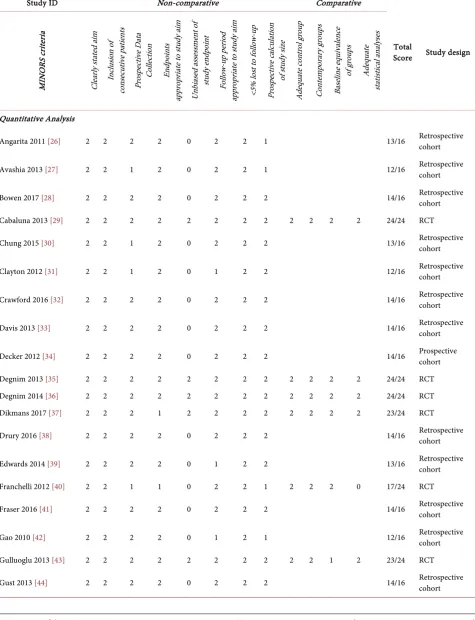
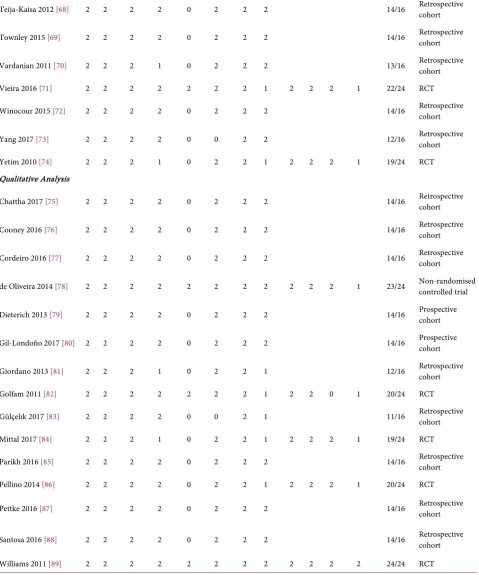
We developed a standardised data extraction sheet and one reviewer (SV) ex-tracted the following data from included studies and the second reviewer (MG) checked the extracted data. Discrepancies were resolved by discussion and con-sultation with another reviewer (AJ). Two reviewers (SV and MG) independent-ly assessed each published study for the quality of study design by using the Me-thodological Index for Nonrandomised Studies (MINORS) score whereby the global ideal score is 16 for non-comparative studies and 24 for comparative stu-dies [18]. Articles scoring > 10 for non-comparative studies and >15 for com-parative studies, using MINORS criteria were included in the final analysis (Table S1). Risk of bias across studies was not assessed as there were too few in-cluded studies per outcome.
Information was extracted from each included study on: 1) Characteristics of participants 2) Inclusion and exclusion criteria 3) Risk factor or type of inter-vention 4) Well-reported outcome measurements (including a clear report of surgical site infections or breast wound infections).
2.3. Data Synthesis and Analysis
DOI: 10.4236/abcr.2019.83007 90 Advances in Breast Cancer Research and 95% Confidence Intervals (CI) for each risk factor and intervention were calculated. No additional analyses were done. The analysis was performed by using Review Manager Version 5 [19].
2.4. Definitions
The Centres for Disease Control and Prevention (CDC) definitions [5] [20] for surgical site infection were used. These are classified into superficial, deep or organ/space relating to implant/infection. The ASEPSIS (Additional treatment, Serous discharge, Erythema, Purulent exudate, Separation of deep tissues, Isola-tion of bacteria, Stay duraIsola-tion as inpatient > 14 days) scoring system was also used to quantify surgical site infections [21].
WHO classification of nutritional status according to Body Mass Index (BMI) [22] was used to categorise underweight (BMI < 18.5), normal weight (BMI 18.5 - 24.9), pre-obesity (BMI 25.0 - 29.9), obesity class 1 (BMI 30.0 - 34.9), obesity class 2 (BMI 35.0 - 39.9), and obesity class 3 (BMI > 40). Patients were consi-dered to have diabetes mellitus only if they were taking oral hypoglycaemic agents and/or on insulin. Patients were considered smokers if they were cur-rently smokers or had smoked cigarettes in the year before admission for sur-gery. The tumour-node-metastasis (TNM) classification [23] for breast cancer was used to determine breast cancer staging. The American Society of Anesthe-siology (ASA) Physical Status classification [24] was defined as follows: 1) nor-mal healthy patient; 2) mild systemic disease; 3) patient with severe systemic disease; 4) severe systemic disease with constant threat to life; and 5) moribund patient not expected to survive without surgery. Neoadjuvant chemotherapy treatment was defined as administration of chemotherapeutic agents for cancer within 30 to 90 days prior to surgery [28] [33] [34] [40] [57] [61] [65]. Neoadju-vant radiotherapy included patients who had treatment within 90 days before surgery. Breast reoperations were defined as re-excision or mastectomy within 180 days of initial breast surgery.
To determine the level of risk, a number of classification systems were used in this study. These included the surgical wound classification [5] [20] and the Na-tional Nosocomial Infection Surveillance (NNIS) Risk Index [25].
3. Results
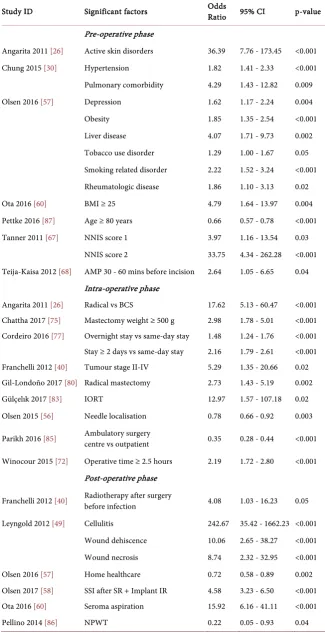
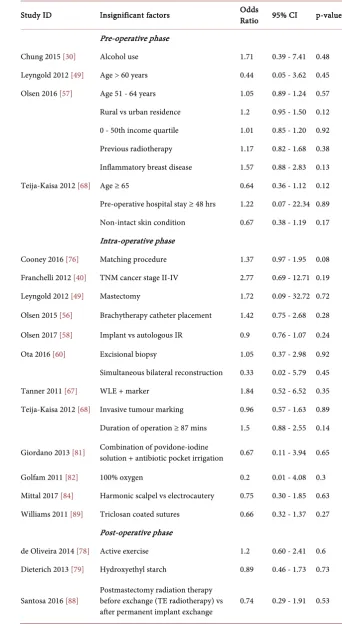
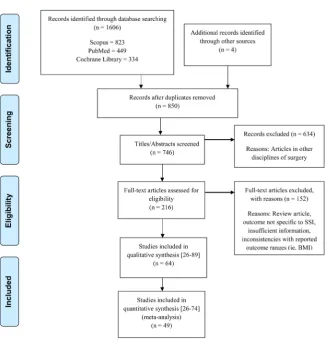
This meta-analysis reviewed 1606 articles for risk factors and interventions of SSI in breast surgery. 64 studies were found to be suitable after eligibility analysis and 49 studies were included for quantitative analysis of this meta-analysis (Figure 1). Characteristics of the studies included in this meta-analysis are listed
in Table S2. Significant and insignificant factors affecting breast SSO that are
not included in the quantitative meta-analysis are listed in Table 1 and Table 2 respectively.
DOI: 10.4236/abcr.2019.83007 91 Advances in Breast Cancer Research Pre-operative phase
Angarita 2011 [26] Active skin disorders 36.39 7.76 - 173.45 <0.001
Chung 2015 [30] Hypertension 1.82 1.41 - 2.33 <0.001
Pulmonary comorbidity 4.29 1.43 - 12.82 0.009
Olsen 2016 [57] Depression 1.62 1.17 - 2.24 0.004
Obesity 1.85 1.35 - 2.54 <0.001
Liver disease 4.07 1.71 - 9.73 0.002
Tobacco use disorder 1.29 1.00 - 1.67 0.05 Smoking related disorder 2.22 1.52 - 3.24 <0.001 Rheumatologic disease 1.86 1.10 - 3.13 0.02
Ota 2016 [60] BMI ≥ 25 4.79 1.64 - 13.97 0.004
Pettke 2016 [87] Age ≥ 80 years 0.66 0.57 - 0.78 <0.001
Tanner 2011 [67] NNIS score 1 3.97 1.16 - 13.54 0.03
NNIS score 2 33.75 4.34 - 262.28 <0.001 Teija-Kaisa 2012 [68] AMP 30 - 60 mins before incision 2.64 1.05 - 6.65 0.04
Intra-operative phase
Angarita 2011 [26] Radical vs BCS 17.62 5.13 - 60.47 <0.001 Chattha 2017 [75] Mastectomy weight ≥ 500 g 2.98 1.78 - 5.01 <0.001 Cordeiro 2016 [77] Overnight stay vs same-day stay 1.48 1.24 - 1.76 <0.001 Stay ≥ 2 days vs same-day stay 2.16 1.79 - 2.61 <0.001 Franchelli 2012 [40] Tumour stage II-IV 5.29 1.35 - 20.66 0.02 Gil-Londoño 2017 [80] Radical mastectomy 2.73 1.43 - 5.19 0.002
Gülçelık 2017 [83] IORT 12.97 1.57 - 107.18 0.02
Olsen 2015 [56] Needle localisation 0.78 0.66 - 0.92 0.003
Parikh 2016 [85] Ambulatory surgery centre vs outpatient 0.35 0.28 - 0.44 <0.001
Winocour 2015 [72] Operative time ≥ 2.5 hours 2.19 1.72 - 2.80 <0.001 Post-operative phase
Franchelli 2012 [40] Radiotherapy after surgery before infection 4.08 1.03 - 16.23 0.05
Leyngold 2012 [49] Cellulitis 242.67 35.42 - 1662.23 <0.001 Wound dehiscence 10.06 2.65 - 38.27 <0.001 Wound necrosis 8.74 2.32 - 32.95 <0.001
Olsen 2016 [57] Home healthcare 0.72 0.58 - 0.89 0.002
Olsen 2017 [58] SSI after SR + Implant IR 4.58 3.23 - 6.50 <0.001 Ota 2016 [60] Seroma aspiration 15.92 6.16 - 41.11 <0.001
[image:5.595.208.534.92.733.2]DOI: 10.4236/abcr.2019.83007 92 Advances in Breast Cancer Research Table 2. Insignificant factors for breast SSO not included in the quantitative meta-ana- lysis.
Study ID Insignificant factors Odds Ratio 95% CI p-value
Pre-operative phase
Chung 2015 [30] Alcohol use 1.71 0.39 - 7.41 0.48
Leyngold 2012 [49] Age > 60 years 0.44 0.05 - 3.62 0.45 Olsen 2016 [57] Age 51 - 64 years 1.05 0.89 - 1.24 0.57 Rural vs urban residence 1.2 0.95 - 1.50 0.12 0 - 50th income quartile 1.01 0.85 - 1.20 0.92 Previous radiotherapy 1.17 0.82 - 1.68 0.38 Inflammatory breast disease 1.57 0.88 - 2.83 0.13
Teija-Kaisa 2012 [68] Age ≥ 65 0.64 0.36 - 1.12 0.12
Pre-operative hospital stay ≥ 48 hrs 1.22 0.07 - 22.34 0.89 Non-intact skin condition 0.67 0.38 - 1.19 0.17 Intra-operative phase
Cooney 2016 [76] Matching procedure 1.37 0.97 - 1.95 0.08 Franchelli 2012 [40] TNM cancer stage II-IV 2.77 0.69 - 12.71 0.19
Leyngold 2012 [49] Mastectomy 1.72 0.09 - 32.72 0.72
Olsen 2015 [56] Brachytherapy catheter placement 1.42 0.75 - 2.68 0.28
Olsen 2017 [58] Implant vs autologous IR 0.9 0.76 - 1.07 0.24
Ota 2016 [60] Excisional biopsy 1.05 0.37 - 2.98 0.92
Simultaneous bilateral reconstruction 0.33 0.02 - 5.79 0.45
Tanner 2011 [67] WLE + marker 1.84 0.52 - 6.52 0.35
Teija-Kaisa 2012 [68] Invasive tumour marking 0.96 0.57 - 1.63 0.89 Duration of operation ≥ 87 mins 1.5 0.88 - 2.55 0.14
Giordano 2013 [81] Combination of povidone-iodine solution + antibiotic pocket irrigation 0.67 0.11 - 3.94 0.65
Golfam 2011 [82] 100% oxygen 0.2 0.01 - 4.08 0.3
Mittal 2017 [84] Harmonic scalpel vs electrocautery 0.75 0.30 - 1.85 0.63 Williams 2011 [89] Triclosan coated sutures 0.66 0.32 - 1.37 0.27
Post-operative phase
de Oliveira 2014 [78] Active exercise 1.2 0.60 - 2.41 0.6 Dieterich 2013 [79] Hydroxyethyl starch 0.89 0.46 - 1.73 0.73
Santosa 2016 [88] Postmastectomy radiation therapy before exchange (TE radiotherapy) vs
DOI: 10.4236/abcr.2019.83007 93 Advances in Breast Cancer Research Figure 1. Prisma flow diagram.
3.1. Pre-Operative Phase
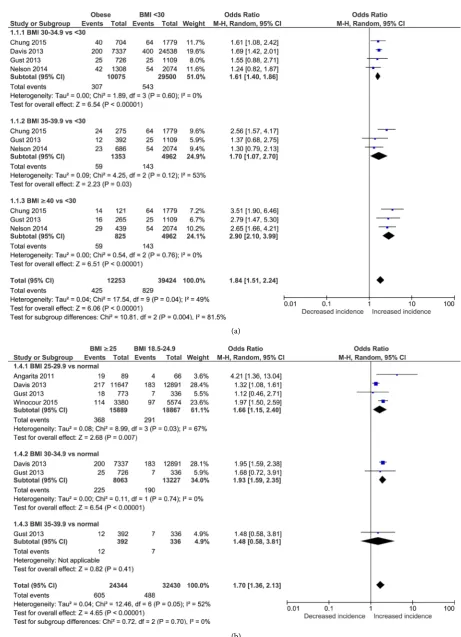
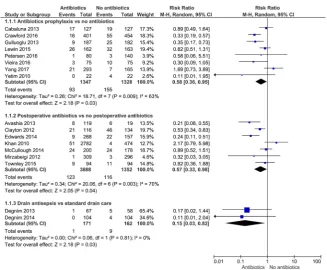
Significant pre-operative risk factors (Figure 2 and Figure 3) for developing SSI in breast wounds are class 3 obesity versus non-obese (OR = 2.90, CI = 2.10 - 3.99, p < 0.001), diabetes mellitus (OR = 2.52, CI = 1.78 - 3.59, p < 0.001), smoking (OR = 2.39, CI = 1.57 - 3.63, p < 0.001), American Society of Anes-thesiologists (ASA) Physical Status classification ≥III (OR = 2.37, CI = 1.51 - 3.74, p < 0.001), class 2 obesity versus non-obese (OR = 1.70, CI = 1.07 - 2.70, p = 0.03), class 1 obesity when compared to non-obese and normal BMI re-spectively (OR = 1.61, CI = 1.40 - 1.86, p < 0.001; OR = 1.93, CI = 1.59 - 2.35, p < 0.001), overweight versus normal BMI (OR = 1.66, CI = 1.15 - 2.40, p = 0.007), and hypertension (OR = 1.63, CI = 1.39 - 1.90, p < 0.001). Overall, be-ing overweight or obese versus normal BMI and bebe-ing obese versus non-obese was significant for increasing the incidence of SSI (OR = 1.70, CI = 1.36 - 2.13, p < 0.001; OR = 1.84, CI = 1.52 - 2.24, p < 0.001 respectively). Interventions shown to be statistically significant in reducing surgical site infections in breast surgery (Figure 6) is antibiotics prophylaxis (RR = 0.58, CI = 0.36 - 0.95, p = 0.03).
DOI: 10.4236/abcr.2019.83007 94 Advances in Breast Cancer Research (a)
[image:8.595.77.539.61.699.2]DOI: 10.4236/abcr.2019.83007 95 Advances in Breast Cancer Research (a)
(b)
(c)
[image:9.595.185.541.64.537.2](d)
Figure 3. (a) Diabetes; (b) Smoking; (c) ASA; (d) Hypertension.
0.84 - 1.10, p = 0.55), age ≥ 50 years old (OR = 1.26, CI = 0.97 - 1.64, p = 0.09) and steroids use (OR = 1.04, CI = 0.81 - 1.32, p = 0.78). Hair removal (RR = 1.26, CI = 0.46 - 3.44, p = 0.66) was not shown to be statistically significant in reduc-ing breast SSI.
3.2. Intra-Operative Phase
DOI: 10.4236/abcr.2019.83007 96 Advances in Breast Cancer Research (a)
(b)
[image:10.595.200.540.65.346.2](c)
Figure 4. (a) Surgical wound class; (b) Surgical drains; (c) ALND.
Insignificant intra-operative risk factors are inpatient admission (OR = 3.59, CI = 0.18 - 72.11, p = 0.40), operative time > 2 hours (OR = 2.87, CI = 0.32 - 25.47, p = 0.34), immediate breast reconstruction (IBR) versus mastectomy only (OR = 2.66, CI = 0.72 - 9.83, p = 0.14), IBR versus delayed reconstruction (OR = 1.39, CI = 0.73 - 2.64, p = 0.32), a cellular dermal matrix (ADM) use (OR = 1.32, CI = 0.22 - 8.06, p = 0.06), breast cancer stage II - IV versus breast cancer stage 0 - I (OR = 1.24, CI = 0.54 - 2.88, p = 0.61), breast cancer versus prophylactic stage (OR = 1.10, CI = 0.82 - 1.47, p = 0.53), and sentinel lymph node biopsy (SLNB) (OR = 0.46, CI = 0.06 - 3.57, p = 0.46).
3.3. Post-Operative Phase
Adjuvant radiotherapy (OR = 1.77, CI = 1.26 - 2.50, p = 0.001) and re-operated patients (OR = 1.65, CI = 1.01 - 2.70, p = 0.05) are significant post-operative risk factors (Figure 5). Interventions shown to be statistically significant in reducing surgical site infections in breast surgery (Figure 6) are post-operative antibiotics (RR = 0.57, CI = 0.33 - 0.98, p = 0.04), and drain antisepsis care (RR = 0.15, CI = 0.03 - 0.82, p = 0.03).
DOI: 10.4236/abcr.2019.83007 97 Advances in Breast Cancer Research (a)
[image:11.595.210.538.66.236.2](b)
Figure 5. (a) Adjuvant radiotherapy; (b) Reoperation.
Figure 6. Antibiotics vs none.
4. Discussion
[image:11.595.210.538.266.536.2]DOI: 10.4236/abcr.2019.83007 98 Advances in Breast Cancer Research Defining and collecting surgical site infection data is somewhat problematic. There have been many reviews of the nomenclature of wound complications. Terms such as surgical site occurrence (SSO) were introduced in 2010 [90]. Current definitions of SSO are subject to debate in many areas of surgery. The standardized definition of an SSI, developed by the Centres for Disease Control and Prevention (CDC), is an infection occurring in part of the body where sur-gery took place, including superficial, deep, and organ space infection [5]. It has been suggested that some SSIs are not relevant and in an effort to add more transparency, the term “surgical site occurrences requiring procedural interven-tions” (SSOPI) has been introduced recently [91]. Another term that has been used is “surgical site event” [92].
Post-operative breast surgery infections even when delayed, or initially thought to be indolent, can be devastating with implant loss or delays in adjuvant treatment. Recently it has been suggested that SSIs following breast cancer surgery decrease oncological survival [3] [93], while others do not support this [94] [95].
Disregarding considerations regarding the reliability of definitions and sur-veillance, it is clear that understanding risk factors for infection is crucial to pventing SSO and optimising care. The cost of SSI after breast surgery was re-ported at $4091 by one study [96]. The care bundle is not a novel concept, but it is integral for the provision of a team-based approach to patient care. The risk factors identified by this study were grouped into pre-operative, operative and post-operative, which may aid in a tailored approach to intervention.
Patient factors such as obesity and the degree of obesity, smoking, diabetes, recent surgery, and anaesthetic risk will significantly increase the SSI risk. The Breast Care team needs to consider these factors while initially tailoring an op-timal surgical strategy and even consider modifying the use of implant based re-construction in these high-risk patients.
Neo-adjuvant chemotherapy is increasingly used and is not associated with an increased SSI risk.
5. Conclusion
This meta-analysis has identified significant risk factors for developing breast related adverse surgical site infections. Planned strategy to mitigate against these should be incorporated into Breast Surgery Care Bundles. Current SSO levels in breast surgery are unacceptably high and need to be addressed. In-corporating wound bundles as key reportable performance indicators or as a mandatory field in oncologist registries may encourage their wider adoption. This may help address concerns expressed about the incidence of wound in-fection mastectomy [15].
Author Contributions
DOI: 10.4236/abcr.2019.83007 99 Advances in Breast Cancer Research of final article submission.
Ethical Approval
This study was ethically approved by the Galway University Hospitals Research Ethics Committee.
Fund
This study was supported by funding from the School of Medicine, National University of Ireland, Galway; Breast Development Fund Letterkenny; and Do-negal Clinical Research Academy (DCRA).
Conflicts of Interest
The authors have no conflicting interests.
References
[1] Plastic Surgery Statistics Report (2013) American Society of Plastic Surgeons. ASPS National Clearinghouse of Plastic Surgery Procedural Statistics.
https://www.plasticsurgery.org/documents/News/Statistics/2013/plastic-surgery-stat istics-full-report-2013.pdf
[2] Beecher, S., OʼLeary, D.P., McLaughlin, R. and Kerin, M.J. (2018) The Impact of Surgical Complications on Cancer Recurrence Rates: A Literature Review. Oncology Research and Treatment, 41, 478-482. https://doi.org/10.1159/000487510
[3] Beecher, S.M., O’Leary, D.P., McLaughlin, R., Sweeney, K.J. and Kerin, M.J. (2016) Influence of Complications Following Immediate Breast Reconstruction on Breast Cancer Recurrence Rates. British Journal of Surgery, 103, 391-398.
https://doi.org/10.1002/bjs.10068
[4] O’Leary, D.P., Wang, J.H., Cotter, T.G. and Redmond, H.P. (2013) Less Stress, More Success? Oncological Implications of Surgery-Induced Oxidative Stress. Gut, 62, 461-470. https://doi.org/10.1136/gutjnl-2011-300948
[5] Surgical Site Infection (SSI) Event (2016) Centers for Disease Control and Preven-tion (CDC). http://www.cdc.gov/nhsn/acute-care-hospital/ssi/
[6] Artinyan, A., Orcutt, S.T., Anaya, D.A., Richardson, P., Chen, G.J. and Berger, D.H. (2015) Infectious Postoperative Complications Decrease Long-Term Survival in tients Undergoing Curative Surgery for Colorectal Cancer: A Study of 12,075 Pa-tients. Annals of Surgery, 261, 497-505.
https://doi.org/10.1097/SLA.0000000000000854
[7] Hennigs, A., Biehl, H., Rauch, G., Golatta, M., Tabatabai, P., Domschke, C., et al. (2016) Change of Patient-Reported Aesthetic Outcome Over Time and Identifica-tion of Factors Characterizing Poor Aesthetic Outcome after Breast-Conserving Therapy: Long-Term Results of a Prospective Cohort Study. Annals of Surgical Oncology, 23, 1744-1751. https://doi.org/10.1245/s10434-015-4943-z
DOI: 10.4236/abcr.2019.83007 100 Advances in Breast Cancer Research HPB, 15, 384-391. https://doi.org/10.1111/j.1477-2574.2012.00604.x
[9] Dellinger, E.P. (2010) Adherence to Surgical Care Improvement Project Measures: The Whole Is Greater than the Parts. Future Microbiology, 5, 1781-1785.
https://doi.org/10.2217/fmb.10.145
[10] Young, P.Y. and Khadaroo, R.G. (2014) Surgical Site Infections. Surgical Clinics of North America, 94, 1245-1264. https://doi.org/10.1016/j.suc.2014.08.008
[11] Schweizer, M.L., Chiang, H., Septimus, E., Moody, J., Braun, B., Hafner, J., etal. (2015) Association of a Bundled Intervention with Surgical Site Infections among Patients Undergoing Cardiac, Hip, or Knee Surgery. JAMA: The Journal of the American Medical Association, 313, 2162-2171.
https://doi.org/10.1001/jama.2015.5387
[12] Johnson, M.P., Kim, S.J., Langstraat, C.L., Jain, S., Habermann, E.B., Wentink, J.E.,
et al. (2016) Using Bundled Interventions to Reduce Surgical Site Infection after Major Gynecologic Cancer Surgery. Obstetrics & Gynecology, 127, 1135-1144.
https://doi.org/10.1097/AOG.0000000000001449
[13] Featherall, J., Miller, J.A., Bennett, E., et al. (2016) Implementation of an Infection Prevention Bundle to Reduce Surgical Site Infections and Cost Following Spine Surgery. JAMASurgery, 151, 988-990. https://doi.org/10.1001/jamasurg.2016.1794
[14] Barr, S.P., Topps, A.R., Barnes, N.L., Henderson, J., Hignett, S., Teasdale, R.L., McKenna, A., Harvey, J.R. and Kirwan, C.C. (2016) Northwest Breast Surgical Re-search Collaborative. Infection Prevention in Breast Implant Surgery—A Review of the Surgical Evidence, Guidelines and a Checklist. European Journal of Surgical Oncology, 42, 591-603. https://doi.org/10.1016/j.ejso.2016.02.240
[15] National Mastectomy and Breast Reconstruction Audit (2011) The NHS Informa-tion Centre.
https://www.rcseng.ac.uk/surgeons/research/surgical-research/docs/national-maste ctomy-and-breast-reconstruction-audit-fourth-report-2011
[16] Liberati, A., Altman, D.G., Tetzlaff, J., Mulrow, C., Gøtzsche, P.C., Ioannidis, J.P.A.,
et al. (2009) The PRISMA Statement for Reporting Systematic Reviews and Me-ta-Analyses of Studies that Evaluate Health Care Interventions: Explanation and elaboration. PLOS Medicine, 6, e1000100.
https://doi.org/10.1371/journal.pmed.1000100
[17] Higgins, J.P. and Green, S. (2008) Cochrane Handbook for Systematic Reviews of Interventions: Cochrane Book Series. Wiley, New York, 1-649.
https://doi.org/10.1002/9780470712184
[18] Slim, K., Nini, E., Forestier, D., Kwiatkowski, F., Panis, Y. and Chipponi, J. (2003) Methodological Index for Non-Randomized Studies (MINORS): Development and Validation of a New Instrument. ANZ Journal of Surgery, 73, 712-716.
https://doi.org/10.1046/j.1445-2197.2003.02748.x
[19] Review Manager (RevMan) (2014) Version 5.3. Copenhagen: The Nordic Cochrane Centre, The Cochrane Collaboration.
[20] Garner, J.S. (1985) Guideline for Prevention of Surgical Wound Infections, 1985. Centers for Disease Control and Prevention.
http://wonder.cdc.gov/wonder/prevguid/p0000420/p0000420.asp
[21] Wilson, A.P., Treasure, T., Sturridge, M.F. and Grüneberg, R.N. (1986) A Scoring Method (ASEPSIS) for Postoperative Wound Infections for Use in Clinical Trials of Antibiotic Prophylaxis. The Lancet, 327, 311-312.
[22] Body Mass Index—BMI (2019).
DOI: 10.4236/abcr.2019.83007 101 Advances in Breast Cancer Research
cation System. American Society of Anesthesiologists.
[25] Culver, D.H., Horan, T.C., Gaynes, R.P., et al. (1991) Surgical Wound Infection Rates by Wound Class, Operative Procedure, and Patient Risk Index. The American Journal of Medicine, 91, S152-S157. https://doi.org/10.1016/0002-9343(91)90361-Z
[26] Angarita, F.A., Acuna, S.A., Torregrosa, L., Tawil, M., Escallon, J. and Ruíz, T.Á. (2011) Perioperative Variables Associated with Surgical Site Infection in Breast Cancer Surgery. Journal of Hospital Infection, 79, 328-332.
https://doi.org/10.1016/j.jhin.2011.08.006
[27] Avashia, Y.J., Mohan, R., Berhane, C. and Oeltjen, J.C. (2013) Postoperative Antibi-otic Prophylaxis for Implant-Based Breast Reconstruction with Acellular Dermal Matrix. Plastic and Reconstructive Surgery, 131, 453-461.
https://doi.org/10.1097/PRS.0b013e31827c6d90
[28] Bowen, M.E., Mone, M.C., Buys, S.S., Sheng, X. and Nelson, E.W. (2016) Surgical Outcomes for Mastectomy Patients Receiving Neoadjuvant Chemotherapy: A Pro-pensity-Matched Analysis. Annals of Surgery, 265, 448-456.
https://doi.org/10.1097/SLA.0000000000001804
[29] Cabaluna, N.D., Uy, G.B., Galicia, R.M., Cortez, S.C., Yray, M.D.S. and Buckley, B.S. (2013) A Randomized, Double-Blinded Placebo-Controlled Clinical Trial of the Routine Use of Preoperative Antibiotic Prophylaxis in Modified Radical Mastecto-my. World Journal of Surgery, 37, 59-66.
https://doi.org/10.1007/s00268-012-1816-5
[30] Chung, C.U., Wink, J.D., Nelson, J.A., Fischer, J.P., Serletti, J.M. and Kanchwala, S.K. (2015) Surgical Site Infections after Free Flap Breast Reconstruction: An Analysis of 2899 Patients from the ACS-NSQIP Datasets. Journal of Reconstructive Microsurgery, 31, 434-441. https://doi.org/10.1055/s-0035-1548739
[31] Clayton, J.L., Bazakas, A., Lee, C.N., Scott Hultman, C. and Halvorson, E.G. (2012) Once Is Not Enough: Withholding Postoperative Prophylactic Antibiotics in Pros-thetic Breast Reconstruction Is Associated with an Increased Risk of Infection. Plas-tic and Reconstructive Surgery, 130, 495-502.
https://doi.org/10.1097/PRS.0b013e31825dbefe
[32] Crawford, C.B., Clay, J.A., Seydel, A.S. and Wernberg, J.A. (2016) Surgical Site In-fections in Breast Surgery: The Use of Preoperative Antibiotics for Elective, Nonre-constructive Procedures. International Journal of Breast Cancer, 2016, Article ID: 1645192. https://doi.org/10.1155/2016/1645192
[33] Davis, G.B., Peric, M., Chan, L.S., Wong, A.K. and Sener, S.F. (2013) Identifying Risk Factors for Surgical Site Infections in Mastectomy Patients Using the National Surgical Quality Improvement Program Database. The American Journal of Sur-gery, 205, 194-199. https://doi.org/10.1016/j.amjsurg.2012.05.007
[34] Decker, M.R., Greenblatt, D.Y., Havlena, J., Wilke, L.G., Greenberg, C.C. and Neu-man, H.B. (2012) Impact of Neoadjuvant Chemotherapy on Wound Complications after Breast Surgery. Surgery, 152, 382-388.
https://doi.org/10.1016/j.surg.2012.05.001
[35] Degnim, A.C., Scow, J.S., Hoskin, T.L., Miller, J.P., Loprinzi, M., Boughey, J.C., et al. (2013) Randomized Controlled Trial to Reduce Bacterial Colonization of Surgic-al Drains after Breast and Axillary Operations. Annals of Surgery, 258, 240-247.
DOI: 10.4236/abcr.2019.83007 102 Advances in Breast Cancer Research
[36] Degnim, A.C., Hoskin, T.L., Brahmbhatt, R.D., Warren-Peled, A., Loprinzi, M., Pa-vey, E.S., et al. (2014) Randomized Trial of Drain Antisepsis after Mastectomy and Immediate Prosthetic Breast Reconstruction. Annals of Surgical Oncology, 21, 3240-3248. https://doi.org/10.1245/s10434-014-3918-9
[37] Dikmans, R.E., Negenborn, V.L., Bouman, M.B., Winters, H.A., Twisk, J.W., Ruhé, P.Q., Mureau, M.A., Smit, J.M., Tuinder, S., Eltahir, Y., Posch, N.A., van Steve-ninck-Barends, J.M., Meesters-Caberg, M.A., van der Hulst, R.R., Ritt, M.J. and Mullender, M.G. (2017) Two-Stage Implant-Based Breast Reconstruction Com-pared with Immediate One-Stage Implant-Based Breast Reconstruction Augmented with an Acellular Dermal Matrix: An Open-Label, Phase 4, Multicentre, Rando-mised, Controlled Trial. The Lancet Oncology, 18, 251-258.
https://doi.org/10.1016/S1470-2045(16)30668-4
[38] Drury, K.E., Lanier, S.T., Khavanin, N., Hume, K.M., Gutowski, K.A., Thornton, B.P., etal. (2016) Impact of Postoperative Antibiotic Prophylaxis Duration on Sur-gical Site Infections in Autologous Breast Reconstruction. Annals of Plastic Surgery, 76, 174-179. https://doi.org/10.1097/SAP.0000000000000514
[39] Edwards, B.L., Stukenborg, G.J., Brenin, D.R. and Schroen, A.T. (2014) Use of Prophylactic Postoperative Antibiotics during Surgical Drain Presence Following Mastectomy. Annals of Surgical Oncology, 21, 3249-3255.
https://doi.org/10.1245/s10434-014-3960-7
[40] Franchelli, S., Vassallo, F., Porzio, C., Mannucci, M., Priano, V., Schenone, E., etal. (2012) Breast Implant Infections after Surgical Reconstruction in Patients with Breast Cancer: Assessment of Risk Factors and Pathogens over Extended Post- Operative Observation. Surgical Infections, 13, 154-158.
https://doi.org/10.1089/sur.2011.004
[41] Fraser, V.J., Nickel, K.B., Fox, I.K., Margenthaler, J.A. and Olsen, M.A. (2016) The Epidemiology and Outcomes of Breast Cancer Surgery. Transactions of the Ameri-can Clinical and Climatological Association, 127, 46-58.
[42] Gao, Y., Xu, L., Ye, J., Wang, D., Zhao, J., Zhang, L., Duan, X. and Liu, Y. (2010) Analysis of Risk Factors of Surgical Site Infections in Breast Cancer. Chinese Medi-cal Journal, 123, 559-562.
[43] Gulluoglu, B.M., Guler, S.A., Ugurlu, M.U. and Culha, G. (2013) Efficacy of Proph-ylactic Antibiotic Administration for Breast Cancer Surgery in Overweight or Obese patients: A Randomized Controlled Trial. Annals of Surgery, 257, 37-43.
https://doi.org/10.1097/SLA.0b013e31826d832d
[44] Gust, M.J., Smetona, J.T., Persing, J.S., Hanwright, P.J., Fine, N.A. and Kim, J.Y.S. (2013) The Impact of Body Mass Index on Reduction Mammoplasty: A Multicenter Analysis of 2492 Patients. Aesthetic Surgery Journal, 33, 1140-1147.
https://doi.org/10.1177/1090820X13508131
[45] Hadad, E., Wiser, I., Rosenthal, A., Landau, G., Ziv, E. and Heller, L. (2017) Suction Drains in Esthetic Breast Implant Exchange Are Associated with Surgical Site Infec-tions: A Retrospective Cohort Study. Journal of Plastic, Reconstructive & Aesthetic Surgery, 70, 1635-1640. https://doi.org/10.1016/j.bjps.2017.06.034
[46] Hillam, J.S., Borsting, E.A., Chim, J.H. and Thaller, S.R. (2017) Smoking as a Risk Factor for Breast Reduction: An Analysis of 13,503 Cases. Journal of Plastic, Recon-structive & Aesthetic Surgery, 70, 734-740.
https://doi.org/10.1016/j.bjps.2016.12.012
DOI: 10.4236/abcr.2019.83007 103 Advances in Breast Cancer Research
https://doi.org/10.1097/SAP.0000000000000352
[49] Leyngold, M.M., Stutman, R.L., Khiabani, K.T., Shah, H., Fong, E., Ho, C., et al. (2012) Contributing Variables to Post Mastectomy Tissue Expander Infection. The Breast Journal, 18, 351-356. https://doi.org/10.1111/j.1524-4741.2012.01253.x
[50] Liu, A.S., Kao, H., Reish, R.G., Hergrueter, C.A., May Jr., J.W. and Guo, L. (2011) Postoperative Complications in Prosthesis-Based Breast Reconstruction Using Acellular Dermal Matrix. Plastic and Reconstructive Surgery, 127, 1755-1762.
https://doi.org/10.1097/PRS.0b013e31820cf233
[51] Liu, D.Z., Dubbins, J.A., Louie, O., Said, H.K., Neligan, P.C. and Mathes, D.W. (2012) Duration of Antibiotics after Microsurgical Breast Reconstruction Does Not Change Surgical Infection Rate. Plastic and Reconstructive Surgery, 129, 362-367.
https://doi.org/10.1097/PRS.0b013e31823ae8ce
[52] McCullough, M.C., Chu, C.K., Duggal, C.S., Losken, A. and Carlson, G.W. (2014) Antibiotic Prophylaxis and Resistance in Surgical Site Infection after Immediate Tissue Expander Reconstruction of the Breast. Annals of Plastic Surgery, 77, 501-505. [53] Mirzabeigi, M.N., Mericli, A.F., Ortlip, T., Tuma, G.A., Copit, S.E., Fox, I.V., etal. (2012) Evaluating the Role of Postoperative Prophylactic Antibiotics in Primary and Secondary Breast Augmentation: A Retrospective Review. Aesthetic Surgery Jour-nal, 32, 61-68. https://doi.org/10.1177/1090820X11430830
[54] Nelson, J.A., Fischer, J.P., Chung, C.U., West, A., Tuggle, C.T., Serletti, J.M., etal. (2014) Obesity and Early Complications Following Reduction Mammoplasty: An Analysis of 4545 Patients from the 2005-2011 NSQIP Datasets. Journal of Plastic Surgery and Hand Surgery, 48, 334-339.
https://doi.org/10.3109/2000656X.2014.886582
[55] Nguyen, T., Costa, M.A., Vidar, E.N., Shahabi, A., Peric, M., Hernandez, A.M., Chan, L.S., Sener, S.F. and Wong, A. (2012) Effect of Immediate Reconstruction on Postmastectomy Surgical Site Infection. Annals of Surgery, 256, 326-333.
https://doi.org/10.1097/SLA.0b013e3182602bb7
[56] Olsen, M.A., Nickel, K.B., Margenthaler, J.A., Wallace, A.E., Mines, D., Miller, J.P., Fraser, V.J. and Warren, D.K. (2015) Increased Risk of Surgical Site Infection among Breast-Conserving Surgery Re-Excisions. Annals of Surgical Oncology, 22, 2003-2009. https://doi.org/10.1245/s10434-014-4200-x
[57] Olsen, M.A., Nickel, K.B., Margenthaler, J.A., etal. (2016) Development of a Risk Prediction Model to Individualize Risk Factors for Surgical Site Infection after Mastectomy. Annals of Surgical Oncology, 23, 2471-2479.
https://doi.org/10.1245/s10434-015-5083-1
[58] Olsen, M.A., Nickel, K.B., Fox, I.K., Margenthaler, J.A., Wallace, A.E. and Fraser, V.J. (2017) Comparison of Wound Complications after Immediate, Delayed, and Secondary Breast Reconstruction Procedures. JAMA Surgery, 152, e172338.
https://doi.org/10.1001/jamasurg.2017.2338
[59] Ota, D., Fukuuchi, A., Iwahira, Y., Kato, T., Takeuchi, M., Okamoto, J., etal. (2014) Clinical Outcome of Reconstruction with Tissue Expanders for Patients with Breast Cancer and Mastectomy. Clinical Breast Cancer, 14, 339-345.
https://doi.org/10.1016/j.clbc.2013.12.014
DOI: 10.4236/abcr.2019.83007 104 Advances in Breast Cancer Research
(2016) Identification of Complications in Mastectomy with Immediate Reconstruc-tion Using Tissue Expanders and Permanent Implants for Breast Cancer Patients.
BreastCancer, 23, 400-406.https://doi.org/10.1007/s12282-014-0577-4
[61] Peled, A.W., Itakura, K., Foster, R.D., Hamolsky, D., Tanaka, J., Ewing, C., etal. (2010) Impact of Chemotherapy on Postoperative Complications after Mastectomy and Immediate Breast Reconstruction. The Archives of Surgery, 145, 880-885.
https://doi.org/10.1001/archsurg.2010.163
[62] Petersen, L., Carlson, K., Kopkash, K., Witt, T. and Madrigrano, A. (2017) Preoper-ative Antibiotics Do Not Reduce PostoperPreoper-ative Infections Following Needle-Localized Lumpectomy. The Breast Journal, 23, 49-51. https://doi.org/10.1111/tbj.12679
[63] Phillips, B.T., Fourman, M.S., Dagum, A.B., Huston, T.L., Ganz, J.C., Khan, S.U., et al. (2013) Results of a Prospective Randomized Clinical Trial Assessing Postopera-tive Antibiotic Use in Immediate Breast Reconstruction. Journal of the American College of Surgeons, 217, S88. https://doi.org/10.1016/j.jamcollsurg.2013.07.197
[64] Phillips, B.T., Fourman, M.S., Bishawi, M., Zegers, M., O’Hea, B.J., Ganz, J.C., Hus-ton, T.L., Dagum, A.B., Khan, S.U. and Bui, D.T. (2016) Are Prophylactic Postoper-ative Antibiotics Necessary for Immediate Breast Reconstruction? Results of a Prospective Randomized Clinical Trial. Journal of the American College of Surge-ons, 222, 1116-1124. https://doi.org/10.1016/j.jamcollsurg.2016.02.018
[65] Sinha, I., Pusic, A.L., Wilkins, E.G., Hamill, J.B., Chen, X., Kim, H.M., Guldbrand-sen, G. and Chun, Y.S. (2017) Late Surgical-Site Infection in Immediate Im-plant-Based Breast Reconstruction. Plastic and Reconstructive Surgery, 139, 20-28.
https://doi.org/10.1097/PRS.0000000000002839
[66] Sorkin, M., Qi, J., Kim, H.M., etal. (2017) Acellular Dermal Matrix in Immediate Expander/Implant Breast Reconstruction: A Multicenter Assessment of Risks and Benefits. Plastic and Reconstructive Surgery, 140, 1091-1100.
https://doi.org/10.1097/PRS.0000000000003842
[67] Tanner, J., Khan, D., Ball, J., Aplin, C., Pickard, J. and Bankart, J. (2011) The Rate, Risk Factors and Cost of Surgical Site Infections in Primary Breast Surgery. Journal of Infection Prevention, 12, 204-209. https://doi.org/10.1177/1757177411411123
[68] Teija-Kaisa, A., Eija, M., Marja, S. and Outi, L. (2013) Risk Factors for Surgical Site Infection in Breast Surgery. Journal of Clinical Nursing, 22, 948-957.
https://doi.org/10.1111/jocn.12009
[69] Townley, W.A., Baluch, N., Bagher, S., Maass, S.W.M.C., O’Neill, A., Zhong, T., et al. (2015) A Single Pre-Operative Antibiotic Dose Is as Effective as Continued Anti-biotic Prophylaxis in Implant-Based Breast Reconstruction: A Matched Cohort Study. Journal of Plastic, Reconstructive & Aesthetic Surgery, 68, 673-678.
https://doi.org/10.1016/j.bjps.2014.12.041
[70] Vardanian, A.J., Clayton, J.L., Roostaeian, J., Shirvanian, V., Da Lio, A., Lipa, J.E., et al. (2011) Comparison of Implant-Based Immediate Breast Reconstruction with and without Acellular Dermal Matrix. Plastic and Reconstructive Surgery, 128, 403e-410e.
https://doi.org/10.1097/PRS.0b013e31822b6637
[71] Vieira, L.F., De Melo Neto, A.F., Schio, M.R., De Oliveira, J.A., Almeida, C.L. and Ferraz, A.A. (2016) Controversies in Reduction Mammoplasty: Being A “Clean” Operation, Does It Mandate Antibiotic Prophylaxis? Surgical Infections, 17, 596-600.
https://doi.org/10.1089/sur.2016.072
Na-DOI: 10.4236/abcr.2019.83007 105 Advances in Breast Cancer Research Surgery, 28, e527-e531. https://doi.org/10.1097/SCS.0000000000003780
[74] Yetim, I., Özkan, O.V., Dervişoglu, A., Erzurumlu, K. and Canbolant, E. (2010) Ef-fect of Local Gentamicin Application on Healing and Wound InEf-fection in Patients with Modified Radical Mastectomy: A Prospective Randomized Study. Journal of International Medical Research, 38, 1442-1447.
https://doi.org/10.1177/147323001003800426
[75] Chattha, A., Bucknor, A., Kamali, P., Van Veldhuisen, C.L., Flecha-Hirsch, R., Sharma, R., Tobias, A.M., Lee, B.T. and Lin, S.J. (2017) Comparison of Risk Factors and Complications in Patients by Stratified Mastectomy Weight: An Institutional Review of 1041 Consecutive Cases. Journal of Surgical Oncology, 116, 811-818.
https://doi.org/10.1002/jso.24753
[76] Cooney, C.M., Sebai, M.E., Ogbuagu, O., Devulapalli, C., Manahan, M.A. and Ros-son, G.D. (2016) Matching Procedures at the Time of Immediate Breast Recon-struction: An American College of Surgeons National Surgical Quality Improve-ment Program Study of 24,191 Patients. Plastic and Reconstructive Surgery, 138, 959e-968e. https://doi.org/10.1097/PRS.0000000000002739
[77] Cordeiro, E., Jackson, T. and Cil, T. (2016) Same-Day Major Breast Cancer Surgery is Safe: An Analysis of Short-Term Outcomes Using NSQIP Data. Annals of Surgic-al Oncology, 23, 2480-2486. https://doi.org/10.1245/s10434-016-5128-0
[78] De Oliveira, M.M.F., De Rezende, L.F., Do Amaral, M.T.P., Pinto E Silva, M.P., Morais, S.S. and Costa Gurgel, M.S. (2014) Manual Lymphatic Drainage versus Ex-ercise in the Early postoperative Period for Breast Cancer. Physiotherapy Theory and Practice, 30, 384-389.https://doi.org/10.3109/09593985.2013.876695
[79] Dieterich, M., Reimer, T., Kundt, G., Stubert, J. and Gerber, B. (2013) The Role of Hydroxyethyl Starch in Preventing Surgical-Site Infections and Nipple Necrosis in Patients Undergoing Reduction Mammoplasty: A Prospective Case—Control Study of 334 Patients. Aesthetic Plastic Surgery, 37, 554-560.
https://doi.org/10.1007/s00266-013-0113-5
[80] Gil-Londoño, J.-C., Nagles-Pelaez, J.-A., Maya-Salazar, W.-A., Madrid, J., Maya-Res- trepo, M.-A., Agudelo-Pérez, R.-A., etal. (2016) Surgical Site Infection after Breast Cancer Surgery at 30 Days and Associated Factors. Infectio, 21, 96-101.
https://doi.org/10.1016/j.infect.2016.04.003
[81] Giordano, S., Peltoniemi, H., Lilius, P. and Salmi, A. (2013) Povidone-Iodine Com-bined with Antibiotic Topical Irrigation to Reduce Capsular Contracture in Cos-metic Breast Augmentation: A Comparative Study. Aesthetic Surgery Journal, 33, 675-680.https://doi.org/10.1177/1090820X13491490
[82] Golfam, F., Golfam, P., Golfam, B., Mortaz, S. and Pahlevani, P. (2011) PP-036 Ef-fects of Supplemental Oxygen for Prevention of Wound Infection after Breast Sur-gery. International Journal of Infectious Diseases, 15, S55.
https://doi.org/10.1016/S1201-9712(11)60189-6
[83] Gülçelik, M.A., Doğan, L., Karaman, N., Turan, M., Kahraman, Y.S., Akgül, G.G. and Özaslan, C. (2017) Intraoperative Boost Radiation Effects on Early Wound Complications in Breast Cancer Patients Undergoing Breast-Conserving Surgery.
Turkish Journal of Medical Sciences, 47, 1185-1190.
DOI: 10.4236/abcr.2019.83007 106 Advances in Breast Cancer Research
[84] Mittal, P., Kumar, A., Kaur, S., Pandove, P.K., Singla, R.L. and Singh, J. (2017) A Comparative Study of the Use of Harmonic Scalpel versus Unipolar Cautery in Modified Radical Mastectomy. Nigerian Journal of Surgery, 23, 20-25.
https://doi.org/10.4103/1117-6806.199962
[85] Parikh, R., Pollock, D., Sharma, J. and Edwards, J. (2016) Is There Room for Pre-vention? Examining the Effect of Outpatient Facility Type on the Risk of Surgical Site Infection. Infection Control & Hospital Epidemiology, 37, 1179-1185.
https://doi.org/10.1017/ice.2016.146
[86] Pellino, G., Sciaudone, G., Candilio, G., De Fatico, G.S., Landino, I., Della Corte, A.,
etal. (2014) Preventive NPWT Over Closed Incisions in General Surgery: Does Age Matter? International Journal of Surgery, 12, S64-S68.
https://doi.org/10.1016/j.ijsu.2014.08.378
[87] Pettke, E., Ilonzo, N., Ayewah, M., Tsantes, S., Estabrook, A. and Ma, A.M.T. (2016) Short-Term, Postoperative Breast Cancer Outcomes in Patients with Advanced Age.
The American Journal of Surgery, 212, 677-681.
https://doi.org/10.1016/j.amjsurg.2016.06.007
[88] Santosa, K.B., Chen, X., Qi, J., Ballard, T.N., Kim, H.M., Hamill, J.B., Bensenhaver, J.M., Pusic, A.L. and Wilkins, E.G. (2016) Postmastectomy Radiation Therapy and Two-Stage Implant-Based Breast Reconstruction: Is There a Better Time to Irra-diate? Plastic and Reconstructive Surgery, 138, 761-769.
https://doi.org/10.1097/PRS.0000000000002534
[89] Williams, N., Sweetland, H., Goyal, S., Ivins, N. and Leaper, D.J. (2011) Rando-mized Trial of Antimicrobial-Coated Sutures to Prevent Surgical Site Infection after Breast Cancer Surgery. Surgical Infections, 12, 469-474.
https://doi.org/10.1089/sur.2011.045
[90] Breuing, K., Butler, C.E., Ferzoco, S., Franz, M., Hultman, C.S., Kilbridge, J.F., etal. (2010) Incisional Ventral Hernias: Review of the Literature and Recommendations Regarding the Grading and Technique of Repair. Surgery, 148, 544-558.
https://doi.org/10.1016/j.surg.2010.01.008
[91] Baucom, R.B., Ousley, J., Beveridge, G.B., Phillips, S.E., Pierce, R.A., Holzman, M.D., Sharp, K.W., Nealon, W.H. and Poulose, B.K. (2016) Cancer Survivorship: Defining the Incidence of Incisional Hernia after Resection for Intra-Abdominal Malignancy. Annals of Surgical Oncology, 23, 764-771.
https://doi.org/10.1245/s10434-016-5546-z
[92] DeBord, J., Novitsky, Y., Fitzgibbons, R., Miserez, M. and Montgomery, A. (2018) SSI, SSO, SSE, SSOPI: The Elusive Language of Complications in Hernia Surgery.
Hernia, 22, 737-738. https://doi.org/10.1007/s10029-018-1813-1
[93] Indelicato, D., Grobmyer, S.R., Newlin, H., etal. (2007) Association between Opera-tive Closure Type and Acute Infection, Local Recurrence, and Disease Surveillance in Patients Undergoing Breast Conserving Therapy for Early-Stage Breast Cancer.
Surgery, 141, 645-653. https://doi.org/10.1016/j.surg.2006.12.011
[94] Chan, M.Y.P., Ho, S.Y.M., Thambiah, M., Seah, D.W., Chen, J.C., etal. (2017) Im-mediate Breast Reconstruction Does Not Delay Adjuvant Chemotherapy nor affect Clinical Outcome. Breast Cancer: Current Research, 2, 118.
https://doi.org/10.4172/2572-4118.1000118
[95] Valente, S.A., Liu, Y., Upadhyaya, S., Tu, C. and Pratt, D.A. (2019) The Effect of Wound Complications Following Mastectomy with Immediate Reconstruction on Breast Cancer Recurrence. The American Journal of Surgery, 217, 514-518.
DOI: 10.4236/abcr.2019.83007 108 Advances in Breast Cancer Research
Supplemental Files
Table S1. MINORS grading of studies included in the meta-analysis.
Study ID Non-comparative Comparative
Total
Score Study design
MI N O RS c rit eria Cl ear ly s tat ed ai m Inc lu sio n o f co ns ecu tiv e p ati en ts Pr os pec tiv e D at a Co lle ct io n End po int s appr opr iat e t o s tu dy aim Un bi as ed as ses sm en t o f stu dy en dp oi nt Fo llo w-up pe riod ap pr op riat e t o s tu dy ai m <5 % los t t o f ol low -up Pr os pe ct iv e c alc ula tio n of st ud y si ze Adeq uat e c on tro l gr ou p Co nt em po ra ry g ro up s Bas eli ne eq ui val en ce of gr ou ps Adeq uat e stat ist ical an aly ses Quantitative Analysis
Angarita 2011 [26] 2 2 2 2 0 2 2 1 13/16 Retrospective cohort
Avashia 2013 [27] 2 2 1 2 0 2 2 1 12/16 Retrospective cohort
Bowen 2017 [28] 2 2 2 2 0 2 2 2 14/16 Retrospective cohort
Cabaluna 2013 [29] 2 2 2 2 2 2 2 2 2 2 2 2 24/24 RCT
Chung 2015 [30] 2 2 1 2 0 2 2 2 13/16 Retrospective cohort
Clayton 2012 [31] 2 2 1 2 0 1 2 2 12/16 Retrospective cohort
Crawford 2016 [32] 2 2 2 2 0 2 2 2 14/16 Retrospective cohort
Davis 2013 [33] 2 2 2 2 0 2 2 2 14/16 Retrospective cohort
Decker 2012 [34] 2 2 2 2 0 2 2 2 14/16 Prospective cohort
Degnim 2013 [35] 2 2 2 2 2 2 2 2 2 2 2 2 24/24 RCT
Degnim 2014 [36] 2 2 2 2 2 2 2 2 2 2 2 2 24/24 RCT
Dikmans 2017 [37] 2 2 2 1 2 2 2 2 2 2 2 2 23/24 RCT
Drury 2016 [38] 2 2 2 2 0 2 2 2 14/16 Retrospective cohort
Edwards 2014 [39] 2 2 2 2 0 1 2 2 13/16 Retrospective cohort
Franchelli 2012 [40] 2 2 1 1 0 2 2 1 2 2 2 0 17/24 RCT
Fraser 2016 [41] 2 2 2 2 0 2 2 2 14/16 Retrospective cohort
Gao 2010 [42] 2 2 2 2 0 1 2 1 12/16 Retrospective cohort
Gulluoglu 2013 [43] 2 2 2 2 2 2 2 2 2 2 1 2 23/24 RCT
DOI: 10.4236/abcr.2019.83007 109 Advances in Breast Cancer Research
Hillam 2017 [46] 2 2 2 2 0 2 2 2 14/16 Retrospective cohort
Khan 2010 [47] 2 2 2 2 0 0 2 1 11/16 Retrospective cohort
Lewin 2015 [48] 2 2 2 2 1 2 2 2 2 2 2 2 23/24 RCT
Leyngold 2012 [49] 2 2 2 1 0 0 2 2 11/16 Retrospective cohort
Liu 2011 [50] 2 2 2 1 0 2 2 2 13/16 Retrospective cohort
Liu 2012 [51] 2 2 2 2 0 0 2 2 12/16 Retrospective cohort
McCullough 2014 [52] 2 2 2 2 0 1 2 1 12/16 Retrospective cohort
Mirzabeigi 2012 [53] 2 2 2 1 0 2 2 1 12/16 Retrospective cohort
Nelson 2014 [54] 2 2 2 2 0 2 2 1 13/16 Retrospective cohort
Nguyen 2012 [55] 2 2 2 2 0 2 2 2 14/16 Retrospective cohort
Olsen 2015 [56] 2 2 2 2 0 2 2 2 14/16 Retrospective cohort
Olsen 2016 [57] 2 2 2 2 0 2 2 2 14/16 Retrospective cohort
Olsen 2017 [58] 2 2 1 2 0 2 2 1 12/16 Retrospective cohort
Ota 2014 [59] 2 2 2 2 0 2 2 1 13/16 Retrospective cohort
Ota 2016 [60] 2 2 2 2 0 2 2 2 14/16 Retrospective cohort
Peled 2010 [61] 2 2 2 2 0 2 2 1 13/16 Retrospective cohort
Petersen 2016 [62] 2 2 2 1 0 2 2 1 12/16 Retrospective cohort
Phillips 2013 [63] 2 2 2 2 0 2 2 1 2 2 2 1 20/24 RCT
Phillips 2016 [64] 2 2 2 2 0 2 2 1 2 2 2 1 20/24 RCT
Sinha 2017 [65] 2 2 2 2 0 2 2 2 14/16 Prospective cohort
Sorkin 2017 [66] 2 2 2 2 0 2 1 2 13/16 Prospective cohort
DOI: 10.4236/abcr.2019.83007 110 Advances in Breast Cancer Research
Continued
Teija-Kaisa 2012 [68] 2 2 2 2 0 2 2 2 14/16 Retrospective cohort
Townley 2015 [69] 2 2 2 2 0 2 2 2 14/16 Retrospective cohort
Vardanian 2011 [70] 2 2 2 1 0 2 2 2 13/16 Retrospective cohort
Vieira 2016 [71] 2 2 2 2 2 2 2 1 2 2 2 1 22/24 RCT
Winocour 2015 [72] 2 2 2 2 0 2 2 2 14/16 Retrospective cohort
Yang 2017 [73] 2 2 2 2 0 0 2 2 12/16 Retrospective cohort
Yetim 2010 [74] 2 2 2 1 0 2 2 1 2 2 2 1 19/24 RCT
Qualitative Analysis
Chattha 2017 [75] 2 2 2 2 0 2 2 2 14/16 Retrospective cohort
Cooney 2016 [76] 2 2 2 2 0 2 2 2 14/16 Retrospective cohort
Cordeiro 2016 [77] 2 2 2 2 0 2 2 2 14/16 Retrospective cohort
de Oliveira 2014 [78] 2 2 2 2 2 2 2 2 2 2 2 1 23/24 Non-randomised controlled trial
Dieterich 2013 [79] 2 2 2 2 0 2 2 2 14/16 Prospective cohort
Gil-Londoño 2017 [80] 2 2 2 2 0 2 2 2 14/16 Prospective cohort
Giordano 2013 [81] 2 2 2 1 0 2 2 1 12/16 Retrospective cohort
Golfam 2011 [82] 2 2 2 2 2 2 2 1 2 2 0 1 20/24 RCT
Gülçelık 2017 [83] 2 2 2 2 0 0 2 1 11/16 Retrospective cohort
Mittal 2017 [84] 2 2 2 1 0 2 2 1 2 2 2 1 19/24 RCT
Parikh 2016 [85] 2 2 2 2 0 2 2 2 14/16 Retrospective cohort
Pellino 2014 [86] 2 2 2 2 0 2 2 1 2 2 2 1 20/24 RCT
Pettke 2016 [87] 2 2 2 2 0 2 2 2 14/16 Retrospective cohort
Santosa 2016 [88] 2 2 2 2 0 2 2 2 14/16 Retrospective cohort
[image:24.595.59.539.92.668.2]Williams 2011 [89] 2 2 2 2 2 2 2 2 2 2 2 2 24/24 RCT
Table S2. Characteristics of studies included in the meta-analysis.
DOI: 10.4236/abcr.2019.83007 111 Advances in Breast Cancer Research AMP: Antimicrobial Prophylaxis,
ASA: American Society of Anesthesiologists Physical Classification System, BCS: Breast Conserving Surgery,
BMI: Body Mass Index, BR: Breast Reconstruction,
CDC: Centers for Disease Control and Prevention Guideline for Prevention of Surgical Site Infections,
CI: Confidence Interval,
DCIS: Ductal Carcinoma
in Situ
, DR: Delayed Reconstruction,ECOG: Eastern Cooperative Oncology Group performance status, IBBR: Implant-Based Breast Reconstruction,
IBR: Immediate Breast Reconstruction, IORT: Intraoperative Radiotherapy, IR: Immediate Reconstruction,
ITEBR: Immediate Tissue Expander-Based Breast Reconstruction, MINORS: Methodological Index for Nonrandomised Studies, MLD: Manual Lymphatic Drainage,
MRM: Modified Radical Mastectomy,
NNIS: National Nosocomial Infection Surveillance, NPWT: Negative Pressure Wound Therapy, OR: Odds Ratio,
RCT: Randomised Controlled Trial, PI: Permanent Implant,
RR: Risk Ratio,
SLNB: Sentinel Lymph Node Biopsy, SR: Subsequent Reconstruction, SSI: Surgical Site Infection, SSO: Surgical Site Occurrence, TE: Tissue Expander,
TEBR: Tissue Expander-Based Reconstruction, TM: Total Mastectomy,