Simulation of Waves Processes in Dusty Emission
of Volcano
V.V. Grimalsky1, M.A. Cruz Chavez1, S.V. Koshevaya1, A.Kotsarenko2, M.Hayakawa3, R. Pérez Enriquez2
1Autonomous University of Morelos (UAEM), Cuernavaca ZP 62209, Mor., Mexico 2Center of Geoscience, UNAM, Juriquilla, Qro., ZP 76230, Mexico 3The University of Electro-Communication, Chofu, Tokyo 182, Japan
E-mail: [email protected], [email protected]
Received February 4, 2011; revised March 8, 2011; accepted March 29, 2011
Abstract
A general method of simulation of processes in dusty based on special programs is presented here. It is pos-sible to prepare the modeling of the dusty in volcano like the dust sound waveguides. Dusty is in state of the plasma .Waveguides are formed by the distribution of dusty particles with various masses m = m(x) in trans-verse coordinate. The dust sound waves propagate along the longitudinal z-direction. In the case of contact of dusty plasma with a semi-infinite dielectric, there exists the dust acoustic mode that possesses the negative group velocity (backward wave) in the specified interval of wave numbers. For analysis it is necessary to use the special numerical methods of calculation of the equations with boundary conditions. Simulation of ion sound wave propagation shows a new dispersion between frequency and wave vector. In some region of pa-rameters of dusty the negative dispersion of wave takes place. This means that the phase and group velocities of wave are opposite (negative dispersion). This phenomenon takes place, when the mass of dust particles has the maximum in the center of the waveguide. The negative dispersion caused the instability in dusty, which open the possibility to create a new phenomenon in dusty including the high temperature and the flame.
Keywords:Dusty Plasma, Dispersion, Negative Group Velocity
1. Introduction
Nowadays, dusty, both in space and under laboratory conditions are the object of numerous investigations [1-6]. Besides traditional investigation of dusty plasmas in connected with it influence to communication, flights of airplanes and people living near volcano and another eruptions. There are also the artificial dust clouds in the atmosphere caused by industrial pollutions, very danger for communication and for flights. An attractive property of dusty plasmas is supporting various oscillations and waves, both linear and nonlinear [2,3,7-11]. There are a lot of papers devoted to the waves in bounded or inho-mogeneous plasmas, where some types of surface plasma waves can exist and the presence of the dust component can affect essentially their characteristics [5-12]. A dis-tinctive property of the dust component is a possibility to get plasmas with dust particles of various properties in different parts of the system [1-3,5]. For instance, it is
possible to consider a situation when along a certain di-rection the mass of the particles varies. The dependence of the mass of the particle on the coordinate should in-fluence on the properties of the waves propagating per-pendicularly to such an axis.
com-puting method which take into account the boundary conditions in no homogenous dusty.
2. Model of Dusty Plasma
Consider the dusty plasma that includes positive ions and negative dust. The temperature of ions is finite whereas the temperature of chaotic motion of the dust is lower. Note that the temperature of the dust particles, which are much more massive that the ions, is the characteristic of their chaotic motion, it is not the temperature within a single dust particle.
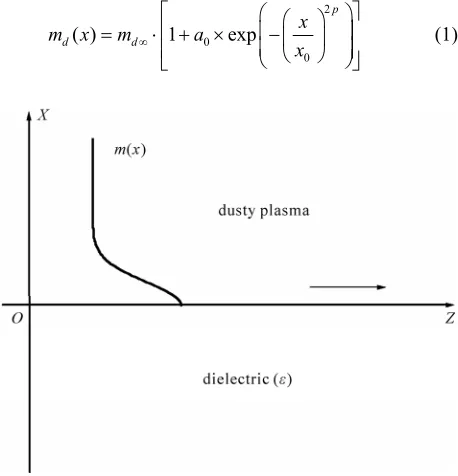
The dust acoustic waves in the bounded plasma can be described by hydrodynamic equations for ions and dust added by boundary conditions. Below, we consider the waves that propagate along the interface between the dusty plasma (x > 0) and the dielectric with a permittiv-ity (x < 0), see Figure 1.
Generally, the particles of the dust in different parts of the plasma are different and may have different masses. First of all it is necessary to formulate the basic equa-tions and boundary condiequa-tions for an analysis of the dus-ty plasma waveguide with the particles of variable masses. It is necessary to consider the dusty plasma with the following components: negative dust (md, –Q) and positive ions (mi, e). The charge of each dust particle is
–Q = –Ze, Z1. The temperatures of the components are TdTi 0. The practical interest has the case when the particles of the dust have different masses: md =
md(x). Here x is the initial x-coordinate of the particle. Real model of dust is the case no homogeneous plasma of the following masses dependence:
2 0
0
( ) 1 exp
p
d d
x
m x m a
[image:2.595.58.287.468.706.2]x (1)
Figure 1. Geometry of the problem.
where the constant a0 has the values within the interval –1 < a0 < 10. In the homogeneous plasma it is the case that the constant a0 = 0. The parameter md is the mass
of the particle far from the interface x = 0. The parameter
p is p = 1 or 2 (case 1 is the Gaussian profile; case 2 is supergaussian one, or step-like).
The propagation of dust acoustic surface waves is in-vestigated, when this propagation is along z-axis takes place, whereas in x-direction the localization occurs.
The hydrodynamic equations for the dust component are [2,3]:
div 0; d ; d d ; d d dd d B d
d d d
d d d
x
dx d d x
n n t k T Q n
t t m m n
u
V m m x u
t V V V
V V E (2)
One can see that in the hydrodynamic equations for the dust there is an additional source of nonlinearity, due to the dependence of the mass of the particle on the dis-placed transverse coordinate x.
For the electric field, the Poisson equation takes the form:
4π eni Qnd ;
E . (3)
The condition of quasi-neutrality of the charge is
0 0 0
i d
en Qn
.
For ions, also we use the hydrodynamic equations:
ddiv 0;
d d
i i
i i i i i B i i
n
n m n en k T n
t t
V V (4)
But, because of the inequality mimd, it is possible to consider the validity of the Boltzmann distribution for ions:
0exp ; i B i
i i T
Ti k T n n e
(5) Therefore, the Poisson equation can be simplified:
0
4π i exp d
Ti
e n Qn
(6)
The waves of small amplitudes are considered; there-fore, the linearized equations are utilized below. Note that in the linealized equations it is necessary to use the dependence of md on x only.
3. Basic Equations
and n is omitted) can be represented as:
0
1 ; ;
div 0;
T n n
t m x m x
ñ
n n n t V V (7)
The following nondimensional variables have been applied: x x/rDi, z z/rDi, V V/Vn, t t/tn,
/Ti, m m/m, ñ ñ/nd0, T = Tde/TiQ 1. Here the scale of the distance rDi = (kBTi/4e2ni0)1/2 is the De-bye radius for ions, the characteristic velocity is Vn = (QkBTi/em)1/2, the time scale is tn = rDi/Vn. Therefore, the undimensional mass of the dust particle is m(x) =
1 + a0exp(–(x/x0)2p). Note that the undimensional dust temperature is a product of two small magnitudes Td/Ti < 1 and e/Q ~ 10–310–6, therefore, T < 10–3.
It is necessary to use the following algorithm of solu-tion. First of all the traveling wave has view , ñ
exp(i(t – kz)).In this case, the set of equations (7) can be reduced to the equations for the potential and for va-riable part of the dust concentration:
2 2 2 2 2 2d 1 d
d d
1 d 1 d 0
d d
d 1 0.
d
ñ k ñ
x m x x m x T
k T x m x x m x T
k n x (7)
It is necessary to add Equations (8) by the boundary conditions. The continuity of the electric potential, the
x-component of the electric field (absence of the surface charge at T 0), and zeroing vx-component of dust ve-locity result in the boundary conditions at x = +0:
d d d
0; 0.
d d d
n
k T
x x x
Another boundary conditions are at x = Lxx0. In the region xx0 the value of the nondimensional dust mass is m = 1. In this region it is possible to reduce
Equa-tions (8):
2 2 2 2 2 2 2d 1 1 0;
d d
1 0
d
ñ k n
T T x k n x (10)
4. Simulation Method
The solution of (10) has the character to decreases at
xx0 like, ñ ~ exp(-x), > 0. It takes the form:
1 1 2 2
1 1 1 2 2 2
2 2 1,2 1,2
exp exp ;
exp exp ;
where 1
A x A x
ñ A x A x
k (11)
In case of 1,2 > 0 the solutions have following view:
2
22 k2 2 k2 1 2 1 1 0
T T
.
Excluding the constants A1,2 from (11), one can get the following boundary conditions at x = Lxx0:
2 1 1 2 1 2
1 2 1 2
1 2 2 1 1 1 2 2
1 2 1 2
d 0; d d 0. d n x n n x (12)
It is necessary begin with simplified model where pa-rameter T = 0. It is possible to obtain the single equation for the potential only there:
2
d d
1 0.
dx d x dx k d x
(13)
A notation is used for the effective permittivity of the plasma due to the dust component: d(x)= 1 – 1/(m(x)2). To get the waves localized in x-direction, it is necessary to satisfy the condition d( ) 0x .
The boundary condition at x = +0 is:
0
d 0 dd x k
x
, (14)
because the potential and x-component of the electric induction are continuous there.
At x = Lxx0, it is possible to get the boundary con-dition as:
2 2
2
d 1 1
0, 0, 1 .
d d d
k x
(15)
For the numerical solution of Equation (8) added by boundary conditions (9) and (12), we have used the finite differences [13]:
2 1 1 2 2 1 1 21/ 2 1/ 2
1
d 1
| 2 ;
d
d 1 d 1 1 1 ;
d d
d 1
, where ,
d j
j
N
x x j j j
j j j j
j j
x x
N N j j j
x x
x h
n n n n n
x m x x h m x m x
x x j h
x h
Here h is the step along OX axis; Lx = Nh.
As a result, a set of uniform linear equations has been formed. They possess a matrix structure:
1, 1 0, 1, 1
0,0 0 0, 1 1
1, 1 0,
0,
1, , 1;
0, 0;
j j j j j j
N N N N
j N
n
A A A
A A
A A A
(17)
Here the coeficients 1,j etc. are matrices 2 2. This set of equations has been solved by the factorization method. Namely, it is possible to represent:
1
ˆ , , ,1;
jj j jN
A A (18)
and to calculate the matrices ˆj consecutively, step by step. As a result, at j = 0 it is possible to get a single ma-trix equation for A0 as:
0,0 1,0 1ˆ
00
A (19)
It is necessary to search for nontrivial solutions: 00
A . Therefore, the following determinant is equal to zero:
0,0 1,0 1ˆ
det 0
(20) This is the dispersion equation for the set of dispersion curves = m(k), m = 1, 2, The interst of our mod-eling is to obtain the lowest (fundamental) mode, which can be observed in experiments.
For the simplified version, Equations (13), (14), (15), the method is the same, but the matrices are reduced to scalars.
5. Results of Simulation and Discussing
Using Equation (8) and boundary conditions (9), (12), it is possible to simulate the dispersion curves and the transverse profiles of the surface dust acoustic waves. The shooting method has been applied to solve the ordi-nary differential equations jointly with boundary condi-tions. The main attention has been paid to the qualitative effects of the variable masses of dust particles on the propagation of the surface dust waves. Below, the results of simulations are presented for different parameters of the dust. The results are given for the undimensional magnitudes in Figures 2-5. The simulations have been
(a) (b)
[image:4.595.78.521.366.675.2]
(c) (d)
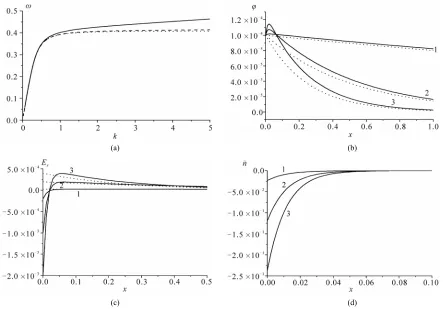
Figure 2. The dispersion curve (k) (a), transverse profiles of the potential (b), x-component of the electric field Ex (c), va-riable part of concentration ñ (for T = 10-4) (d). Solid curves are for T = 10–4, dash curves are for T = 10–6, dot curves are for T
(a) (b)
[image:5.595.80.522.77.444.2]
(c) (d)
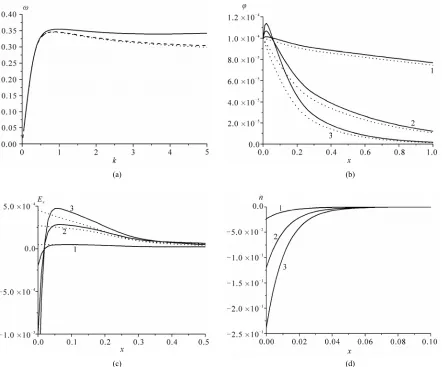
Figure 3. The dispersion curve (k) (a), transverse profiles of the potential (b), x-component of the electric field Ex (c), va-riable part of the dust concentration ñ (for T = 10–4) (d). Solid curves are for T = 10–4, dash curves are for T = 10–6, dot curves
are for T = 0. The parameters are as follows: a0 = 1 (heavier particles in the center of the waveguide), ε = 5, x0 = 0.25, p = 2. The
curves 1, 2, 3 correspond to the values of the wave numbers k = 0.4, k = 2, k = 4.
(a) (b)
Figure 4. The dispersion curves (k)for dusty plasma waveguides with the heavier particles in the center of the waveguide. Solid curves are for T = 10–4, dash curves are for T = 10–6, dot curves are for T = 0.The parameters are: (a) a
0 = 1,ε = 5, x0 =
0.25, p = 1 (Gaussian profile); (b) a0 = 1, ε = 10, x0 = 0.25, p = 2 (step-like profile).
[image:5.595.66.521.507.679.2](a)
(a)
[image:6.595.66.279.80.625.2](c)
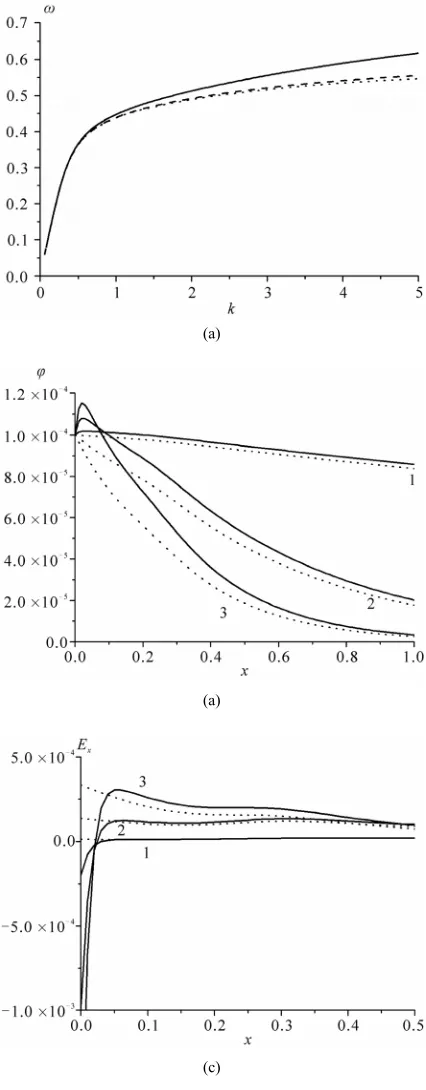
Figure 5. The dispersion curve (k)(a), transverse profiles of the potential (b), x-component of the electric field Ex (c). Solid curves are for T = 10–4, dash curves are for T =
10–6, dot curves are for T = 0. The parameters are as follows:
a0 = –0.5 (lighter particles in the center of the waveguide),
x0 = 0.25, ε = 5, p = 2 (step-like profile of the mass). The
curves 1, 2, 3 correspond to the values of the wave numbers k = 0.4, k = 2, k = 4.
realized for different dust temperatures T = 10–310–6, and also for T = 0.
For uniform semi-infinite dusty plasma, the results of simulations coincide with well-known data on surface dust acoustic waves, see Figure 2. It is seen that the face plasma waves are preferably oscillations of the sur-face charge. The localization thickness of the charge near the surface is of about x ~ 0.010.02.
But the simulations of the dusty plasmas with variable masses of the dust particles yield non-trivial results. One can see that when the dust particles are heavier in the center of the waveguide, it is possible to observe the negative group velocity of surface waves at some inter-vals of the wave numbers, see Figures 3, 4.
This result is tolerant to changes of parameters of the dusty plasma waveguide, both for Gaussian and step-like profiles of the masses of dust particles and also for dif-ferent values of the dielectric permittivity of contacting dielectrics. When the finite temperature of the dust is taken into account, the negative dust velocity occurs at T
10–4, whereas at higher temperatures this phenomenon vanishes.
A possibility of opposite directions of phase and group velocities of the surface plasma waves is important for realization of wave instabilities, for instance, due to rota-tion of dust particles [2]. Namely, as known from the backward wave tube theory, the negative group velocity can lead to positive distributed feedback within the sys-tem [14,15]. The region of the wave numbers where the group velocity of the wave is close to zero and changes its sign can be also useful for observing nonlinear wave phenomena, especially, envelope solitons or modulation instability [14,16].
In the case of lighter particles in the center of the wa-veguide, the group velocity is positive. But at some val-ues of the wave numbers, the distribution of the trans-verse Ex component of the electric field possesses non-monotonic dependence on the transverse coordinate
x, see Figure 5.
This can be important for the dynamics of nonlinear waves in this waveguide. The results on negative group velocity have been confirmed by our more exact nu-merical simulations of hydrodynamic equations, where both the finite temperature of chaotic motion of dust par-ticles and the finite mass of ions were taken into account.
6. Conclusion
from the boundary is m∞ = 2 10–8 g, the relation between
the charges of the dust particle and the ion is Q/e = 103. In this case, the Debye radius for the ions (and the char-acteristic spatial scale) is rDi = (kBTi/4e2ni0)1/2 10 cm; the characteristic velocity is Vn = (kBTi/m∞× Q/e)1/2 0.1
cm/s; the characteristic time is tn = rD/Vn100 s 1.6 min.
When the dust particles are heavier in the center of the waveguide, it is possible to observe the negative group velocity of surface waves. So, this case is a good condi-tion for obtain of the absolute instability of dust surface plasma waves. This instability should be analyzed addi-tionally. The estimated temporal and spatial scales have demonstrated that it could be possible an appearance of investigated phenomena under natural hazards, like vol-cano eruptions.
7. Acknowledgements
Authors are grateful to CONACyT (Mexico) for a partial financial support of our work.
8. References
[1] V., Fortov, A. Ivlev, S. Khrapak, A. Khrapak and G. Morfill G.E., “Complex (dusty) plasmas: Current status, open issues, perspectives”, Physics Reports, Vol. 421, No 1-2, 2005, PP. 1-103.
[2] Shukla, P., Mamun, A. (2002) Introduction to Dusty Plasma Physics. Bristol, Institute of Physics Publ. [3] Verheest F., (2000) Waves in Dusty Space Plasmas.
Dor-drecht, Kluwer Publ.
[4] P. Shukla and A. Mamun,“Solitons, shocks and vortices in dusty plasmas”, New Journal of Physics, Vol. 5, No 1, 2003, PP.17.1-17.37.
[5] S. Popel, S. Kopnin, I. Kosarev, M. Yu, “Solitons in Earth’s dusty mesosphere”, Advances in Space Research, Vol. 37, No 2, 2006, PP. 414-419.
[6] P. Shukla, “A survey of dusty plasma physics”, Physics of Plasmas, Vol. 8, No 5, 2001, PP. 1791-1803.
[7] K. Ostriko, M. Yu and L. Stenflo, “Surface waves in strongly irradiated dusty plasmas”, Physical Review E, Vol. 61, No 1, 2000, PP. 782-787.
[8] B. Klumov, G. Morfill, S. Popel, “Formation of Struc-tures in a Dusty Ionosphere”, Journal of Experimental and Theoretical Physics, Vol. 100, No 1, 2005, PP. 152- 164.
[9] Kopnin S., Popel S. (2005) Dust Acoustic Mode Mani-festations in Earth’s Dusty Ionosphere, AIP Conference Proceedings, Vol. 799, PP. 161-164.
[10] S. Popel, M. Yu, V. Tsytovich, “Shock waves in plasmas containing variable charge impurities”, Physics of Plas-mas, Vol. 3, No 12, 1996, PP. 4313-4315.
[11] S. Popel, A. Golub’, T. Losseva, R. Bingham and S. Benkadda, “Evolution of perturbation in charge-varying dusty plasmas”, Physics of Plasmas, Vol. 8, No 5, 2001, PP. 1497-1504.
[12] V, Grimalsk, S. Koshevaya, R. Perez-Enriquez, A. Kot-sarenko, “Interaction of linear and nonlinear ion-sound waves with inclusions of dusty plasma”, Physica Scripta, Vol. 74, No 3, 2006, PP. 317-324.
[13] Samarskii, A., (2001) The Theory of Difference Schemes. N.Y., Marcel Dekker.
[14] Infeld, E., and Rowlands G. (2000) Nonlinear Waves, Solitons and Chaos. Cambridge University Press, Cam-bridge.
[15] Lifshitz, E., Pitaevskii, L. (1981) Physical Kinetics. London, Pergamon.